BETTER! with Dr. Stephanie Estima
Hormones, Deep Sleep and Perimenopause
Are Hormones Ruining Your Deep Sleep? Chicken Soup for Your Brain with Ariel Garten (and Muse)
▶ Listen to the full episode More from BETTER! with Dr. Stephanie Estima
The brief
Neuroscientist Ariel Garten explains why perimenopause fractures deep sleep and how the brain cleans itself during it. She covers cool rooms, screen curfews, pink noise, and timed wake windows that rebuild deep sleep, steady emotional swings, and boost blood flow to the prefrontal cortex.
A woman in her mid-forties wakes at three in the morning. Her heart is racing, the sheets are damp, and her brain is already running a highlight reel of everything she forgot to do that day. This is not a character flaw. It is, according to Dr. Stephanie Estima, what happens when estrogen and progesterone, the hormones that help calm the nervous system through the brain chemical GABA, start to thin out in perimenopause (08:52). Sleep gets worse first, and almost everything else, mood, memory, appetite, follows from there.
Garten is a former psychotherapist and the co-founder of Muse, a headband that reads brainwaves and has quietly become a research tool in sleep labs around the world. On Dr. Stephanie Estima's show, she walks through what a good night of sleep actually looks like inside the skull, and why that architecture degrades exactly when women need it most.
The Brain's Power Wash
Deep sleep, Garten explains, is the stage where the entire brain synchronizes into a slow pulsing pattern called a delta rhythm, somewhere between one and four cycles per second (12:36). These waves do not run continuously. They arrive in clusters, three or four in a row, then a pause, then another cluster. Garten calls these clusters trains, and the longer the trains, the deeper and more restorative the sleep.
"Deep sleep is like the gold, the chicken soup, the best stuff for the brain and the body." — Ariel Garten [17:05]
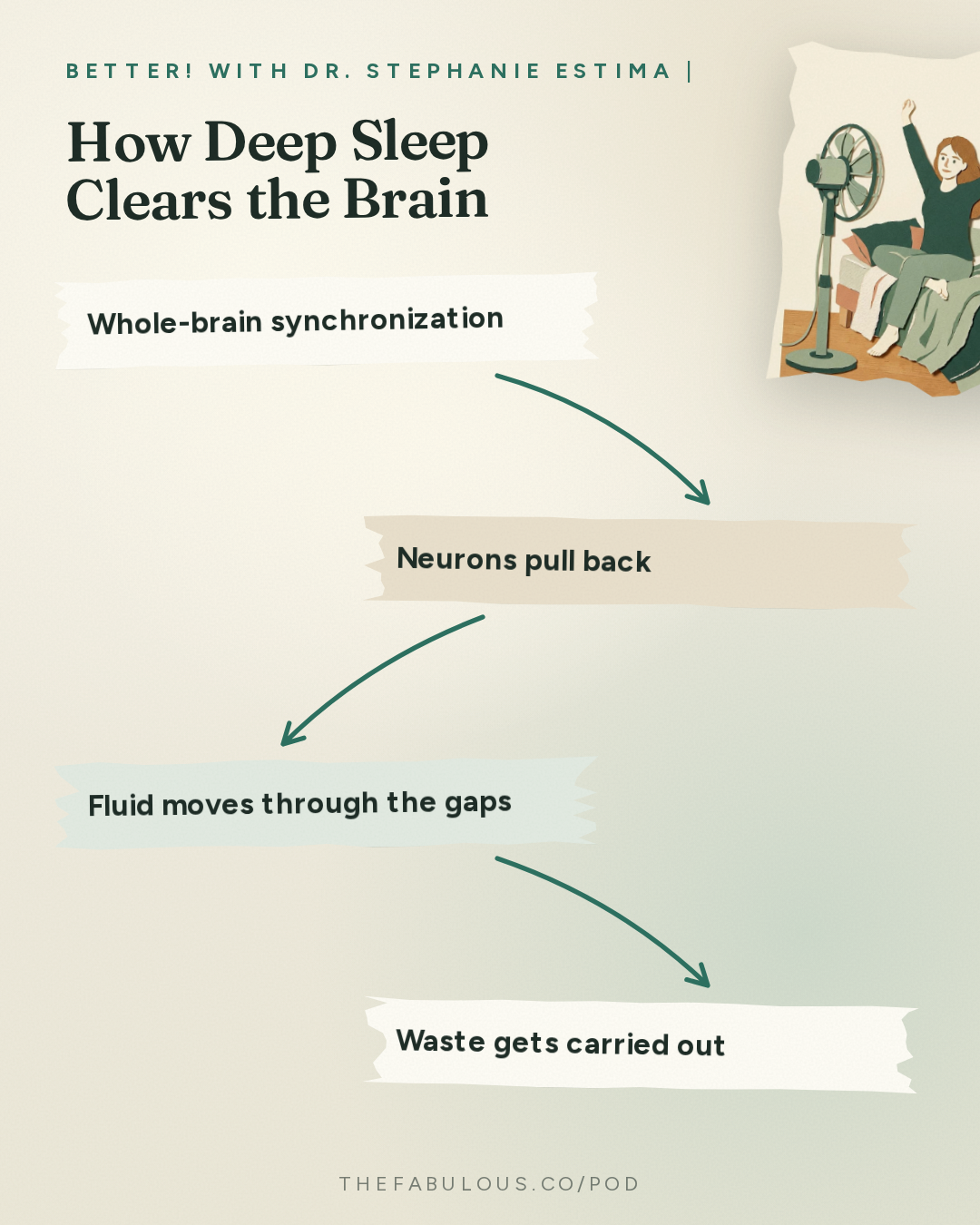
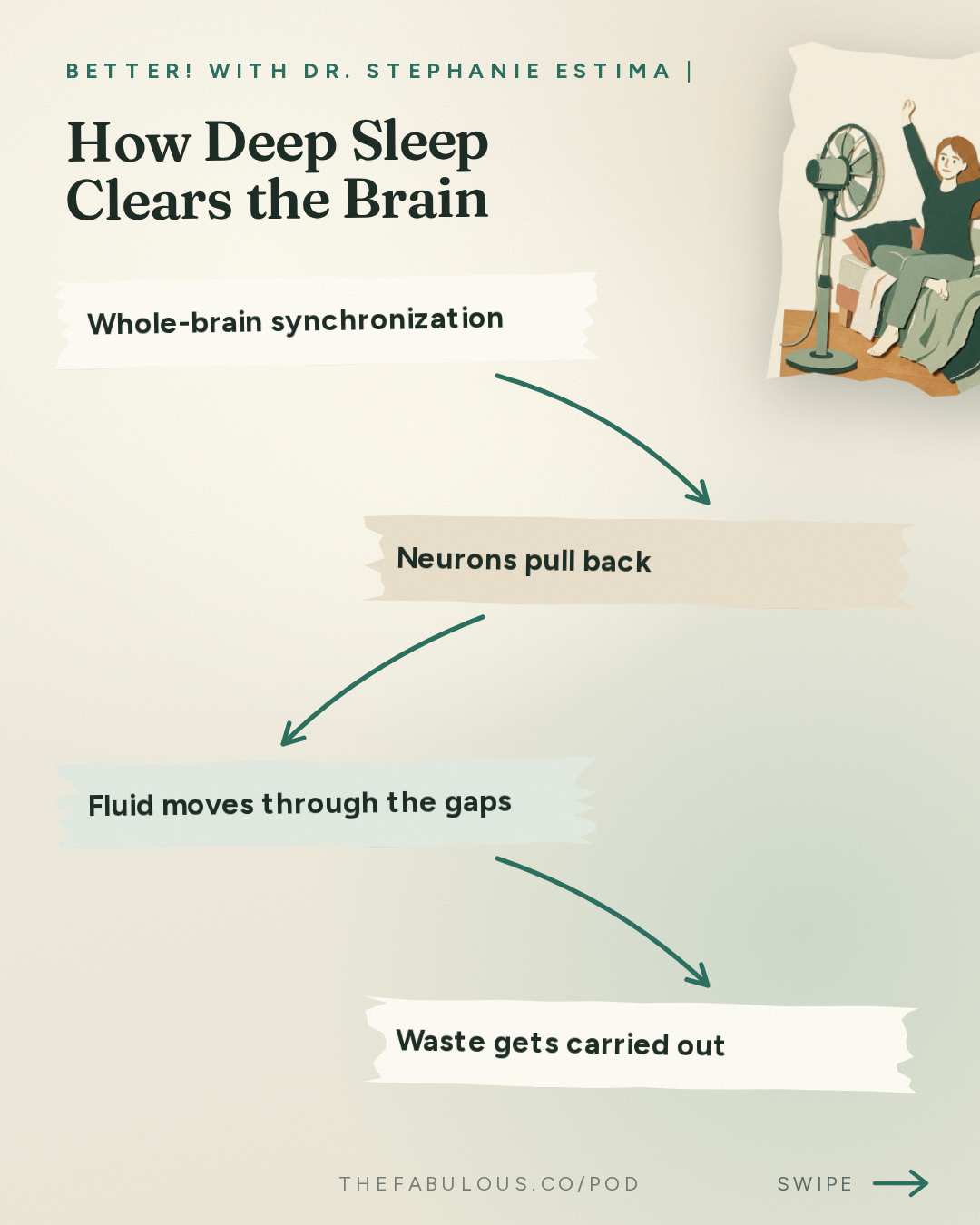
The reason has to do with waste removal. During deep sleep, neurons physically shrink back from one another, opening tiny channels between cells.
"Our neurons actually shrink back a little bit from one another, opening spaces between them that allows more of this glymph fluid to move through." — Ariel Garten [15:50]
Cerebrospinal fluid floods through those channels in a system researchers call glymphatic, a play on the body's lymphatic network. The pulsing of delta waves is thought to act like a pump, pushing that fluid through the brain and carrying off metabolic debris, including amyloid beta, the protein that clumps into the plaques associated with Alzheimer's disease (16:16). More trains, pumped more times in a row, may mean more fluid moved and more waste cleared.
This is where Muse's engineering gets interesting. The headband detects the onset of a delta wave during deep sleep and responds with a nearly inaudible pulse of pink noise, a sound that is not pretty so much as flat and unobtrusive (23:11). The theory is simple: stimulate a slow wave at the right moment and it begets another one, extending the train the way a second stone dropped in a lake amplifies the ripples from the first. In testing across roughly 40,000 recorded nights, Dr. Stephanie Estima reports that slow wave trains ran 24 percent longer and occurred 42 percent more often per minute when the feature was active (26:34). Ongoing studies at Sunnybrook, in Spain, at Mass General Hospital, and at the University of Ottawa are tracking whether this translates into measurable cognitive benefit for older adults, though those results are still pending (26:06).
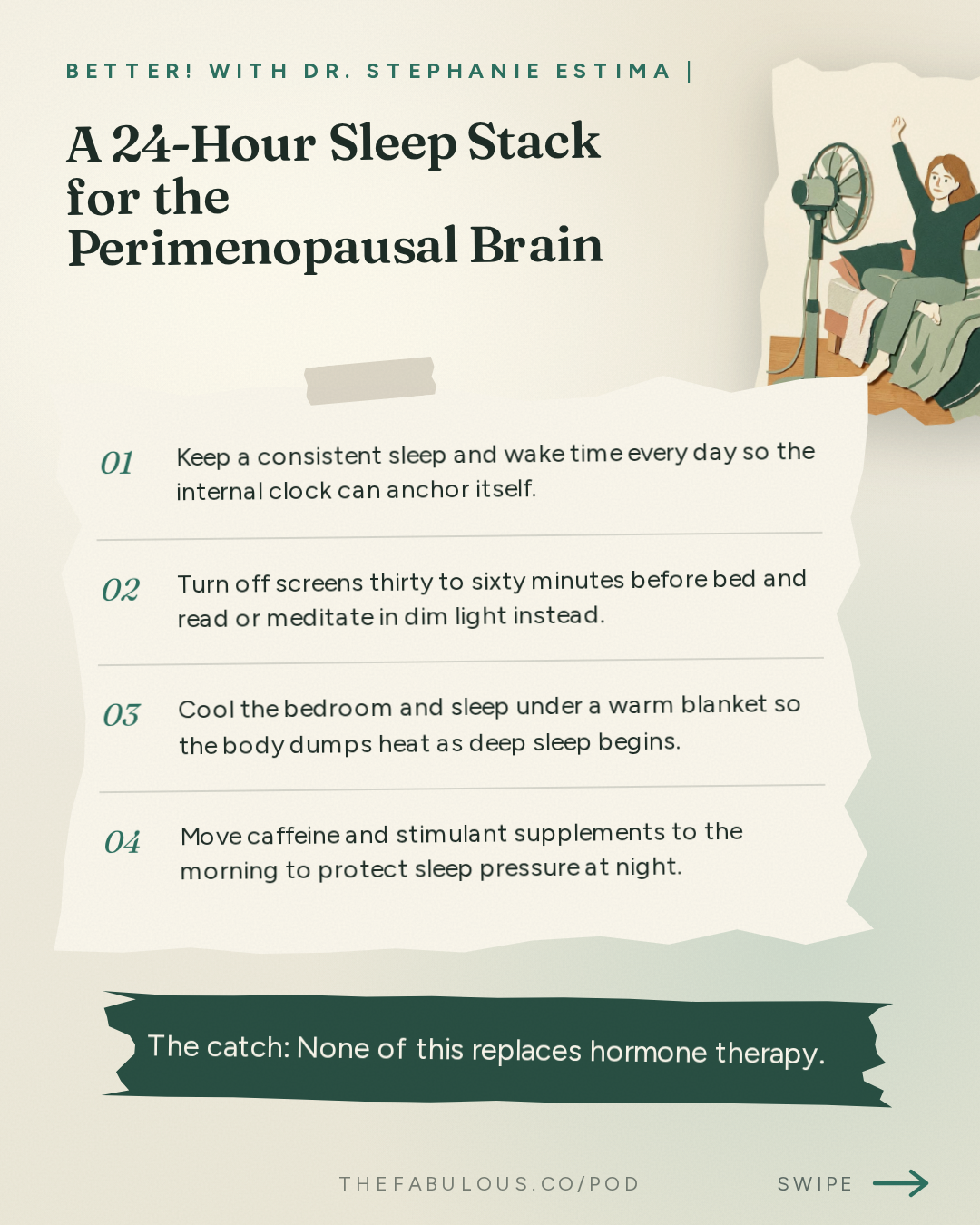
None of this is exotic biohacking. Garten's practical advice for protecting deep sleep is almost boring: keep a consistent bedtime, dim the lights and put the phone away thirty to sixty minutes before sleep because screens measurably suppress melatonin (11:00), keep caffeine and stimulant supplements confined to the morning, and cool the bedroom so the body can dump heat under a warm blanket, which itself deepens deep sleep (18:41). The sophistication is in the biology underneath, not in the routine itself.
The emotional stakes of getting this wrong are higher than most people assume. Garten cites a study by researcher Dr. Jack Peltz that used Muse headbands on college students, tracking self-reported anxiety before bed and the next morning alongside recorded sleep quality.
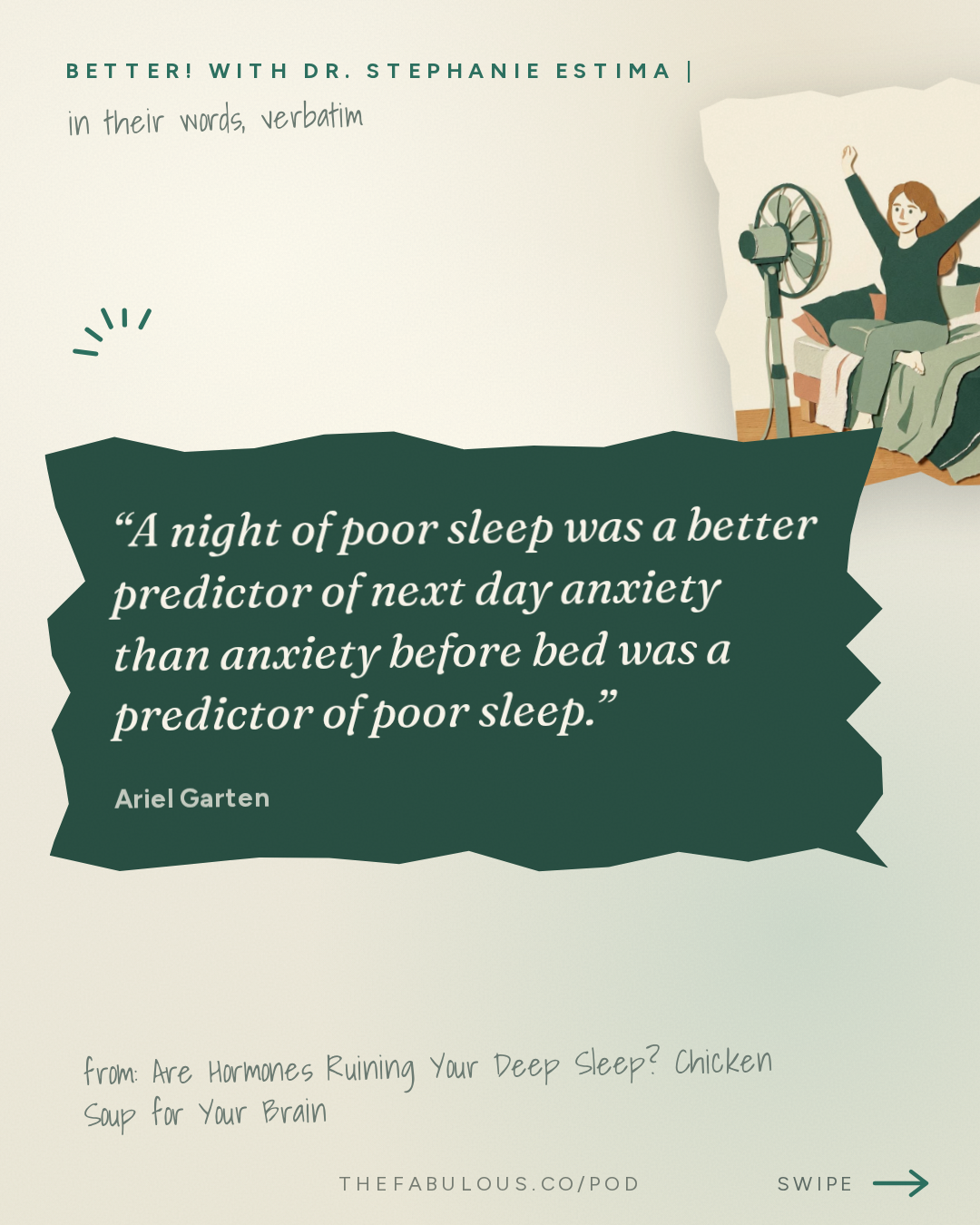
"A night of poor sleep was a better predictor of next day anxiety than anxiety before bed was a predictor of poor sleep." — Ariel Garten [29:32]
In other words, the common assumption, that anxious people simply sleep badly, has the arrow pointing the wrong way. Bad sleep drives next-day anxiety more reliably than anxiety disrupts sleep. Garten's own data also shows women register higher average levels of a brainwave pattern called high beta activity throughout the day, a marker associated with elevated anxiety (32:14). Combine thinning hormones, degraded deep sleep, and a baseline tilt toward anxious brain activity, and the so-called irrational midlife rage that women are told to be embarrassed about starts to look like straightforward neurobiology. Estima, picking up the thread, offers a reframe rather than an apology.
"Anger and rage can be a superpower because it is completely garnering a large amount of energy in a very short period of time." — Dr. Stephanie Estima [35:08]
The suggestion is not to suppress the surge but to notice it as a sensation, separate it from whatever story the mind wants to attach to it, husband, kids, traffic, and then spend the energy somewhere useful, a workout, a project, a cause.
Reading the Brain in Real Time
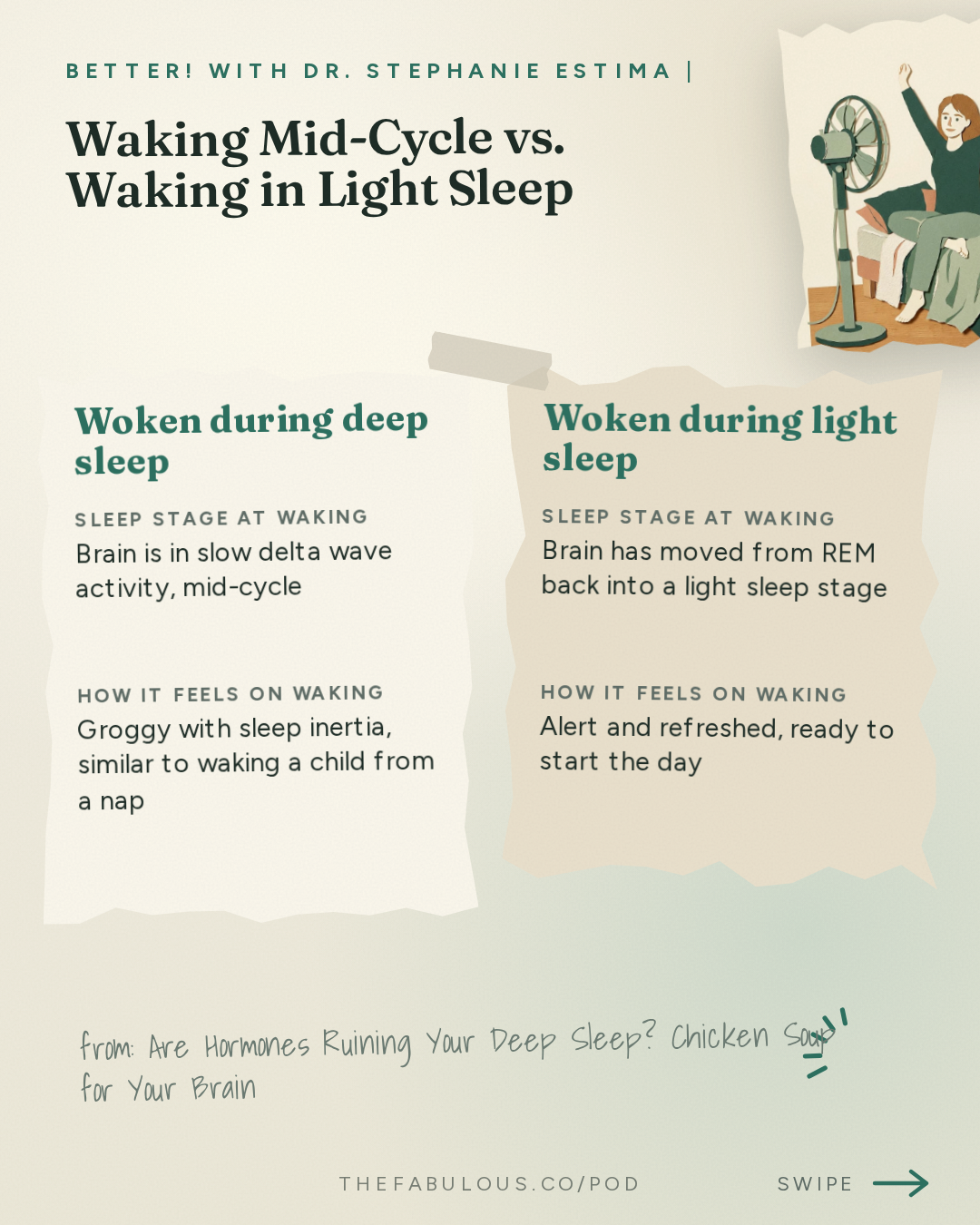
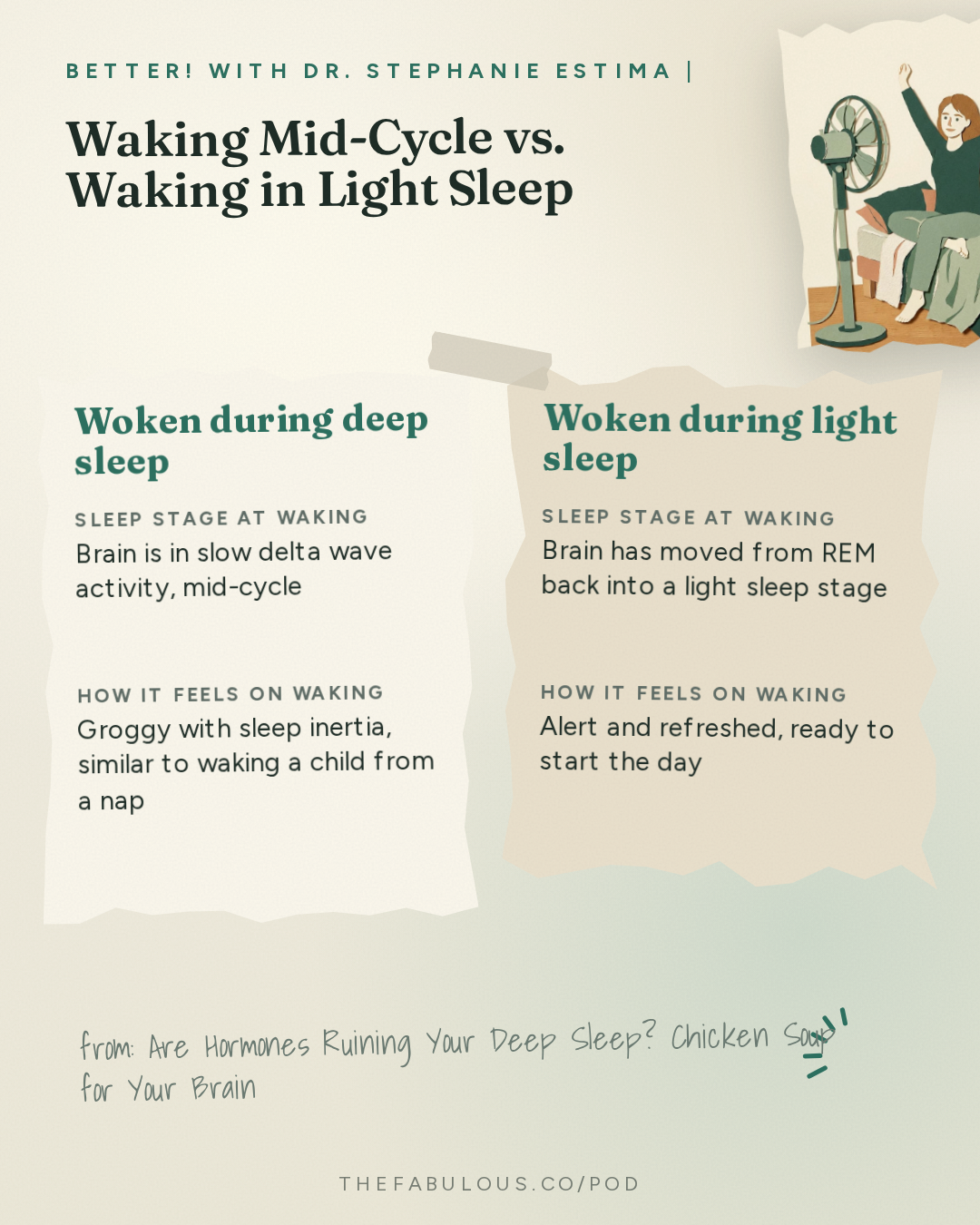
The conversation's most technical turn concerns how people wake up, and how they might watch their own brain work. Garten points out that a person cycles through four to six full sleep cycles a night, moving from light sleep to deep sleep to REM and back (38:35). Wake up during light sleep, at the top of a cycle, and the result is alertness. Wake up mid-cycle, pulled out of deep sleep by a blunt alarm, and the result is sleep inertia, the thick grogginess familiar to anyone who has tried to rouse a napping toddler (39:27). Muse's answer is a feature called Smart Wake Up, which lets a user set a window, say 6:45 to 7:30, and tracks brain state to trigger the alarm only once the sleeper has drifted back into light sleep (39:04).
Dreams get a similar reframing. Garten argues that everyone dreams every night, and people who say they never dream simply never wake up during one (42:26). Dream recall is less a party trick than a window into emotional processing and memory consolidation, and a trained version of it, lucid dreaming, lets a sleeper consciously intervene inside a dream (47:00). Garten describes using this to defuse a recurring nightmare, recognizing mid-dream that the threat was not real, and says the technique has documented promise as a therapeutic tool for post-traumatic stress and chronic nightmares (47:29), alongside its more playful use for creative problem-solving.
The technical centerpiece is a method called functional near-infrared spectroscopy, or fNIRS, which the Muse headband also performs using small windows that shine red and infrared light through the forehead to the surface of the brain (53:07). The light bounces back differently depending on how much oxygen the blood underneath is carrying, which lets the device estimate blood flow to the prefrontal cortex, the brain region behind planning, focus, and emotional control. Users get real-time neurofeedback, watching an animated owl fly higher as blood flow increases, which trains the brain to reliably direct oxygen where it is needed (55:32). Estima connects this directly to the "metabolic crisis" of the perimenopausal brain, in which falling estrogen disrupts how brain cells use glucose, producing the word-finding slips and fog so many women report in their forties (50:45).
A separate sensor, a photoplethysmograph that reads blood flow and oxygen saturation from the forehead's blood vessels, can also detect irregular breathing patterns associated with sleep apnea. A Carleton University study found this forehead sensing was faster and as effective as the standard fingertip pulse oximeter (61:07), though Muse currently withholds that specific data from users pending FDA clearance, directing anyone with concerns to a doctor (61:50). A planned study with the Kite Research Institute aims to test Muse as an intervention, not just a detector, for sleep-disordered breathing (62:36).
What ties all of this together is not a gadget but a premise: the perimenopausal brain is not broken, it is under new management. Estrogen and progesterone used to do quiet structural work, stabilizing sleep architecture and dampening anxious circuitry, and when they recede, something has to pick up the slack. Garten's case is that attention, cooling, timing, and feedback, ordinary and almost dull interventions, can do real work against a hormonal shift that otherwise feels like it is rewriting someone's personality overnight. The brain, it turns out, still listens.
Ask this episode anything
Pod's AI answers from the episode itself, with the minute mark so you can hear it yourself.
Or start with one of these
Ask this episode
Pod's AI listens to the whole episode to answer, and points you to the minute it comes from.
The rest of this answer, and any question after it
Answers come from the episode itself, never from a summary of it.
ContinueKey takeaways
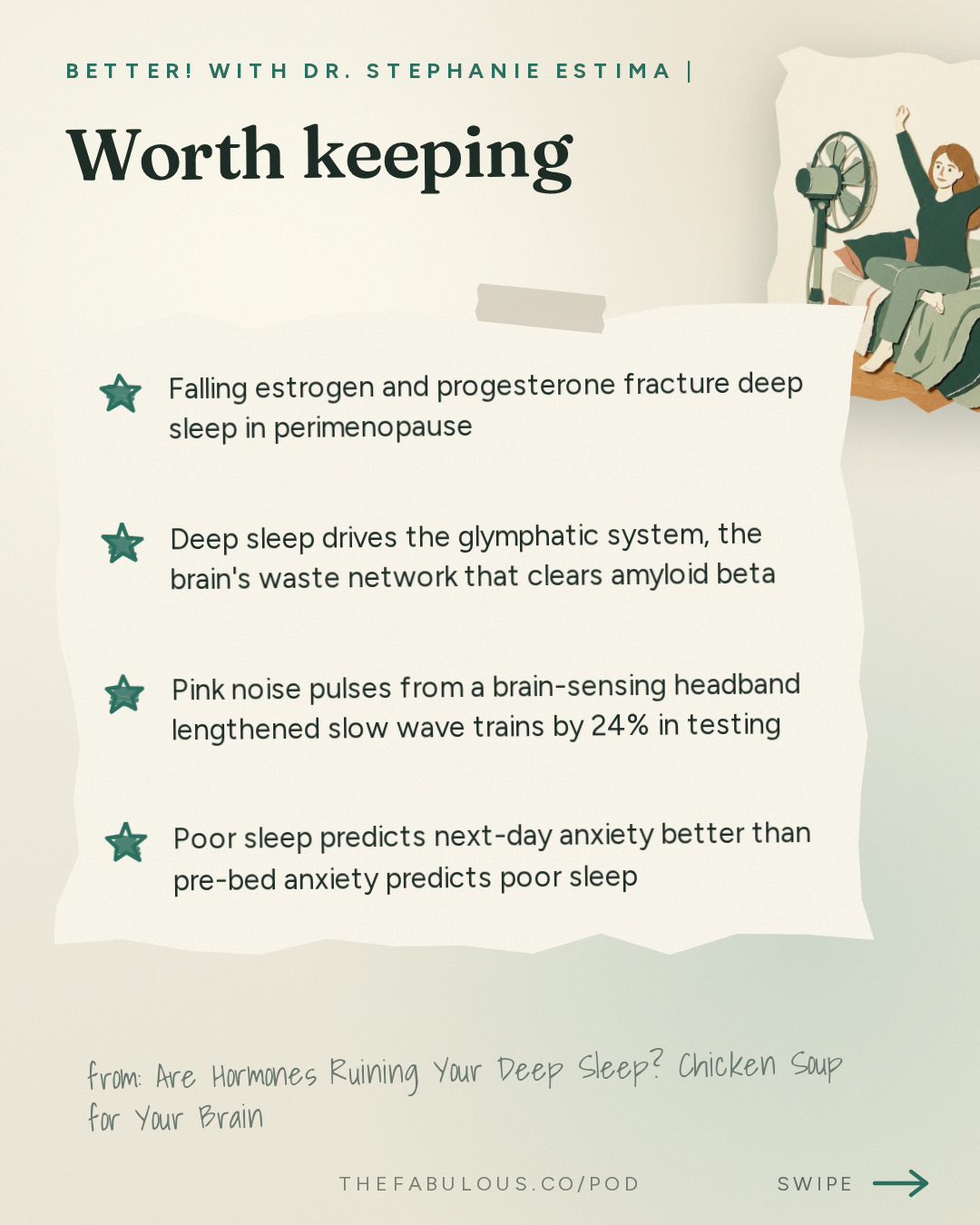
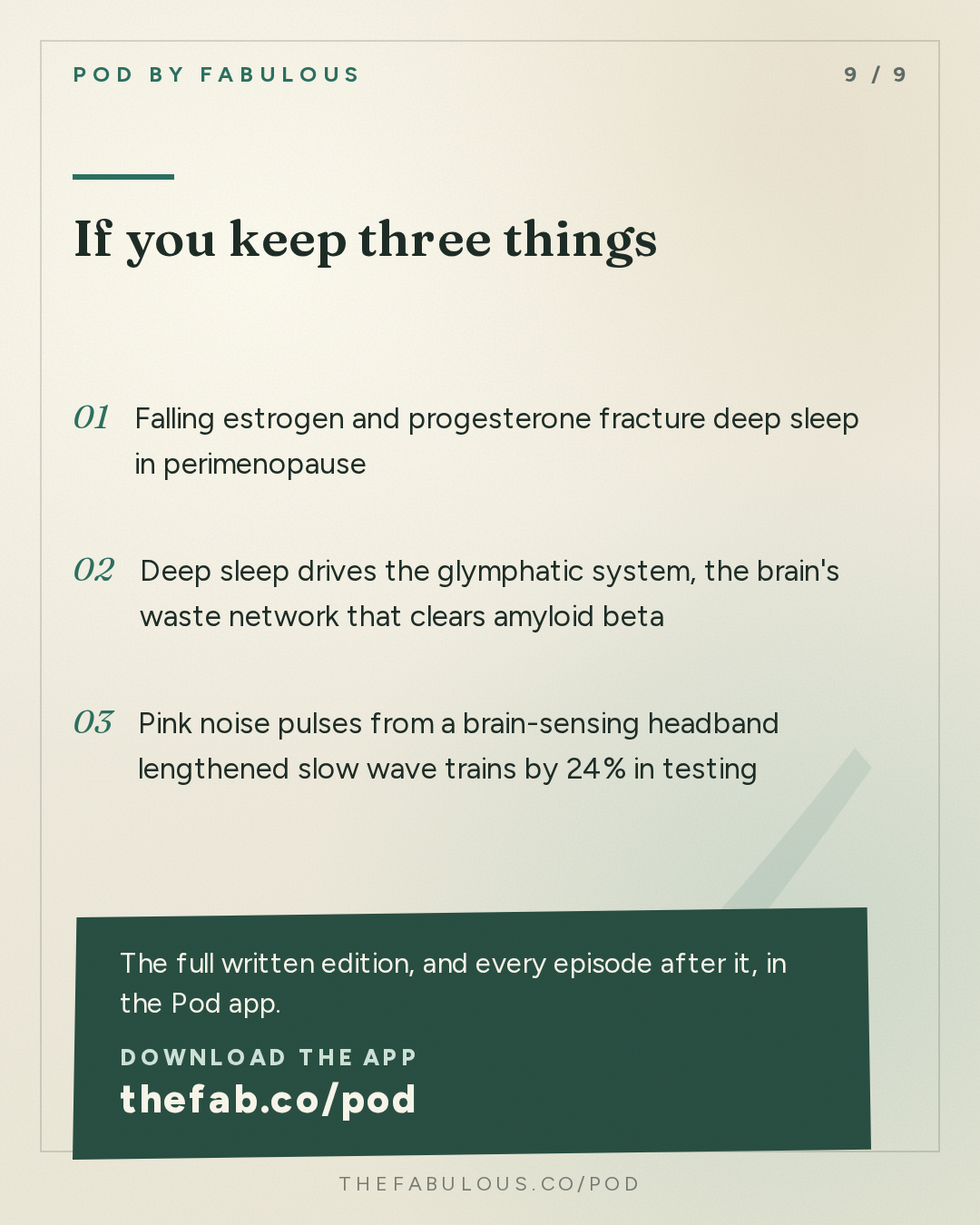
- Falling estrogen and progesterone fracture deep sleep in perimenopause
- Deep sleep drives the glymphatic system, the brain's waste network that clears amyloid beta
- Pink noise pulses from a brain-sensing headband lengthened slow wave trains by 24% in testing
- Poor sleep predicts next-day anxiety better than pre-bed anxiety predicts poor sleep
- Waking during light sleep instead of deep sleep avoids groggy sleep inertia
The episode in cards
By the numbers
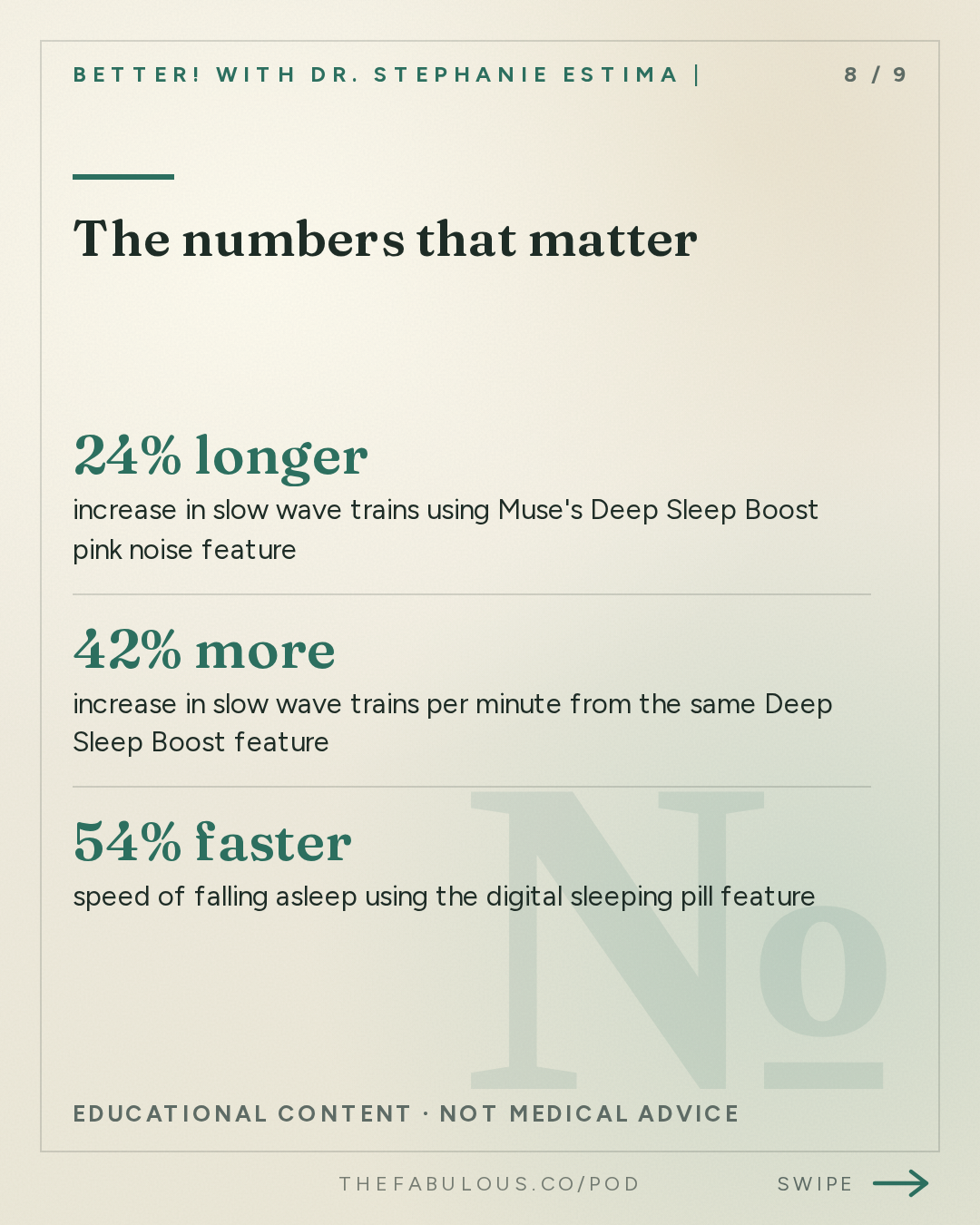
- 24% longer increase in slow wave trains using Muse's Deep Sleep Boost pink noise feature
- 42% more increase in slow wave trains per minute from the same Deep Sleep Boost feature
- 54% faster speed of falling asleep using the digital sleeping pill feature
In their words
“Deep sleep is like the gold, the chicken soup, the best stuff for the brain and the body.”
“A night of poor sleep was a better predictor of next day anxiety than anxiety before bed was a predictor of poor sleep.”
“Our neurons actually shrink back a little bit from one another, opening spaces between them that allows more of this glymph fluid to move through.”
“Anger and rage can be a superpower. Totally. Because it is completely garnering a large amount of energy in a very short period of time”
Protocols
-
Screen curfew before bed
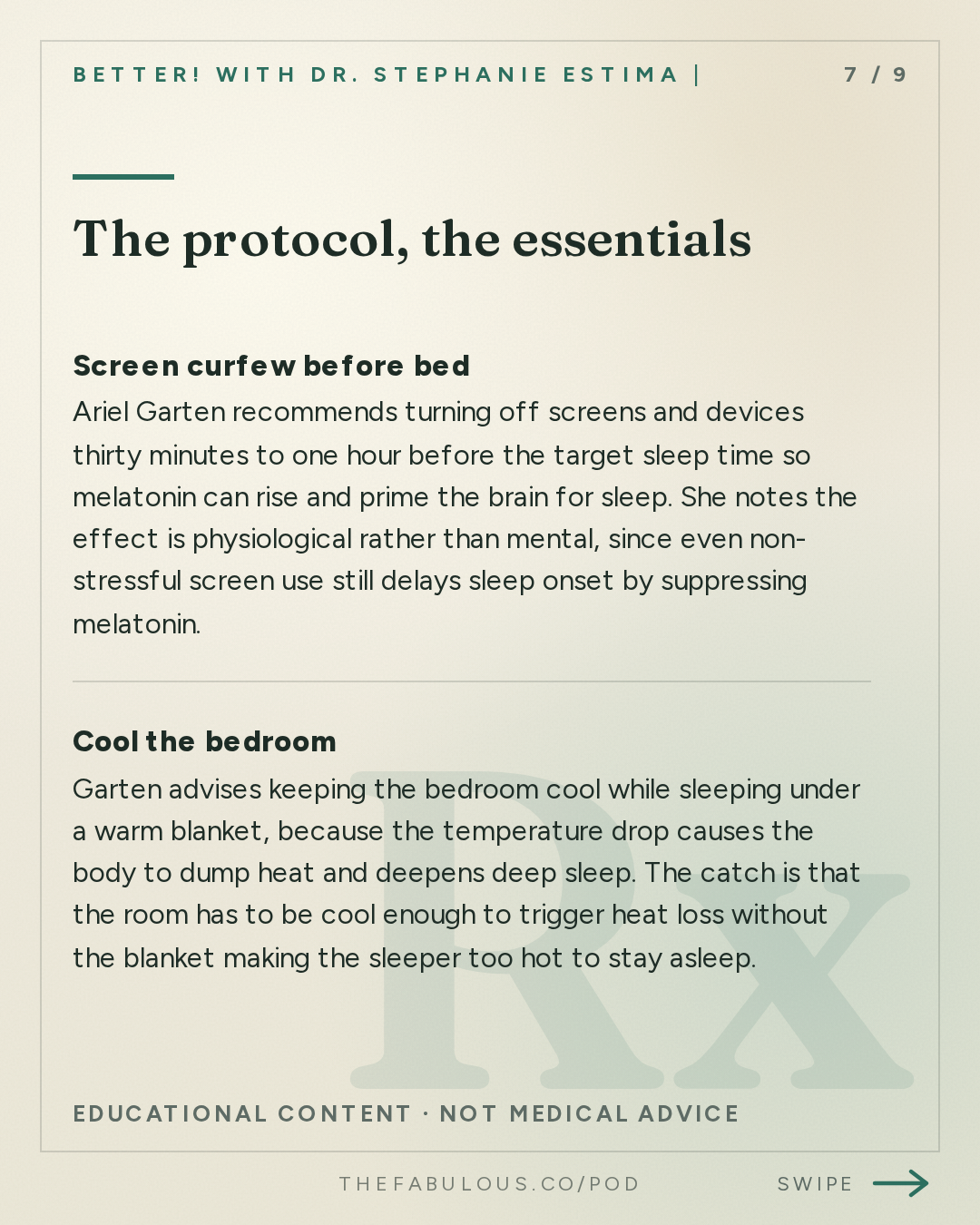
Ariel Garten recommends turning off screens and devices thirty minutes to one hour before the target sleep time so melatonin can rise and prime the brain for sleep. She notes the effect is physiological rather than mental, since even non-stressful screen use still delays sleep onset by suppressing melatonin.
nightly
-
Cool the bedroom
Garten advises keeping the bedroom cool while sleeping under a warm blanket, because the temperature drop causes the body to dump heat and deepens deep sleep. The catch is that the room has to be cool enough to trigger heat loss without the blanket making the sleeper too hot to stay asleep.
nightly
-
Keep stimulants in the morning
Garten recommends moving caffeine and other stimulant supplements to the morning so they clear the system before bedtime. She cautions that late caffeine lowers sleep pressure and reduces the amount of deep sleep obtained that night.
daily
-
Set a smart wake window
Garten recommends setting a wake window, for example 6:45 to 7:30 AM, so a brain-tracking device can rouse the sleeper during light sleep rather than deep sleep. She notes that waking mid-cycle out of deep sleep produces sleep inertia, the groggy feeling that lingers after waking.
nightly
Questions this episode answers
Why does deep sleep get worse during perimenopause?
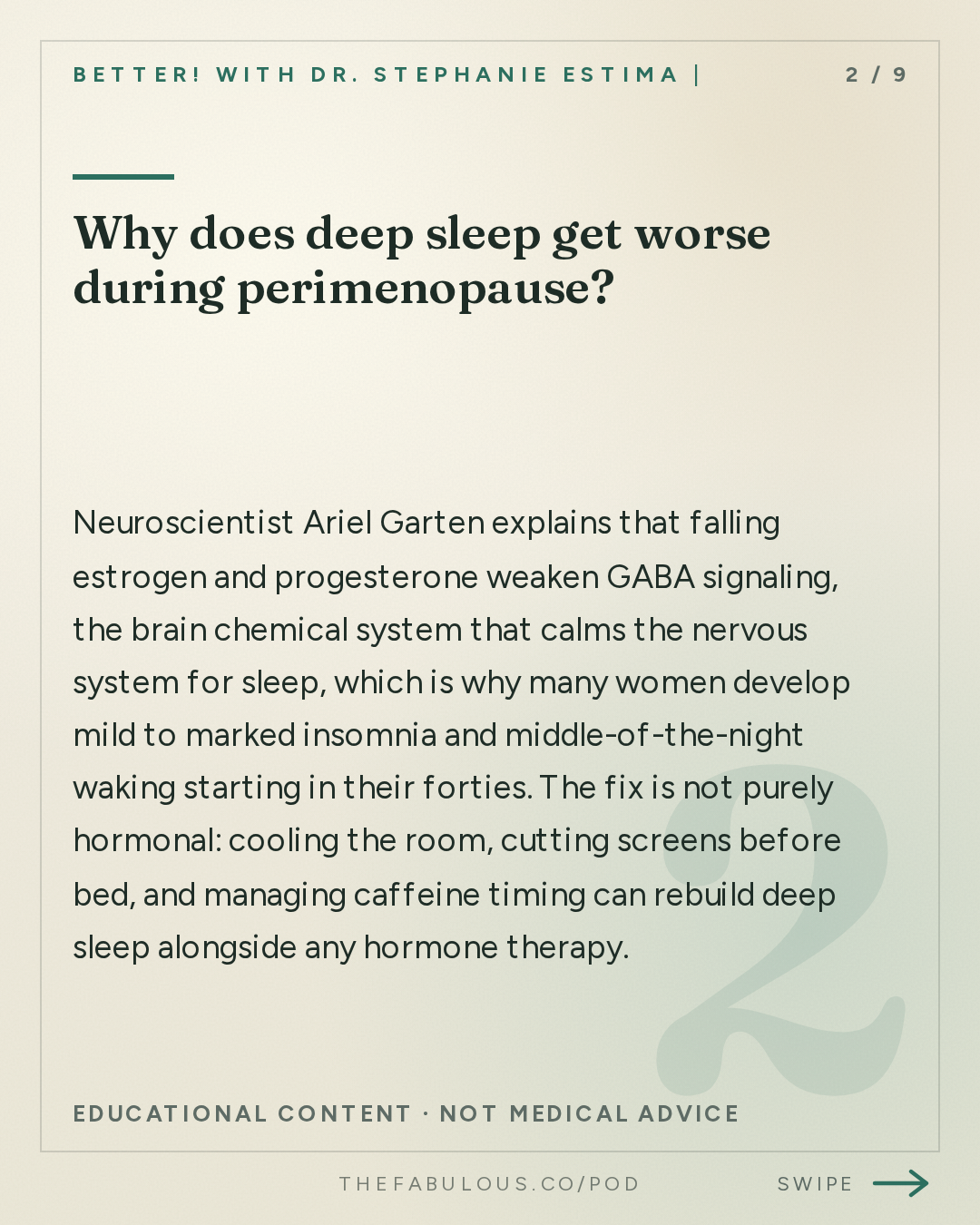
Neuroscientist Ariel Garten explains that falling estrogen and progesterone weaken GABA signaling, the brain chemical system that calms the nervous system for sleep, which is why many women develop mild to marked insomnia and middle-of-the-night waking starting in their forties (09:16). The fix is not purely hormonal: cooling the room, cutting screens before bed, and managing caffeine timing can rebuild deep sleep alongside any hormone therapy (17:55).
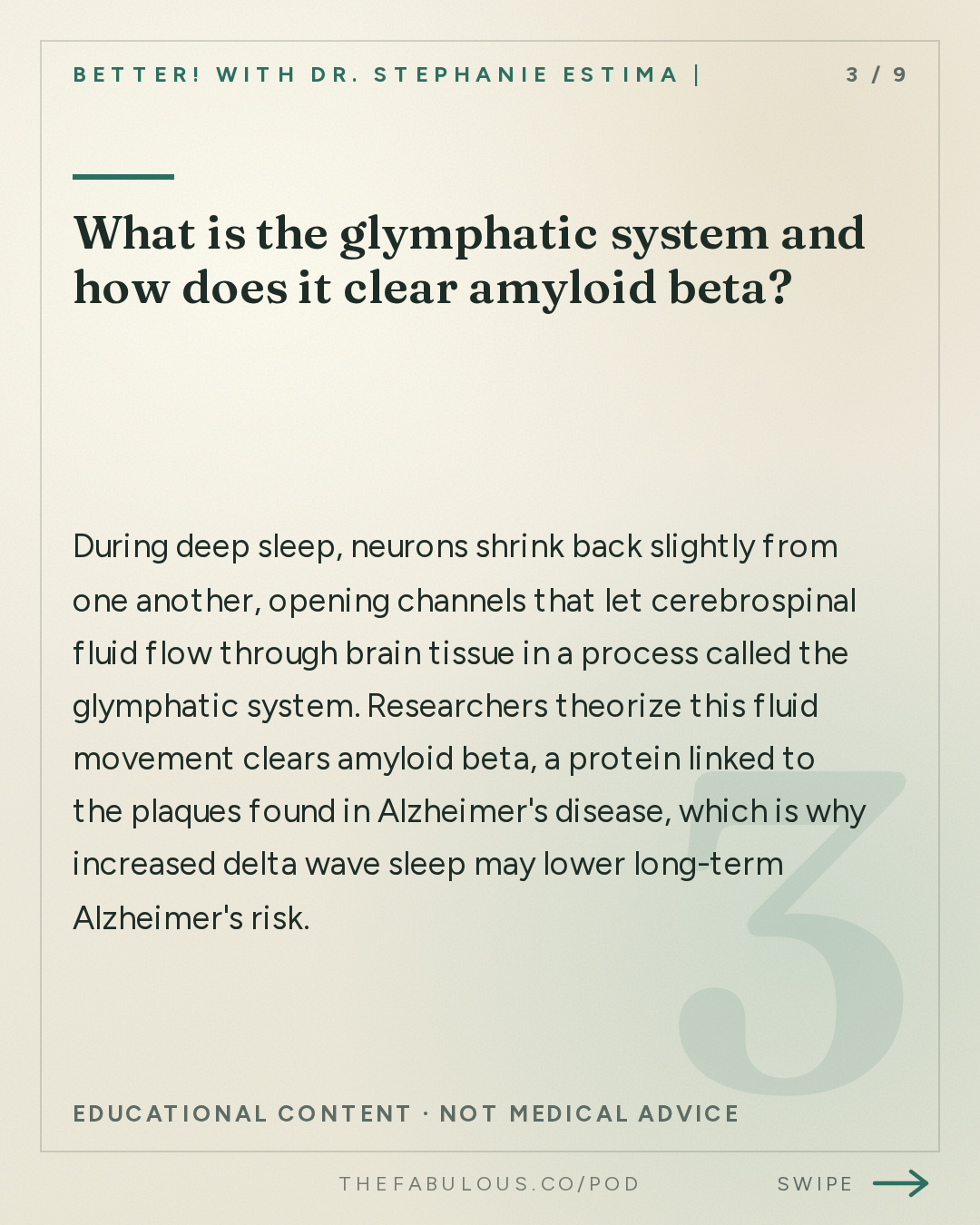
What is the glymphatic system and how does it clear amyloid beta?
During deep sleep, neurons shrink back slightly from one another, opening channels that let cerebrospinal fluid flow through brain tissue in a process called the glymphatic system (15:50). Researchers theorize this fluid movement clears amyloid beta, a protein linked to the plaques found in Alzheimer's disease, which is why increased delta wave sleep may lower long-term Alzheimer's risk (16:16).
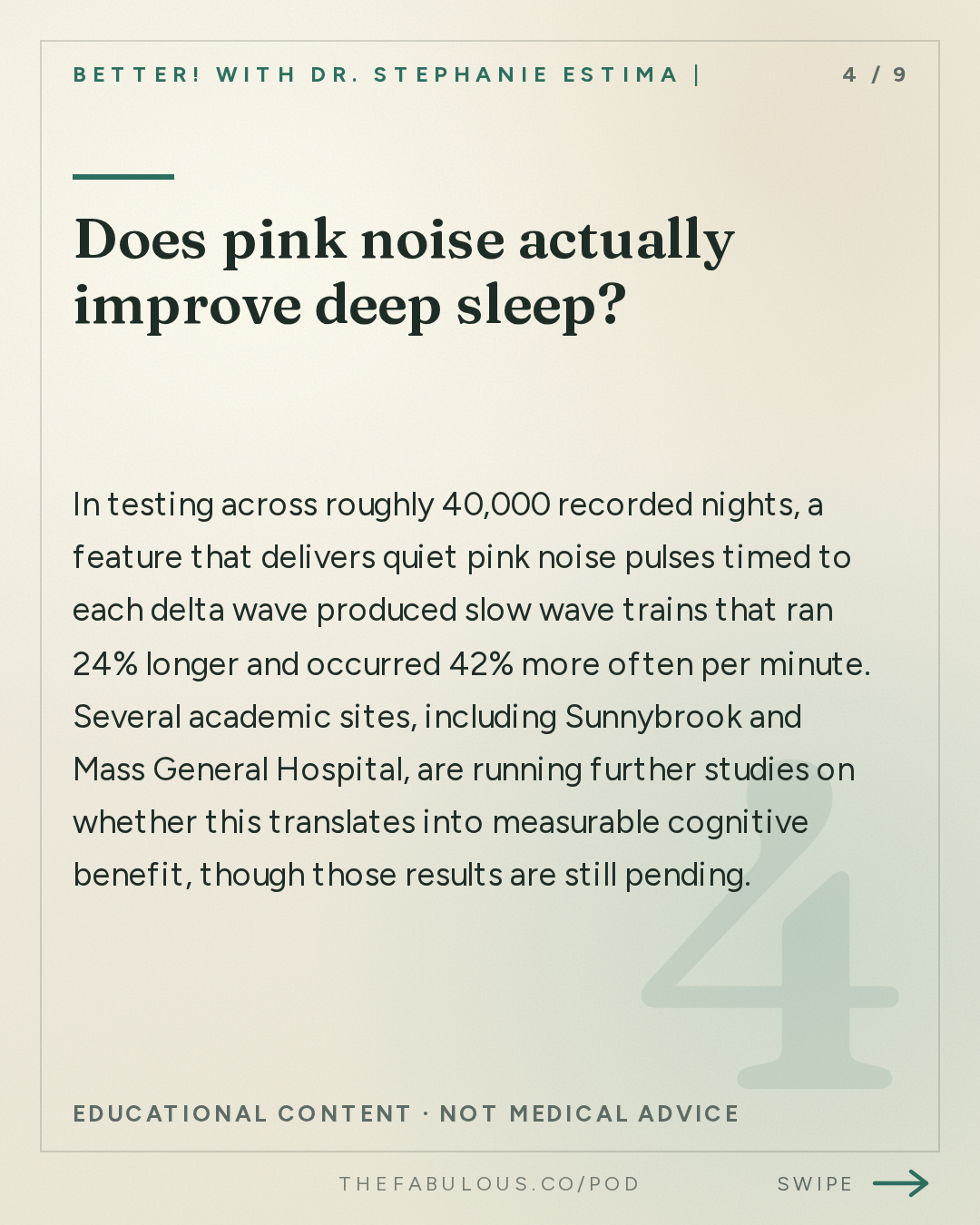
Does pink noise actually improve deep sleep?
In testing across roughly 40,000 recorded nights, a feature that delivers quiet pink noise pulses timed to each delta wave produced slow wave trains that ran 24% longer and occurred 42% more often per minute (26:34). Several academic sites, including Sunnybrook and Mass General Hospital, are running further studies on whether this translates into measurable cognitive benefit, though those results are still pending (26:06).
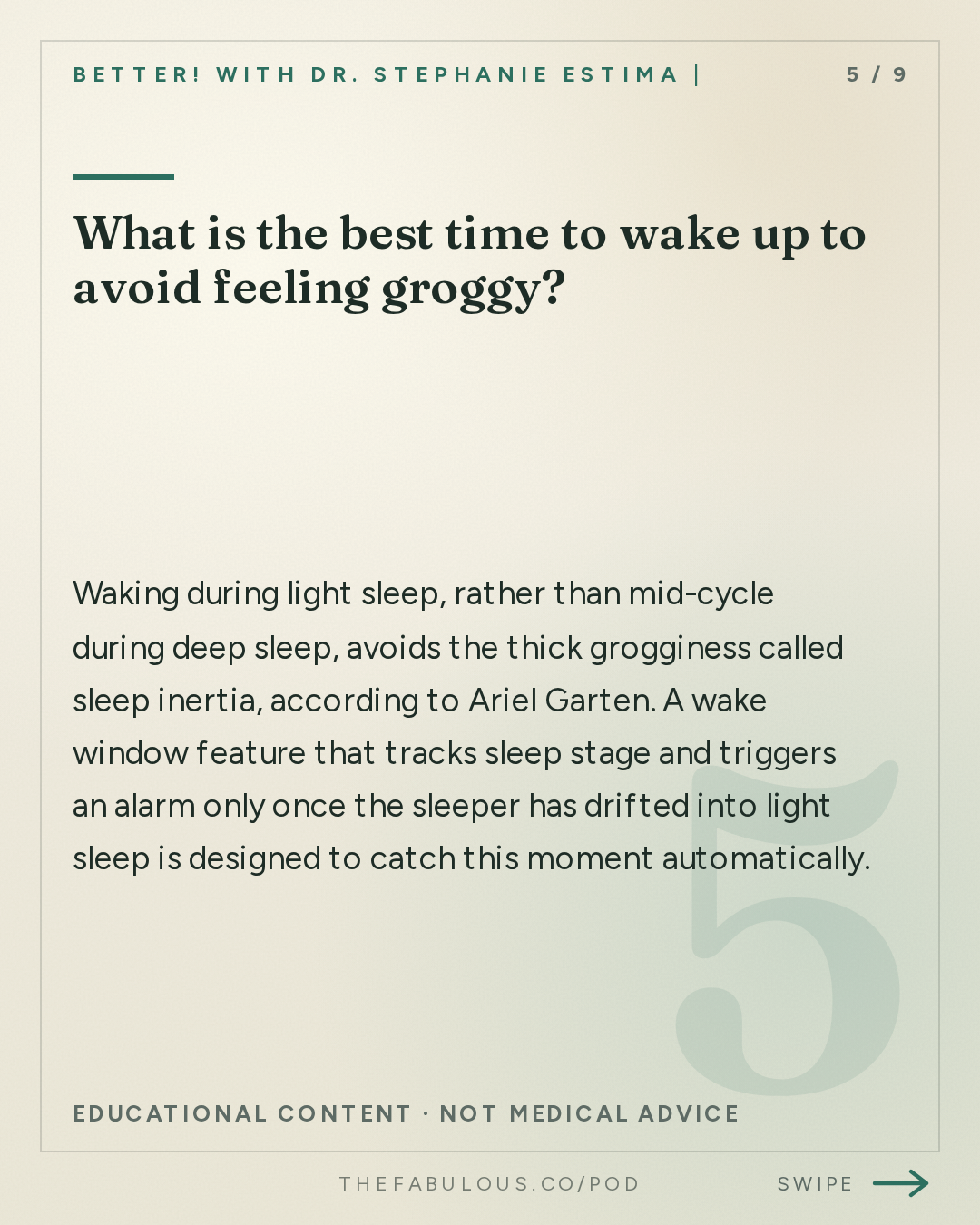
What is the best time to wake up to avoid feeling groggy?
Waking during light sleep, rather than mid-cycle during deep sleep, avoids the thick grogginess called sleep inertia, according to Ariel Garten (39:27). A wake window feature that tracks sleep stage and triggers an alarm only once the sleeper has drifted into light sleep is designed to catch this moment automatically (39:04).
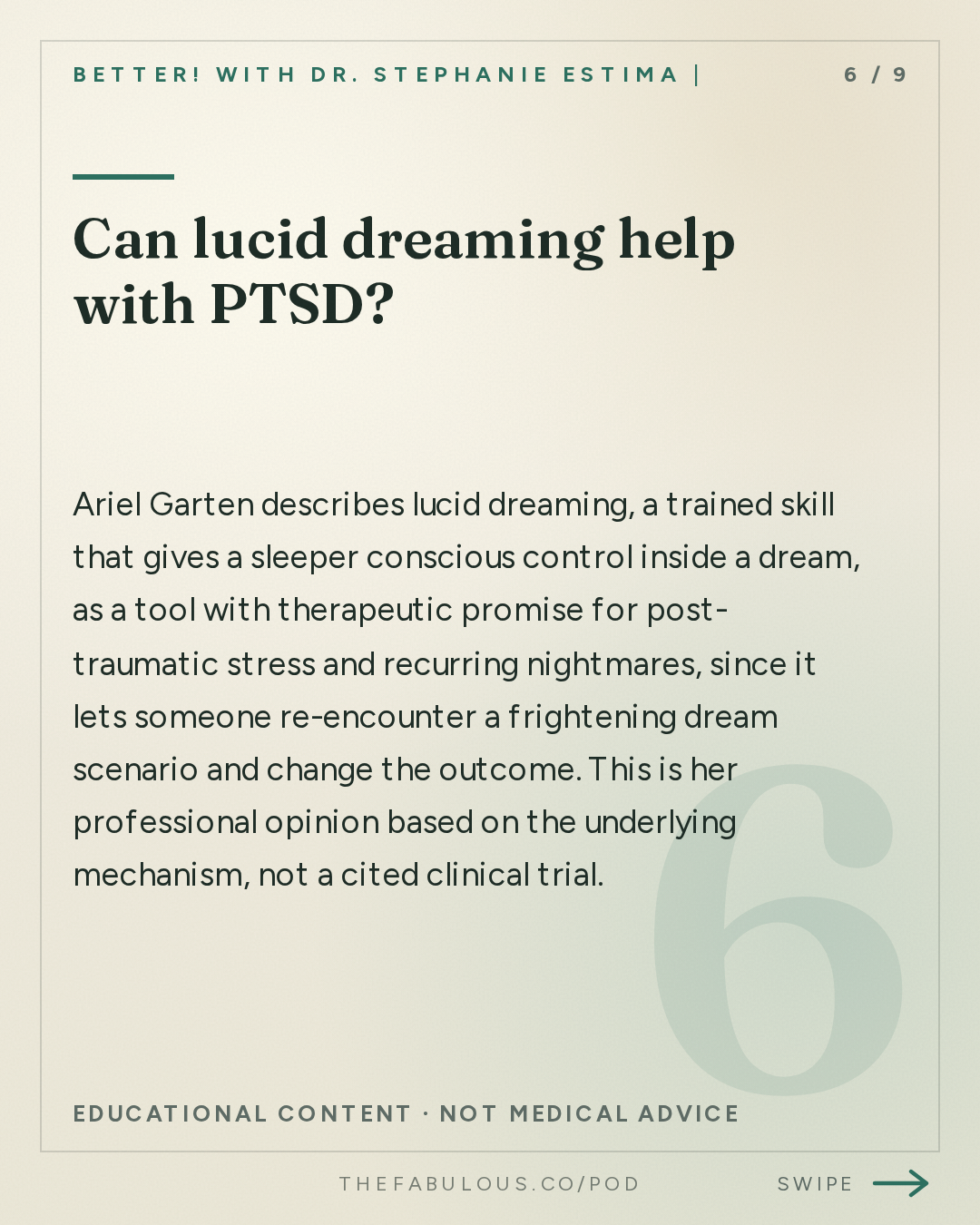
Can lucid dreaming help with PTSD?
Ariel Garten describes lucid dreaming, a trained skill that gives a sleeper conscious control inside a dream, as a tool with therapeutic promise for post-traumatic stress and recurring nightmares, since it lets someone re-encounter a frightening dream scenario and change the outcome (47:29). This is her professional opinion based on the underlying mechanism, not a cited clinical trial.
What does fNIRS measure and how can it improve prefrontal cortex blood flow?
Functional near-infrared spectroscopy, or fNIRS, uses light shone through the forehead to estimate how much oxygenated blood is reaching the brain's surface, including the prefrontal cortex, the region behind planning and focus (53:07). Neurofeedback that visually rewards increased blood flow, such as an on-screen animation, can train the brain to reliably direct more blood and oxygen to that region over repeated sessions (55:32).
The full read, in cards
Go deeper
- Muse Deep Sleep Boost analysis of roughly 40,000 recorded nights — found slow wave trains ran 24% longer and occurred 42% more often per minute with pink noise stimulation
- Dr. Jack Peltz sleep and anxiety study using Muse in college students — found a night of poor sleep predicted next-day anxiety more strongly than pre-bed anxiety predicted poor sleep
- Carleton University comparison of Muse's forehead SpO2 sensor to a standard fingertip oximeter — found the forehead sensor was faster and as effective as the fingertip standard
- Kite Research Institute sleep apnea intervention study — planned research using Muse experimentally to intervene in sleep disordered breathing
Mentioned
Ariel Garten · Dr. Stephanie Estima · Muse · fNIRS · InteraXon · University of Toronto · Carleton University · Mass General Hospital · Dr. Jack Peltz · Kite Research Institute · Sunnybrook · University of Ottawa
More from this show and category
CBT for Emotional Eating and Body Image
Clinical psychologist Dr. Rachel Goldman explains how to tell physical hunger from emotional eating, and why labeling food 'good' or 'bad' quietly wrecks self-worth. She offers concrete CBT tools: name the feeling, wait ten minutes, plate the food, sit down, and treat a raisin like it deserves your full attention.
Joint Health in Menopause: Train, Don't Avoid
Cartilage is not a tire with a fixed tread, it's a sponge fed by movement, says Dr. Stephanie Estima. Joint cartilage has no blood supply, so compression and release during movement pump nutrients in and waste out. She argues declining estrogen drives what researchers now call Musculoskeletal Syndrome of Menopause, and that strength training, done without ego, protects joints better than avoidance or stretching alone.
Keith Baar's Tendon Isometric Protocol Explained
Tendons stop responding to exercise after about 10 minutes and need six to eight hours before another session helps. Physiologist Keith Baar's fix is the 3LD isometric: a 30-second, low-load hold that lets the tendon 'creep' and spread tension evenly, replacing both heavy lifting and the outdated RICE protocol for injury recovery.
How to Build Glutes Without Growing Legs
Hip dips are permanent anatomy, not a fitness failure, says glute researcher and hip thrust inventor Bret Contreras. He explains why horizontal moves like hip thrusts and kickbacks are gentler on joints than squats, how women recover faster than men, and how a five-month training rotation builds glutes while sparing the legs.
