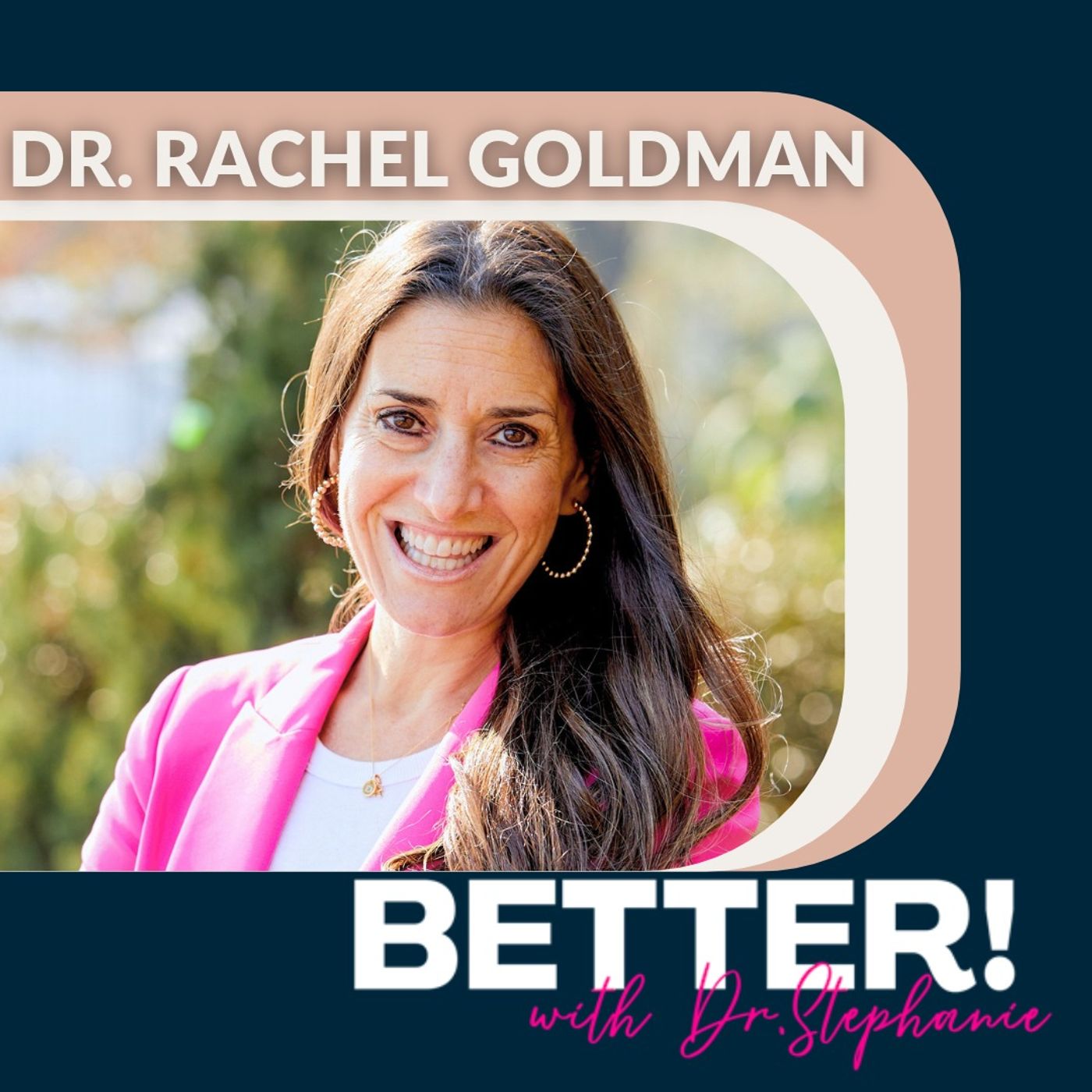
BETTER! with Dr. Stephanie Estima
CBT for Emotional Eating and Body Image
No Good or Bad Foods: Why You Can't Just Enjoy a Meal with Dr. Rachel Goldman
▶ Listen to the full episode More from BETTER! with Dr. Stephanie Estima
The brief
Clinical psychologist Dr. Rachel Goldman explains how to tell physical hunger from emotional eating, and why labeling food 'good' or 'bad' quietly wrecks self-worth. She offers concrete CBT tools: name the feeling, wait ten minutes, plate the food, sit down, and treat a raisin like it deserves your full attention.
A few years ago, Stephanie Estima fired her coach. The offense: a piece of chocolate. The coach had asked her to let it melt in her mouth, slowly, without biting, and simply notice what came up. What came up was rage. "I was so agitated by this," Estima admits on this episode of Better, "I fired her." It took months, and an apology email, before she understood that the exercise had worked exactly as intended: it had found the one thing she could not stand to do, which was sit still with pleasure and pay attention to it.
That small, funny story is the whole episode in miniature. Estima's guest, clinical psychologist Dr. Rachel Goldman of NYU Grossman School of Medicine and author of When Life Happens, spends an hour making one argument from several angles: the problem was never the chocolate, or the cookie, or the muffin. The problem is the thought that shows up right after.
Two kinds of hunger, and a test for telling them apart
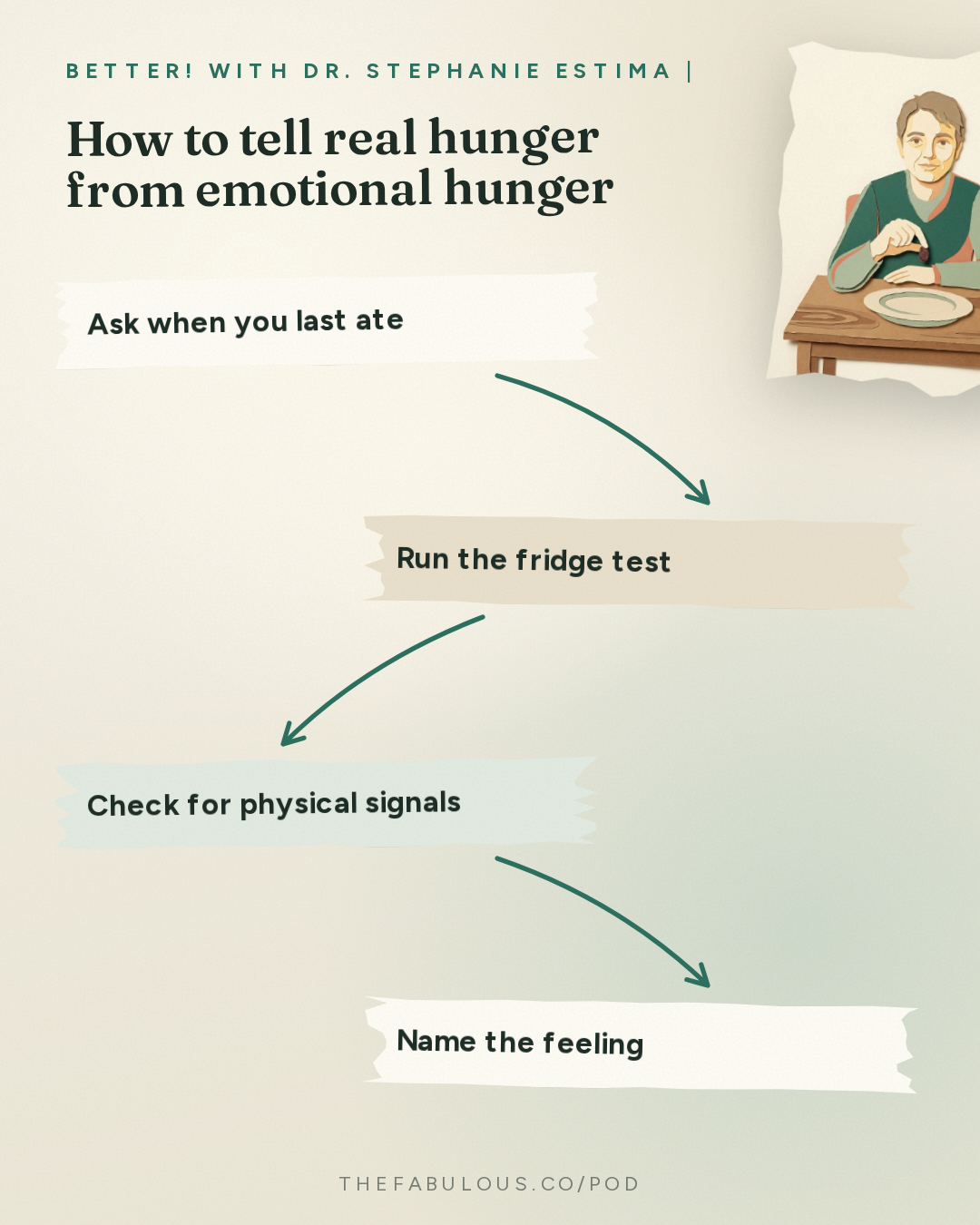
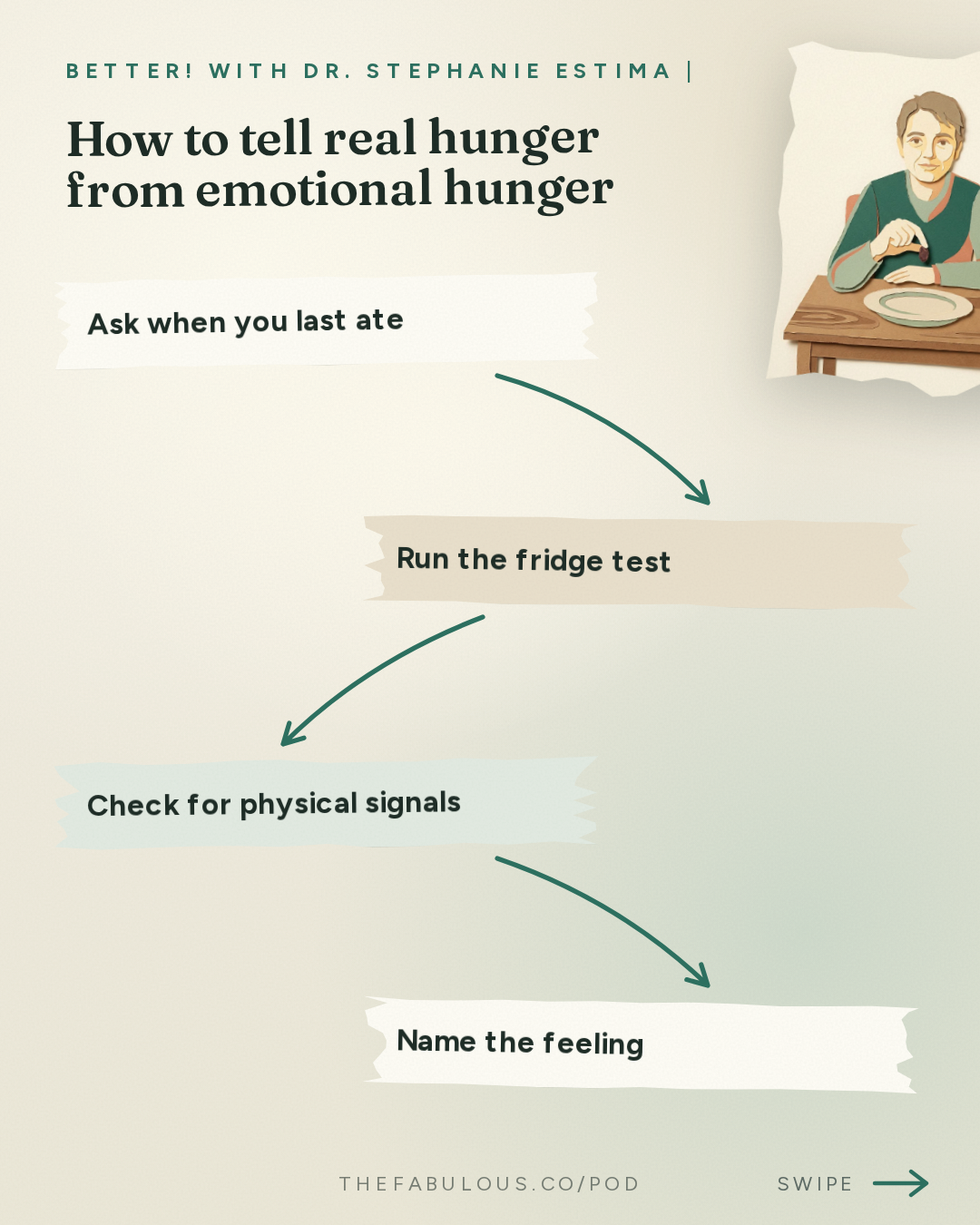
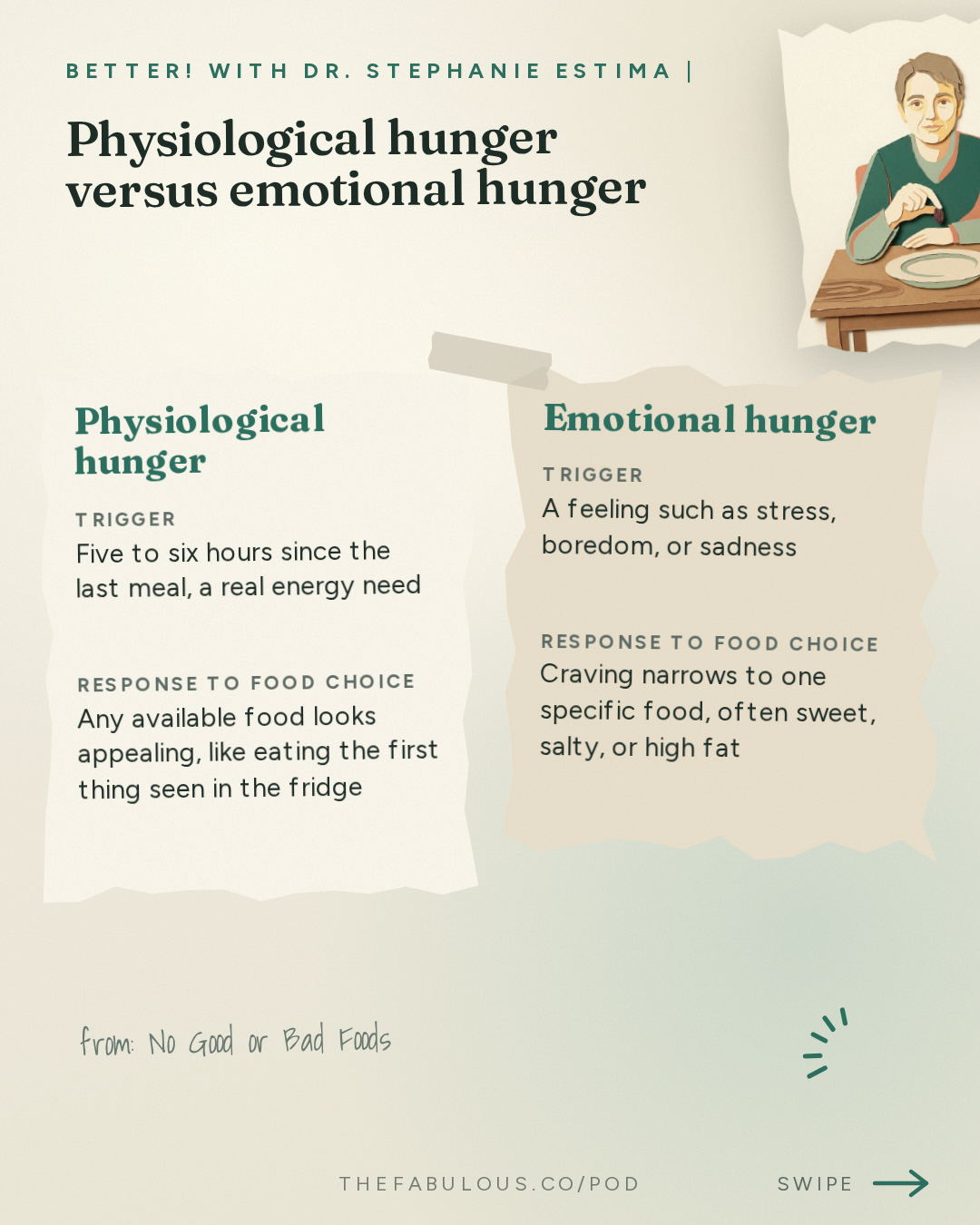
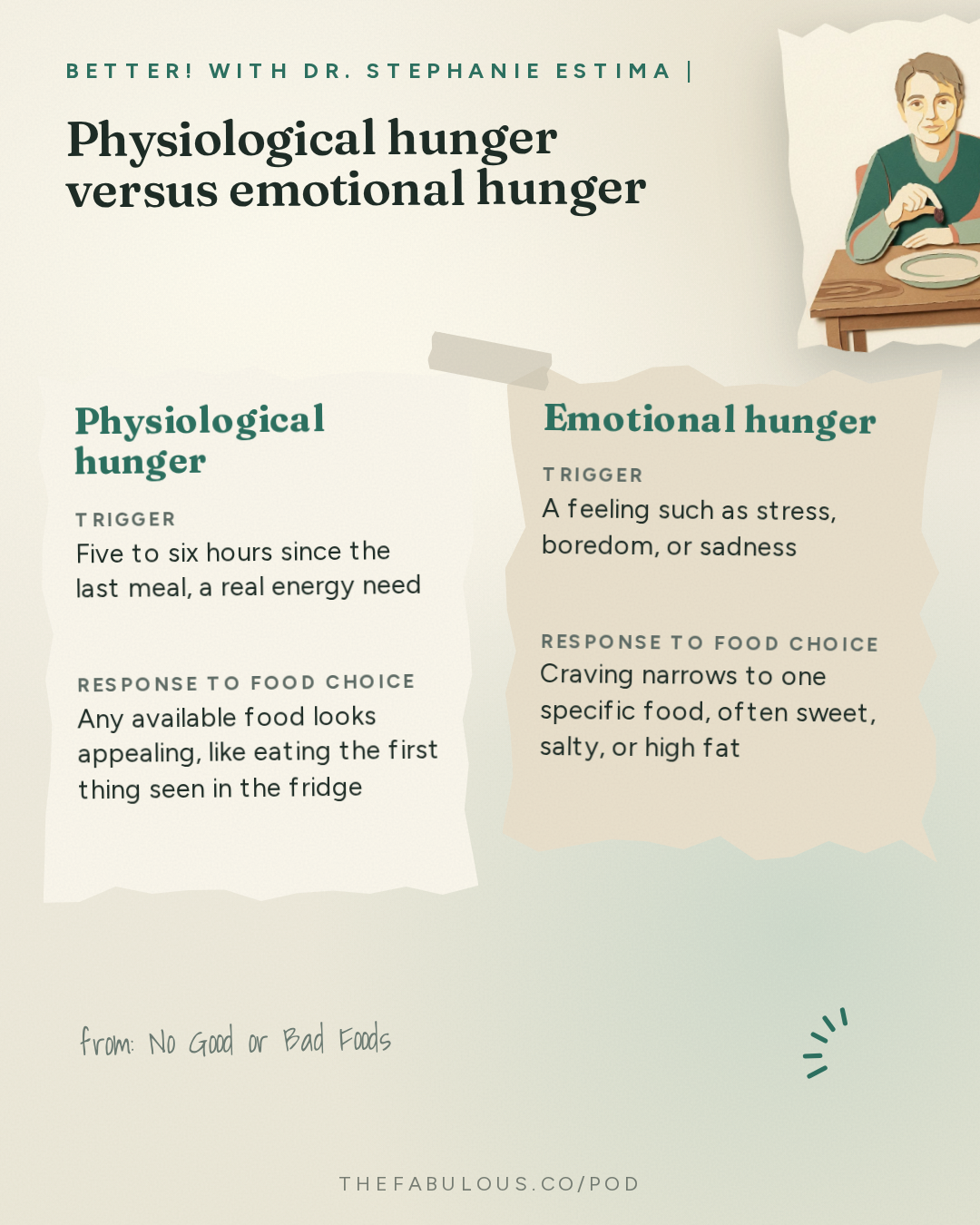
Goldman starts with a distinction that sounds obvious until she defines it. Physiological hunger is the body's actual need for fuel. It shows up roughly five to six hours after the last meal, and it comes with real signals: a stomach that growls, a brain that slows down, an afternoon slump around 3 p.m. that most people blame on needing coffee when they actually need food (08:57). Her favorite diagnostic is almost comically simple. "If you open the refrigerator and the first thing you see, you eat it, you're probably physiologically hungry," she says (07:14). Opening and closing cabinets, scanning for something specific, is a different animal. That is emotional hunger, and it is driven by a feeling rather than a fuel gauge: stress, boredom, sadness, even happiness (07:41).
Here is the part that tends to surprise people: Goldman does not think emotional eating is inherently a problem. Turning to food for comfort becomes an issue only under two conditions, she says, when it is the only coping tool a person has, or when it causes real distress (08:10). Binge eating, by clinical definition, involves a loss of control during the episode (12:35); a planned bowl of ice cream, eaten while sitting down and actually tasted, is a different experience even if the calories are identical.
What matters most, in her framework, is not the behavior at all.
"It's the thought that follows the behavior that's more important than the behavior itself." (Dr. Rachel Goldman, [11:54])
This is the core move of cognitive behavioral therapy, or CBT, the approach Goldman practices, which treats thoughts, feelings, and actions as linked in a loop. Eat a cookie and feel fine about it, and the loop closes. Eat the same cookie and spiral into guilt, and that guilt becomes its own behavior generator: it can trigger restriction the next day, which can trigger another binge, and so on. The cookie was never the event. The self-talk was.
Why 'bad food' makes you feel like a bad person
This is also Goldman's case against labeling food good or bad, a habit she considers not just unhelpful but actively harmful. Some foods have more nutrients than others; that is a fact printed on a label. But nutrient density is not morality, and conflating the two has a cost.
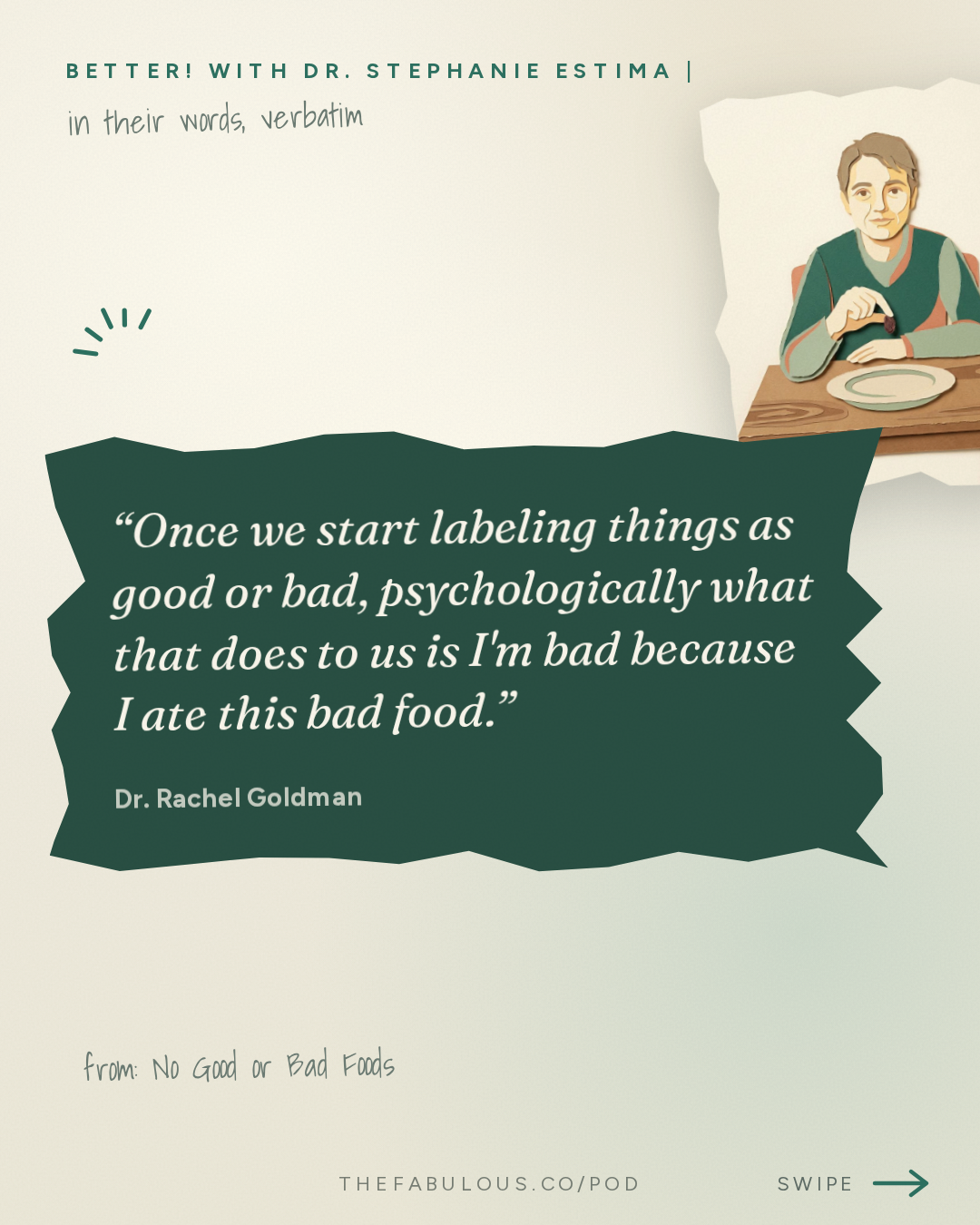
"Once we start labeling things as good or bad, psychologically what that does to us is I'm bad because I ate this bad food... we start labeling and associating and tying our self-worth to it." (Dr. Rachel Goldman, [19:15])
Estima, who hosts the show, brings her own example: two pieces of sourdough toast every morning, nutritionally unremarkable, eaten anyway because it brings her joy (20:26). Goldman matches it with dessert every single night, usually ice cream, treated as a small ritual of self-care rather than a lapse (20:47). Neither woman is arguing for eating without limits. They are arguing that the daily pattern matters more than any single plate, and that joy is allowed to be one of the reasons food gets eaten.
The practical tools Goldman offers are deliberately small. When an urge to eat hits outside of real hunger, she tells clients to pause and name the specific emotion, stress, boredom, loneliness, rather than acting on the impulse blind (15:44). Then she gives it five to ten minutes with a distraction, a walk, a phone call, cleaning, anything that actually appeals to that person. If the craving for that particular food is still there after ten minutes, she says, eat it, and eat it mindfully, rather than treating the wait as a test to pass or fail (16:41).
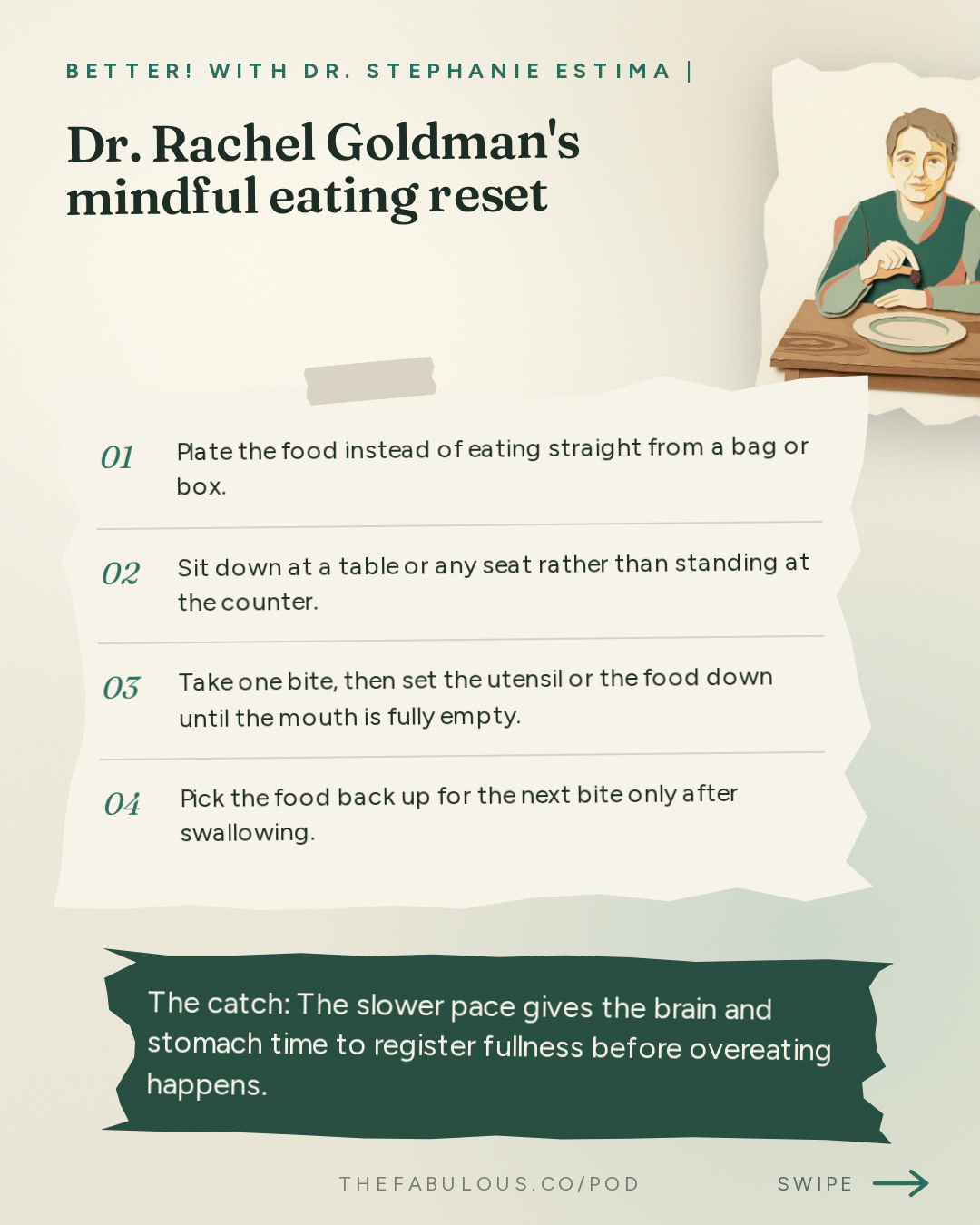
Mindful eating, in her clinical definition, is simply the opposite of mindless eating: no bag, no box, no counter. Plate the food, sit down, and use a trick she calls, half-jokingly, the utensil method. Take a bite, then put the utensil, or the food, down and let the mouth fully empty before picking it back up (27:53). It sounds trivial. Its purpose is not trivial: eating slowly gives the stomach time to signal the brain before a person has eaten past the point of fullness (28:09). She pairs this with a classic CBT exercise sometimes called the humble raisin, in which a client looks at, smells, and slowly tastes a single raisin, almond, or piece of chocolate before deciding how automatic their eating has become (28:51).
Fasting gets a more skeptical hearing. Goldman is careful not to dismiss it outright; she acknowledges real health benefits under the right circumstances. But she wants the word used honestly.
"Fasting, in essence, is restriction, right? Let's just label it as it is. It's restriction." (Dr. Rachel Goldman, [33:46])
For anyone with a history of disordered eating, restriction of any kind can set off a binge cycle, and for everyone else, she worries that fasting windows quietly train people to under-eat without teaching them how to eat well once the window opens (35:53). Her test for whether any behavior, fasting included, has crossed into disordered territory borrows directly from the DSM, the Diagnostic and Statistical Manual that psychologists use to classify mental health conditions. Nearly every diagnosis in it shares one criterion: does the behavior cause distress, and does it get in the way of daily functioning (35:09). If the answer is yes to either, Goldman says, it is worth addressing, regardless of how many times it has happened.
The conversation turns, inevitably, to GLP-1 medications and the bodies showing up on red carpets. Goldman's position is less about the drugs themselves, which she treats as legitimate medical tools when properly supervised, and more about the guessing game the public plays with other people's bodies. "We don't comment on people's body shapes or sizes because we don't know what they're going through," she says (48:06), whether that means an eating disorder, an illness, or a medication nobody has disclosed. Her one carve-out: when a public figure has a young, impressionable audience, she thinks the conversation is worth having, not as public shaming, but as a chance to ask a child or teenager how an image makes them feel (50:38). A study cited in the episode found that girls as young as six showed a correlation between time spent on social media and both body dysmorphia and self-harm risk (53:04), which is part of why Goldman treats the home, not just the feed, as the place where body image gets shaped.
For parents worried about a child's relationship with food or weight, her advice is procedural rather than dramatic: raise it away from the table, in a low-stakes moment, ideally while moving. "Individuals open up a little bit more when they're moving their bodies," she says (59:04), and Estima, who has sons rather than daughters, agrees that her hardest conversations happen on walks, side by side, with nobody required to make eye contact.
The episode ends on a number: a 62-year-old woman who walks 15,000 steps a day, trains four times a week, and wrote in to say she just wants to lose four pounds (64:24). Goldman's response is not to argue with the goal but to interrogate it: what would those four pounds actually change? Usually, she says, the number on the scale is standing in for something else entirely, confidence, comfort in one's own skin, the ability to keep up with her kids, none of which a scale can measure (68:46). Goldman's own shorthand for this, delivered almost as an aside, is the one line of the episode that sounds like it could outlast the rest: she is training for life, not for a number, because the scale was never going to tell her whether she can still lift her kids.
Ask this episode anything
Pod's AI answers from the episode itself, with the minute mark so you can hear it yourself.
Or start with one of these
Ask this episode
Pod's AI listens to the whole episode to answer, and points you to the minute it comes from.
The rest of this answer, and any question after it
Answers come from the episode itself, never from a summary of it.
ContinueKey takeaways
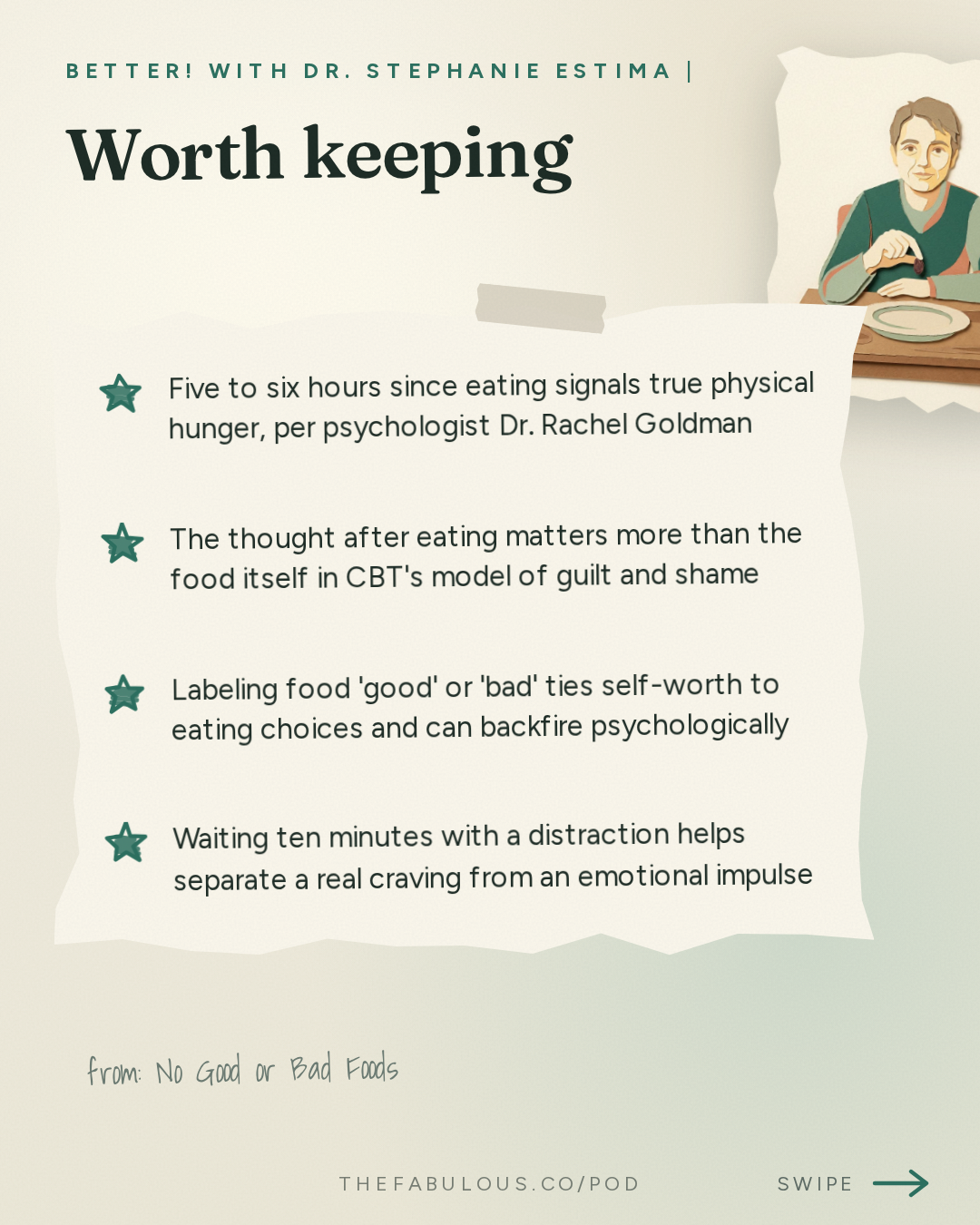
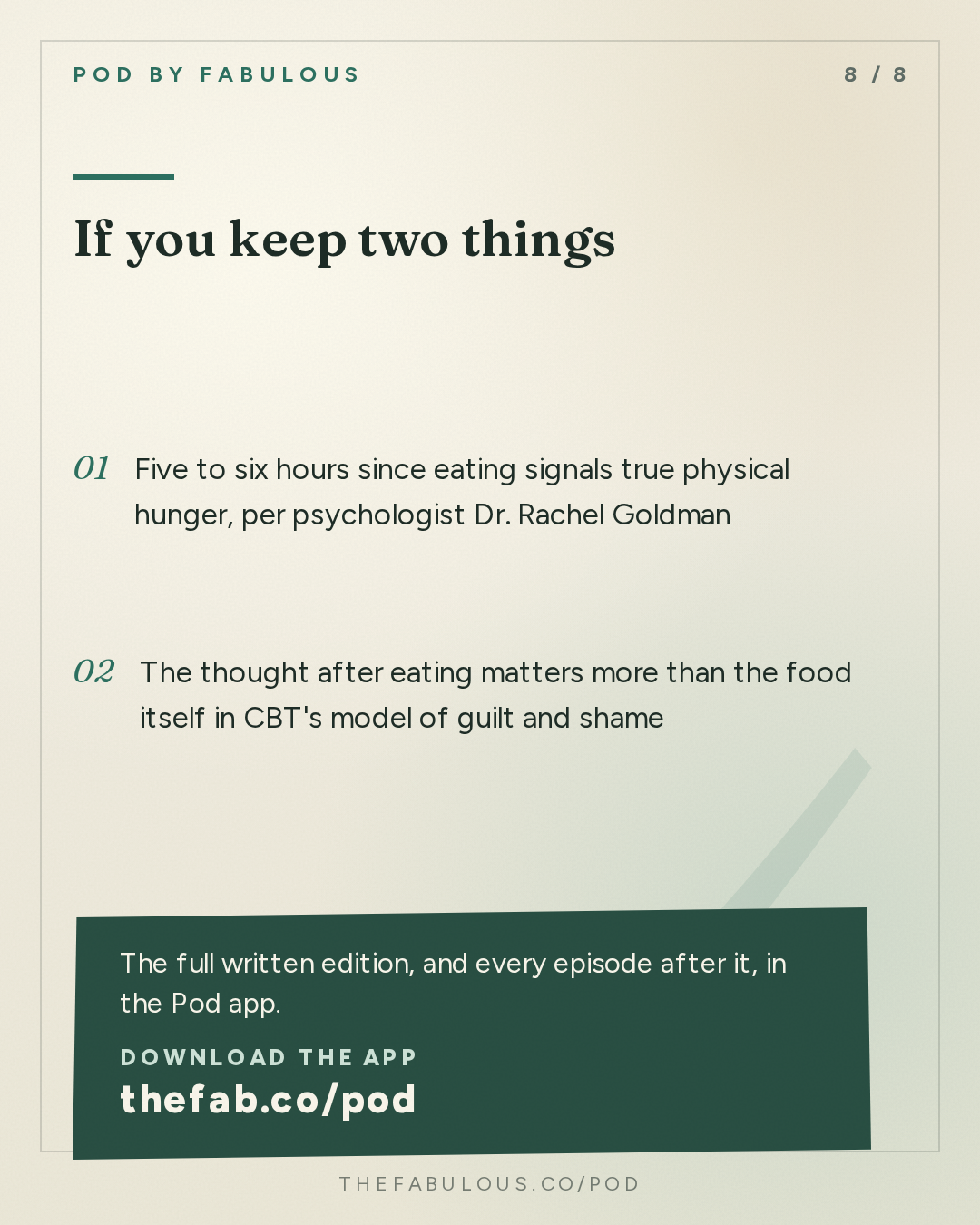
- Five to six hours since eating signals true physical hunger, per psychologist Dr. Rachel Goldman
- The thought after eating matters more than the food itself in CBT's model of guilt and shame
- Labeling food 'good' or 'bad' ties self-worth to eating choices and can backfire psychologically
- Waiting ten minutes with a distraction helps separate a real craving from an emotional impulse
- Fasting is restriction, and restriction can trigger binge cycles in people prone to disordered eating
The episode in cards
By the numbers
- 10 minutes wait time with a distraction before deciding whether to eat a craving
In their words
“Physiological hunger is also if you open the refrigerator and the first thing you see, you eat it, you're probably physiologically hunger- hungry”
“It's the thought that follows the behavior that's more important than the behavior itself.”
“Once we start labeling things as good or bad, psychologically what that does to us is I'm bad because I ate this bad food.”
“Fasting, in essence, is restriction, right? Let's just label it as it is. It's restriction.”
Protocols
-
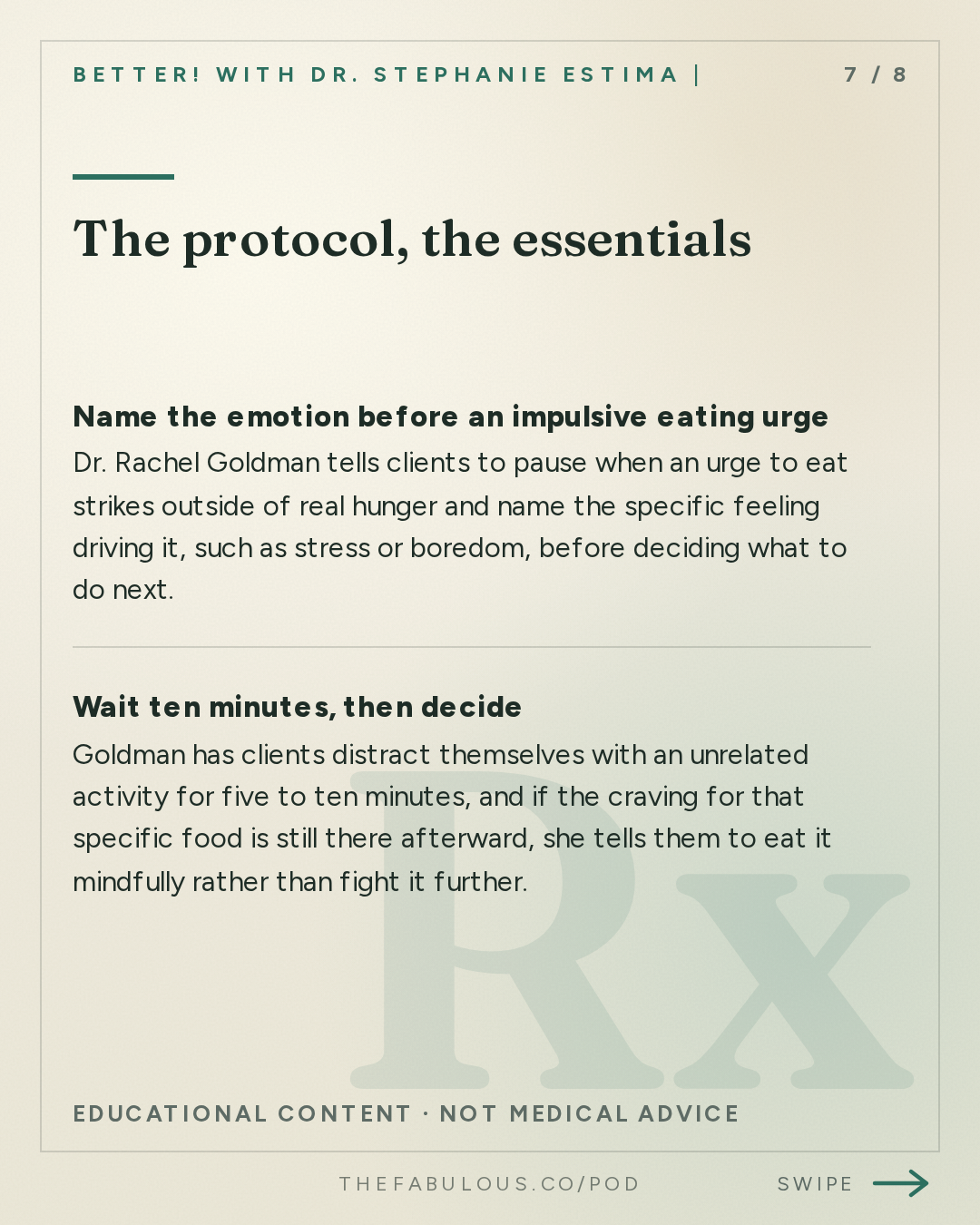
Name the emotion before an impulsive eating urge
Dr. Rachel Goldman tells clients to pause when an urge to eat strikes outside of real hunger and name the specific feeling driving it, such as stress or boredom, before deciding what to do next.
Each time an eating urge appears that is not tied to physical hunger
-
Wait ten minutes, then decide
Goldman has clients distract themselves with an unrelated activity for five to ten minutes, and if the craving for that specific food is still there afterward, she tells them to eat it mindfully rather than fight it further.
Every time a craving shows up
-
Plate it, sit down, set the utensil down between bites
Goldman instructs clients to plate their food, sit at a table rather than eat standing over a counter, and put the utensil or food down after each bite until the mouth is empty before picking it up again.
As a standing practice at meals
-
Raise body image concerns on a walk, away from food
Goldman recommends bringing up a body-image worry during a low-stakes moment away from the dinner table, such as a walk or a car ride, and opening with an observation like noticing baggy clothing rather than a pointed accusation.
Once a concern arises, chosen deliberately rather than in the heat of the moment
Questions this episode answers
How can I tell if I'm physically hungry or emotionally hungry?
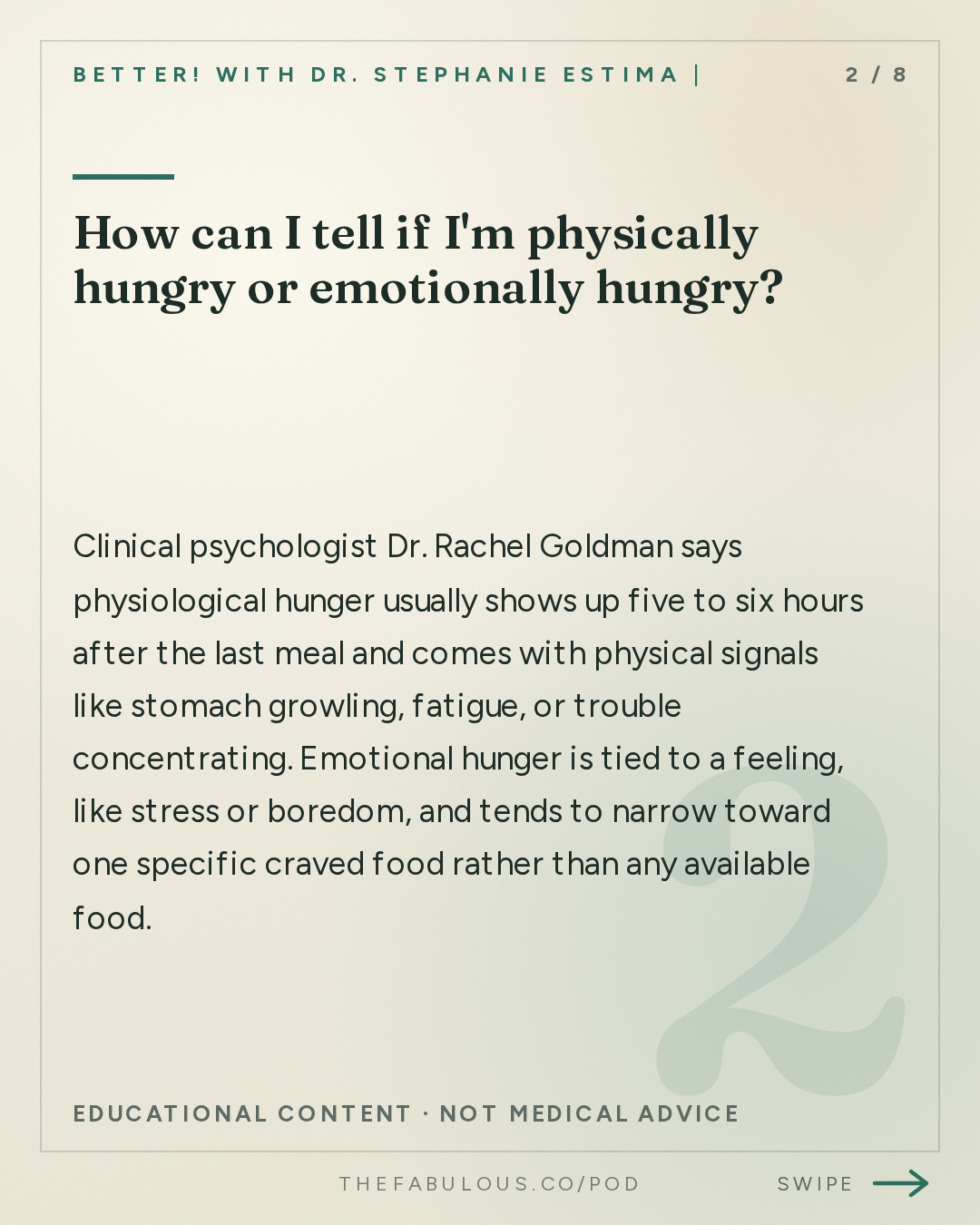
Clinical psychologist Dr. Rachel Goldman says physiological hunger usually shows up five to six hours after the last meal and comes with physical signals like stomach growling, fatigue, or trouble concentrating (06:29, 08:57). Emotional hunger is tied to a feeling, like stress or boredom, and tends to narrow toward one specific craved food rather than any available food (07:41).
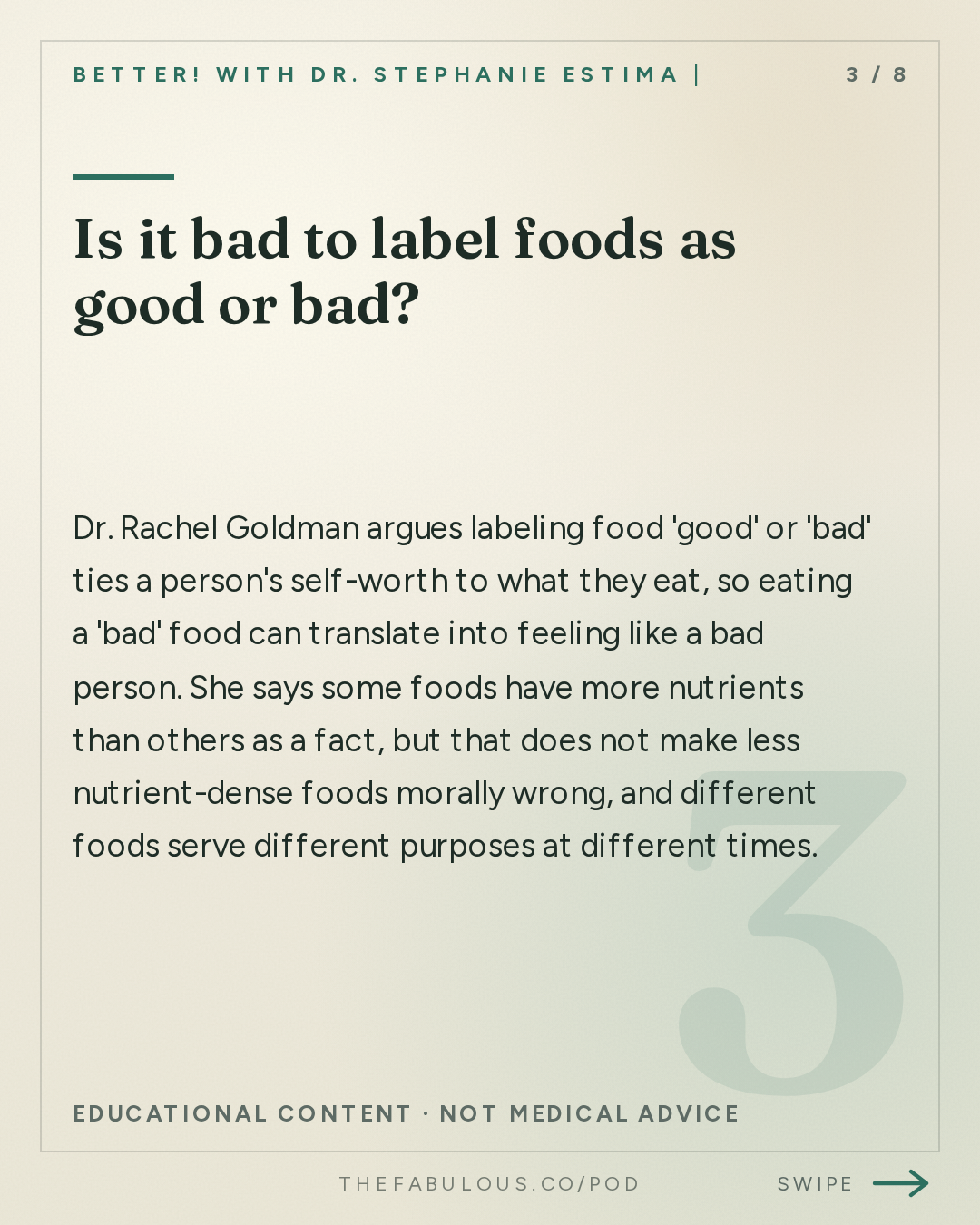
Is it bad to label foods as good or bad?
Dr. Rachel Goldman argues labeling food 'good' or 'bad' ties a person's self-worth to what they eat, so eating a 'bad' food can translate into feeling like a bad person (19:15). She says some foods have more nutrients than others as a fact, but that does not make less nutrient-dense foods morally wrong, and different foods serve different purposes at different times (19:39).
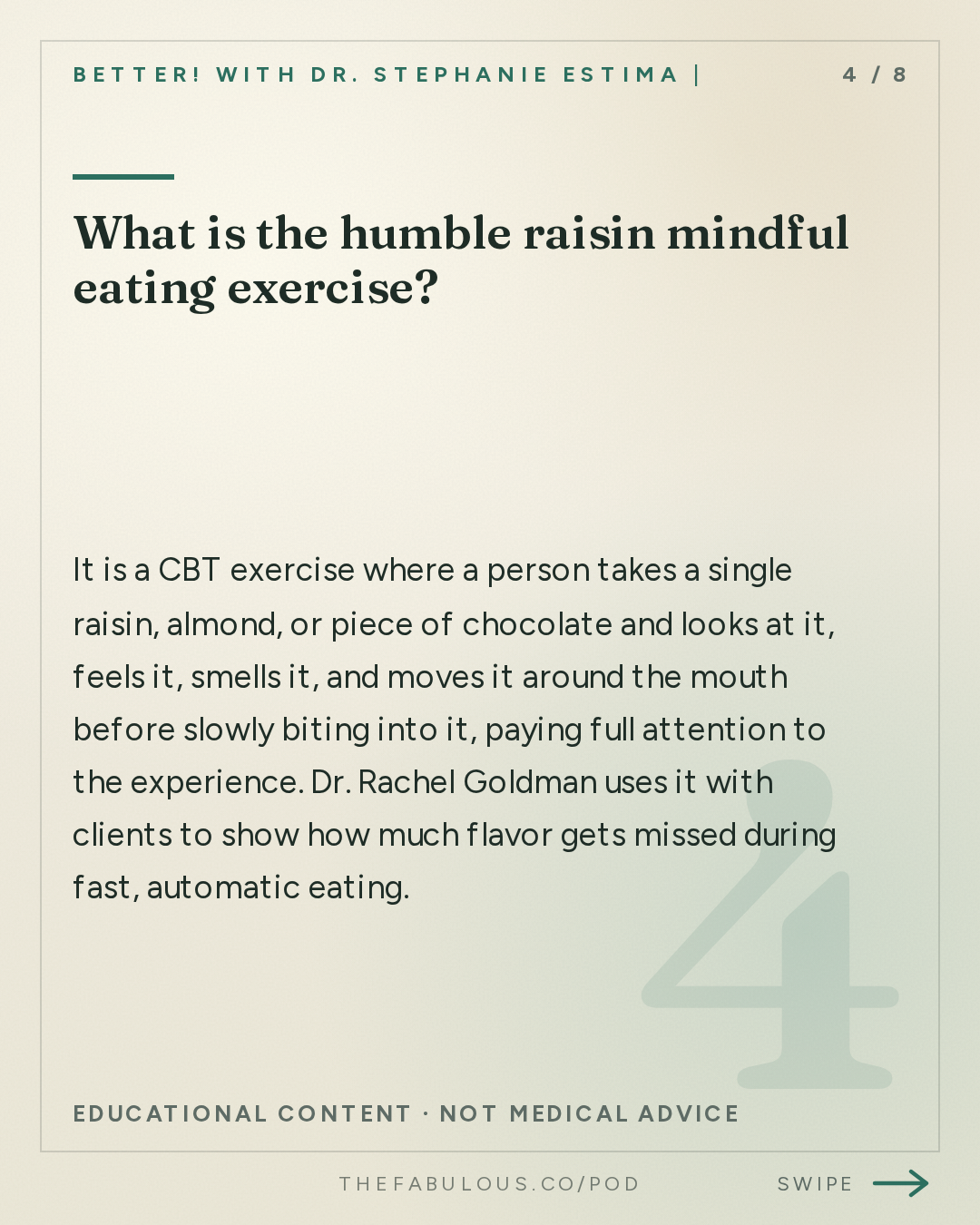
What is the humble raisin mindful eating exercise?
It is a CBT exercise where a person takes a single raisin, almond, or piece of chocolate and looks at it, feels it, smells it, and moves it around the mouth before slowly biting into it, paying full attention to the experience (28:51). Dr. Rachel Goldman uses it with clients to show how much flavor gets missed during fast, automatic eating (29:36).
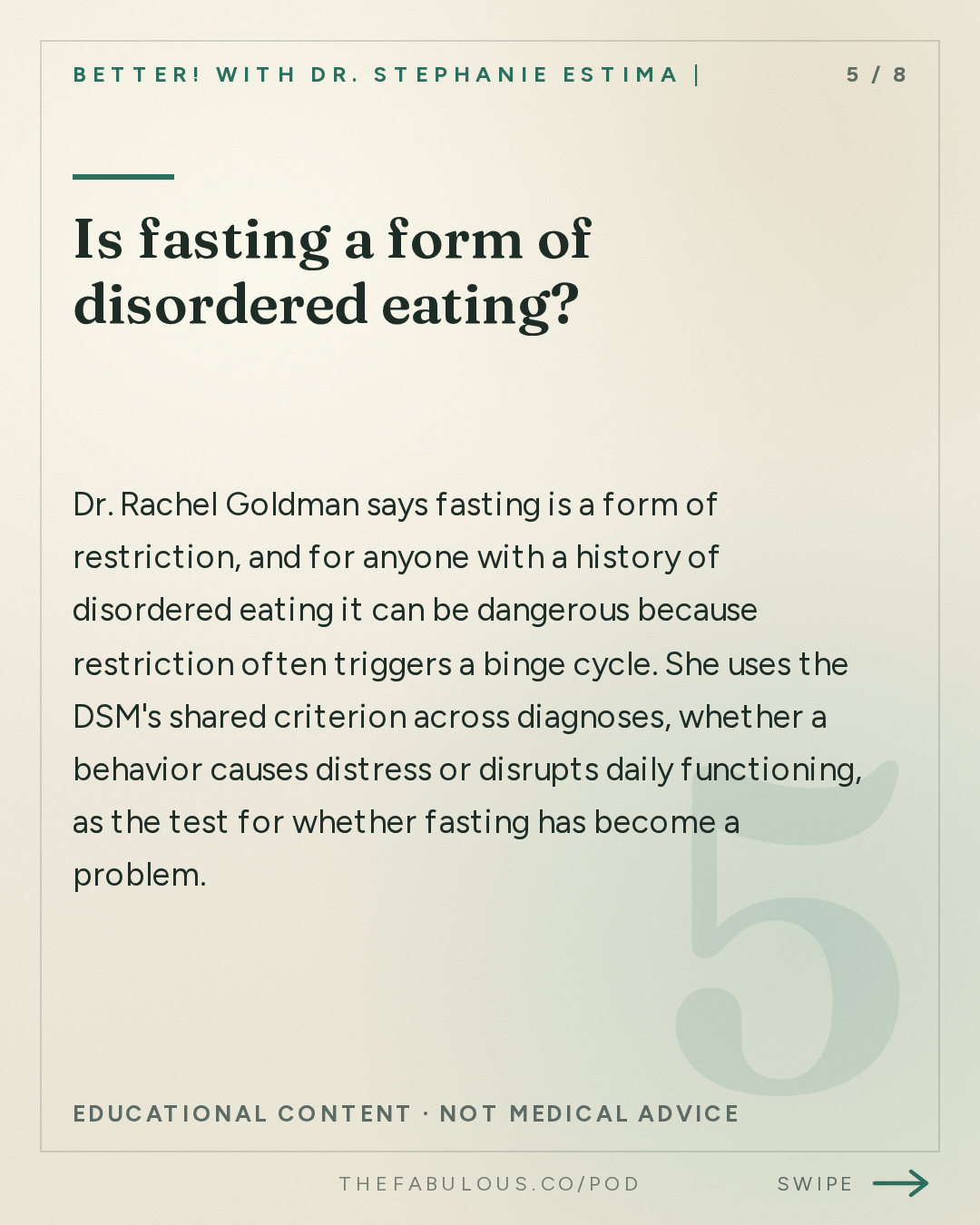
Is fasting a form of disordered eating?
Dr. Rachel Goldman says fasting is a form of restriction, and for anyone with a history of disordered eating it can be dangerous because restriction often triggers a binge cycle (33:46). She uses the DSM's shared criterion across diagnoses, whether a behavior causes distress or disrupts daily functioning, as the test for whether fasting has become a problem (35:09).
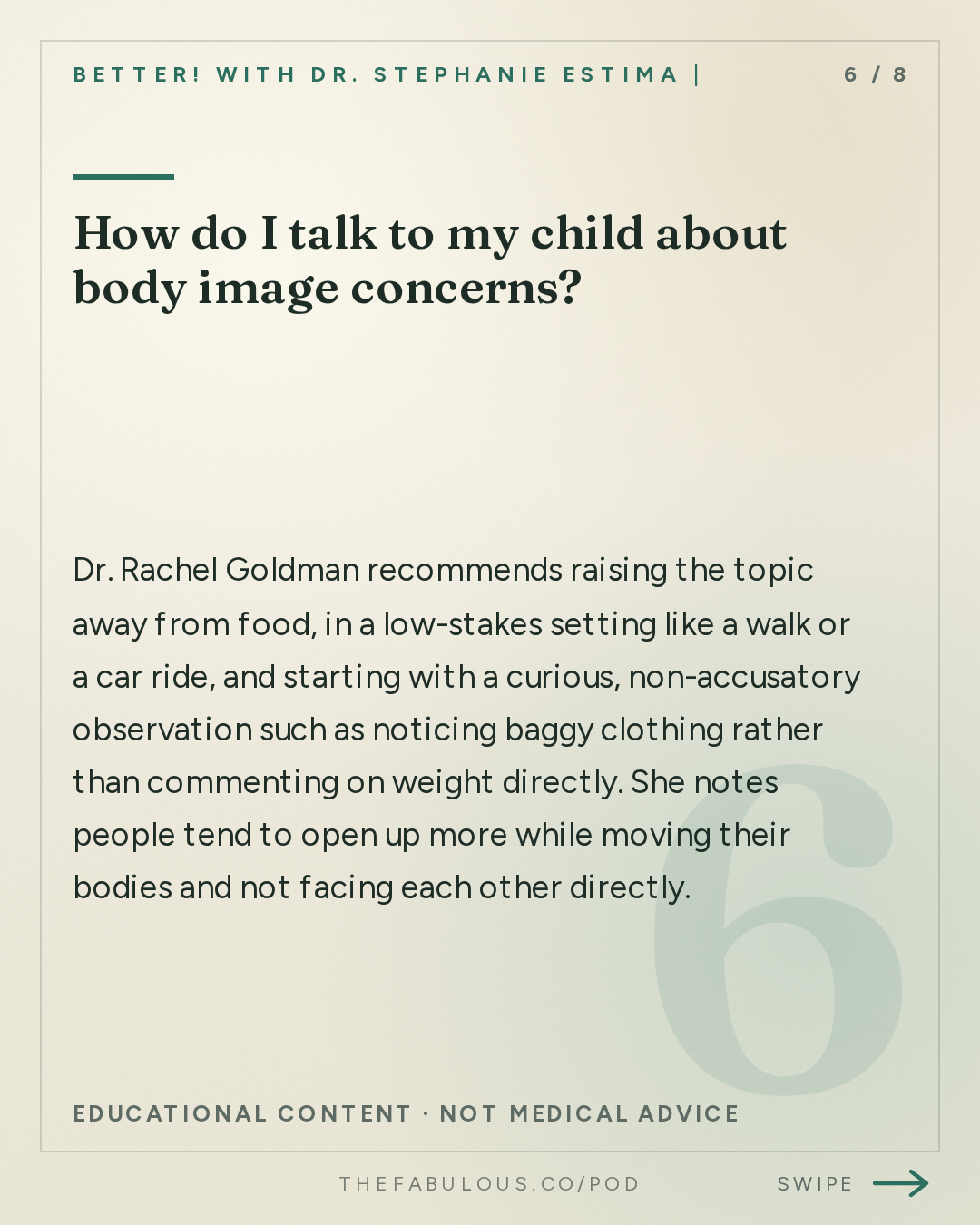
How do I talk to my child about body image concerns?
Dr. Rachel Goldman recommends raising the topic away from food, in a low-stakes setting like a walk or a car ride, and starting with a curious, non-accusatory observation such as noticing baggy clothing rather than commenting on weight directly (56:30). She notes people tend to open up more while moving their bodies and not facing each other directly (59:04).
The full read, in cards
Go deeper
- When Life Happens — Dr. Rachel Goldman's book on CBT for stress, body image, and behavior change, including a dedicated body image chapter
- Social media and body dysmorphia study — found a correlation between time spent on the app and body dysmorphia and self-harm risk in girls as young as six
- Bill Campbell's research on menopausal women — found exercise-driven calorie deficits may serve perimenopausal and menopausal women better than dietary restriction
Mentioned
Dr. Rachel Goldman · Dr. Stephanie Estima · NYU Grossman School of Medicine · When Life Happens · DSM · Ozempic · Bill Campbell · Jessica Simpson · Mariah Carey · Hugh Jackman
More from this show and category

Joint Health in Menopause: Train, Don't Avoid
Cartilage is not a tire with a fixed tread, it's a sponge fed by movement, says Dr. Stephanie Estima. Joint cartilage has no blood supply, so compression and release during movement pump nutrients in and waste out. She argues declining estrogen drives what researchers now call Musculoskeletal Syndrome of Menopause, and that strength training, done without ego, protects joints better than avoidance or stretching alone.
Keith Baar's Tendon Isometric Protocol Explained
Tendons stop responding to exercise after about 10 minutes and need six to eight hours before another session helps. Physiologist Keith Baar's fix is the 3LD isometric: a 30-second, low-load hold that lets the tendon 'creep' and spread tension evenly, replacing both heavy lifting and the outdated RICE protocol for injury recovery.
How to Build Glutes Without Growing Legs
Hip dips are permanent anatomy, not a fitness failure, says glute researcher and hip thrust inventor Bret Contreras. He explains why horizontal moves like hip thrusts and kickbacks are gentler on joints than squats, how women recover faster than men, and how a five-month training rotation builds glutes while sparing the legs.
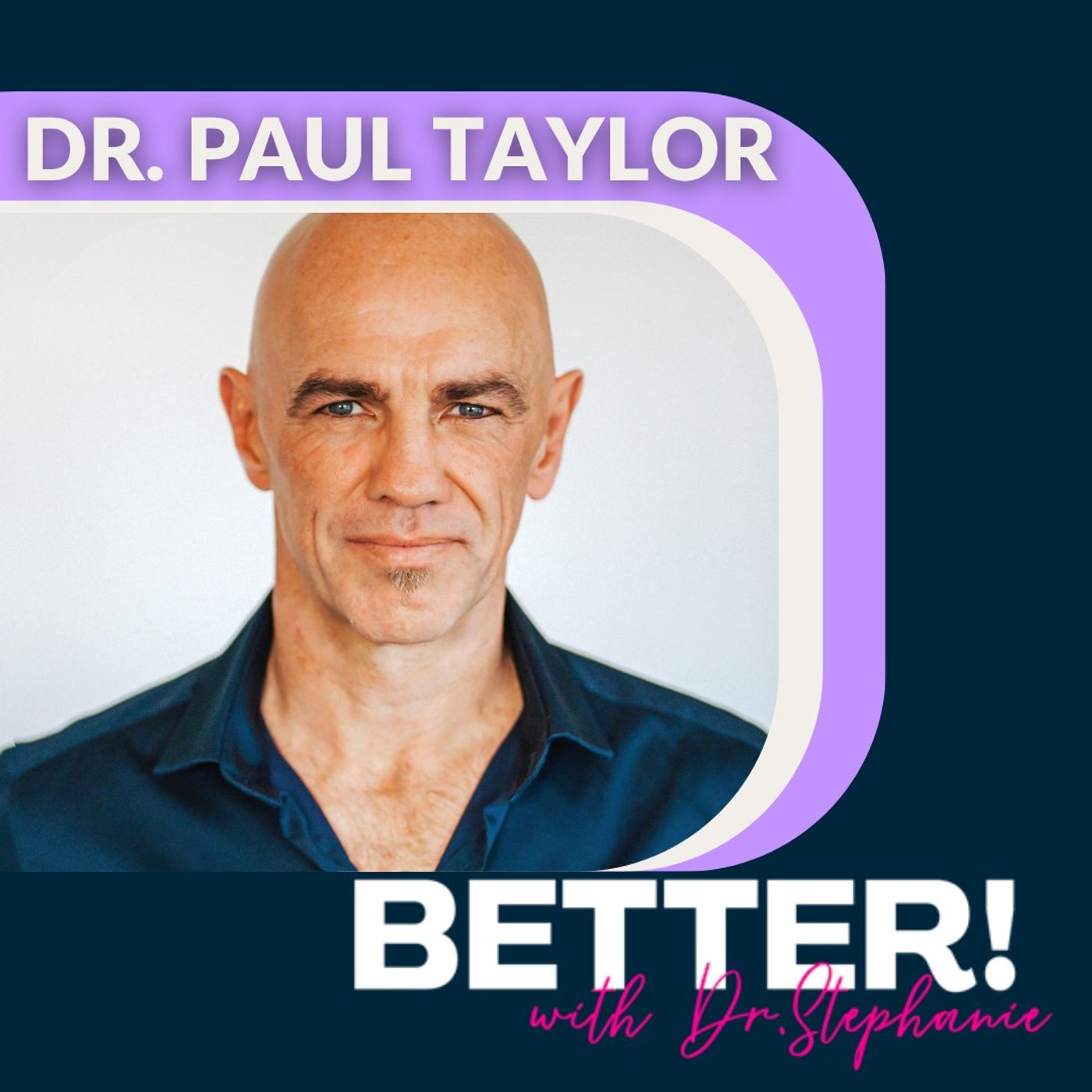
Muscle Power vs Strength for Longevity
Psychophysiologist Paul Taylor says muscle power, not size or strength, best predicts how long people live. He tells Dr. Stephanie Estima that myokines, signaling molecules released by contracting muscle, act like an internal pharmacy, and he gives dosing-style guidance on power training, protein, omega-3, and cold plunge limits.
