
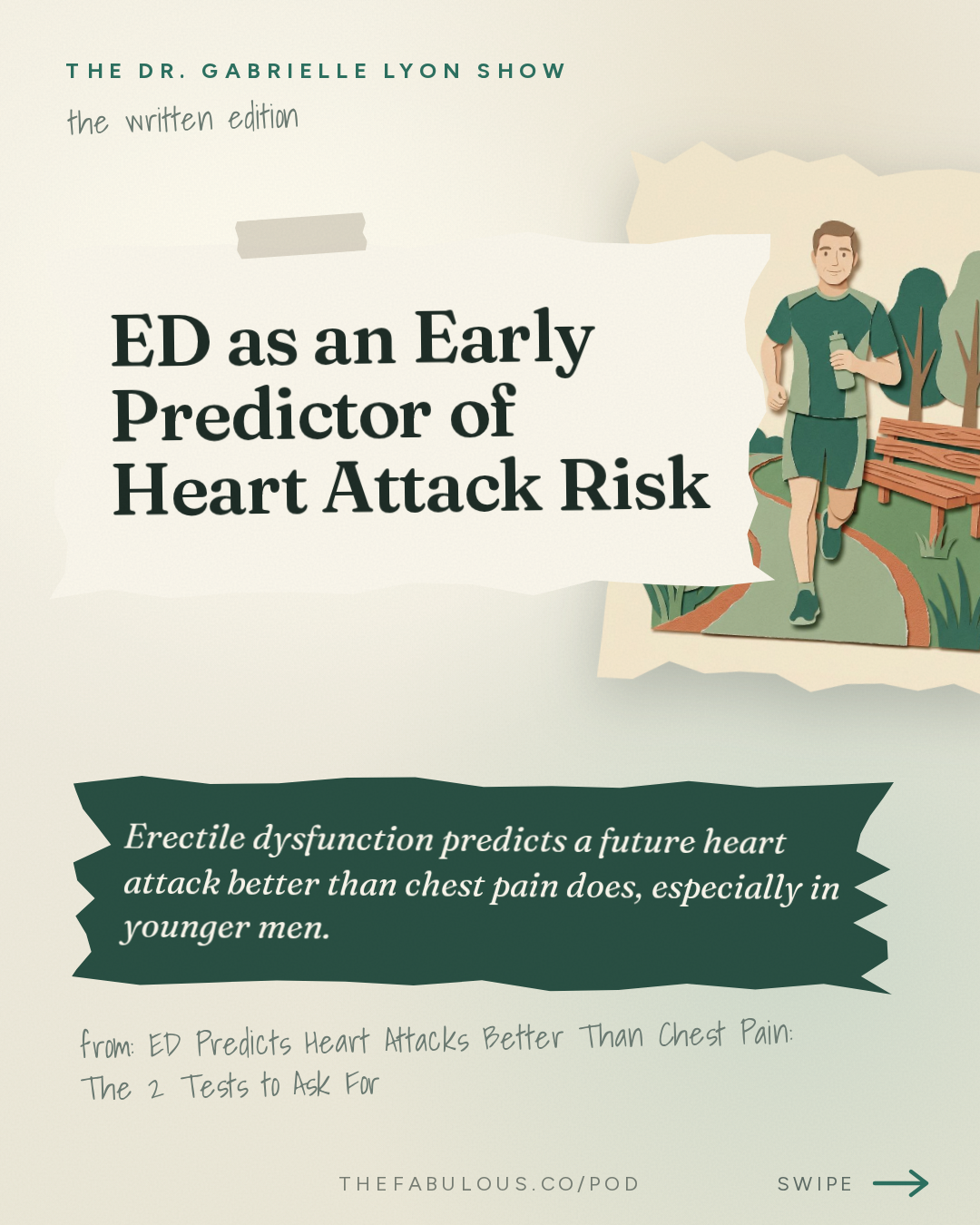
ED as an Early Predictor of Heart Attack Risk
ED Predicts Heart Attacks Better Than Chest Pain: The 2 Tests to Ask For | Dr. Tobias Kohler
▶ Listen to the full episode More from The Dr. Gabrielle Lyon Show
The brief
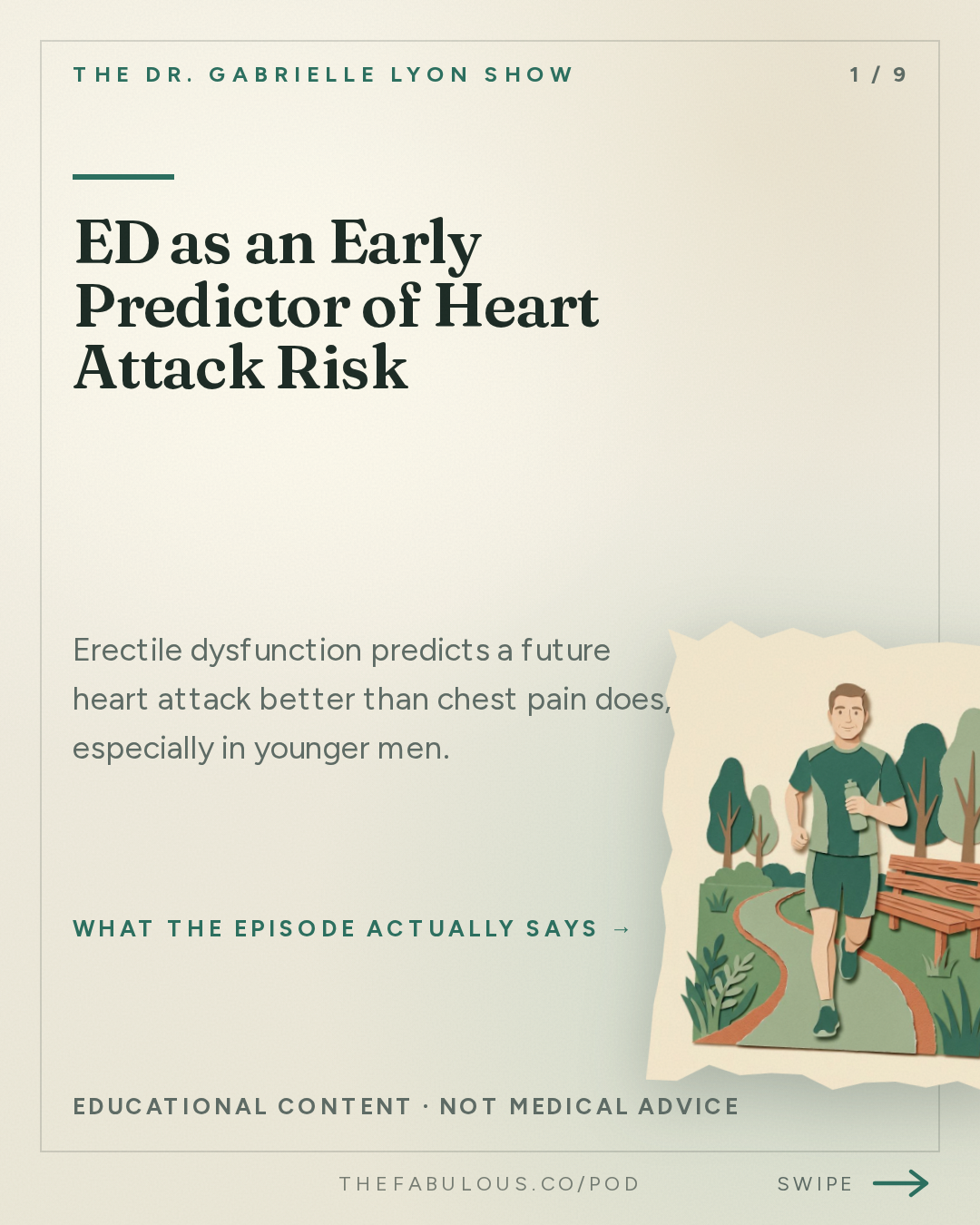
Erectile dysfunction predicts a future heart attack better than chest pain does, especially in younger men (11:11). Urologist Tobias Kohler describes two cheap early-warning tests, a coronary calcium scan and a Mayo Clinic ceramide blood test, plus the cardiac damage caused by high-dose testosterone abuse (12:49, 44:55).
Ask this episode anything
Pod's AI answers from the episode itself, with the minute mark so you can hear it yourself.
Or start with one of these
Ask this episode
Pod's AI listens to the whole episode to answer, and points you to the minute it comes from.
The rest of this answer, and any question after it
Answers come from the episode itself, never from a summary of it.
Continue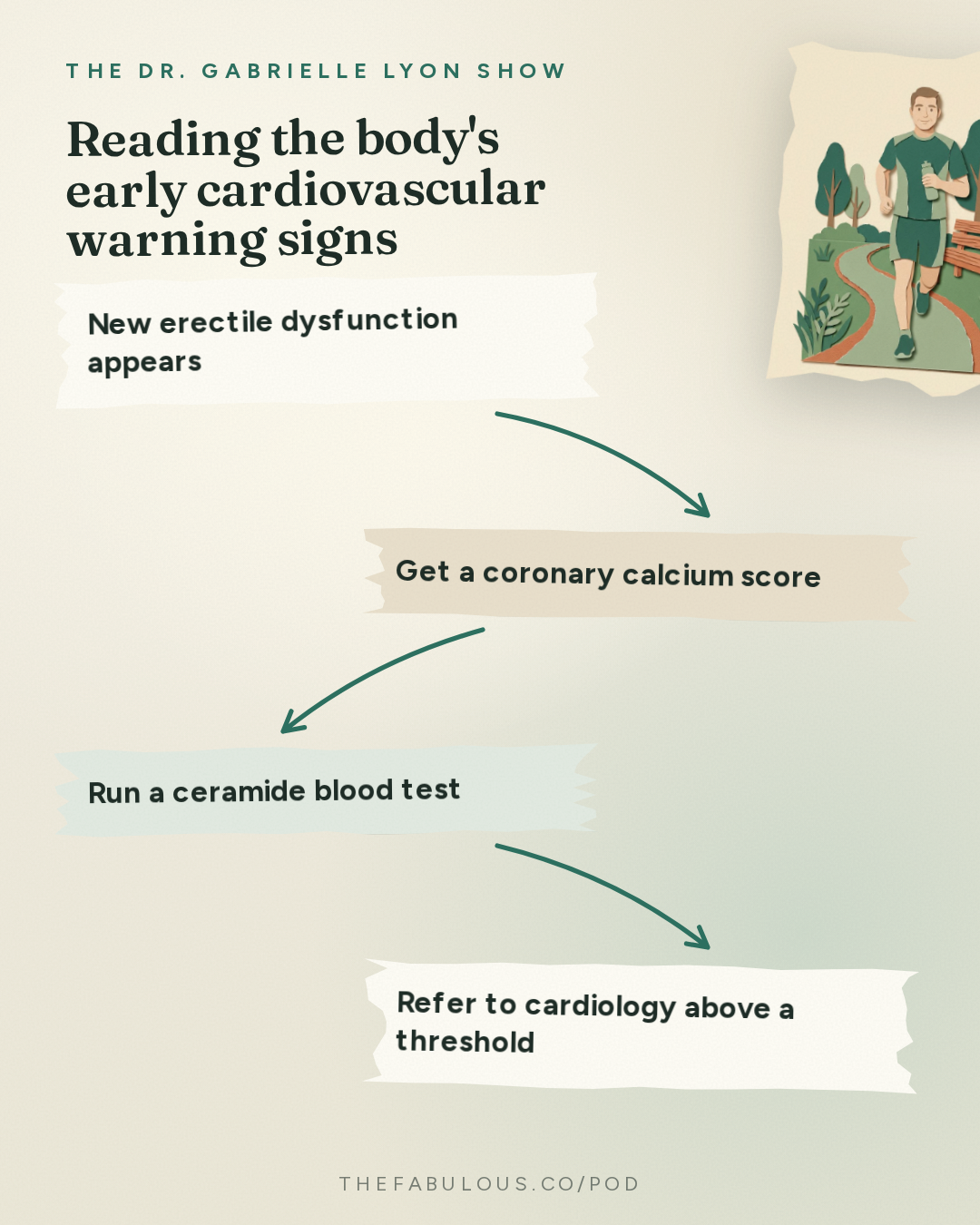
Key takeaways
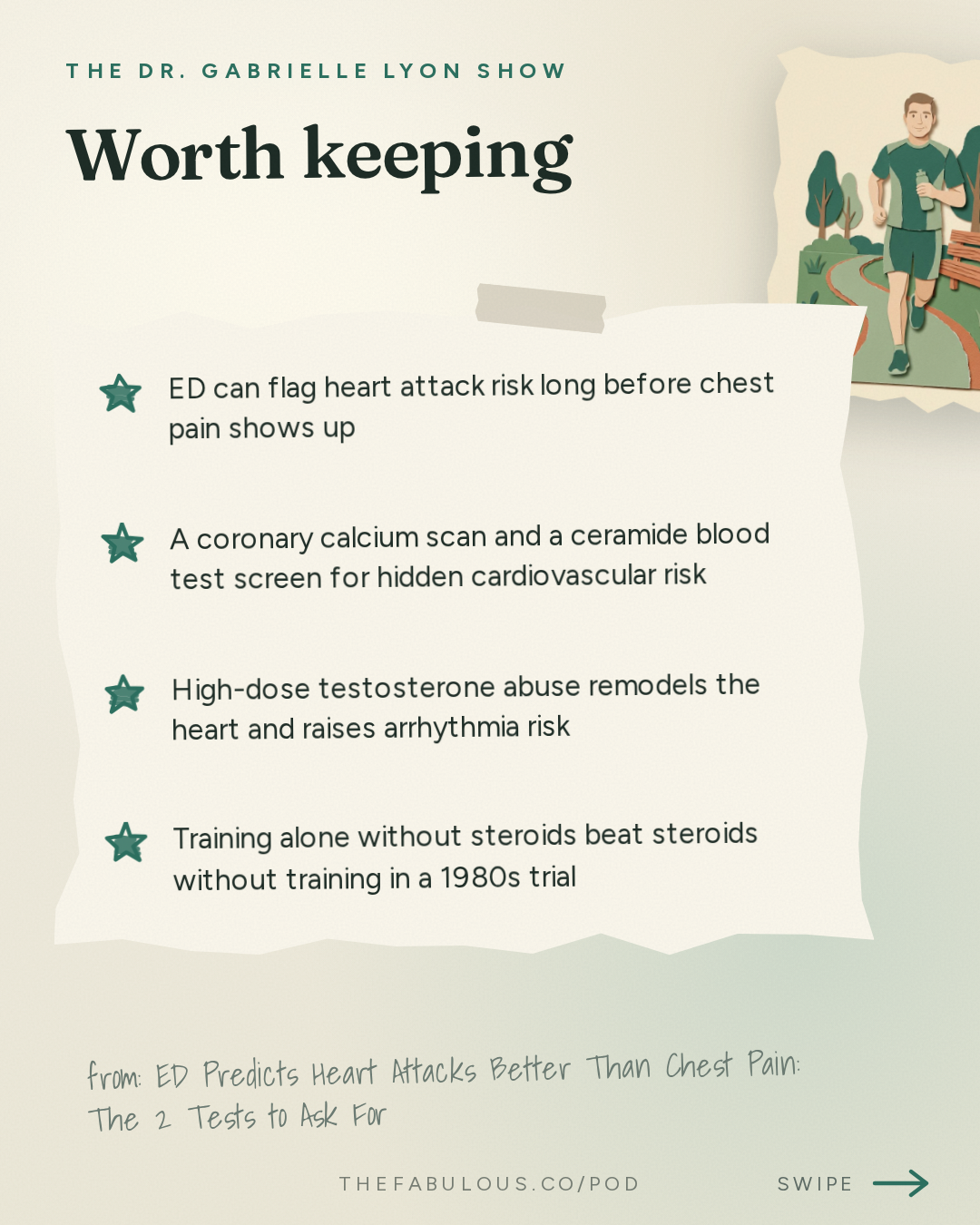
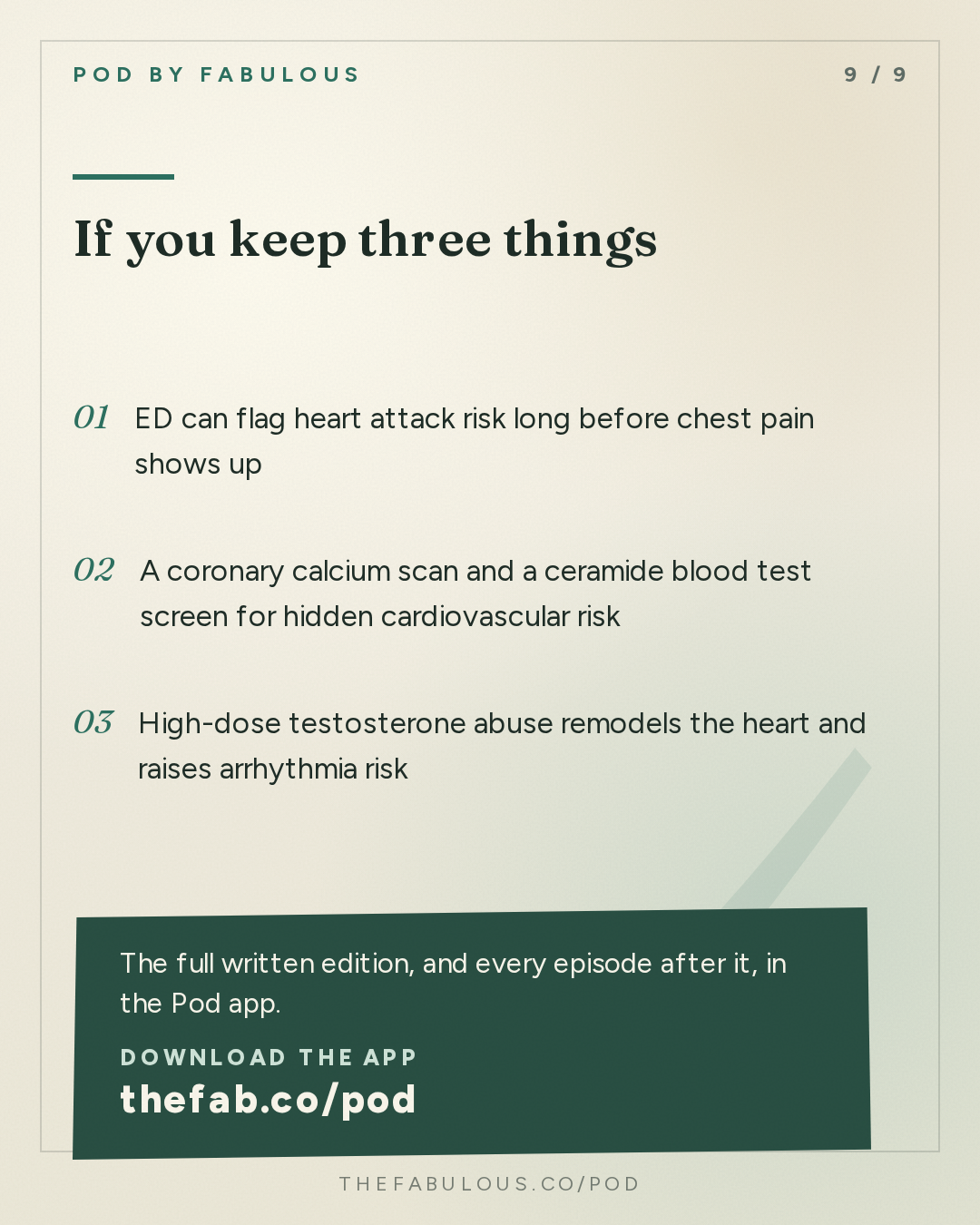
- ED can flag heart attack risk long before chest pain shows up
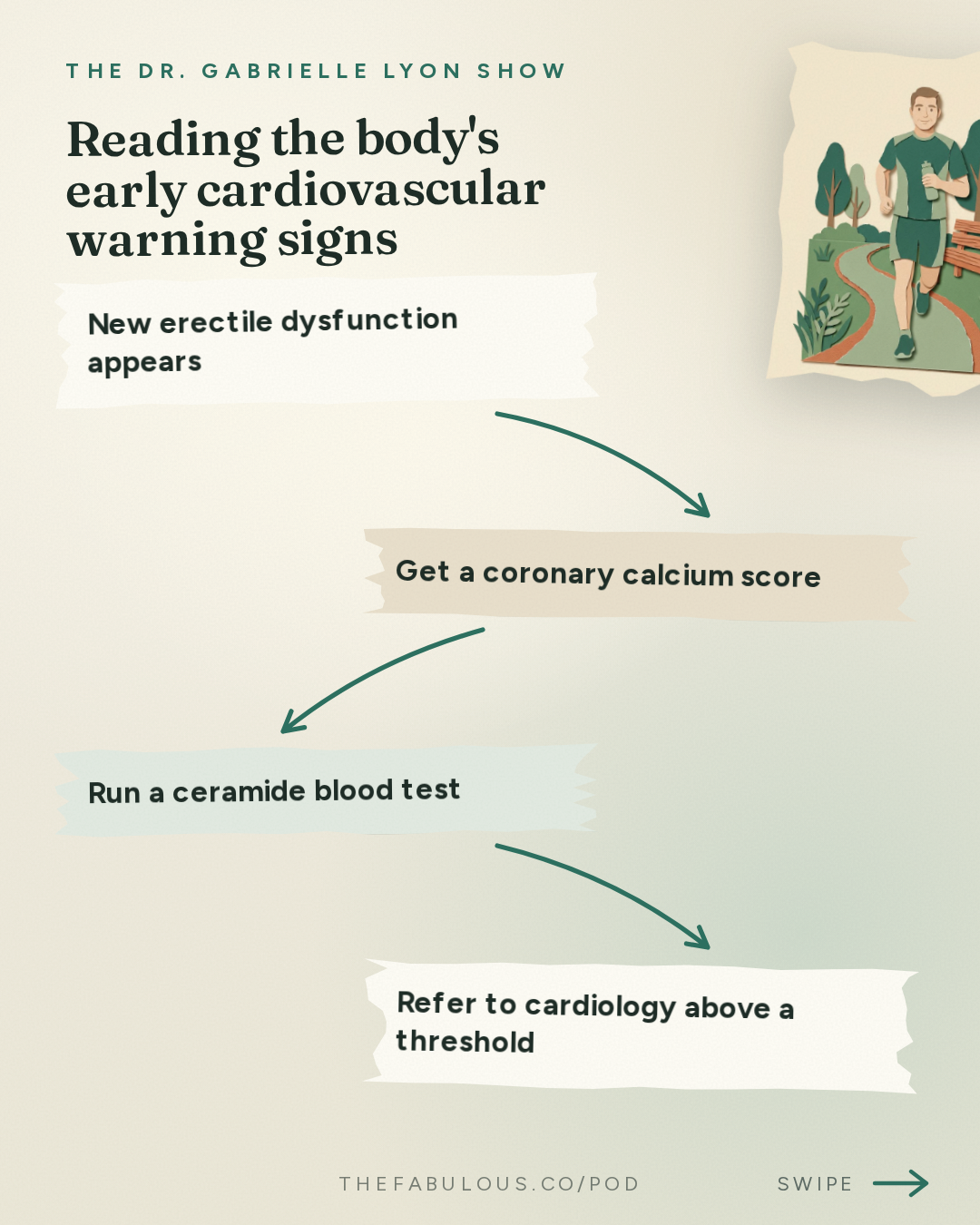
- A coronary calcium scan and a ceramide blood test screen for hidden cardiovascular risk
- High-dose testosterone abuse remodels the heart and raises arrhythmia risk
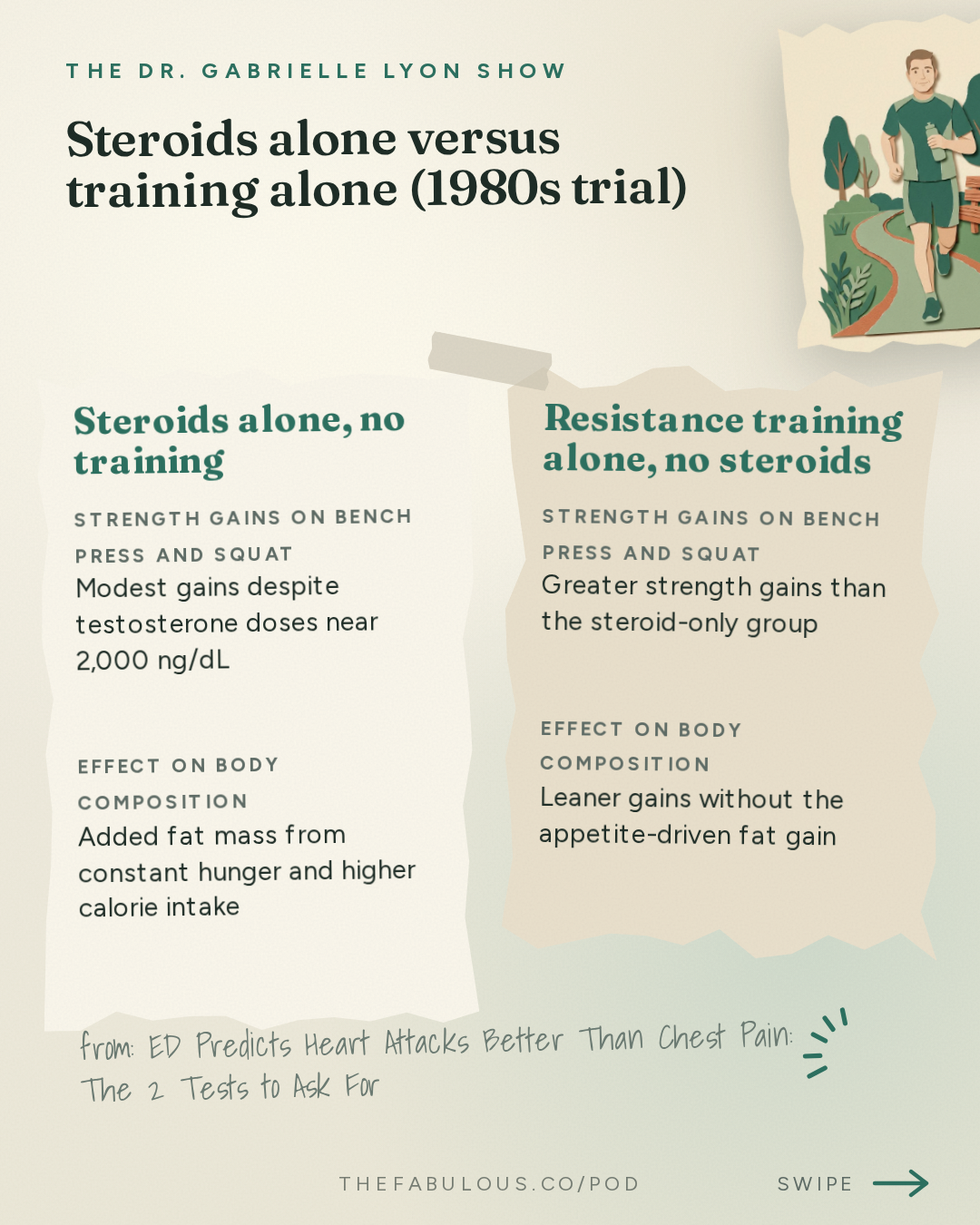
- Training alone without steroids beat steroids without training in a 1980s trial
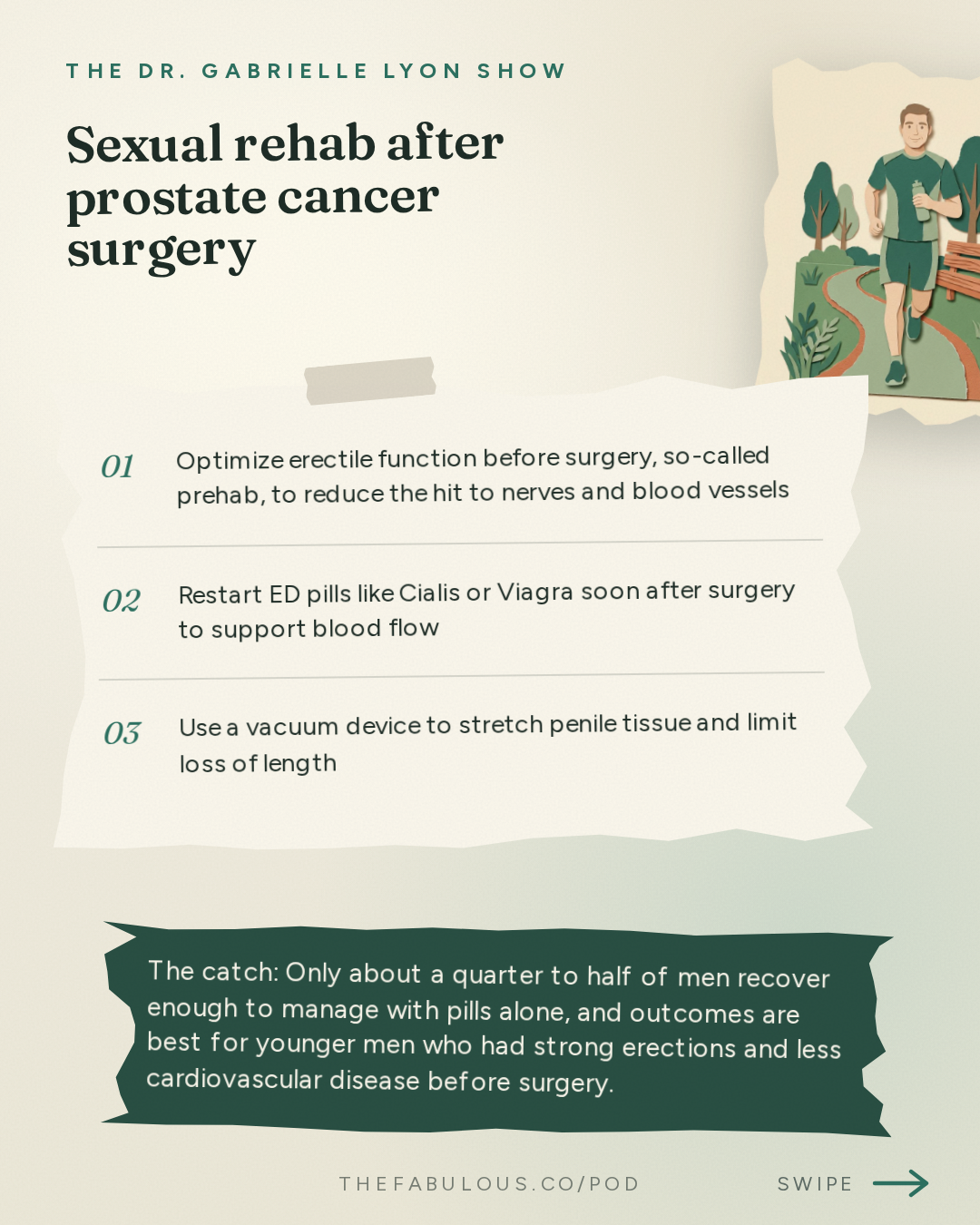
- Prostatectomy patients recover erections in stages, from pills to injections to implants
The episode in cards

A man's first heart attack often arrives with no warning at all. Ask a room of medical students what usually happens right before someone's first heart attack, and the textbook answer is unsettling: nothing. No chest pain, no shortness of breath, just a body that seemed fine until it wasn't. That gap in the warning system is why Mayo Clinic urologist Tobias Kohler keeps steering the conversation toward an organ cardiologists rarely mention: the penis.
"The check engine light, the canary in the coal mine" - Tobias Kohler [00:59]
The logic, Kohler explains, is plumbing. An erection needs healthy blood vessels, working nerves, and balanced hormones all at once. When the body is under stress or getting sick, it redirects blood toward the brain and away from less urgent business (00:59). So if the plumbing fails in the bedroom before it fails anywhere else noticeable, that failure is data. It is why the Princeton IV Consensus Guidelines, a set of recommendations written by a mixed panel of cardiologists, urologists, and endocrinologists that Kohler co-chairs, now treat erectile dysfunction as a cardiac symptom rather than a private inconvenience (10:36).
"The most effective predictor of having a heart attack that we have is erectile dysfunction, especially in younger men" - Tobias Kohler [11:11]
The guidelines translate that finding into something concrete: a young man with new erectile trouble should strongly consider a coronary calcium score, a CT scan that measures hardened plaque in the heart's arteries years before a heart attack might happen (11:59). Cialis, one of the standard erectile dysfunction pills, may also carry a cardioprotective effect on top of its usual job, though Kohler is careful to say the evidence there is still developing (11:59).
The Ceramide Clue
Standard cholesterol panels have a known blind spot: plenty of people with normal cholesterol still have heart attacks (24:43). Kohler's answer to that gap is a newer blood test built around ceramides, a ubiquitous protein already familiar to anyone who reads a lotion label, because certain ceramides also mark inflammation in the lining of blood vessels near the heart (12:49). Mayo Clinic has built a specific version of the test, scored from zero to twelve, where a twelve means, in Kohler's words, you are going to the cardiologist tomorrow (13:48). What makes the test unusual is its speed. Cholesterol numbers move slowly and do not react quickly to a new gym habit. Ceramide scores do. Kohler says patients who clean up their diet and start exercising can see the number drop within weeks, which turns the test into feedback rather than just a diagnosis (15:12).
That same conversation exposed a limit of the standard cholesterol playbook. Preventive cardiologist Dr. Kopetsky, a mentor Kohler cites throughout the episode, argues that everyone starts life with an LDL cholesterol level around 50 milligrams per deciliter (mg/dL), and that anyone who has already had a heart attack or shows plaque on a scan should aim to get back down there (23:15). The more familiar guideline threshold, an LDL above 130 mg/dL affecting roughly a quarter of the population, is a population-level trigger for dietary intervention, not a personal optimum (24:21). For someone with no cardiac history, Kopetsky's target is 100 mg/dL, still double the birth level but far below where most adults sit before treatment (25:01). On a related worry, Kohler says he has not seen convincing evidence that statins meaningfully lower testosterone, and notes that people who take statins actually show lower rates of dementia, not higher (22:54).
What Happens When Testosterone Runs Too Hot
Testosterone, Kohler says, behaves like most things in physiology: too little is bad, there is a healthy range, and past a certain point the body starts to break. A normal adult male level sits around 500 nanograms per deciliter (ng/dL); the guidelines say to aim for around that level, and Kohler notes that anything near 1,000 ng/dL, achieved naturally by very few men, is a reasonable upper limit from his own perspective (30:16). The trouble starts well above that, in the range of 2,000 to 3,000 ng/dL that some men chase through unsupervised, high-dose use (29:26). At that level, Kohler says, cardiovascular disease risk rises clearly, largely because the heart itself changes shape and its electrical wiring changes with it, which is why sudden arrhythmia, not a classic blocked artery, kills many men who abuse steroids (44:55). Cardiac mortality among certain WrestleMania-era wrestlers ran roughly 100 times higher than the general population, a number Kohler attributes partly to steroid use and partly to the extreme weight swings that followed retirement from training (43:46).
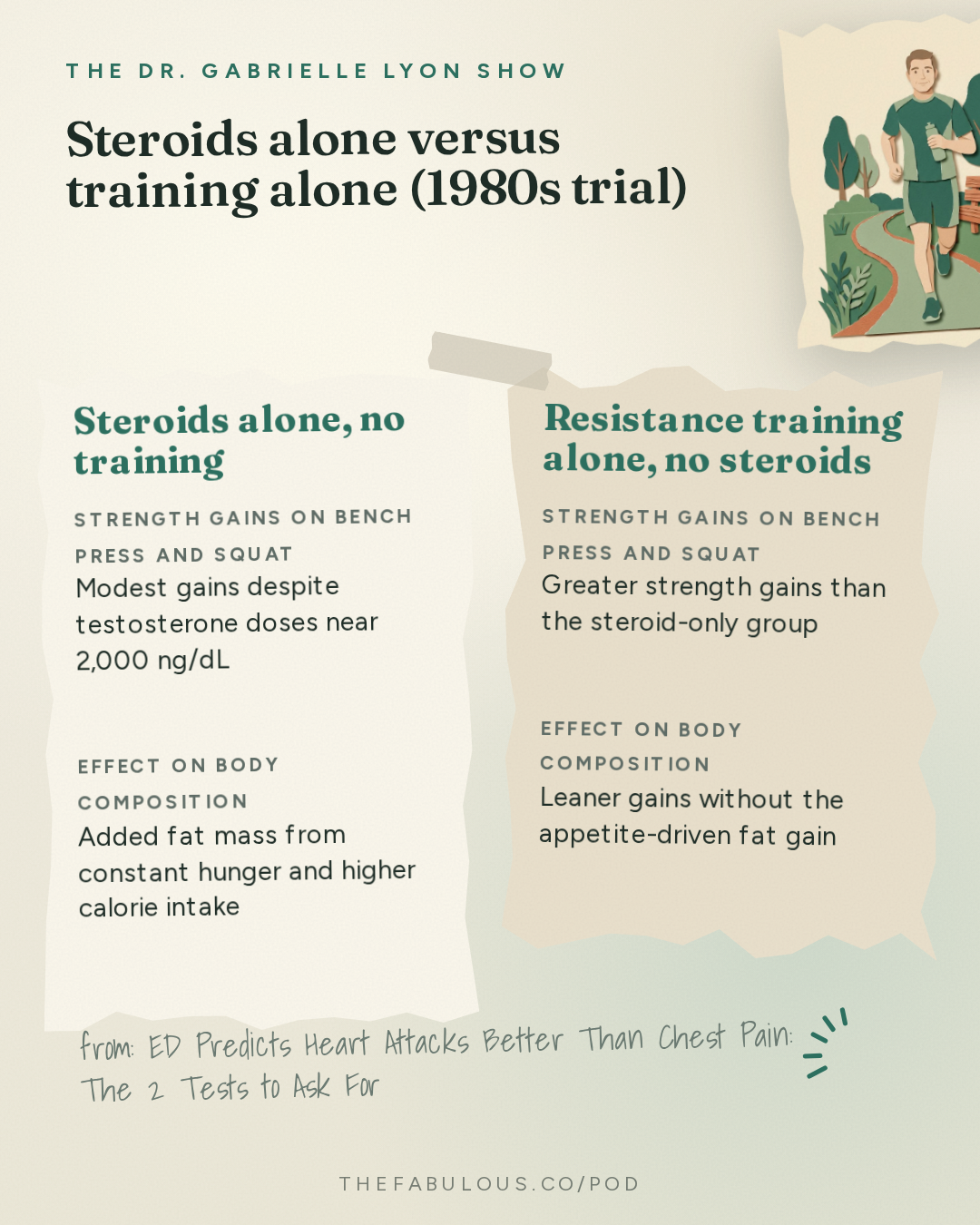
An old, almost forgotten trial from the 1980s complicates the shortcut logic. Researchers gave ordinary men 400-milligram testosterone injections, high enough to push levels near 2,000 ng/dL, and split them into groups: steroids with no training, training with no steroids, both, or neither. On bench press and squat scores, the men who trained without steroids beat the men who took steroids without training (39:25). The lesson Kohler draws is blunt: the exercise stimulus, not the drug, is doing most of the early work, and the real danger of chasing shortcuts is a body that eventually needs ever-higher doses just to feel normal, since men who run testosterone at 2,000 ng/dL for years can develop a new, higher set point and feel awful at what used to be a healthy level (37:08).
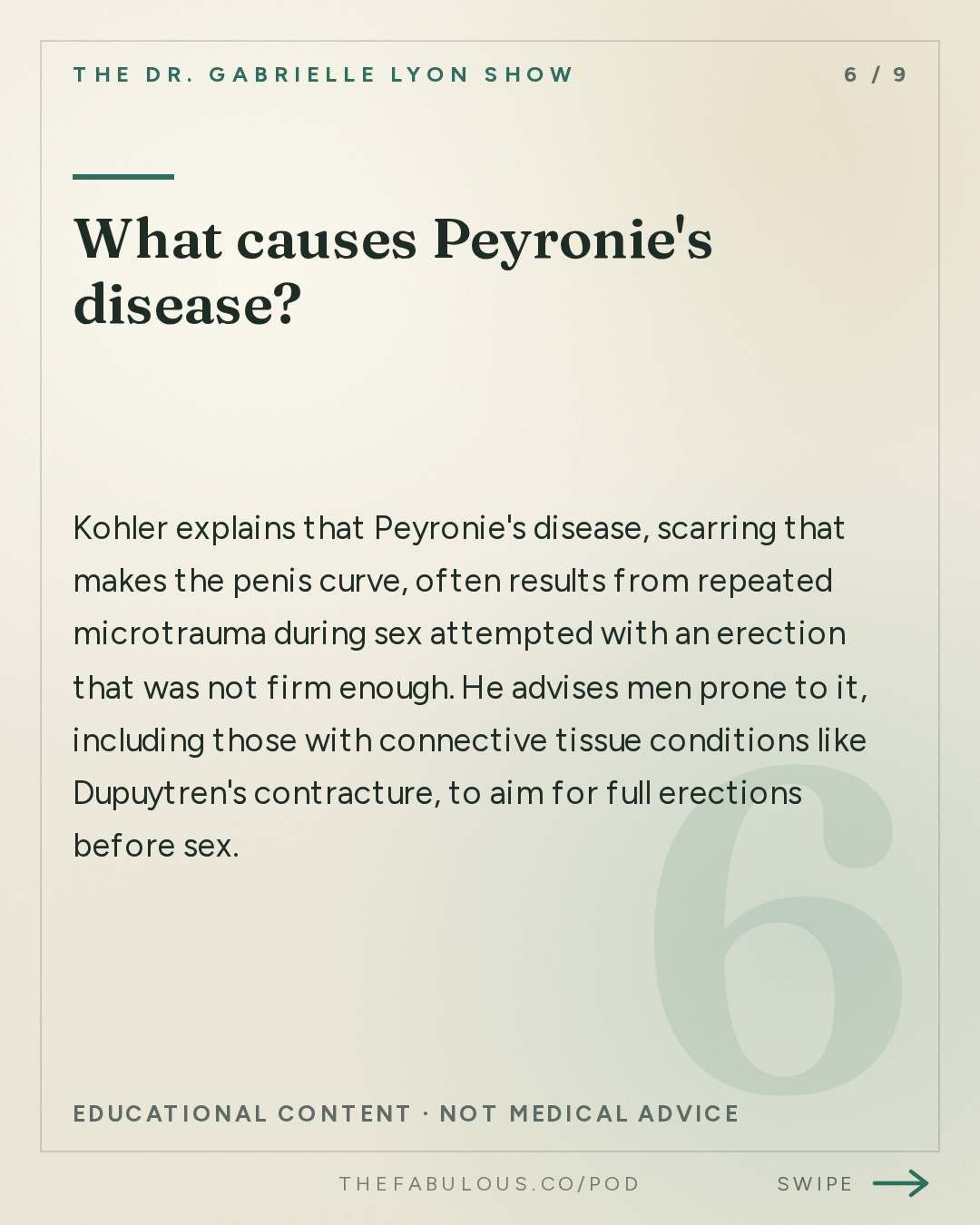
The same vascular story shows up lower down. Peyronie's disease, a condition where scar tissue makes the penis curve, often starts as a repeated microtrauma from attempting sex with an erection that was not quite firm enough to withstand the friction (54:10). Kohler's practical advice to men prone to it, including those with connective tissue conditions like Dupuytren's contracture, is straightforward: aim for full, reliable erections during sex rather than pushing through partial ones (55:38).
For men recovering from a radical prostatectomy, a surgery to remove the prostate for cancer, that same vascular fragility becomes the whole story. The nerves and blood vessels that serve the penis sit right next to the prostate, and removing the gland often damages one or both (63:10). Kohler lays out recovery as a ladder: pills first, then a vacuum device to stretch and preserve length, then injectable medication if pills fail, and only after a year, if nothing else works and the patient wants it, a penile implant (62:45). Roughly a quarter to half of men recover enough to manage with pills alone, better odds for younger men who had strong erections and less cardiovascular disease going in (66:00). Kohler's closing advice for anyone facing a major diagnosis is to lean on the people around them, because a patient absorbed in fear about cancer rarely remembers to ask about fertility preservation or sexual rehabilitation on their own (66:21).
The episode ends on an anecdote that undercuts the whole premise of chasing testosterone in the first place. A physical therapist at Mayo Clinic with advanced prostate cancer was terrified that hormone-deprivation therapy would strip his muscle. Kohler told him to keep lifting anyway. Two months later, with testosterone near zero, the man was hitting personal records he had never hit before, apparently because clearing his cancer's inflammatory burden freed up resources his body had been diverting elsewhere (69:24). It is a strange, hopeful footnote to an episode mostly about warning signs: sometimes the body's capacity is larger than the story a single hormone number seems to tell.
By the numbers
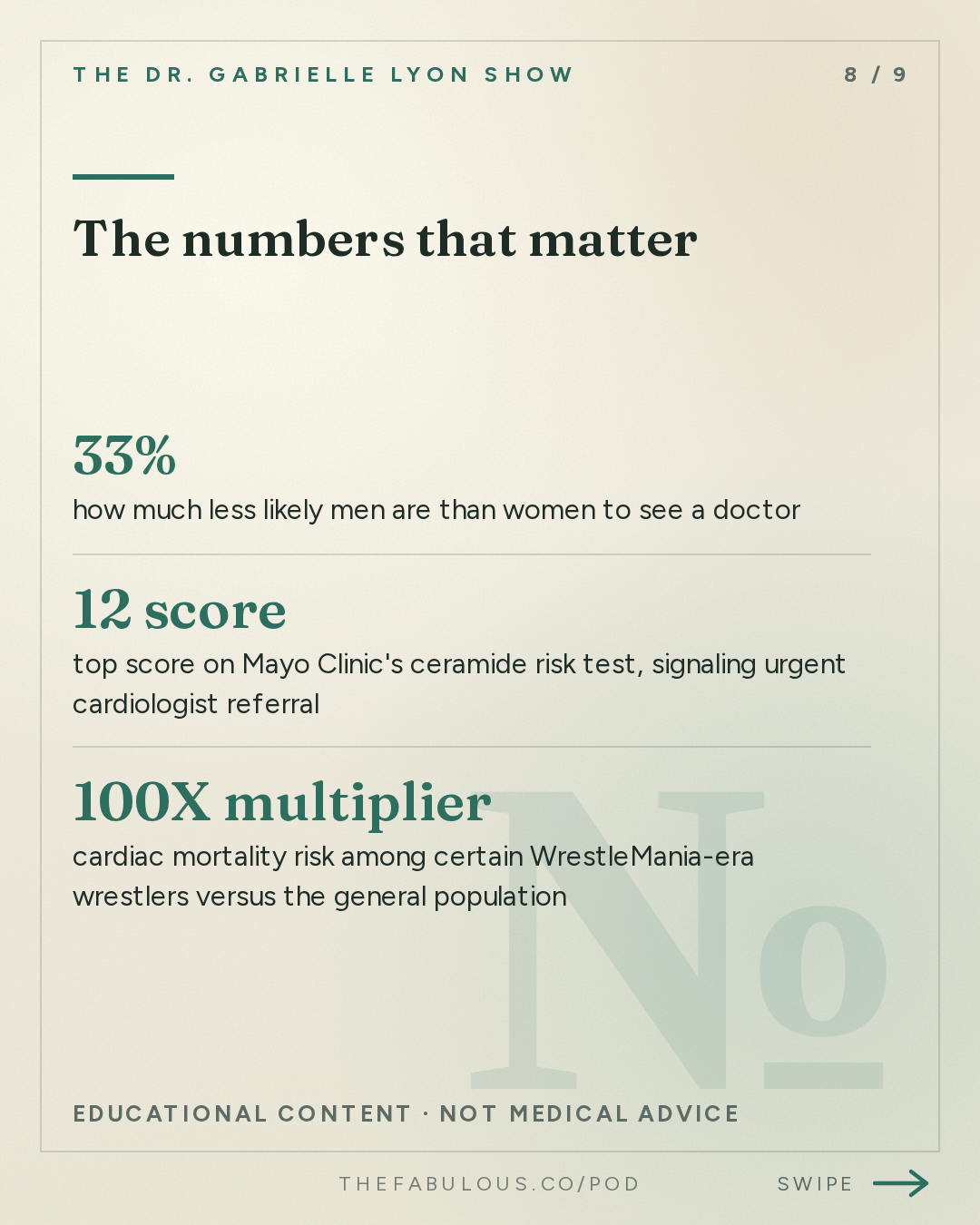
- 33% percent how much less likely men are than women to see a doctor
- 12 score top score on Mayo Clinic's ceramide risk test, signaling urgent cardiologist referral
- 100X multiplier cardiac mortality risk among certain WrestleMania-era wrestlers versus the general population
In their words
“The check engine light, the canary in the coal mine”
“The most effective predictor of having a heart attack that we have is erectile dysfunction, especially in younger men”
“You are your own CEO of your own body”
“There are plenty of people with normal cholesterol that still get heart attacks”
Protocols
-
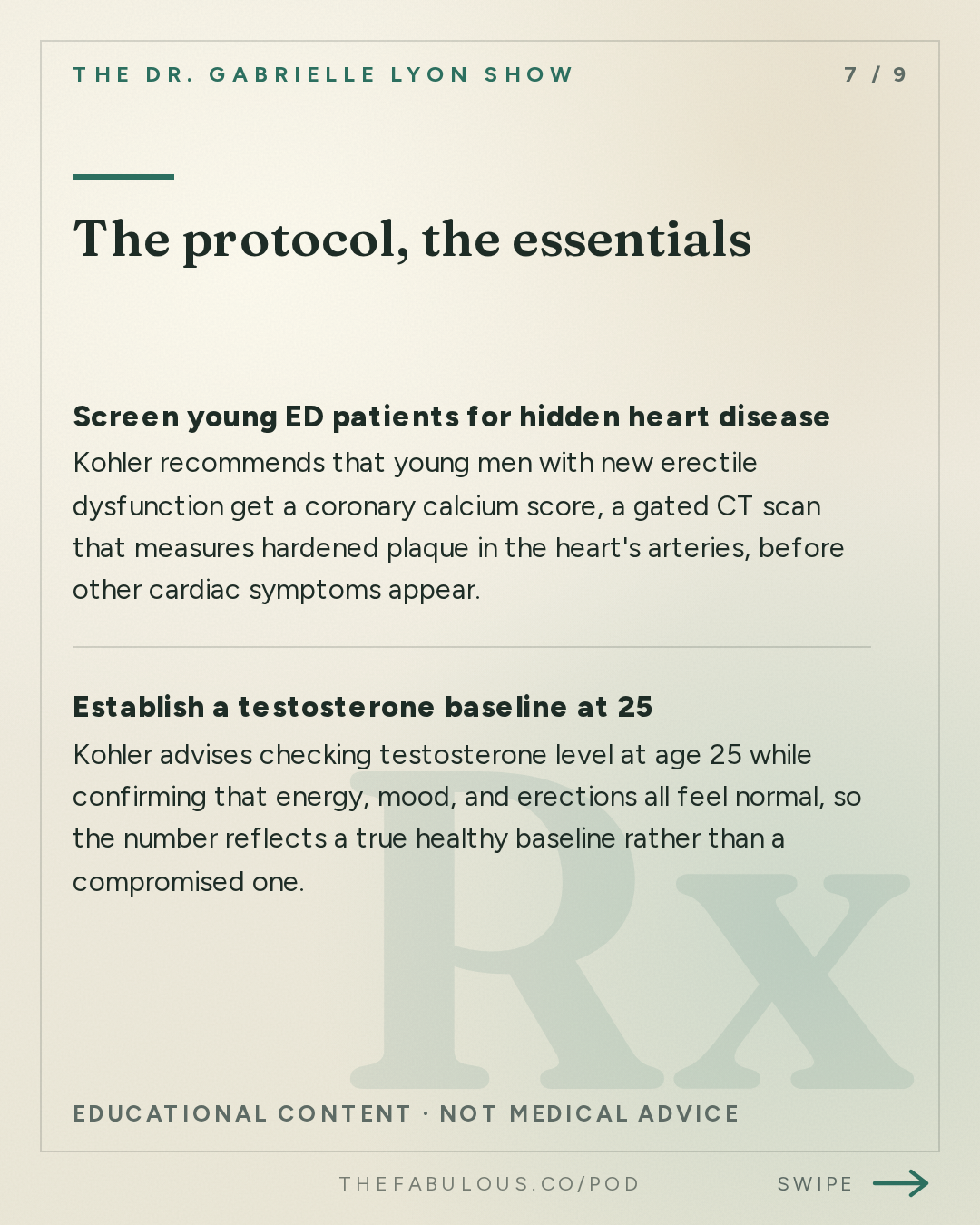
Screen young ED patients for hidden heart disease
Kohler recommends that young men with new erectile dysfunction get a coronary calcium score, a gated CT scan that measures hardened plaque in the heart's arteries, before other cardiac symptoms appear.
Once, as an early screening test
-
Establish a testosterone baseline at 25
Kohler advises checking testosterone level at age 25 while confirming that energy, mood, and erections all feel normal, so the number reflects a true healthy baseline rather than a compromised one.
Once, ideally before any symptoms of low testosterone
-
Target an LDL of 50 mg/dL after a cardiac event
Preventive cardiologist Dr. Kopetsky, as relayed by Kohler, sets an LDL goal of 50 mg/dL, the level present at birth, for anyone who has had a heart attack or shows plaque on a scan.
Ongoing, monitored through routine lipid panels
-
Retest ceramide score after lifestyle changes
Kohler tests ceramide levels, a Mayo Clinic blood marker of blood vessel inflammation, at baseline and again a few weeks after a patient improves diet and exercise, because the score can drop quickly with healthier behavior.
Baseline, then recheck after several weeks of change
Questions this episode answers
Is erectile dysfunction a warning sign of heart disease?
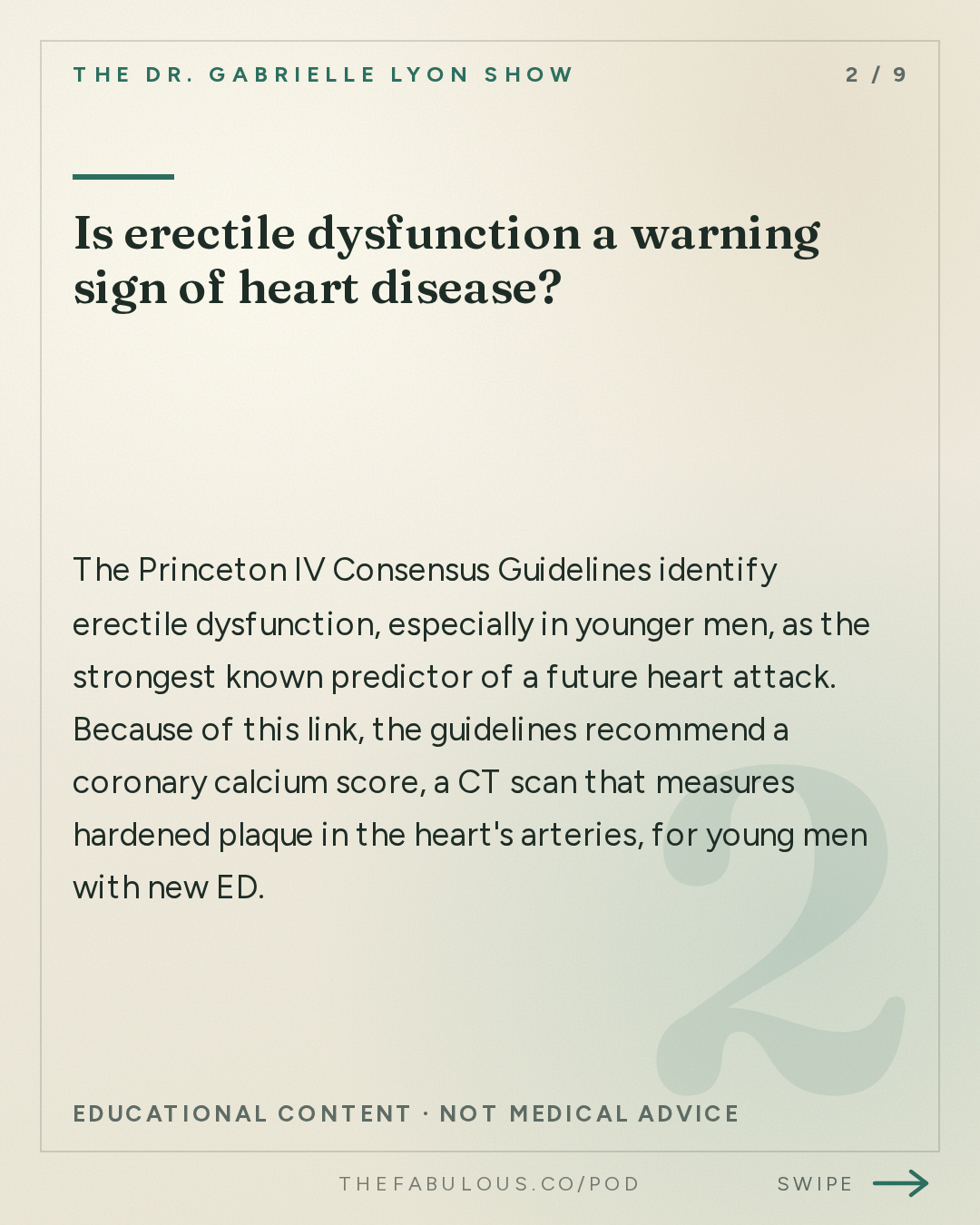
The Princeton IV Consensus Guidelines identify erectile dysfunction, especially in younger men, as the strongest known predictor of a future heart attack (11:11). Because of this link, the guidelines recommend a coronary calcium score, a CT scan that measures hardened plaque in the heart's arteries, for young men with new ED (11:59).
What is a ceramide blood test and how does it predict heart attacks?
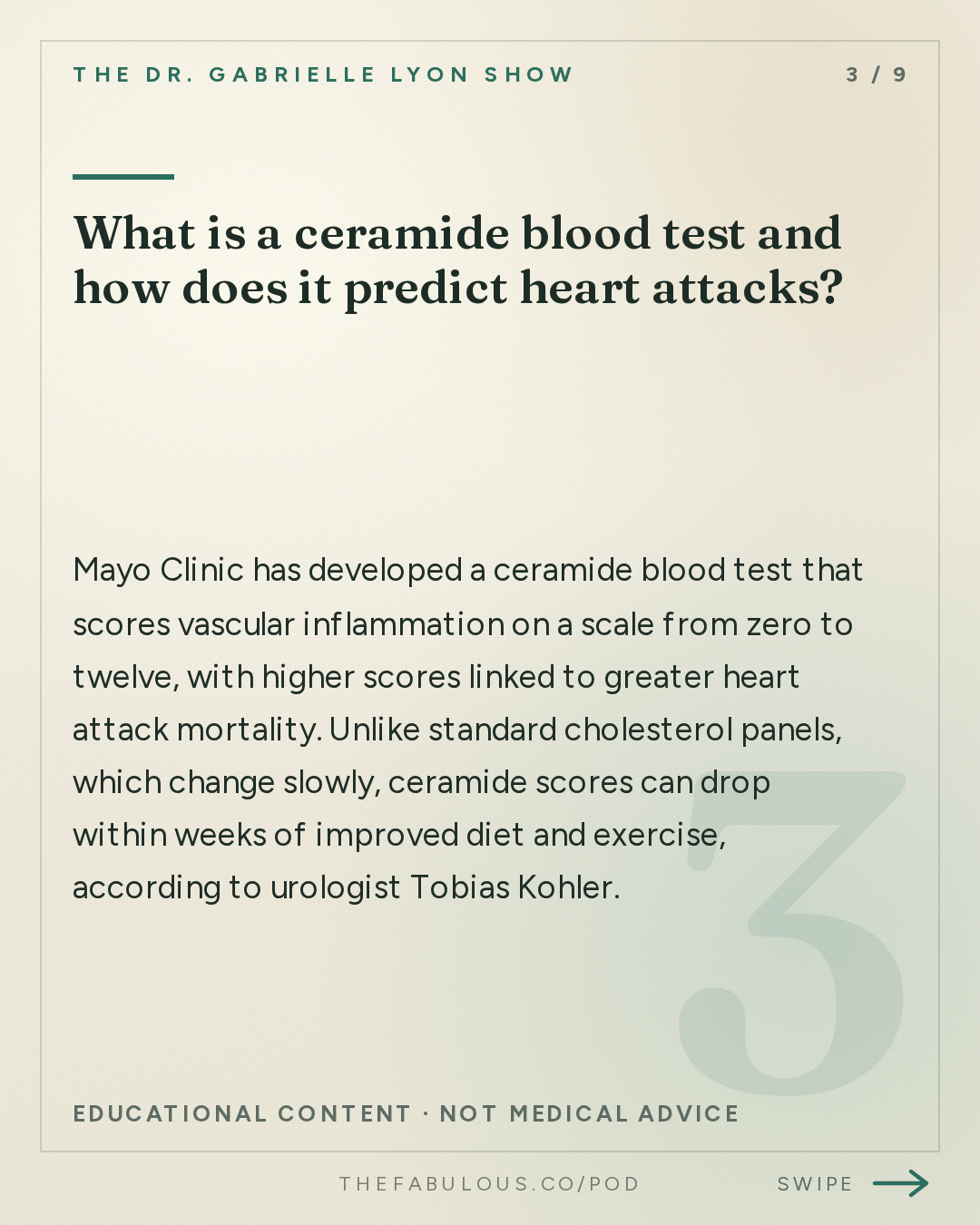
Mayo Clinic has developed a ceramide blood test that scores vascular inflammation on a scale from zero to twelve, with higher scores linked to greater heart attack mortality (13:06, 14:14). Unlike standard cholesterol panels, which change slowly, ceramide scores can drop within weeks of improved diet and exercise, according to urologist Tobias Kohler (15:12).
Does high-dose testosterone damage the heart?
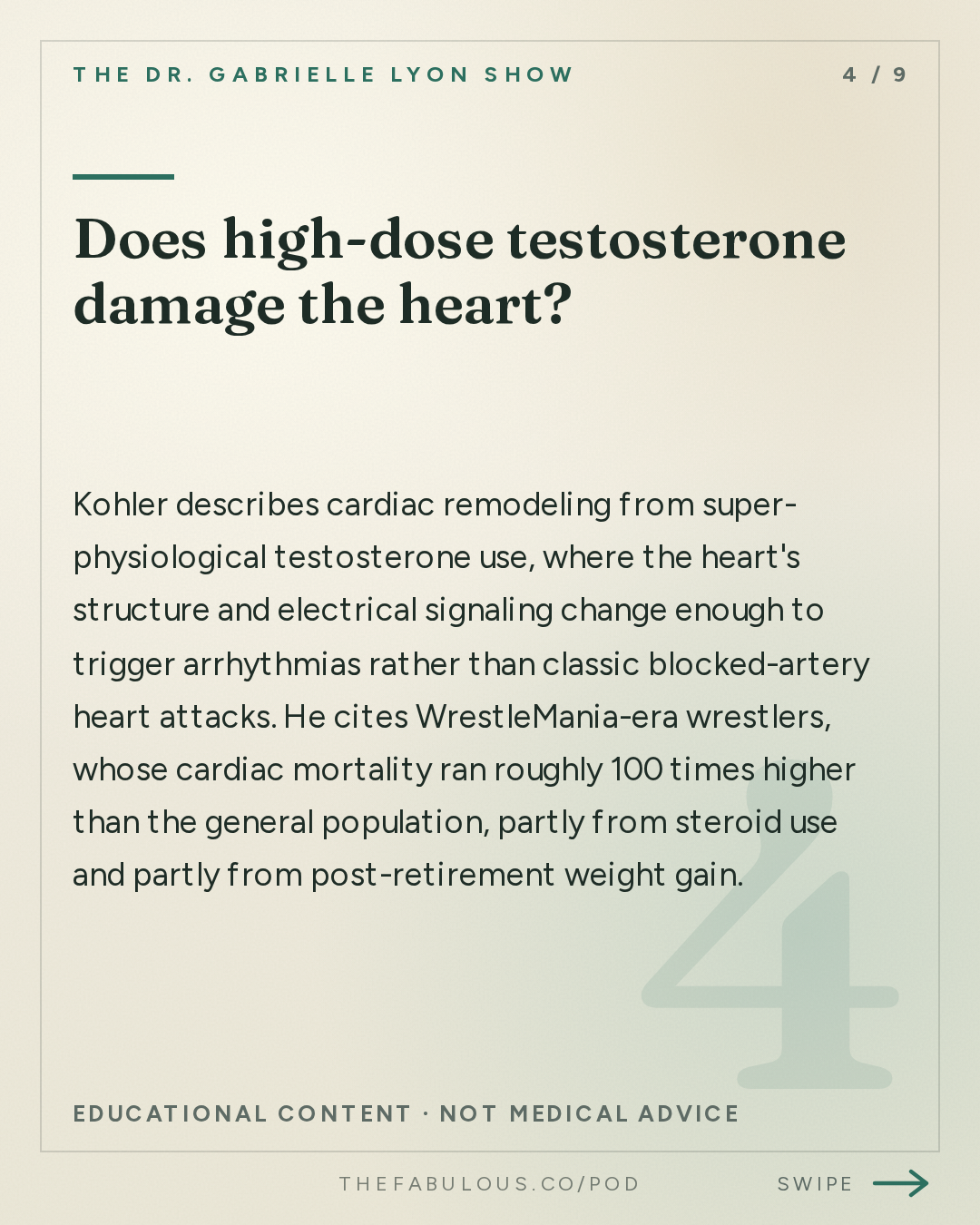
Kohler describes cardiac remodeling from super-physiological testosterone use, where the heart's structure and electrical signaling change enough to trigger arrhythmias rather than classic blocked-artery heart attacks (44:55). He cites WrestleMania-era wrestlers, whose cardiac mortality ran roughly 100 times higher than the general population, partly from steroid use and partly from post-retirement weight gain (43:46).
Do statins lower testosterone or cause dementia?
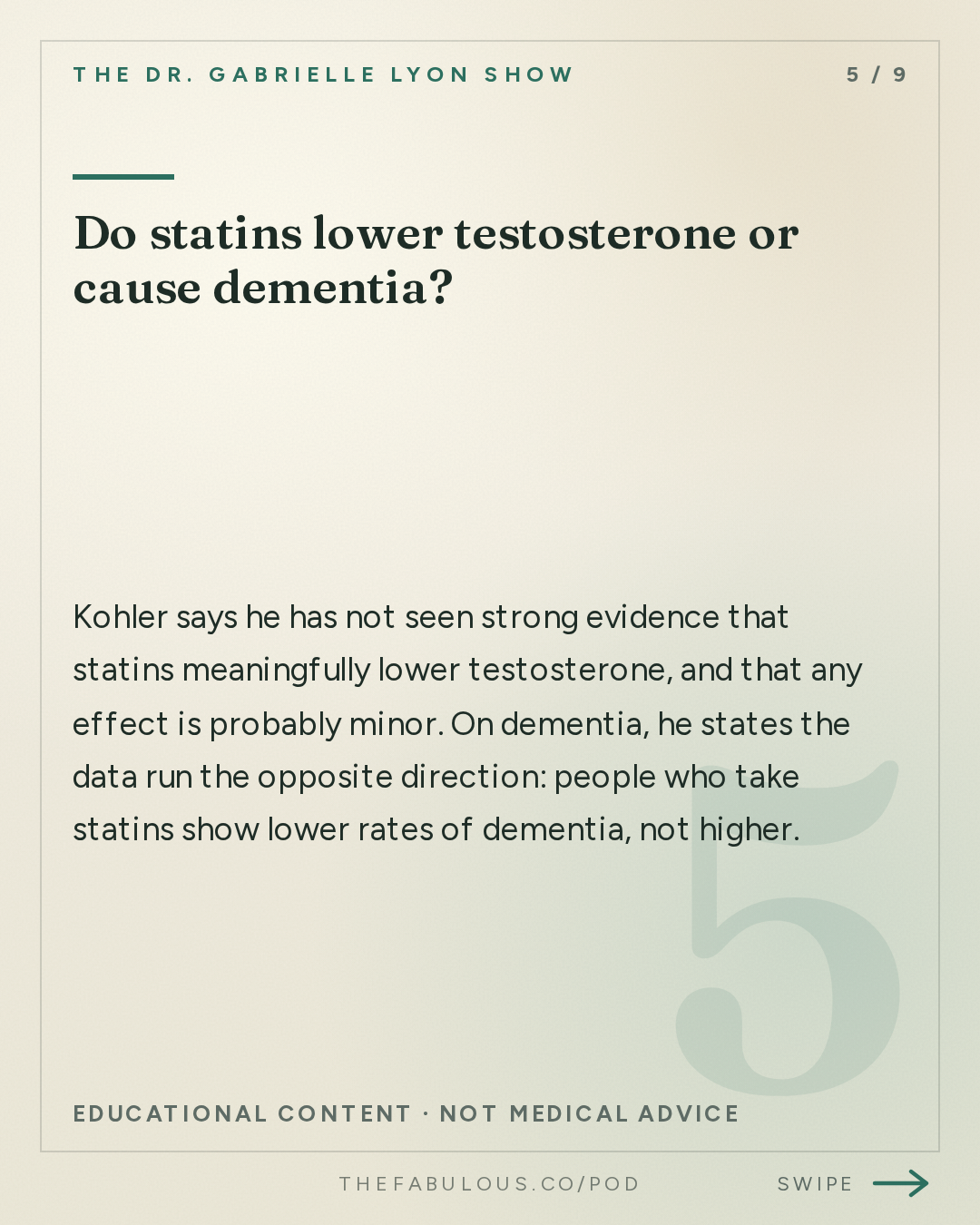
Kohler says he has not seen strong evidence that statins meaningfully lower testosterone, and that any effect is probably minor (22:54). On dementia, he states the data run the opposite direction: people who take statins show lower rates of dementia, not higher (22:54).
What causes Peyronie's disease?
Kohler explains that Peyronie's disease, scarring that makes the penis curve, often results from repeated microtrauma during sex attempted with an erection that was not firm enough (54:10). He advises men prone to it, including those with connective tissue conditions like Dupuytren's contracture, to aim for full erections before sex (55:38).
What are the treatment options for ED after prostate removal surgery?
Kohler describes a stepwise recovery path: ED pills first, then a vacuum device to preserve penile length, then injectable medication if pills fail, and a penile implant about a year later if injections fail and the patient wants surgery (62:45). Roughly a quarter to half of men recover enough to manage with pills alone, with better odds for younger men who had strong erections before surgery (66:00).
The full read, in cards
Go deeper
- Princeton IV Consensus Guidelines on Erectile Dysfunction and Cardiovascular Disease — Panel guidance naming ED as a strong predictor of future heart attack and recommending coronary calcium scoring
- Mayo Clinic ceramide blood test — A blood marker of vascular inflammation scored zero to twelve that predicts heart attack mortality and shifts with lifestyle change
- 1980s testosterone and exercise trial — Randomized trial showing training alone beat high-dose testosterone alone on bench press and squat strength
- Forever Strong — Gabrielle Lyon's book referenced as an example lifestyle plan tied to improving a ceramide score
Mentioned
Dr. Tobias Kohler · Dr. Gabrielle Lyon · Mayo Clinic · Princeton IV Consensus Guidelines · Dr. Brian Christine · Forever Strong · Dr. Kopetsky · Michael Easter
More from this show and category

Menopause, Muscle Loss, and Insulin Resistance
Menopause changes the body mainly by shrinking muscle, not just by crashing hormones. Dr. Gabrielle Lyon argues that muscle loss, which starts speeding up about two years before a woman's final period, drives the insulin resistance, bone loss, and fat gain often blamed on menopause alone, and that resistance training and higher protein intake are the direct countermeasures.

Vaginal Estrogen for UTI Prevention
Urologist Dr. Kelly Casperson explains that genitourinary syndrome of menopause (GSM) affects 50% to 90% of postmenopausal women. Vaginal estrogen cuts recurrent urinary tract infections by half, lowers hospitalization and death risk, and is safe for most breast cancer survivors, yet only 9% of women diagnosed with GSM get a prescription.

Physiology of Grief and Heart Attack Risk
Grief is not just an emotion, it is a measurable physiological event: a 21-times spike in heart attack risk in the first 24 hours after a loss, elevated cortisol for months, and a brain that keeps treating the dead as still out there somewhere.

Gabrielle Lyon: Muscle Is the Longevity Organ
Dr. Gabrielle Lyon argues that skeletal muscle, not body fat, is the organ that determines how well women age. She explains that muscle drives glucose disposal, releases hormone-like myokines, and needs at least 100 grams of daily protein plus resistance training to stay healthy after midlife.
