
The Overwhelm Recovery ProtocolWellness & Routines · ~5 min
About this template · Updated November 2026
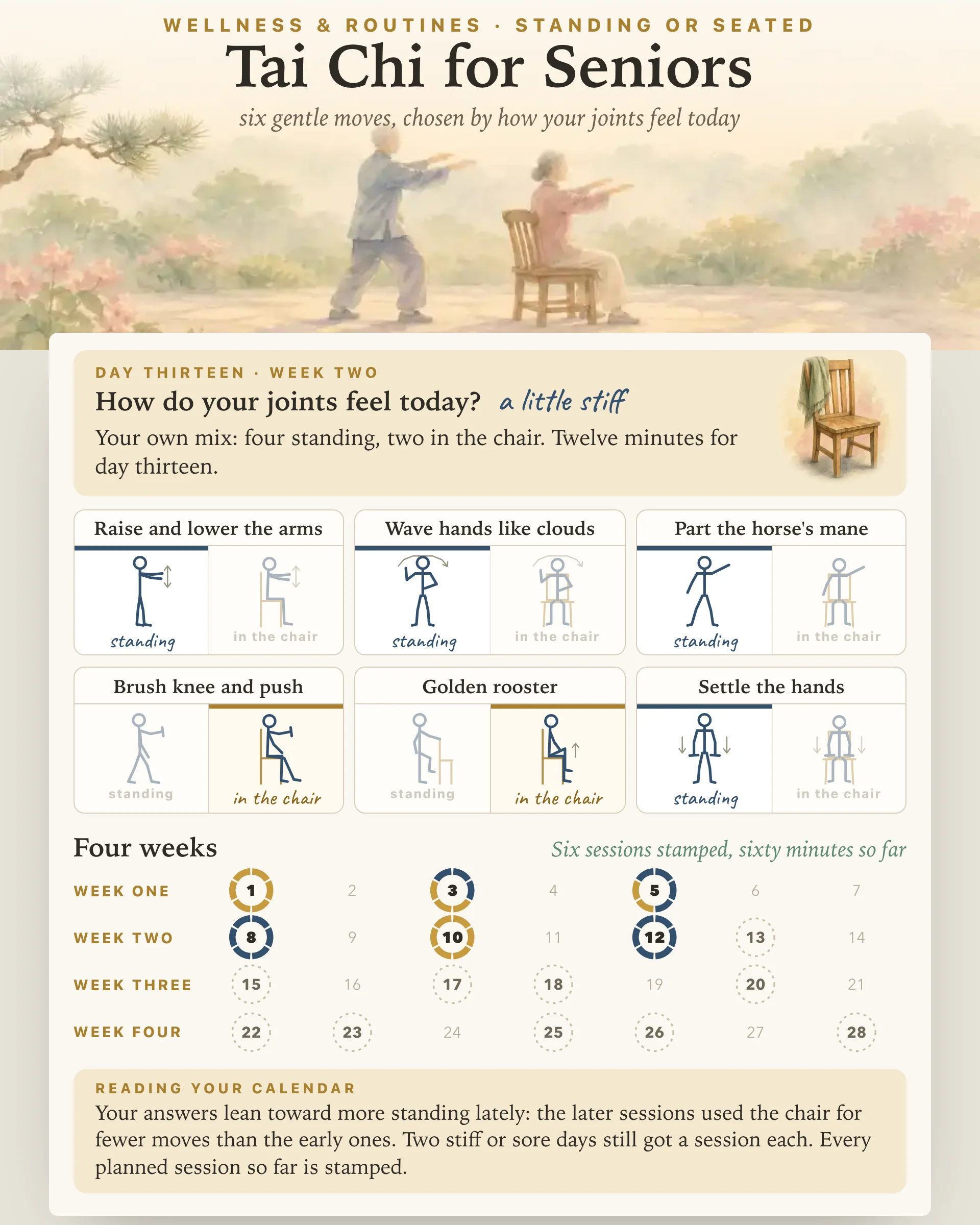
Some mornings your knees feel ten years younger than the calendar says. Other mornings the stairs need planning. A practice that only works on the good days will not last, so this one is built in two versions: each of its six moves can be done on your feet with a sturdy chair beside you, or sitting in that same chair, and your joints get the first say.
Tai chi began as a Chinese martial art and is now practiced mostly as slow exercise. Knees stay soft, weight drifts from one foot to the other, the arms follow, and the breath sets the pace. You do not need special clothes or a large room. You need flat shoes with some grip, a chair without wheels, and about ten minutes.
Start with the question at the top: how do your joints feel today? Four answers are on offer, and each one sets the cards. Loose puts all six on your feet. A little stiff keeps the arm moves standing and sends the three leg moves to the chair. Stiff seats everything. Sore or unsteady seats everything and cuts the minutes in half, and the page will not let you swap back to standing that day.
On any other day you can overrule it by tapping the other side of a card.
When you finish, stamp the day. The calendar draws a ring with six parts, one per move, blue for standing and gold for the chair, so four weeks of rings show how you actually practiced. After three sessions, a short reading compares your early sessions with your recent ones.
Week one has three sessions of ten minutes, four slow rounds of each move. Week two has four sessions of twelve minutes, with one full breath to every round. Week three stays at four sessions, now fourteen minutes and eight rounds of each. Week four has five sessions of fifteen minutes, and the six moves start to join into one flow. Miss a day and you simply pick up at the next one.
A Cochrane review of exercise for older people living in the community covered more than a hundred trials. It found that programs built on balance and functional exercises reduce the rate of falls, and that tai chi may also lower that rate, a result the authors rated as low certainty, though they were more confident that fewer people in tai chi groups fell at all. For sore knees, a trial comparing tai chi with physical therapy for knee osteoarthritis found similar benefits from the two at twelve weeks, in a group whose average age was sixty. The National Center for Complementary and Integrative Health says tai chi appears to be safe, with mostly minor problems such as muscle aches, and warns against using it to put off seeing a provider about a medical problem.
Now the limits. Those results come from groups in organized programs, often with an instructor and usually for longer than four weeks. No study has tested this page. It will not tell you your fall risk, and it cannot promise fewer falls or less pain. Seated tai chi has been studied far less than standing practice, so think of the chair as a way to keep moving on hard days rather than as a proven balance program. If a senior center or hospital near you runs a class, go: a teacher can see things a page cannot.
Check with your doctor or a physical therapist before your first session if you have had a fall, dizziness, a joint replacement, a heart or blood pressure condition, or ongoing pain. Stop if anything hurts. Any time you stand to practice, keep a sturdy chair or counter close enough to touch.
Open the page when you are about to practice, because the answer depends on how today feels. On rest days, The Daily Stretch Mat offers something light, and a few minutes of Belly Breathing is a quiet way to rehearse the long out-breath the closing move asks for. If you would like to bring the same slow attention to your steps once the four weeks are done, the Tai Chi Walking Plan is the next page to try.
To stay seated for all of it, Chair Tai Chi never leaves the chair, and if walking is what you miss most, The Counter Walk takes the same slow attention into your steps.
On some days the chair will do most of the work. That still counts as a day of tai chi.
Slow moves that keep the knees soft and let the arms follow the breath are a sensible place to begin. This page uses six: raise and lower the arms, wave hands like clouds, part the horse's mane, brush knee and push, golden rooster, and settle the hands. Each one comes in a standing and a seated version.
The National Center for Complementary and Integrative Health says it appears to be safe, and the problems it reports are mostly minor, such as muscle aches. Even so, talk to your doctor or a physical therapist first if you have had a fall, dizziness, a joint replacement, a heart or blood pressure condition, or pain, and stop if anything hurts.
Many can. People in the trials of a large Cochrane review on exercise and falls averaged seventy-six years old, although those trials tested many kinds of exercise, not only tai chi. Begin on the seated side if standing feels uncertain, and ask your doctor if you are unsure which side suits you.
Yes. Every move on this page has a seated version, done on a sturdy chair without wheels with your feet flat and your back tall. Seated tai chi has been studied far less than standing practice, so treat it as a gentle way to keep moving on stiff days, not as a proven balance program.
It may, for people in organized programs. A Cochrane review rated its estimate for the rate of falls as low certainty, was more confident that fewer people fell at least once, and found its strongest evidence for balance and functional exercises. This short home plan has not been tested, cannot promise fewer falls, and does not score your risk.
By the team behind Fabulous, the science-based self-care app used by over 30 million people.


