
The Overwhelm Recovery ProtocolWellness & Routines · ~5 min
About this template · Updated November 2026
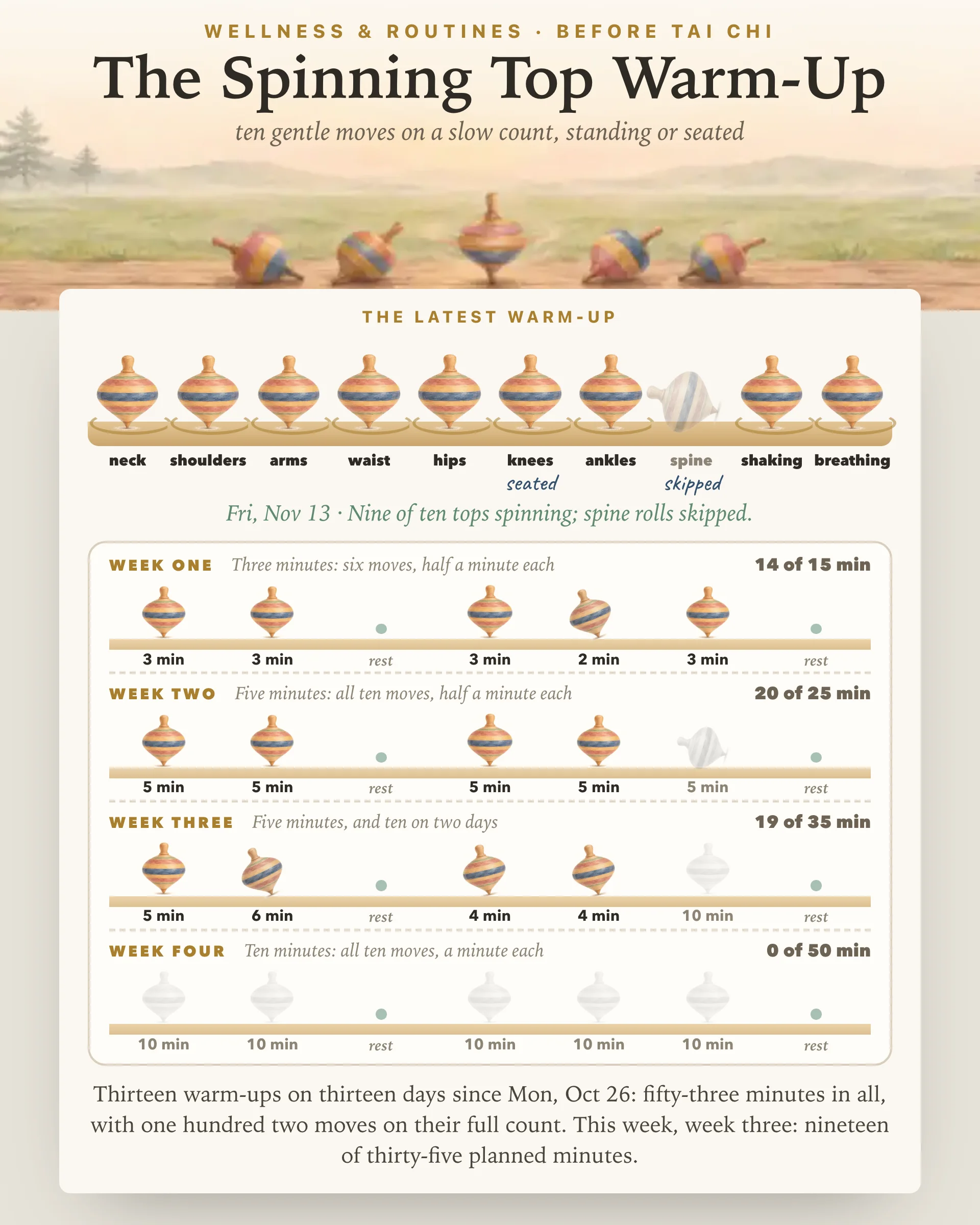
Tai chi warm up exercises are the quiet few minutes before the form itself, so the first slow move of practice never lands on a stiff joint. This page is only that part. It teaches none of the form itself; it gets you ready for it, standing or seated, in three, five or ten minutes.
Top to bottom, so no joint gets missed:
Every move has a seated version on the sheet: hip circles become a slow rock over your sit bones, knee circles straighten one knee at a time, and spine rolls round and lengthen your back with the breath. Seat any of them before you begin, or all ten.
Three minutes runs six moves for half a minute each: neck, shoulders, waist, hips, ankles and breathing. Five runs all ten for half a minute, and ten gives each of them a full minute.
The four-week plan starts at three minutes on five days a week, moves to five in week two, adds two ten-minute days in week three and settles at ten in week four. Choose another length on any day; the log keeps whatever you actually did.
Each move runs in rounds of eight slow counts, about a second and a quarter apiece: four counts one way, four counts back. The large word on the sheet is the count. The clock reads real time, so a phone that locks mid-move still shows the right count when you look back.
A move that runs its whole count sets its painted top spinning. Skip one that pinches or doesn't suit you today and its top stays lying on the deck, and the skipped seconds come off your minutes. Ending early takes two taps, and only whole minutes go in the log: stop at a minute and a half and one minute counts; under a minute logs nothing.
Four weeks below show a top a day: upright when that day's minutes reach the plan, leaning after a shorter warm-up, lying down on a planned day you missed. Skip the same move twice in a row and the sheet suggests its seated version.
A review of randomized trials on warming up and sports injuries found five usable trials, all with sports participants: three saw fewer injuries after a warm-up, two saw no difference, and the authors judged the evidence too thin to endorse or drop the habit. It was about sport, not about older adults or tai chi.
A review of stretching studies in healthy, active people found range of motion improved after every kind of stretching it looked at, but the gain usually faded within half an hour, and long static holds slightly reduced performance right afterward. That is why this warm-up keeps moving instead of holding, right before practice. Its participants were healthy and active, so it cannot tell you how stiff shoulders at seventy respond.
For tai chi itself, a review of 153 randomized trials, most of them with older adults, found no serious side effects linked to tai chi, and the ones reported were mostly minor aches such as knee and back pain. Only a third of those trials reported side effects at all, so the true rate is unclear, and the review did not look at whether warming up first spares you those aches. Treat these minutes as a gentle way to arrive at practice, not as protection.
Ask a doctor or physical therapist before your first warm-up if you have had a fall, dizziness, a joint replacement, a heart or blood pressure condition, or a joint that aches when you move it. Stay inside easy range, and stop or skip anything that hurts. Keep a counter or a sturdy chair within reach while you stand, and go seated on any day your balance feels unsure. Leave spine rolls out if you have been told to avoid bending forward, as with osteoporosis.
This sheet only warms you up; the moves are taught elsewhere. The Tai Chi Starter Scroll adds one move a week, Tai Chi Move Cards builds a routine from eight foundational moves, and Tai Chi for Seniors sets each move standing and seated side by side. The 7-Minute Tai Chi Kite opens with its own minute of loosening, so on a stiff morning, run three minutes here first and then fly the kite. If your practice happens in a chair, The Eight Koi Chair Routine follows these warm-ups with eight seated moves.
Slow, small moves that take each joint through an easy range, top to bottom: neck turns, shoulder rolls, arm swings, waist turns, hip circles, knee circles while holding a counter, ankle circles and a small spine roll. This page ends with gentle shaking and a spell of standing still while your breathing slows. None of them should hurt.
There is no fixed rule. Three minutes is enough to loosen your neck, shoulders, waist, hips and ankles before a short practice, and ten gives every joint a full minute on a morning when you feel stiff.
Short, moving stretches fit the start of a practice better than long holds. A review of stretching studies in healthy, active adults found that range of motion improved for less than half an hour afterward, so a short, moving warm-up right before you practice makes more sense than a long stretch earlier in the day.
Yes. Every move here has a seated version: the neck, shoulder and arm moves are the same in a chair, the waist turns from the chest, and the hips, knees and ankles get a seated way of their own. Sit near the front of a sturdy chair with both feet on the floor.
In a review of 153 tai chi trials, most of them with older adults, only a third reported side effects at all, and those were mostly minor aches such as sore knees or backs. Keep every move small, never push into pain, and ask a doctor or physical therapist first if you have had a fall, a joint replacement, dizziness, or a heart or blood pressure condition.
By the team behind Fabulous, the science-based self-care app used by over 30 million people.


