
The Overwhelm Recovery ProtocolWellness & Routines · ~5 min
About this template · Updated November 2026
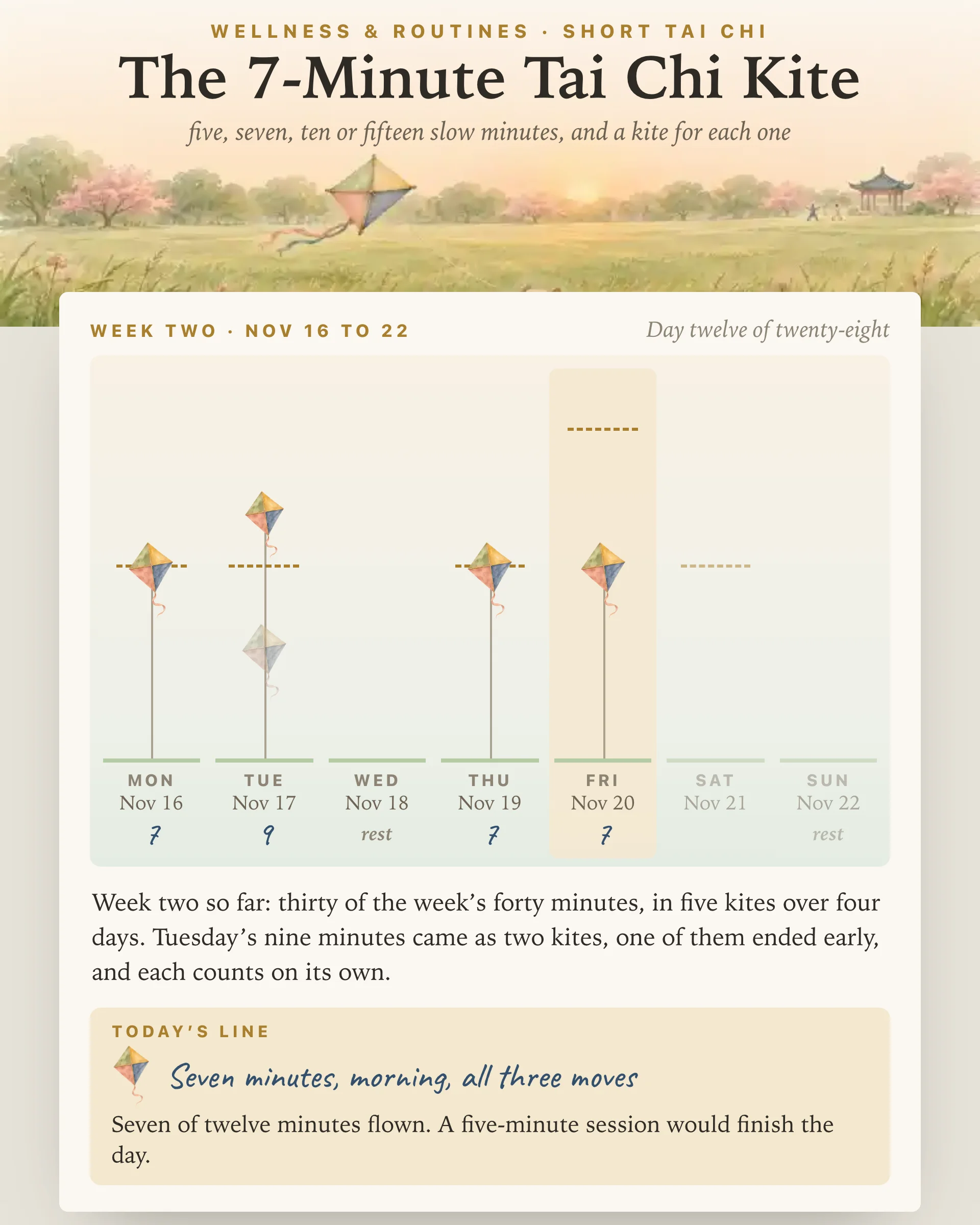
A 7 minute tai chi workout is a whole practice in miniature: loosen up, move slowly through a few classic shapes on both sides, then finish still, your breathing settled. This page builds that session for the time you have, five, seven, ten or fifteen minutes, talks you through it on a slow count, and flies a small paper kite for every session you finish. A short session before breakfast and another after dinner show up as two kites on the same day, both counted.
Seven minutes opens with a minute of loosening: shoulder rolls, wrist circles, then the arms floating up on an in-breath and sinking on the out-breath. Three moves follow, ninety seconds each, half on each side. A minute and a half of closing ends it: the wrists cross, the hands drift down, and you stay still for a few breaths.
Five minutes carries two moves. Ten gives three moves two minutes apiece, with a longer warm-up and closing. Fifteen adds a fourth move and stretches every part to two and a half minutes.
The names come from the short classical forms.
Week one uses only the first four, where your feet stay put. Small steps join in week two, and the last two arrive in week three. Every standing move has a steadier version, such as leaving out the step or keeping a hand on the counter, and a chair version you can switch to mid-session.
Pick your minutes and whether you are standing or seated, then press fly. The clock reads the real time, so a phone that locks mid-session still lands on the right part. Pause stops the clock outright, next part skips ahead, and ending early takes two taps.
Only practice counts. A session run to its end puts a full kite on today’s line; one you end early keeps its whole minutes and flies smaller and paler. A move stopped partway is not marked done, and under a minute adds nothing. Sessions done elsewhere can be added by hand, up to six kites a day.
The plan runs twenty-eight days with two rest days a week. Week one asks for a seven or a five on five days. Week two settles into sevens, with one day of a seven plus a five. Week three brings two short sessions on some days and the first tens. Week four builds to fourteen or fifteen minutes on most days, whole or in pieces. In the kite field each day is a string, each session a kite tied higher up it, and a gold dash marks the plan.
The case for short sessions comes from studies of everyday activity, not tai chi. A systematic review prepared for the 2018 US physical activity guidelines found activity in bouts of any length linked with better health, lower all-cause mortality included. That evidence was observational and about moderate to vigorous activity; the randomized trials it found only tested bouts of ten minutes or more. A meta-analysis of nineteen studies with 1,080 adults compared the same total exercise done in one bout or spread across the day and found no difference in fitness or blood pressure.
For tai chi itself, an evidence map of 107 systematic reviews found promising results for balance confidence, fall prevention for people living at home, blood pressure and muscle strength, while warning that weak or too few trials kept conclusions tentative. None of this tested seven-minute sessions, so treat the short version as a way to practice often, not as a treatment.
If you have had a fall, dizziness, a joint replacement, a heart or blood pressure condition, or ongoing pain, ask a doctor or physical therapist before you begin. Stop any move that hurts, and keep a counter or chair back within reach when standing.
Use it on days when a longer practice will not happen: before breakfast, between calls, after a long sit. For a brisk bodyweight circuit of the same length, try the seven-minute circuit of painted cards. To choose your own moves and order, use the move cards. If standing is off the table, a four-week seated plan keeps every move in the chair.
Seven minutes is enough to loosen the joints, practice three moves slowly on both sides and settle your breathing. Reviews of exercise done in shorter bouts suggest the minutes still count toward your weekly total, though none of them tested tai chi in seven-minute pieces. Two or three short sessions in a day give you more practice without needing a free half hour.
Here it is one minute of loosening up, two moves for ninety seconds each, and a one-minute closing with still breaths. It fits before breakfast or between two tasks, and it counts as its own kite.
The longer versions give each move more time rather than cramming in extra ones. Ten minutes holds three moves of two minutes each between a two-minute warm-up and closing. Fifteen adds a fourth move and gives every part two and a half minutes, so each side gets more slow repetitions.
Yes. Every move has a version done near the front of a sturdy chair with both feet on the floor, and you can switch to it at any point in a session. The standing versions each come with a steadier option too, such as leaving out a step or keeping one hand on the counter.
They stay separate: a seven in the morning and a five at night are two kites on that day’s line, adding up to twelve minutes. A session you stop early keeps only its whole minutes, and a move cut off partway is not counted as done.
By the team behind Fabulous, the science-based self-care app used by over 30 million people.


