
The Overwhelm Recovery ProtocolWellness & Routines · ~5 min
About this template · Updated November 2026
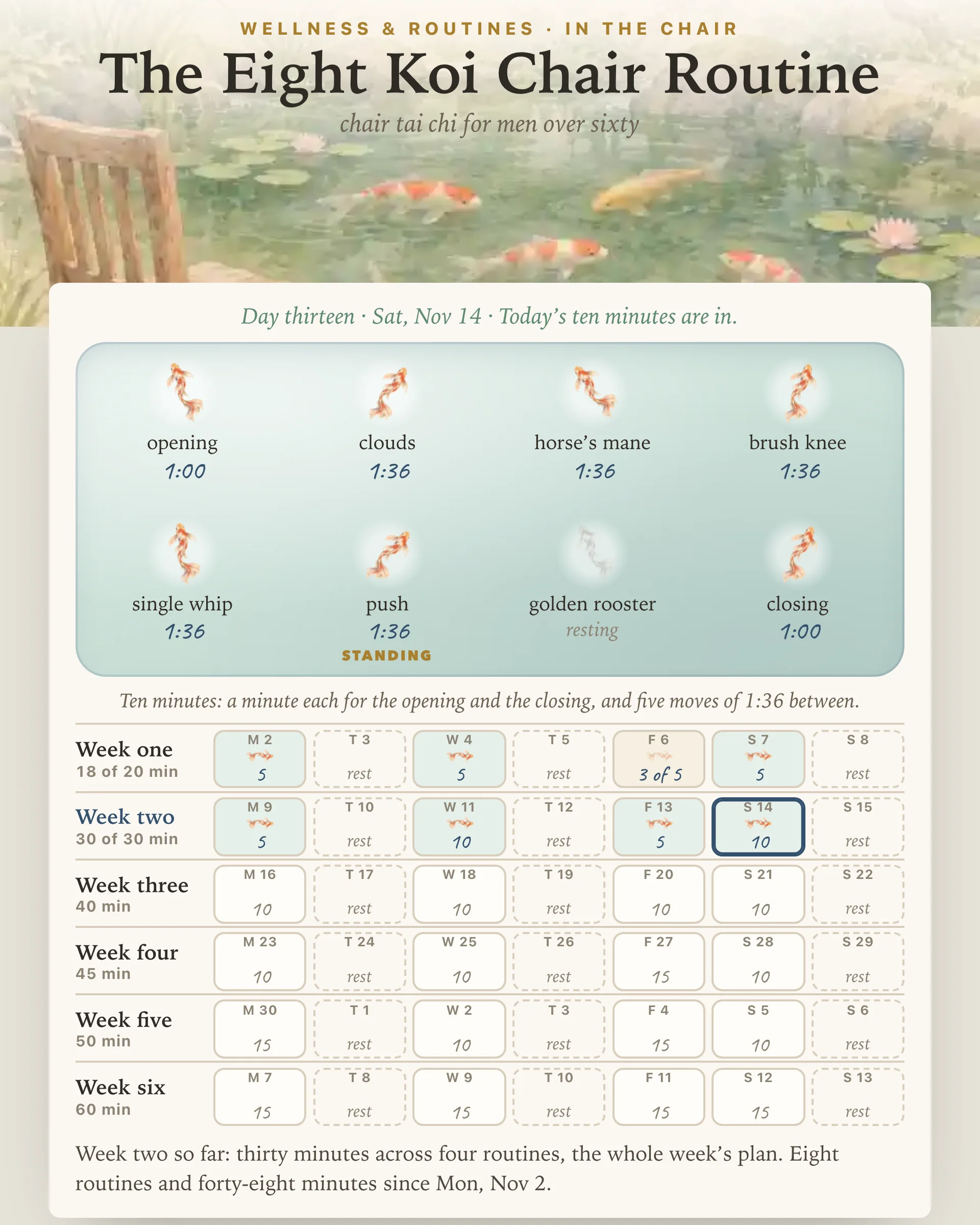
This page is chair tai chi for men over 60 who want the slow movement of tai chi without worrying about their footing. Every move is done sitting down, and each has a standing option, hands on the chair back, for days you want it. The sheet is drawn as a small pond with eight koi, one for each move: you choose five, ten or fifteen minutes, the koi that fit swim into the routine, and a slow count walks you through it on a real clock.
Talk to your doctor or a physical therapist first if you have had a fall, dizziness, a joint replacement, a heart or blood pressure condition, or pain when you move. Stop any move that hurts, and never hold your breath. Use a sturdy chair without wheels on a floor that does not slide, sit toward the front of the seat with both feet on the floor, and keep your hands on the chair back for any standing option.
Every routine opens with commencement and ends with the closing, a minute each, and the koi you bring in share the minutes between. Five minutes holds three moves of a minute apiece and turns down a fourth until one rests. Ten and fifteen minutes hold all six, at 1:20 or 2:10 each, and every routine keeps at least two. Tap a koi to read its move, pick the chair or the standing option, and bring it in or let it rest.
The count runs four slow beats one way and four back, about ten seconds a round, and names the side on one-sided moves. The clock reads real time, so a locked phone keeps your place, and a pause stops it outright. Skipped seconds never count, an early stop logs only whole minutes, and a move is finished only once its full time has run.
Week one is four five-minute routines. Week two turns two of them into ten minutes, weeks three and four settle at ten with a first fifteen, and by week six all four days run fifteen. Each day you practice, a small koi lands on that day's square.
The best-known evidence comes mostly from women. A 2019 Cochrane review of exercise for preventing falls pooled 108 exercise trials with 23,407 people living in the community, average age 76, and 77 percent of them were women. In the seven tai chi trials among them, tai chi may have lowered the rate of falls by about 19 percent, evidence the authors rate as low certainty. Those were trials of tai chi in general, not of this routine.
One trial did enroll as many men as women. Woo and colleagues in Hong Kong assigned 180 people aged 65 to 74, half of them men, to tai chi, resistance exercise or neither, three times a week for a year. Women in both exercise groups lost less hip bone than women who did neither; the men showed no bone effect, and balance, flexibility and falls did not differ from the control group. The authors called the benefits modest.
Seated research is thinner. A 2021 review of sitting tai chi for people with limited mobility found eleven studies and rated the evidence low to very low: favorable for depressive symptoms, heart rate and the social side of quality of life, with no support for gains in sitting balance or grip strength. In one randomized trial, Lee and colleagues had 59 older adults from four residential care facilities practice an hour, three times a week, for three months; their seated reach and weight shifting improved, while a group doing mobilizing exercises showed no such change. That is a small study of people in care, not men at home, so this page promises nothing about falls, strength or blood pressure.
Chair Tai Chi follows its own four-week schedule, with a figure on a painted chair moving to a breath-paced timer. This page is written for men over sixty, lets you choose the length and the moves, gives every move a standing option and runs six weeks. Chair Exercises for Men is a strength and cardio circuit with weights and a band, while the work here is slow and needs only the chair. For standing and seated versions side by side, try Tai Chi for Seniors. To loosen up first, The Spinning Top Warm-Up takes three to ten minutes, each move with a seated version.
Mornings suit many men, as does the stiff hour after a long drive or a ballgame. On a short day, pick five minutes rather than skipping the day.
It is a gentle way to move the arms, shoulders, waist and hips without any standing practice. The biggest review of exercise trials in older adults enrolled mostly women, and the trials of tai chi done sitting are small, so treat it as practice you can keep up rather than a treatment, and ask your doctor first if you have a heart, balance or joint problem.
Yes. Nothing in the routine depends on age. A man in his fifties can start at ten minutes from the first week, or use the standing option on days he wants more work, always holding the chair back.
Five to fifteen minutes is plenty while you learn the moves. The plan starts with five minutes four days a week and builds to fifteen by week six, and a short routine you finish beats a long one you skip.
No. All eight moves are done fully in the chair, including golden rooster, which becomes a seated knee raise. Each move also has a standing option behind the chair with your hands on its back, for days you want one.
Anyone who has had a fall, dizziness, a joint replacement, a heart or blood pressure condition, or pain when moving should ask a doctor or physical therapist first. Stop any move that hurts and keep breathing normally throughout.
By the team behind Fabulous, the science-based self-care app used by over 30 million people.


