
The Overwhelm Recovery ProtocolWellness & Routines · ~5 min
About this template · Updated November 2026
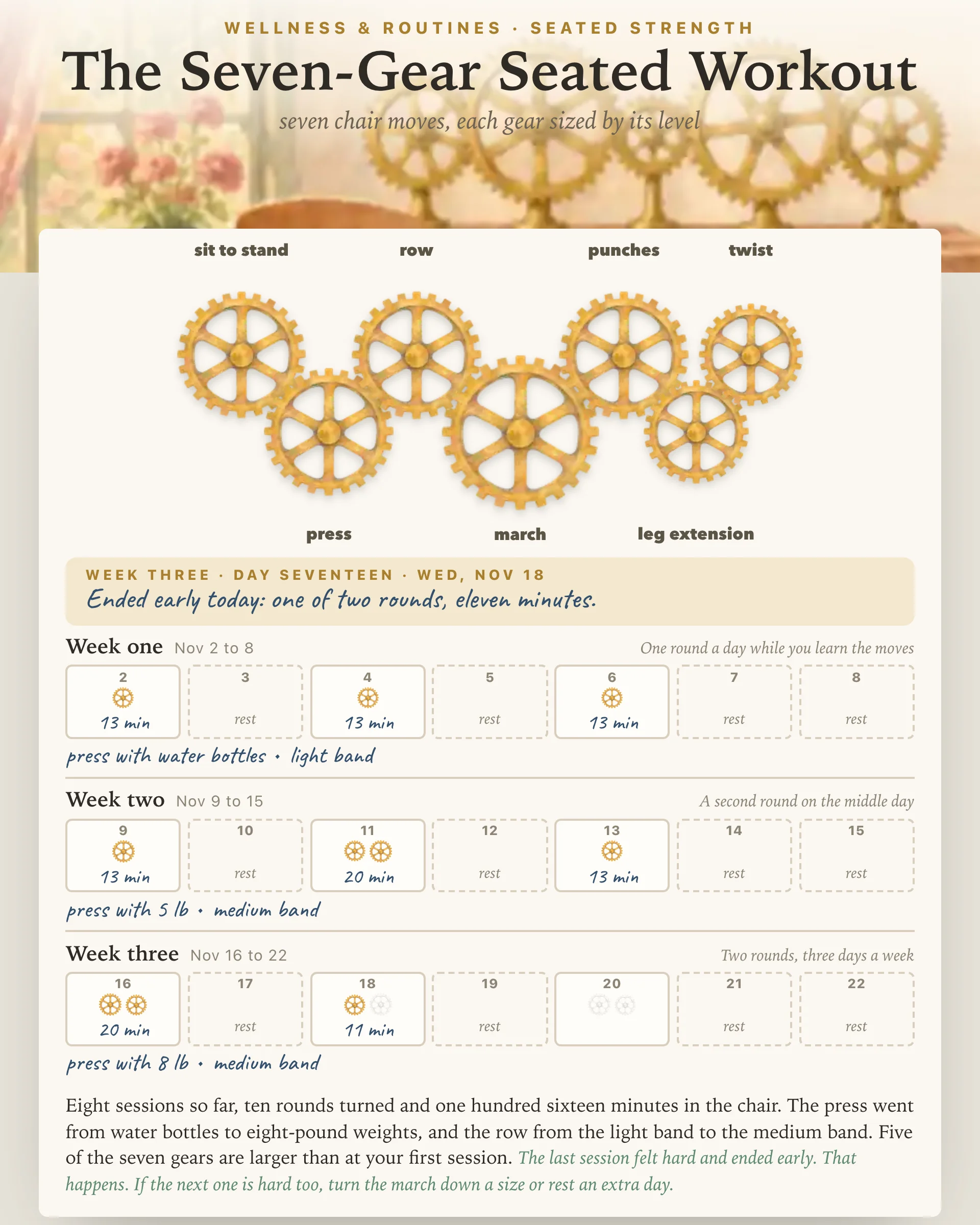
Plenty of men come to seated exercise sideways: after a knee or back problem, after years at a desk, or because getting down to the floor and back up stopped being simple. A chair lets you work your legs, your pushing and pulling muscles and your breathing without kneeling or balancing, starting today with a pair of water bottles.
This page turns that into a twenty-minute seated circuit you can see. Each of the seven moves is a brass gear in a small train, drawn at the size you set: small for the easier version, middle for standard, large for harder. A clock runs the circuit, and four weeks of rounds and weights add up below it.
Before your first session, check with a doctor or physical therapist if you live with a heart or blood pressure condition, get chest pain or unusual breathlessness when you exert yourself, have had a joint replaced or any recent surgery, have back or joint pain, or have had dizzy spells. Use a sturdy chair without wheels pushed against a wall. Stop any move that hurts, and stop the whole session and get help if you feel chest pain, faintness or breathlessness that seems wrong.
Every session opens with three minutes of gentle marching. Each gear then gets forty seconds of work and twenty to breathe, a round of seven minutes, and a three-minute cool-down closes it: thirteen minutes for one round, twenty for two.
The gears turn while you work, and each lights up once its forty seconds are done. The clock reads real time against your start, so a phone that locks keeps honest time, and a pause never counts. A round counts once all seven gears have had their full time. Stop early and you keep the whole minutes you did, without the round you were partway through.
Week one is three days of one round while you learn the moves, with rest days between. Week two adds a second round on the middle day. Week three is two rounds on three days, and week four adds a short fourth day. Each day on the board shows its planned rounds as small cogs that fill in as rounds are finished, and each week notes the press weight and band you used.
After each session, mark it easy, about right or hard. Two easy sessions in a row and the note under the board names the smallest gears, ready to grow. Two hard ones and it names the largest gear to turn down, or suggests an extra rest day. If a move hurt, it says to leave that move at its easiest and get checked if the pain stays.
The World Health Organization's 2020 guidelines ask adults of every age for regular muscle-strengthening work on top of 150 to 300 minutes a week of moderate activity, and they say plainly that some activity beats none. This plan covers the strength part; walking or other movement can fill the rest of the week.
A Cochrane review of progressive resistance training in older adults, pooling 121 trials, found a large effect on strength and a moderate to large one on how easily people got out of a chair, with a small effect on overall physical ability. Most programs met two or three times a week and grew harder over time, which is what the sizing up here is for. The review also notes that side effects such as joint pain and soreness were poorly recorded.
Chair workouts as such have a thinner record. A systematic review of chair-based exercise for frail older people found only six trials, all of low quality: four reported some benefit, two found none, and none reported harm. So this page makes no promise about muscle, weight or heart health. It gives you a steady, gradually harder routine and an honest log.
If the moves here feel like a lot to begin with, the gentler chair circuit for older adults lets you pick legs, arms, core or stretching and builds a loop of one-minute stops around them. If you are ready for more band work, The Resistance Band Rack builds a full band routine, and The Chair Cardio Mixtape is there for days you want to keep the heart rate up rather than build strength. When the harder size of every gear starts to feel easy, that is a good moment to take some of the work to your feet. When you are ready to train standing with dumbbells, The Twelve-Week Honeycomb is a twelve-week plan for men over fifty.
A useful seated set covers the legs, a push, a pull and some cardio: sit to stand, an overhead press with light dumbbells or water bottles, a band row, a brisk seated march, punches, leg extensions and a slow torso twist. Each move here has an easier and a harder version, so the same seven can keep up with you as you get stronger.
They are a real place to start. Trials of resistance training in older adults found clear strength gains when the work grew a little harder over time, two or three times a week. Chair programs on their own have been studied less, in small trials of mixed quality, so think of this as a beginning and add standing work when you feel ready.
Two or three strength sessions a week with a rest day between them suits most beginners. The plan on this page opens with three short one-round days a week and builds to two rounds, with a short fourth day in the last week.
Start lighter than you expect, with water bottles or three to five pound dumbbells. You should finish the forty seconds with steady form and a little left over. When two sessions in a row feel easy, go up one step, either in weight or by sizing the gear up.
Talk to a doctor or physical therapist first if you have a heart or blood pressure condition, chest pain or unusual breathlessness on effort, a joint replacement, recent surgery, back or joint pain, or dizzy spells. Stop any move that hurts, and stop the session and get help for chest pain, faintness or breathlessness that feels wrong.
By the team behind Fabulous, the science-based self-care app used by over 30 million people.


