
The Overwhelm Recovery ProtocolWellness & Routines · ~5 min
About this template · Updated November 2026
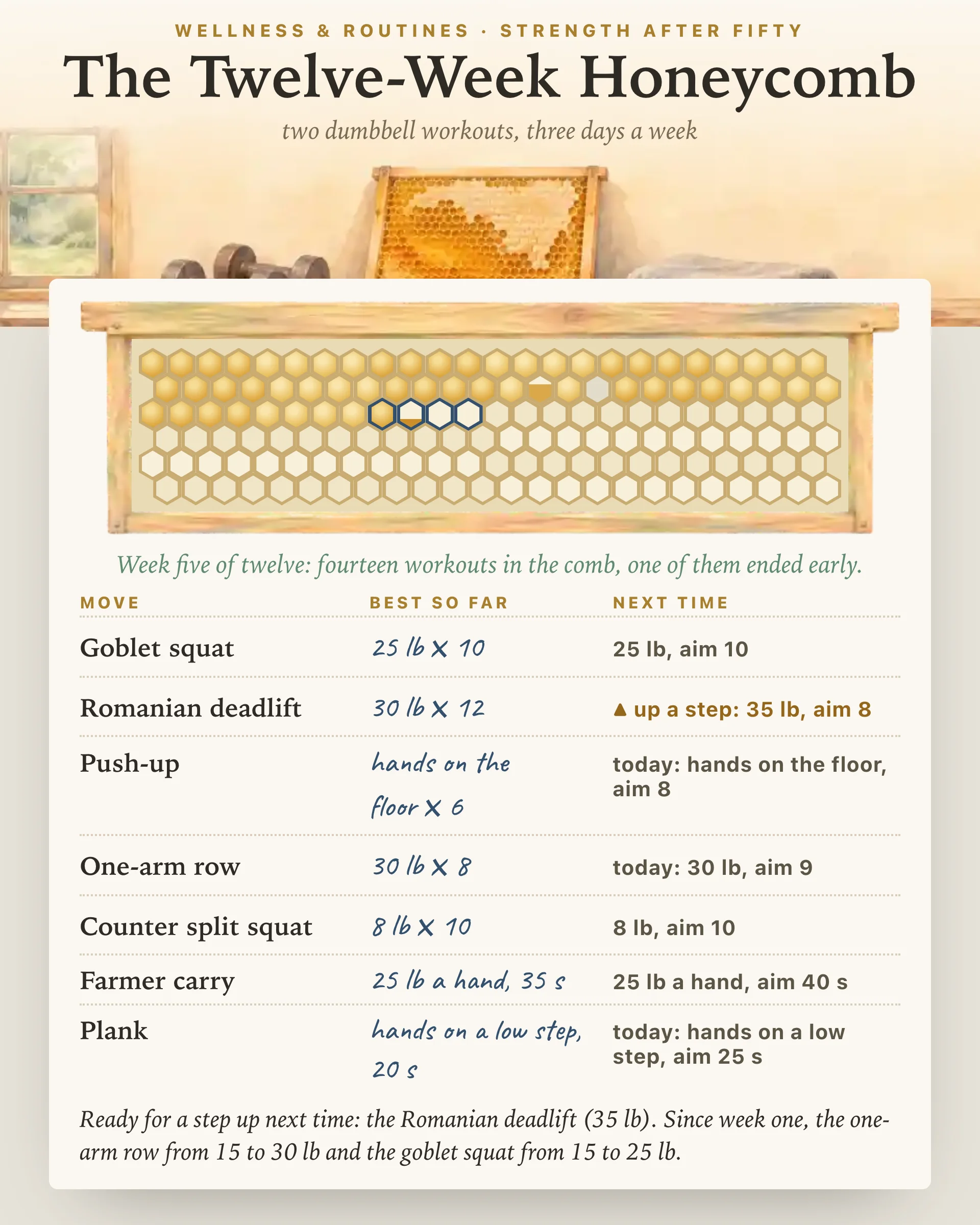
This page is a twelve-week dumbbell plan for men in their fifties and beyond, in a spare room or at a gym. Two workouts take turns three days a week, built from seven moves: squatting, hinging at the hips, pushing, pulling, stepping, carrying and holding still. Each move has a joint-friendly swap, every finished set goes into a beehive frame, and a plain rule tells you when a move has earned more weight.
Before week one, see your doctor or a physical therapist if you have a heart or blood pressure condition, get chest pain or unusual breathlessness when you exert yourself, have a hernia, have had a joint replaced or any recent surgery, have fallen or had dizzy spells, or live with back or joint pain. Stop any move that hurts. Breathe out on the hard part of each rep instead of holding your breath, and keep a counter or a sturdy chair within reach while you stand.
A Cochrane review of 121 trials covering 6,700 older people found that resistance work which grows steadily harder, usually done two or three times a week, had a large effect on strength and a moderate to large one on rising from a chair. Its effect on overall physical ability was small, and side effects were poorly recorded, with joint pain and muscle soreness the usual complaints.
Muscle is the reason many men start, and the honest number is modest. A meta-analysis of 49 studies in adults aged 50 and over found an average gain of about 1.1 kg, roughly two and a half pounds, of lean body mass. The studies differed a great deal, people further into older age gained less, and programs with more total sets gained more. An average across very different trials is no forecast for any one man.
Bone is even less settled. A systematic review of exercise trials in men over 50 found only eight that met its bar, with limited and inconsistent effects on bone density at the hip and none at the spine. So this page makes no promise about your bones, your heart or your weight. What the evidence does support is getting stronger, and the CDC's guidance for adults asks for muscle-strengthening work on at least two days a week across the legs, hips, back, abdomen, chest, shoulders and arms. Three workouts here clear that with a day to spare.
The plan counts workouts rather than dates, so a missed Wednesday simply waits.
Workout A is the goblet squat, a push-up or press, the one-arm row and a plank. Workout B is the Romanian deadlift, the split squat, the one-arm row again and a farmer carry. The row turns up in both, so your upper back gets the most practice.
The swaps are for the knee, back or shoulder that has opinions. The goblet squat becomes a box squat to a chair, so the seat sets your depth, and the Romanian deadlift becomes a hip bridge. Push-ups climb from the wall to the counter, a low step and the floor, while the floor press spares wrists and shoulders. The row can be done standing at the counter, the split squat kept shallow, the carry turned into a standing hold and the plank into a slow dead bug.
Each move has a range, usually eight to twelve reps. Keep a weight until every planned set reaches the top of that range while you could still do about two more clean reps. Then the next workout starts one step heavier, usually five pounds, and back at the bottom of the range. Carries and planks add five seconds a time instead, and step up once every set holds for the full forty-five. Expect your reps to dip for a week after each step; that is the rule working.
The Effort Swatch Card helps you judge what two reps left feels like.
The frame holds a cell for every move of every workout, twelve a week. Tap each set as you finish it and that cell's honey rises; with all its sets in, the cell turns to sealed gold. A plank or carry counts only when its clock runs all the way down. Ending a workout early takes two taps and keeps only the sets you finished, so a half-full cell stays half full. A table below keeps each move's best and what the rule asks next.
If dumbbells feel like too much for now, The Whole-House Strength Routine starts with two short sessions a week using your own rooms. The Thirty-Second Chair is a quick way to see how your legs are doing before week one and after week twelve.
For most men it is, as long as the weights start light and climb in small steps. Talk with a doctor or physical therapist before you begin if you have a heart or blood pressure condition, chest pain or unusual breathlessness when you exert yourself, a hernia, a joint replacement, recent surgery, or back or joint pain. Stop any move that hurts.
Moves that train a whole movement pattern give the most for your time: a squat, a hip hinge like the Romanian deadlift, a push-up or press, a one-arm row, a split squat, a loaded carry and a plank. This plan uses those seven, and each one has a version that is kinder to knees, backs or shoulders.
The CDC asks adults for muscle-strengthening activity on at least two days a week, working every major muscle group. This plan uses three workouts of twenty-five to thirty-five minutes a week with a rest day after each, which leaves the other days free for walking.
Heavy enough that each set ends with about two clean reps still in you, and no heavier. Start lighter than you think in week one. Keep a weight until every set reaches the top of its range, then go up one step, usually five pounds.
Yes. Every move uses dumbbells, so a gym rack works exactly like a home pair. Use a weight bench for the one-arm row and the floor press, and keep the same sets, the same swaps and the same rule for stepping up.
By the team behind Fabulous, the science-based self-care app used by over 30 million people.


