
The Overwhelm Recovery ProtocolWellness & Routines · ~5 min
About this template · Updated November 2026
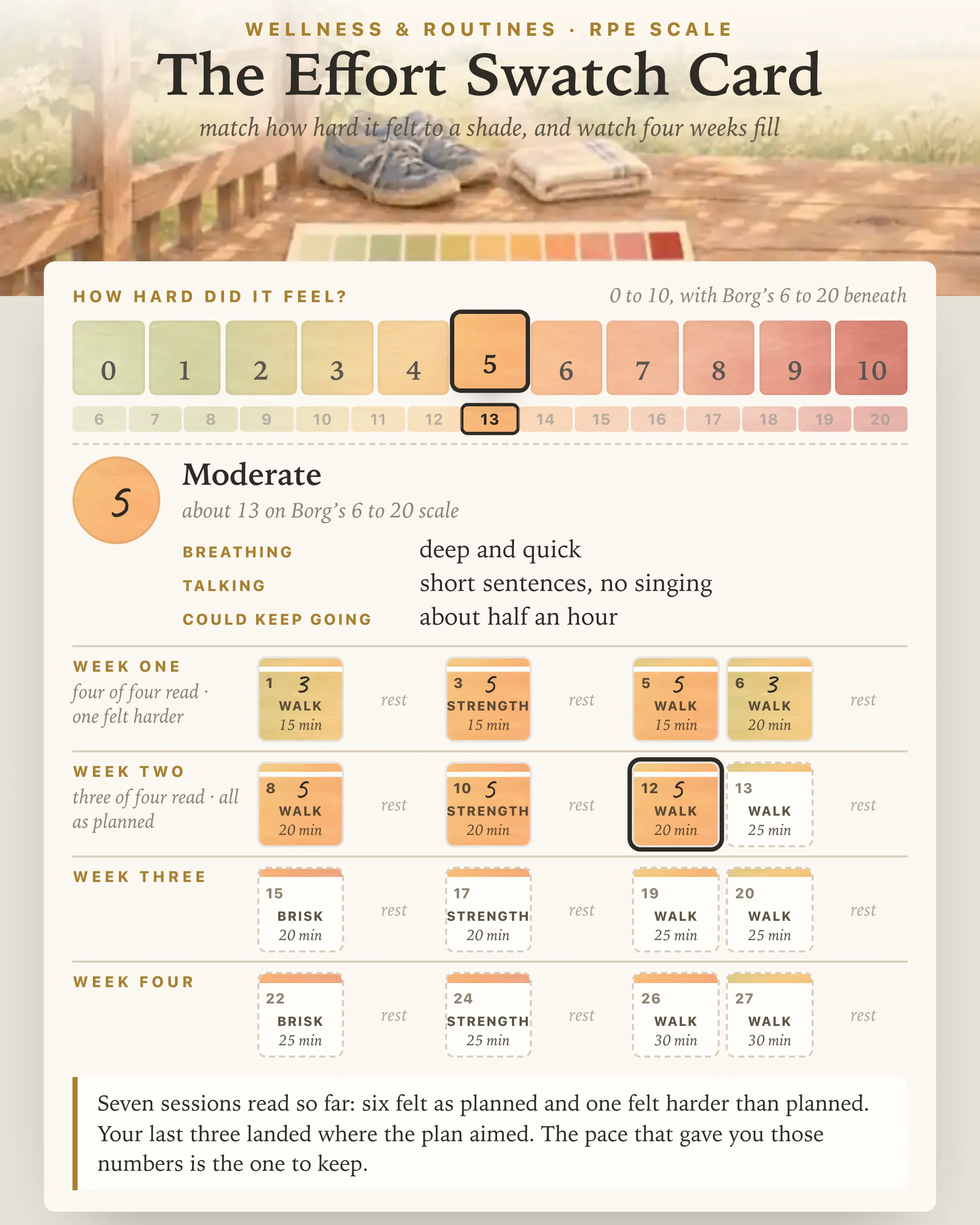
Credit first. Most perceived exertion charts trace back to Gunnar Borg, a Swedish psychologist who studied perception at Stockholm University. He built the 6 to 20 scale in the 1960s and set out the thinking behind it, along with a newer 0 to 10 version, in his 1982 paper Psychophysical bases of perceived exertion. This page is an independent practice sheet in its own words. It is not connected to Borg's work, and nobody who looks after his scales has reviewed or endorsed it.
An RPE scale asks one question: how hard does this feel right now? Your body already reports effort through your breathing, your legs and your sense of how much longer you could go; the scale turns that report into a number you can compare. A walk that felt like a 5 in week one and a 4 in week four, same pace and route, is progress you can feel without a watch. The numbers are personal on purpose. A short night or a hot afternoon can push the same walk a point higher, and rating effort instead of speed moves with the body you have that day.
The card is a strip of eleven paint chips cut from one watercolor wash, pale sage at 0 and deep brick at 10. Tap a chip and it says what that number feels like: your breathing, how much you can still say, and how long you could keep it up, or on a strength day, how many good reps are left. Beneath it, the numbers 6 to 20 of Borg's original scale sit in the same order, so you can see roughly where your answer lands on his. Treat that line-up as a guide: the two scales were built differently, and Borg discouraged reworded versions of his.
The page also carries a four-week plan of sixteen sessions: easy walks, a short strength routine, then brisk intervals from week three. Each session has three parts, and you mark a shade for each as you finish it. One part, labeled on the sheet, is the one the plan reads: inside the day's aim, the session felt as planned; above it, harder; below it, easier. Four strips of seven days fill with your shades under thin bands showing the aim, so a week that ran hot shows up as warm colors under cool bands.
Walking. Rate the steady middle, not the first minutes while you warm up, and use your voice as the check: around a 3 or 4 you can talk in full sentences. The US Centers for Disease Control and Prevention describes moderate effort as a 5 or 6 on a scale of 0 to 10, the pace where you can talk but not sing, and puts vigorous effort at 7 or 8, where only a few words come out before you need a breath. The Walking Workout Ribbon gives you a routine to rate.
Strength. Breathing tells you little during a set of sit to stands, so rate what is left in you. A strength version of the scale ties each number to repetitions in reserve: 10 means no more reps were possible, 9 means one more, 8 means two, as used in a study comparing experienced and newer squatters. That study was small and its volunteers were in their twenties, so take it as a handy way to count rather than a rule for every body. Try it on The Wall Push-Up Ladder.
Intervals. Rate the brisk and easy minutes apart. The brisk ones should reach the day's aim and the easy ones should settle back to a 3 or 4; if they will not, the brisk pace was more than the day needed. To keep the turns for you, pair this card with the Japanese Interval Walking Timer.
Felt effort follows the body's own measures, but loosely. A meta-analysis of studies on Borg's scale found average correlations of about 0.62 with heart rate and 0.57 with blood lactate, below the 0.8 to 0.9 that earlier work had suggested, and stronger in some settings than others. That is close enough to pace a walk by, but it is not a fitness test and cannot tell you whether a symptom matters.
This card gives no heart rate targets. Age and some heart medicines change how fast the heart beats at a given effort, so a number borrowed from a chart can mislead. If you live with a heart or lung condition, ask your doctor which effort numbers suit you before you follow the plan, and stop to rest if you notice chest pain, faintness or a shortness of breath that will not ease.
Open the card during any session you want to pace by feel, and mark each part while the effort is fresh; a rating given an hour later drifts. Week one matters most, because easy walks at a 3 or 4 teach you what those numbers feel like before the 5s and 6s of weeks three and four. If the reading says two of your last three sessions felt harder than planned, slow down. A week that lands where it aimed beats one that lands higher.
RPE stands for rating of perceived exertion: a number for how hard exercise feels to you, judged from your breathing, your muscles and how long you think you could keep going. On the common 0 to 10 version, 0 is sitting still and 10 is the hardest effort you can make.
It is the original perceived exertion scale, built by the Swedish psychologist Gunnar Borg in the 1960s. Its steps were chosen to loosely follow heart rate divided by ten in healthy young adults, so 6 sits near rest and 20 at a maximal effort. That link is rough and shifts as people age, which is why this card sets no heart rate targets.
On a walk, rate the steady middle and check it with your voice: around 3 or 4 you can talk in full sentences, at 5 or 6 you can talk but not sing. In a strength set, rate how many good reps are left, so a 7 means about three more. For intervals, rate the brisk minutes and the easy ones apart; the easy minutes should drop back to a 3 or 4. Most beginner sessions can live between 3 and 5.
No. The card here is a 0 to 10 scale written in its own words, with the numbers 6 to 20 lined up beneath it as a rough guide. Borg's published scales carry his exact wording and instructions for use, and this page is not affiliated with him or endorsed by the people who look after his scales.
Yes. Personalizing it costs nothing and keeps all four weeks: the shade you gave each part of every session, the few words you added, and the running reading of how your sessions compare with the plan's aim.
By the team behind Fabulous, the science-based self-care app used by over 30 million people.


