
The Overwhelm Recovery ProtocolWellness & Routines · ~5 min
About this template · Updated November 2026
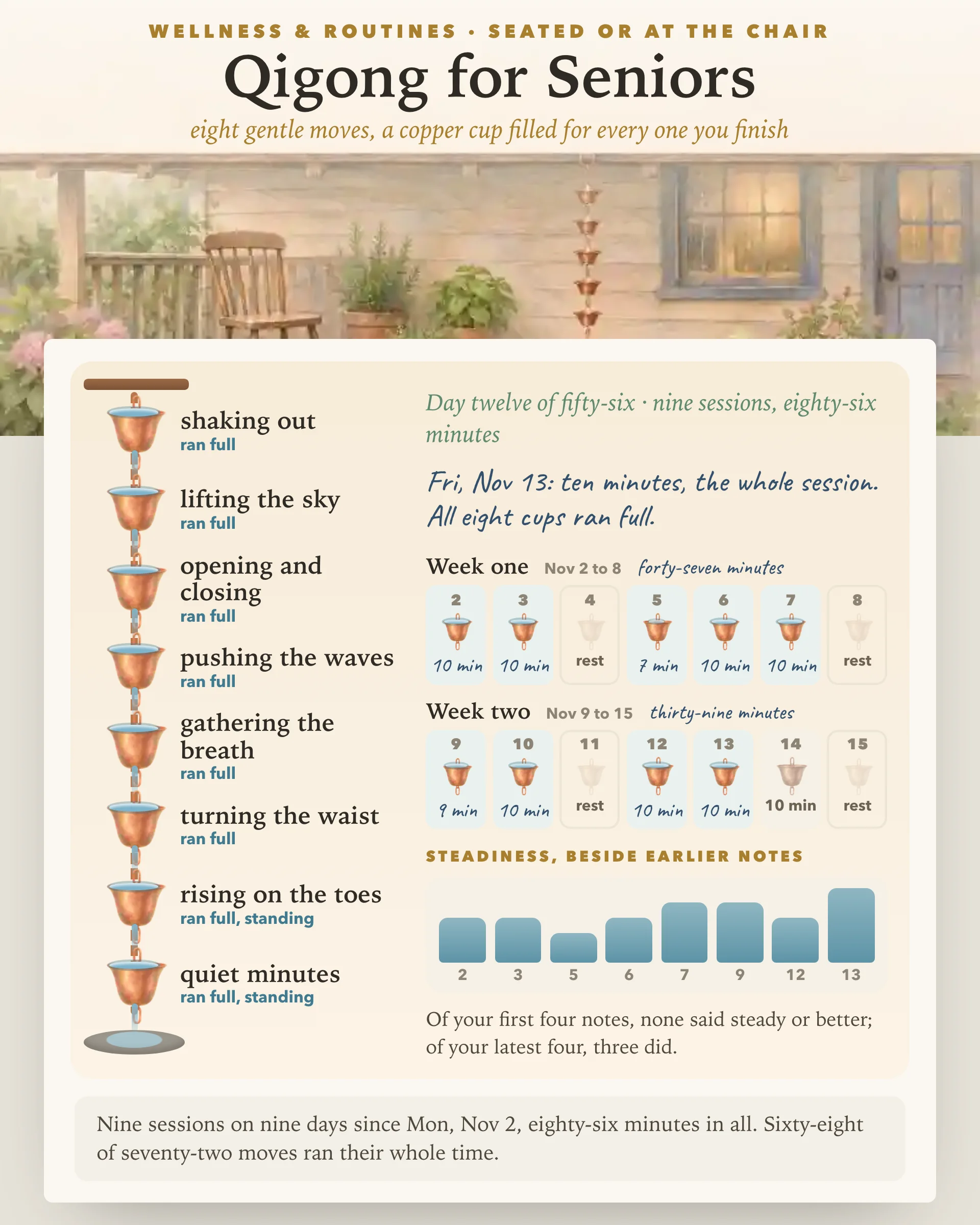
Qigong (say "chee-gung") is a family of slow, repeated movements done in time with an unhurried breath. It asks for no floor work and no speed, which is why it suits so many people in their sixties, seventies and beyond. Here, eight of its gentlest moves make a session you can do seated in a sturdy chair, standing with a hand on its back, or both.
Each has a seated and a standing way, side by side, and you choose; standing, one hand always stays on the chair back. The names are old images for what your arms do; this page makes no claim about energy moving through the body, and no move here treats or cures anything.
The session runs on a copper rain chain, the string of little cups some porches hang where a downspout would go, one cup for each move. While a move runs, its cup slowly fills, and it counts only once it runs full. A bead by the clock swells for four counts as you breathe in and settles for six as you breathe out.
The timer reads the real clock, so a dimmed phone keeps honest time. Pause whenever you like and the clock waits. Skip a move and its cup stays partway, with the skipped seconds left out. Between a seated move and a standing one, the clock waits until you are up and holding the chair. End early and only your whole minutes are kept.
Afterward you can tap how steady you felt, from wobbly to very steady. The notes show as a row of bars set only beside your own earlier ones; they are impressions, not a balance test, and never get a score.
Practice five days a week and rest two. Weeks one and two take ten minutes: a minute of shaking out, eight slow breaths for each of the six middle moves, and a quiet minute to close. The breathing moves then lengthen and the quiet close grows to three minutes, reaching fifteen minutes by week seven.
The strongest evidence on movement and falls in later life comes from tai chi, not qigong. A 2019 Cochrane review led by researchers at the University of Sydney pooled 108 trials with more than 23,000 people living at home, average age 76, and found that exercise programs reduce falls. Within it, tai chi may lower the rate of falls by about a fifth, a finding the authors rated low certainty. Its summary gives no separate result for qigong.
Qigong trials in older adults are fewer and smaller. In one, internal medicine researchers at a New Hampshire medical center randomly assigned 95 adults aged 51 to 96 to begin a ten-move qigong program at once or four weeks later. After twelve weekly classes, scores on a balance and walking test rose, while confidence about balance barely moved; there was no comparison exercise, and falls were not tracked. A 2026 review by sport scientists in Harbin, China, pooled 22 randomized trials with 1,791 older adults and reported better walking distance, balance, mood and quality of life, but no change in everyday tasks such as dressing. Most gains looked similar to ordinary exercise, and the trials averaged about eighty people each.
So this is a gentle way to move and breathe most days, not a proven way to prevent falls, and no stand-in for a balance program a physical therapist sets for you.
Check with your doctor or a physical therapist first if you have had a fall or dizzy spells, have had a hip, knee or shoulder replaced, live with a heart or blood pressure condition, or have pain that has not settled. Stop any move that hurts or leaves you lightheaded. Use a chair without wheels, placed where it cannot slide, and keep it or a counter within reach each time you stand. If feeling unsteady is new for you or getting worse, tell your doctor.
The Five-Petal Qigong Starter is a four-week introduction to five moves. The Morning Willow opens the day standing, and A Nest for the Night winds down an evening. The Eight Silk Panels teaches the classic eight-part set. This page runs eight weeks, gives every move a seated way and a supported standing way side by side, and keeps your steadiness notes. For tai chi with the same chair beside you, try Tai Chi for Seniors.
The moves are slow, low impact and can all be done seated, which makes them gentler than most exercise. Still, ask your doctor or a physical therapist before starting if you have fallen or felt dizzy lately, had a joint replaced, or have a heart or blood pressure condition or lasting pain. Stop if anything hurts and keep a chair or counter within reach whenever you stand.
Yes. Each of the eight moves here has a seated way written out beside the standing one, from shaking out the arms to heel raises in place of rising onto the toes. A session done seated from start to finish counts in full.
This plan asks for five sessions a week, ten minutes at first and fifteen by week seven, for eight weeks. Studies in older adults have often run sessions several times a week for two or three months, and short regular practice is usually easier to keep up than long, rare sessions.
Most of the falls research is on tai chi, which a large review found may lower the rate of falls. Qigong trials in older adults are fewer and smaller; some found better balance and walking scores, but none here can promise fewer falls, and it does not replace a balance program from a physical therapist.
Tai chi is a longer flowing sequence with roots in martial arts, learned as a set order of steps. Qigong is a broader family of shorter moves repeated in time with the breath, so it is often quicker to learn and easier to do in a chair.
By the team behind Fabulous, the science-based self-care app used by over 30 million people.


