
The Overwhelm Recovery ProtocolWellness & Routines · ~5 min
About this template · Updated November 2026
The first minutes after you get up usually go to the phone, the coffee and whatever the day has already lined up. A qigong morning routine keeps a small piece of that time for slow movement on your feet: five unhurried moves, nothing on the floor, then a minute or two of standing still before the day gets going.
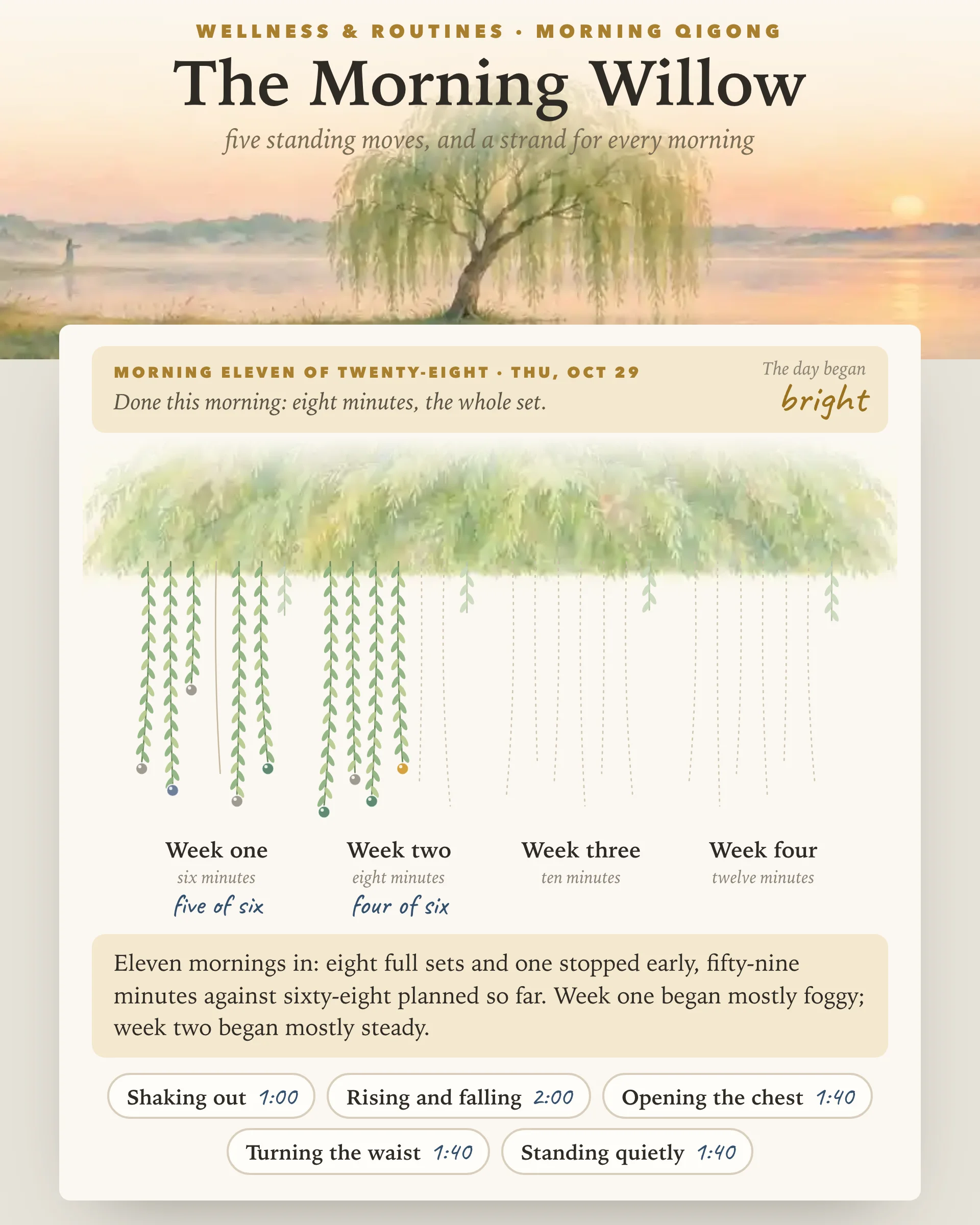
This page gives you that set, times it, paces your breath through the slow parts, and keeps four weeks of mornings on a painted willow, one hanging strand for each.
You do them in the same order every time, from loose to still.
Each move has a seated way for mornings when your legs feel unsure. Keep a sturdy chair beside you whenever you stand. Teachers often talk about chi or energy here; this page leaves that out and says what your body is doing, because that is the part research can speak to.
The top card shows which of the twenty-eight mornings you are on and the minutes the plan sets for it. Keep that length or pick another, choose standing or seated, and press begin. The page walks you through the moves with a cue and a countdown for each. Its clock keeps real time, so a phone that locks halfway through still finds its place when you look back.
For rising and falling, opening the chest and standing quietly, a dewdrop hanging from a willow strand sets the breath. It swells for five seconds while you breathe in and shrinks for five while you breathe out, about six breaths a minute. In the other two, the breath is yours.
Only what you did is counted. Run the set to its end and that morning's strand comes into full leaf. Stop early and the whole minutes are kept, so the strand leafs out partway; stop before a full minute and nothing changes. Then the page asks how the day began, heavy, foggy, steady or bright, and that word becomes a colored dewdrop at the tip of the strand.
Under the willow, a reading adds up sets and minutes against the plan and compares how your weeks began. It reports what you noticed, not what the qigong did: a steadier third week might come from the practice, from better sleep or from a calmer week at work.
Week one is six minutes on six mornings, enough to learn the order. Week two is eight minutes, giving the paced moves more breaths. Week three reaches the full ten-minute set, and week four adds two more minutes of standing quietly. Every seventh morning is a rest day, drawn as a short sprig, though a set done that day still counts.
A review of seventy-seven randomized trials of qigong and tai chi found consistent results in areas such as physical function, falls and their risk factors, quality of life and psychological symptoms. Those programs ran for weeks or months, and a few showed no gain over usual care, so the review describes a practice kept up over time, not what one morning does.
A meta-analysis of seven trials in healthy adults found that one to three months of qigong lowered reported stress and anxiety compared with people on a waiting list. The authors note the trials were few and had design flaws.
The paced breathing has its own small literature. A systematic review of fifteen studies of breathing slower than ten breaths a minute in healthy people linked it to higher heart rate variability and to feeling more relaxed, more alert and less anxious. Take that as a reason to try the slow parts, not a promise.
None of this work shows that qigong cures an illness, and none of it measures chi.
When researchers followed ninety-six people building one new daily habit tied to a fixed point in their day, it took anywhere from eighteen days to more than eight months for the habit to feel automatic, and missing a single day did not set anyone back for good. So hang the set on something that already happens each morning, and when a strand stays bare, pick it up the next day.
Soon after you get up, with a little clear floor and a chair nearby. To learn qigong more slowly over a month, The Five-Petal Qigong Starter builds up session by session. For a classic set of eight moves, open The Eight Silk Panels. And if the slow breathing becomes your favorite part, Resonance Breathing gives it a page of its own.
It is a short run of slow qigong movements done on your feet soon after waking, with the breath kept low and easy. The one on this page has five parts: shaking out, rising and falling with the breath, opening the chest, turning the waist, and standing quietly.
Six minutes takes you through all five moves once. The plan here moves up to eight, ten and then twelve minutes across four weeks, with every seventh morning left for rest, and ten unhurried minutes on most mornings is a sensible place to settle.
Yes. Tap the seated way and each move changes to a chair version: your heels bounce in place of your knees, the arms rise and open while you sit tall, the waist turns stay small, and the closing stillness happens in the chair.
No study shows one time of day working better. Mornings suit many people because the house is quiet and nothing has crowded the day yet, and doing the set at the same point each morning, say right after your first glass of water, helps it stick.
Trials suggest that practice kept up for weeks or months can ease stress and anxiety and help physical function in some groups, though many of the studies are small or loosely designed. Talk of chi or energy flow comes from the tradition and is not something those trials measure, so this page describes the moves plainly.
By the team behind Fabulous, the science-based self-care app used by over 30 million people.


