
The Overwhelm Recovery ProtocolWellness & Routines · ~5 min
About this template · Updated November 2026
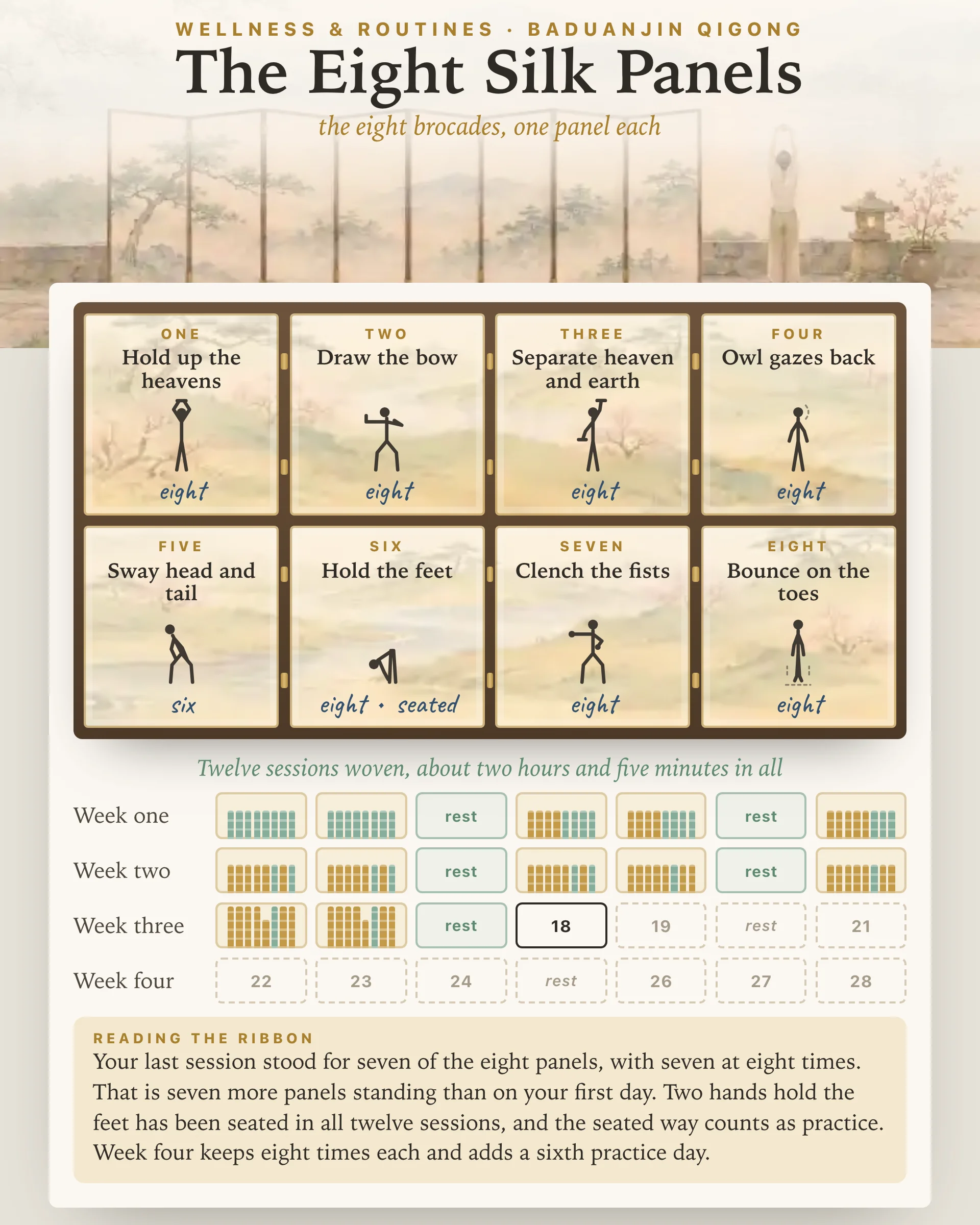
Baduanjin is a set of eight slow movements from Chinese qigong. The name is usually translated as the eight brocades, after a silk woven with a raised pattern, and suggests eight fine pieces of one cloth. Texts from the Song dynasty, around the twelfth century, already describe an early version, and later manuals drew a seated set beside the standing one. All it needs is room to raise your arms overhead and take one wide step.
The traditional names are poetic, and a few promise things about organs or energy that nobody has shown. Here is what each move asks of you, in the usual order:
The worksheet is a folding screen of eight silk panels, one for each move. Tap a panel and its card opens below with cues for doing the move slowly, a seated way, and for the moves that test your footing, a steadier way with a hand on a counter. On each card you choose six or eight times through, and whether you stand or sit.
From those choices the page times your session: half a minute to settle, eight to fourteen seconds for each time through a move (one side counts as one time when a move alternates), and half a minute to close. Six of everything comes to ten minutes, eight of everything to thirteen.
Press begin and the timer travels across the screen in order. The lit panel is the one you are on, the card counts your times through and tells you when to breathe in and out, and nothing makes a sound. Tap any panel to jump the timer there.
When you finish, weave the day in. Eight threads join a four-week ribbon: gold for the panels you stood for, sage for the ones you sat for, and a shorter thread where you chose six. A short reading under the ribbon says what has changed since your first day.
Week one asks for all eight moves, six times each, on five days. Week two keeps that count and invites you to stand where you feel steady. Week three moves up to eight times each, and week four adds a sixth practice day. A missed day stays open until you come back to it, and a panel that never feels right standing can stay seated for good.
Baduanjin has been the subject of many small studies, mostly in China. A 2018 review of 22 studies found results that support it as an add-on in rehabilitation, with improvements reported in thinking, mood and physical measures, and its authors asked for more rigorous trials with longer follow-up before anyone draws firm conclusions. A 2022 meta-analysis of 17 randomized trials involving 1,267 older adults found better balance test scores in the baduanjin groups than in the comparison groups, and it too called for higher-quality evidence.
A 2025 analysis of 40 studies is the most useful for setting expectations. It also found balance improvements in older adults, rated the overall quality of the studies as relatively low, and reported that the clearer gains showed up after about twelve weeks of sessions lasting thirty to forty-nine minutes, five to seven days a week. That is a far bigger dose than ten to thirteen minutes for four weeks. Treat this plan as a way to learn the set and build the habit, not as the program those trials tested. None of this research shows baduanjin acting on energy or on the organs its old names mention.
Talk with a doctor or physical therapist before your first session if you have had a fall, dizzy spells, a joint replacement, a heart or blood pressure condition, or ongoing pain. Stop any move that hurts. Keep a sturdy chair or counter within reach whenever you stand, and use the seated way for the forward fold if bending leaves you lightheaded.
It fits the start of a morning or a break from sitting. For a slower start on stepping, The Tai Chi Starter Scroll brings in one new tai chi form each week. If standing is off the table, this tai chi plan done entirely in a chair stays seated throughout. For steadier footing, The Balance Ladder works on it directly.
Baduanjin is a short set of eight slow movements from Chinese qigong, usually done standing and sometimes seated. Each move is repeated a few times while you breathe evenly, so a whole round takes ten to fifteen minutes. Song dynasty texts from around the twelfth century already describe an early form of it.
In their most common order: two hands hold up the heavens, drawing the bow to shoot the hawk, separating heaven and earth, the wise owl gazes backward, swaying the head and shaking the tail, two hands hold the feet, clenching the fists and glaring fiercely, and bouncing on the toes. Names and order vary a little between teachers.
Yes. Baduanjin is the Chinese name, and eight brocades, eight pieces of brocade and eight silken movements are English translations of it. Brocade is silk woven with a raised pattern, which is where the image of eight fine pieces comes from.
On this plan, ten minutes with each move done six times and thirteen minutes at eight times, counting half a minute to settle and half a minute to close. Studies of baduanjin often used longer sessions on most days of the week, so treat these four weeks as a beginning.
Yes. The set has had a seated version for centuries, and every panel here has a seated way. Anyone who has had a fall, dizzy spells, a joint replacement, a heart or blood pressure condition, or pain should check with a doctor or physical therapist before starting, and keep a sturdy chair or counter close when standing.
By the team behind Fabulous, the science-based self-care app used by over 30 million people.


