
The Overwhelm Recovery ProtocolWellness & Routines · ~5 min
About this template · Updated November 2026
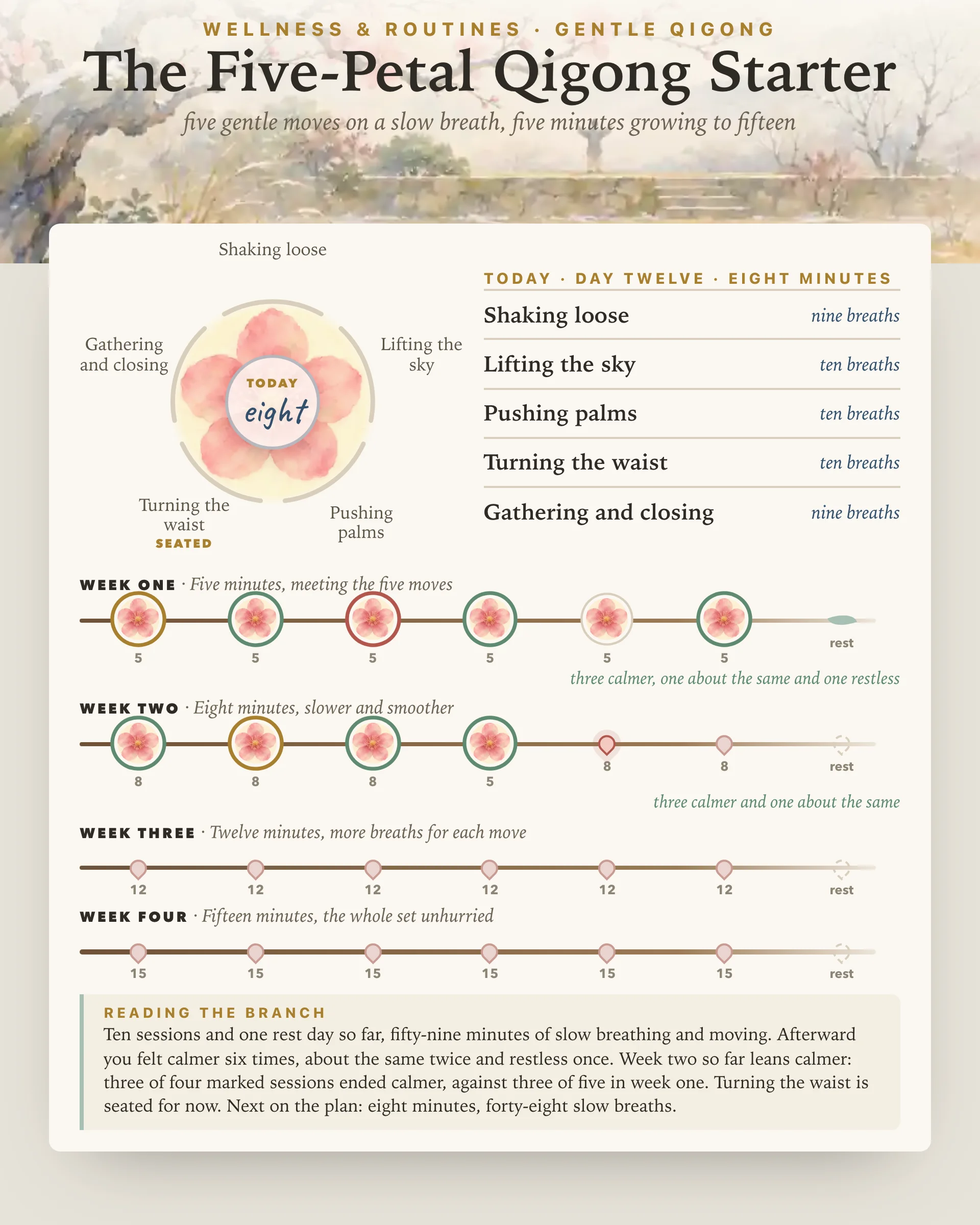
Search for qigong exercises and you mostly find long videos of a teacher flowing through a set on a misty hillside, lovely to watch and hard to copy at home. This page starts smaller: five gentle moves, one slow breath to carry them, and a plan that begins at five minutes a day and reaches fifteen by the fourth week.
Qigong, pronounced chee-gong, grew up in China beside traditional medicine. The US National Center for Complementary and Integrative Health describes it as the regulation of the mind, the breath, and the body's movement and posture, with slow, deep breathing and gentle, smooth movement. Traditional teaching also speaks of moving energy through the body; this page sets that aside and treats qigong as unhurried movement in time with a long breath.
You meet them clockwise around the blossom, starting from the top petal.
Each move has a seated way, done near the front edge of a sturdy chair. Choosing it is part of beginner qigong, not a lesser version, and you can sit for one move while standing for the rest.
The painted blossom is the timer. Tap it and the flower opens slowly while you breathe in for four counts and settles while you breathe out for six, with the count written in its center. A ring of five arcs fills one arc per move, so a glance tells you where you are. If ten-second breaths feel tight, switch to the easier pace, in for three and out for four.
Sessions are counted in breaths. Five minutes at the slow pace is thirty breaths, six for each move, and fifteen minutes is ninety, with any spare breaths going to the middle moves. Pause, skip ahead or stop at any point. A stopped session leaves nothing behind; a finished one opens a blossom on the four-week branch with the minutes you actually spent.
Then the sheet asks one question: do you feel calmer, about the same, or restless? One tap gives that day's blossom a green, gold or brick-red ring. Each week's twig tallies its rings, and the note under the branch compares this week's calm marks with last week's. Two restless marks in a row bring a nudge toward the easier breath or a seated turn.
Week one is five minutes a day, week two eight, week three twelve and week four fifteen, with the seventh day of every week kept for rest: twenty-four sessions and four hours of qigong in a month, growing slowly enough for the moves to feel familiar first. On a day when five minutes is all you have, choose five; the plan picks up again tomorrow.
A review of seven randomized trials in healthy adults found less stress and anxiety after one to three months of qigong practice than in people left on a waiting list. Its authors added that the trials were few and had methodological flaws, so the finding is encouraging, not settled. A systematic review of fifteen studies on breathing slower than ten breaths a minute linked it with feeling more relaxed and less anxious, though every one of those studies looked at healthy people, not people living with anxiety.
Nobody has tested this particular plan, so treat your marks as a small experiment of your own, not a promise. The same federal health center says qigong appears to be a safe form of activity, and it cautions against using it to delay seeing a clinician about a medical problem.
If you have had a fall or dizzy spells, a joint replacement, a heart or blood pressure condition, or pain that does not settle, talk with your doctor or a physical therapist before your first session, and do the same if you are pregnant. Keep a sturdy chair beside you whenever you stand, sit for any move that feels wobbly, and stop if something hurts.
Mornings suit plenty of people, but keeping the same slot each day matters more than the hour. Once the five moves feel familiar and you want a form that adds stepping, The Tai Chi Starter Scroll teaches one tai chi move a week at a similar pace. On days when standing is hard, Chair Tai Chi keeps every movement seated. If the slow breath is the part you love, Resonance Breathing gives it a page of its own. When the five feel easy and a traditional set appeals, The Eight Silk Panels teaches the eight brocades one panel at a time.
They are slow, gentle movements done in time with a long, unhurried breath, practiced in China for centuries alongside traditional medicine. Most beginner sets use simple standing moves such as raising the arms overhead, pressing the palms forward and turning at the waist, and nearly all of them can be done from a chair.
Start with a handful of easy moves and a session short enough to repeat every day, rather than a long set you have to memorize. This plan opens with five minutes, six slow breaths for each of five moves, and lengthens the sessions only once the moves feel familiar.
Five to fifteen minutes is plenty while you are learning. Here the sessions grow from five minutes in the first week to fifteen in the fourth, with one rest day each week, and a shorter session on a busy day still goes on the branch.
Yes. Every move on this page has a seated way, done near the front edge of a sturdy chair with your feet planted, and you can switch any single move to seated while the others stay standing.
They are close relatives. Tai chi began as a martial art built on long linked sequences, while qigong covers a wider family of breathing and movement exercises, many of them short and repeated. Health researchers often count tai chi done for health as one form of qigong.
By the team behind Fabulous, the science-based self-care app used by over 30 million people.


