
The Overwhelm Recovery ProtocolWellness & Routines · ~5 min
About this template · Updated November 2026
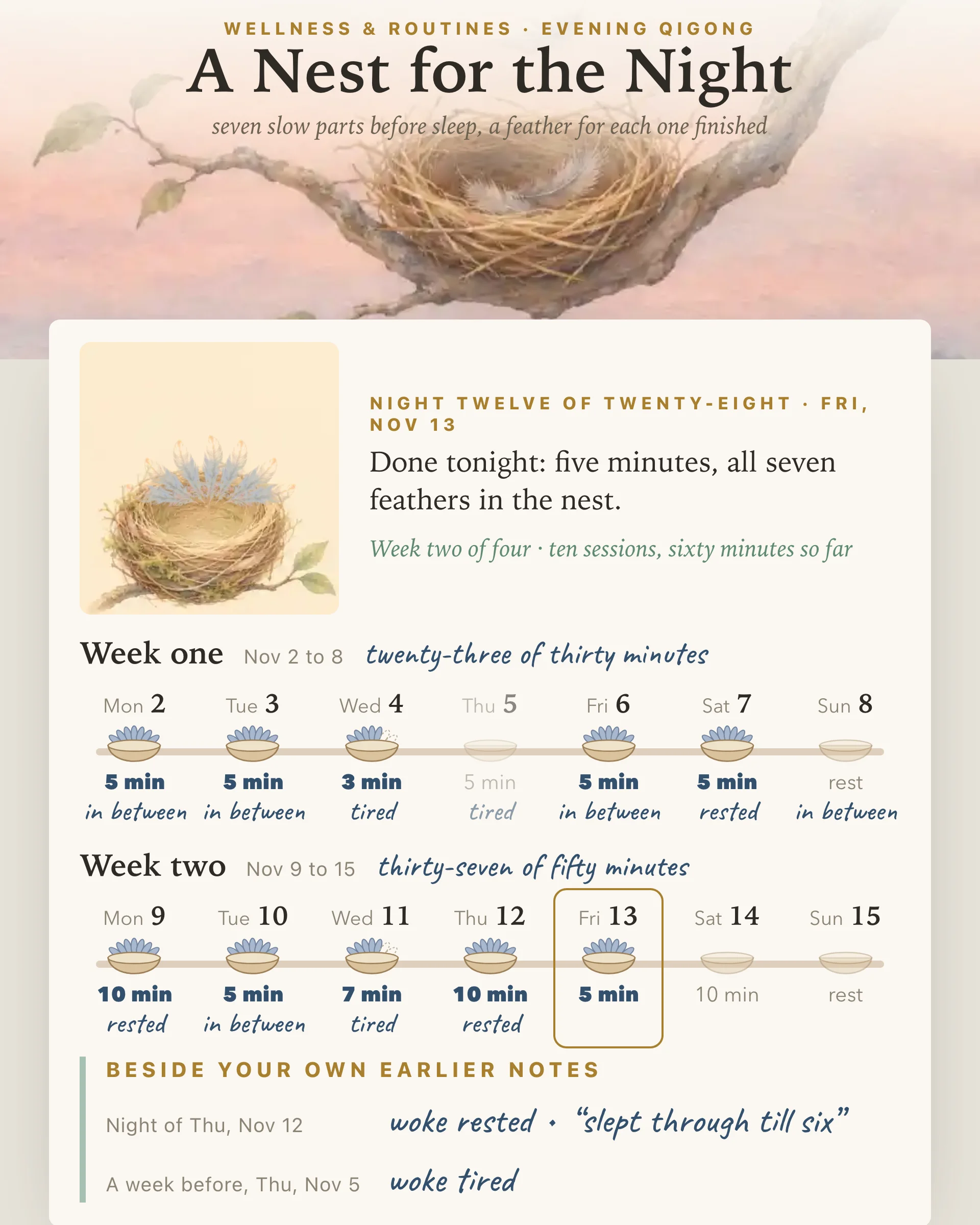
Qigong for sleep here means five to fifteen minutes of slow movement and slower breathing at the end of your evening. Every part is done beside a sturdy chair or sitting on it, at one pace: in for four counts, out for six. A painted feather drifts above a nest while you breathe and settles into it only once its part has run its whole time.
Each part has a seated version. The tree gets the longest share: one minute in the five-minute version, two in the ten and three in the fifteen, with the other six parts splitting the rest evenly.
Pick five, ten or fifteen minutes, choose standing or seated, and press begin. The clock reads real time, so a phone that locks halfway through still shows the right part when you wake it. Stopping takes two taps, so a sleepy thumb cannot end it by accident.
A part counts only when its whole time has run. Stop early and the session keeps its whole minutes while only finished parts leave feathers; a stop inside the first minute leaves the log untouched.
The plan opens with five minutes on six nights a week and builds to fifteen minutes on three nights in week four. A session after midnight still belongs to the evening before.
The next morning you can tap woke rested, in between or woke tired, and add a few words. The page sets that note beside your own from a week earlier, or your last one before it, and beside nothing else: no score, no verdict.
Most research on qigong and sleep tests Baduanjin, a traditional set of eight standing movements practiced for months. A 2024 meta-analysis by nursing and Chinese medicine researchers in Chengdu, with colleagues at a US college of nursing, pooled ten studies of 789 older adults with insomnia. Baduanjin groups scored about two points better than control groups on a sleep-quality questionnaire that runs from zero to twenty-one, and programs of twelve weeks or longer did better than shorter ones. The authors call it a complementary option and ask for better-designed trials, so four weeks here is a beginning, not a test.
A 2022 network meta-analysis by researchers at a nursing school in Taipei compared 35 trials covering 3,519 older adults. Baduanjin and tai chi improved sleep quality more than usual care, but so did resistance training, alone or paired with walking, and cognitive behavioral therapy for insomnia; muscle endurance work combined with walking ranked highest. Qigong is one reasonable choice among several.
The quiet sound exhales come from a set called Liuzijue, built on six shaped out-breaths. A 2026 pilot study by nurses and rehabilitation staff at a hospital in Nantong, China, followed 40 adults aged 18 to 75 with chronic insomnia for three months. Half practiced a version with elastic bands at home, fifteen minutes twice a day on five days a week; half received health education alone. Both groups reported better sleep by about the same amount. The qigong group's wrist-sensor sleep efficiency and anxiety scores moved further, but the groups differed at the start, were not randomized, and knew which group they were in, so the authors call the findings exploratory.
None of these studies tested a short routine done alone at bedtime, and none shows that qigong treats insomnia or sleep apnea.
If insomnia has gone on for months, the 2016 US guideline for internists on chronic insomnia recommends cognitive behavioral therapy for insomnia as the first treatment, so ask your doctor about it. Make an appointment too if someone hears you snore loudly with pauses in your breathing or gasping, or if daytime sleepiness gets in the way of driving or work. Those can be signs of sleep apnea, which no wind-down routine can fix.
Move gently and stop anything that hurts. If you have had a fall, get dizzy, or have a heart or blood pressure condition or a joint replacement, ask a doctor or physical therapist which parts suit you first. Keep a sturdy chair or counter within reach whenever you stand, keep your eyes open while standing still, and choose seated on drowsy nights.
The Five-Petal Qigong Starter teaches five basic moves at any hour, The Morning Willow is a standing set for waking up, and The Bedtime Yoga Moon uses poses in bed. This page is the evening qigong of the family: slower, seated whenever you like, and built to end in stillness.
Some trials suggest it can. A 2024 review of ten studies in older adults with insomnia found that a traditional set of eight standing movements improved self-rated sleep quality compared with control groups, and longer programs did better. The authors still call for better-designed trials, so treat qigong as a gentle habit worth trying rather than a treatment.
Slow, simple movements with a long out-breath suit the evening better than brisk sets. This page uses seven: shaking out, lifting the sky, opening and closing the hands, quiet sound exhales, warming the face, standing like a tree and a sitting breath, each with a seated version.
Any time in the last hour before lights out works. Five to fifteen minutes is enough, and the four-week plan opens at five minutes so the habit is easy to keep. If standing still makes you drowsy, switch to seated.
No. For insomnia that has lasted months, the first treatment doctors recommend is cognitive behavioral therapy for insomnia. Loud snoring with pauses in breathing, gasping at night or heavy daytime sleepiness can point to sleep apnea, which needs a doctor to look into it.
Yes. Each of the seven parts has a seated version, done near the front of a sturdy chair with both feet on the floor, and the last part, the sitting breath, is seated whichever way you begin.
By the team behind Fabulous, the science-based self-care app used by over 30 million people.


