
The Overwhelm Recovery ProtocolWellness & Routines · ~5 min
About this template · Updated November 2026
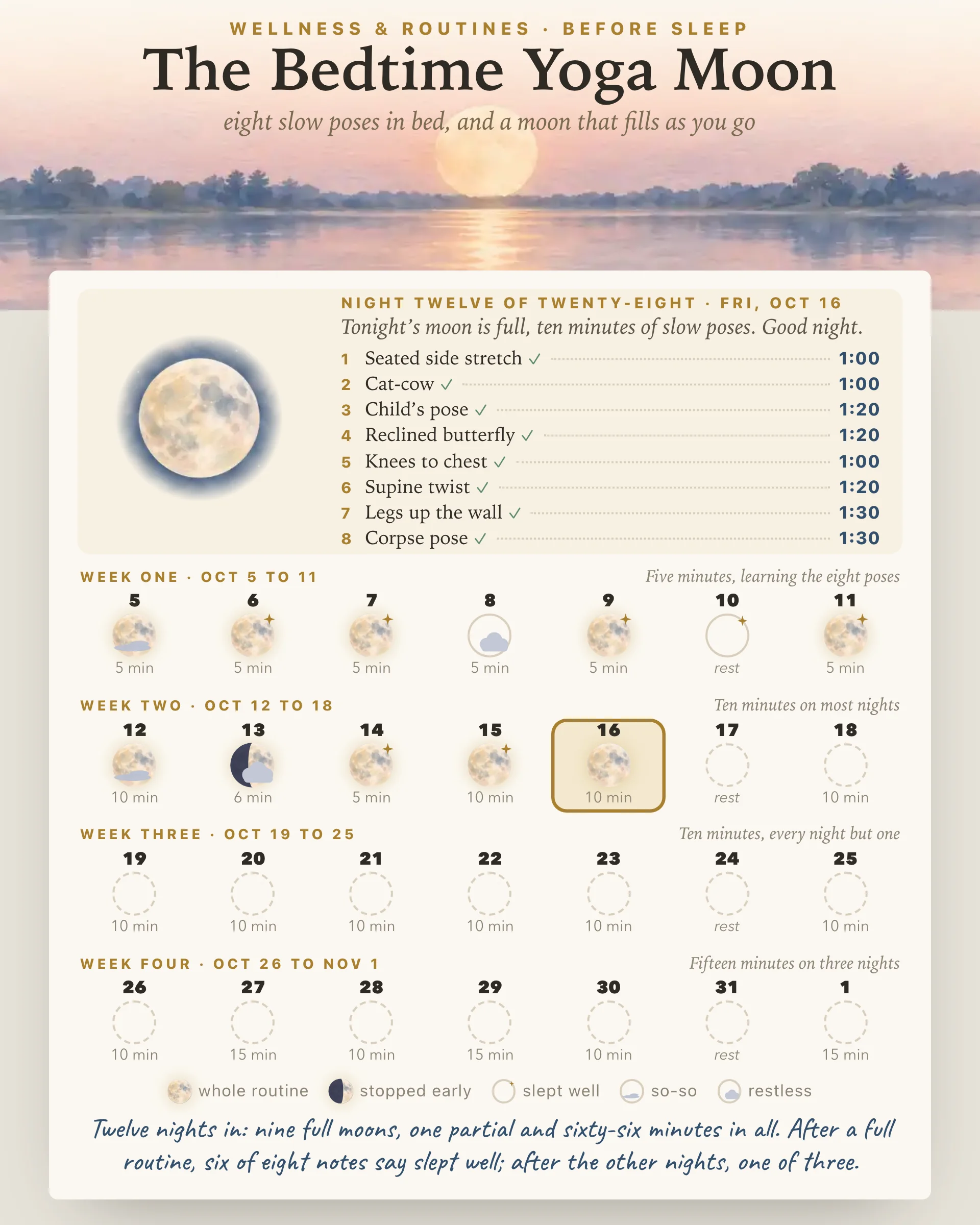
Bedtime yoga is a handful of slow, low poses done in the last half hour before lights out. Nothing here asks you to sweat, balance or reach for a deep stretch: the point is a few quiet minutes for your body to settle while your breathing slows. This sheet turns that into a short routine for your bed or the floor beside it, with a painted moon that fills while you move and a four-week calendar that keeps one moon for every night you practice.
The routine runs from sitting up to lying down, each pose a little closer to the pillow.
Every pose has cues for the mattress and for the floor, and one tap switches between them. If a pose does not suit your knees or back, leave it out and its minutes go to the rest. Up to three can go, so even the shortest version keeps five poses.
Pick five, ten or fifteen minutes. A small gold dot marks the length the plan suggests for tonight, but the choice stays yours. Press begin and the sheet walks you through each pose with a countdown, a cue to switch sides, and a breath count: in for four, out for six. That works out to six breaths a minute. If the count feels long, breathe at your own pace and treat the words as a reminder.
The clock reads real time, so if your phone locks halfway through, the routine is still in the right place when you look again. Pause holds it where it is, and stopping takes two taps, so a sleepy hand cannot end it by accident.
While you move, the moon beside the routine fills from a thin sliver to full. A whole routine leaves a full moon on tonight's square of the calendar. Stopping early leaves a partial moon that counts only the whole minutes you finished, and a stop in the first minute leaves nothing. If the screen feels too bright for a dark bedroom, tap dim the page.
The next morning, tap last night on the calendar and choose slept well, so-so or restless. A small star, a wisp of cloud or a cloud drifting over the moon marks each answer. The reading above the calendar sets your notes after full routines beside your notes after other nights. Treat that as your own diary, not proof: a few nights can lean one way for all sorts of reasons.
Week one keeps every night to five minutes while you learn the eight poses. Week two moves to ten minutes on most nights, week three holds ten every night but one, and week four brings in three fifteen-minute nights. Each week keeps one rest night. A routine done after midnight still counts toward the evening before.
A systematic review and meta-analysis of nineteen trials in women with sleep problems found that yoga improved self-rated sleep quality compared with groups that did not exercise, and reported no serious side effects. The same review found no clear effect on insomnia severity in the three trials that measured it, and none in the trials of women with breast cancer or around menopause. Most trials tested classes over several weeks rather than a few minutes of yoga before bed at home.
A broader meta-analysis of sixty-six studies on physical activity and sleep found small gains in total sleep time and a moderate gain in sleep quality from regular exercise, with results that varied by type of exercise and time of day.
For the breath count, a systematic review of slow breathing gathered fifteen studies of healthy people breathing fewer than ten times a minute. It linked that pace with higher heart rate variability and with people feeling more relaxed and less anxious. Fifteen studies is a thin base, and the review was not about sleep.
So this page makes no promise to cure insomnia or reset your sleep. It offers a gentle routine and an honest record, and leaves the judging to you.
Move slowly and stop short of anything that pinches. Pad sore knees for the kneeling poses, or leave cat-cow and child's pose out. If you have back, hip or knee trouble, or you are pregnant, ask a doctor or physical therapist which poses suit you. If poor sleep goes on for weeks, see a doctor: a routine like this one is a way to wind down, not a treatment.
Yoga Nidra on Still Water is a guided rest to follow straight after corpse pose. The Path to Bed lays out the steps before the poses, and Resonance Breathing practices the slow breath on its own. For slower poses at any hour, The Somatic Yoga Shell paces nine gentle floor poses by a soft count.
It is a short run of slow, mostly low or lying-down poses done in the last half hour before sleep. The aim is to unwind the body and slow the breath, not to stretch hard or build strength.
Gentle ones that keep you close to the floor or the mattress: a seated side stretch, cat-cow, child's pose, reclined butterfly, knees to chest, a supine twist, legs up the wall and corpse pose. Standing balances and deep backbends tend to wake you up, so save them for the morning.
Yes. Each pose on this sheet has an in-bed version, such as cat-cow on the mattress, child's pose folded onto a pillow and legs resting up the headboard wall. A firm mattress works best, and a soft one calls for smaller moves.
Reviews of trials report modest gains in how well people rate their sleep, mostly from yoga classes over several weeks, and not in every group studied. It is not a treatment for a sleep disorder, so if poor sleep lasts for weeks, talk to a doctor.
Five to fifteen minutes is plenty. The plan on this page starts at five minutes a night, settles at ten, and reaches fifteen on three nights of the fourth week, with one night off every week.
By the team behind Fabulous, the science-based self-care app used by over 30 million people.


