
The Overwhelm Recovery ProtocolWellness & Routines · ~5 min
About this template · Updated November 2026
A word of credit before anything else. Thomas Hanna, a philosophy professor and movement theorist, coined the word somatics in 1976, and his wife, the psychologist Eleanor Criswell-Hanna, wrote How Yoga Works: Introduction to Somatic Yoga in 1989. Plenty of teachers now use the label in their own ways. This sheet is a separate, free practice written in plain words, and neither of them, nor anyone who teaches their work, had a hand in it or has given it their blessing.
Somatic yoga keeps familiar shapes (a pelvic tilt, a bridge, a knee twist, child's pose) and changes what you pay attention to while you make them. You move more slowly than seems sensible, stop well short of your limit, and leave a real pause between repetitions so the change has time to register. Most of it happens lying down, which takes balance out of the picture and lets the floor carry your weight.
Researchers call this inward sense interoception. A team at the University of California, San Francisco built a 32-item questionnaire for interoceptive awareness with eight scales, among them noticing sensations, not worrying about them and listening to the body, and offered it as a starting point for research rather than a final word. It describes the skill this practice aims at, and it does not show that slow poses improve it.
The somatic yoga poses on this sheet run in the order your body meets them, so you turn over as few times as possible. Every session opens with constructive rest, lying on your back with your knees bent and leaning together. The middle can hold arch and settle, a back yawn-stretch, a rolling bridge, knees side to side, a banana-shaped side bend lying down, slow cat and cow, and child's pose. Every session closes with a resting body scan.
The plan sets ten minutes a day for the first week, all of it on your back. Side bends and twists take the lead in week two, hands and knees join in week three, and the fourth week stretches toward twenty minutes. Two days in each week are for rest. Each pose has an easier version, such as cat and cow on the edge of the bed for knees that dislike kneeling.
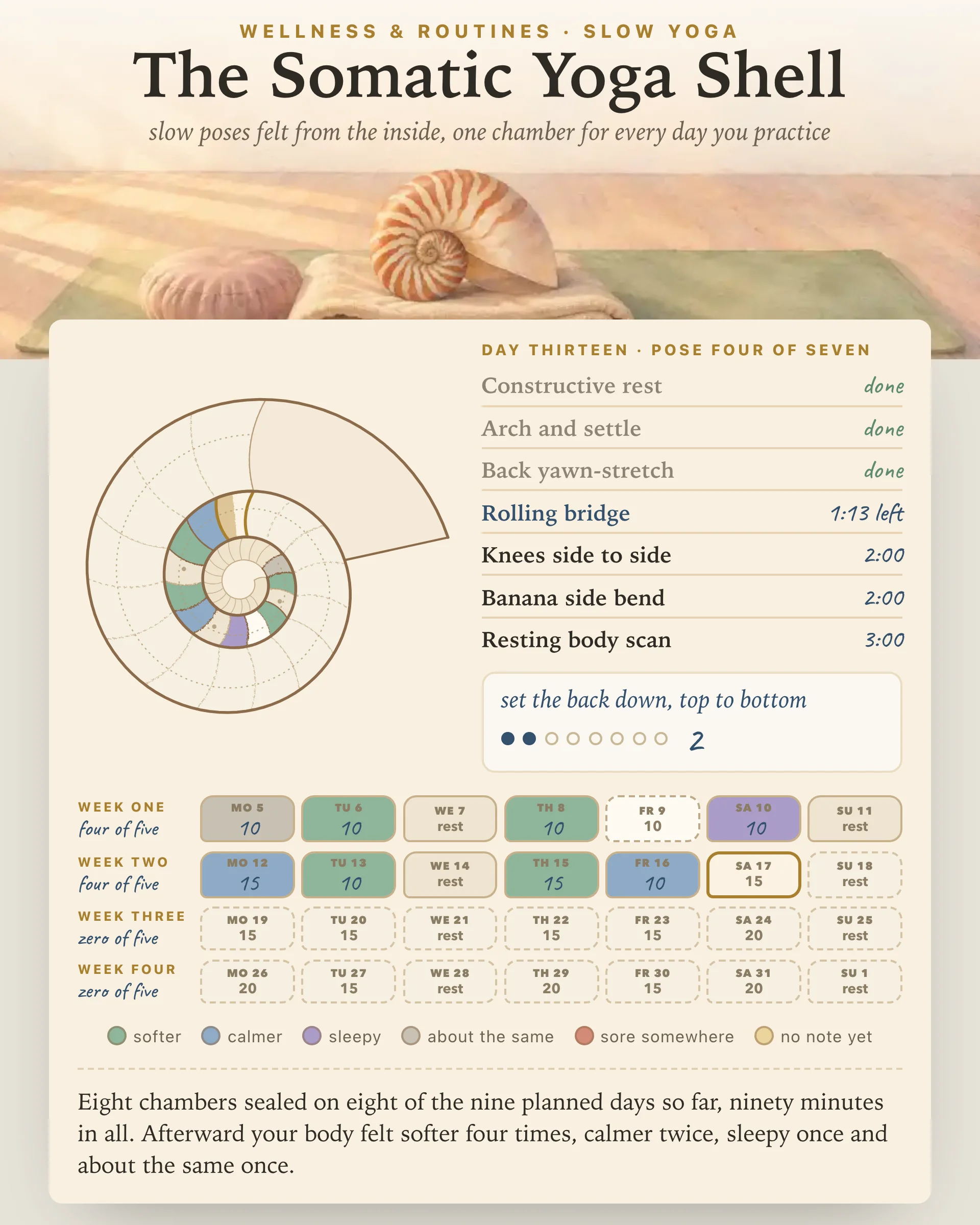
Choose ten, fifteen or twenty minutes and the sheet lays out that day's poses. Press begin and a row of dots fills at the pace to move: five counts to arch, two to pause, five to settle, three to rest, for example. The clock reads real time, so a phone that dims mid-pose picks up where you actually are. During the scan, the page names one part of you after another, feet first, face last.
When the session ends, you tap how your body feels: softer, calmer, sleepy, about the same, or sore somewhere. That chamber of the shell seals in the color you chose, and the four rows of weeks below it fill in the same way. You can also mark the pose you noticed most. Over the weeks, the reading under the shell counts your sessions against the plan, tallies the feelings, and names the pose that keeps catching your attention. A session you did away from the screen can be sealed by hand, and a missed day simply stays hollow.
No trial has tested this sequence, and the honest summary of yoga research in general is modest. A Cochrane review of yoga for chronic low back pain gathered twenty-one trials and found small gains in pain and back function at three months compared with no exercise, gains below what the reviewers count as clinically important, and little or no difference from other back exercise. Most trials used Iyengar, hatha or viniyoga classes rather than a somatic style, and side effects, mostly more back pain, came up more often with yoga, though they stayed uncommon.
So this page makes no promise to heal your back, release trauma or reset your nervous system. It offers regular, unhurried time on the floor and a record of how you felt afterward, for you to judge.
Talk with a doctor or physical therapist first if you have back or neck pain that is new or spreading, osteoporosis, a recent surgery or a pregnancy. Every movement here should feel easy. If one pinches or aches, make it smaller or leave it out, and if something feels sore afterward, tap sore somewhere so the reading reminds you to go gently next time. Roll to your side and pause before you sit up.
Ten minutes on waking catches stiffness while it is easy to feel, and the same ten before bed suits anyone who likes to end the day lying down. If you want a tighter loop of tighten-and-release moves with a body map that shows where you loosened, The Somatic Workout Map is built for that. For a racing, jittery body rather than a stiff one, Somatic Exercises for Anxiety offers shorter practices with a before-and-after reading. And if the closing scan is your favorite part, The Body Scan Cord turns it into a full practice of its own.
It is yoga practiced slowly with your attention turned inward, on what each movement feels like rather than how it looks. Moves stay small, pauses run long, and most of the work happens lying on your back.
Begin on your back with constructive rest, a small pelvic tilt, a yawn-like stretch along the spine and the knees drifting from side to side. Save hands-and-knees shapes such as a slow cat and cow, and child's pose, for once lying down feels familiar.
Many classes flow from one pose to the next and reach for a deeper stretch. In a somatic practice the movement itself is the point: you go slower than feels natural, back off before any strain, and rest between rounds to sense the difference.
Nobody has shown either. Trials of yoga for chronic low back pain found small gains compared with no exercise and no clear edge over other back exercise, and somatic styles were barely tested. For trauma, look for a therapist trained in body-based approaches.
No. She wrote a 1989 book on somatic yoga and Thomas Hanna named the field, but this free sheet is independent, and neither of them nor anyone teaching their methods created, reviewed or endorsed it.
By the team behind Fabulous, the science-based self-care app used by over 30 million people.


