
The Overwhelm Recovery ProtocolWellness & Routines · ~5 min
About this template · Updated September 2026
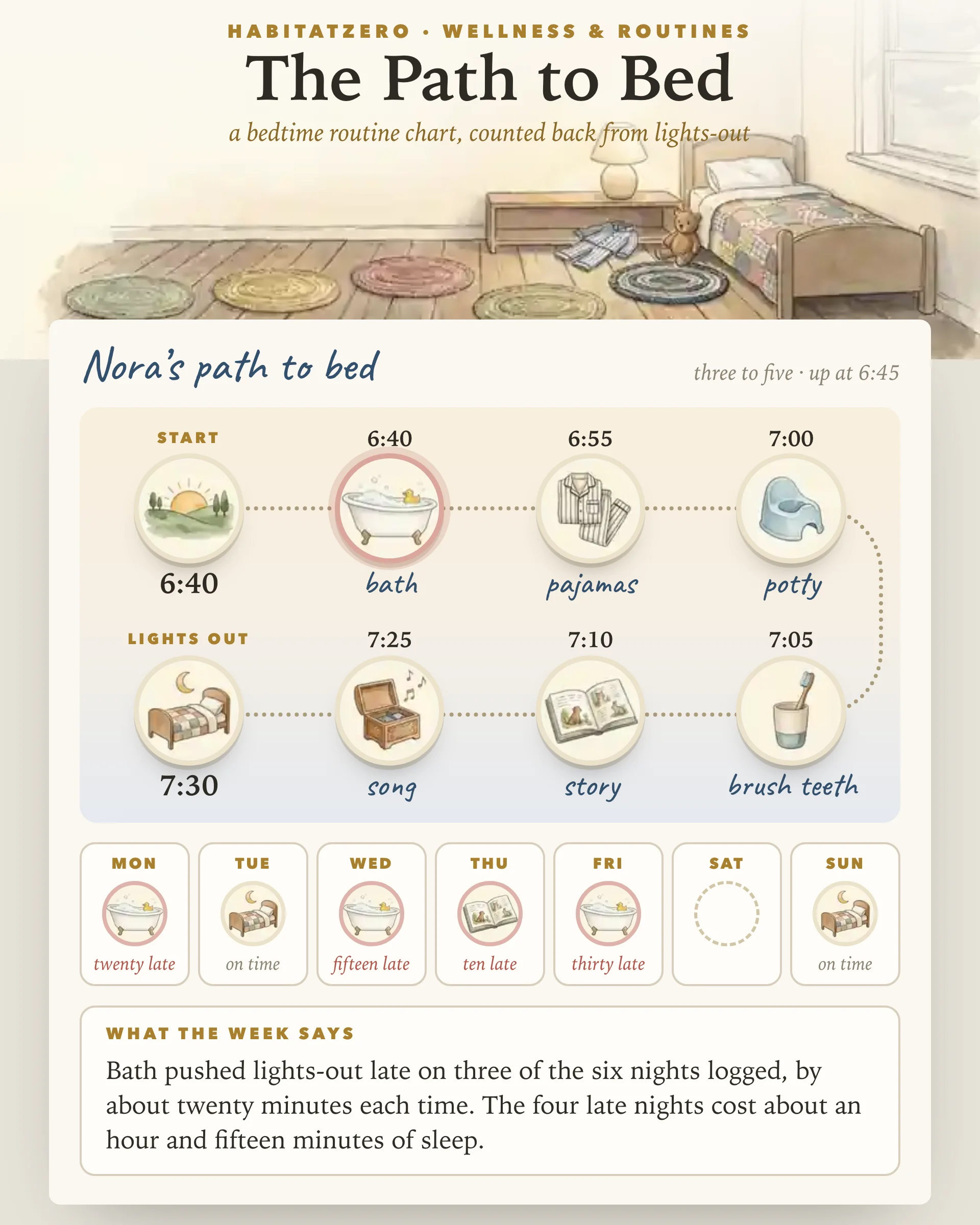
Bedtime with a young child rarely falls apart everywhere at once. It gives way at one step: the bath that turns into a swim, the second book that becomes a third. Lights-out slides a little later, the morning alarm doesn't, and the difference comes out of your child's sleep. This bedtime routine chart lays the evening out in pictures your child can follow, then helps you find the step that keeps giving way.
Sleep researchers describe a bedtime routine plainly: the same activities, in the same order, every night before the lights go out. A child who can't read yet can still follow that order when they can see it, which is the whole case for a visual bedtime routine. A picture on the door answers "what comes next?" before it turns into a debate.
What goes on the path is your family's call. The American Academy of Pediatrics sums up its own version as Brush, Book, Bed: help with brushing, read a favorite book or two, and go to bed at a regular time. Its one ordering rule: the toothbrush should be the last thing to touch teeth before bed. Milk or a snack belongs before brushing, and if you lay a snack stone after teeth, this page says so.
The path starts at a setting sun and ends at a bed. Tap the painted pictures in the order your evening runs and each lands on the path as a stone, up to eight. Write your own for anything the pictures miss; it gets a plain stone with its first letter, ready to draw over on the printout. Tap any stone to change its minutes, move it earlier or later, or take it off with two taps.
Every stone carries its clock time, counted back from lights-out, and the first stone tells you when to begin. Some families call this a night time routine chart; either way, the start time is worth working out rather than guessing.
Below the path, give your child's age and waking time. The chart works out the hours from lights-out to morning and sets them against the ranges in the American Academy of Sleep Medicine's consensus statement: eleven to fourteen hours a day for ages one and two, ten to thirteen for ages three to five, and nine to twelve for ages six to twelve. For the two younger groups those hours include naps, so the chart asks about naps and adds them in. If the night falls outside the range, one tap moves lights-out to the nearest time inside it.
The ranges are wide and sleep needs vary from child to child, so treat them as a band to stay within rather than a number to hit.
After lights-out, tap tonight in the row of seven nights, then pick how many minutes late it ran and the stone where it stalled. By the third night it can name the step that stalls most often, its usual overrun, and roughly how much sleep the late nights cost if the morning stayed put.
That leaves two honest choices. Plan for the step as it really goes: one tap gives it the extra minutes and moves the start earlier, so lights-out holds. Or shorten it, with a five-minute warning before the bath ends or the number of books settled before the first one opens. The nights already logged stay until you clear the week, so the next seven test the new plan.
The clearest test of a routine on its own is a 2009 randomized trial with 405 mothers of children aged seven months to three years. For two weeks the routine group kept the same three steps each night, a bath, a massage and quiet time such as cuddling or a lullaby, with lights out within half an hour of the bath. Their children fell asleep faster and woke less often and more briefly, and the mothers' mood improved. Johnson & Johnson's consumer products company paid for the study, and three of its four authors worked there, which is worth weighing.
A 2015 survey of more than ten thousand children under six in thirteen countries found a dose effect: the more nights a week a family kept a routine, the earlier the bedtimes, the quicker children fell asleep, and the longer they slept. That is an association, not proof, though it points the same way. No study has tested picture charts as such; this one simply makes the same order easy to keep, which is the part the research supports.
Lay the path on a calm afternoon with your child choosing a picture or two, then print it and tape it low on the bedroom door. Log a week before changing anything. If mornings are the harder end of the day, the Out-the-Door Morning Chart counts back from the minute you leave; the Kids Daily Routine Chart covers after-school routines with cards your child turns over; and The Visual Schedule lays out a whole day in pictures.
If bedtime battles don't ease with a steady routine, or your child snores loudly or lies awake for long stretches, bring it up with your pediatrician.
Only the steps your child really does each night, in the order they happen, each with a picture: a bath or a wash, pajamas, the potty, brushing teeth, a book or two, a song or a cuddle, then lights out. The American Academy of Pediatrics boils its own version down to brush, book, bed, and asks that the toothbrush be the last thing to touch teeth, which puts any snack or milk before brushing.
Work back from the time they wake. The American Academy of Sleep Medicine suggests eleven to fourteen hours in a day for ages one and two and ten to thirteen for ages three to five, naps included in both, then nine to twelve hours from six to twelve. So a five-year-old who wakes at 6:45 and no longer naps needs lights-out by 8:45 at the latest to reach ten hours.
No official length exists. In a 2009 trial with babies and toddlers, lights went out within half an hour of the bath ending, and the families saw faster sleep and fewer night wakings. This chart adds up your own stones and shows the total from the first one to lights-out, so a routine creeping past an hour is easy to spot.
Evenings often slip at one stubborn step, and it tends to be the same one. Log a week of nights here, with the minutes late and the stone where things stalled, and the chart names that step and its usual overrun. Then either plan for its real length and start earlier, or give a five-minute warning before it ends.
The filled path on this page is a fixed sample. Laying your own stones, keeping the week of nights and printing the finished path for the bedroom door all happen once you personalize it in HabitatZero, which costs nothing.
By the team behind Fabulous, the science-based self-care app used by over 30 million people.


