The Overwhelm Recovery ProtocolWellness & Routines · ~5 min
About this template · Updated September 2026
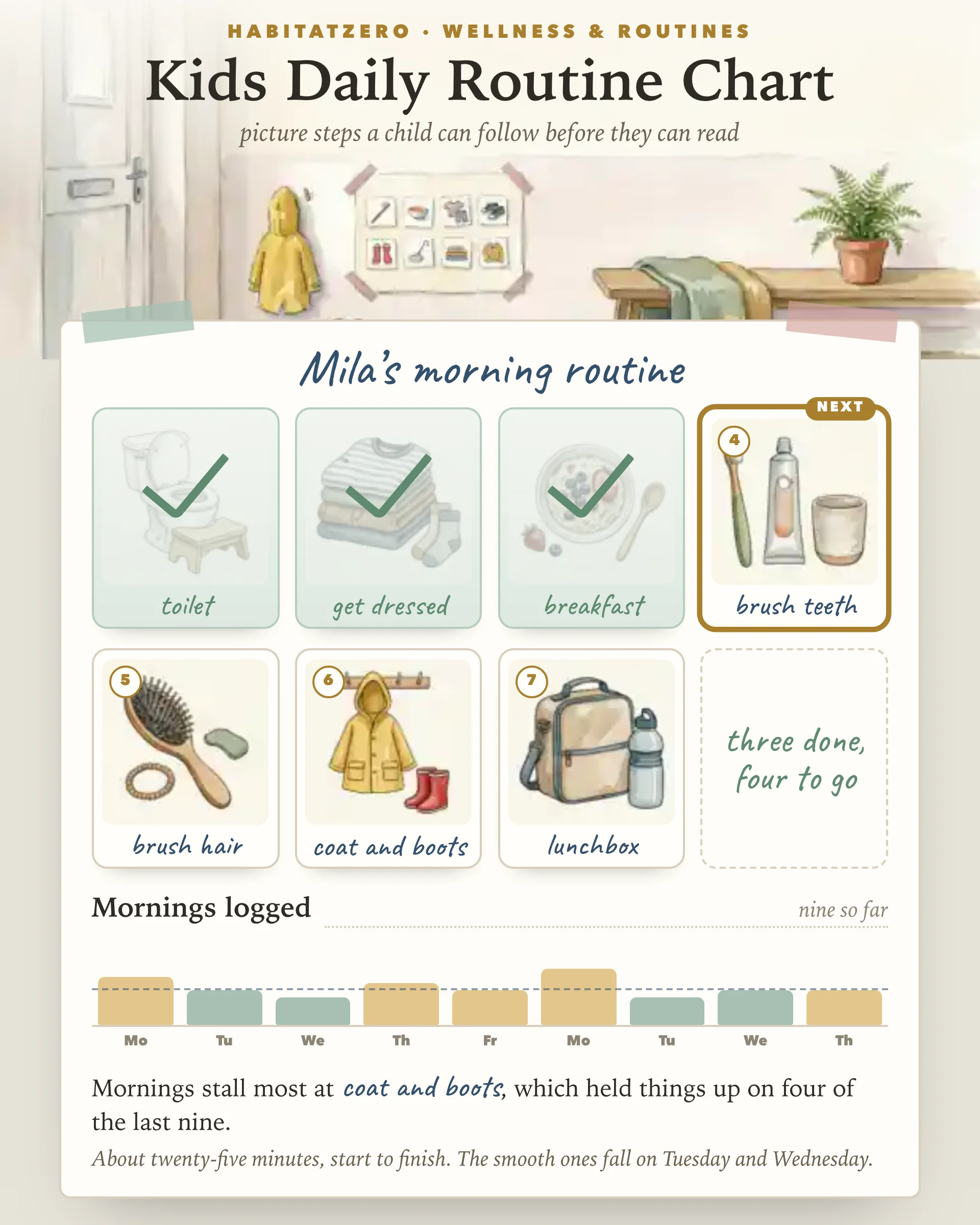
Most hard mornings with a young child break down at the same one or two places. It might be shoes, or getting dressed, or the long drift between breakfast and brushing teeth. A picture routine chart helps on two fronts. It shows your child what comes next without anyone saying it for the fifth time, and if you note how each day actually went, it shows you where the routine keeps catching.
A four-year-old can't follow a written list, but they can follow a row of pictures. Put one routine's steps in order, a toilet, a stack of clothes, a bowl, a toothbrush, and the chart turns into a sequence your child can check for themselves. The prompt moves from your voice to the wall, which tends to land better with a child who is tired of being told.
Keep each chart to a single routine: morning, after school or bedtime. Four to eight pictures is plenty; past that, the chart becomes a list someone has to read aloud again.
Order matters more than most printables admit. Use the order your child actually follows in your house, not the one a template came with. If breakfast has to come before getting dressed because otherwise the clean shirt ends up wearing oatmeal, put breakfast first.
Choose the routine at the top, then tap the painted pictures in the order it runs; each one lands as a numbered card. Sixteen pictures cover the common steps, from the toilet and the lunchbox to the bath and lights out, and you can write your own step when yours isn't there. Arrows move a card earlier or later, and taking one off needs a second tap. Eight cards fill a chart.
When the order looks right, switch the chart to use and hand your child the screen. They tap each card as the step gets done, the card turns over to a green check, and the next one gets a gold ring. Turned cards go face up again by the next day.
After the routine, log the day with two quick picks: where it stalled, or that it ran smoothly, and roughly how long it took. If your child turned the cards as they went, the chart already knows the time from the first card to the last and suggests it. Each logged day adds a bar to a small chart, and once three are in, a reading appears: the step that holds things up most often, the usual length of the routine, and the weekdays that tend to go smoothly. That reading is the part no printable can give you.
Print the chart and you get the pictures in order, large, with an empty circle under each one for a check mark or a sticker.
The case for routines in early childhood is real but mostly correlational. A review of fifty years of family-routine studies found routines linked to parenting competence, child adjustment and marital satisfaction, while warning that the studies measured routines inconsistently and leaned on convenience samples, so cause and effect are hard to separate. For bedtime in particular, an international survey of mothers of more than ten thousand children aged five and under found that a consistent bedtime routine went with earlier bedtimes, falling asleep faster, fewer night wakings and longer sleep, and the more nights a week families kept it, the better those outcomes looked.
Picture schedules themselves have been studied mostly with autistic children. A review of that work concluded that visual activity schedules can be counted as an evidence-based practice for autistic learners, especially when adults also teach the child how to use them. Because that research comes largely from autism and special education settings, it says less about a typical preschooler at home. Nothing here promises better sleep or better behavior. What the chart can do is make the routine visible to your child and show you honestly where it stalls.
Build the chart with your child, not for them. Let them tap in a picture or two, and hang the printed copy at their eye level, near where the routine happens: by the front door for mornings, in the bathroom for bedtime.
Change one thing at a time. If coat and boots is the hold-up on four mornings out of nine, try a single fix, such as setting the boots by the door the night before, and log another week before you judge it. If one step keeps stalling on its own, a first-then board can carry just that step: first boots, then the swing. If the whole routine runs but needs a reason, a token board turns finished charts into tokens toward something small. And when routines run on their own and your child is ready for real jobs around the house, move up to a printable chore chart.
Build the chart on a calm evening, not in the middle of a rough morning. Run it for a week before you change the order, and log as many days as you can, including the bad ones. The bad days are where the pattern shows.
One routine per chart, with four to eight steps shown as pictures and a short word under each, in the order your child actually does them. Morning, after school and bedtime are the natural places to begin, since those stretches of the day repeat.
Four to eight is a comfortable range for young children. Fewer than four hardly needs a chart, and past eight it turns back into a list that someone has to read out loud, which is why this one stops at eight cards per routine.
Yes, with an adult alongside. Start with two or three pictures for the part of the day that goes wrong most often, point at each one as it happens, and add cards once your toddler starts pointing first. At this age the pictures carry the chart, not the words.
It does not have to. Turning the last card over is often reward enough for a young child. If a routine needs more pull, keep the reward small and immediate, such as choosing the bedtime story, and tie it to the whole chart rather than to every step.
The filled chart on this page is a fixed example. Building your own, with your child's steps in your order, turning cards over each day and keeping the log, happens when you personalize it in HabitatZero at no cost. From there it prints as a clean picture chart for the wall, with an empty circle under each card to check off.
By the team behind Fabulous, the science-based self-care app used by over 30 million people.