The Overwhelm Recovery ProtocolWellness & Routines · ~5 min
About this template · Updated September 2026
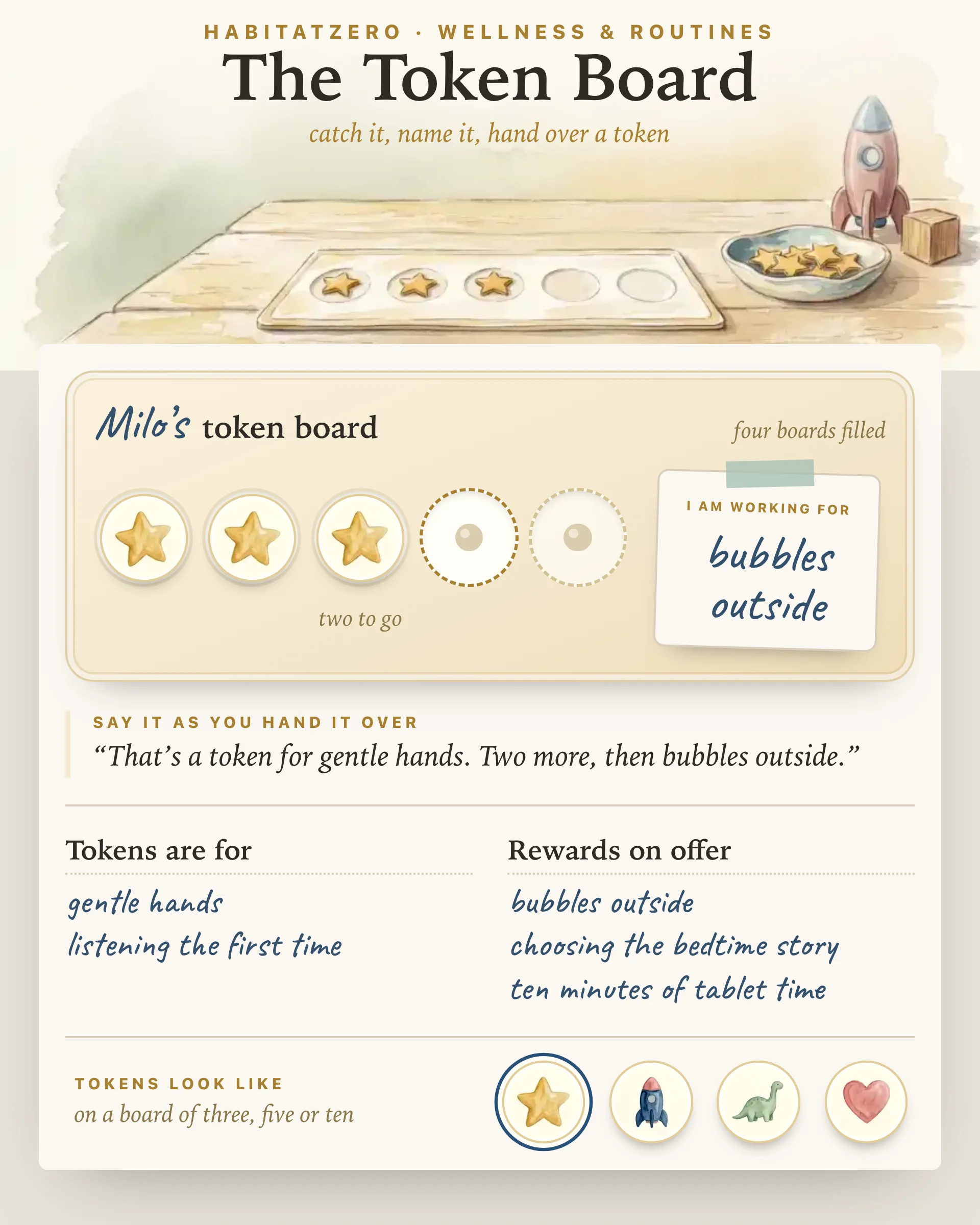
Credit where it started. The token board is a pocket-sized descendant of the token economy, which psychologists Teodoro Ayllon and Nathan Azrin first described in 1965 after using exchangeable tokens on a hospital ward. Boards like this one are now everyday equipment in special education. This page is Fabulous's own version of the format, built independently. It has no tie to Ayllon, Azrin, or any ABA provider or curriculum, and none of them has looked it over or put their name to it.
Picture a strip of card with a few empty spots and a note of something your child wants. Each time they do the thing you are trying to build, a token goes on a spot. When the last spot is covered they get the reward, straight away.
The cleverness is in the gap it closes. "Behave at the supermarket and we'll go to the park on Saturday" asks a five-year-old to connect Tuesday's effort to Saturday's outing. Ayllon and Azrin wrote that their tokens served "to bridge the delay between behavior and reinforcement". The token arrives within seconds, visibly one fifth of the way to something real.
Start with the card that says I am working for. Tap a suggestion or write your own, with your child beside you, because the reward they picked is the one they will work for. Until that card is filled, the board refuses every token.
Next, name up to three things that earn a token, each worded as something to do: gentle hands, not no hitting. A child can aim at "waiting for a turn". Nobody can aim at "stop it".
When you catch the behavior, tap its button. A painted star, rocket, dinosaur or heart lands on the next spot, the count left updates in plain words, and the board hands you a sentence to say out loud, such as "That's a token for gentle hands. Two more, then bubbles outside." That sentence does more work than the star. It tells your child exactly what they did, which is the only part they can repeat.
When the last spot fills, the card is stamped earned, the board lists which behaviors filled it, and it waits for you to press reward given. Then the spots empty and the count of boards filled goes up by one.
Reward first, and keep it small. Each reward should be deliverable within a minute of the board filling, which rules out Saturday's trip and rules in bubbles, a card game, or choosing the snack.
Earned tokens stay earned. The only removal is an undo for a slip of the finger, and even that needs a second tap. Taking tokens back as a penalty is a documented procedure called response cost, and this page deliberately leaves it out, so a rough last hour can never wipe out a good first one.
The size is part of the deal. Boards come with three, five or ten spots, and once a token is down the number locks until the board is finished. Moving the finish line halfway through teaches a child that the board cannot be trusted.
Three behaviors, no more. When everything earns a token, the token stops pointing at anything.
Sixty years of study is not the same as certainty. When researchers weighed classroom token economies for students with challenging behavior against the What Works Clearinghouse standards, they concluded that the published studies did not add up to sufficient evidence to call the approach best practice. That is different from evidence of failure, but it is a good reason to treat a board as something you try and watch, not a guarantee.
The original 1965 report carries its own caution. The behaviors it strengthened dropped when the tokens stopped and came back when they resumed. A board works while it is running, so plan the exit early. After three full boards at one size this page suggests a longer one, and later on, more praise and less board.
The worry that rewards spoil motivation has some support too. A meta-analysis of 128 experiments found that tangible rewards, and rewards people were told to expect, lowered their later free-choice interest in the rewarded activity. Tangible rewards tended to do more harm with children than with college students, while positive feedback on the whole raised interest. A fair reading for a parent: keep the board away from anything your child already does for love, like drawing or reading, and save it for what is currently hard.
A token board is a teaching aid, not an assessment or a treatment plan. If behavior is dangerous, or a school team or behavior analyst is already involved, their plan comes first.
Pick one routine that reliably falls apart, such as getting dressed, the homework half hour or the walk through the shop, and run the board only there. For weekly jobs with a fixed list, the Chore Chart is the better fit. When the hard moment is a wave of feeling and not a missing skill, set up a Calm Corner first, and keep Rainbow Breathing nearby for the minutes before any board makes sense.
It is a small board with a handful of empty spots and a picture or note of something the child wants. An adult places a token each time a chosen behavior shows up, and a full board is traded for the reward. Token boards are everyday tools in special education and autism support, and the format suits any child who does better when progress is visible.
Start with as few as it takes for the child to win quickly. Three spots fit a first week or a brand-new skill, five is the usual size for one activity or outing, and ten is for a child who already trusts that the reward will come. This board offers all three and suggests a longer one after several full boards.
Not on this board. Removing tokens as a penalty exists in the research under the name response cost, but this page leaves it out on purpose: a board that can also confiscate stops being purely about catching good moments. The only removal here is an undo for a mistaken tap, and it needs a second tap to confirm.
A sticker chart usually tracks a fixed list of jobs across a week. A token board is faster and looser: tokens arrive within seconds of the behavior, the board fills in one sitting or one day, and the reward is agreed before the first token is given.
You can look through the filled example on this page in any browser. Handing out your own tokens, keeping the count of boards filled and saving your reward list happens once you personalize the board in HabitatZero, which costs nothing.
By the team behind Fabulous, the science-based self-care app used by over 30 million people.