The Overwhelm Recovery ProtocolWellness & Routines · ~5 min
About this template · Updated July 2026
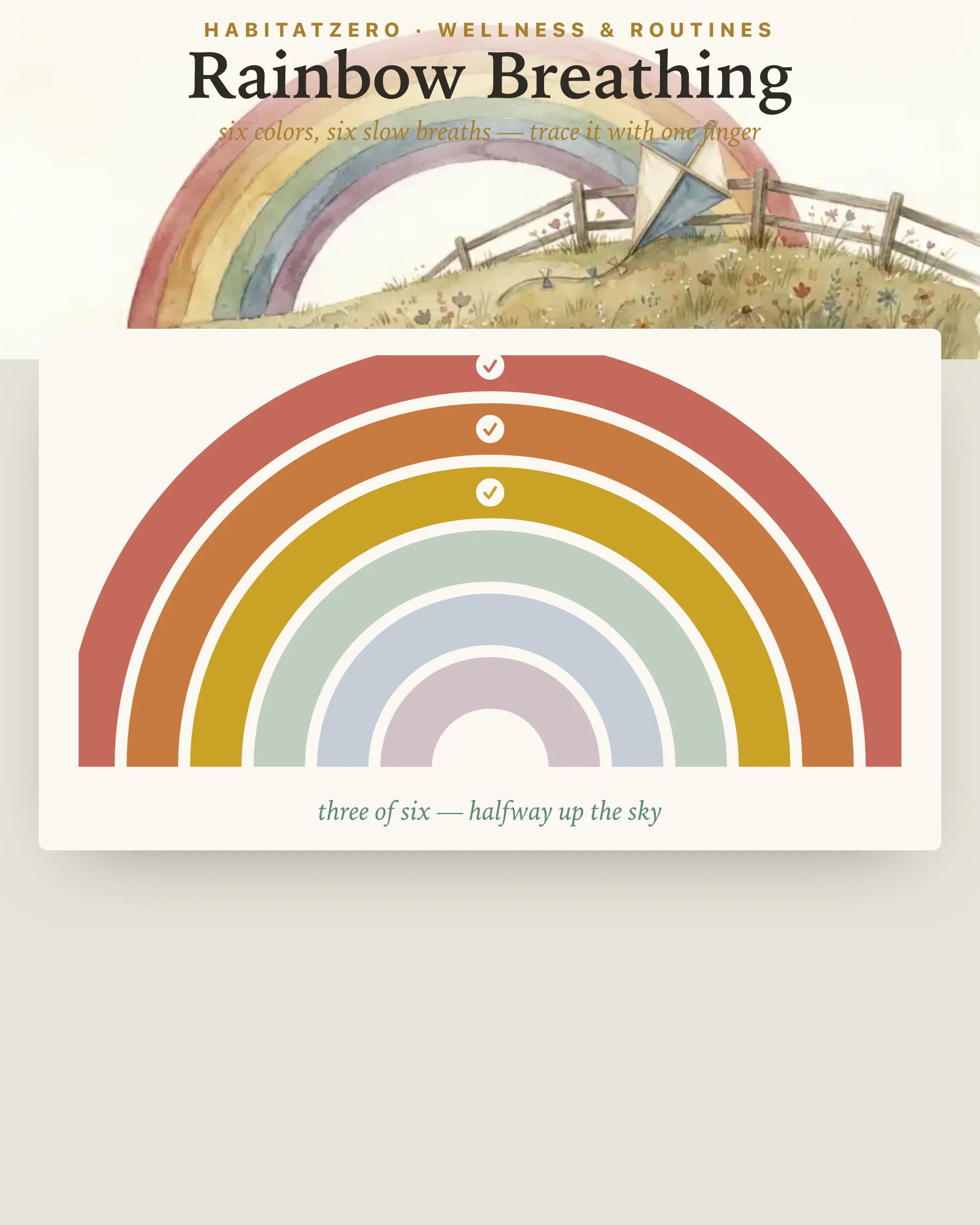
Some tools for kids work because they're clever. This one works because it's obvious. A rainbow has an up side and a down side, and a breath has an in and an out — put a finger at the bottom of the red band, trace up while breathing in, come down the other side breathing out, and one color equals one slow breath. Six bands, six breaths, and the moment that was too big is usually a size smaller. This page is written for the grown-up; the rainbow is for whoever needs it.
Start at the dot. The red band has a marked starting point at its bottom-left. Finger on the dot, and the journey begins on an in-breath.
Up is in, down is out. The arc is deliberately long — tracing it at finger speed stretches the breath without a single instruction about how to breathe. You can feel when you've rushed an arc, which makes the rainbow self-correcting in a way that "take a deep breath" never is.
One color per pass, moving inward. Red, orange, yellow, green, blue, violet. On the printed sheet the tracing is the whole game. On screen, tap a band when its pass is done and it stamps with a small check — and when all six are traced, a sun comes out at the corner of the sky, which is exactly the right amount of ceremony.
There's a traced by line at the bottom, because a sheet with your name on it gets used differently than a worksheet — it becomes my rainbow.
The honest version: the research on slow breathing is mostly about grown-ups, and it's encouraging. Unhurried breathing at around six breaths a minute sits in a sweet spot for the body's calming reflexes — famously shown when researchers found that reciting the rosary or a yoga mantra naturally slows breathing to that pace and steadies cardiovascular rhythms. And studies of slow diaphragmatic breathing in healthy adults found improvements in attention and stress markers after practice. A long arc traced at finger speed lands a child in the same neighborhood — the rainbow is simply a pacer a four-year-old can operate, no counting required.
Whether it becomes a lifelong skill or just a good ninety seconds on a hard afternoon, both outcomes are wins.
Introduce it in fair weather — a calm after-breakfast rainbow teaches the skill; a mid-meltdown debut asks a new skill to perform under pressure, which is unfair to skills and children alike. Do the first one together, fingers side by side, your breath setting the pace slower than feels natural. Then let the sheet live where the moments happen: the fridge, the car door pocket, folded in a backpack.
And keep it an invitation. Want to do a rainbow with me? keeps the rainbow friendly; sending a child off to do their breathing turns the kindest tool into a chore. Most parents discover they end up breathing along — the sheet regrettably fails to check whose feelings were big.
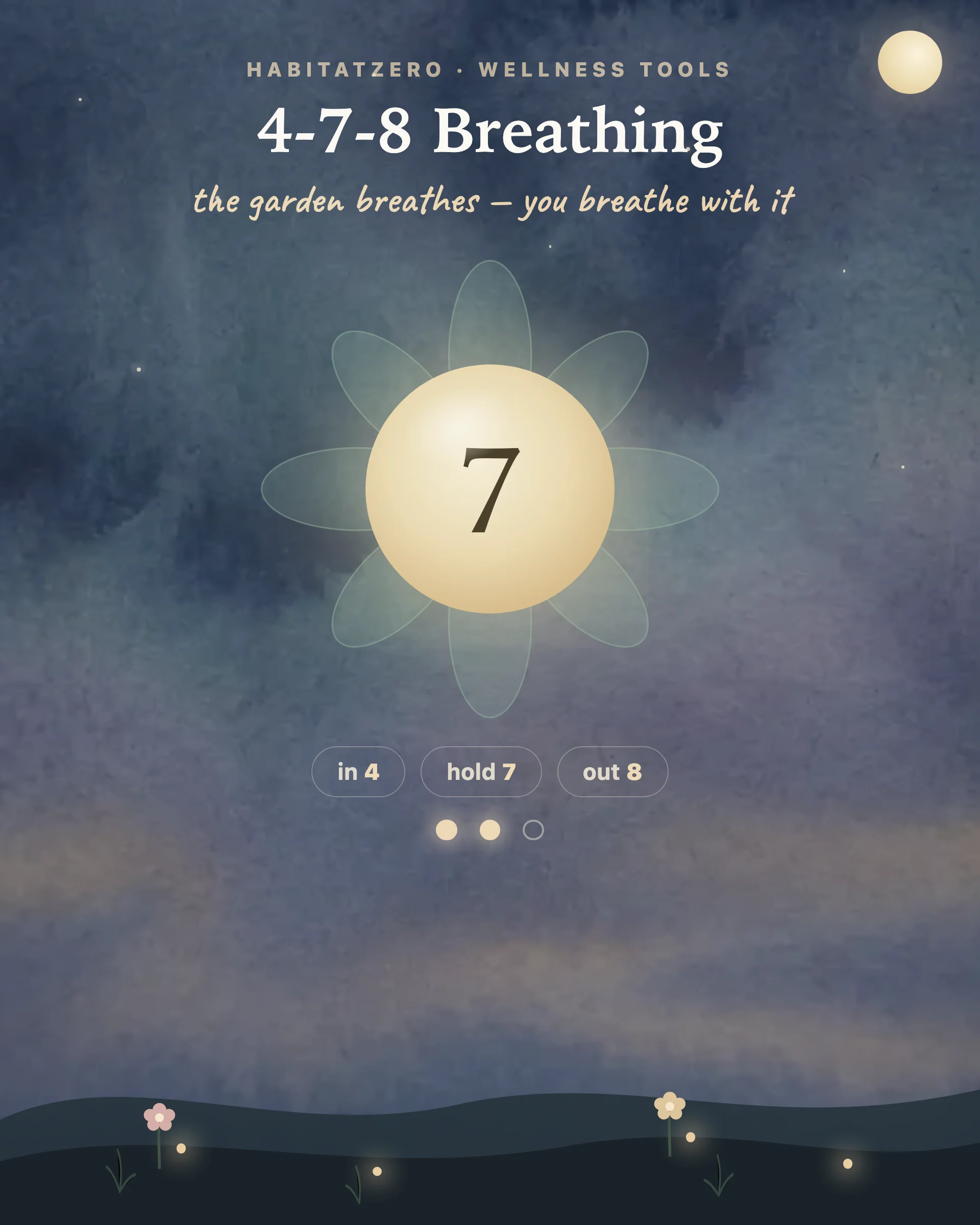
HabitatZero keeps a small shelf of tools for households. The calm-down corner is the room this rainbow belongs in — a parent-built spot with a breathing flower, feelings faces, and a what-helps-me list; this sheet slots straight into it. For the grown-ups, box breathing and 4-7-8 breathing are the same slow-breath idea with the training wheels off.
Print it. Put a finger on the red dot. The sky does the rest.
A way to make slow breathing visible and traceable for a child. The rainbow has six color bands; a finger traces up one side of a band while breathing in and down the other side while breathing out, then moves inward to the next color. Six colors make six slow breaths — enough to let a big moment shrink to child size. No counting, no instructions to remember: the arc itself does the pacing.
Together, and when things are calm — a skill learned in fair weather is the one that works in a storm. Print the sheet, put your finger on the red dot, and do the first rainbow side by side, letting your own breath set a slow pace. After that it can live on the fridge, in the car door pocket, or folded in a backpack. Keep it an invitation, never a consequence: 'want to do a rainbow with me?' works; 'go do your rainbow' doesn't.
Any moment that needs a slower gear: the wind-down before bed, the wobbly minutes after a big feeling, the car outside school, the pause before homework. It also works as a lovely ordinary ritual — a rainbow after breakfast costs ninety seconds and starts the day at walking pace. Many families find the grown-up ends up breathing along, which is not an accident worth avoiding.
Because a finger on paper gives the breath somewhere to go. Counting is abstract and easy to rush; an arc is long, physical, and honest — you can feel when you've hurried it. The slow pace matters most: unhurried breathing, around the pace the long arc naturally enforces, is the part research keeps finding does the settling. The rainbow is simply a pacer a four-year-old can operate.
Any child old enough to trace a line with a finger — and there is no ceiling. The printed sheet works for a toddler doing it hand-over-hand with a parent, a school-age kid running passes alone, and honestly for the grown-up who printed it. If your child is past rainbows, the box breathing and 4-7-8 pages are the same slow-breath idea in grown-up clothes.
By the team behind Fabulous, the science-based self-care app used by over 30 million people.