The Overwhelm Recovery ProtocolWellness & Routines · ~5 min
About this template · Updated July 2026
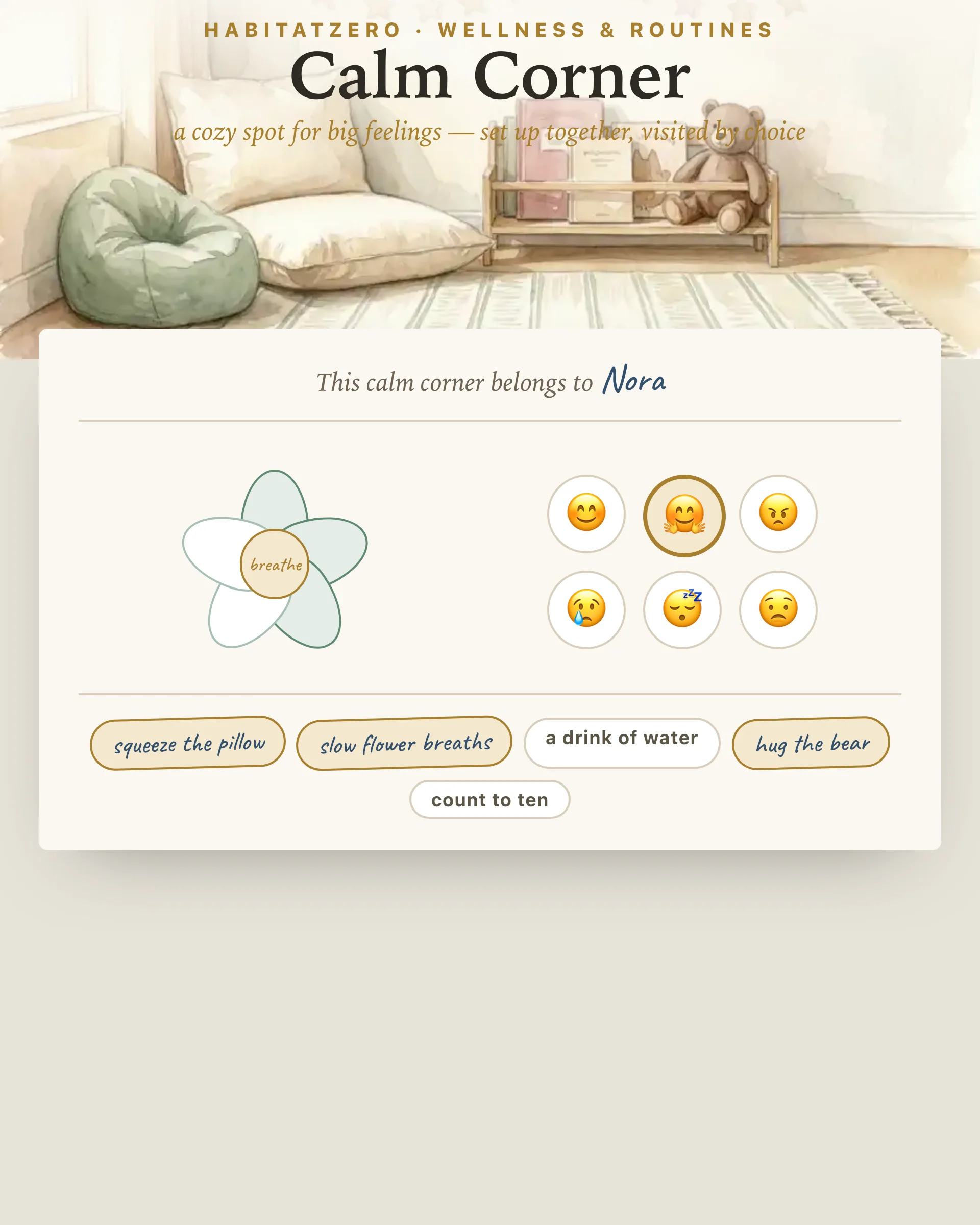
Somewhere between the classroom Pinterest boards and the sensory-bin shopping lists, the calm down corner acquired a reputation for requiring equipment. It doesn't. A corner needs three things: somewhere soft to land, a reason it belongs to the child, and one or two tools small enough for small hands. This printable sheet is the third part — the poster that hangs on the corner's wall and quietly does the teaching.
The breathing flower. Five petals, one slow breath each, traced with a finger until the flower is full. Slow breathing is the rare settling tool that works at every age and travels everywhere — the research summarized in a systematic review of breath-control studies links slow techniques with genuine physiological calming — but for a five-year-old the mechanism matters less than the game: trace the petal, make the breath last the whole way around. On screen the petals fill with a tap; on paper, a finger does the work, which is rather the point.
The faces row. Six big faces — happy, worried, mad, sad, tired, need-a-hug — because pointing arrives years before vocabulary does. A child who can't say "I'm overwhelmed and I don't know why" can point at 🤗, and that point is a complete, successful communication. Parents' guides like the American Academy of Pediatrics' pages on helping children handle stress keep returning to the same theme: children manage feelings better when the adults around them make those feelings easy to show and safe to have. A row of faces at eye level is that policy, laminated.
The what-helps-me menu. Eight candidate helpers — squeeze the pillow, slow flower breaths, a drink of water, look at a book, count to ten, hug the bear, draw the feeling out, ask for a hug — of which your child picks up to four with you. The picking is half the value: a menu chosen together on a calm Tuesday is a menu that gets used on a loud Thursday. Four is the cap because a hard moment can choose from four; it cannot choose from twenty.
Set it up together, visit it for pleasant things first, and never send a child there. The corner is a place to go, not a place to be put — the moment it becomes the destination for trouble, it stops being a refuge and starts being a sentence. Write their name on the sheet in your own hand (there's a line for it), let them watch you hang it, and sit nearby the first few times. Company counts as calming.
The sheet prints clean — name, flower, faces, and the four chosen helpers, in the same warm inks as the screen — sized for a wall at kid height. It joins HabitatZero's small family of parent-printed, kid-used sheets: when the corner's resident is ready for missions rather than refuge, the chore chart and the kids reading log are the natural next posters for the same stretch of wall.
One cushion, one bear, one sheet. The corner does the rest.
A small, cozy spot — a cushion, a shelf, maybe a canopy — where a child can go when feelings get big. It is furniture, not a consequence: a place a child chooses to visit, stocked with a few things that genuinely help them settle. This sheet is the corner's wall poster, holding the three tools most corners need — a breathing exercise, a way to show feelings, and a menu of helpers.
Less than the photos on the internet suggest. A soft place to sit, one or two books, something huggable, and this sheet at eye level covers most homes. The magic ingredient is not the equipment — it is that your child helped choose what went in, which is exactly what the what-helps-me picker on this sheet is for. Four helpers, picked together, beat a basket of twenty sensory gadgets.
Build it together on a calm day, visit it together for pleasant things first — a story, a snuggle — and never send a child there. The corner keeps its power only as long as it stays a place your child chooses; the moment it becomes where you go when you are in trouble, it stops working. Sitting nearby while your child uses it counts as helping, especially at first.
The sheet is drawn for roughly ages two to eight — old enough to point at a face, young enough that the flower still feels like a game. Younger children will need you in the corner with them, doing the breaths together; older children often keep using the corner but graduate from the sheet, at which point HabitatZero's chore chart and kids reading log make good next residents of the same wall.
Yes — the page carries a print stylesheet, so printing produces the finished poster: their name in your handwriting, the breathing flower, the faces row, and the four helpers you picked together, all in the same warm inks you see on screen. Signed-in HabitatZero users also keep the interactive layer, where petals fill with a tap and picks are saved between visits.
By the team behind Fabulous, the science-based self-care app used by over 30 million people.