The Overwhelm Recovery ProtocolWellness & Routines · ~5 min
About this template · Updated July 2026
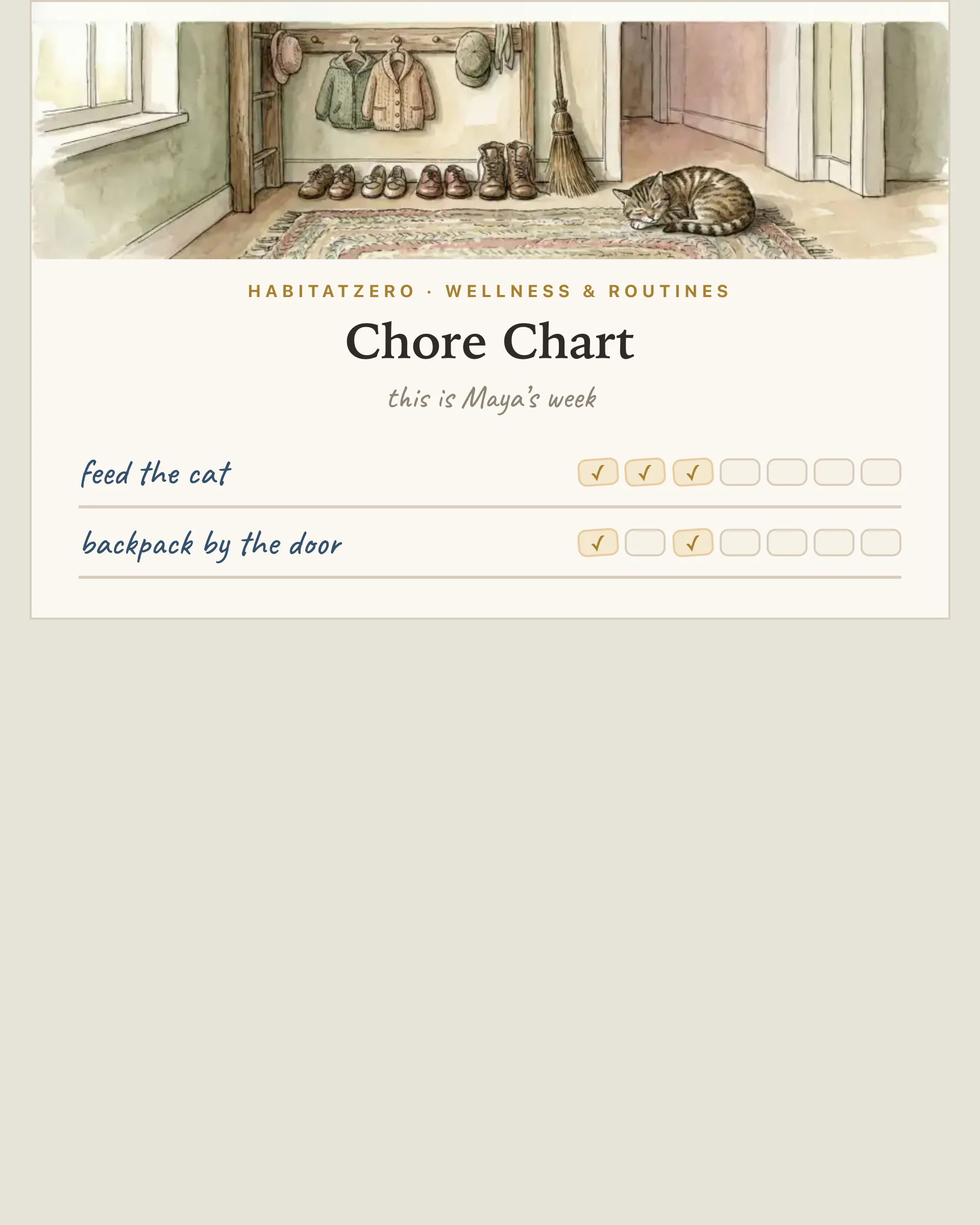
Every parent discovers the same law of household physics: a chore spoken evaporates, a chore written on the fridge persists. The chart isn't nagging — it's the end of nagging, because the expectations moved out of your mouth and onto the wall, where they can be checked without a negotiation. This page prints that chart, with one upgrade over the usual PDF: you edit everything before it prints.
Type the child's name and it sits at the top of the printed page. Type the chores in your family's words — "feed the cat", "backpack by the door", "plates to the sink" — not someone else's laminated ideals. The difference sounds cosmetic and isn't: a chart that says Maya and the cat reads as belonging to Maya, while a generic printout reads as homework from the internet. Ownership is half the battle with chores, and it starts with whose words are on the page.
Keep the list short and finishable. Three to five chores a younger child can complete without help beats eight aspirational ones — the chart's job is to manufacture the experience of a full row, because full rows are what keep the week going. There's real machinery behind that: effort measurably accelerates as a visible finish line approaches — the same goal-gradient effect that makes a nearly-full coffee card irresistible — and recording progress at all reliably raises follow-through. A week of checkboxes is a finish line a seven-year-old can see from the couch.
The chart's bottom line prints whatever you type after when the week is full: — and the honest advice is to keep it small, weekly, and experiential. "Saturday pancakes, your call." "Movie night pick." "Thirty minutes later to bed on Friday." A near reward the child can picture beats a distant allowance ledger, and naming it on the chart itself turns the whole page into a single visible promise: fill the week, get the thing. One chart per kid; the household printer can handle the sibling rivalry.
One tap prints a clean letter-or-A4 page — light line art, ink-friendly, with a hand-drawn header that survives a black-and-white printer just fine. Print blank on Sunday night for the fridge, or print with the ticks made so far if you've been checking boxes on screen mid-week. And if mornings are the daily battleground rather than chores, the morning routine checklist runs the same trick on the school scramble — while the grown-ups' version of this page is the printable habit tracker, one door down.
Magnet it at kid height. The chart works best when checking the box is something they get to do, not something done to them.
Yes — free, in your browser, no signup and nothing to unlock. Type the name and chores and print as many copies as the household needs; the free page keeps nothing after you leave, so the fridge copy is the record. In the Fabulous app the same chart saves its ticks and syncs across devices.
Yes — that is the difference between this and the usual PDF. You type the child's name, the chores in your family's words, and the weekly reward; the printed page comes out with all of it in place. No PDF editor, no squeezing handwriting into preset rows.
Chores the child can finish without help, described so completion is obvious: feed the cat, backpack by the door, plates to the sink. Three to five is plenty for younger kids; the chart holds eight rows for older ones. In the Fabulous app, the chart can suggest age-appropriate chores from a one-line description of your kid.
The bottom of the chart carries one line — when the week is full: — and whatever you type there prints with it. Small and weekly beats big and distant: research on goal pursuit finds effort rises as the finish line gets closer, which is exactly what a visible week of checkboxes creates.
Yes — tap print and choose Save as PDF in the dialog. The chart is one letter or A4 page in portrait with light line art, so it prints fast and will not empty a cartridge.
By the team behind Fabulous, the science-based self-care app used by over 30 million people.