The Overwhelm Recovery ProtocolWellness & Routines · ~5 min
About this template · Updated September 2026
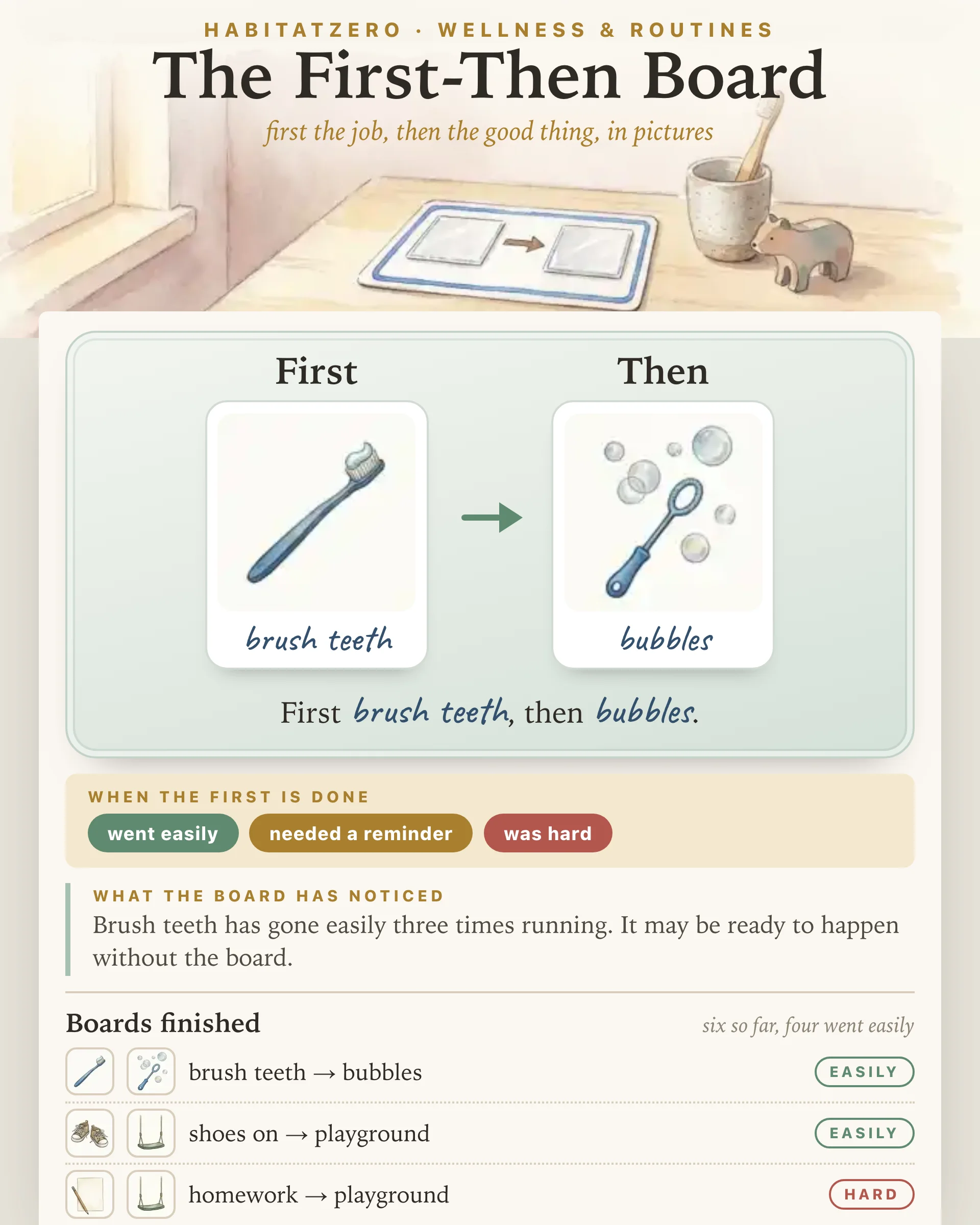
A first-then board is the smallest visual schedule there is: two pictures side by side. On the left, the job. On the right, what comes straight after it. The sentence you say while pointing at them is the whole method: first brush teeth, then bubbles. It is standard equipment in autism classrooms, and it works just as well on a kitchen table for a four-year-old who can hear the word "after" but cannot yet feel it.
A child who is refusing a task is rarely refusing the task itself. They are refusing the unknown length of it, the loss of whatever they were doing, or the fact that a grown-up's voice just got louder. The board answers all three at once. The job has a picture, so it has an edge. The good thing has a picture too, so it is not a promise floating in the air. And because the board is doing the asking, your voice can stay level.
The idea underneath is older than the board. In 1959 David Premack set out the observation that a more likely activity can serve as a reward for a less likely one, a rule that now carries his name. Grandparents got there first, which is why it is also called grandma's rule: eat your vegetables, then pudding. A first-then board is that rule made visible.
Tap a picture from the first row and it lands in the first pocket: brush teeth, get dressed, homework, tidy up, dinner, bath, shoes, pack the bag. Tap one from the second row for the then pocket: tablet, playground, snack, bubbles, a story, the trampoline, music, a cuddle. Anything else can be written in your own words and becomes a card of its own, up to five per side, so speech practice or choose the song are one tap away next time.
Under the pictures the sentence writes itself in your handwriting. The words on each card are yours to edit, so "tablet" can become "ten minutes of tablet" if that is the real deal.
When the job is done, you tap how it went: easily, with a reminder, or hard. A check lands on the first picture and the then pocket lights up with a small now. That is the moment to hand over the good thing, before you tidy anything else. Tap all done and the board clears, ready for the next pair; the pairs you have used sit under it as one-tap chips.
Every finished board goes into a log with its how-it-went mark, and the board reads that log back to you. Once a job has gone easily three times in a row, the board says so and suggests it may be ready to happen without a picture. If a job has been hard twice running, it suggests the opposite move: shrink the first, grow the then, or both. That reading is the reason to mark honestly. The fade is the point; the board is scaffolding, and scaffolding comes down.
Visual supports sit among the practices with the strongest research base for autistic children. The third-generation review of evidence-based practices for autism, covering studies from 1990 to 2017, found twenty-eight focused practices that met its evidence standard, and visual supports are one of them. A review aimed squarely at visual activity schedules, the family this board belongs to, went through the single-case studies and concluded that they can be considered an evidence-based practice for individuals with autism, especially when paired with systematic teaching.
Two honest limits. Most of that research is small single-case work in autism settings; it tells you the approach is worth trying, not that it will work for your child on Tuesday. And the studies mostly test longer schedules run by adults who prompt consistently, so the two-pocket board borrows its evidence from a bigger sibling. If a behavior specialist or school team already has a plan, theirs comes first. This page is a support to run, not an assessment of anything.
Reach for it at the transitions that regularly go wrong: getting dressed, leaving the playground, sitting down to homework, the bath. For a wave of feeling rather than a task, set up a Calm Corner first; a board cannot ask anything of a child who is already overwhelmed. For the week's jobs with a fixed list, the Chore Chart suits better, and when the whole day needs a shape rather than one pair, start with the Daily Routine and keep this board for the one step inside it that still sticks.
A first then board is a two-picture visual schedule. The left picture shows the job a child needs to do, the right picture shows what happens as soon as it is finished, and the adult reads the pair as one sentence: first this, then that. It turns a stand-off into a small deal the child can see.
A visual schedule lays out a whole stretch of the day, often six or more steps in a strip. A first-then board holds only the next step and its payoff. Children who cannot yet follow a long strip can usually manage one pair, which is why many families and classrooms begin with the two-pocket version.
Something the child genuinely wants and that you can hand over within a minute of the job ending: bubbles, the swing, a short turn on the tablet, a story, a snack. Far-off promises weaken the board. Here you can pick a painted picture or write your own words, and the caption under every card can be edited to match the real deal.
No. The format grew up in autism and special education settings, where visual supports have the strongest research base, but it helps any young child who follows after better when they can see it, including many children with ADHD, language delays, or just a stubborn week.
The example on this page is fixed so you can see how a set board reads. Filling your own pockets, editing the words, marking boards done and keeping the log means personalizing it in HabitatZero, which is free. From there it also prints as a clean two-picture sheet for the table or the fridge.
By the team behind Fabulous, the science-based self-care app used by over 30 million people.