The Overwhelm Recovery ProtocolWellness & Routines · ~5 min
About this template · Updated July 2026
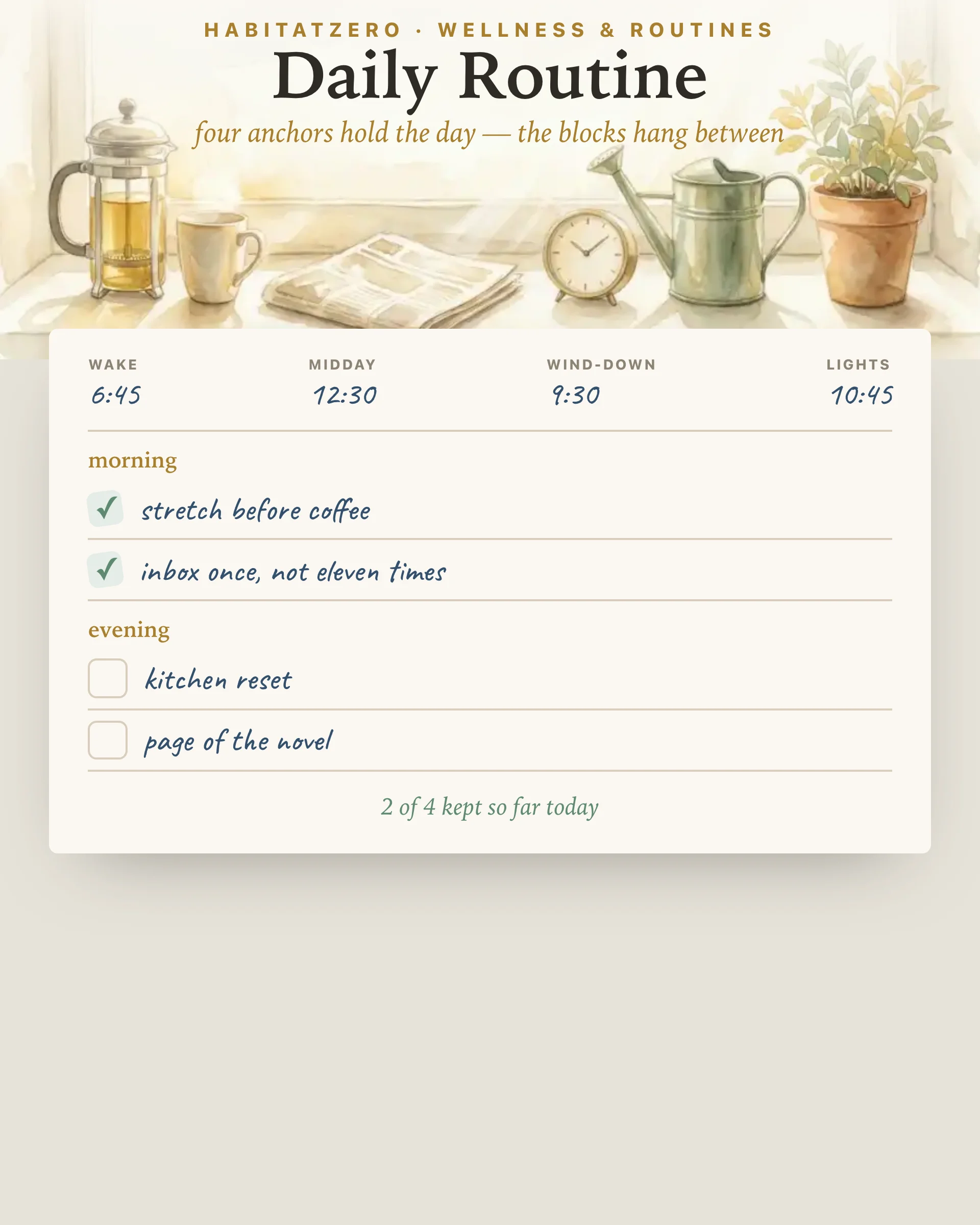
A daily routine template has one job: make tomorrow cheaper than today. Not more impressive — cheaper. Every decision the template absorbs (when do I get up, what happens after coffee, when do screens go dark) is a decision your tired evening self doesn't have to litigate. The sheet above does this with deliberately little machinery: four anchor times, a handful of blocks hung between them, and a tick for each block as the day spends it.
The template opens with wake, midday, wind-down, and lights out because rhythm is the part of a routine that does the heavy lifting. The lifestyle-medicine literature on daily routines ties regular daily patterns — consistent sleep timing, meals, activity — to better sleep and healthier functioning, and notes that the regularity itself, not the specific content, carries much of the benefit. That's why the anchors come before any blocks: a mediocre routine at the same times beats an inspired one at random times. Write the anchors in your own words — "screens off 9:30" holds better than a bare number because it names the act, not just the hour.
Between the anchors, the day gets three loose hooks — morning, midday, evening — and your blocks hang on them. No minute-scheduling, no duration fields. That looseness is load-bearing: the habit-formation research followed people building small daily behaviors and found automaticity grew from repeating an action in a stable context, with missed days here and there costing little. "After the morning hook" is a stable context that survives a moved meeting; "7:15–7:30" is a promise the first dentist appointment breaks. Keep each block small enough that a bad day can still keep it, and let the chip carry it to a different hook when life reorganizes the day.
Ticking a kept block is the whole reward system — the count climbs, and a fully-kept ordinary day gets called what it is: a quiet victory. Tomorrow morning, the fresh-day sweep clears the ticks and the same template stands ready again. Nothing rolls over, nothing accumulates into guilt. A routine chart that remembers your misses becomes a ledger of failure by Friday; one that wakes up blank every day keeps inviting you back, which is the only feature that matters in week six.
Print it if paper is where your routines live — the printed page drops the buttons and keeps the chart, anchors on top, empty tick boxes ready for a pen on the fridge.
Two layers: fixed anchor times that give the day its skeleton - waking, a midday marker, a wind-down cue, lights out - and a short set of repeatable blocks hung between them. The anchors rarely change; the blocks evolve. Templates fail when they try to script every hour instead of just holding the frame.
Yes - the sheet prints clean, with the add controls and buttons stripped away so what lands on paper is the chart itself: your anchors on top, your blocks grouped by time of day, and empty tick boxes ready for a pen. Fill it here first or print it blank and write by hand.
Fewer than enthusiasm suggests. The cap here is twelve, but most durable routines run on five to eight - enough to shape the day, few enough that a normal Tuesday can actually keep them. A routine long enough to feel like a second job gets quit like one.
That checklist owns one stretch of the day and runs it step by step with timing. This template holds the whole day at lower resolution: four anchors, three day-parts, and blocks you tick whenever they happen. Use the morning checklist inside this template's first hook if your mornings need the extra structure.
Because days differ but anchors repeat. An hourly schedule breaks the first time a meeting moves; anchor times - wake, midday, wind-down, lights out - survive almost any Tuesday. Regular daily rhythms are consistently linked with better sleep and steadier mood, and the anchors are where that regularity lives.
By the team behind Fabulous, the science-based self-care app used by over 30 million people.