The Overwhelm Recovery ProtocolWellness & Routines · ~5 min
About this template · Updated September 2026
School mornings rarely fall apart at the front door. They fall apart somewhere around breakfast, and you only find out at the door, when everyone is hunting for a shoe and the bus is already at the corner. By then nobody can say where the minutes went.
A morning routine chart earns its spot on the wall when it answers one question at a glance: where should we be right now? For that it needs clock times, not just a list of jobs with boxes to tick.
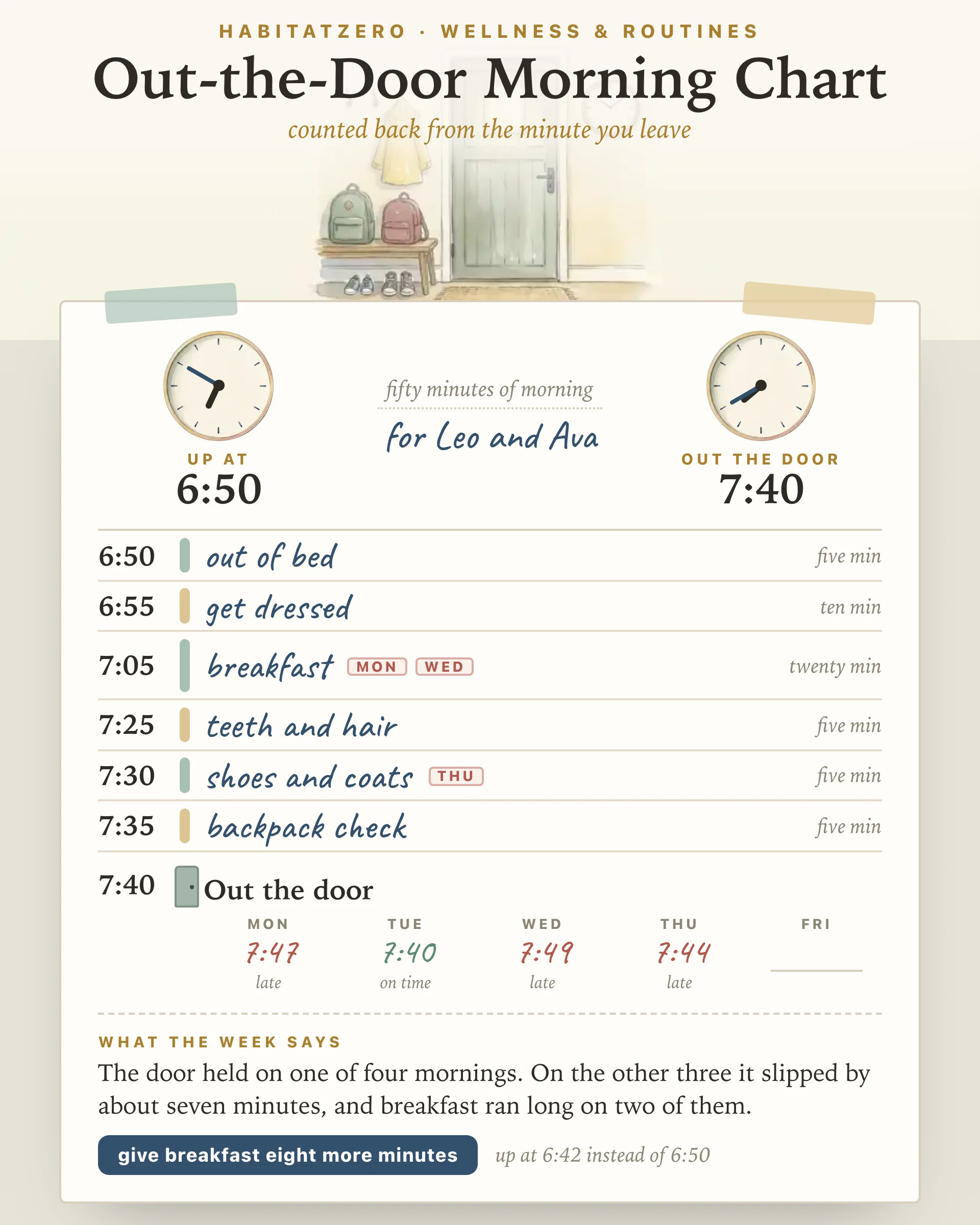
The way to get those times is to start from the one moment that cannot move, the minute you have to leave for the bus or the bell, and work backward. Say you leave at 7:40 and the last three steps are brushing teeth, shoes and coats, and a backpack check, five minutes each. Then the backpack check starts at 7:35, shoes and coats at 7:30, and teeth at 7:25. Keep climbing and you reach the time the first child has to be out of bed.
That subtraction is what this chart does for you. You set the door clock, tap the steps in the order your kids really do them, and every row shows the time it should start. The painted clock at the top shows the wake-up time your steps add up to, so a child who is still learning to read a clock face can compare it with the one on the kitchen wall.
Your first version of the morning will probably be too hopeful, and that is not a character flaw. In a series of studies, Roger Buehler, Dale Griffin and Michael Ross found that people's forecasts of how long their own tasks would take were too optimistic across a range of tasks. People pictured the plan going smoothly instead of recalling how similar tasks had actually gone, and in one study the optimism disappeared when they were asked to tie the forecast to that past experience.
Memory is part of the trouble too. A review by Michael Roy and colleagues argues that people remember past tasks as shorter than they really were, so even an estimate built on experience comes in low. Breakfast feels like a fifteen-minute job because the last one felt like fifteen minutes.
So stop estimating and start noting, which is why this chart asks about real mornings.
A review of fifty years of research on family routines, by Barbara Fiese and colleagues, found regular routines linked with parenting competence and children's adjustment, while noting that the studies measured routines in inconsistent ways, relied on convenience samples, and did not untangle direct effects from indirect ones.
So a chart is not a proven cure for dawdling, and this page does not claim to be one. What it can do reliably is put the plan where everyone can see it, and keep the plan honest by checking it against what really happened on Monday, Tuesday and Wednesday.
Build it at the start of a school year, after a change such as a new bus time, or when the same argument keeps repeating at the door. Log a full week before you change anything, because a single bad morning says very little.
If the morning you want to fix is your own rather than the family's, the Morning Routine Checklist walks one adult through their steps with a gentle timer. For a younger child who digs in at one particular step, a First-Then Board sets that job beside what comes after it, and a Token Board can reward the step that keeps running long.
The steps between getting up and leaving, in the order your children actually do them, each with the clock time it should start. Once a child can read a clock, a start time does more work than a picture, because it can be checked against the clock in the kitchen.
Start from the minute you have to leave and count backward, giving each step the minutes it really takes rather than the minutes it ought to take. Then test the chart against a few real mornings, since most families find at least one step is longer than they thought.
Yes. Personalize it in HabitatZero, which costs nothing, and you can change the leave time, the steps, their minutes and their order, then print a clean copy for the wall. Your chart and its week of logged mornings stay saved there.
Usually one step takes longer than the chart allows, and it is often not the one you would guess. Note when you really left and which step dragged for three or four mornings; the pattern shows up quickly, and giving that step its real minutes fixes more than hurrying does.
If your children leave together and do the same steps, one shared chart keeps everyone on the same clock. If their mornings really differ, or one child needs longer for a step, give each child a chart of their own. Children who cannot read yet tend to do better with picture cards than with clock times.
By the team behind Fabulous, the science-based self-care app used by over 30 million people.