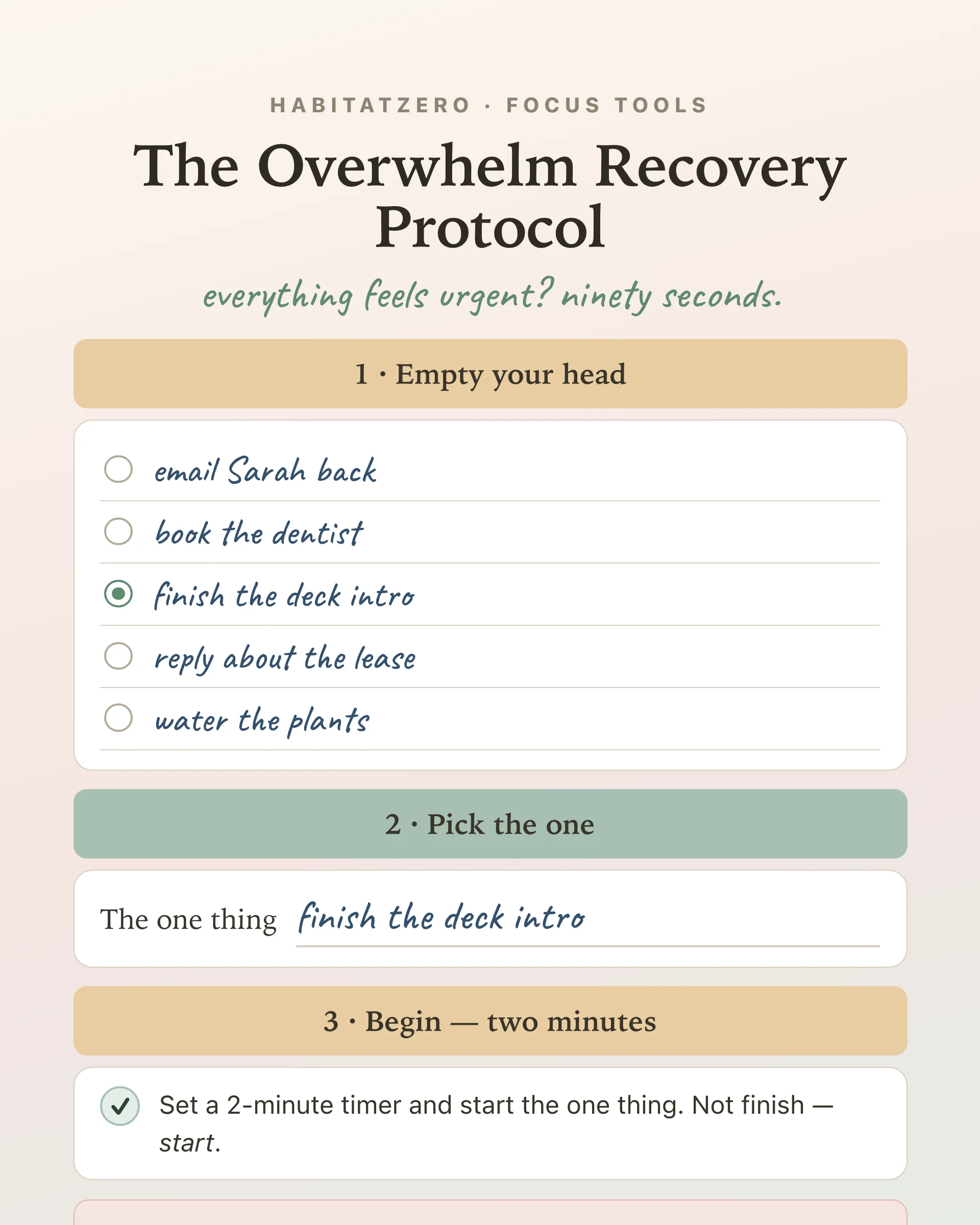
The Overwhelm Recovery ProtocolWellness & Routines · ~5 min
About this template · Updated September 2026
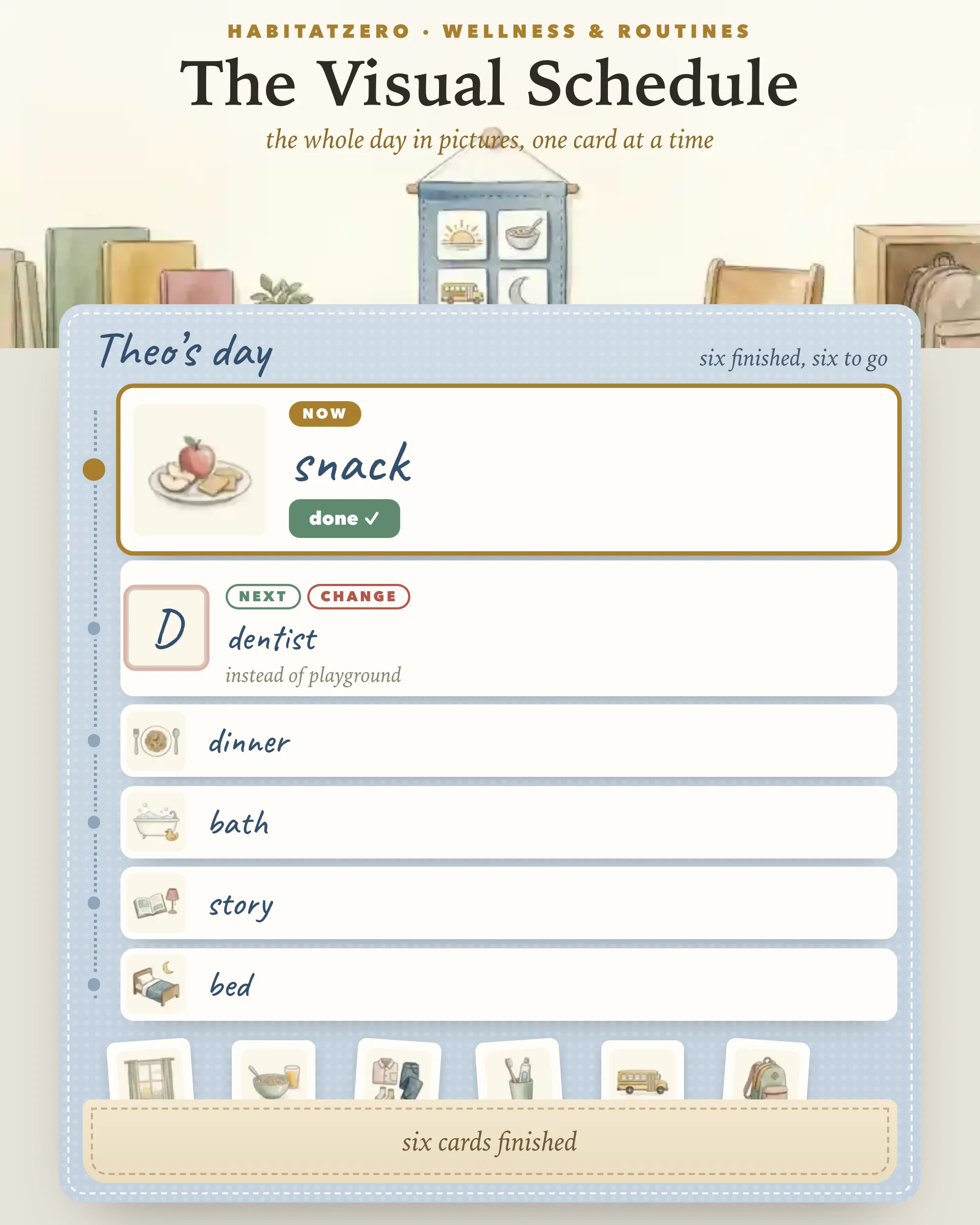
A visual schedule shows a child the day as a row of pictures: breakfast, the bus, school, a snack, the park, bath, bed. One card for each activity, in order, hung where the child can see it. Instead of asking what comes after lunch, your child looks at the strip.
For many children the hard part of the day is the gaps between activities: leaving the playground, switching off the tablet, finding out that gym moved to the afternoon. A schedule your child can check turns those moments from surprises into something already on the wall. It also takes a job off your voice. You point at the card, and the card does the reminding.
Visual schedules are most closely studied with autistic children, but the idea suits any child who finds transitions hard, cannot read a clock yet, or gets swamped by a spoken list of plans. That covers many kids with ADHD, children starting at a new school, and plenty of toddlers. You do not need a diagnosis to use one, and using one says nothing about a diagnosis. In a classroom, the same strip can sit on one child's desk as a student visual schedule while the class schedule stays on the board.
Start from a ready-made school day, class day or day at home, which double as visual schedule examples you can edit. Or tap the painted cards in the order the day really runs. A picture can come back later, like a second snack, just never twice in a row. Anything the pictures miss, from swim lessons to a visit with Grandpa, goes on a card in your own words. Fourteen cards is the ceiling, since a longer strip stops reading at a glance.
Drag a card by its dots, or use the arrows. Then start the day. The top card is now, the card under it is next, and tapping done drops the finished card into the pocket at the foot of the strip, like the finished envelope on a classroom wall. Tapped too soon? Put the last one back.
Two controls do what a paper strip cannot. The first sets how much your child sees at once: the whole day, three cards at a time, or only now and next. The second is the swap mark on each card. When a plan changes, swap the card for what happens instead, and the strip marks it as a change. It lasts for today; tomorrow the usual card is back and the pocket starts empty.
When the strip looks right, print it as a sheet of cut-out picture cards with a label for the finished pocket.
The firmest evidence comes from work with autistic learners. The National Clearinghouse on Autism Evidence and Practice counts visual supports, a family of tools that includes visual schedules, among its evidence-based practices for children, youth and young adults with autism, drawing on sixty-five studies published between 1990 and 2017. A separate review of twenty years of research found thirty-one studies of visual activity schedules with autistic students. Sixteen of them met the review's quality bar, and the authors concluded that the schedules qualify as an evidence-based practice, especially when adults pair them with systematic teaching.
Transitions are where the effect shows most plainly. In one small study, two autistic boys began the next activity sooner once visual supports marked the change, and one needed fewer spoken and physical prompts. The evidence for ADHD is thinner. A study of two boys at risk for ADHD found that their on-task behavior during independent work rose after they were taught to follow an activity schedule.
Much of this research follows a handful of children at a time, the schedules were usually taught on purpose rather than simply hung up, and a schedule is a support for the day, not a cure or a test for anything. What the studies do back is the modest claim that seeing the day helps many children move through it.
Teach the checking, not just the chart. For the first week, walk your child to the strip at each change: look at the card, do it, put it in the pocket. Then walk a little less each day, until the checking is your child's.
Use the same words at every change and let the card lead. Snack is finished. Check your schedule. Then point, and wait.
Put a change on the strip before it happens, not after. A dentist visit in place of the playground goes down easier when it has been on the card since breakfast.
Match the length to the child. If the whole day is too much, switch to three at a time or now and next, and lengthen it as the routine settles.
A visual schedule covers the whole day. For one job your child resists, the First-Then Board pairs it with what comes right after. For the steps inside one morning or bedtime routine, try the Kids Daily Routine Chart. If motivation is the snag, The Token Board adds a reward to count toward. And when your own day needs a shape too, Daily Routine does it for grown-ups.
It is the order of a day shown as pictures, one activity per card, placed where a child can see it. The child checks the strip to find out what is happening now and what comes next, and moves each finished card out of the way, so the day holds fewer surprises.
The most common version is a vertical strip of picture cards on a wall or fridge with a pocket at the bottom for finished cards. Young children usually need simple pictures and only two or three cards in view, while older kids can take in a whole day, often with a word under each picture.
Begin with the order the day actually runs, not the ideal version. Use one clear picture per activity and a short word under it, then teach the checking routine: look at the strip, do the card, put it in the finished pocket. When plans change, change the card first.
Most of the research involves autistic learners, and for them visual schedules count as an evidence-based practice. Studies of children with ADHD are fewer and smaller, though one found two boys at risk for ADHD were on task more often once they learned an activity schedule. Plenty of families and teachers use one for any child who struggles with changes.
The sample strip on this page is yours to look through. Building your own child's day, running it with the finished pocket and printing it as cut-out cards all open up when you personalize it in HabitatZero, which costs nothing.
By the team behind Fabulous, the science-based self-care app used by over 30 million people.