
The Overwhelm Recovery ProtocolWellness & Routines · ~5 min
About this template · Updated November 2026
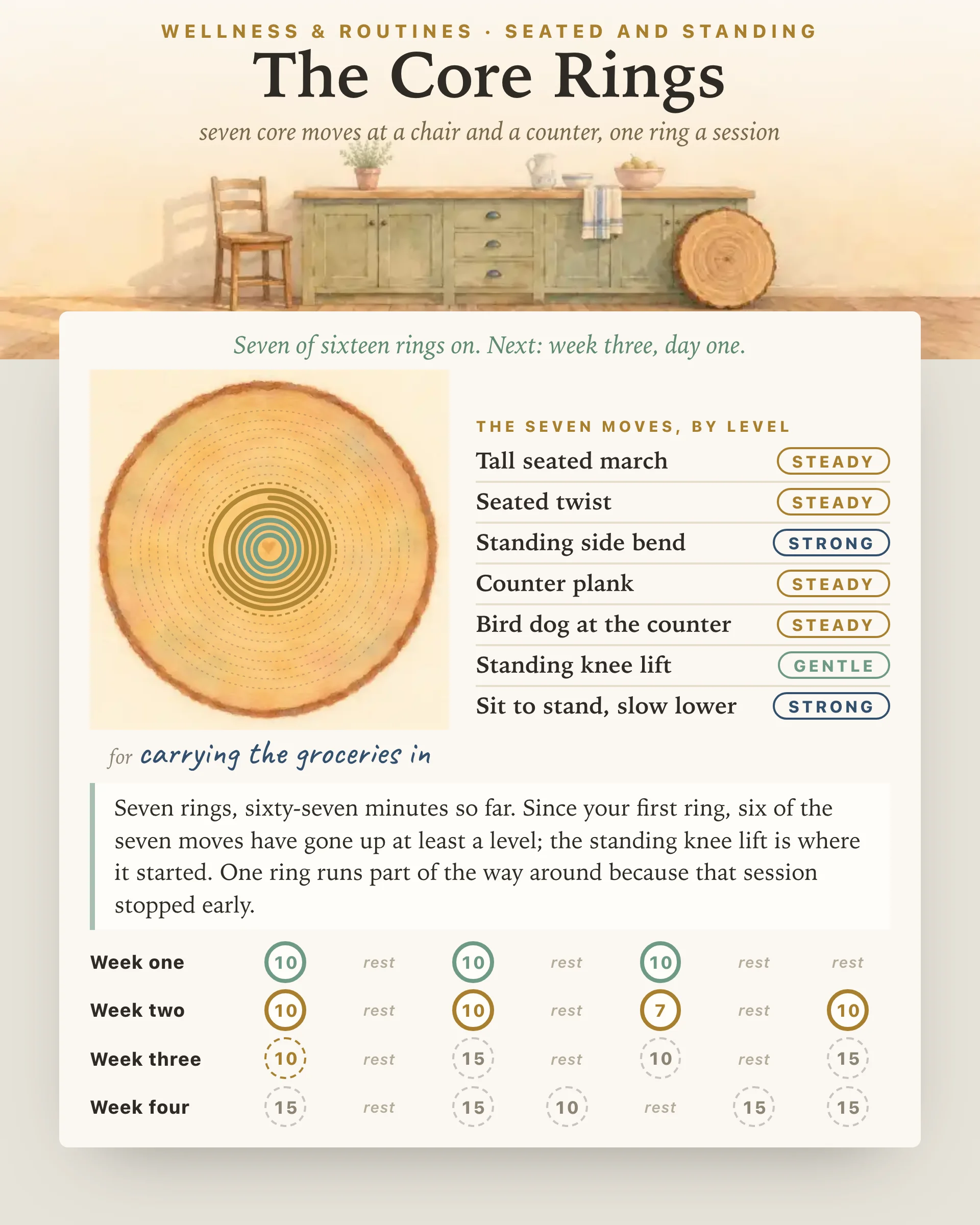
Most core routines start with "lie on your back," and for many people past sixty getting down to the floor is the hard part. The core exercises for seniors on this page skip the floor entirely. Every move happens on a sturdy chair or at a kitchen counter, and each comes in three levels, so the same seven moves can grow with you over four weeks.
Your core is the band of muscle around your middle: deep belly muscles, the muscles along your spine, the sides of your waist and the pelvic floor. It holds your trunk steady while your arms and legs do something else, so you notice it in plain moments: standing up from a low couch, twisting for the seatbelt, carrying groceries from the car.
Each move on the sheet names the everyday job it rehearses:
Pick a level for each move before you start. Gentle is seated or with both hands down, steady asks a bit more of your hold, and strong adds a slower count or a light weight while one hand stays on the counter. Each move keeps its own level, and you can lower one mid-session.
Then press start. The timer gives a two-minute warm-up, one minute per move in a ten-minute session or a minute and a half in a fifteen-minute one, and a slow cool-down. It reads the clock, so a locked screen does not throw it off, and paused time does not count.
Each finished session grows a ring on the trunk slice, from the heart outward, colored by that day's levels: sage for mostly gentle, gold for mostly steady, blue for mostly strong. Stop early and the ring runs only as far around as the minutes you did. A short reading compares your first ring with your latest and names the moves that have gone up a level.
The plan runs four weeks: three ten-minute sessions in week one, four in week two, four with two stretched to fifteen minutes in week three, and five in week four, with rest days between most.
A level is right when you finish its whole minute with steady breathing and good form. Once a move feels like that two sessions running, try the next level for that move only. If the steady counter plank makes your shoulders ache, go back to gentle; a gentle ring is still a full ring.
Breathe out through the hard part of each move. Holding your breath while you brace briefly raises blood pressure, so avoid it, especially in the plank holds.
A systematic review by Granacher and colleagues gathered twenty studies on trunk strength in older adults. It found small to medium links between trunk strength and balance, everyday function and falls, and core training programs that seniors stuck with and that improved strength and balance scores. The authors also rated most of those trials as modest in quality and asked for better ones.
In a pilot trial of twenty-four adults aged sixty-five to eighty-five, Kahle and Tevald found that six weeks of home core exercises, three times a week, improved reach and balance test scores against a group that did not exercise. A pilot that small shows promise, not proof.
A Cochrane review of exercise for preventing falls in older people found that programs built mainly on balance and functional exercises lowered the rate of falls. Those programs were broader than core work, and no study shows that these seven moves alone change your chance of falling. Treat this page as one part of staying active, alongside walking and balance practice such as The Balance Ladder or The Whole-House Strength Routine.
Talk with your doctor or a physical therapist before the first session if you have had a fall, dizzy spells, a joint replacement, surgery on your back or belly, a hernia, a heart or blood pressure condition, or pain that lingers. Stop any move that hurts, and keep a sturdy chair or the counter within reach whenever you are standing.
If floor work is easy for you and you want a harder daily challenge, try The 30-Day Ab Challenge. If standing is the trouble, The Chair Circuit keeps the whole session seated. For a harder standing circuit with no floor work, The Standing Cairn builds core work on your feet.
Moves that train the trunk to stay steady while the arms and legs work: a tall seated march, a seated twist, a side bend, a plank leaning on a kitchen counter, a bird dog with hands on the counter, a standing knee lift and a slow sit to stand. Each one mirrors an everyday job such as getting up from a chair or reaching for a high shelf.
Yes. Every move on this sheet is done on a chair or standing at a counter. The counter plank stands in for a floor plank, and the seated march and twist work the belly and the sides of the waist without lying down at all.
This plan starts with three ten-minute sessions in the first week and builds to five in the fourth, with rest days between most of them. Health guidelines suggest strength work on two or more days a week for older adults, so short core sessions fit alongside walking, leg work and balance practice.
Start at gentle for most moves, which keeps you seated or with both hands down. Move one up to steady once you can finish its minute with even breathing two sessions running, and drop back any time a move hurts or feels shaky.
Ask your doctor or a physical therapist first if you have had a fall, dizziness, a joint replacement, back or belly surgery, a hernia, a heart or blood pressure condition, or ongoing pain. Breathe out during the effort, stop anything that hurts, and keep the chair or counter within reach whenever you stand.
By the team behind Fabulous, the science-based self-care app used by over 30 million people.


