
The Overwhelm Recovery ProtocolWellness & Routines · ~5 min
About this template · Updated November 2026
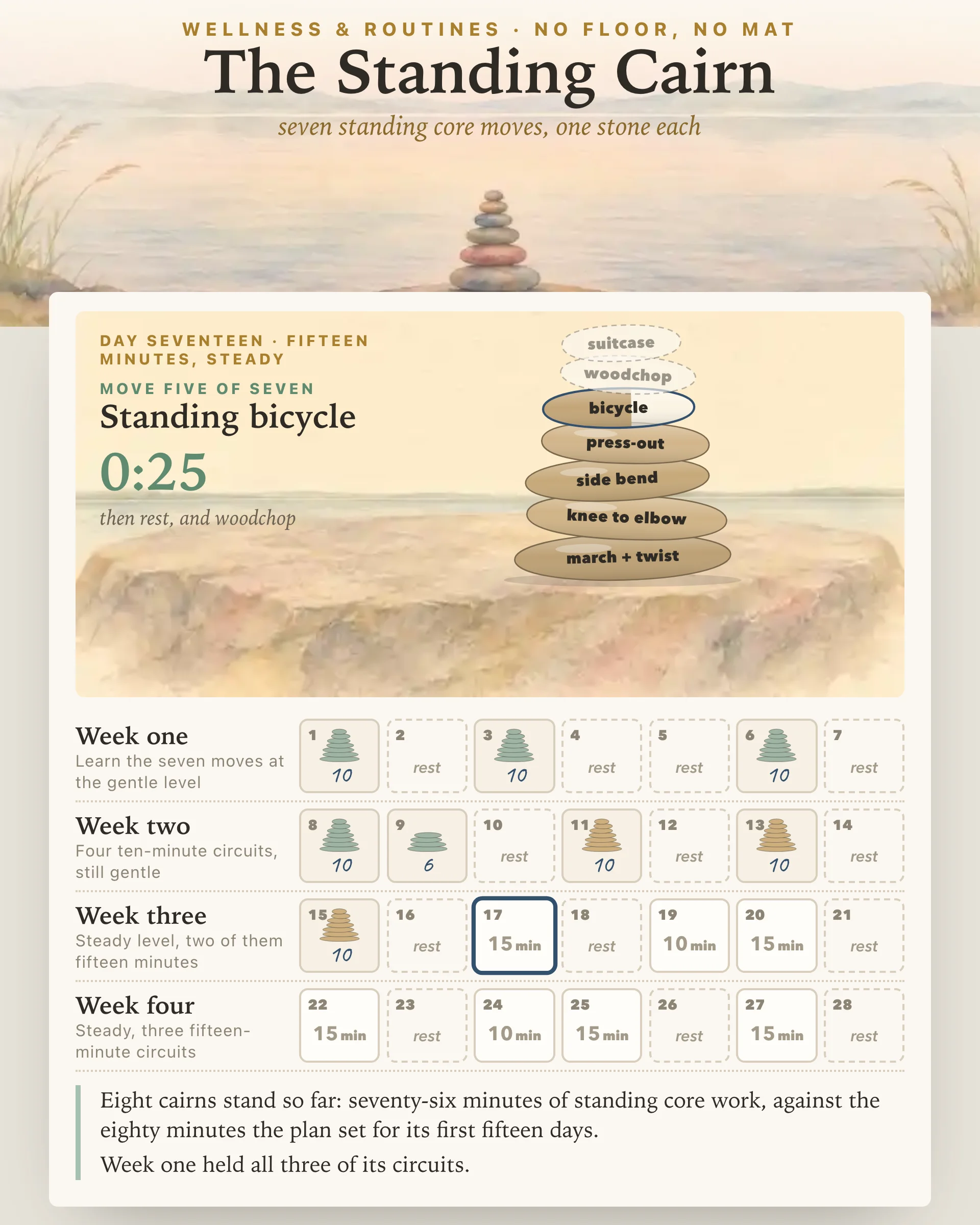
Most ab routines begin by asking you to lie down. That is a real obstacle when getting to the floor is slow, when your back grumbles about it, or when your only clear space is the kitchen floor by the counter. Standing ab exercises skip the mat entirely. They also train your trunk the way you use it: upright, carrying groceries, turning to reach a seat belt.
This page turns seven of those moves into a short circuit you follow with a timer, and four weeks of circuits you can watch build up.
Each one gives your trunk a different job.
Every move comes at three levels. Gentle keeps a hand on the counter whenever a foot leaves the floor and uses little or no weight. Steady frees both hands and adds a full water bottle. Strong asks for a heavier weight and a pause at the hardest point.
Pick ten or fifteen minutes and a level. Ten minutes gives each move a one-minute slot; fifteen gives it a minute and a half, with a longer warm-up. The level sets how much of each slot is work: half of it at gentle, most of it at strong. The timer names each part, tells you when to switch sides, and shows what comes next during every rest so you can grab the bottle in time.
The cairn on the painted ledge is your progress. Each move you finish sets its stone, from the march at the bottom to the suitcase hold at the top. Stop early and the stones you earned stay put. The clock works from the real time that has passed, so a screen that locks mid-circuit does not leave you behind, and a pause is never counted.
Below it, four weeks of circuits sit in a grid. The plan opens with three gentle ten-minute circuits, moves to four, then shifts to the steady level and to fifteen minutes on some days. Set each circuit on its day and a small cairn appears there, shorter if you stopped early. A brief reading adds up your minutes against the plan, says which weeks held, and notices when three full circuits in a row suggest moving up a level.
Start with the honest part. Ab exercises do not burn fat off your belly. In a small trial, six weeks of abdominal exercises five days a week left belly fat, waist size and overall body fat no different from a group that did nothing, although the exercisers did get noticeably better at curl-ups. Fat comes and goes across the whole body, with food, sleep, movement and time. This page does not promise a flat stomach.
What a stronger trunk offers is quieter and more useful. A systematic review of trunk strength in older adults found that trunk strength goes along with better balance and everyday function, and that core training programs improved strength and balance scores. The authors also rated the studies as modest in quality and asked for better ones, so read that as promising rather than settled. Nothing here shows that these seven moves on their own will prevent a fall.
The World Health Organization's 2020 guidelines on physical activity advise muscle-strengthening work on two or more days a week for adults. A standing circuit covers part of that; your legs, back and arms still want their own work.
If you have had a fall, dizzy spells, a joint replacement, back or belly surgery, a hernia, a recent pregnancy, a heart or blood pressure condition, or pain that lingers, ask your doctor or a physical therapist which of these moves suit you. Keep a hand near the counter whenever one foot is off the floor, breathe out on the effort rather than holding your breath, and stop any move that hurts. A twinge is information, not a dare.
Reach for it when getting down to the floor feels like too much, or tie it to something you already do, like the morning coffee. If you would rather work on a mat with a rising count of reps, The 30-Day Ab Challenge is built for exactly that. For longer band sessions, try The Resistance Band Rack, and if standing taller is the real goal, The Plumb Line Posture Plan sits well beside these circuits.
Ones that keep you upright with a hand free to steady yourself: a march with a gentle twist, a standing side crunch, a side bend, a band press-out, a slow standing bicycle, a woodchop and a suitcase hold. Begin each at the gentle level, resting a hand on the counter whenever a foot lifts.
They train the same muscles from a different position. Crunches and planks on the floor load the front of the belly hard, while standing moves ask your trunk to bend, turn and refuse to turn while you stay upright, which is closer to carrying and reaching in daily life. Plenty of people do both.
Not on its own. Working one area does not burn the fat that sits over it, and a six-week trial of ab exercises five days a week found no change in belly fat or waist size. Expect a stronger, steadier trunk instead. Body fat shifts with overall movement, eating, sleep and time.
Three or four short circuits a week is plenty at the start. The four-week plan on this page opens with three ten-minute circuits, builds to four, and then moves to fifteen minutes on some days, always with rest days between.
Yes. The timer, the three levels and the four-week grid cost nothing, and personalizing the page keeps your cairns, your level and the moment you chose for your circuits.
By the team behind Fabulous, the science-based self-care app used by over 30 million people.


