
The Overwhelm Recovery ProtocolWellness & Routines · ~5 min
About this template · Updated September 2026
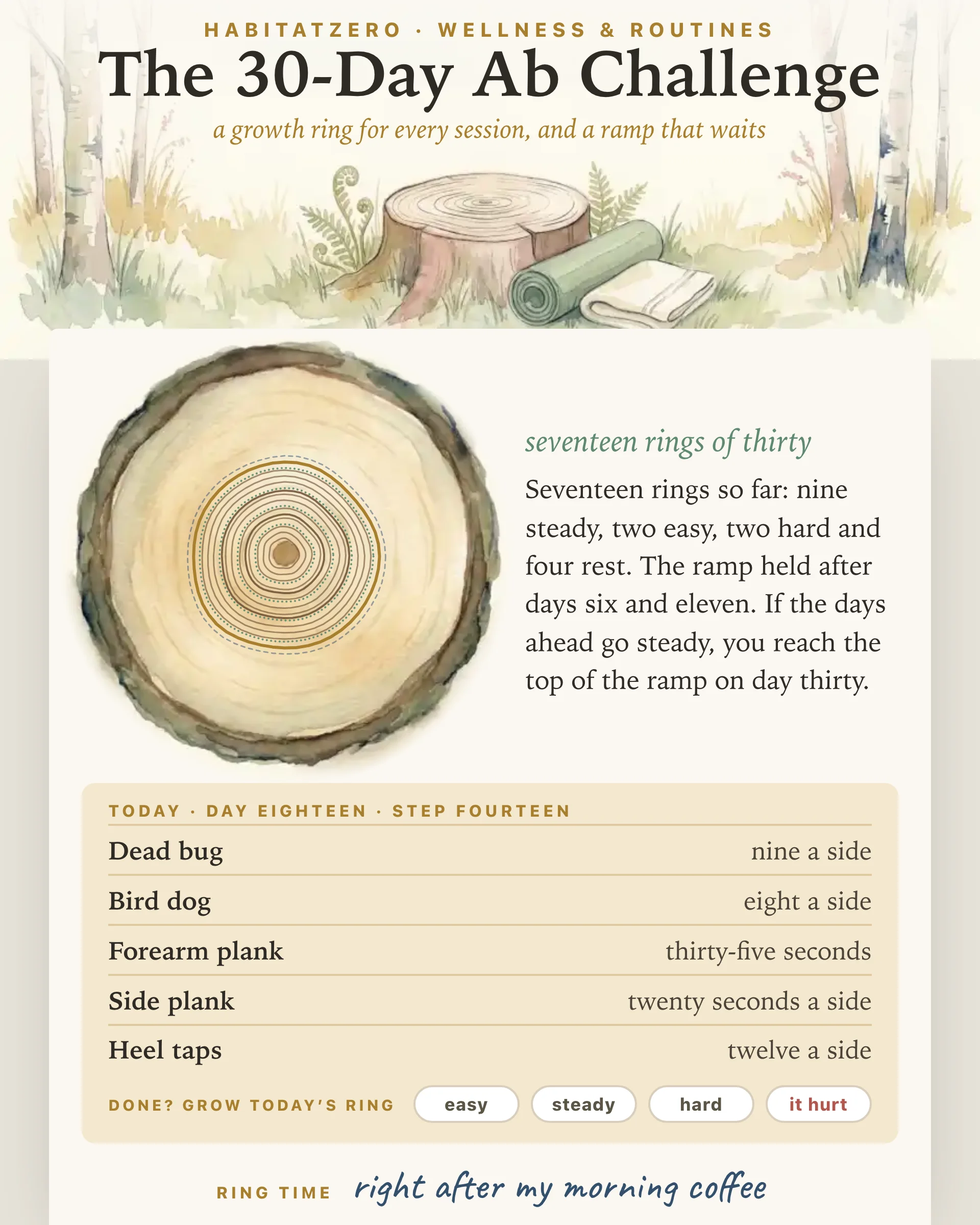
Most 30-day ab challenges share one shape: a chart that starts at fifteen crunches and climbs toward a hundred or more. By the third week the sets drag on, your neck aches before your stomach does, and the chart goes in a drawer. This page takes the other road: five moves, a small dose of each, a rest day every fourth day and a firm ceiling on every dose. Then it lets the way each session felt decide what the next one asks of you.
Every training day uses the same five moves, done once through, slowly:
The doses sit on a ramp of twenty-three steps. Step one is five dead bugs a side, four bird dogs a side, a fifteen-second plank, ten seconds of side plank each way and six curl-ups, about three minutes in all. The top step is twelve dead bugs a side, ten bird dogs a side, a forty-five-second plank, thirty seconds a side and twelve reverse crunches, about six minutes. Nothing climbs past that. Once a dose reaches its cap, you make it harder by doing it more slowly.
The ceiling is deliberate. Long ab sets invite sloppy reps: hips drop in the plank, the low back peels off the floor, hands start tugging at the neck. Short doses keep every rep a good one, and the session small enough to repeat for a month.
The worksheet draws your month as a cut log. Each session grows one ring outward from the center, and you say how it went with a single tap:
Every fourth day is a rest day, drawn as a dotted ring. Real trees keep a similar record: a dry year lays down a narrow ring, a fire leaves a scar, and the trunk grows on around both. After a few weeks your log shows where things went smoothly and where the ramp waited for you, which says more than a row of checkmarks. If every session goes steady, day thirty lands on the top step.
Once thirty rings are in, the log turns down a thirty-first and offers a fresh log that starts at the step where this one ended.
In a six-week trial of abdominal exercise, sedentary adults did seven ab exercises, two sets of ten, five days a week. Compared with a group that did none, they showed no change in body weight, body fat, belly fat or waist measurements. What did change was endurance: they managed more curl-ups at the end. Core training builds a stronger, steadier trunk. It does not burn fat from the spot you train, so this page makes no promises about your waistline.
It is not a complete strength routine either. The CDC asks adults for muscle-strengthening activity on two or more days a week covering the legs, hips, back, abdomen, chest, shoulders and arms, plus 150 minutes of moderate activity such as brisk walking. The Walking Challenge covers the moving part, and a Workout Calendar helps you fit other strength days around the rings.
The one piece of typing on the page is the ring time: something you already do daily that the session will follow, such as your morning coffee. A review that pooled 94 tests of if-then plans found that deciding in advance when and where you will act had a medium-to-large effect on whether people followed through. Hook the session to a moment that already happens, and it stops fighting for a slot.
Stop for sharp pain, and for any pain in your back, and log that day as it hurt. Keep breathing through every hold; if you catch yourself holding your breath, the dose is too much for today. If you live with a back condition, are pregnant or had a baby recently, or have had abdominal surgery, ask a clinician which of these moves suit you before day one.
Start at the turn of a month, in the new year, or whenever you want a daily commitment that will not swallow an evening. Step one is gentle enough for beginners, and anyone returning after a break can tap easy to climb faster. If you would rather spend a month on a different small task each day, The 30-Day Challenge is built for that.
It is a month of short daily core sessions that get a little harder as the weeks go by. This one uses five moves, a rest day every fourth day and doses that stop at a cap, and it sets each session from how the previous one felt.
Not by itself. In a six-week trial, adults who did ab exercises five days a week lost no belly fat compared with a group that skipped them, although their abdominal endurance improved. Expect a stronger, steadier trunk rather than a smaller waist.
Far fewer than the viral charts ask for. This plan never goes past twelve slow reverse crunches or fourteen heel taps a side, and it spreads the work across planks, dead bugs and bird dogs so your neck and low back are not doing all of it.
The US guidelines ask for muscle-strengthening work on at least two days a week, so daily sessions are optional. This plan runs three days on and one day off with small doses. If you feel sore or worn down, take an extra rest day, and treat pain as a reason to stop rather than a hard day.
No. The ramp table on the page is enough to follow the plan by hand, and the sample log shows how the rings work. Opening it in HabitatZero, which is free, keeps your rings, sets each session from the last one and remembers your ring time.
By the team behind Fabulous, the science-based self-care app used by over 30 million people.


