Menopause Advocacy and Policy Reform Guide
392. When in Menopause: Advocacy, Policy, and the Power of Speaking Up
The brief
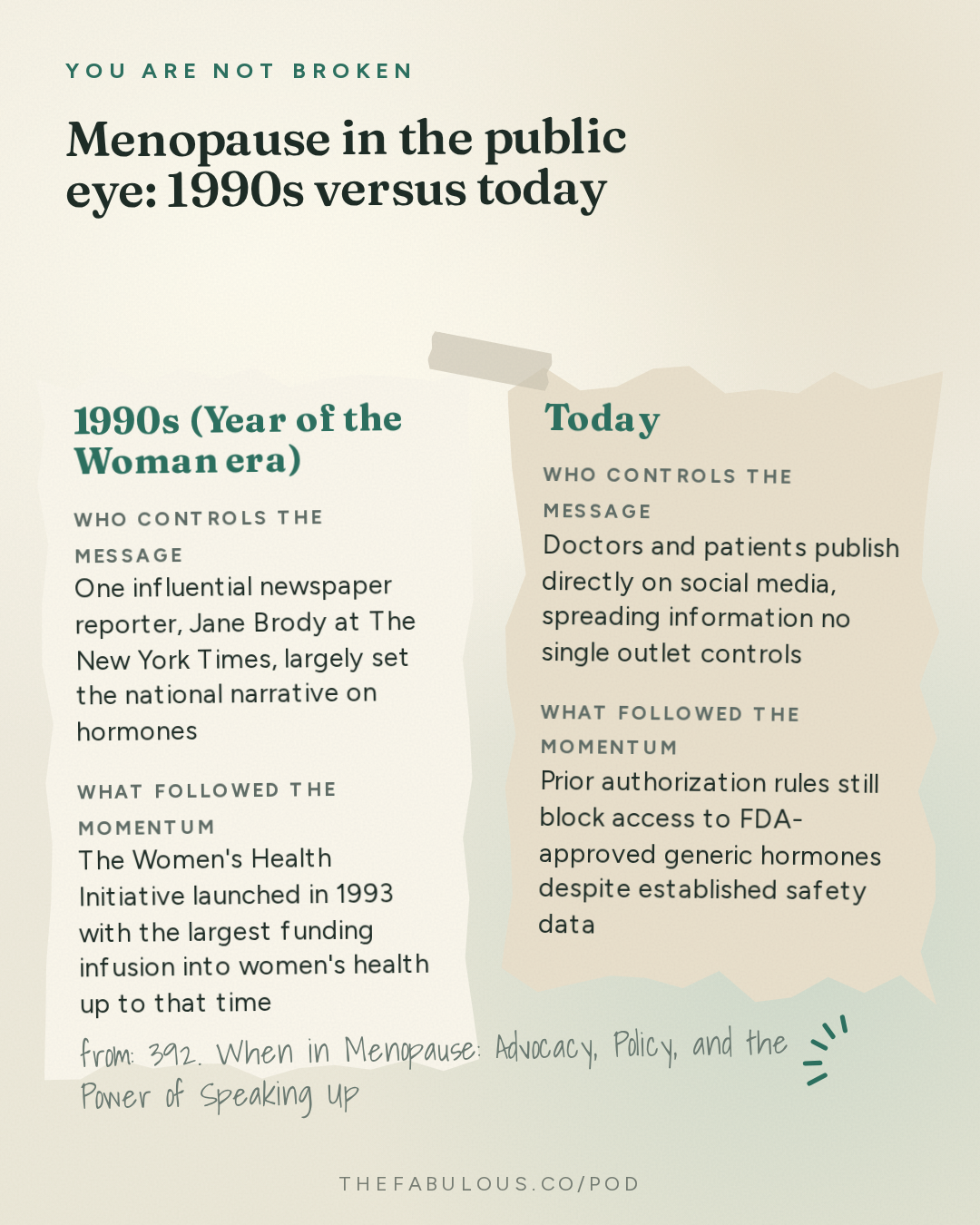
Lawyer Jennifer Weiss-Wolf compares menopause advocacy to a choose-your-own-adventure book: everyone brings different skills. She traces today's momentum back to 1992's 'Year of the Woman' and the 2002 Women's Health Initiative backlash, and warns that US law still has no explicit protection against menopause discrimination at work (36:59), so she tells people to write to legislators and file FDA comments instead of venting online (17:49).
In a conference room at the Department of Health and Human Services, lawyers, physicians, and advocates spent four hours talking about the one hormone treatment nearly everyone in the room already agreed was safe, cheap, and badly underused: vaginal estrogen. Then the conversation hit a wall that had nothing to do with medicine. Social media platforms will not reliably let small creators say the word vagina. The fix floated in the room was half a joke: rename it sepsis prevention cream, so the algorithm lets it through (13:19).
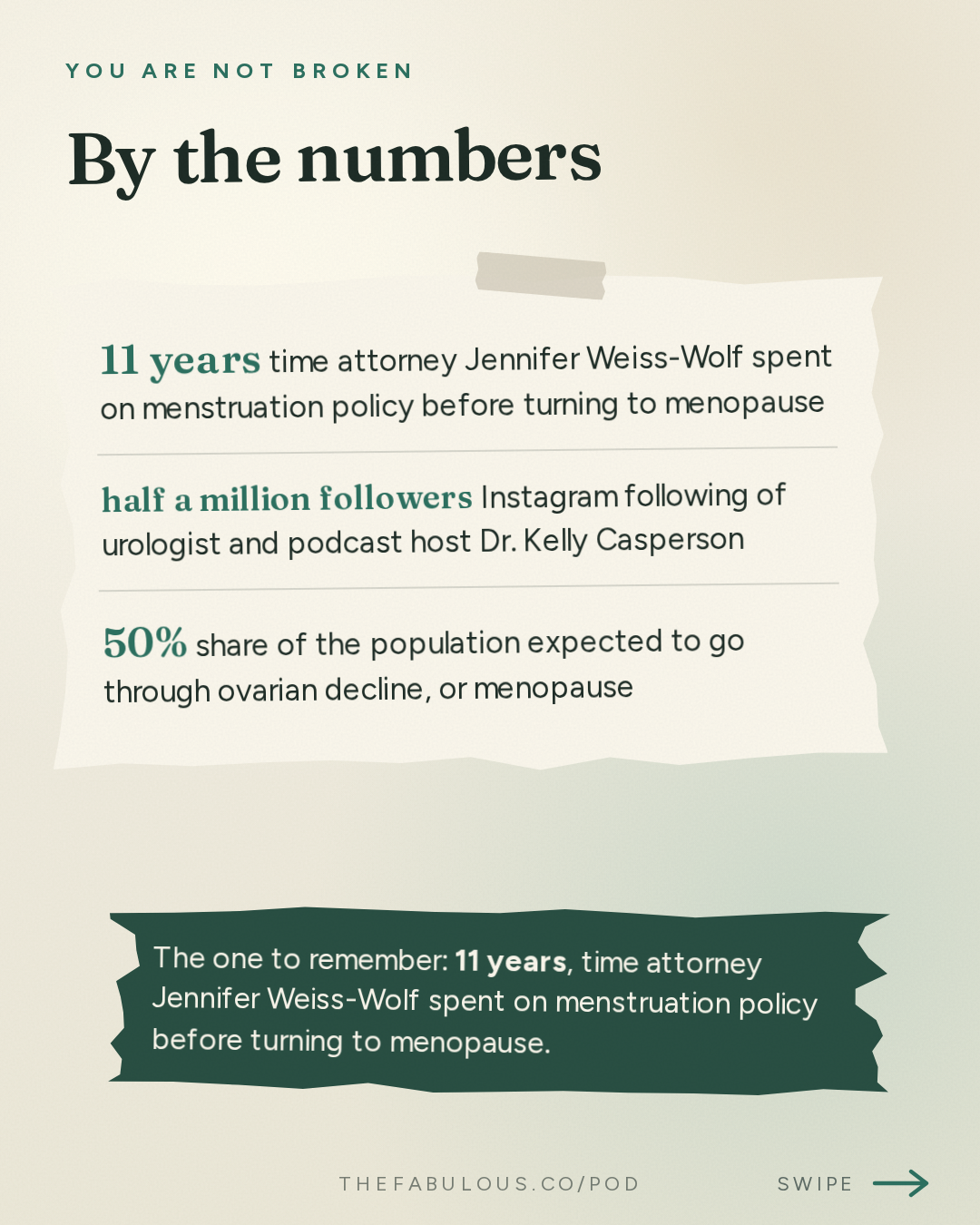
That anecdote, told by Dr. Kelly Casperson on her podcast You Are Not Broken, says something about where women's health policy stands right now. The science is often settled. The politics are often friendlier than expected. The obstacle sits somewhere else entirely, in a content moderation rule, an insurance form, or a law that was never written. Weiss-Wolf runs a women's leadership center at NYU School of Law. She spent about 11 years building policy around menstruation before menopause caught her attention around 2020 (02:44). She is also the author of a new book, When in Menopause: A User's Manual and Citizen's Guide, and she had just testified at a Senate hearing on aging, one of four witnesses alongside three physicians.
Weiss-Wolf's organizing idea is that advocacy has no single template. She describes it as a choose-your-own-adventure story, the kind of book where every reader takes a different path to the same ending.
"I describe advocacy itself as, um, a, a choose your own adventure book... It's not one roadmap. It's not one set of skills." — Jennifer Weiss-Wolf [07:27]
That framing came out of her menstruation work, where she found herself next to athletes, artists, and teenagers who cared nothing for legislative language but cared deeply about the same outcome. Menopause, she admits, has turned out to be a harder problem. Not because people care less, but because the underlying science has been neglected at the macro level for decades, starved of federal research funding even while individual doctors kept accumulating real evidence on the ground (10:22).
A Pattern That Keeps Repeating
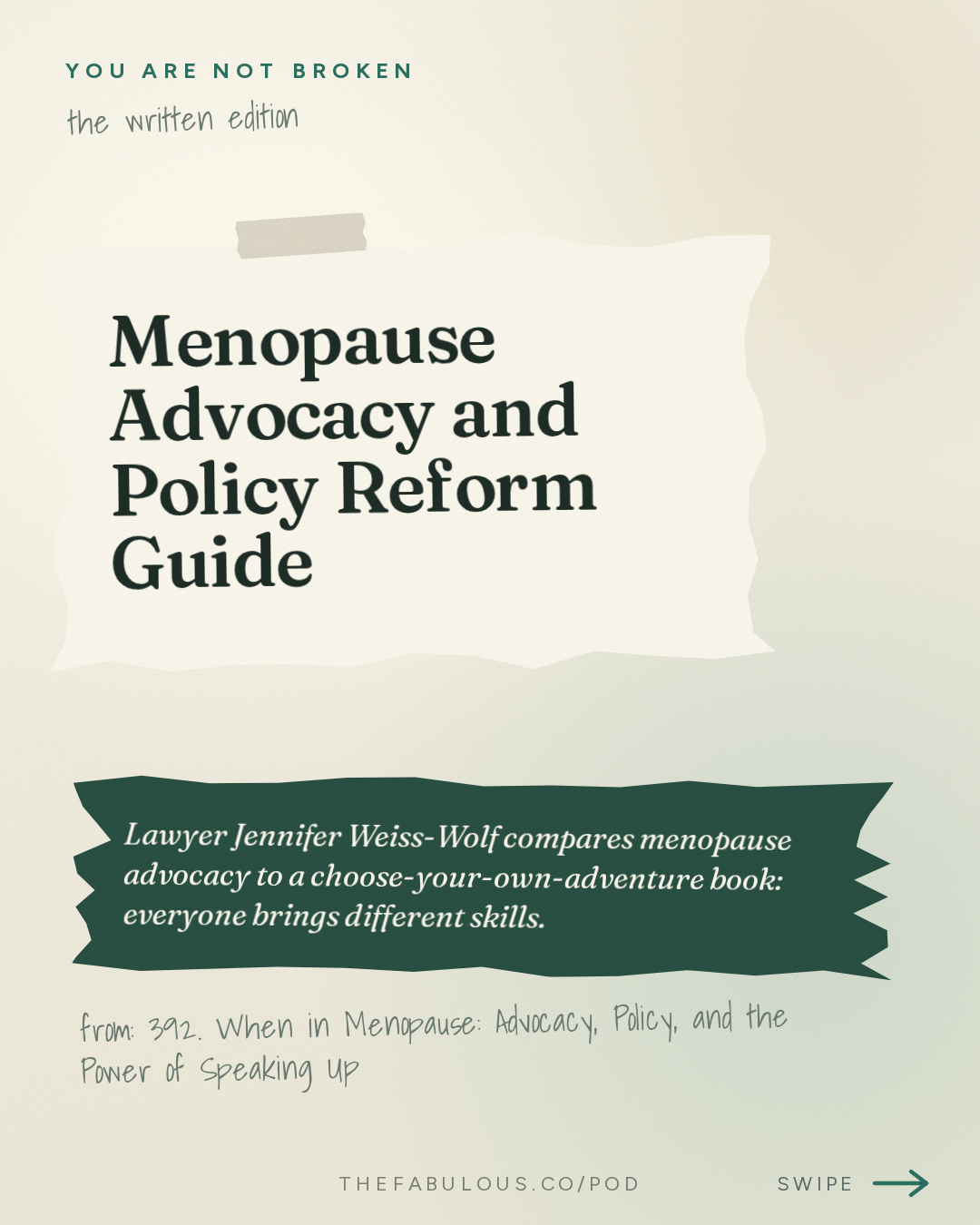
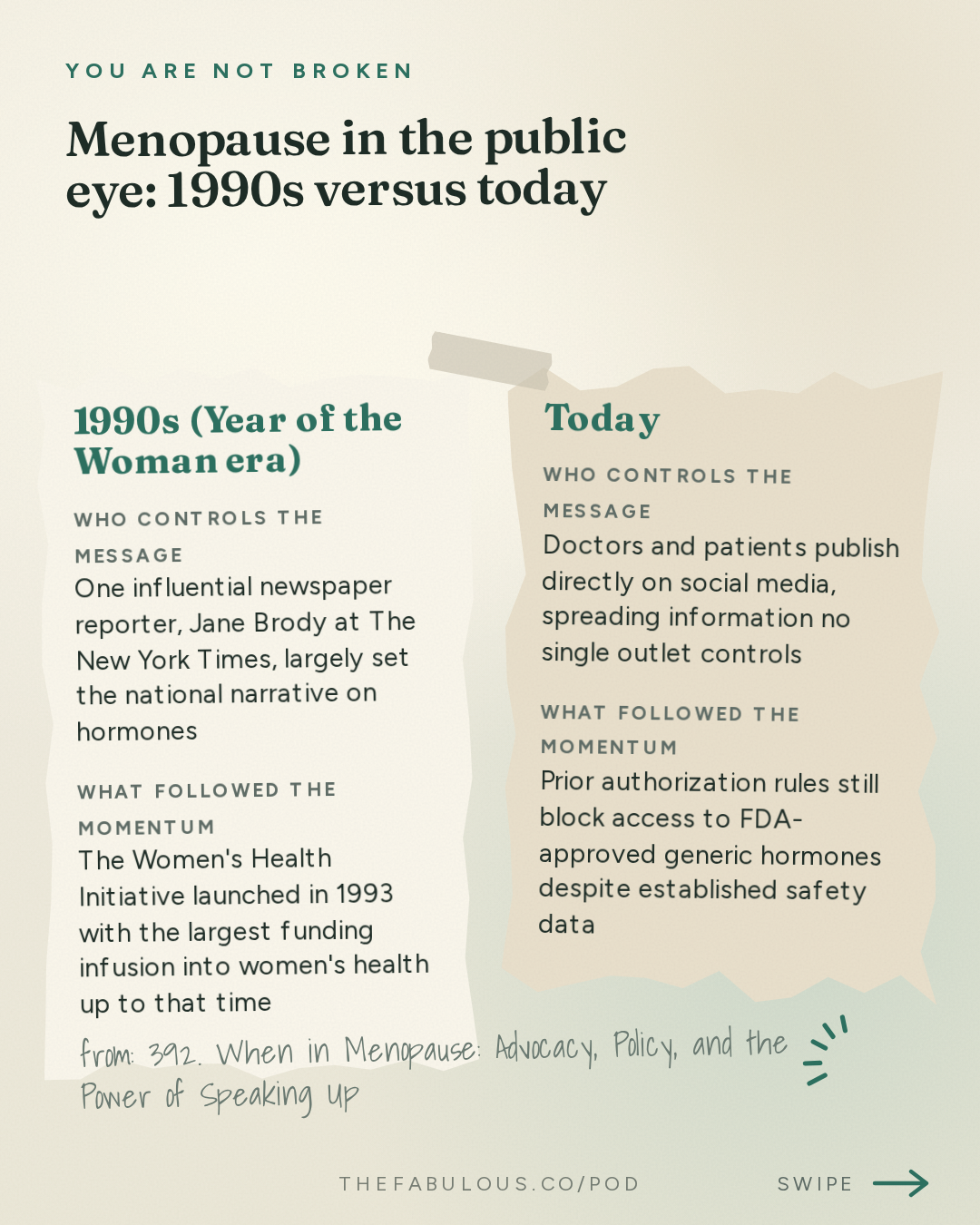
Weiss-Wolf went looking for precedent in old newspapers and found two earlier moments when menopause briefly became a national conversation, and then wasn't. The first was the 1960s and 1970s, when estrogen was popularized partly for women's health and partly, as physician Robert Wilson argued in his book Feminine Forever, for men's benefit. Safety concerns followed quickly. A campaign led by consumer advocate Ralph Nader and allied feminists pushed the FDA to require added warnings, which is where today's hormone labeling rules originated (25:41).
The second moment came in 1992, when a record number of women were elected to Congress in what was called the Year of the Woman (26:33). Weiss-Wolf found an October 1992 New York Times op-ed titled Mighty Menopause that she says reads as if it were written yesterday. That political wave helped fund the Women's Health Initiative (WHI) in 1993, the largest single investment the government had made in women's health research up to that point (27:09). Then, in 2002, a WHI press announcement on hormone therapy risk landed at a moment when, Weiss-Wolf and Casperson both suggest, a single skeptical voice at an influential newspaper had already primed the audience for alarm (27:46, 30:48). Hormone use collapsed and stayed low for years. On the podcast, the two openly wondered aloud whether a decade of expanding female political power had been met, not entirely by coincidence, with a message that made women afraid of their own bodies and too sick to keep pushing (32:11).
What is different now, Weiss-Wolf argues, is that no single reporter or network can control the story the way one newspaper columnist could in 1990. Doctors, patients, and researchers can publish directly.
"The few and the mighty are crumbling to, to the power of, of people who are great communicators." — Dr. Kelly Casperson [29:44]
She calls this a form of insurance against a repeat of 2002: if a federal agency tries to land a controversial announcement without context again, there are now thousands of doctors and patients ready to push back in real time.
The Gaps Policy Hasn't Closed
Media visibility has not solved the legal problem underneath it. Weiss-Wolf is blunt that no US anti-discrimination law, not the Americans with Disabilities Act, not the Pregnancy Discrimination Act, not any state age-discrimination statute, explicitly covers menopause (36:59). That gap makes her cautious about the workplace benefits many employers are now floating.
"Without that protection, I would not feel comfortable telling any employee that they should march into their HR office and demand menopause benefits." — Jennifer Weiss-Wolf [38:04]
Her worry is concrete: an employee who announces she is using a menopause accommodation could be quietly demoted or passed over for a project, with no legal claim available if it happens. She wants lawyers to build a real anti-discrimination framework before advocates spend political capital on perks that offer no protection underneath them.
A second structural gap sits inside insurance. Casperson points out that Washington State recently passed its own menopause workplace law, yet prior authorization requirements for generic, FDA-approved hormone medications remain a major barrier to actually getting treatment (39:37, 40:05). A fan in a hot office, she notes, does nothing for a patient who cannot get her prescription approved. Both agree that state-level workplace gestures look good in a press release but do not touch the insurance layer where access actually breaks down. At the Senate hearing, three physicians and Weiss-Wolf testified, and every witness centered their testimony on hormone access, including data suggesting women between ages 50 and 60 on hormone therapy showed increased longevity, a framing Casperson says would have been unthinkable at a Senate hearing on aging a decade ago (44:15).
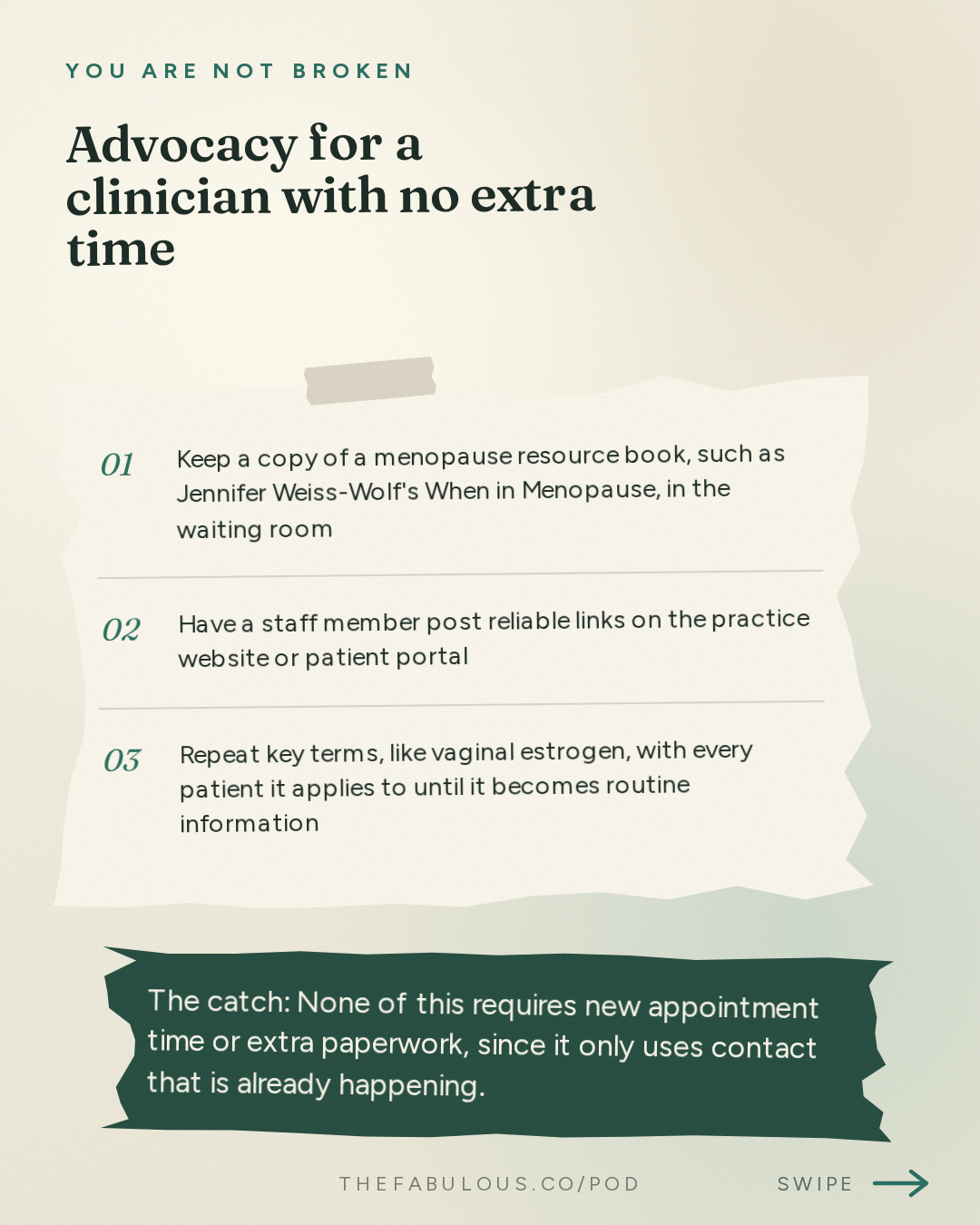
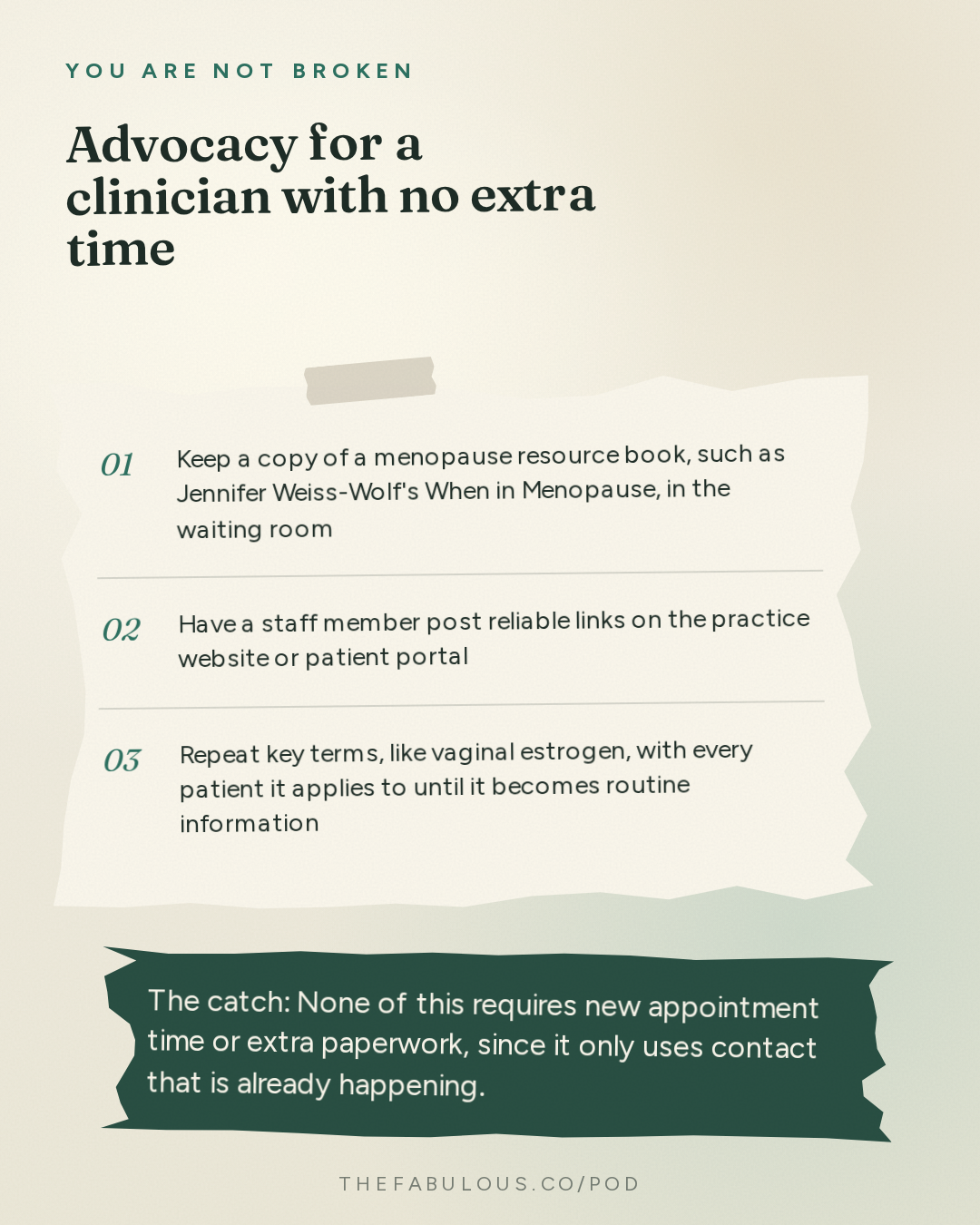
So what does an ordinary person, or a rushed clinician, actually do with all this? Weiss-Wolf's answer avoids grand gestures. Writing directly to a state or federal legislator, or filing a comment during an FDA public comment period, moves more than a social media post ever will. Casperson points to the open comment campaign that helped secure a dedicated FDA hearing day on female testosterone as proof it works (17:49). For clinicians seeing dozens of patients a day with no time to spare, her suggestion is smaller still: keep a resource book in the waiting room, or have staff post reliable links, since every patient who walks through the door is already a chance to spread accurate information without adding a single task to the schedule (48:18). And for everyone else, she points to spaces that already exist. Her own first event for the book is not a lecture hall but a mini class at her gym, taught in leggings and barre socks, because she believes advocacy does not survive without community.
"Advocacy doesn't exist without community." — Jennifer Weiss-Wolf [52:38]
Both women end on a generational note. Casperson frames it as two waves colliding: an overburdened healthcare system built around treating symptoms after they appear, meeting a cohort of younger patients who have grown up expecting prevention instead of suffering (34:29). Weiss-Wolf adds that Gen X women, long underestimated, pair naturally with millennials who were raised to expect more, a combination she thinks could reshape how the country treats aging bodies. None of it depends on a single leader or a tidy headline moment. It depends, by her own account, on a lot of separate people deciding that their particular skill, whether it is legislative drafting, a singing voice, or a Tuesday morning barre class, counts as advocacy too.
Ask this episode anything
Pod's AI answers from the episode itself, with the minute mark so you can hear it yourself.
Or start with one of these
Ask this episode
Pod's AI listens to the whole episode to answer, and points you to the minute it comes from.
The rest of this answer, and any question after it
Answers come from the episode itself, never from a summary of it.
ContinueKey takeaways
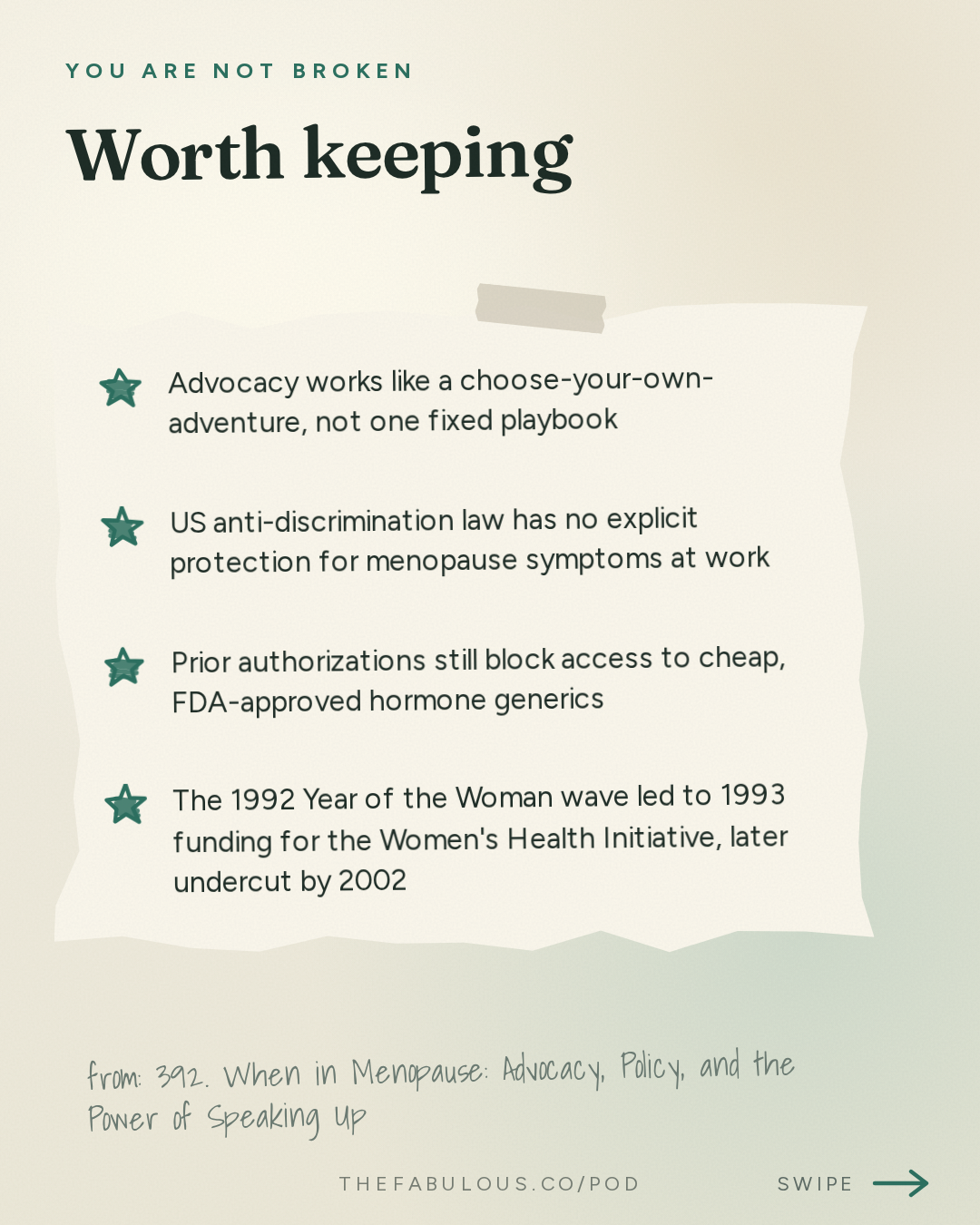
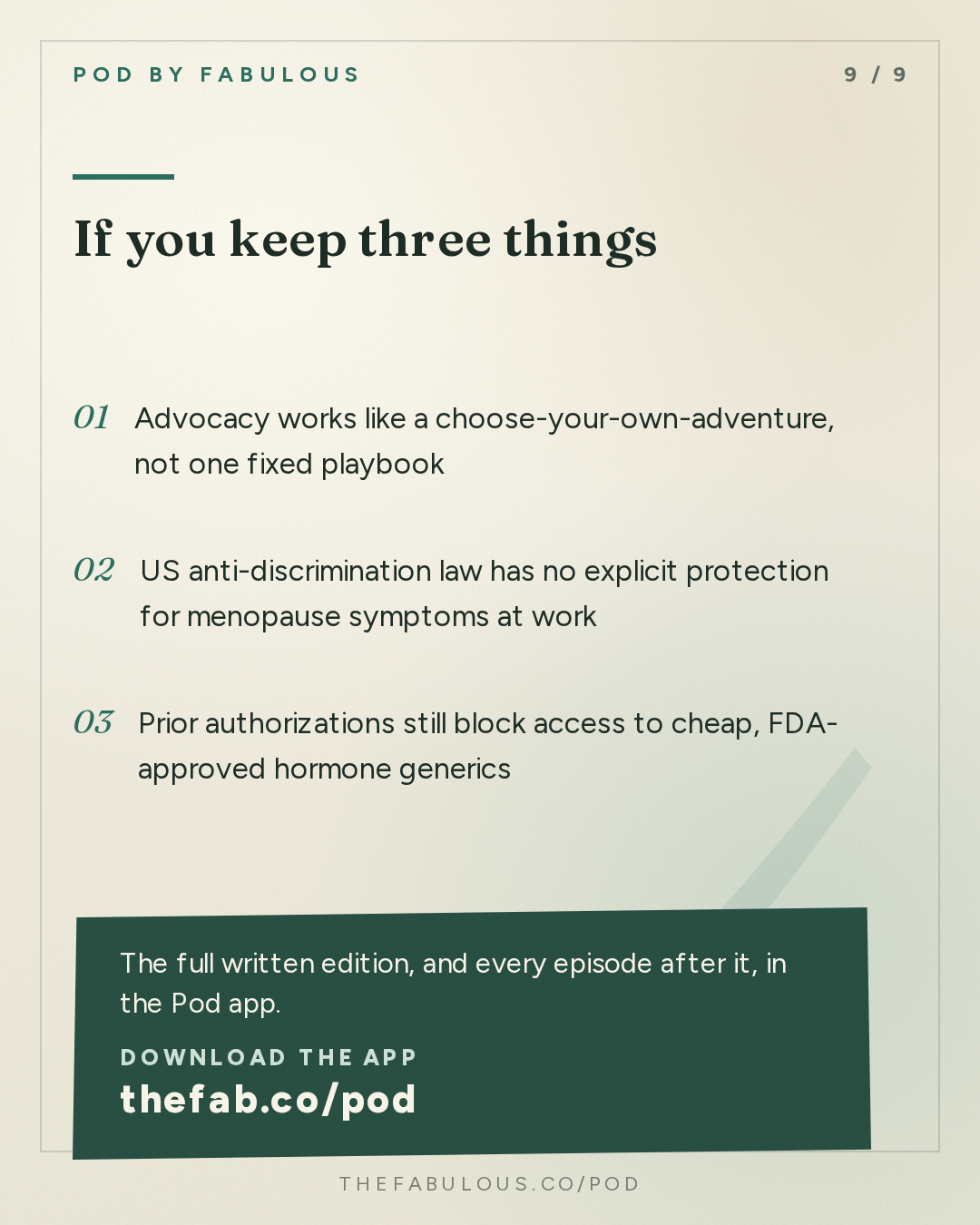
- Advocacy works like a choose-your-own-adventure, not one fixed playbook (07:27)
- US anti-discrimination law has no explicit protection for menopause symptoms at work (36:59)
- Prior authorizations still block access to cheap, FDA-approved hormone generics (40:05)
- The 1992 Year of the Woman wave led to 1993 funding for the Women's Health Initiative, later undercut by 2002 (27:09)
- Clinicians can advocate just by stocking resource books or links for patients they already see (48:18)
The episode in cards
By the numbers
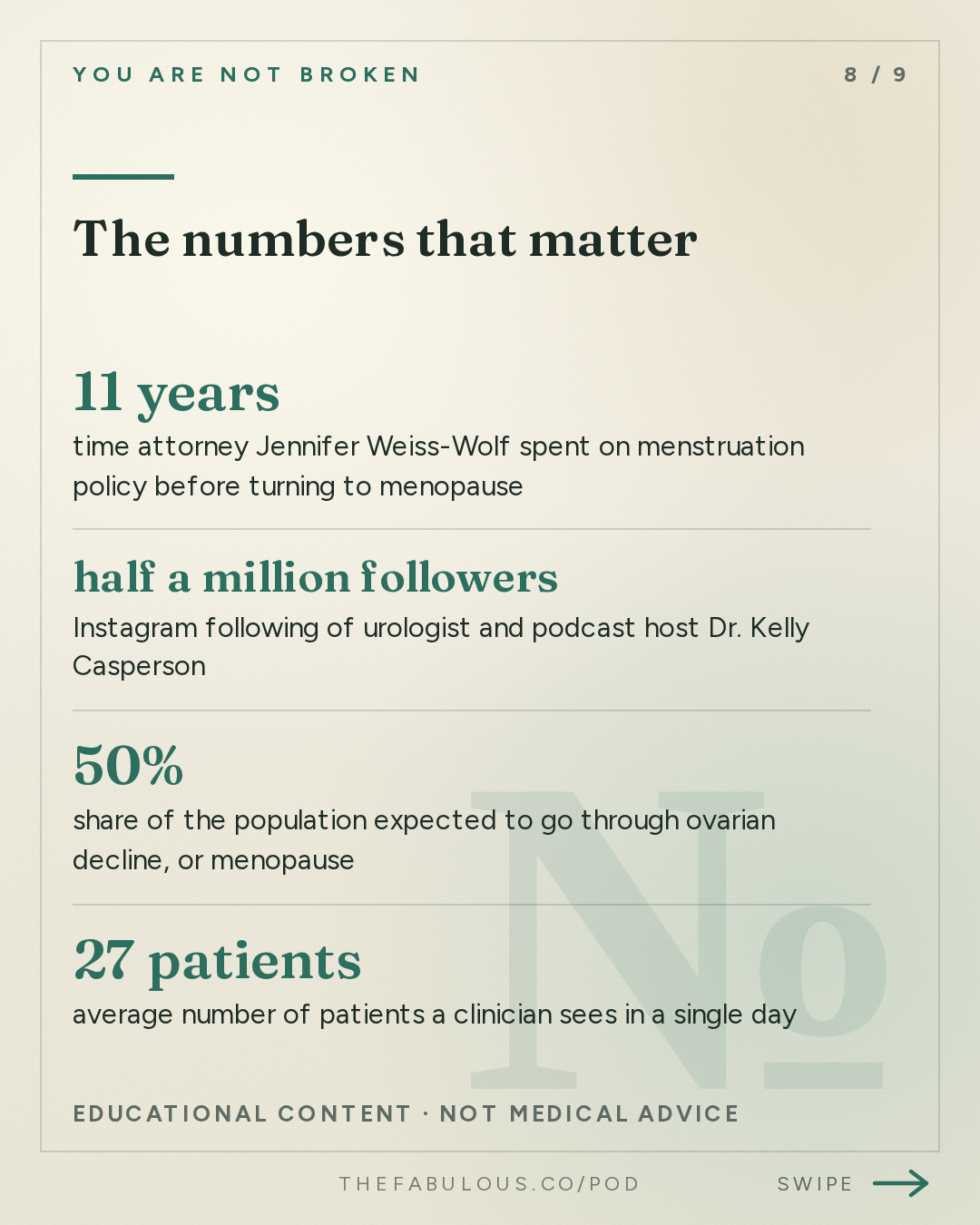
- 11 years time attorney Jennifer Weiss-Wolf spent on menstruation policy before turning to menopause
- half a million followers Instagram following of urologist and podcast host Dr. Kelly Casperson
- 50% percent share of the population expected to go through ovarian decline, or menopause
- 27 patients average number of patients a clinician sees in a single day
In their words
“The few and the mighty are crumbling to, to the power of, of people who are great communicators.”
“Without that protection, I would not feel comfortable telling any employee that they should march into their HR office and demand menopause benefits.”
“Advocacy doesn't exist without community.”
Protocols
-
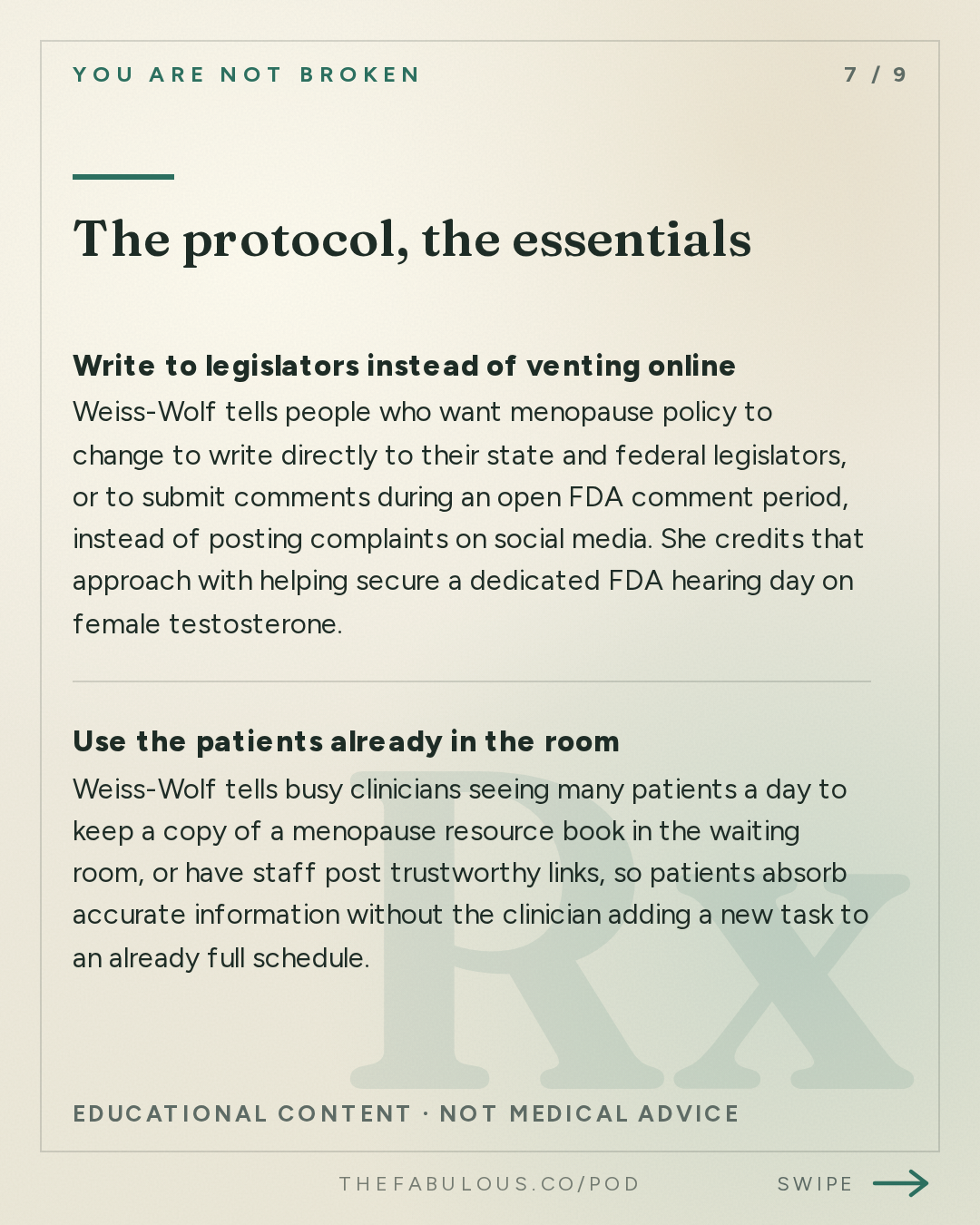
Write to legislators instead of venting online
Weiss-Wolf tells people who want menopause policy to change to write directly to their state and federal legislators, or to submit comments during an open FDA comment period, instead of posting complaints on social media. She credits that approach with helping secure a dedicated FDA hearing day on female testosterone.
Whenever a relevant bill or FDA comment period is open
-
Use the patients already in the room
Weiss-Wolf tells busy clinicians seeing many patients a day to keep a copy of a menopause resource book in the waiting room, or have staff post trustworthy links, so patients absorb accurate information without the clinician adding a new task to an already full schedule.
Ongoing, no extra appointment time required
-
Start conversations where people already gather
Weiss-Wolf recommends bringing menopause education into spaces that already exist, such as a gym class, library, book group, or church, rather than waiting for a formal platform. She argues that advocacy does not survive without community, so a small class taught in a gym can matter as much as testimony before Congress.
Whenever a local group already meets
Questions this episode answers
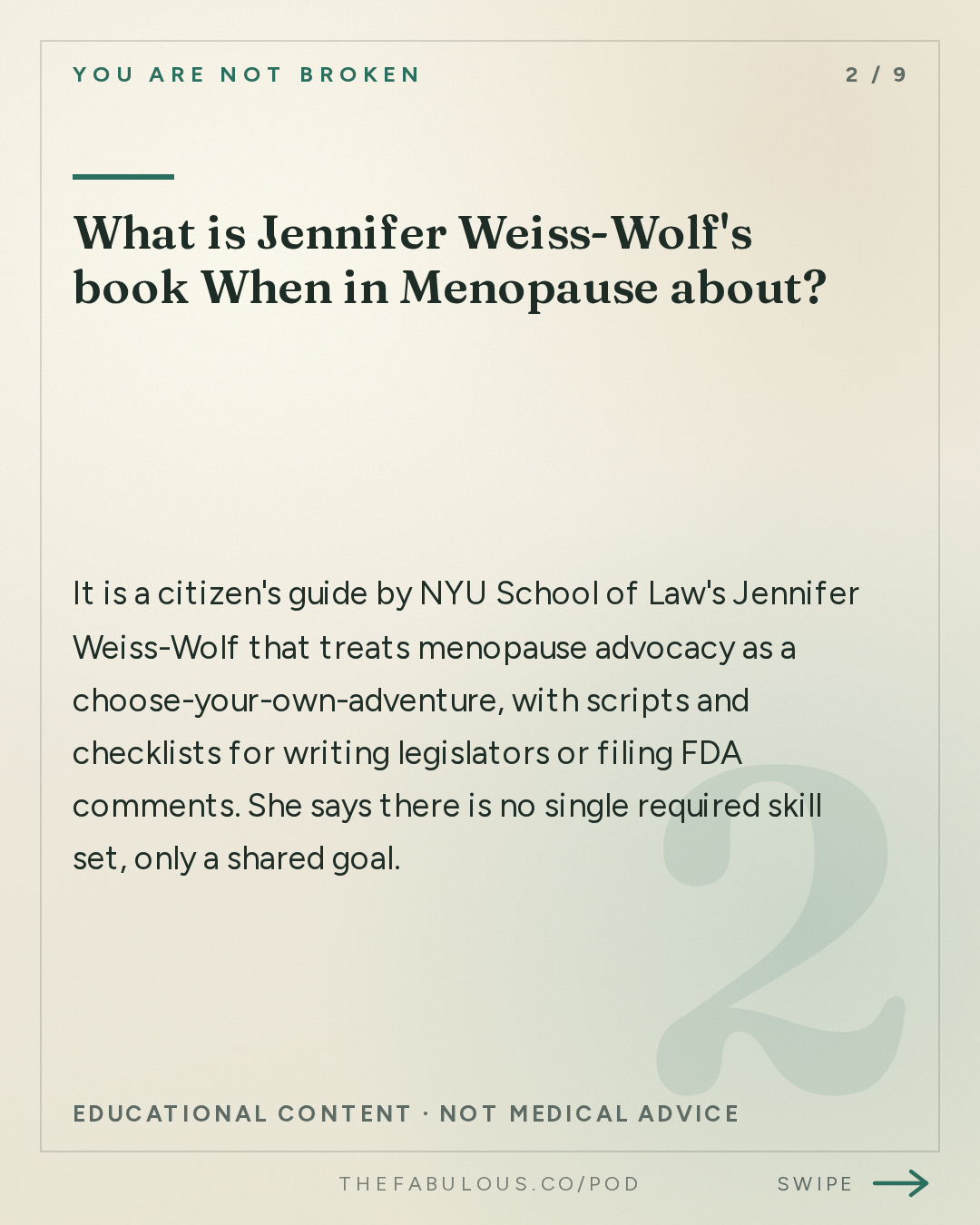
What is Jennifer Weiss-Wolf's book When in Menopause about?
It is a citizen's guide by NYU School of Law's Jennifer Weiss-Wolf that treats menopause advocacy as a choose-your-own-adventure, with scripts and checklists for writing legislators or filing FDA comments (07:27). She says there is no single required skill set, only a shared goal.
Is menopause protected under US anti-discrimination law?
No. Attorney Jennifer Weiss-Wolf says no current US anti-discrimination law, unlike those covering pregnancy or disability, explicitly covers menopause (36:59). She argues this makes it risky to tell employees to demand workplace accommodations until a real legal protection exists.
How can someone advocate for menopause benefits at work?
Weiss-Wolf cautions that because no law explicitly protects against menopause discrimination, an employee who announces she is using an accommodation could be quietly demoted with no legal recourse (38:04). She suggests building anti-discrimination protections first, then pushing for specific workplace benefits.
What was the Women's Health Initiative and why did it matter?
The Women's Health Initiative (WHI) launched in 1993 after a wave of women elected to Congress in 1992, called the Year of the Woman, drove new federal funding into women's health research (27:09). Its 2002 press announcement on hormone therapy risk triggered a pullback in hormone use that advocates say took years to recover from (27:46).
Why do insurance prior authorizations matter for menopause treatment?
Weiss-Wolf and urologist Dr. Kelly Casperson say prior authorization requirements for generic, FDA-approved hormone therapies remain a major access barrier, even in states that have passed menopause workplace laws, because those laws do not touch insurance approval processes (40:05).
What did the 2024 Senate hearing on menopause and aging cover?
Senators Kirsten Gillibrand and Rick Scott heard testimony from three physicians and Jennifer Weiss-Wolf, with every witness centering on hormone access, including data suggesting women ages 50 to 60 on hormone therapy showed increased longevity (43:38).
The full read, in cards
Go deeper
- Dr. Elsie Day's research on vaginal estrogen — found that vaginal estrogen use is linked to fewer deaths, cited as a neglected but important finding
- Women's Health Initiative (WHI) — launched in 1993 with major federal funding, then its 2002 hormone risk announcement caused a long pullback in hormone therapy use
- Mighty Menopause, The New York Times op-ed — an October 1992 piece on reclaiming hormonal power that Weiss-Wolf says still reads as current
- When in Menopause: A User's Manual and Citizen's Guide — Weiss-Wolf's book offering scripts and checklists for menopause policy advocacy
Mentioned
Jennifer Weiss-Wolf · Dr. Kelly Casperson · NYU School of Law · When in Menopause: A User's Manual and Citizen's Guide · Women's Health Initiative · FDA · HHS · Kirsten Gillibrand · Rick Scott · Jane Brody · Dr. Elsie Day
More from this show and category
Vaginal Estrogen for UTI Prevention
Urologist Dr. Kelly Casperson explains that genitourinary syndrome of menopause (GSM) affects 50% to 90% of postmenopausal women. Vaginal estrogen cuts recurrent urinary tract infections by half, lowers hospitalization and death risk, and is safe for most breast cancer survivors, yet only 9% of women diagnosed with GSM get a prescription.
Postpartum OCD vs Psychosis: Key Differences
Postpartum OCD causes unwanted, intrusive thoughts about harming a baby, not a desire to act. CNN anchor Pamela Brown and OB-GYN Dr. Mary Claire Haver distinguish it from postpartum psychosis, a break from reality involving voices (42:59), and cover GLP-1 fertility effects, testosterone therapy, and vaginal estrogen's role preventing UTIs (35:52).
How Much Lifting Is Enough for Health?
Public health guidelines recommend lifting twice a week, but the study behind that number found three days worked better. Jordan Feigenbaum argues lifting doesn't hurt the heart, carries lower injury risk than running, and shows no real ceiling for strength, bone density, or metabolic benefits, so most people should train roughly double the current guideline.
Hormones and Attraction: What the Science Shows
Hormones shape attraction traits mostly during puberty, not day to day. A masculine face doesn't reveal current testosterone, and the ovulatory-shift theory, that women prefer masculine men mainly near ovulation, lacks support. Perceived physical strength explains 70% of women's attractiveness ratings for men's bodies, making muscle, unlike facial bone structure, the one hormone-built trait people can still train.
