Hormones and Attraction: What the Science Shows
Hormones and Attraction: What We Think We Know vs. What the Science Says
▶ Listen to the full episode More from The Dr. Gabrielle Lyon Show
The brief
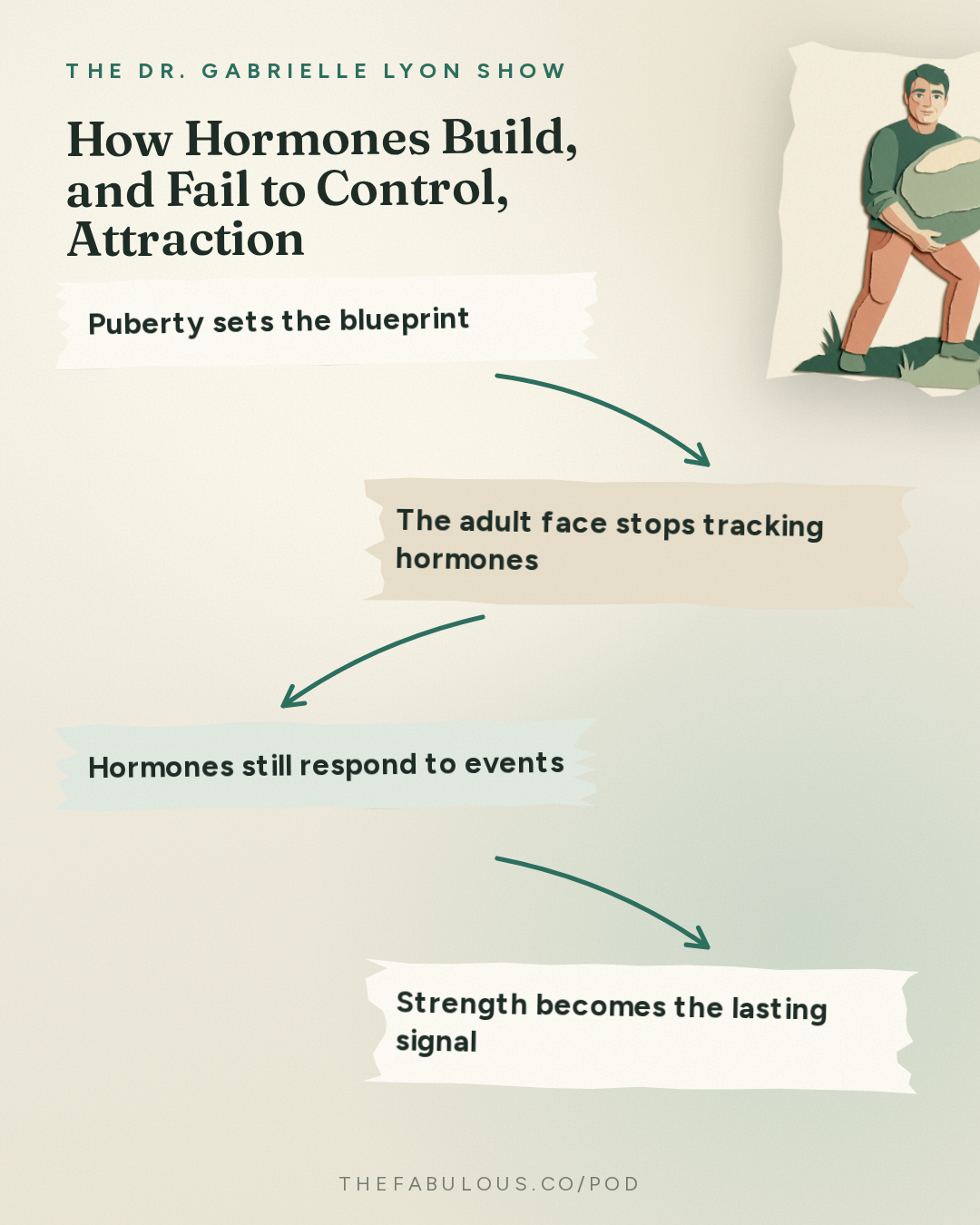
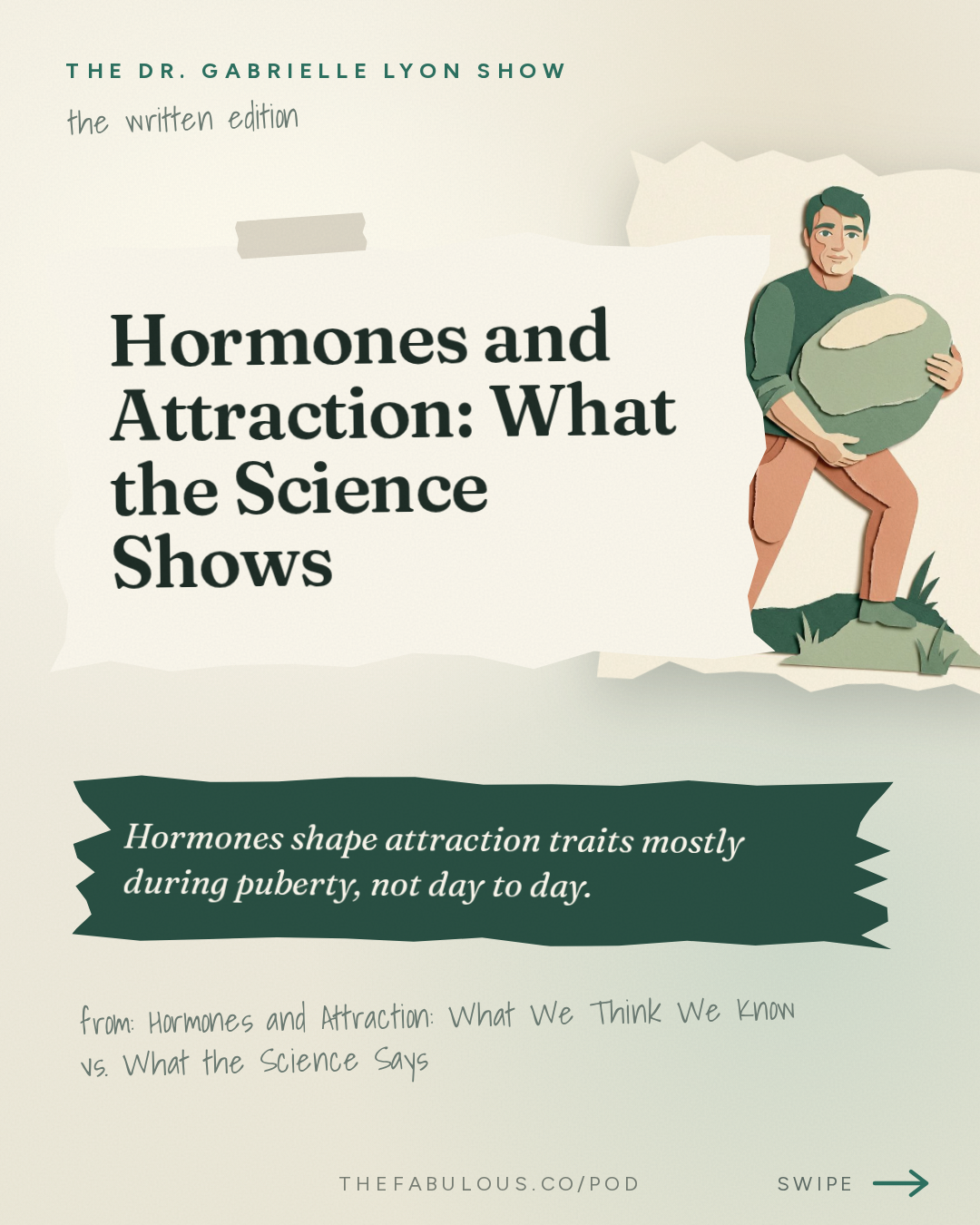
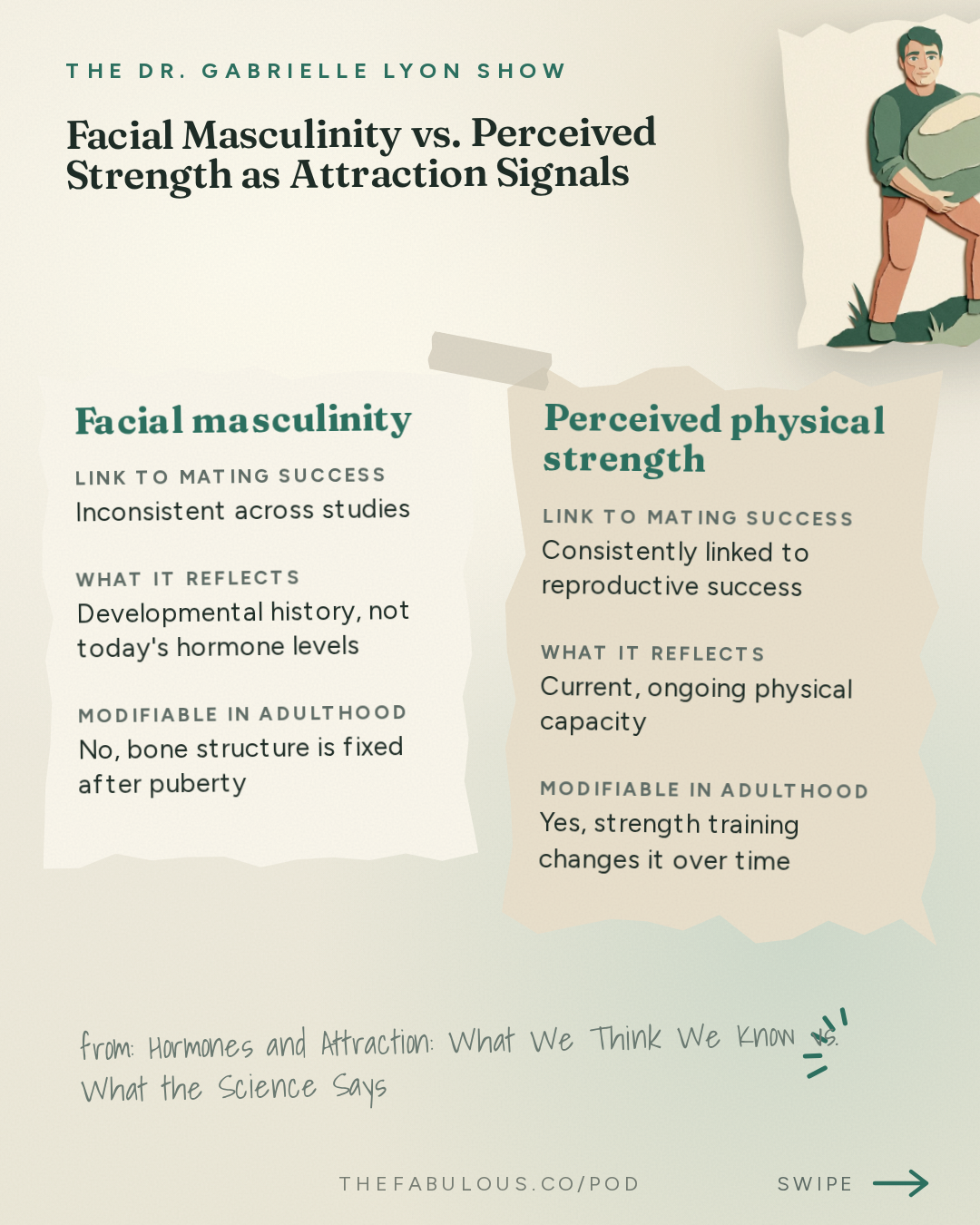
Hormones shape attraction traits mostly during puberty, not day to day. A masculine face doesn't reveal current testosterone, and the ovulatory-shift theory, that women prefer masculine men mainly near ovulation, lacks support. Perceived physical strength explains 70% of women's attractiveness ratings for men's bodies, making muscle, unlike facial bone structure, the one hormone-built trait people can still train.
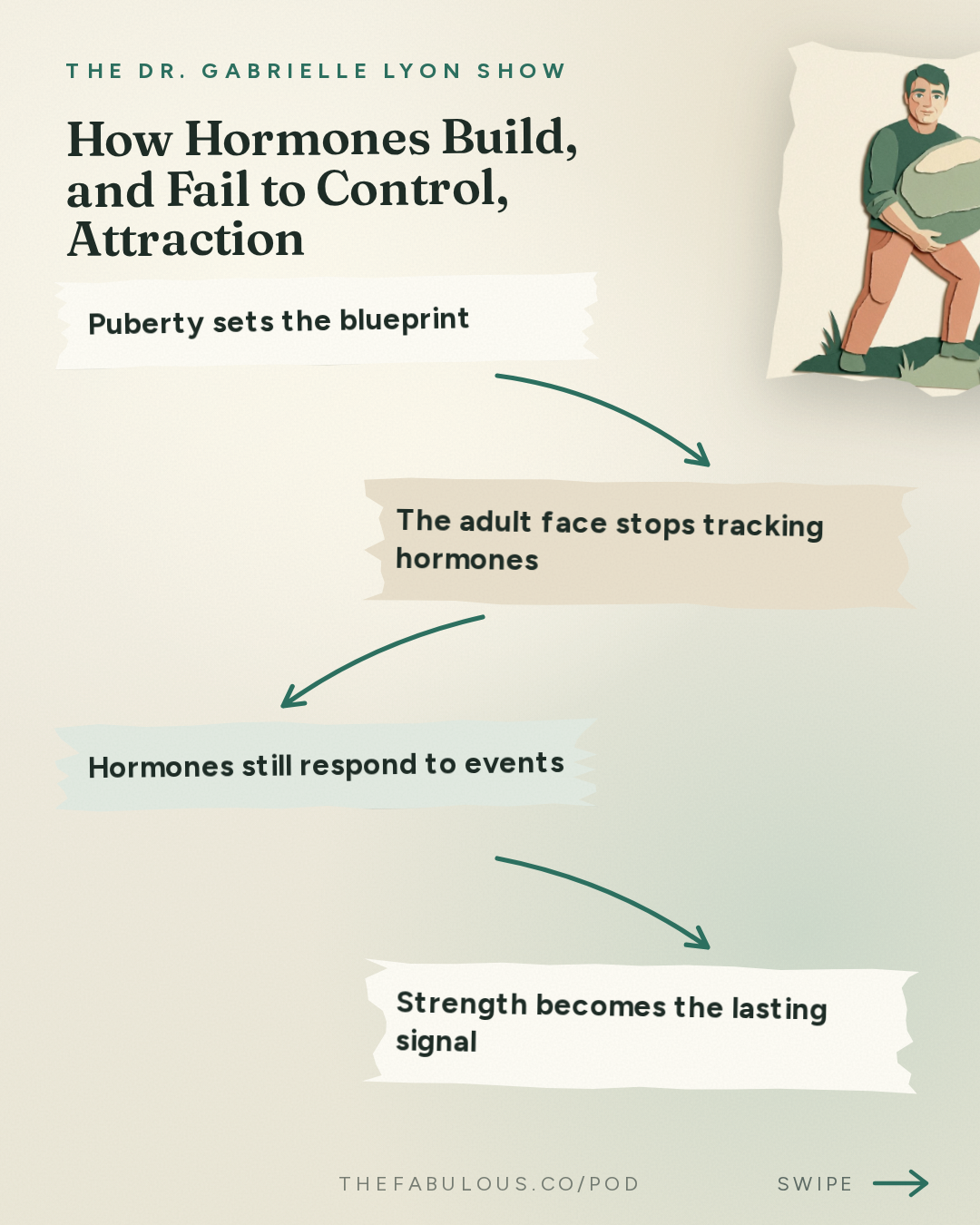
A man turns forty five and starts testosterone replacement, half expecting his jaw to sharpen and his brow to thicken. It never happens. The bones of his face finished their one chance to be shaped by hormones back in puberty, and no adult dose can call them back for a rewrite. That small, stubborn fact is the spine of this episode: hormones build a great deal of what we find attractive, but they do most of that building early, once, and then they stop. What is left, once puberty closes the account, is something much more interesting than a hormone panel.
The familiar story goes like this: testosterone and estrogen do not just run libido, bone density, and reproduction. During development, especially puberty, they also sculpt the traits that read as male or female at a glance, things like facial structure, voice, muscle, fat distribution, skin, and hair (01:39). From there it is a short step to a tidier, more seductive claim, the one behind countless magazine headlines: that a masculine face is basically a testosterone readout, and that women are wired to chase that readout hardest when they are most fertile. This is the ovulatory shift hypothesis, the idea that female preference for masculine-looking men spikes specifically around ovulation, as a kind of evolved genetic quality filter. It has the clean shape of a good evolutionary story. It has not held up well.
When researchers moved from small, one-time surveys to larger studies that measured the same women's hormones repeatedly over time, instead of guessing at cycle phase from a calendar, the ovulatory shift became very hard to reproduce (02:37, 03:07). Preferences for masculine faces turned out to be inconsistent across studies, sometimes present, sometimes context dependent, sometimes absent entirely (08:09). That does not mean reproductive hormones are irrelevant to attraction, they clearly shape libido and sexual motivation. It means the specific, popular version of the story, that a hormone threshold flips a switch and jawlines suddenly matter more, is not supported by the data.
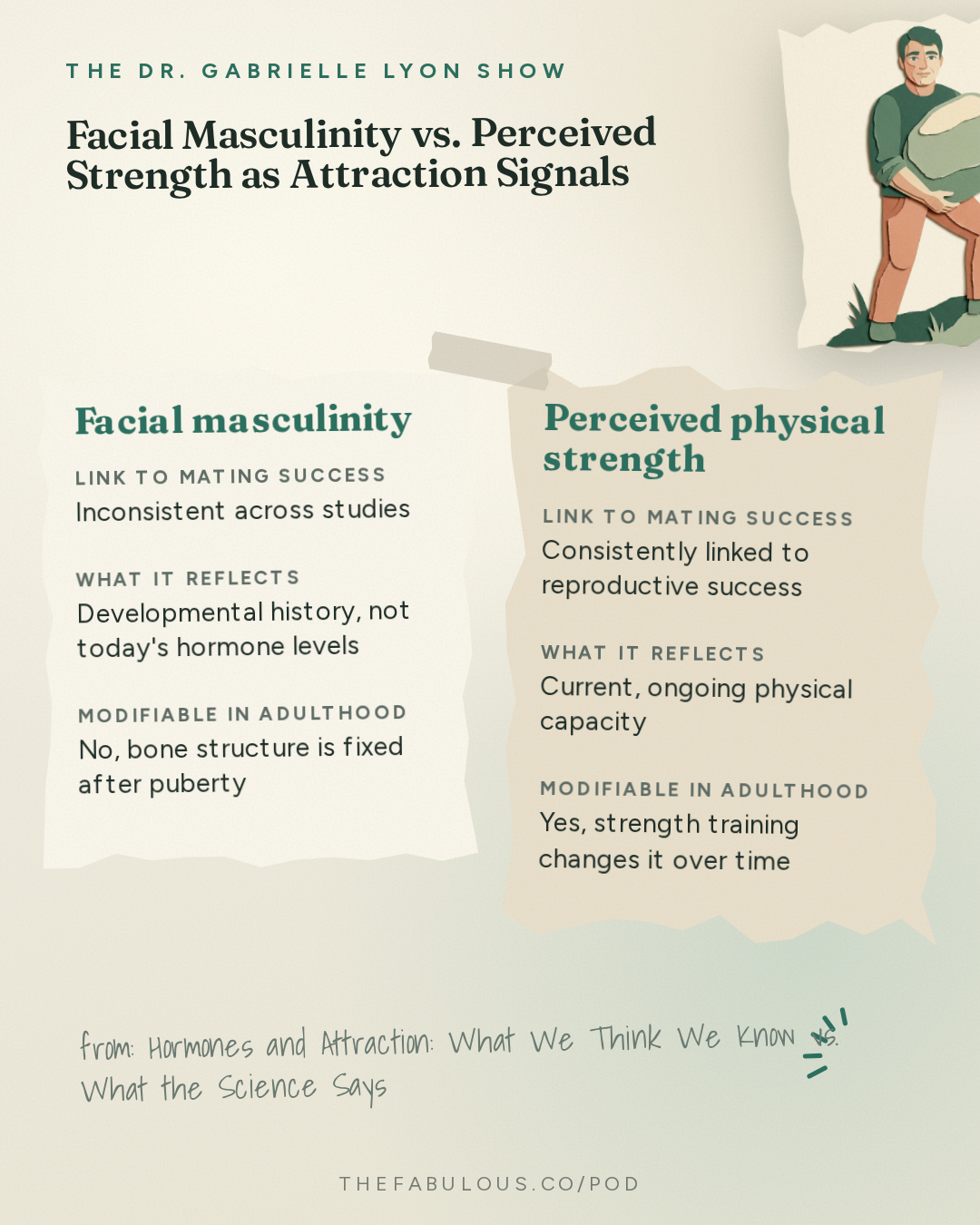
The deeper problem is with the premise itself: that a masculine face is a live readout of a man's current testosterone. A study by researchers named Pound and colleagues tested this directly and did not find the simple relationship everyone assumes, that men with more masculine faces simply run hotter on baseline testosterone (05:09). What they found instead was odder and more useful: men with more masculine faces showed a larger testosterone surge after winning a competition, which points to a dynamic, responsive hormonal system rather than a fixed dial (05:40). A masculine face, in other words, may say something about how a person's development went. It says very little about what is circulating in their blood this afternoon.
"Your face is not a hormone panel." — Gabrielle Lyon [04:40]
Lyon pushes the point further with a thought experiment: take two fifteen year old boys. One matures earlier, grows bigger and stronger, and because of that gets picked for sports, then trains for years, accumulating skill and muscle on top of his head start. By adulthood, what a doctor sees in him is not simply hormones, it is selection, puberty, genetics, hormones, training, and years of choices, all stacked together (06:41). This is the difference between genotype, the inherited genetic blueprint a person is born with, and phenotype, the physical result of that blueprint interacting with behavior and environment (07:14). A muscular man might have ordinary testosterone and a decade of consistent training. Another man might have higher testosterone and have never lifted a weight in his life. They will not look the same.
"A masculine face may tell you something about a person's developmental history. It doesn't tell you his or her testosterone today." — Gabrielle Lyon [06:09]
Strength Beats the Jawline
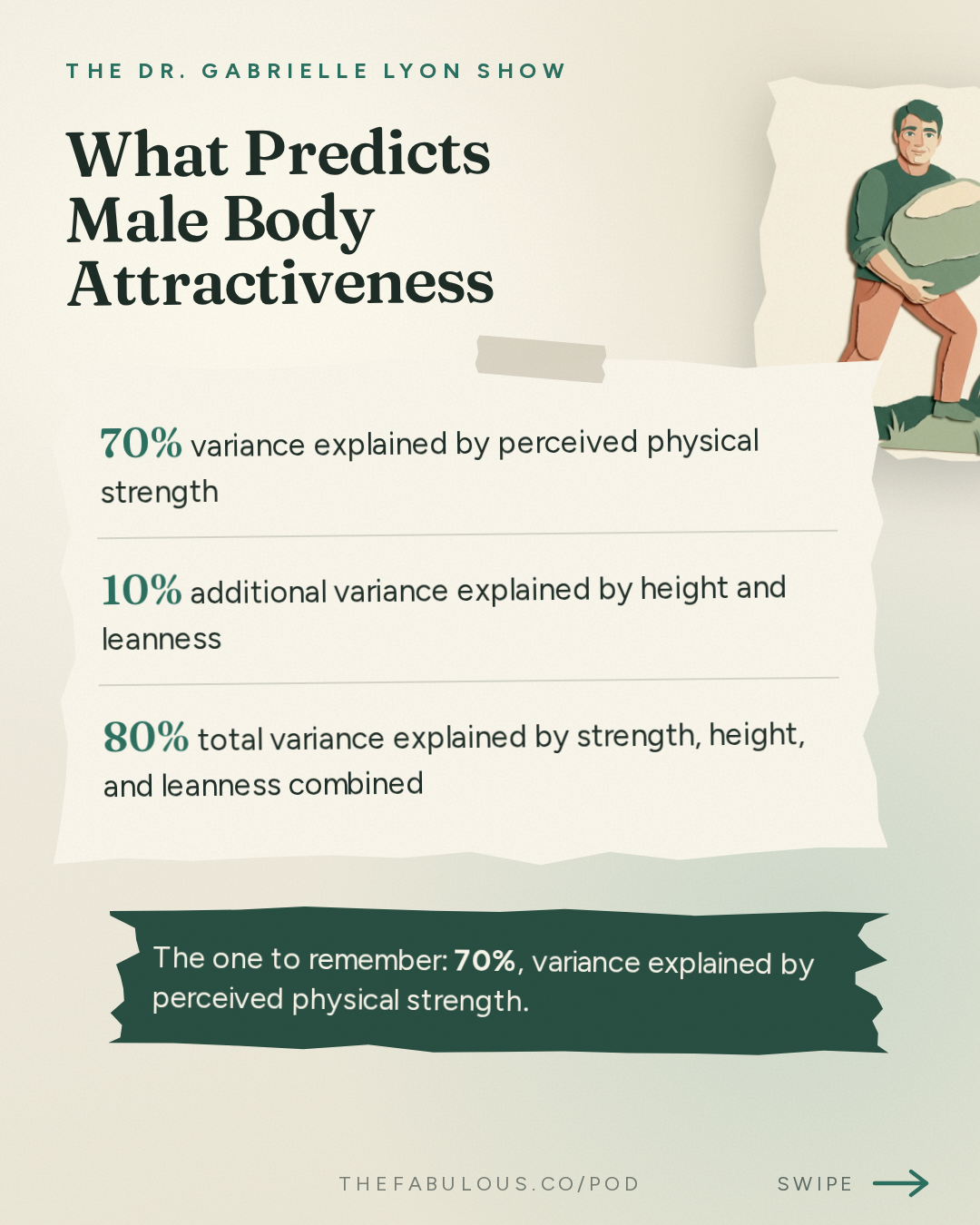
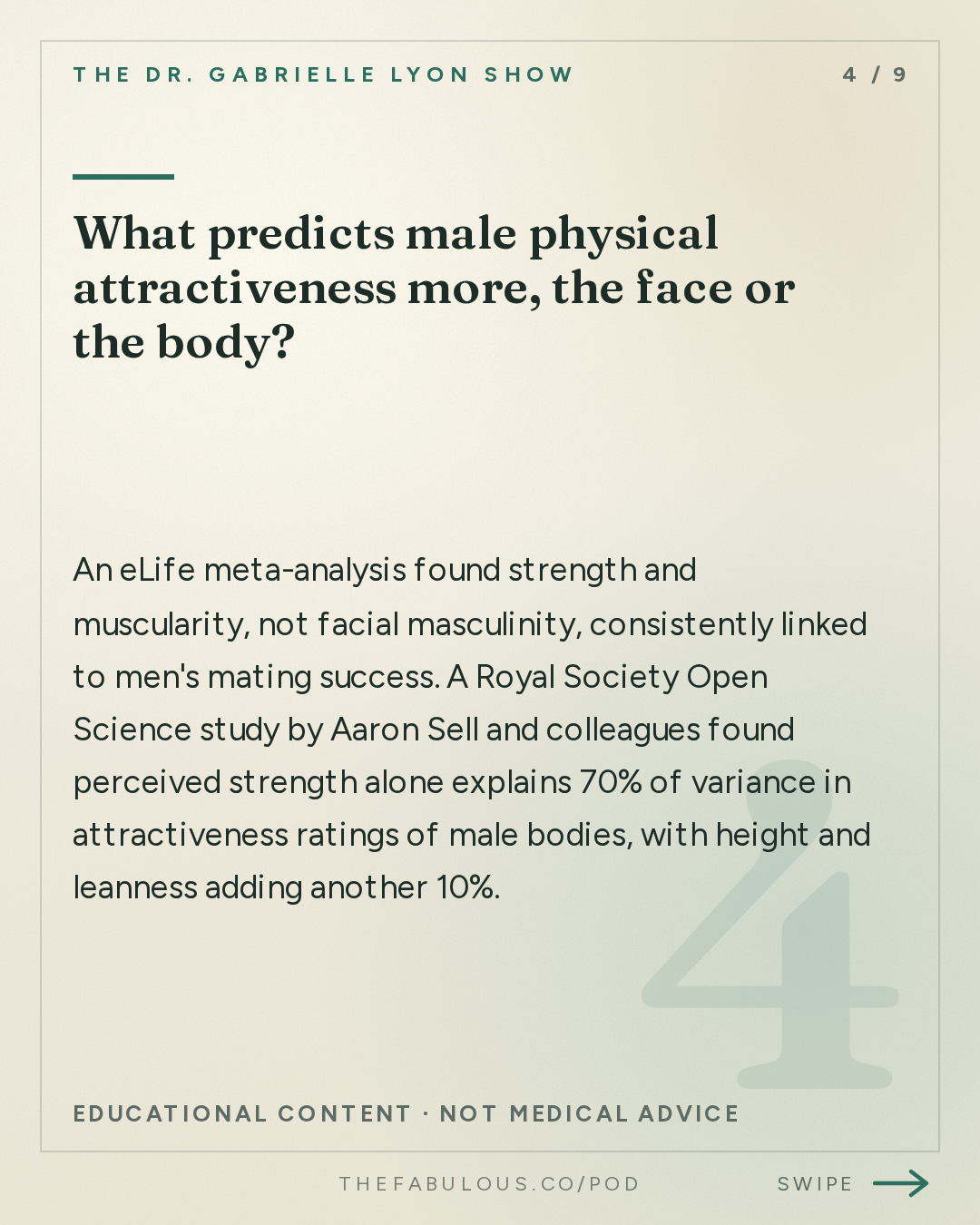
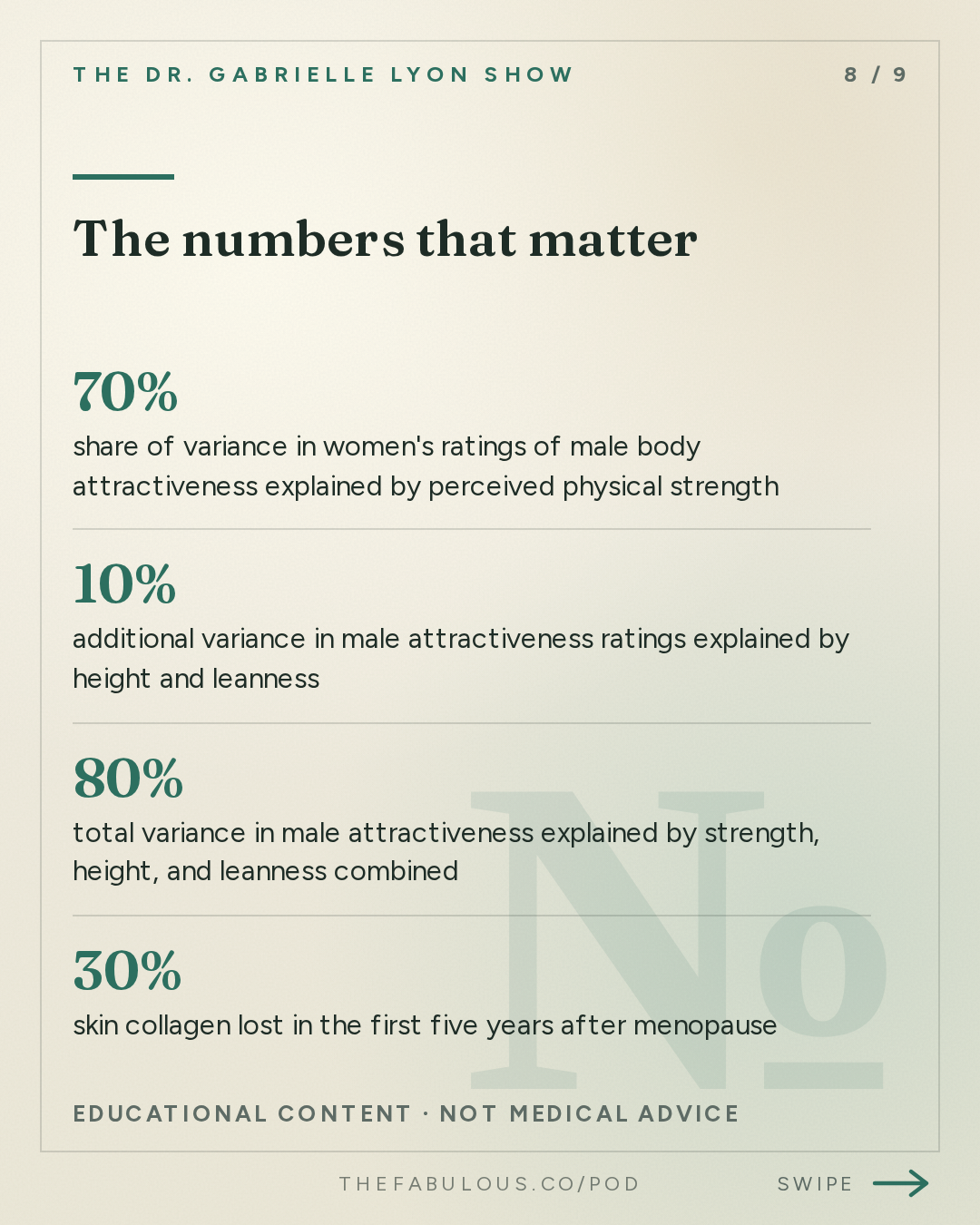
If the face is such an unreliable gauge, what actually predicts attraction? A meta-analysis in the journal eLife looked at masculine traits against real mating and reproductive outcomes and found that strength and muscularity were the traits consistently tied to men's mating success, while facial masculinity was not nearly as consistent a predictor (09:37, 10:08). A separate study in Royal Society Open Science, led by a researcher named Aaron Sell, showed women photographs of men's bodies and asked them to rate attractiveness. Perceived physical strength alone explained 70 percent of the variance in how women rated male physical attractiveness (11:10). Height and leanness added another 10 percent, bringing the total to roughly 80 percent explained by just those three visible traits. Notably, the relationship was linear: there was no point at which a body read as "too muscular" to raters, stronger kept scoring higher across the board (11:10).
It is worth being precise about what that 80 percent does and does not mean. This is body attractiveness under experimental conditions, a snapshot judgment from a photo. It says nothing about who someone falls in love with, marries, or builds a life with, and nothing about intelligence, loyalty, or kindness (11:41). But as a pure visual signal, strength carries enormous weight, far more than bone structure.
There is a plausible evolutionary reason for that. In ancestral environments, physical strength was tied directly to a man's ability to hunt, defend resources, and protect a mate and offspring (12:05). Building and holding muscle also requires a well-functioning immune system and an efficient metabolism, which makes a strong body a hard to fake signal of underlying health, the kind of thing that is difficult to counterfeit with grooming or clothing (12:59). Strong individuals were also more likely to win status contests within a group, which historically meant better resources for a family. None of this requires knowing anyone's lab values. It only requires looking at what a body can do.
What Estrogen Leaves Behind
Women's biology gets a parallel treatment. One classic study found that women with higher measured estrogen were rated as more feminine, attractive, and healthy looking (13:56). But that correlation does not let anyone reverse engineer a number from a photo, and raising estrogen artificially will not make someone more attractive, because biology does not work like a volume knob.
"Hormones are not a volume knob you turn up for better results." — Gabrielle Lyon [14:20]
Culture is the other variable that quietly undercuts any hormone-as-destiny story. If estrogen simply dictated beauty, beauty standards would not move. They move constantly, from the softer, fuller bodies Renaissance painters favored to the thin ideal of parts of the twentieth century to the athletic, visibly muscular standard gaining ground now (14:42, 15:16). Biology sets raw material. Culture argues about what to do with it.
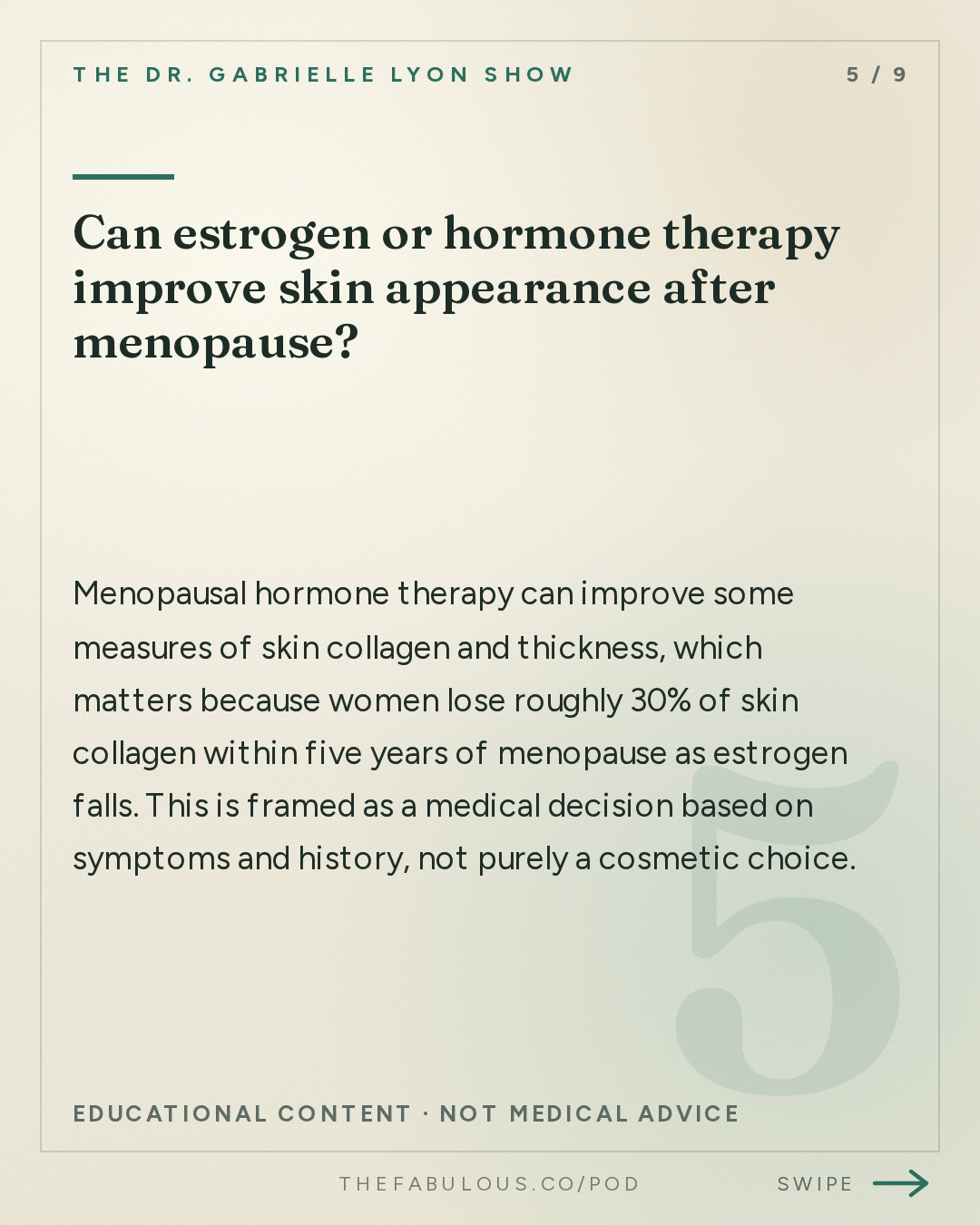
Where estrogen's fingerprints are easiest to see is in tissue most people never think of as hormone-responsive: skin. Estrogen receptors sit throughout skin and connective tissue, and estrogen affects collagen, hydration, thickness, and blood flow (15:44). When estrogen drops at menopause, women can lose on the order of 30 percent of their skin collagen within the first five years, which shows up as thinner, drier, less elastic skin and more visible wrinkling and bruising (16:08). Menopausal hormone therapy can improve some of those collagen and thickness measures, though that is one factor among several, including symptoms, age, and medical history, in a decision made with a clinician (16:08, 16:36).
The thread running under all of it is agency. Skeletal structure, facial maturation, and voice are hormone-built traits locked in during puberty and are not up for renegotiation in adulthood. Skin changes with estrogen whether or not anyone chooses it. Muscle is different. It is shaped by the same endocrine system, yet it stays negotiable for an entire lifetime.
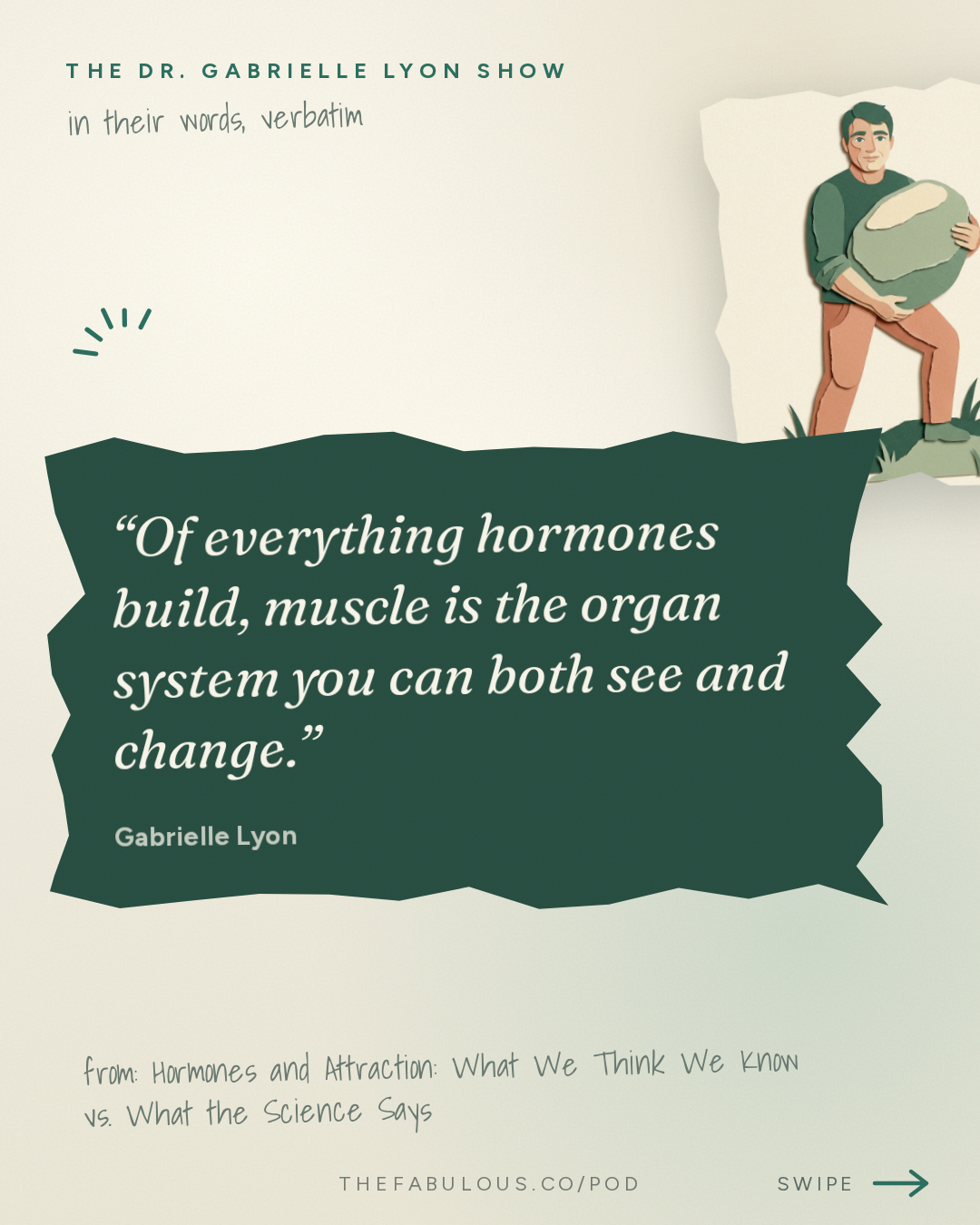
"Of everything hormones build, muscle is the organ system you can both see and change." — Gabrielle Lyon [17:07]
That is the real argument of the episode, dressed up as a myth-busting tour through testosterone and jawlines. People cannot read anyone's hormone numbers off a face or off skin. What they are seeing, always, is a phenotype, a lifetime of genetics, development, environment, and behavior compressed into one visible body (17:07). Strength happens to be the part of that body still being written. It is visible, it is trainable, and according to the data here, it is also the trait most consistently tied to how attractive a body reads to someone else. The jaw is fixed by puberty. The deadlift is not.
Ask this episode anything
Pod's AI answers from the episode itself, with the minute mark so you can hear it yourself.
Or start with one of these
Ask this episode
Pod's AI listens to the whole episode to answer, and points you to the minute it comes from.
The rest of this answer, and any question after it
Answers come from the episode itself, never from a summary of it.
ContinueKey takeaways
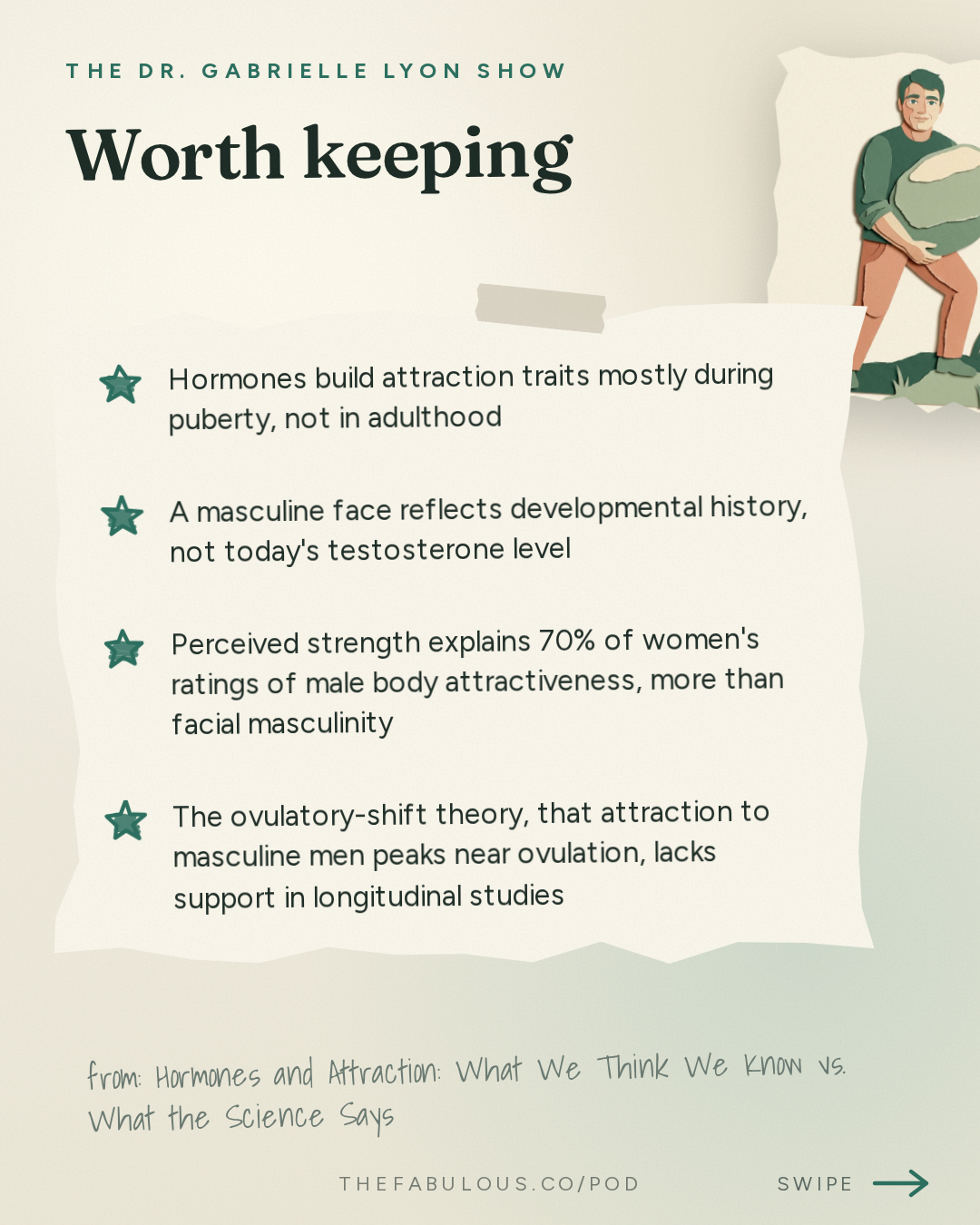
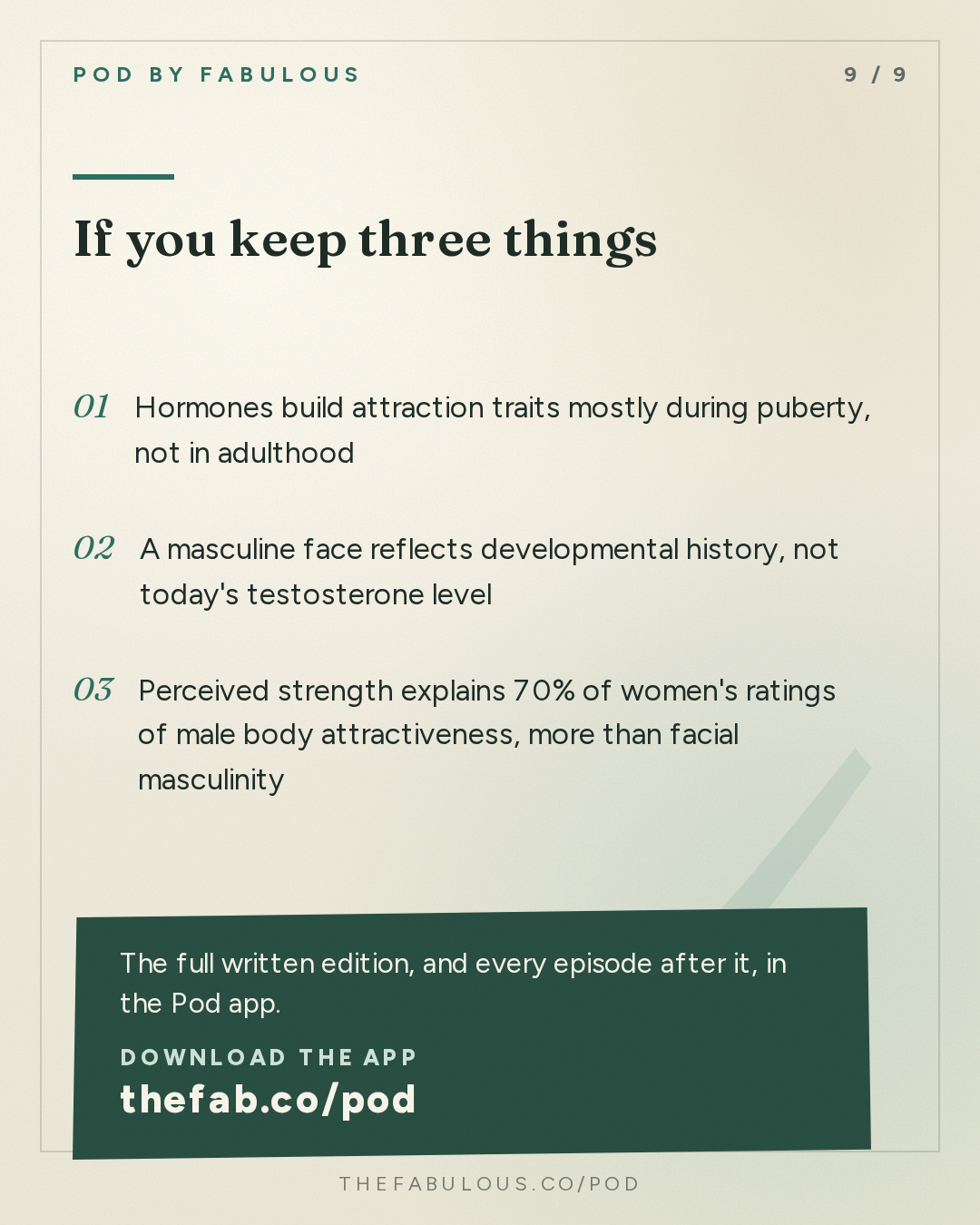
- Hormones build attraction traits mostly during puberty, not in adulthood
- A masculine face reflects developmental history, not today's testosterone level (06:09)
- Perceived strength explains 70% of women's ratings of male body attractiveness, more than facial masculinity (11:10)
- The ovulatory-shift theory, that attraction to masculine men peaks near ovulation, lacks support in longitudinal studies (03:07)
- Menopause can cut skin collagen by about 30% within five years as estrogen falls (16:08)
The episode in cards

By the numbers
- 70% share of variance in women's ratings of male body attractiveness explained by perceived physical strength
- 10% additional variance in male attractiveness ratings explained by height and leanness
- 80% total variance in male attractiveness explained by strength, height, and leanness combined
- 30% skin collagen lost in the first five years after menopause
- 45 years old age cited as too late for testosterone therapy to reshape the facial skeleton
In their words
“You can't take testosterone at 45 and rebuild your facial skeleton, and taking more estrogen isn't gonna suddenly make a woman more attractive.”
“Your face is not a hormone panel.”
“A masculine face may tell you something about a person's developmental history. It doesn't tell you his or her testosterone today”
“Of everything hormones build, muscle is the organ system you can both see and change.”
Protocols
-
Train strength instead of chasing hormone numbers
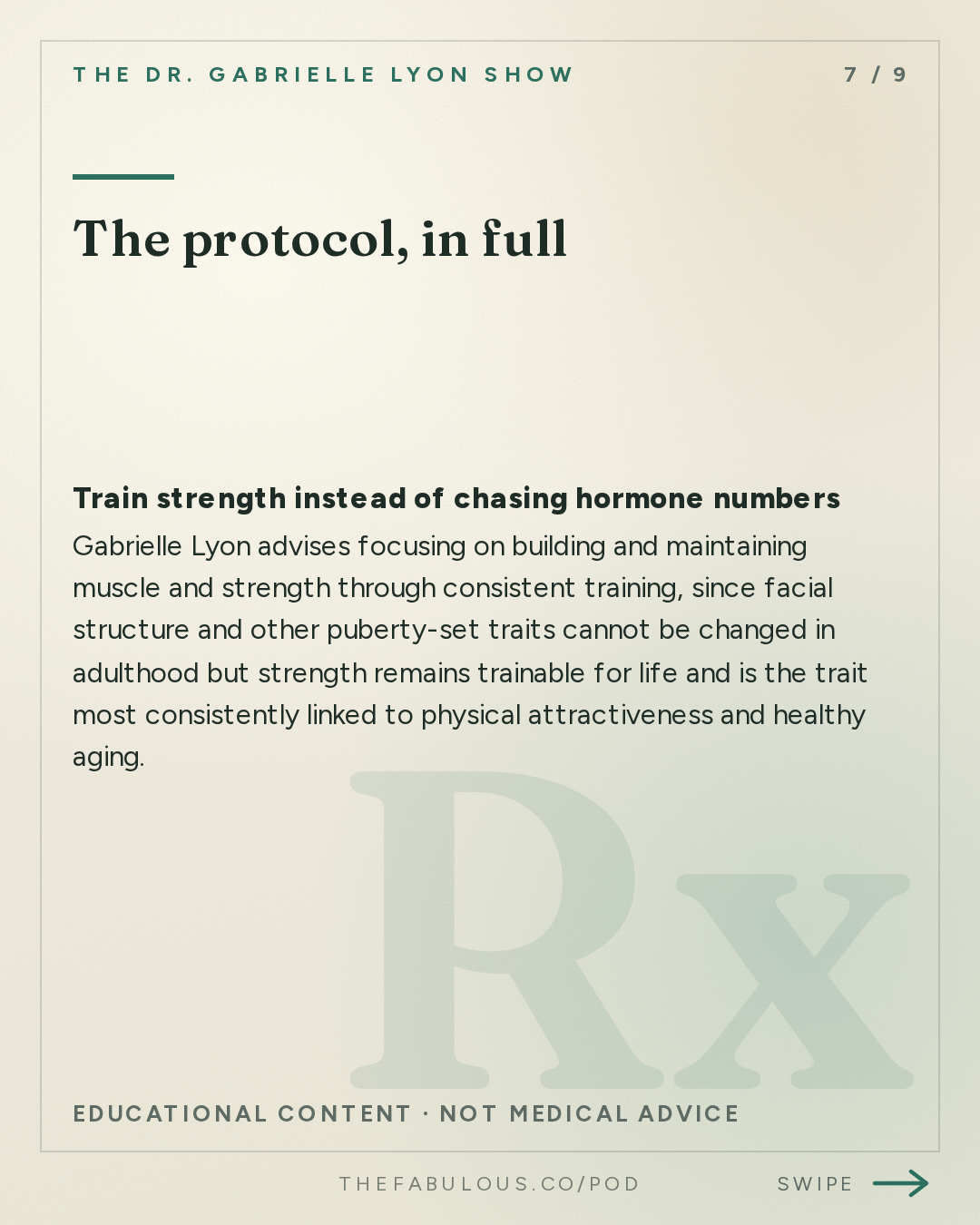
Gabrielle Lyon advises focusing on building and maintaining muscle and strength through consistent training, since facial structure and other puberty-set traits cannot be changed in adulthood but strength remains trainable for life and is the trait most consistently linked to physical attractiveness and healthy aging.
ongoing, lifelong practice
Questions this episode answers
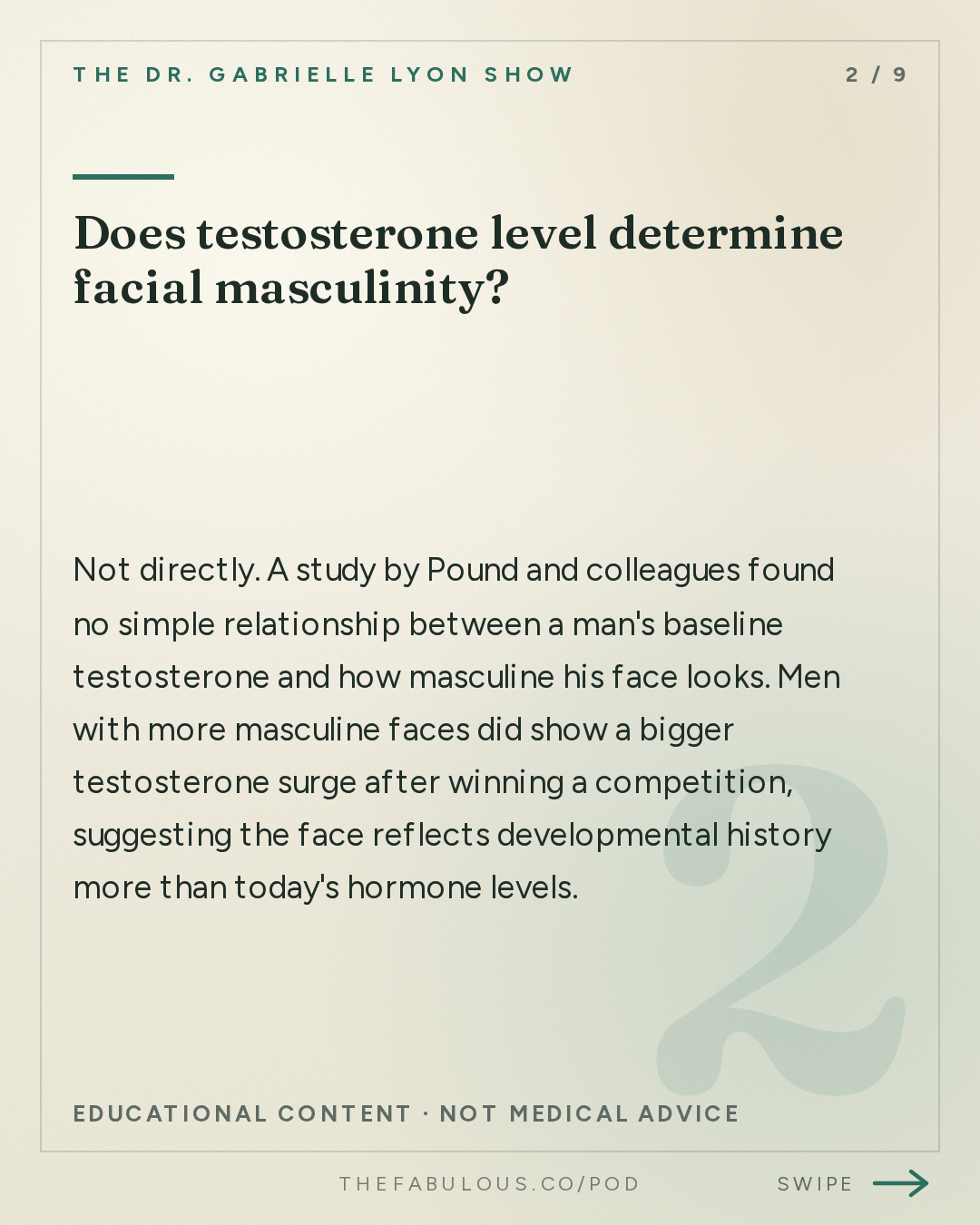
Does testosterone level determine facial masculinity?
Not directly. A study by Pound and colleagues found no simple relationship between a man's baseline testosterone and how masculine his face looks (05:09). Men with more masculine faces did show a bigger testosterone surge after winning a competition, suggesting the face reflects developmental history more than today's hormone levels.
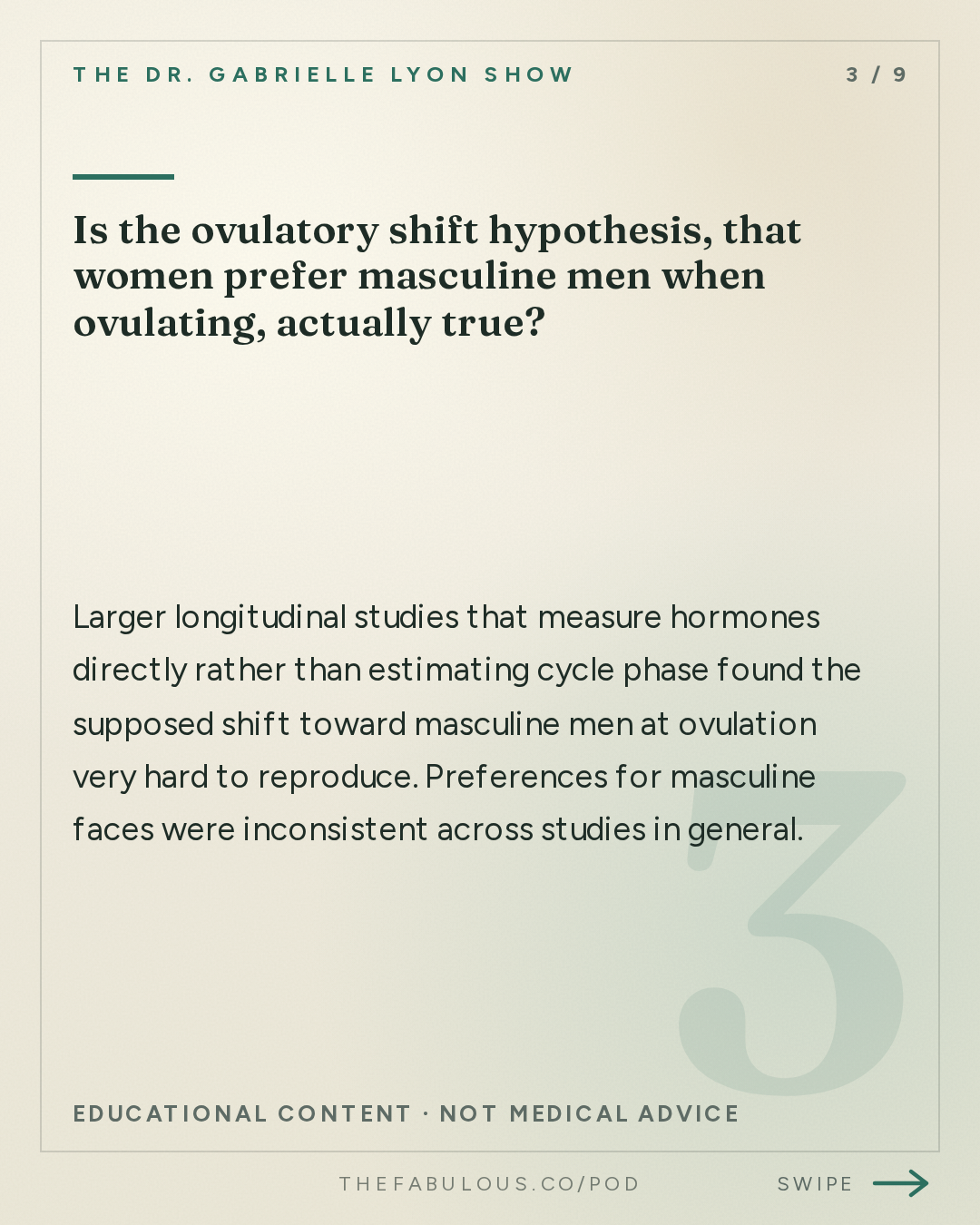
Is the ovulatory shift hypothesis, that women prefer masculine men when ovulating, actually true?
Larger longitudinal studies that measure hormones directly rather than estimating cycle phase found the supposed shift toward masculine men at ovulation very hard to reproduce (03:07). Preferences for masculine faces were inconsistent across studies in general (08:09).
What predicts male physical attractiveness more, the face or the body?
An eLife meta-analysis found strength and muscularity, not facial masculinity, consistently linked to men's mating success (09:37). A Royal Society Open Science study by Aaron Sell and colleagues found perceived strength alone explains 70% of variance in attractiveness ratings of male bodies, with height and leanness adding another 10% (11:10).
Can estrogen or hormone therapy improve skin appearance after menopause?
Menopausal hormone therapy can improve some measures of skin collagen and thickness, which matters because women lose roughly 30% of skin collagen within five years of menopause as estrogen falls (16:08). This is framed as a medical decision based on symptoms and history, not purely a cosmetic choice.
Can you tell someone's testosterone or estrogen level by looking at them?
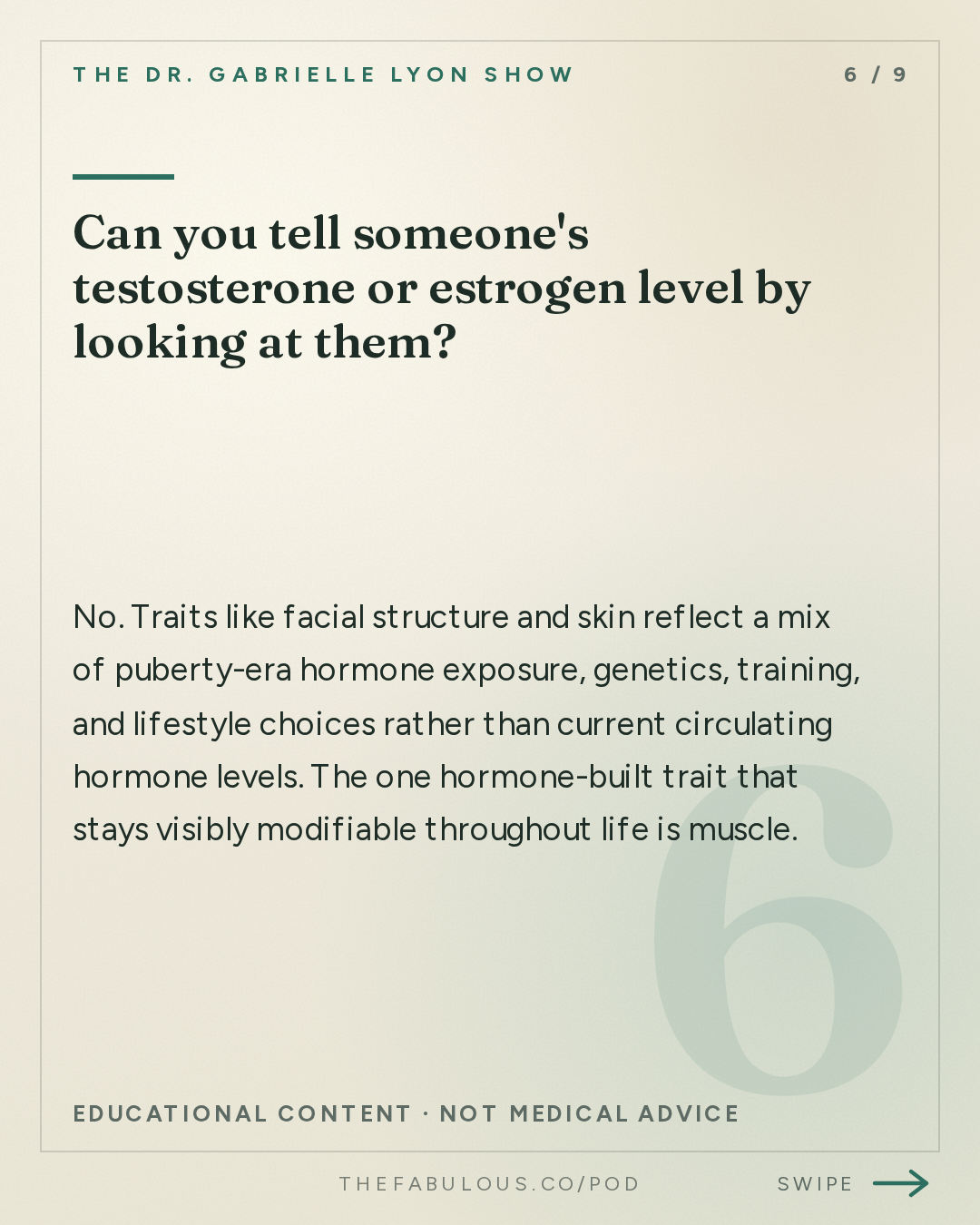
No. Traits like facial structure and skin reflect a mix of puberty-era hormone exposure, genetics, training, and lifestyle choices rather than current circulating hormone levels (17:07). The one hormone-built trait that stays visibly modifiable throughout life is muscle.
The full read, in cards
Go deeper
- Pound and colleagues, study on facial masculinity and testosterone response to competition — found no simple link between baseline testosterone and facial masculinity, but a larger testosterone surge after winning in more masculine-faced men
- eLife meta-analysis on masculine traits and mating success — found strength and muscularity, not facial masculinity, consistently linked to men's reproductive success
- Aaron Sell et al., Royal Society Open Science study on body attractiveness — found perceived strength explains 70% of variance in women's ratings of male body attractiveness
- Classic study on estrogen and facial femininity ratings — found higher measured estrogen associated with ratings of femininity, attractiveness, and health
Mentioned
Pound · Amy Cuddy · Aaron Sell · Royal Society Open Science · eLife
More from this show and category
JJ Thomas's Primal Physical Therapy Guide
Physical therapist JJ Thomas argues that pain is an alarm pointing to a movement problem elsewhere in the body, not proof that the hurting spot is broken. She treats patients with seven foundational movements (squat, hinge, push, pull, carry, reach, rotate) and dry needling at sites far from the pain, arguing most overuse injuries are really underuse injuries of neighboring muscles.
Building Muscle in Menopause: What Studies Show
No, it is not too late: postmenopausal women gained up to eight pounds of muscle in 12 weeks of structured lifting. Hormone therapy does not build muscle on its own, but it can amplify gains from resistance training, and the protein target for bone and muscle protection is roughly double the standard RDA.

Surgical Prehabilitation Protocol Guide
Prehabilitation, the practice of preparing the body before surgery instead of only recovering after it, can measurably change outcomes. Duke University surgeon Rebecca Knackstedt recommends 2 grams of protein per kilogram of body weight daily (34:26), a vitamin D level near 70 ng/mL (25:47), targeted muscle training, and five days of immunonutrition before major operations (69:01) to cut complications and speed healing.

ED as an Early Predictor of Heart Attack Risk
Erectile dysfunction predicts a future heart attack better than chest pain does, especially in younger men (11:11). Urologist Tobias Kohler describes two cheap early-warning tests, a coronary calcium scan and a Mayo Clinic ceramide blood test, plus the cardiac damage caused by high-dose testosterone abuse (12:49, 44:55).
