unPAUSED with Dr. Mary Claire Haver
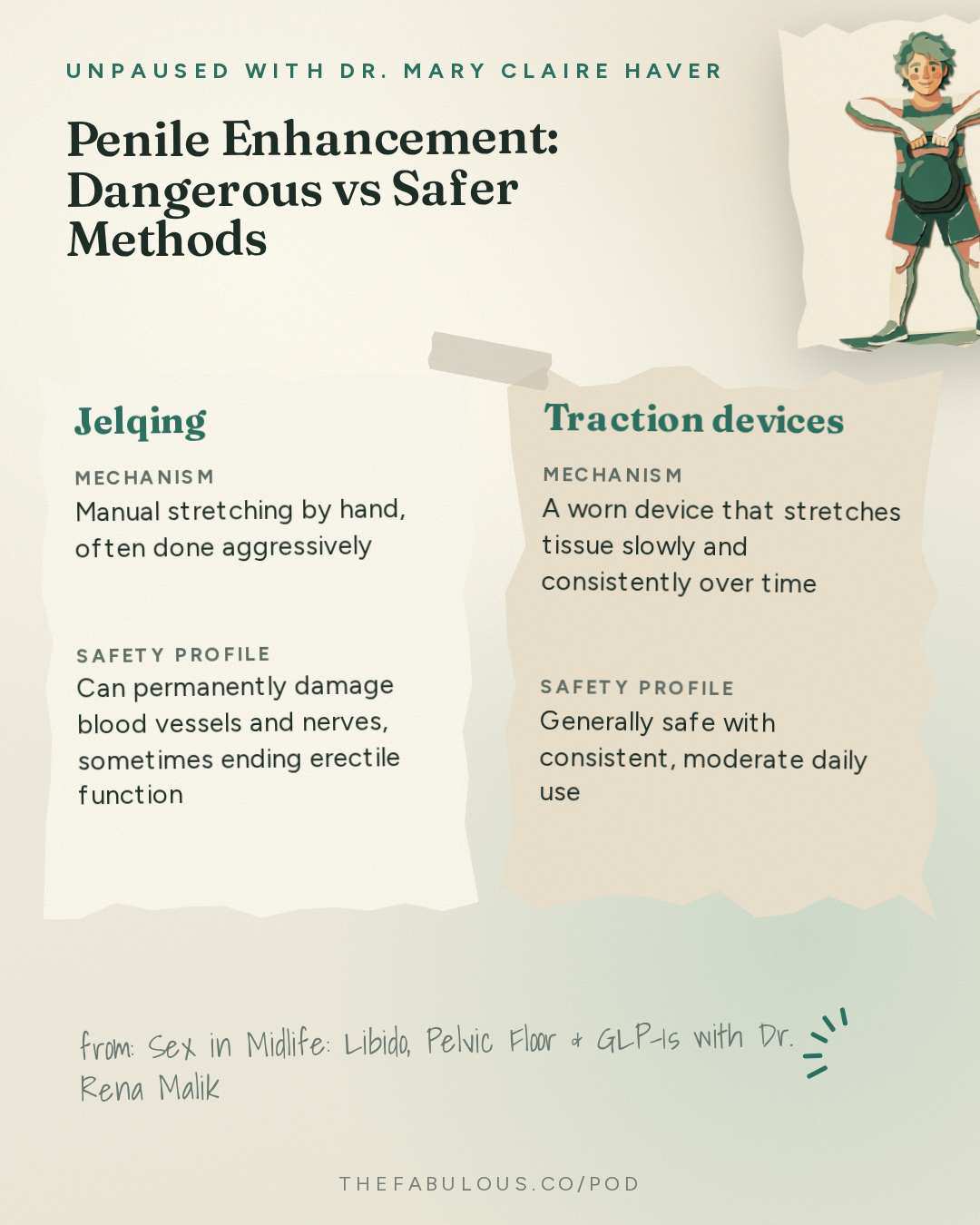
GLP-1s and Libido: What Dr. Rena Malik Says
Sex in Midlife: Libido, Pelvic Floor & GLP-1s with Dr. Rena Malik
▶ Listen to the full episode More from unPAUSED with Dr. Mary Claire Haver
The brief
GLP-1 drugs can blunt sexual desire the same way they blunt food cravings, but a dose change fixes it, says urologist Dr. Rena Malik. Her "four pillars" (fuel, strength, environment, confidence) tie diet, sleep, exercise, and pelvic floor health to erection and orgasm quality, with moderate cardio matching Viagra's effect (18:10) and five hours of sleep cutting testosterone 15% (16:02).
A drug built to quiet the urge to eat can also quiet the urge for sex. That is not a design flaw, says urologist Dr. Rena Malik. It is a clue about how desire actually works.
GLP-1 medications, the class that includes semaglutide and tirzepatide, were made to dial down cravings. Malik, who treats sexual dysfunction and has written a new book called The Hard Truth, says patients on these drugs tell her two different stories. Some find their sex lives improve, because their metabolic health is getting better and they feel more confident in their bodies (00:52). Others notice the opposite.
"GLP-1s, they decrease desire for food. But they also decrease desire for other things." — Dr. Rena Malik [01:14]
People on these drugs report less binge shopping, less gambling, less drinking. Sex can land in the same bucket. Malik's fix is not to quit the medication. She tells patients to talk to their doctor about lowering the dose or switching from semaglutide to tirzepatide (01:35, 02:18). In couples, this shows up as a mismatch: one partner's interest drops while the other's stays the same, and both need to understand the cause sits in the prescription, not the relationship.
There is a stranger thread here. Malik saw data presented at the American Urological Association's annual meeting, not yet published, showing that GLP-1 drugs raise testosterone even after researchers control for the weight loss that normally explains that rise on its own (02:56). Nobody yet knows the mechanism. What is not strange, unfortunately, is the delay before people seek help. Malik says it is almost always years, not months (04:43). A Cleveland Clinic study called MENTION, which tracks how men interact with the health system, found that two out of three men would rather do household chores than see a doctor (05:00). They will try supplements, online pharmacies, anything, before they sit down with a physician.
What Counts as a Checkup
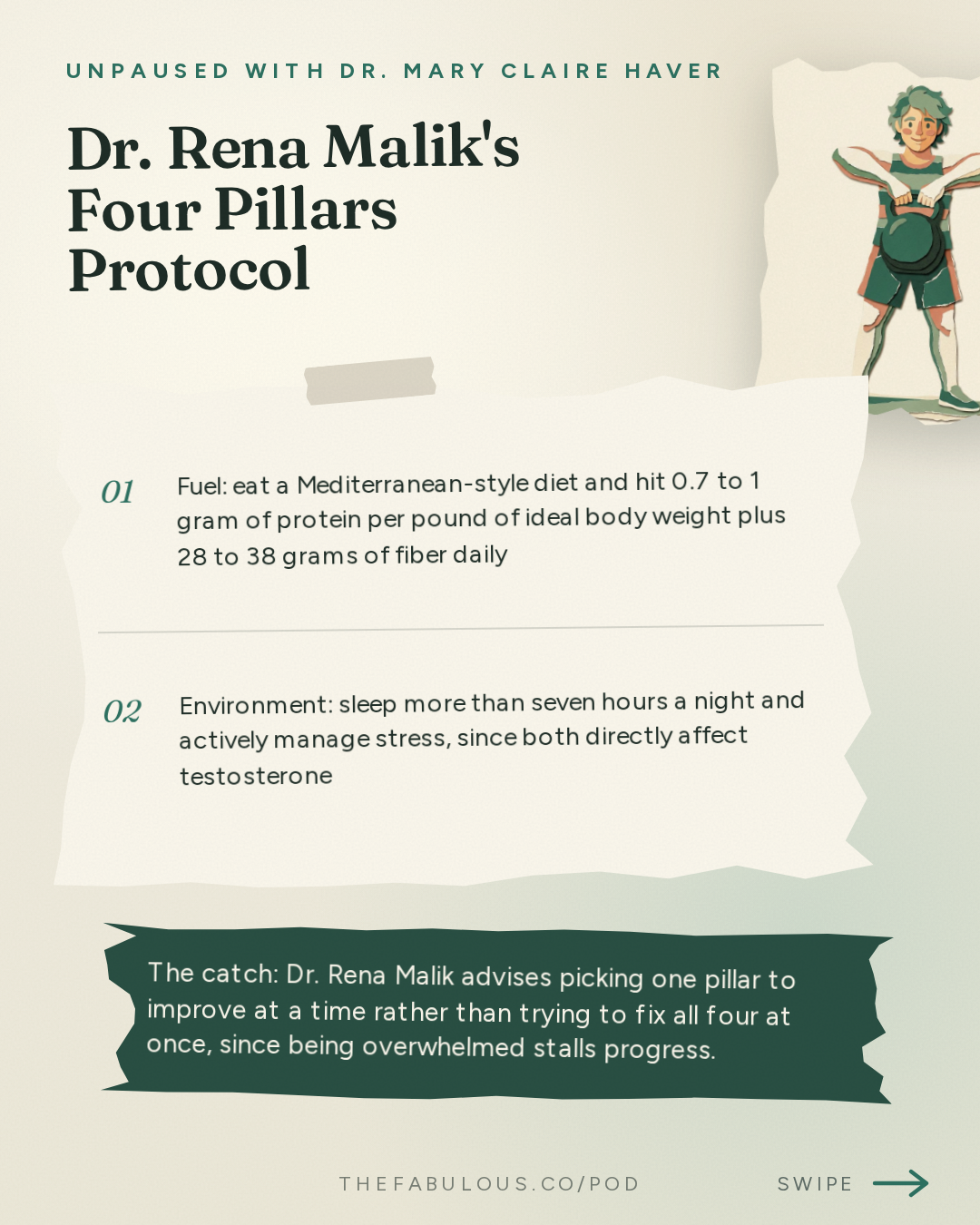
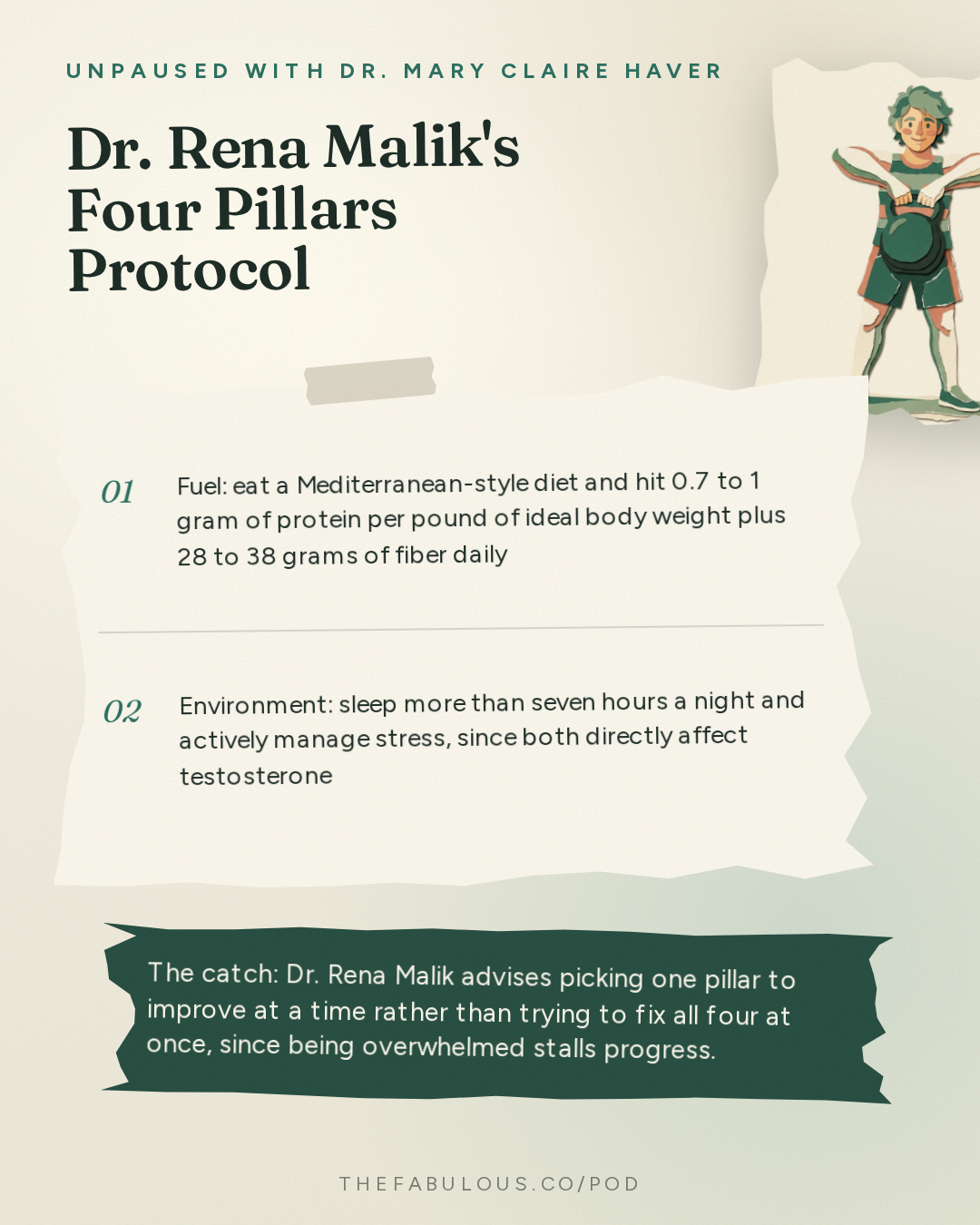
The Hard Truth organizes sexual health into four pillars: fuel, strength, environment, and confidence (10:59). Underneath the framework sits a claim worth sitting with. Sex, Malik argues, is a biomarker, not just a pleasure. She points to population data linking how often people have sex with lower all-cause mortality, though she is careful to note the data only shows correlation, since it cannot rule out that people who have more sex are simply healthier or more socially connected to begin with (11:19). Her stronger argument is mechanical: an erection, or an orgasm, needs blood vessels, hormones, and nerves all firing correctly at once. "Your blood flow is working. Your hormones are working. Your nervous function is working," she says (11:40). When sex goes well, several organ systems are quietly passing a test together.
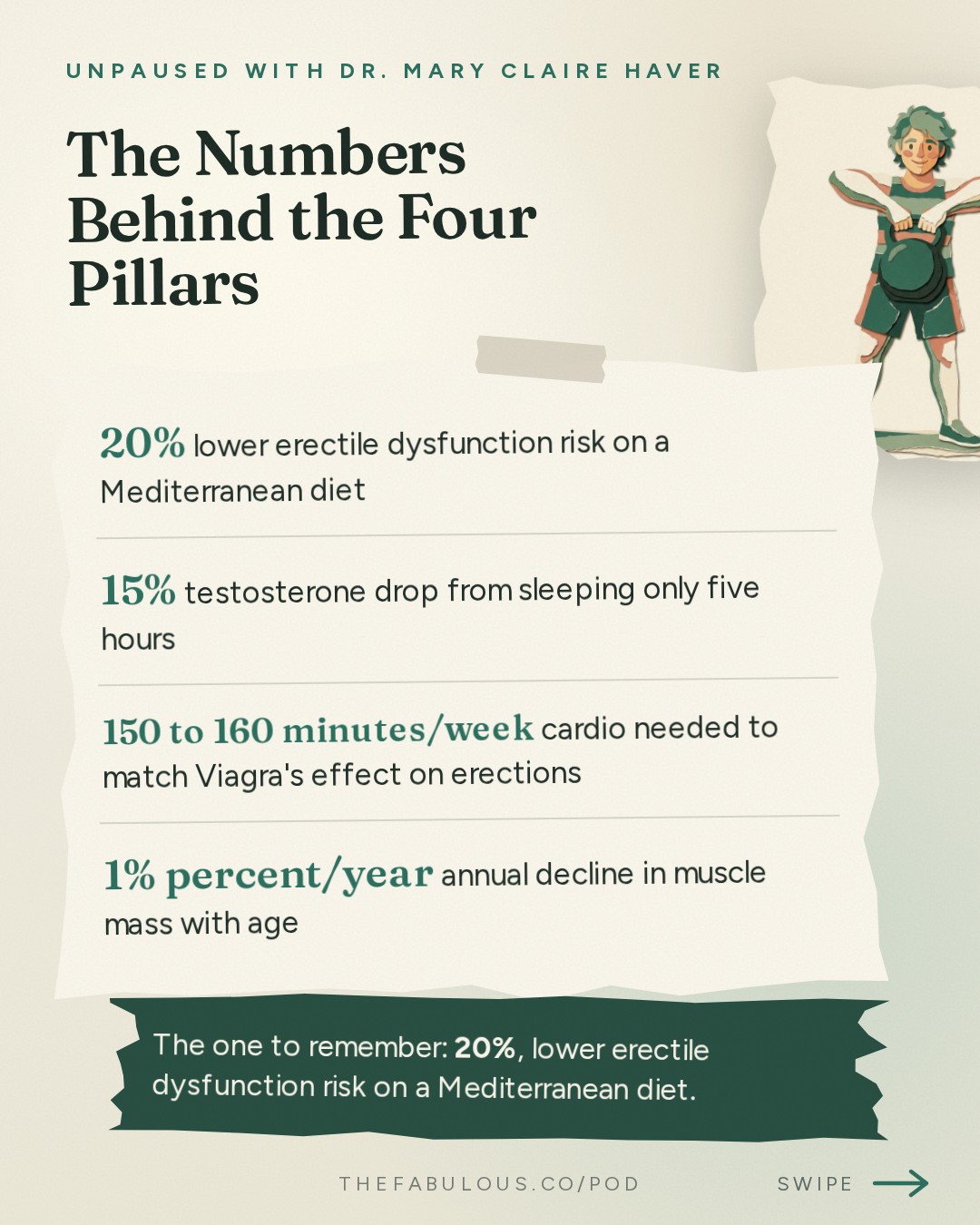
Fuel is the most familiar pillar and the most specific. Men eating a Mediterranean diet, built around vegetables, fish, olive oil, and whole grains, show a 20 percent lower risk of erectile dysfunction (13:10). Malik's targets: 0.7 to 1 gram of protein per pound of ideal body weight, and the FDA's fiber recommendation of 28 grams a day for women and 38 for men, numbers she says almost nobody hits (13:30). In her own patient population, roughly 80 percent test deficient in vitamin D (14:42). On supplements, she draws a sharp line. Ashwagandha, an herb widely marketed for erectile function, does not have strong clinical data behind it, in her view (05:21). L-arginine, an amino acid that is a precursor to nitric oxide, a gas that relaxes blood vessels and lets more blood into the penis, has more convincing support (05:59). Her rule for anything else on a supplement shelf: know what gap it is filling before you take it (15:17).
Environment covers sleep and stress, and this is where the numbers get uncomfortable. Malik cites a study in which men slept more than seven hours a night, then were dropped to five hours after a washout period. Their testosterone fell 15 percent (16:02). The body repurposes testosterone during sleep, she explains, so cutting sleep cuts the hormone supply. Stress works through a separate channel. A study of medical residents working roughly 80-hour weeks found their testosterone significantly lower, some at hypogonadal levels below 300 nanograms per deciliter, compared with same-age hospital employees who were not in training (17:03). The mechanism is the nervous system itself: arousal requires the parasympathetic branch, the "rest and digest" state, to be active, while stress flips the body into its sympathetic, "fight or flight" mode. The two do not run well at the same time (17:51).
Strength pairs cardiovascular exercise with resistance training. Moderate intensity cardio, 150 to 160 minutes a week, improves erection quality by roughly the same magnitude as taking Viagra, according to the trials Malik cites (18:10). Resistance training built around large muscle groups, like squats and deadlifts, raises testosterone on its own (19:23). Muscle mass naturally declines about 1 percent a year after a certain age, and preserving it tracks with better libido, erectile function, and sexual satisfaction in men, though Malik notes this specific question has not been studied in women yet (19:44).
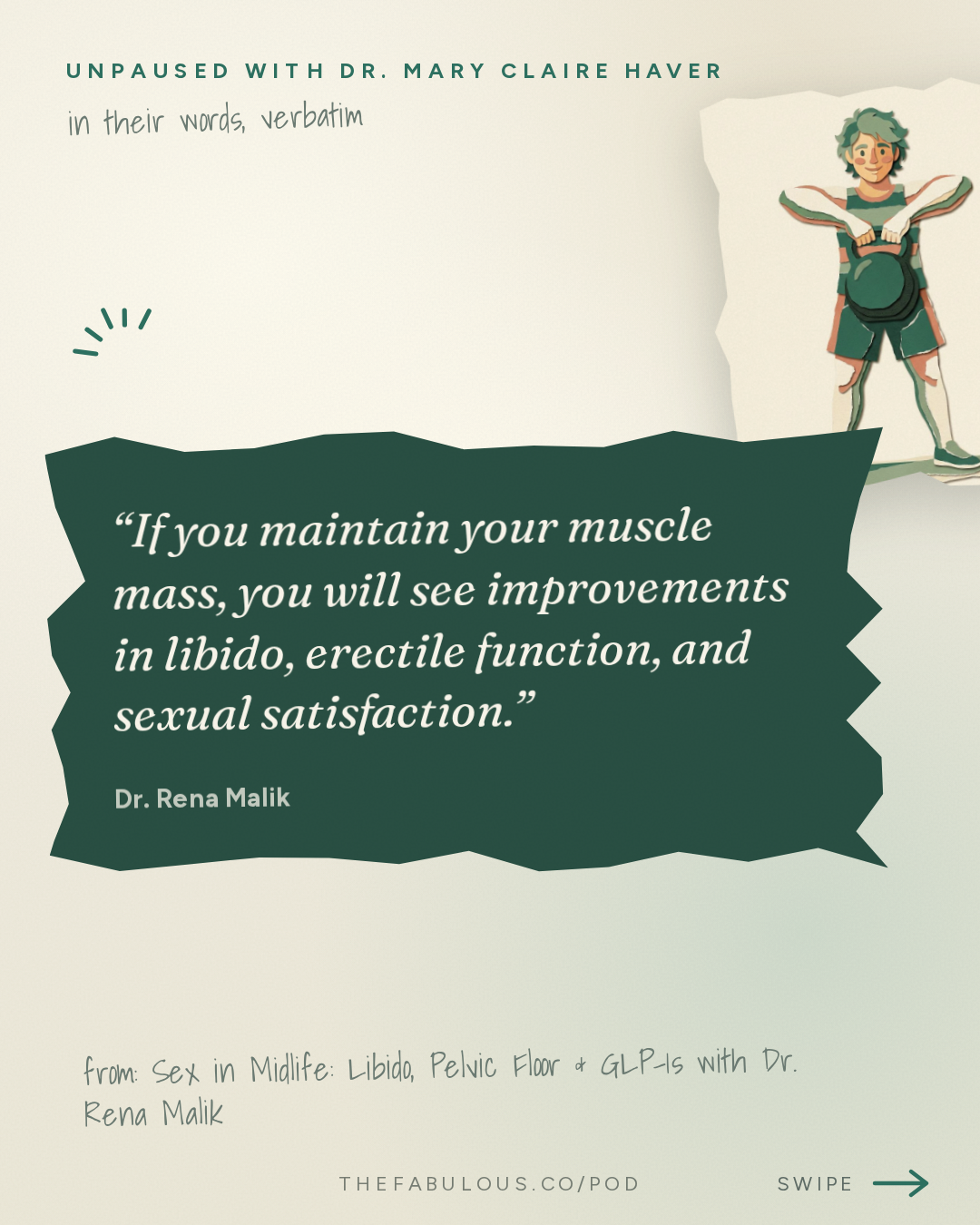
"If you maintain your muscle mass, you will see improvements in libido, erectile function, and sexual satisfaction." — Dr. Rena Malik [19:44]
The fourth leg of strength, pelvic floor health, gets less attention than it should. Kegel exercises can increase orgasm intensity in both men and women, but Malik warns that a pelvic floor that is already too tight, a condition clinicians call high tone, is under-diagnosed, and more Kegels can make those symptoms worse (20:27). Warning signs include pain during sex, pain with erections or ejaculation, urinary urgency, and unexplained hip or back pain. Her advice is to get evaluated by a pelvic floor physical therapist or a urologist trained in the area before starting any Kegel routine (20:54).
The Loudest Myth in the Room
No topic in the episode generates more anxiety, or more bad information, than penis size. Malik says more men want a larger penis than want to be taller, and the preoccupation starts in childhood, long before puberty (24:24). The anatomy does not support the anxiety. By Malik's account, roughly 85 percent of women need clitoral stimulation to reach climax, something that has nothing to do with length (25:24).
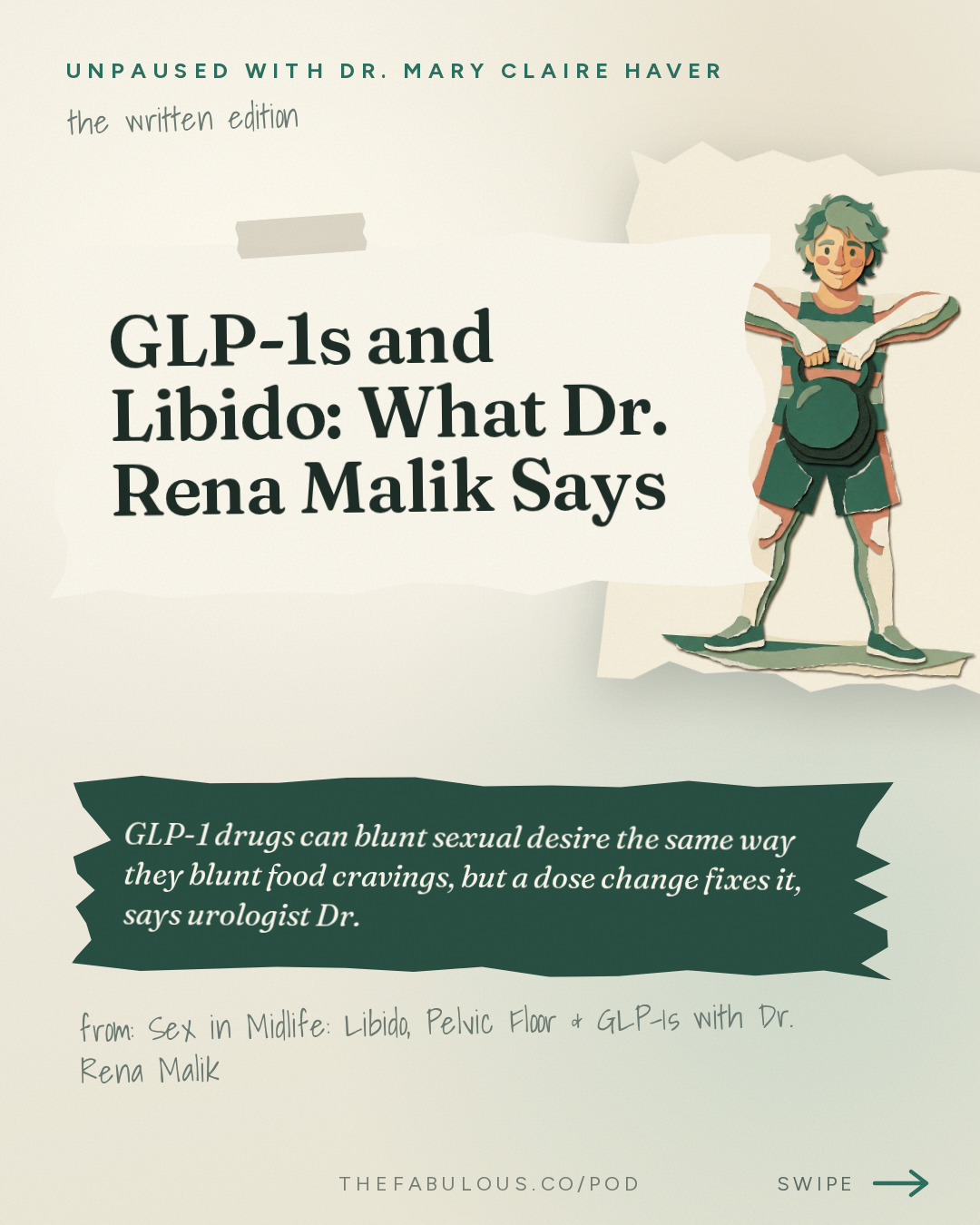
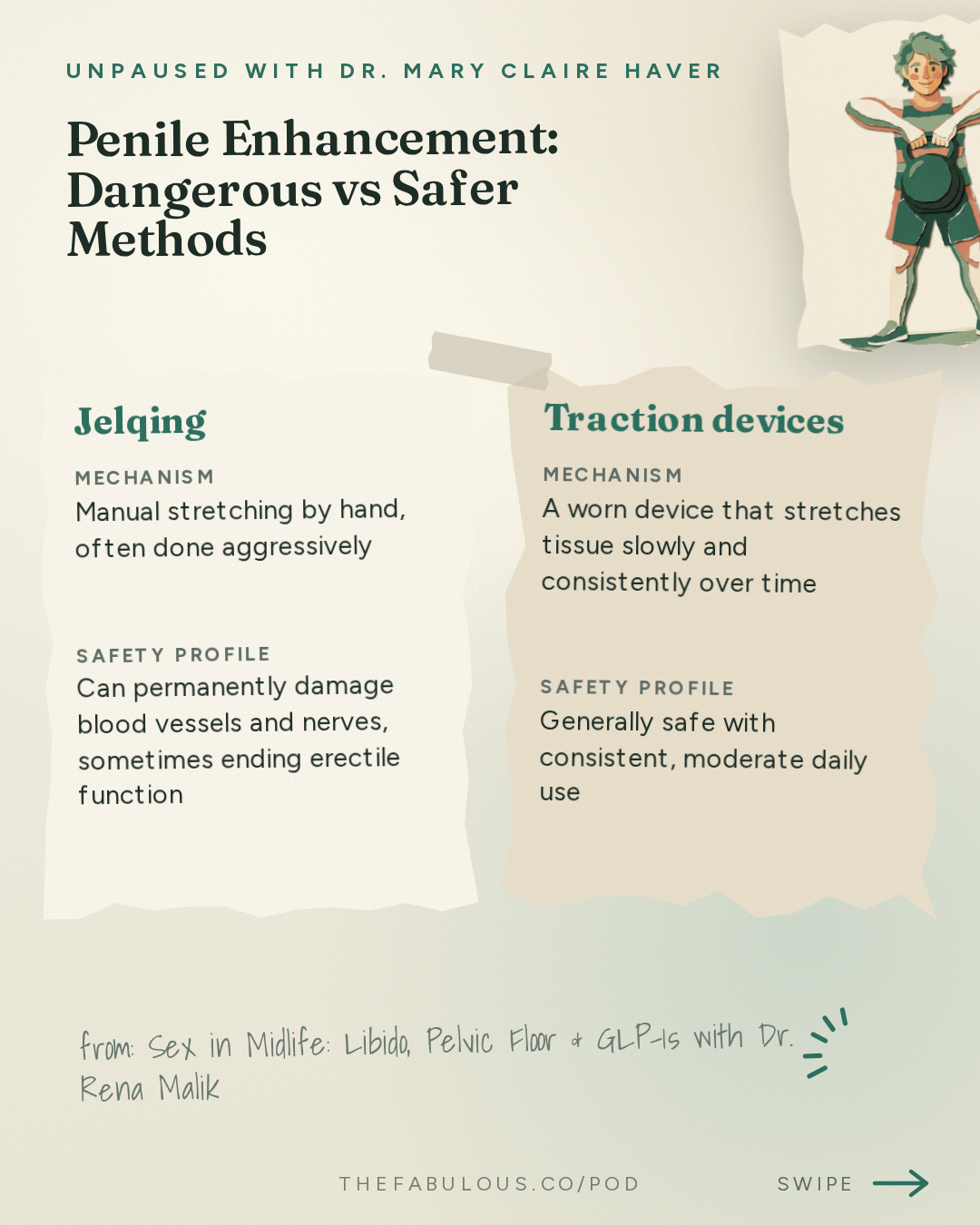
That gap between fear and fact has fueled dangerous trends. Jelqing, a viral practice involving aggressive manual stretching, can permanently damage blood vessels and nerves, sometimes ending a man's ability to get an erection at all (26:07). A safer but far more demanding option is a traction device, worn for hours a day, which produces an average length increase of about 2 centimeters with consistent use (27:00). For context, Malik cites the average erect length in these studies as 5.2 to 5.5 inches (27:00). Her cheapest, fastest fix carries no medical risk at all: trim pubic hair or lose weight, since both simply reveal more of the anatomy that is already there (28:56). For girth, she describes hyaluronic acid fillers, the same material used in lips and faces, as reasonably safe in small amounts when injected by an expert, and genuinely dangerous in large volumes, citing an influencer who died of a pulmonary embolism after receiving a very large filler injection (29:24).
The conversation closes on a population easy to overlook: older adults starting new relationships after a partner's death, often in group living settings, where sexually transmitted infections are rising because pregnancy no longer feels like a reason for caution (30:40). Malik's advice there is the same as everywhere else in the episode: barrier protection, honest testing, and conversation before intimacy, not after. She adds one pillar that didn't make the book's table of contents, the company people keep. Surrounding yourself with couples who have quietly given up on sex, she says, makes it easier to convince yourself you don't want it either, even when that isn't true (38:26). The reverse, she implies, should also hold. The throughline of the whole hour is less about performance than about information: sex, examined honestly, tells a person things about blood flow, hormones, sleep debt, and stress that a lab panel might miss, and most of it is fixable once someone finally brings it up.
Ask this episode anything
Pod's AI answers from the episode itself, with the minute mark so you can hear it yourself.
Or start with one of these
Ask this episode
Pod's AI listens to the whole episode to answer, and points you to the minute it comes from.
The rest of this answer, and any question after it
Answers come from the episode itself, never from a summary of it.
ContinueKey takeaways
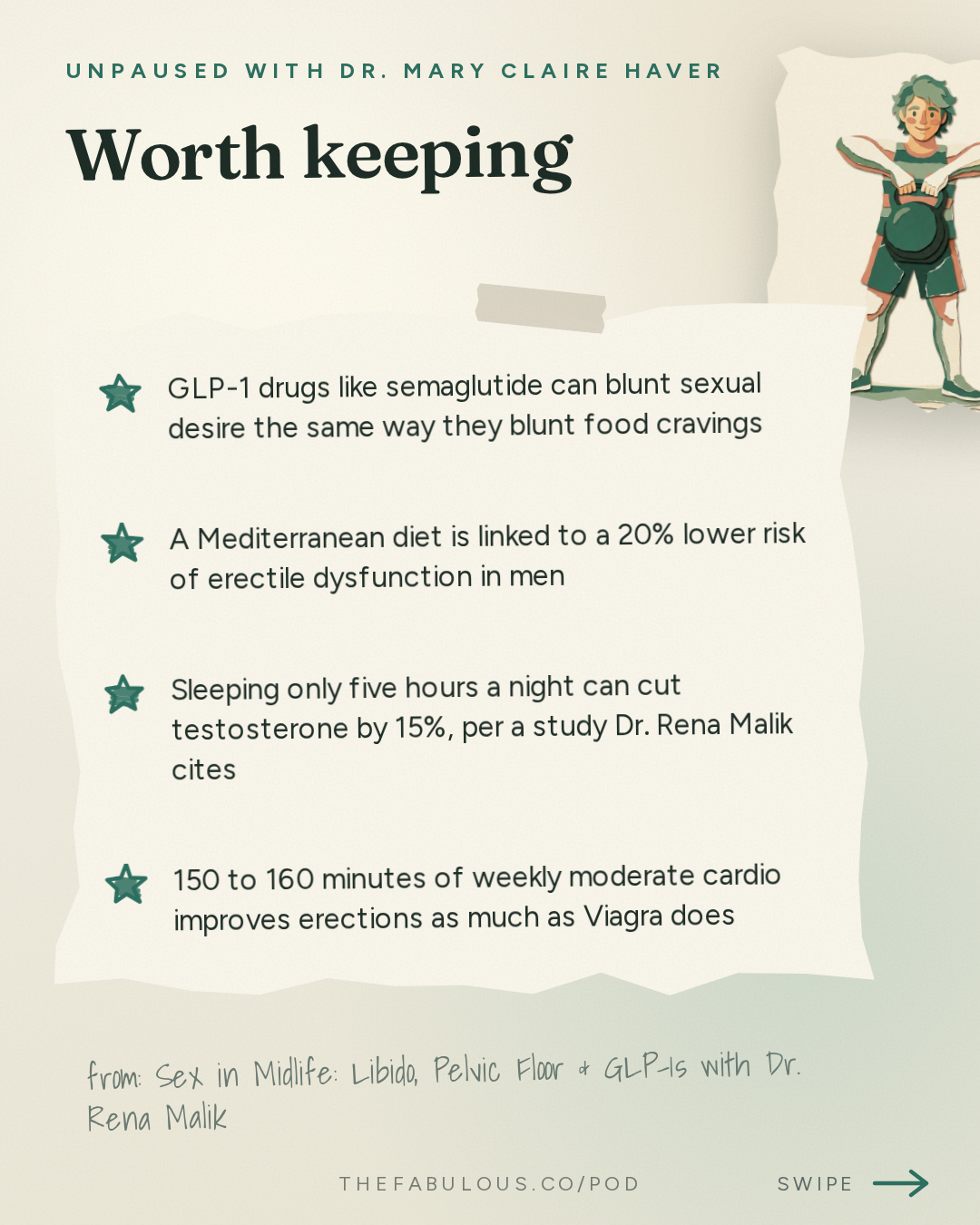
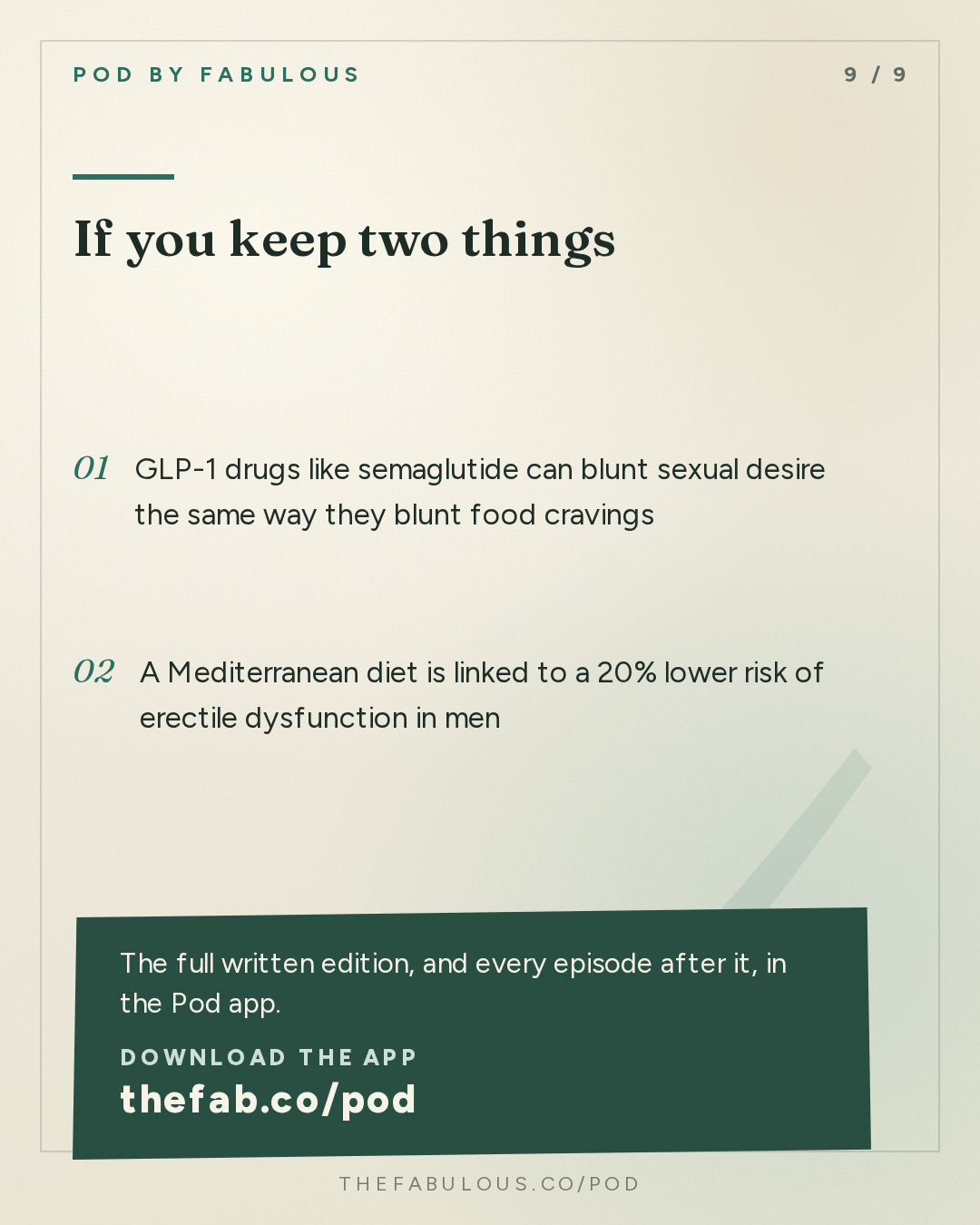
- GLP-1 drugs like semaglutide can blunt sexual desire the same way they blunt food cravings
- A Mediterranean diet is linked to a 20% lower risk of erectile dysfunction in men (13:10)
- Sleeping only five hours a night can cut testosterone by 15%, per a study Dr. Rena Malik cites (16:02)
- 150 to 160 minutes of weekly moderate cardio improves erections as much as Viagra does (18:10)
- Jelqing can permanently damage penile blood vessels and nerves, unlike safer traction devices (26:07)
The episode in cards
By the numbers
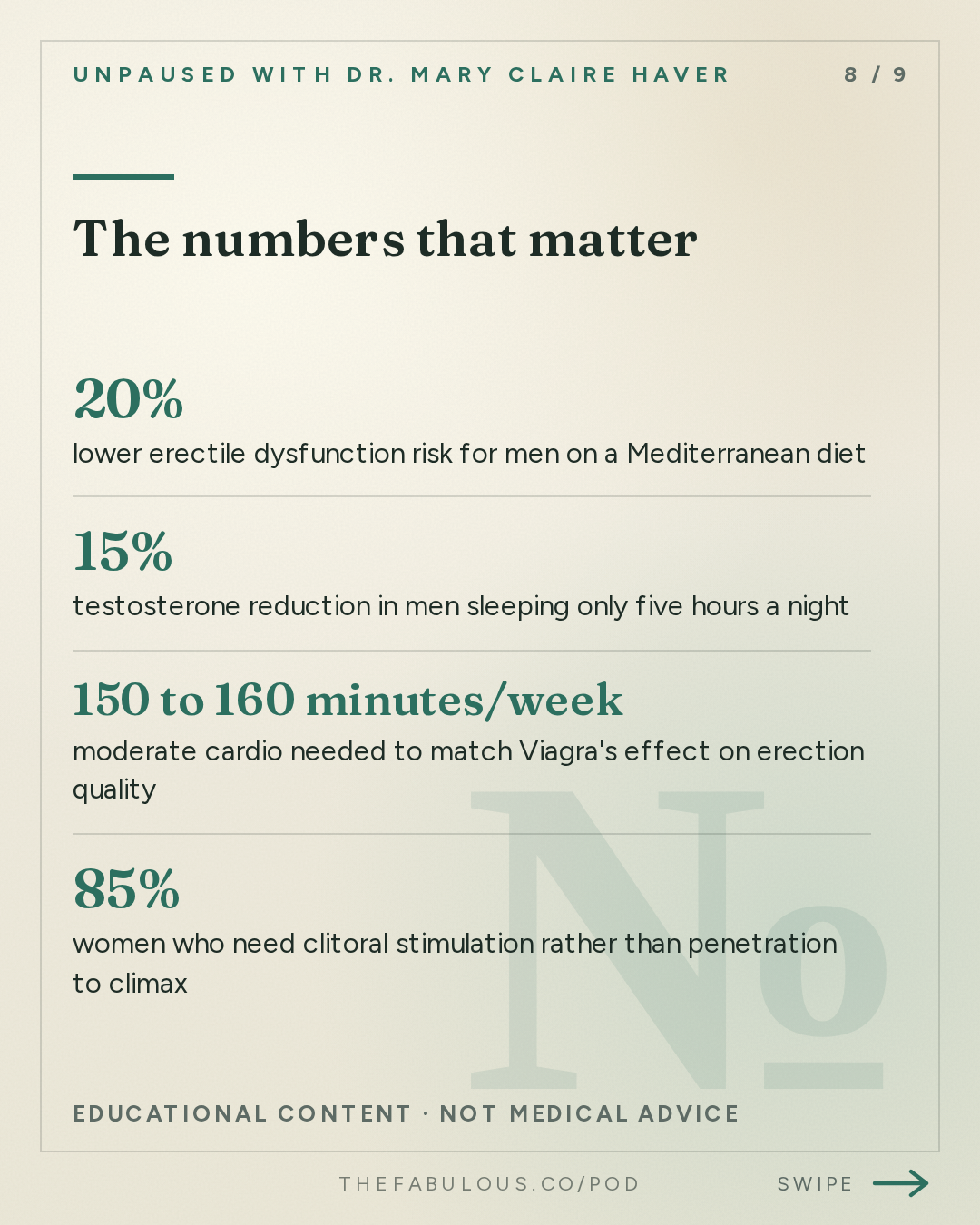
- 20% percent lower erectile dysfunction risk for men on a Mediterranean diet
- 15% percent testosterone reduction in men sleeping only five hours a night
- 150 to 160 minutes/week moderate cardio needed to match Viagra's effect on erection quality
- 85% percent women who need clitoral stimulation rather than penetration to climax
- 2 cm average length gain from consistent traction device use
In their words
“They decrease desire for food. Mm-hmm. But they also decrease desire for other things”
“If you maintain your muscle mass, you will see improvements in libido, erectile function, and sexual satisfaction.”
“The biggest free way to increase your penis size is to trim your pubic hair or lose weight.”
“Surround yourself with people who have similar goals as you in terms of if sex is important to you.”
Protocols
-
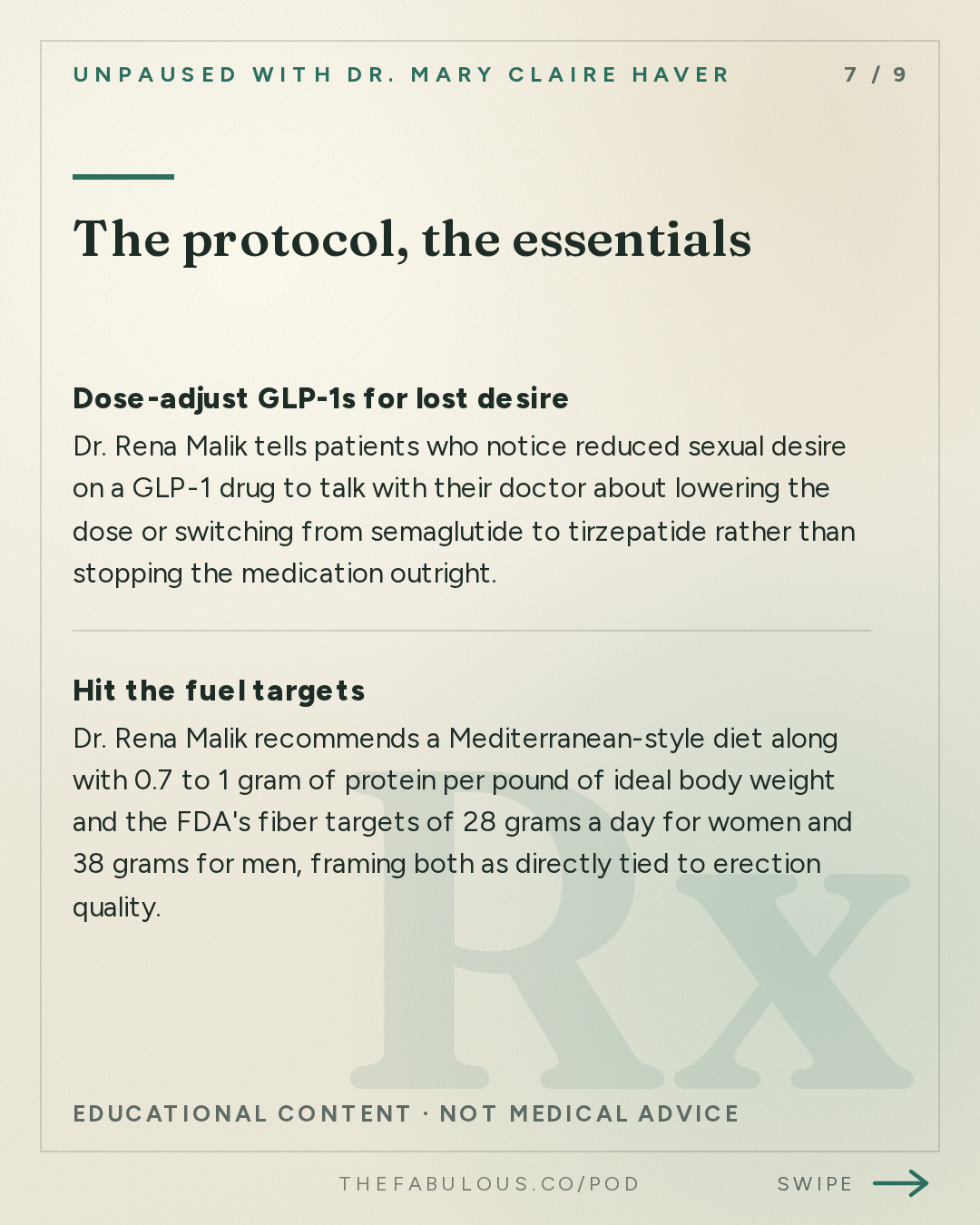
Dose-adjust GLP-1s for lost desire
Dr. Rena Malik tells patients who notice reduced sexual desire on a GLP-1 drug to talk with their doctor about lowering the dose or switching from semaglutide to tirzepatide rather than stopping the medication outright.
as needed when desire drops
-
Hit the fuel targets
Dr. Rena Malik recommends a Mediterranean-style diet along with 0.7 to 1 gram of protein per pound of ideal body weight and the FDA's fiber targets of 28 grams a day for women and 38 grams for men, framing both as directly tied to erection quality.
daily
-
Match Viagra with cardio
Dr. Rena Malik recommends 150 to 160 minutes of moderate-intensity cardiovascular exercise per week because trials show it improves erection quality by roughly the same amount as taking Viagra, and she advises people who do not currently exercise to start with just five minutes of walking a day instead of the full amount.
weekly
-
Check the pelvic floor before Kegels
Dr. Rena Malik advises anyone with pain during sex, pain with erections or ejaculation, urinary urgency, or unexplained hip or back pain to get evaluated by a pelvic floor physical therapist or a trained urologist before starting Kegel exercises, because Kegels can worsen symptoms if the pelvic floor is already too tight.
before starting any Kegel routine
Questions this episode answers
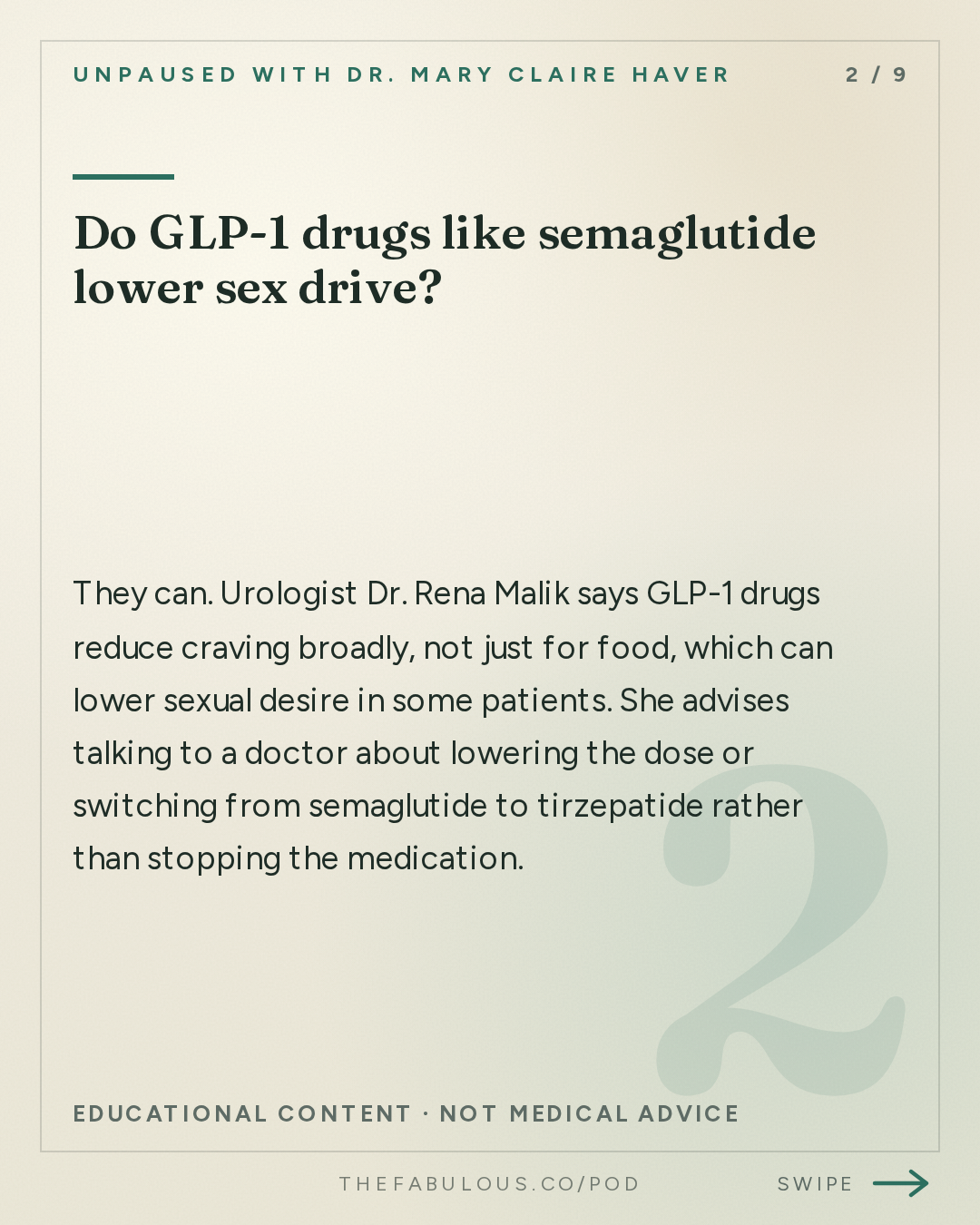
Do GLP-1 drugs like semaglutide lower sex drive?
They can. Urologist Dr. Rena Malik says GLP-1 drugs reduce craving broadly, not just for food, which can lower sexual desire in some patients (01:14). She advises talking to a doctor about lowering the dose or switching from semaglutide to tirzepatide rather than stopping the medication (01:35).
Can exercise really work as well as Viagra for erectile dysfunction?
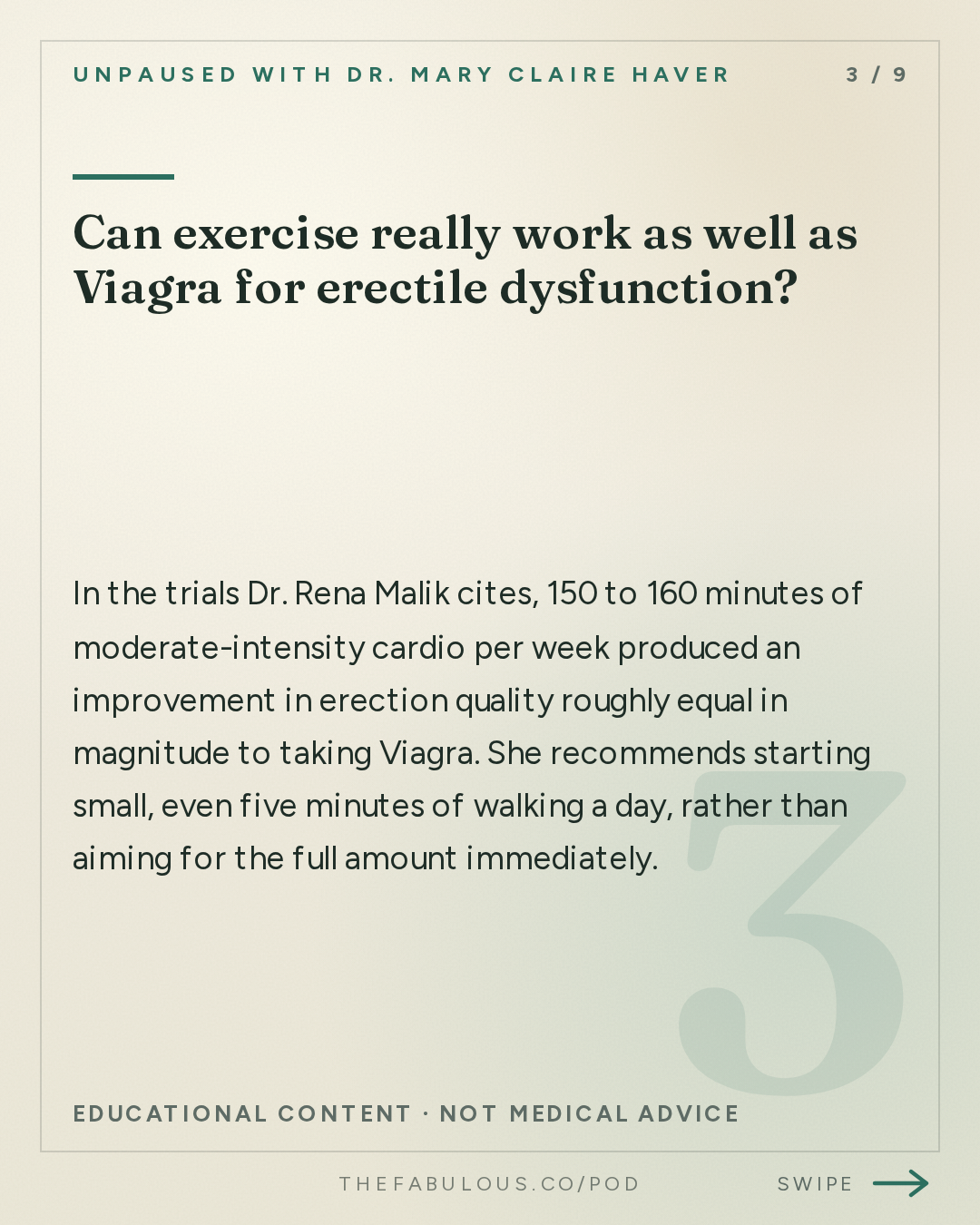
In the trials Dr. Rena Malik cites, 150 to 160 minutes of moderate-intensity cardio per week produced an improvement in erection quality roughly equal in magnitude to taking Viagra (18:10). She recommends starting small, even five minutes of walking a day, rather than aiming for the full amount immediately.
How much does poor sleep affect testosterone?
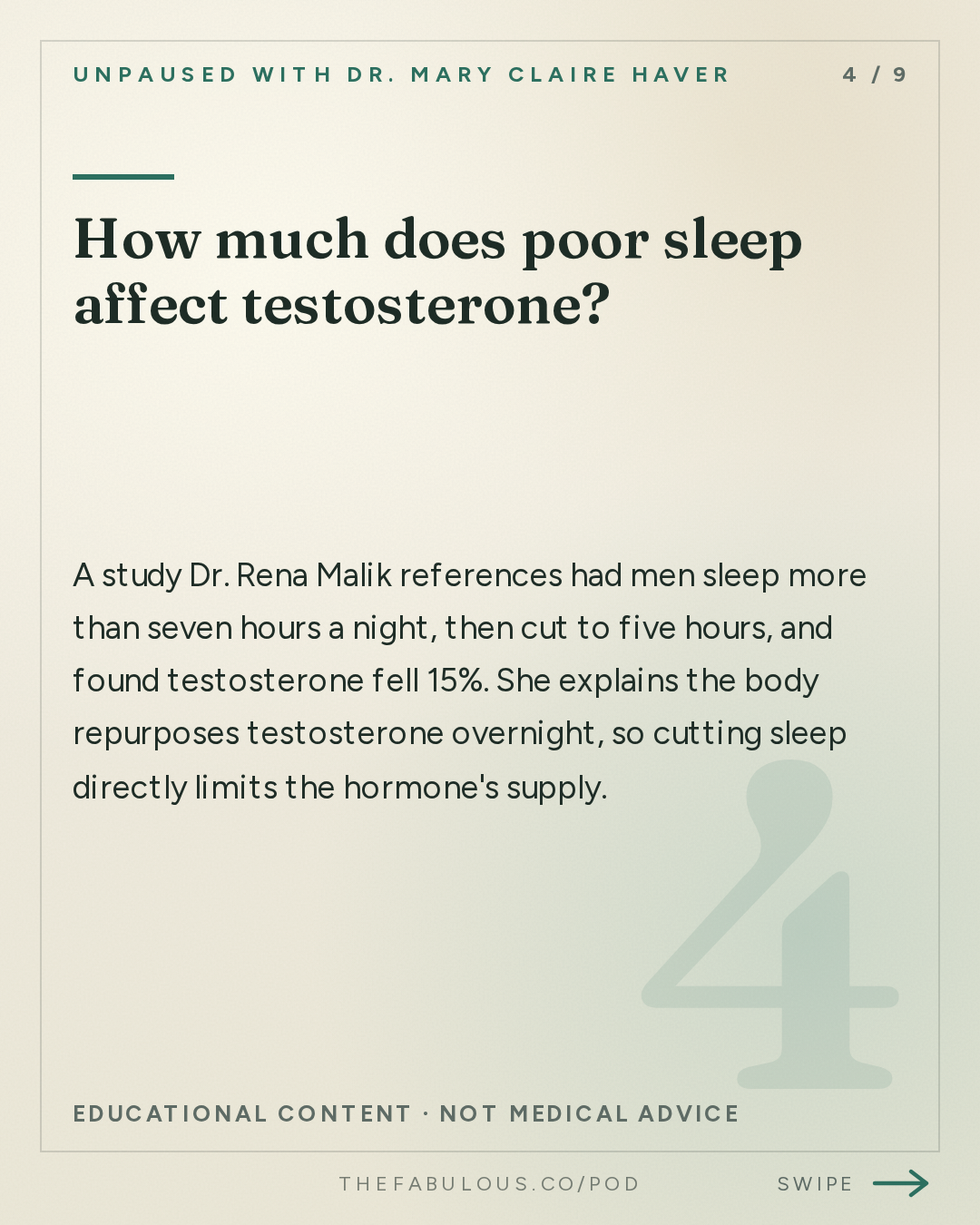
A study Dr. Rena Malik references had men sleep more than seven hours a night, then cut to five hours, and found testosterone fell 15% (16:02). She explains the body repurposes testosterone overnight, so cutting sleep directly limits the hormone's supply.
Is jelqing safe for increasing penis size?
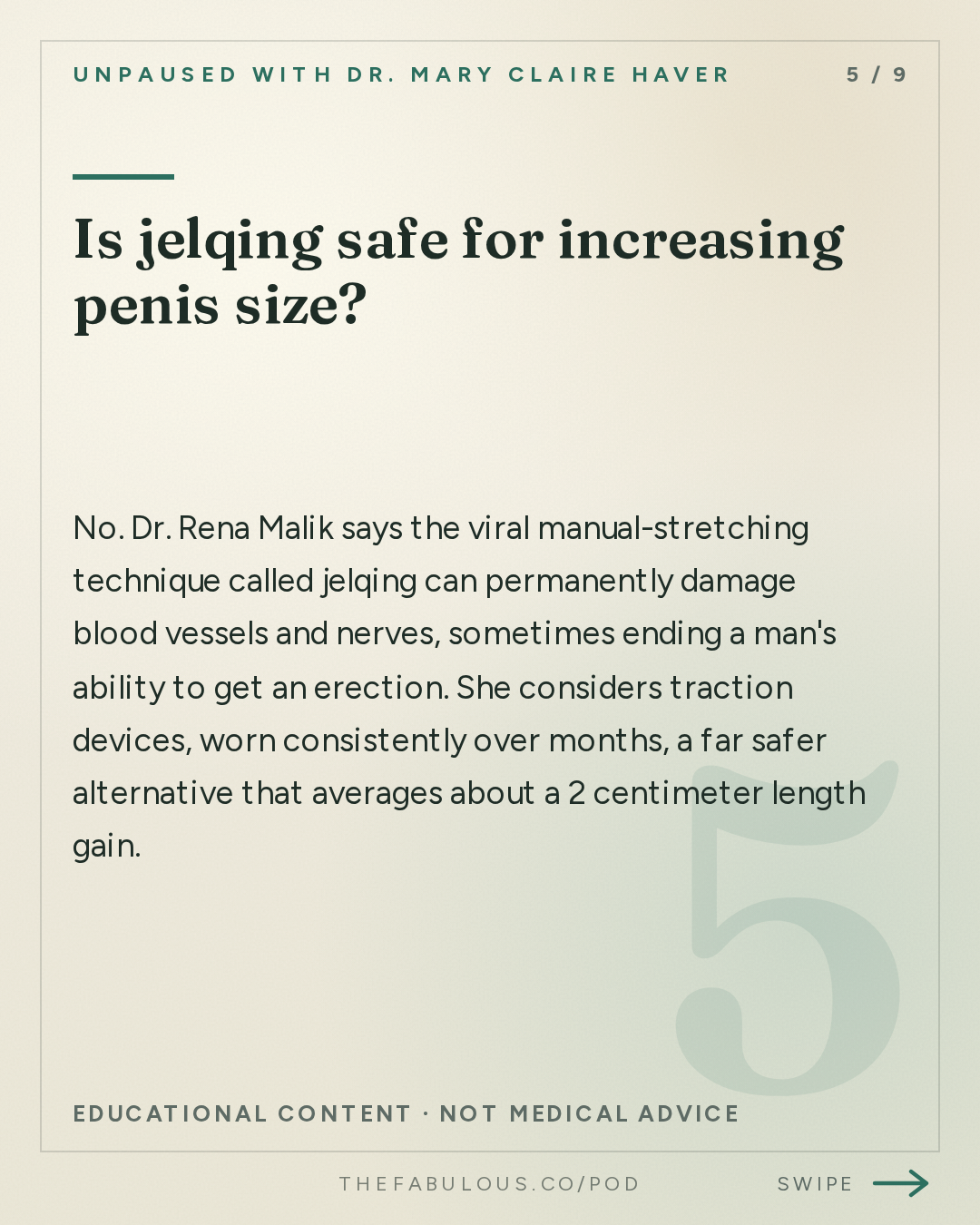
No. Dr. Rena Malik says the viral manual-stretching technique called jelqing can permanently damage blood vessels and nerves, sometimes ending a man's ability to get an erection (26:07). She considers traction devices, worn consistently over months, a far safer alternative that averages about a 2 centimeter length gain (27:00).
What is the average erect penis size?
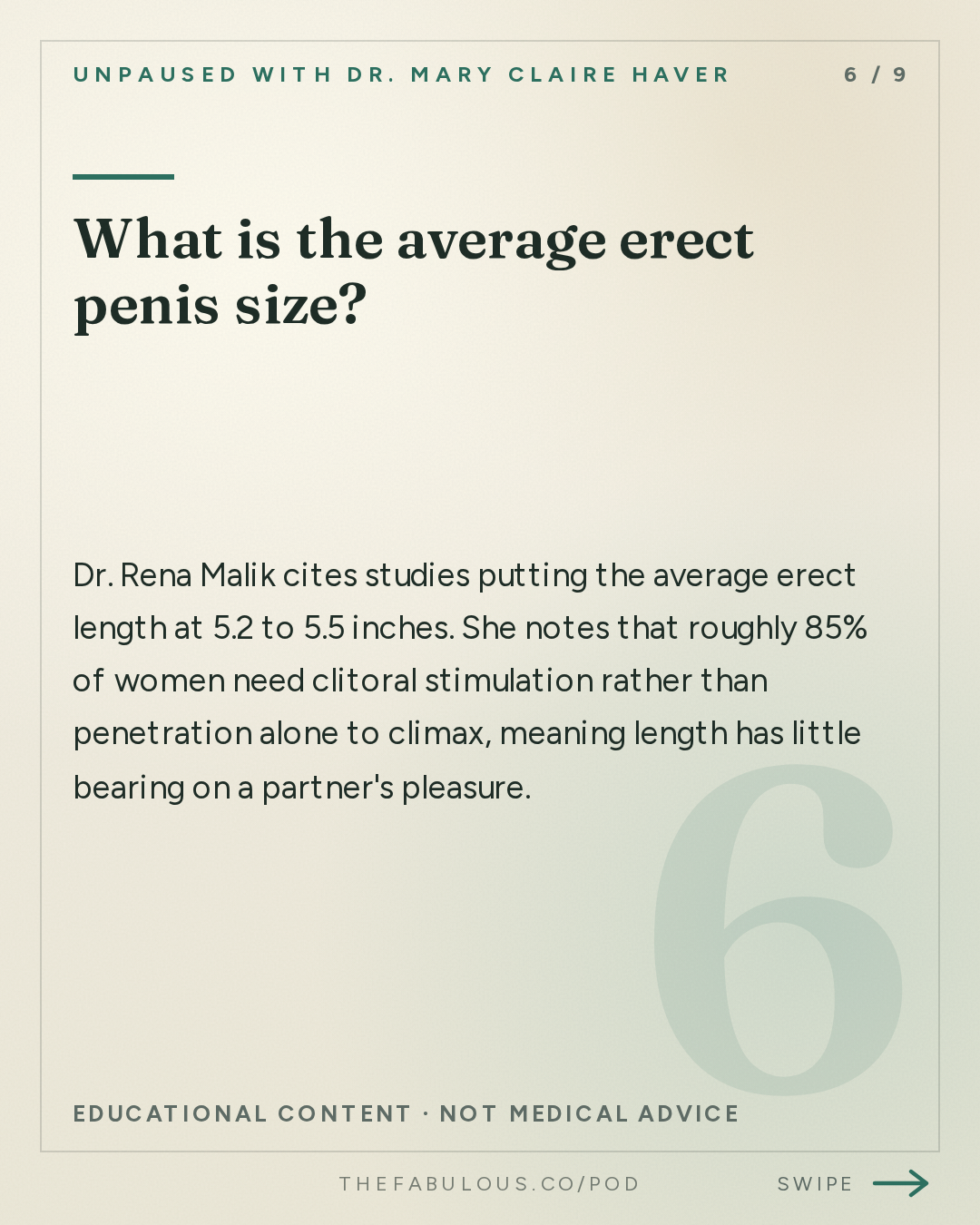
Dr. Rena Malik cites studies putting the average erect length at 5.2 to 5.5 inches (27:00). She notes that roughly 85% of women need clitoral stimulation rather than penetration alone to climax, meaning length has little bearing on a partner's pleasure (25:24).
What are Dr. Rena Malik's four pillars of sexual health?
Fuel, strength, environment, and confidence (10:59). Fuel covers diet and supplements, strength covers cardio and resistance training, environment covers sleep and stress, and confidence covers communication and anatomy knowledge with a partner.
The full read, in cards
Go deeper
- MENTION study — Cleveland Clinic research tracking how men interact with healthcare, found two-thirds would rather do chores than see a doctor
- American Urological Association pre-publication data on GLP-1s and testosterone — found testosterone improved on GLP-1 drugs even after controlling for weight loss
- The Hard Truth — Dr. Rena Malik's book covering erections, testosterone, prostate health, and genital enhancement myths
- Sleep restriction and testosterone study — men sleeping five hours a night saw testosterone drop 15% compared with sleeping over seven hours
Mentioned
Dr. Rena Malik · Dr. Mary Claire Haver · Cleveland Clinic · MENTION study · The Hard Truth · American Urological Association · Mohit Khera · L-arginine · Viagra · Cialis · Ashwagandha
More from this show and category
Erectile Dysfunction and Heart Disease: The Link
Erectile dysfunction can appear three to five years before heart disease is diagnosed, and raises heart attack and stroke risk by 25%. Urologist Dr. Rena Malik, author of The Hard Truth, explains why ED is a vascular biomarker, what metabolic tests should follow a diagnosis, and how testosterone, daily tadalafil, and other treatments fit into men's long-term health.
Women's Heart Health After Menopause Guide
Cardiologist Jeremy London breaks down the 2026 cardiovascular guidelines and explains why early menopause now counts as a heart disease risk factor. He also details which blood tests, ApoB, Lp(a), and fasting insulin, catch risk earlier than standard cholesterol panels, and outlines exercise, nutrition, and sleep protocols for protecting the heart through menopause.
Menopause and Heart Disease Risk Explained
Heart disease kills more women than all cancers combined, and the risk trajectory shifts hard during perimenopause, when falling estrogen raises LDL by an average of 18% and stiffens blood vessels (01:29, 30:39). Cardiovascular surgeon Dr. Jeremy London explains why, and what to do about it.
IUD for Perimenopause Symptoms and HRT
An IUD thins the uterine lining, protects it during hormone therapy, and prevents pregnancy, a three-in-one fix for perimenopause. OB-GYN Dr. Fran Haydanek also flags abnormal bleeding as a cancer red flag, notes PCOS raises endometrial cancer risk five times, and cites WHI data showing only nine extra breast cancers per 10,000 women yearly on combined hormone therapy.
