
unPAUSED with Dr. Mary Claire Haver
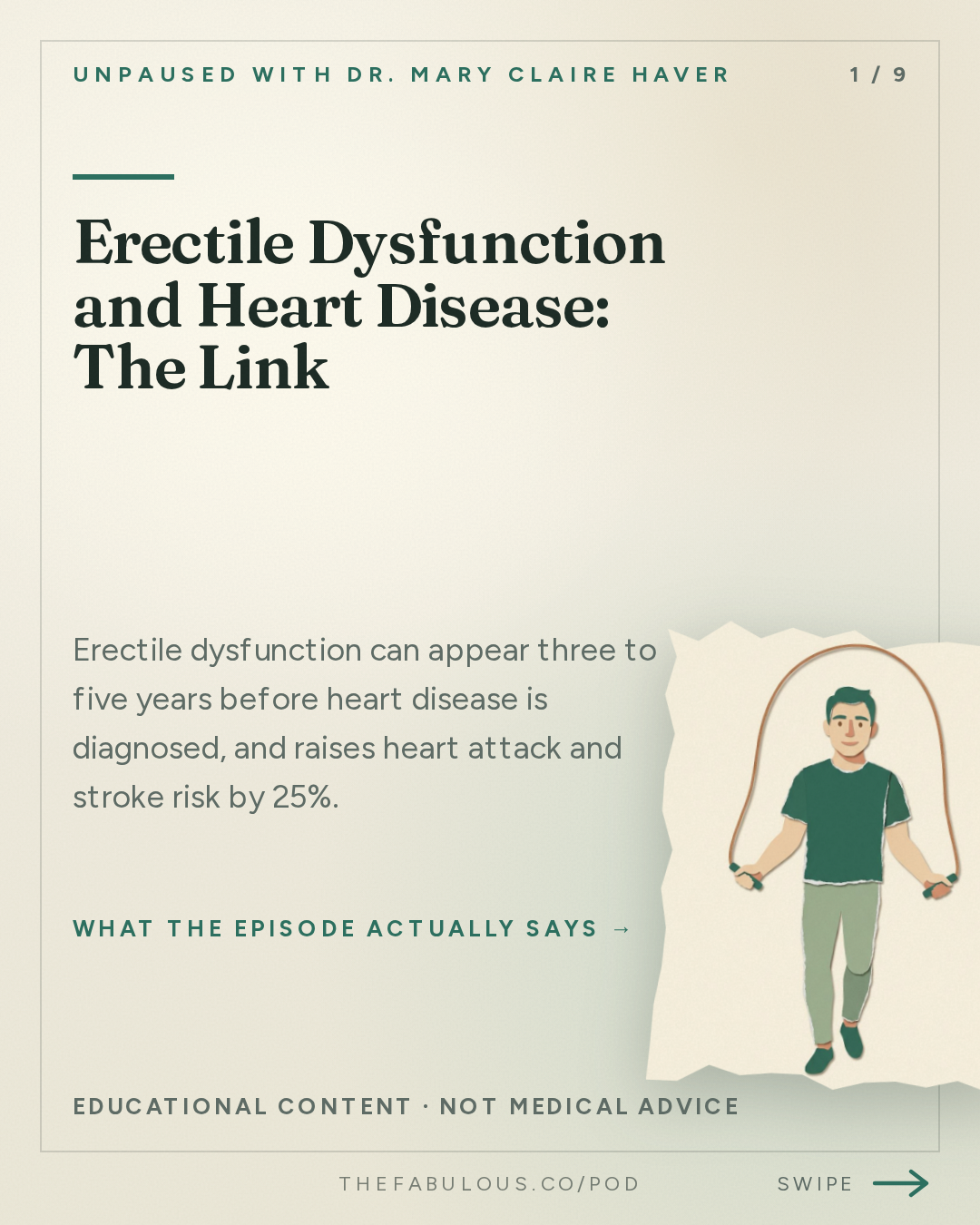
Erectile Dysfunction and Heart Disease: The Link
Erectile Dysfunction Isn’t Just His Problem with Dr. Rena Malik
▶ Listen to the full episode More from unPAUSED with Dr. Mary Claire Haver
The brief
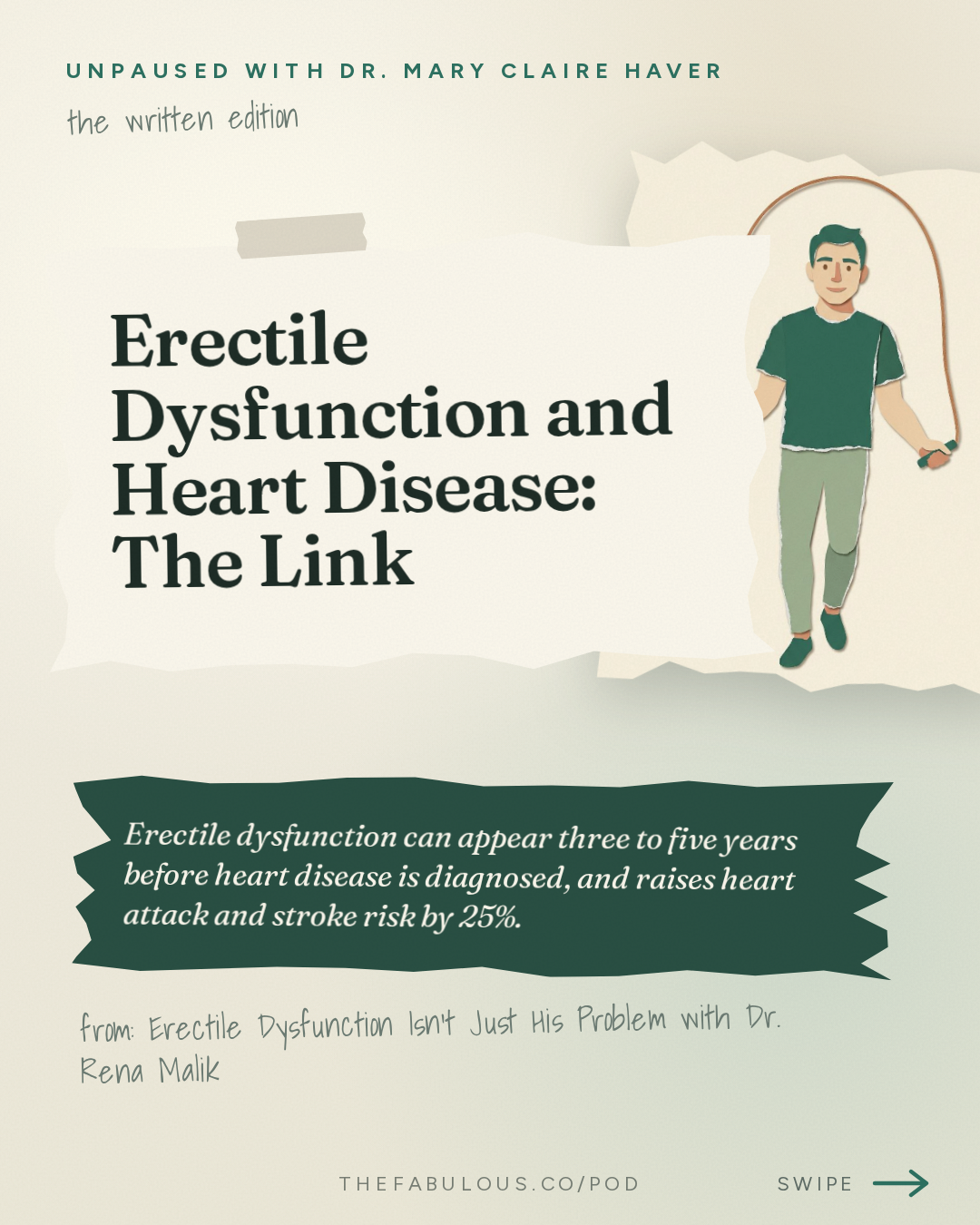
Erectile dysfunction can appear three to five years before heart disease is diagnosed, and raises heart attack and stroke risk by 25%. Urologist Dr. Rena Malik, author of The Hard Truth, explains why ED is a vascular biomarker, what metabolic tests should follow a diagnosis, and how testosterone, daily tadalafil, and other treatments fit into men's long-term health.
The arteries that carry blood into the penis are about half the width of the arteries that feed the heart (11:38). That single anatomical fact, offered by urologist Dr. Rena Malik, turns a problem many men treat as a private embarrassment into something closer to a warning light. Small pipes narrow before big ones do. So trouble getting or keeping an erection often shows up years before chest pain does. Malik, a board certified urologist and pelvic surgeon who wrote the book The Hard Truth, spent an hour on Unpaused with Dr. Mary Claire Haver making the case that erectile dysfunction, or ED, is not a sexual inconvenience. It is a biomarker, a signal from the body's smallest blood vessels that something larger is going wrong.
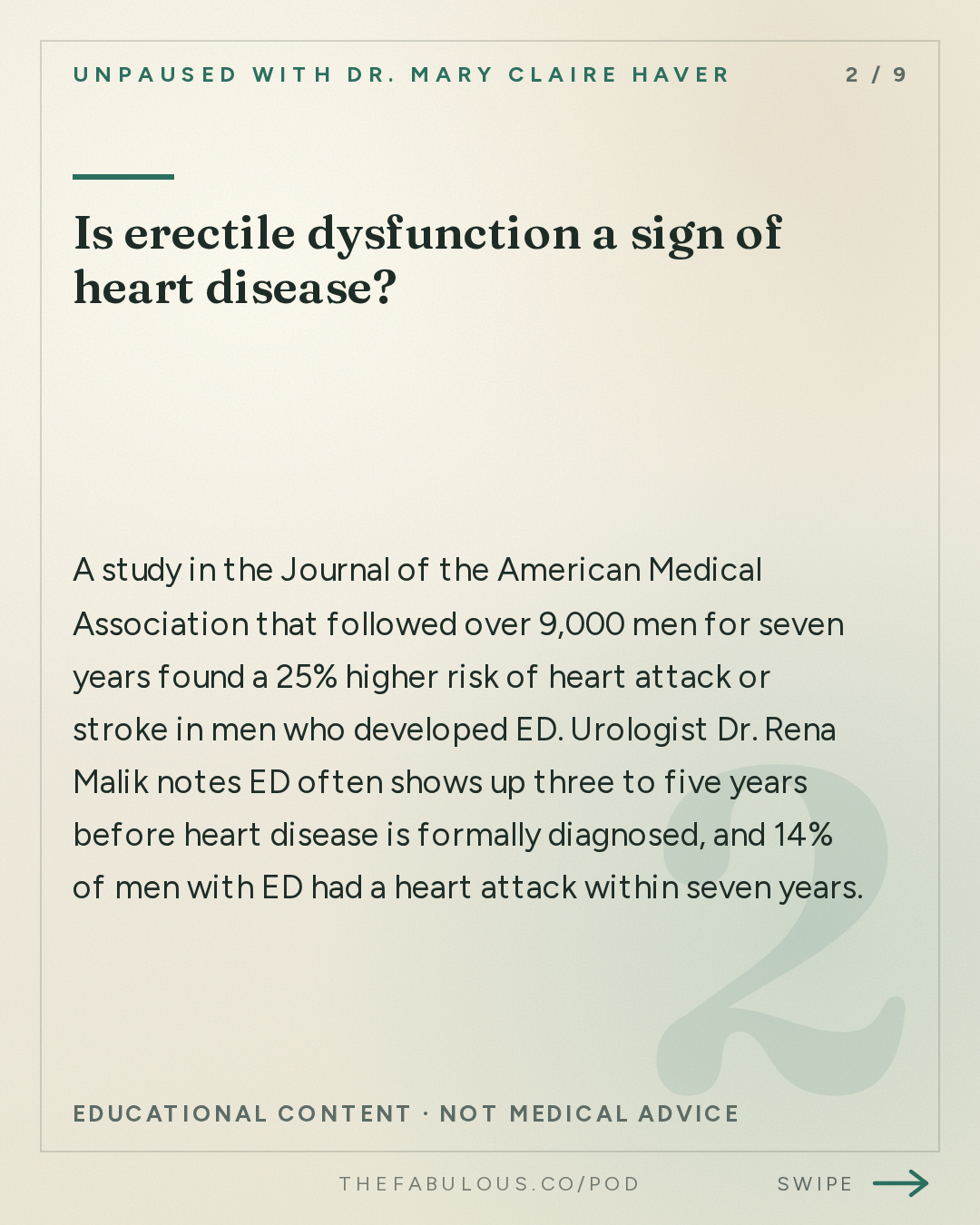
The data is specific. A study in the Journal of the American Medical Association followed more than 9,000 men for seven years and found that those who developed ED had a 25% higher risk of heart attack or stroke than men who did not (02:09). Within that same window, 14% of the men with ED went on to have a heart attack (12:11). ED, Malik says, commonly appears three to five years before a formal diagnosis of heart disease (00:00). The mechanism is plumbing: blood vessels stiffened by high blood pressure or narrowed by cholesterol plaque struggle to feed small vessels first and large ones later.
"So long before you see problems with your heart, which would be like a chest pain, shortness of breath, heart disease, high, those sorts of things, you will see problems with your penis first." Dr. Rena Malik, [11:48]
The same logic likely applies to women, even though almost no one studies it. Women with sexual dysfunction are one and a half times more likely to have cardiovascular problems (00:22). Clitoral tissue and penile tissue come from the same structure in a developing fetus, called the genital tubercle, and work the same way: nerves release nitric oxide, blood vessels relax, blood flows in, veins compress to hold it there (16:19). "Blood flow is blood flow," Malik says more than once, a line that works almost as a thesis. The reason female sexual medicine lags, she argues, is not indifference so much as a historical lack of tools. Vaginal estrogen was expensive and had no generic for years, and surgeons trained to fix problems with a scalpel had no procedure to offer a woman with low desire or pain. The default explanation became psychological rather than physiological, a pattern familiar across women's health.
What a Urologist Actually Checks
More than half of men over 50 have some degree of erectile dysfunction, a share that rises toward 60% in their sixties and 70% in their seventies (06:02). Yet Malik estimates that 90% of the men who come into her office have already been told, by someone, that this is just aging and nothing can be done (31:08). Part of the reason, she says, is structural: primary care visits are short, and clinicians are not compensated for the extra time it takes to walk a patient through a vascular problem and a medication list.
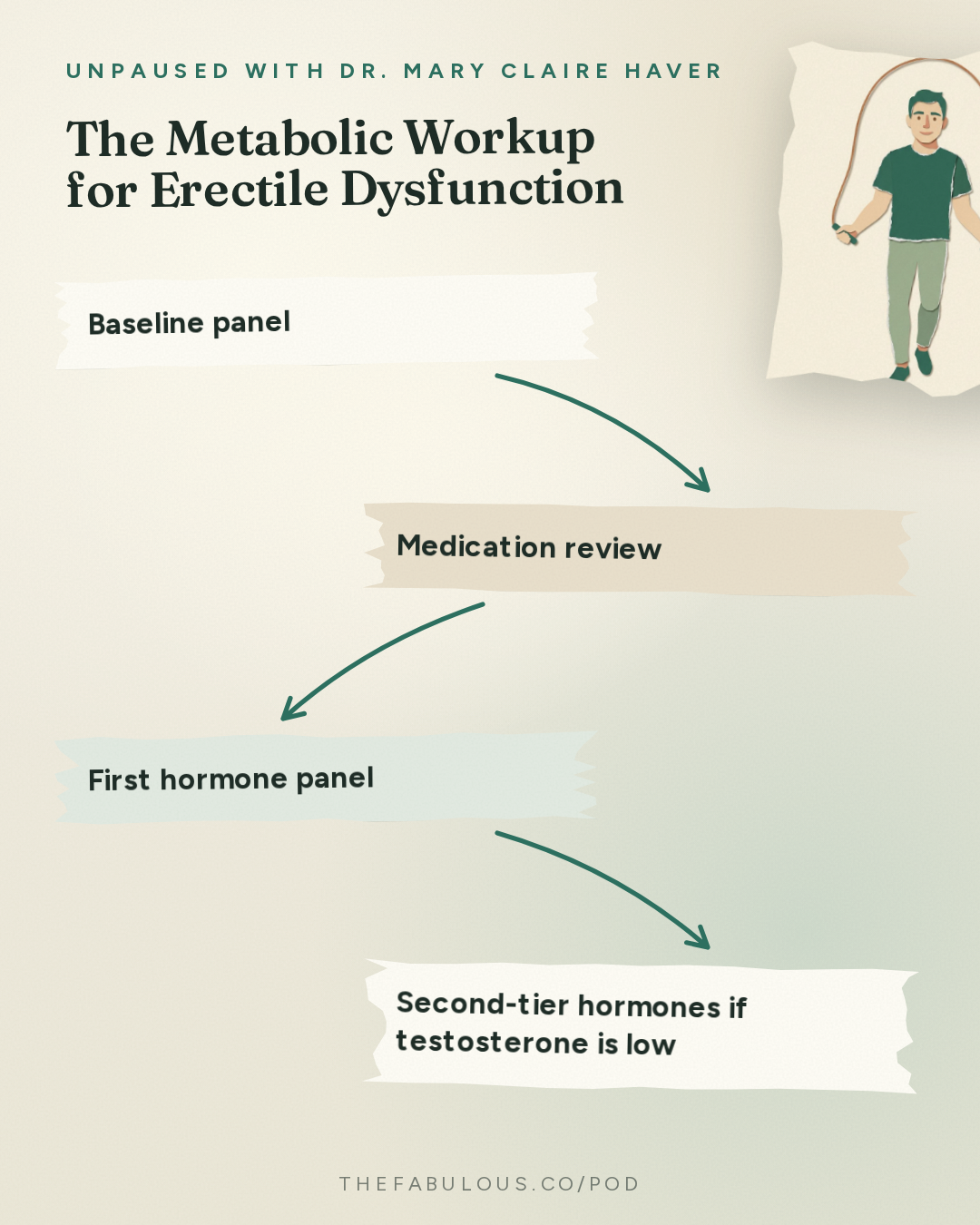
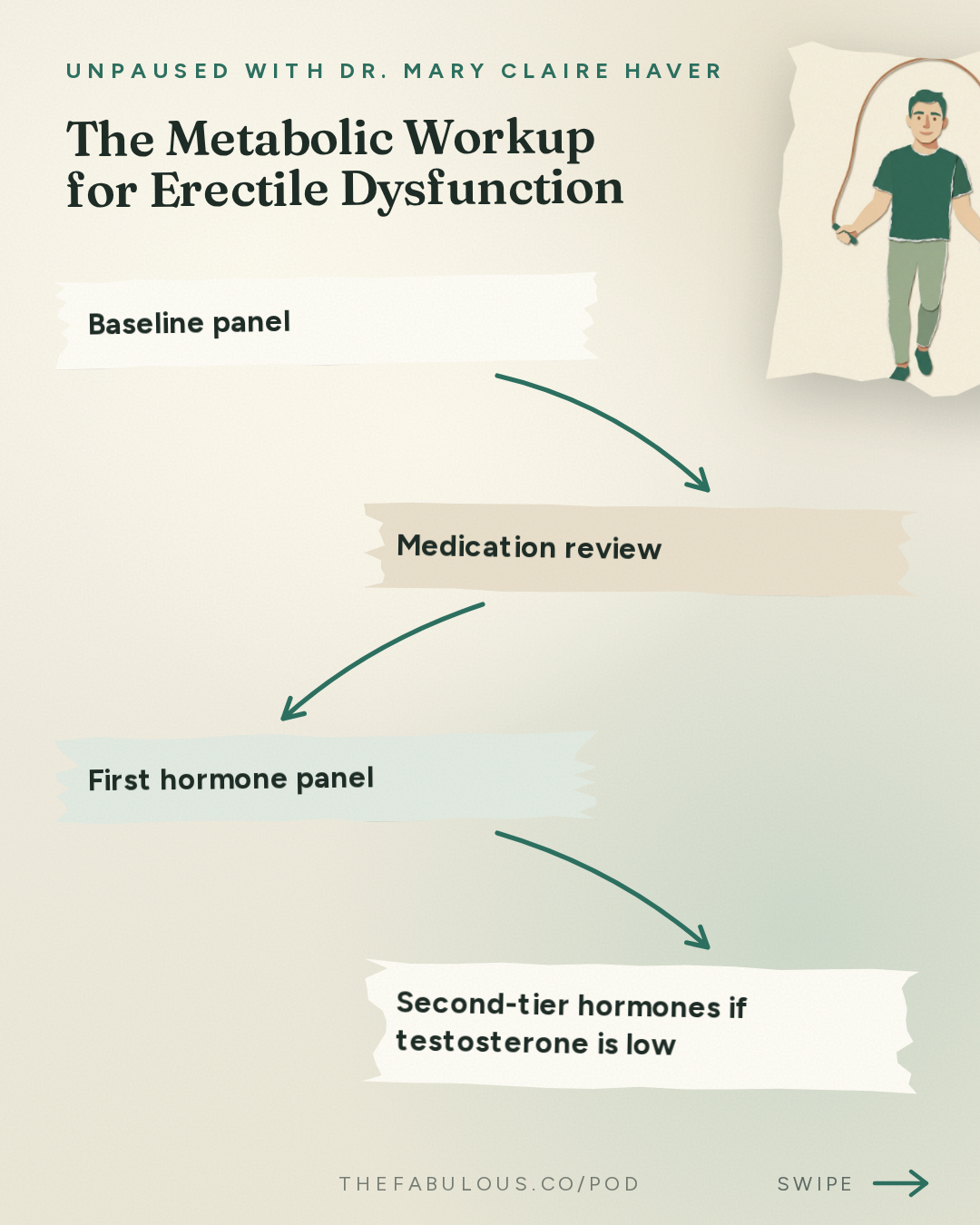
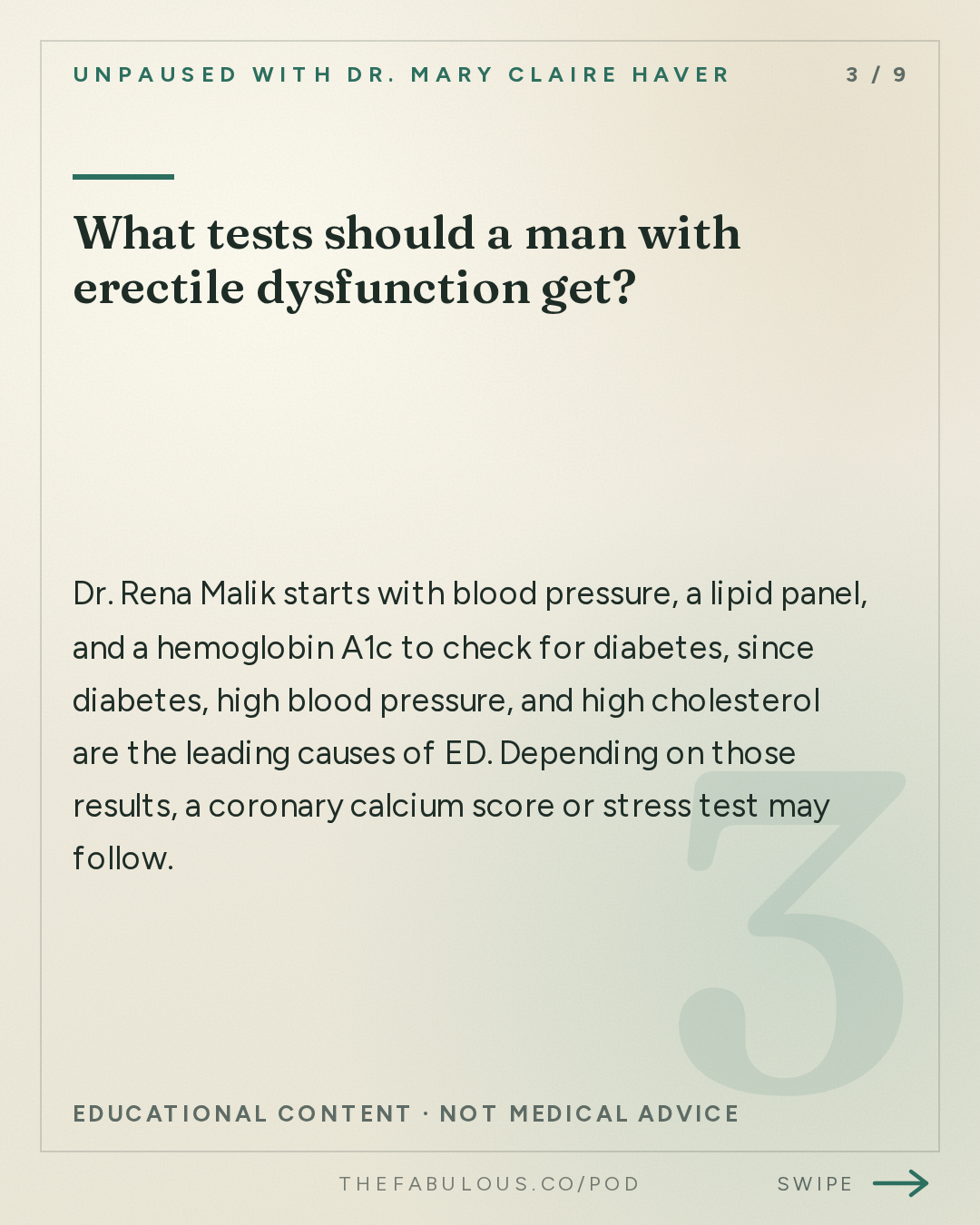
Malik's own workup starts with the basics: blood pressure, a lipid panel for cholesterol, and a hemoglobin A1c to screen for diabetes, since diabetes, high blood pressure, and high cholesterol are the leading causes of ED (12:38). Men with diabetes are three times more likely to develop erectile dysfunction, partly because elevated blood sugar damages both blood vessels and the nerves that trigger an erection (34:01). She reviews medications too. Antidepressants and some blood pressure drugs are common culprits, though she is careful to add that no one should stop taking them without first talking to the prescribing doctor (36:50). If testosterone looks low, using the American Urological Association's cutoff of 300 nanograms per deciliter, she checks sex hormone binding globulin, a protein that can trap testosterone and keep it from reaching tissue even when the total number looks normal (37:08). If testosterone is still low, she adds prolactin, LH, FSH, estradiol, and thyroid hormone, since any of these can interrupt the signal that runs from the brain to the testicles (38:07).
One detail doubles as a nightly health check. During REM sleep, men have three to five erections, and women have the clitoral equivalent (40:04). It is the body's way of keeping that tissue supplied with oxygenated blood. Stop having erections, whether awake or asleep, and scar tissue, called fibrosis, can build up inside the penis (41:07). Malik says she sees this directly during implant surgery on men who went years without any erection at all.
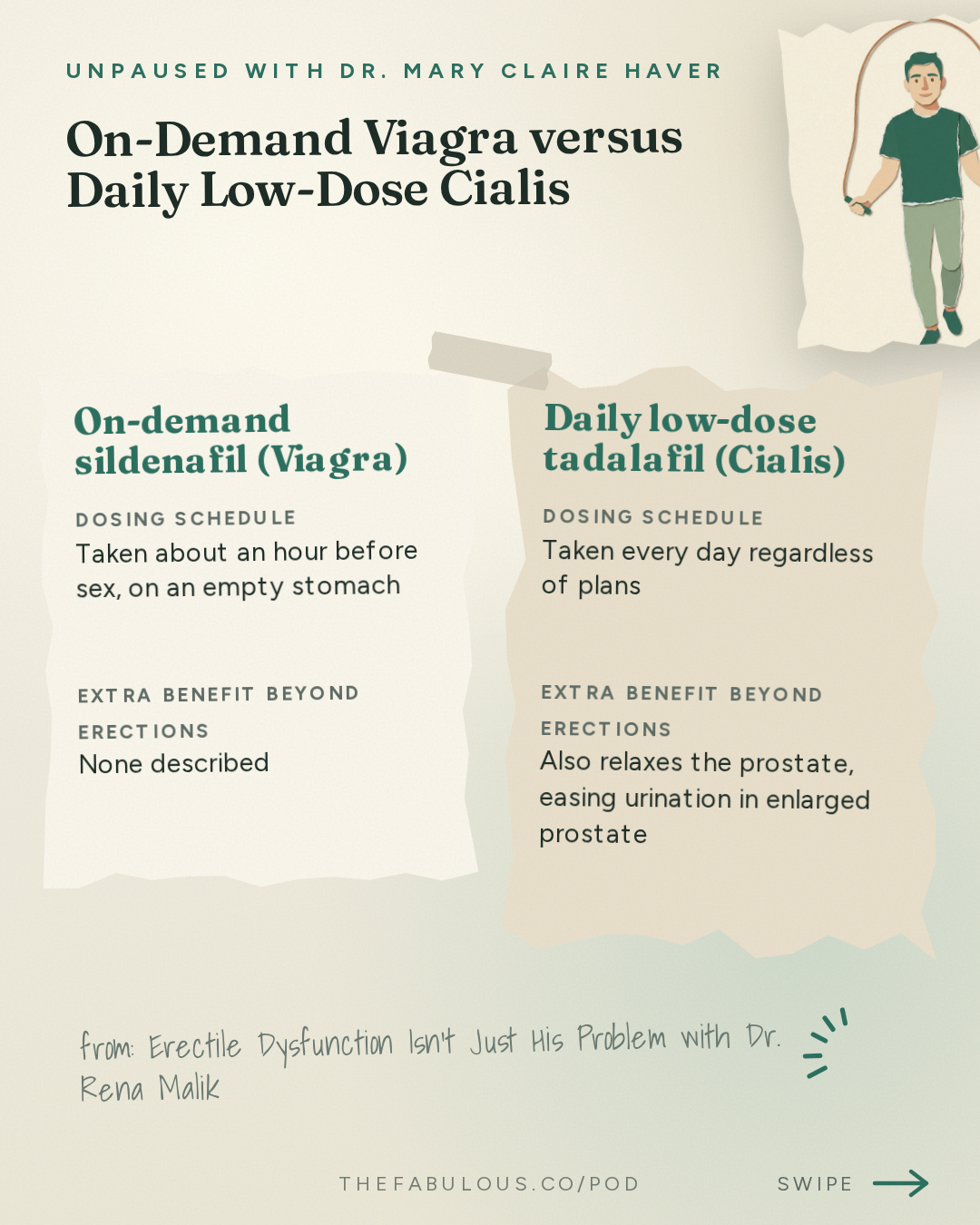
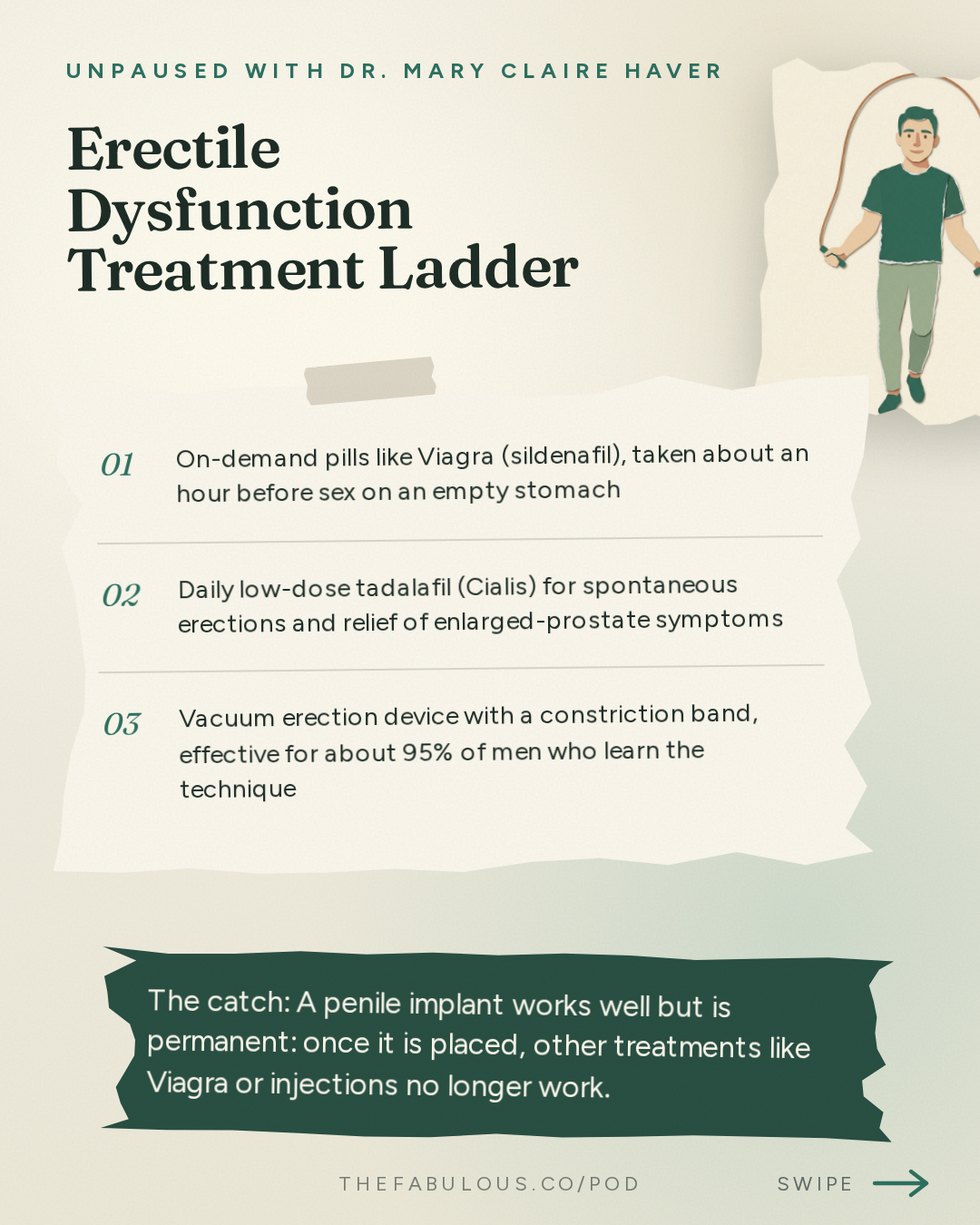
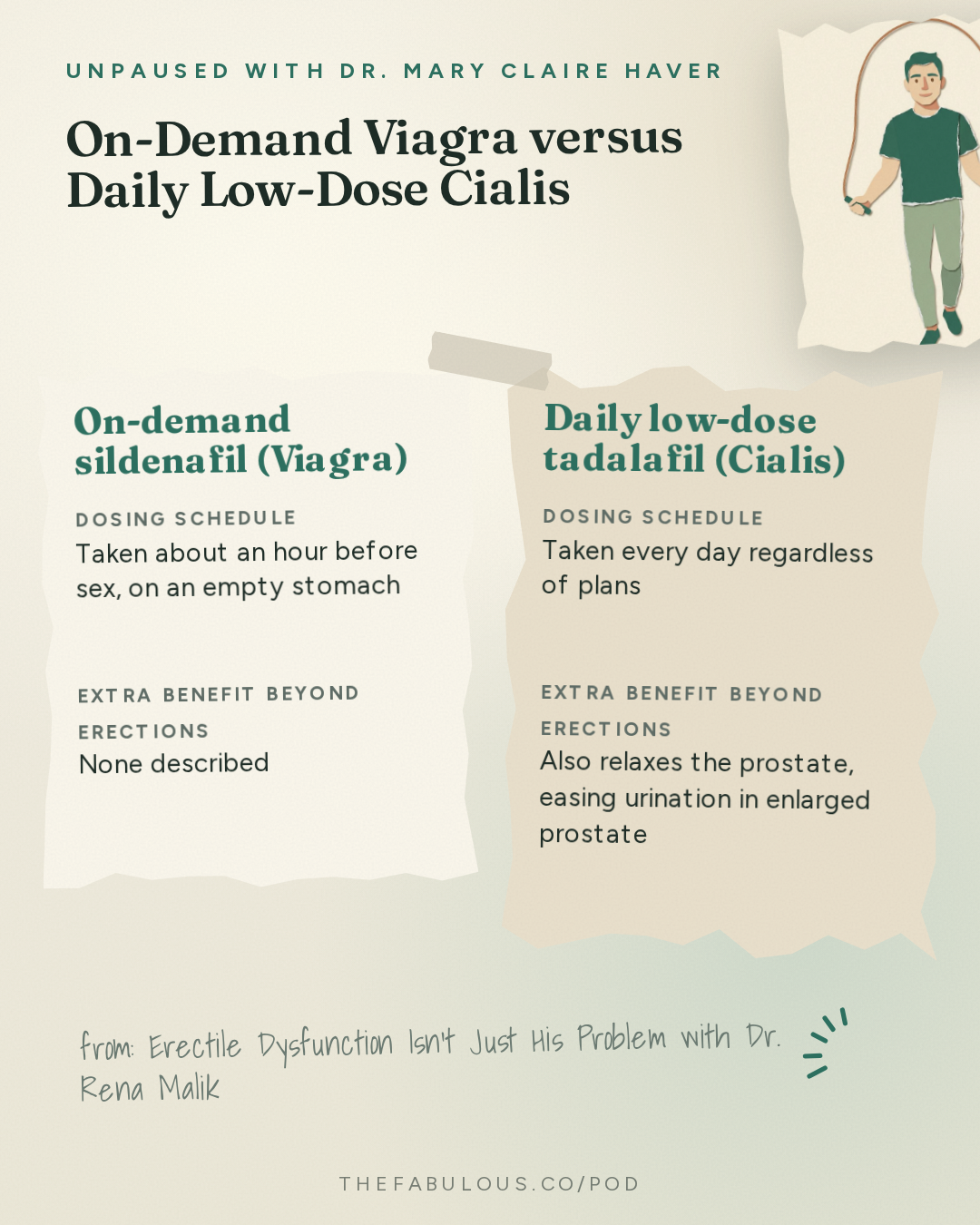
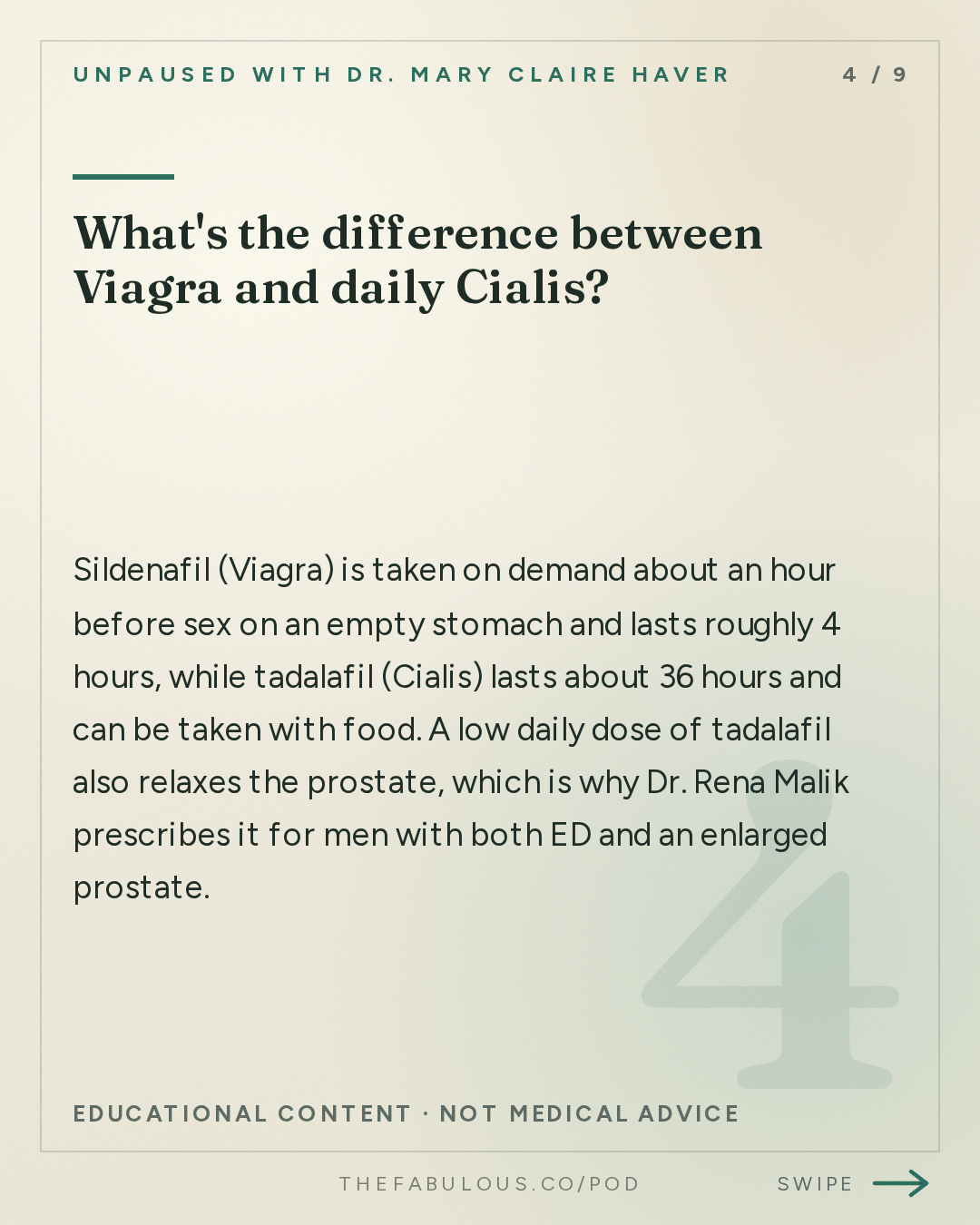
Medication is the most familiar fix, but by Malik's own account it does not solve anything underneath. "When I give you a prescription for Viagra or Cialis or any of these medications, I'm not fixing anything. I'm giving you the ability to get an erection in the moment" (12:59). Sildenafil (Viagra) and similar on-demand pills work for about four hours and need to be taken on an empty stomach roughly an hour before sex. Tadalafil (Cialis) lasts about 36 hours and can be taken with food, and some men take a low daily dose instead, which works all the time and allows for spontaneous erections rather than requiring advance planning (19:48). That daily dose has a second use: it relaxes the prostate as well as penile blood vessels, which is why Malik often prescribes it for men who have both erectile trouble and an enlarged prostate (20:28). Further down the treatment ladder sit vacuum erection devices, which work for roughly 95% of men who learn to use them (21:44), self-injected medication that produces an erection within about ten minutes, and finally penile implant surgery, a permanent option that, once placed, replaces every other method; a man with an implant can no longer rely on Viagra or an injection (25:29).
Beyond the Bedroom
Testosterone has become a crowded topic online, but Malik's clinical read is specific. In men, correcting low testosterone reliably improves muscle size, lowers fat mass, and clears what patients describe as brain fog, often the first change they report back to her (41:55). Some men on antidepressants are able to reduce their dose once testosterone is corrected, because mood often improves too. The honest caveat is that sensitivity to testosterone varies by person, tied partly to the density of androgen receptors, so no single number works for everyone (43:06).
What lingers from this conversation is not the pharmacology. It is the relational cost of staying quiet. Malik describes men who quietly stop initiating any affection once they lose confidence in their erections, because, in her telling, sex is the only way many of them know how to show up as intimate partners.
"For men, oftentimes the only intimacy they know how to show up for is sex." Dr. Rena Malik, [49:09]
Partners often read that withdrawal as rejection, and because nobody says anything, the distance grows. Malik's clinical advice doubles as relationship advice: widen the definition of intimacy before silence sets the pattern.
"Sex is the closeness that brings two people together, and it can look a thousand different ways." Dr. Rena Malik, [50:17]
Malik's larger point returns to the vascular system. The habits that protect an erection, controlling blood sugar, lowering blood pressure, moving the body, are the same habits that protect the heart and the brain. She describes a patient who dropped his hemoglobin A1c from above 11 to below 8 in five months, not because of a cholesterol scare but because he wanted a penile implant and needed to qualify for surgery (31:44). Neither a stroke warning nor a lab number had moved him before that. The prospect of losing his erection did. If that is what gets a man into his primary care doctor's office, Malik is not going to argue with it. She is going to hand him the lab slip.
Ask this episode anything
Pod's AI answers from the episode itself, with the minute mark so you can hear it yourself.
Or start with one of these
Ask this episode
Pod's AI listens to the whole episode to answer, and points you to the minute it comes from.
The rest of this answer, and any question after it
Answers come from the episode itself, never from a summary of it.
ContinueKey takeaways
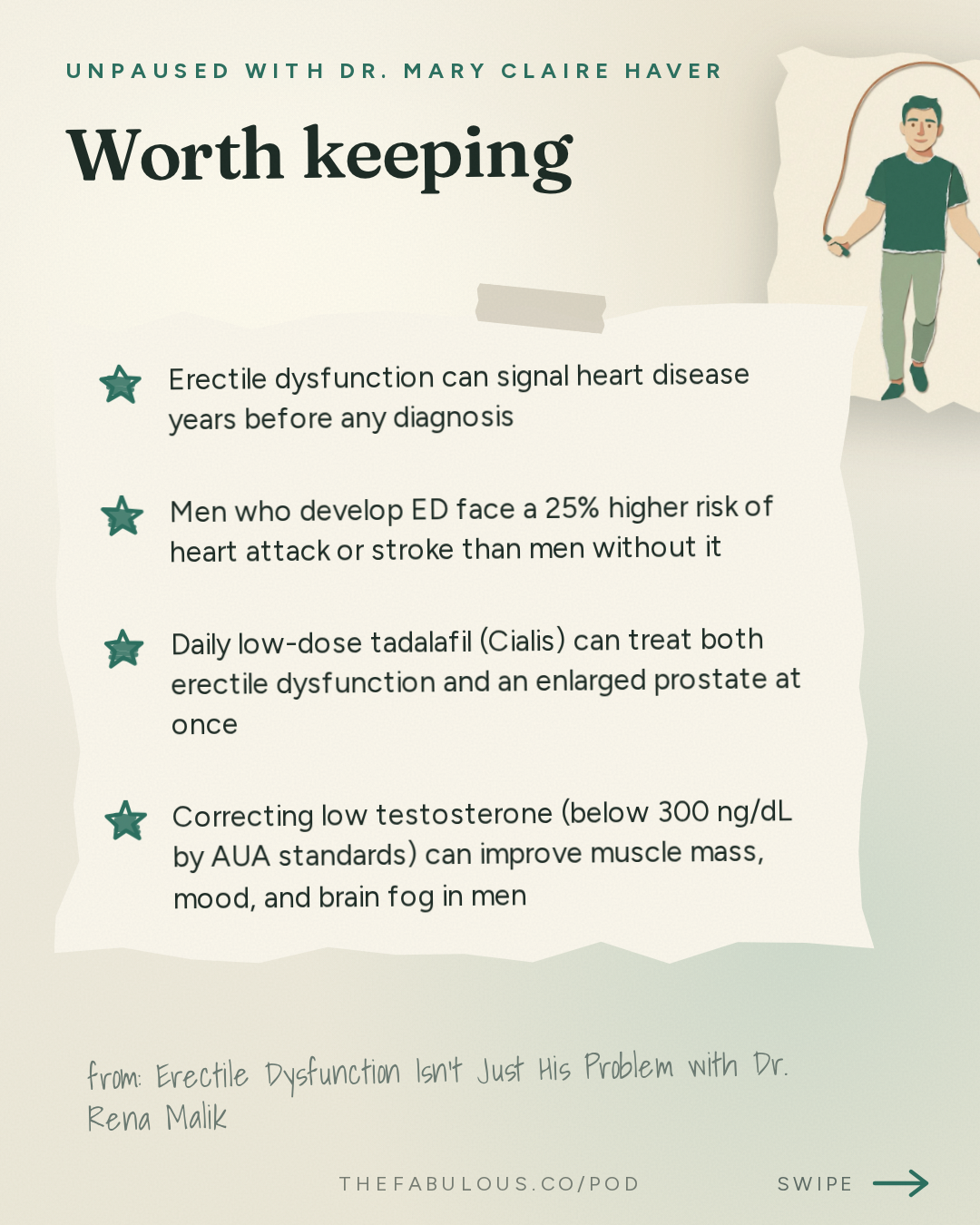
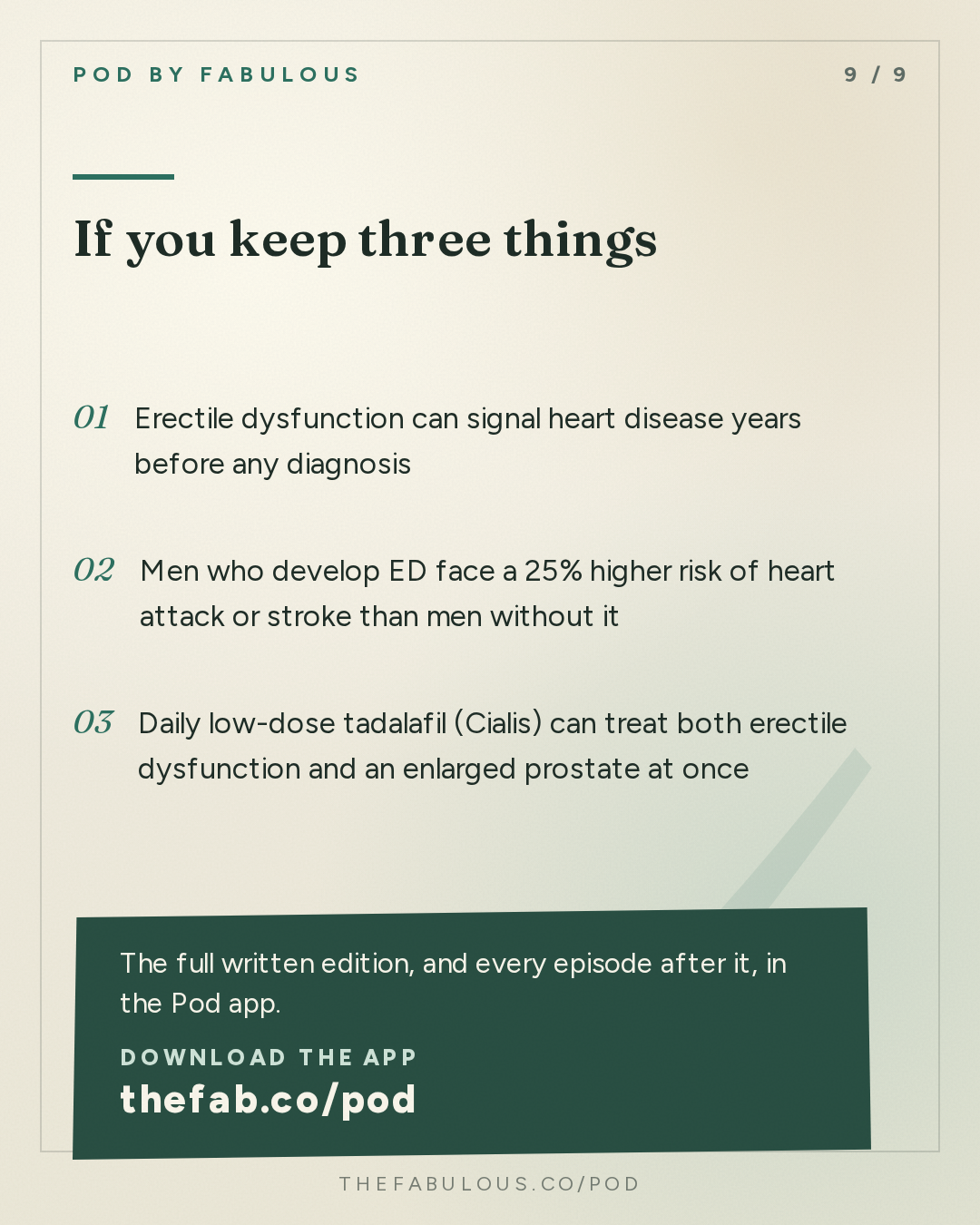
- Erectile dysfunction can signal heart disease years before any diagnosis
- Men who develop ED face a 25% higher risk of heart attack or stroke than men without it
- Daily low-dose tadalafil (Cialis) can treat both erectile dysfunction and an enlarged prostate at once
- Correcting low testosterone (below 300 ng/dL by AUA standards) can improve muscle mass, mood, and brain fog in men
- Nightly erections during REM sleep keep penile and clitoral tissue healthy, so losing them risks scar tissue buildup
The episode in cards

By the numbers
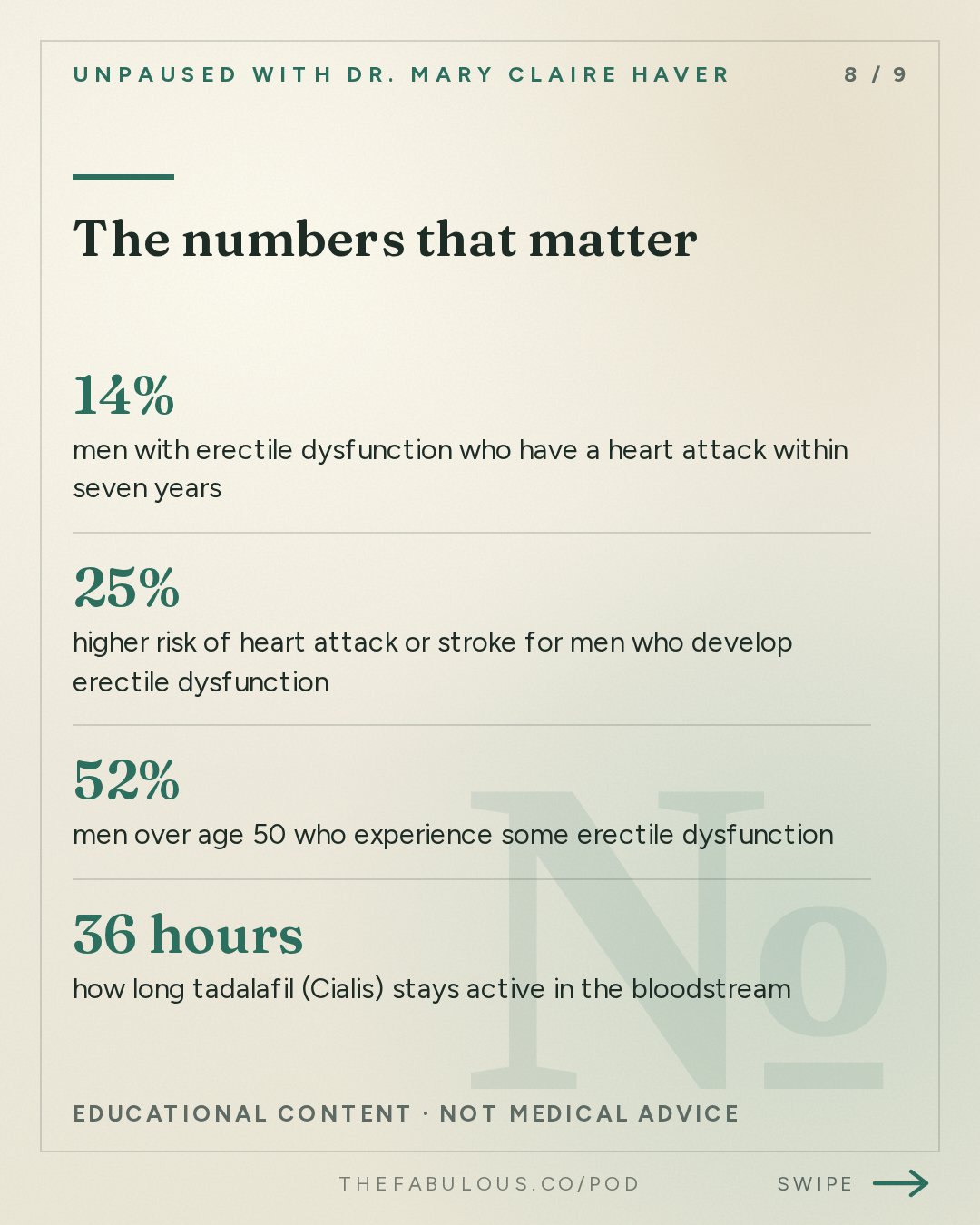
- 14% percent men with erectile dysfunction who have a heart attack within seven years
- 25% percent higher risk of heart attack or stroke for men who develop erectile dysfunction
- 52% percent men over age 50 who experience some erectile dysfunction
- 36 hours how long tadalafil (Cialis) stays active in the bloodstream
- 300 ng/dL American Urological Association cutoff for low testosterone in men
In their words
“So long before you see problems with your heart, which would be like a chest pain, shortness of breath, heart disease, high, those sorts of things, you will see problems with your penis first.”
“When I give you a prescription for Viagra or Cialis or any of these medications, I'm not fixing anything. I'm giving you the ability to get an erection in the moment.”
“For men, oftentimes the only intimacy they know how to show up for is sex.”
“Sex is the closeness that brings two people together, and it can look a thousand different ways.”
Protocols
-
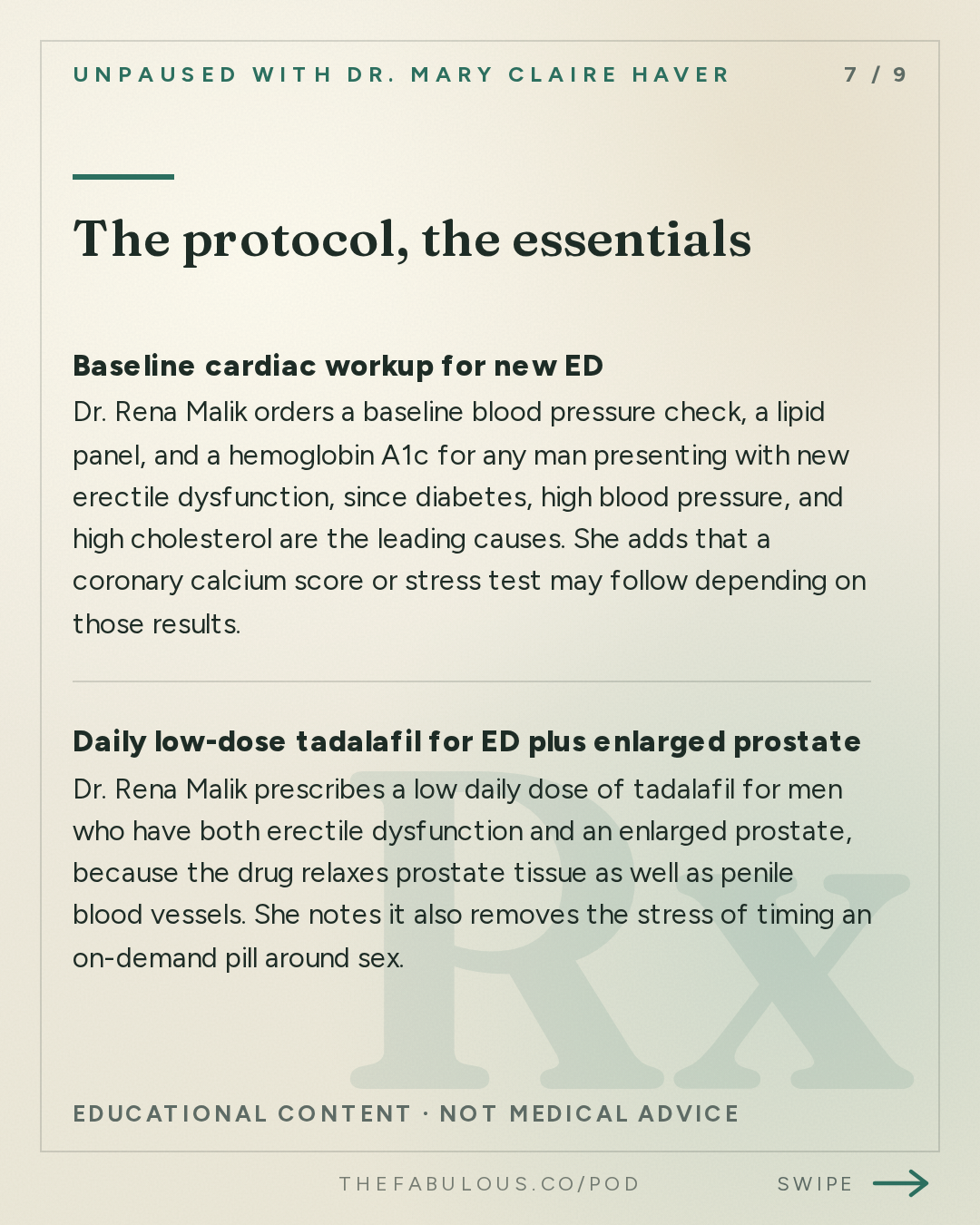
Baseline cardiac workup for new ED
Dr. Rena Malik orders a baseline blood pressure check, a lipid panel, and a hemoglobin A1c for any man presenting with new erectile dysfunction, since diabetes, high blood pressure, and high cholesterol are the leading causes. She adds that a coronary calcium score or stress test may follow depending on those results.
At first diagnosis of ED
-
Daily low-dose tadalafil for ED plus enlarged prostate
Dr. Rena Malik prescribes a low daily dose of tadalafil for men who have both erectile dysfunction and an enlarged prostate, because the drug relaxes prostate tissue as well as penile blood vessels. She notes it also removes the stress of timing an on-demand pill around sex.
Daily
-
Hormone panel for low desire
Dr. Rena Malik checks total testosterone and sex hormone binding globulin in men reporting low desire, and if testosterone is low she adds prolactin, LH, FSH, estradiol, and thyroid hormone to find where the signal from brain to testicle is breaking down.
As needed when desire is low
-
Do not self-stop suspect medications
Dr. Rena Malik tells patients who suspect antidepressants or blood pressure medication are causing their erectile dysfunction to keep taking them and talk to the prescribing doctor about switching, rather than stopping on their own.
Ongoing medication review
Questions this episode answers
Is erectile dysfunction a sign of heart disease?
A study in the Journal of the American Medical Association that followed over 9,000 men for seven years found a 25% higher risk of heart attack or stroke in men who developed ED (02:09). Urologist Dr. Rena Malik notes ED often shows up three to five years before heart disease is formally diagnosed, and 14% of men with ED had a heart attack within seven years (12:11).
What tests should a man with erectile dysfunction get?
Dr. Rena Malik starts with blood pressure, a lipid panel, and a hemoglobin A1c to check for diabetes, since diabetes, high blood pressure, and high cholesterol are the leading causes of ED (12:38). Depending on those results, a coronary calcium score or stress test may follow.
What's the difference between Viagra and daily Cialis?
Sildenafil (Viagra) is taken on demand about an hour before sex on an empty stomach and lasts roughly 4 hours, while tadalafil (Cialis) lasts about 36 hours and can be taken with food (19:48). A low daily dose of tadalafil also relaxes the prostate, which is why Dr. Rena Malik prescribes it for men with both ED and an enlarged prostate (20:28).
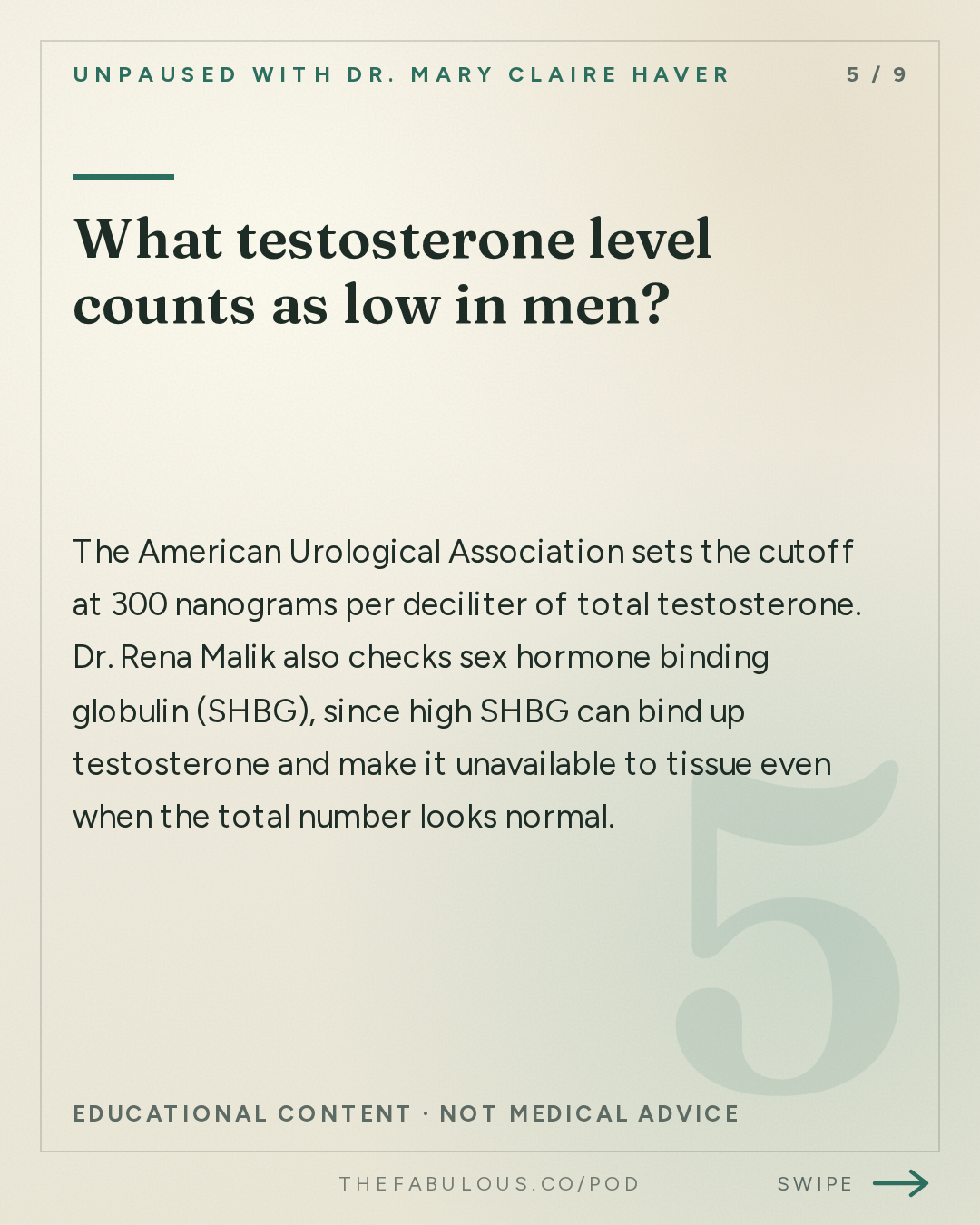
What testosterone level counts as low in men?
The American Urological Association sets the cutoff at 300 nanograms per deciliter of total testosterone (37:08). Dr. Rena Malik also checks sex hormone binding globulin (SHBG), since high SHBG can bind up testosterone and make it unavailable to tissue even when the total number looks normal.
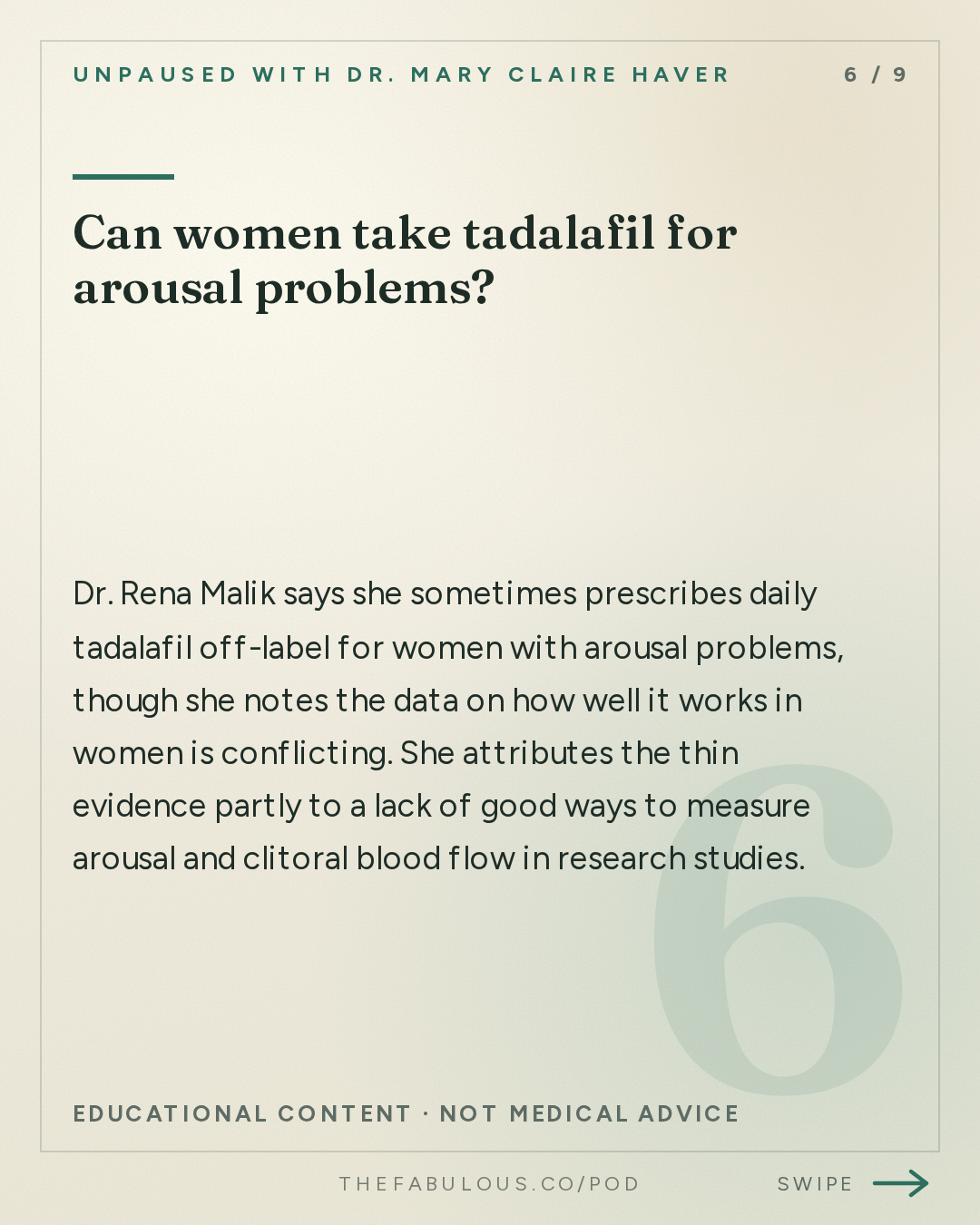
Can women take tadalafil for arousal problems?
Dr. Rena Malik says she sometimes prescribes daily tadalafil off-label for women with arousal problems, though she notes the data on how well it works in women is conflicting (22:50). She attributes the thin evidence partly to a lack of good ways to measure arousal and clitoral blood flow in research studies.
The full read, in cards
Go deeper
- Journal of the American Medical Association study of over 9,000 men followed for seven years — found men who developed ED had a 25% higher risk of heart attack or stroke
- The Hard Truth: Everything Men Need to Know for Good Health, Great Sex, and a Long Life — Dr. Rena Malik's evidence-based guide to men's sexual and metabolic health
Mentioned
Dr. Rena Malik · Dr. Mary Claire Haver · The Hard Truth · Journal of the American Medical Association · American Urological Association · Veterans Affairs · Viagra · Cialis · Addyi · Vyleesi
More from this show and category
Women's Heart Health After Menopause Guide
Cardiologist Jeremy London breaks down the 2026 cardiovascular guidelines and explains why early menopause now counts as a heart disease risk factor. He also details which blood tests, ApoB, Lp(a), and fasting insulin, catch risk earlier than standard cholesterol panels, and outlines exercise, nutrition, and sleep protocols for protecting the heart through menopause.
Menopause and Heart Disease Risk Explained
Heart disease kills more women than all cancers combined, and the risk trajectory shifts hard during perimenopause, when falling estrogen raises LDL by an average of 18% and stiffens blood vessels (01:29, 30:39). Cardiovascular surgeon Dr. Jeremy London explains why, and what to do about it.

IUD for Perimenopause Symptoms and HRT
An IUD thins the uterine lining, protects it during hormone therapy, and prevents pregnancy, a three-in-one fix for perimenopause. OB-GYN Dr. Fran Haydanek also flags abnormal bleeding as a cancer red flag, notes PCOS raises endometrial cancer risk five times, and cites WHI data showing only nine extra breast cancers per 10,000 women yearly on combined hormone therapy.

GSM Treatment: Vaginal Estrogen Explained
Genitourinary syndrome of menopause (GSM) affects 50 to 80% of postmenopausal women but only 7% of those diagnosed are prescribed its safest fix, vaginal estrogen (37:09, 11:00). The FDA dropped a 27-year boxed warning on low-dose vaginal estrogen in November 2025, and OB-GYN Dr. Mary Claire Haver says the condition is cheap and almost always treatable.
