
unPAUSED with Dr. Mary Claire Haver
GSM Treatment: Vaginal Estrogen Explained
Menopause Masterclass: Recurrent UTIs and the Genitourinary Syndrome of Menopause (GSM)
▶ Listen to the full episode More from unPAUSED with Dr. Mary Claire Haver
The brief
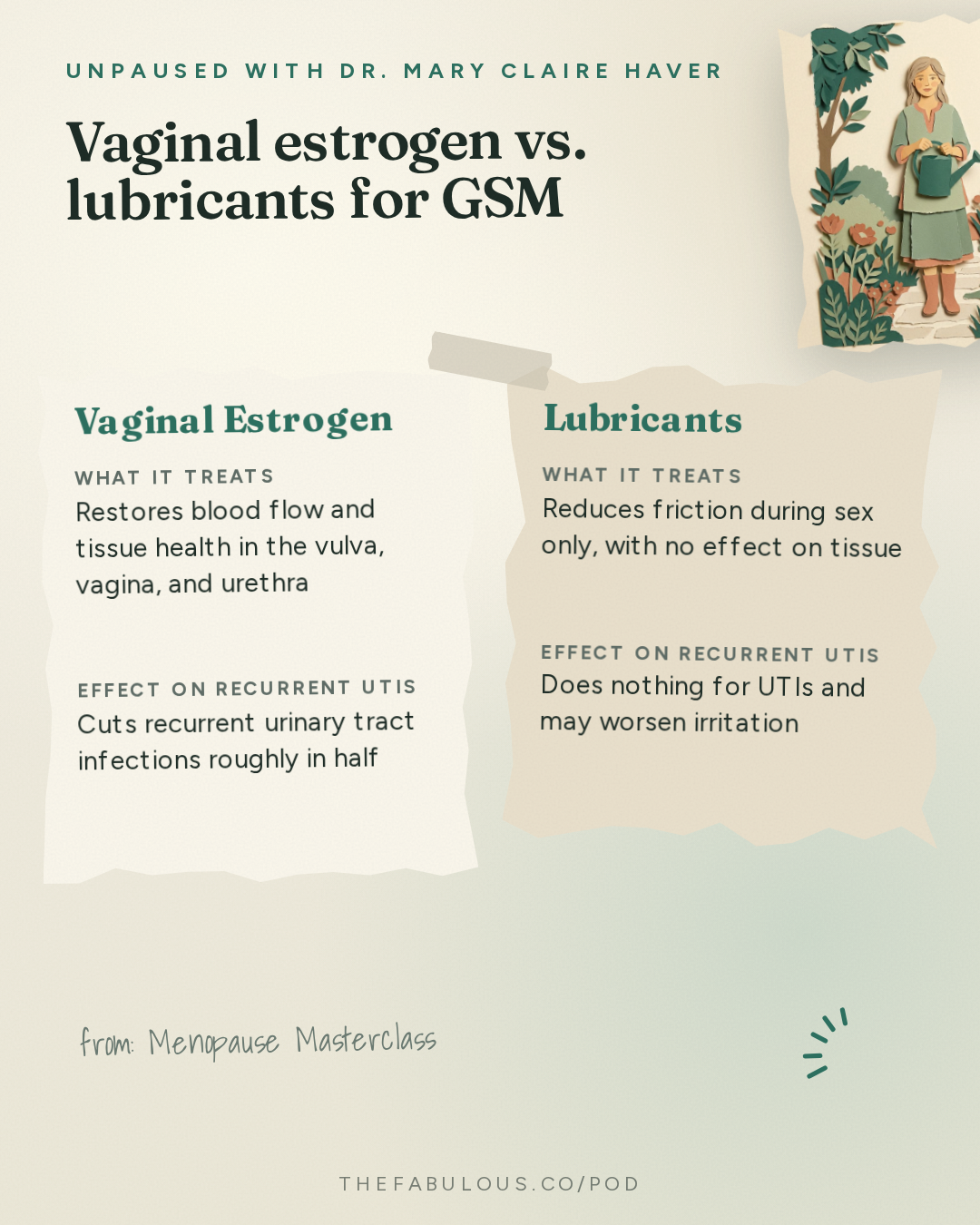
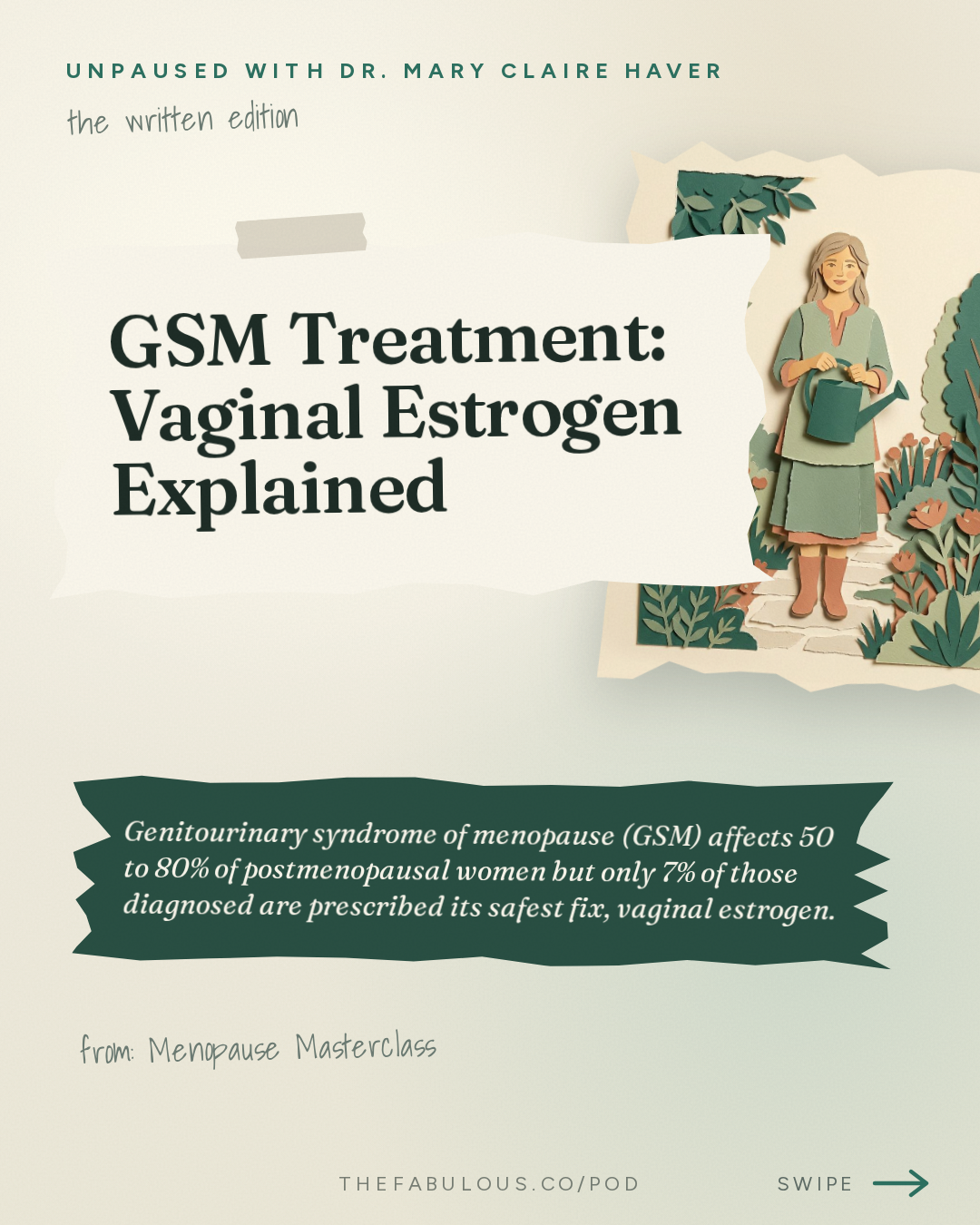
Genitourinary syndrome of menopause (GSM) affects 50 to 80% of postmenopausal women but only 7% of those diagnosed are prescribed its safest fix, vaginal estrogen (37:09, 11:00). The FDA dropped a 27-year boxed warning on low-dose vaginal estrogen in November 2025, and OB-GYN Dr. Mary Claire Haver says the condition is cheap and almost always treatable.
In 1998 the FDA fast-tracked a new drug for erectile dysfunction and approved it within months. That same year, a different hormone cream, the kind that treats the female equivalent of the same problem, was just four years away from getting a warning label so severe it told women it might kill them. The warning stayed on vaginal estrogen for 27 years (14:30). The little blue pill got a red carpet. The cream got a skull and crossbones. Dr. Mary Claire Haver, a board-certified obstetrician and gynecologist and certified menopause practitioner, calls this out directly on her podcast, and the gap she describes is not really about two drugs. It is about a condition that may be the most common, cheapest, and easiest thing in midlife medicine to fix, and the one doctors fix least.
That condition now has a name almost nobody recognizes: genitourinary syndrome of menopause, or GSM. Before 2014, when a group of specialists renamed it, doctors called it atrophic vaginitis. Before that, further back, it had an even uglier label: the senile vagina (02:33). The new name is a mouthful, but Haver says it fixed something real. For the first time, the word urinary sat inside the diagnosis, because GSM is not one symptom. It is a cluster of changes in the vulva, vagina, clitoris, urethra, and bladder, all of them packed tightly into the pelvis, all of them starved of the same hormone at the same time (03:31).
Haver did not catch it in herself. She had started hormone therapy for hot flashes and assumed her whole genitourinary system was covered. What she actually had was delayed orgasm, which she blamed on stress, on aging, on anything but biology, until a friend asked a blunt question in a group chat: how much vaginal estrogen was she using? The answer was none. "I just didn't connect delayed orgasm with GSM," she says. "I had no idea" (06:16). The larger point she draws from her own blind spot: systemic hormone therapy, the pills or patches that stop hot flashes, is "a microdose compared to what your body used to make on its own," and it was never designed to fully protect the pelvis (05:26).
What Estrogen Loss Does to the Body
Haver's working analogy is a plant. Hormones are water. At puberty, estrogen and testosterone flood the genital tissue and it blossoms: the vaginal lining thickens, folds in on itself, and stays lubricated. After menopause, the water stops, and the process runs in reverse (16:22). The vaginal lining thins and flattens. The opening narrows. The labia minora, the inner folds of the vulva, slowly resorb over five, ten, twenty years, a gradual shrinking that went viral on social media after a colleague, Dr. Rachel Rubin, posted about it and sparked a comment section full of confused viewers (17:10). The clitoris, which runs mostly on testosterone rather than estrogen, shrinks too and loses blood flow and nerve sensitivity, a process with its own name: clitoral atrophy (19:53). Haver notes that testosterone decline actually starts in a woman's thirties, well before menopause, which is why delayed orgasm can show up years ahead of hot flashes.
Then there is what urologists call the ring of fire, the strip of tissue called the vestibule that surrounds the urethra, the tube that drains the bladder. It behaves more like the inside of a cheek than like vaginal tissue, and a standard speculum exam skips over it entirely, which is why so much entry pain goes undiagnosed (20:14). The bladder and urethra share a wall lined with hormone receptors, so when estrogen drops, the brain starts misreading ordinary bladder signals as emergencies: urgency, frequency, trips to the bathroom at night. In older women this chain gets dangerous. Thin, fragile tissue plus a disrupted microbiome means recurrent urinary tract infections, and in frail elderly patients a UTI can tip into sepsis, delirium, a fall, and a hip fracture, a cascade Haver says starts with an untreated genitourinary syndrome (22:40).
"Common doesn't mean normal, and it's not anyone's fault. It's biology." — Dr. Mary Claire Haver [01:20]
Why So Few Women Get Treated
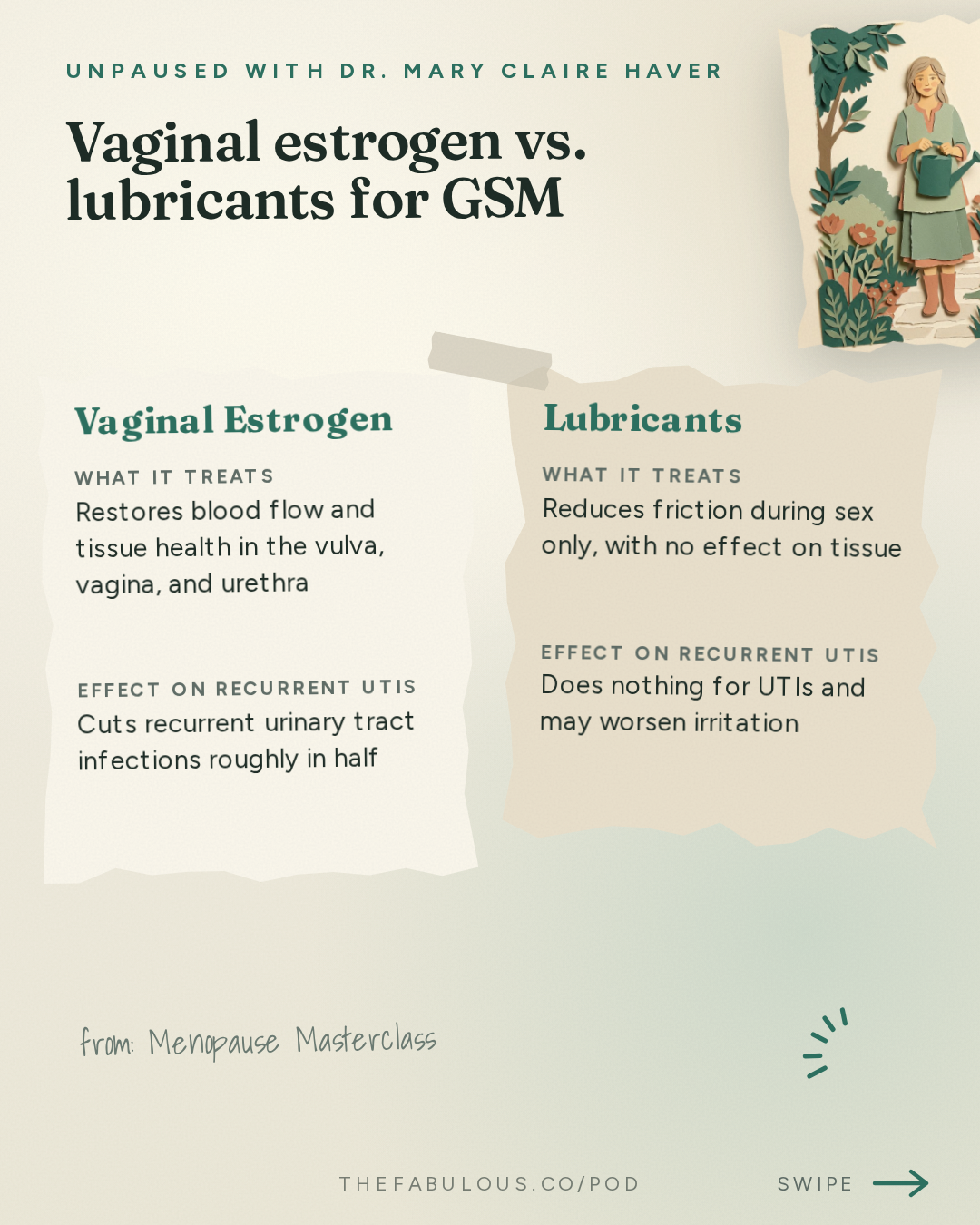
The scare that built this gap dates to 2002, when headlines from the Women's Health Initiative study linked hormone therapy to breast cancer, a link Haver says was never as clear as the coverage implied (11:35). Use of systemic hormone therapy collapsed from roughly 30 to 40% of menopausal women to single digits, and the FDA slapped a sweeping boxed warning, stroke, clots, heart attack, dementia, onto every estrogen product, with no distinction between a systemic pill and a trace-dose vaginal cream (12:05). For two decades, Haver says, clinicians including herself trained and practiced in that fear. Guidelines required women to fail lubricants before hormones were even considered, despite the fact that lubricants "don't prevent a single urinary tract infection" (14:01).
The label finally changed on November 10, 2025, when the FDA removed the boxed warning from low-dose vaginal estrogen (15:20), four months after an FDA expert panel publicly called for its removal (14:30) and after what Haver describes as years of grassroots pressure, letters, and social media campaigns. "The data didn't change," she says. "The data had been there for decades" (15:20). But a label change does not retrain thousands of clinicians overnight, and the numbers show it: in a Medicare analysis, only about 7% of women diagnosed with GSM were ever prescribed vaginal estrogen (37:09), and Haver suspects actual use was lower still, since many women received the prescription and were too frightened by the old warning to fill it. A cost-savings study, with Rubin among its authors, estimated that broader use of vaginal estrogen could save Medicare between $6 billion and $22 billion a year, mostly by preventing the UTIs that lead to hospitalization in older women (38:10).
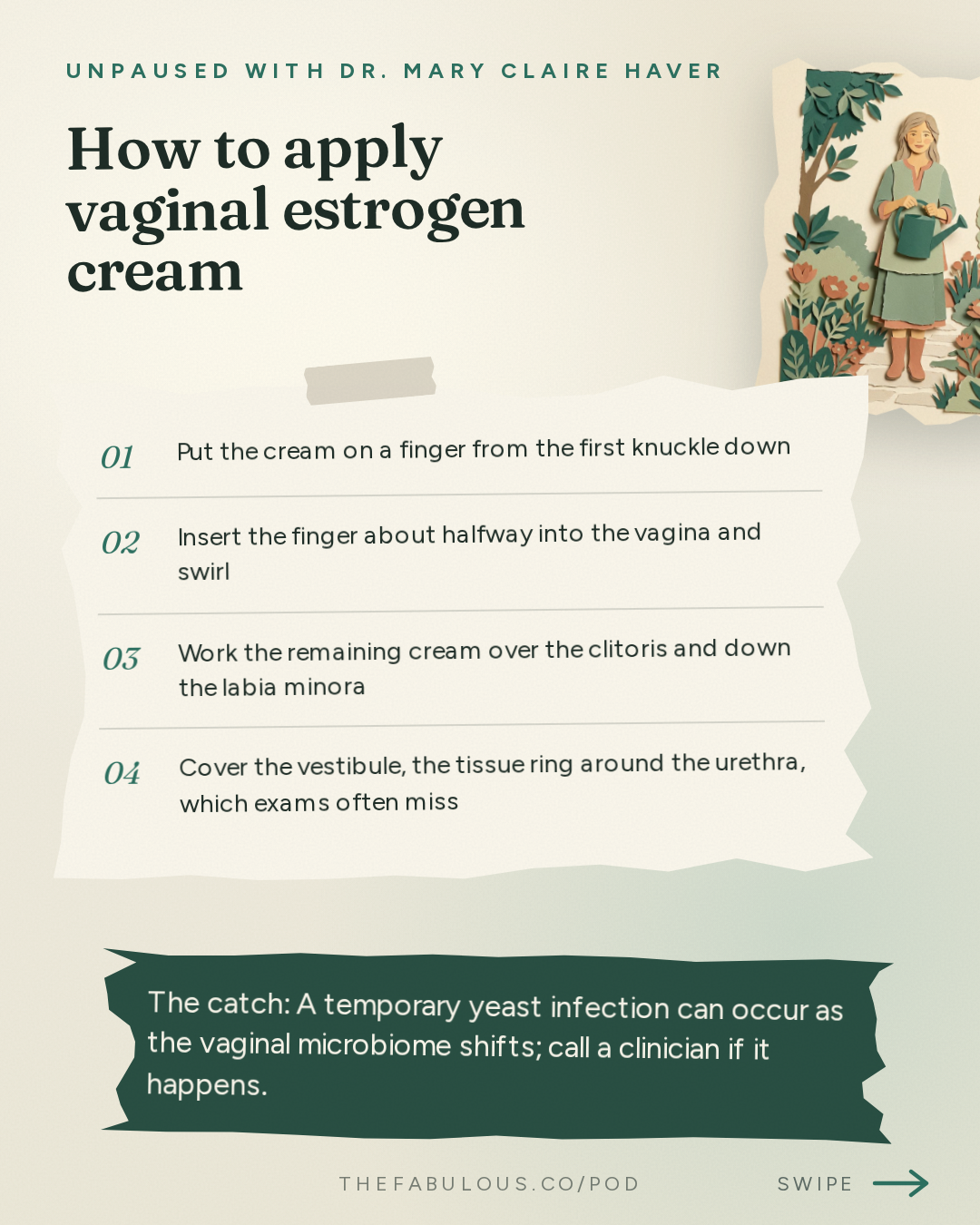
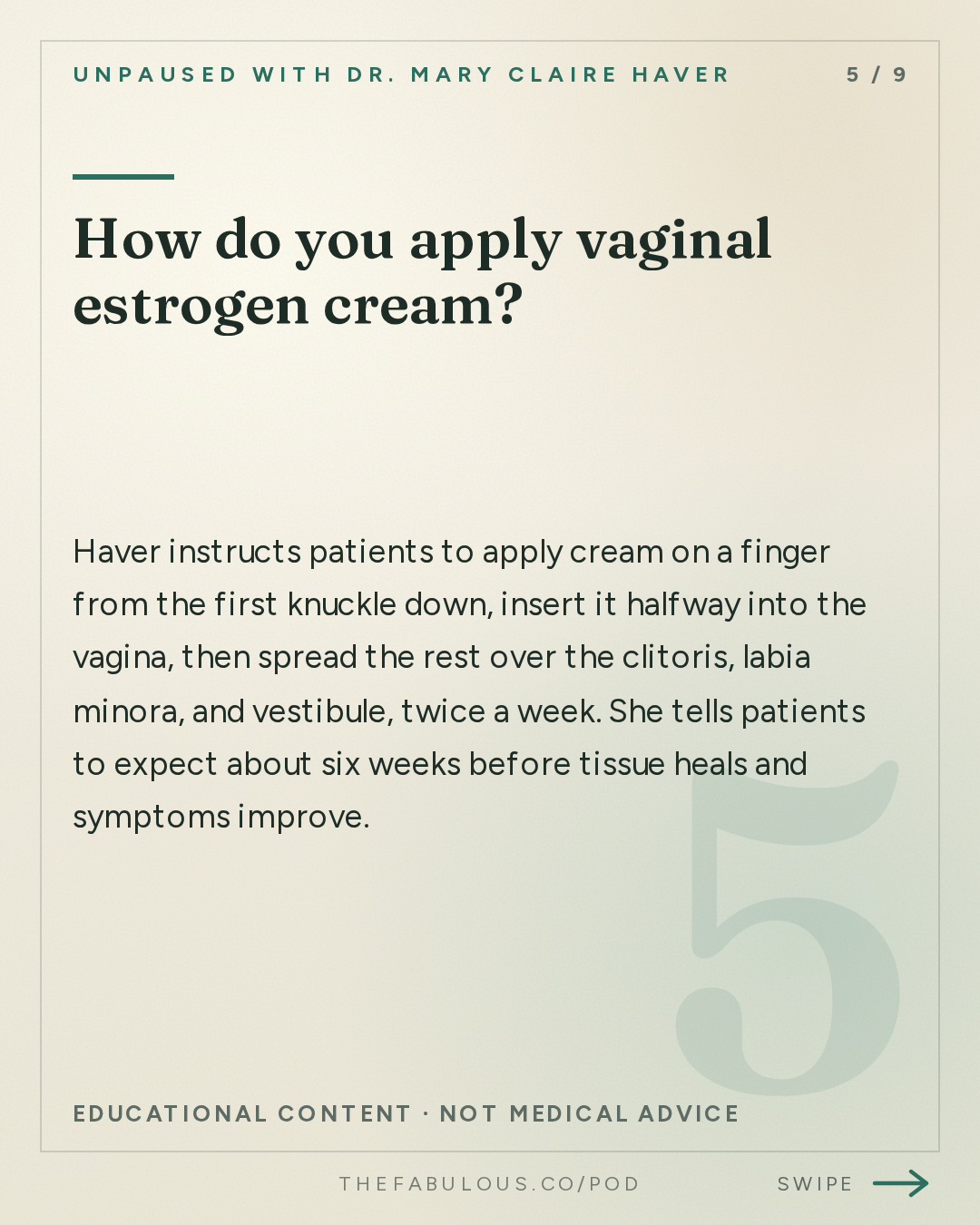
Treatment itself is almost aggressively simple. Vaginal estrogen comes as a cream, tablet, insert, or ring, and Haver's clinic favors the cream, in part because a tube costs $13 to $20 and lasts weeks (26:25). She tells patients to apply it from the first knuckle down, insert a finger halfway into the vagina, then work the rest of the cream over the clitoris, down the labia minora, and into the vestibule, the area most exams miss, twice a week.
"Treat the entire neighborhood, not just one block." — Dr. Mary Claire Haver [28:43]
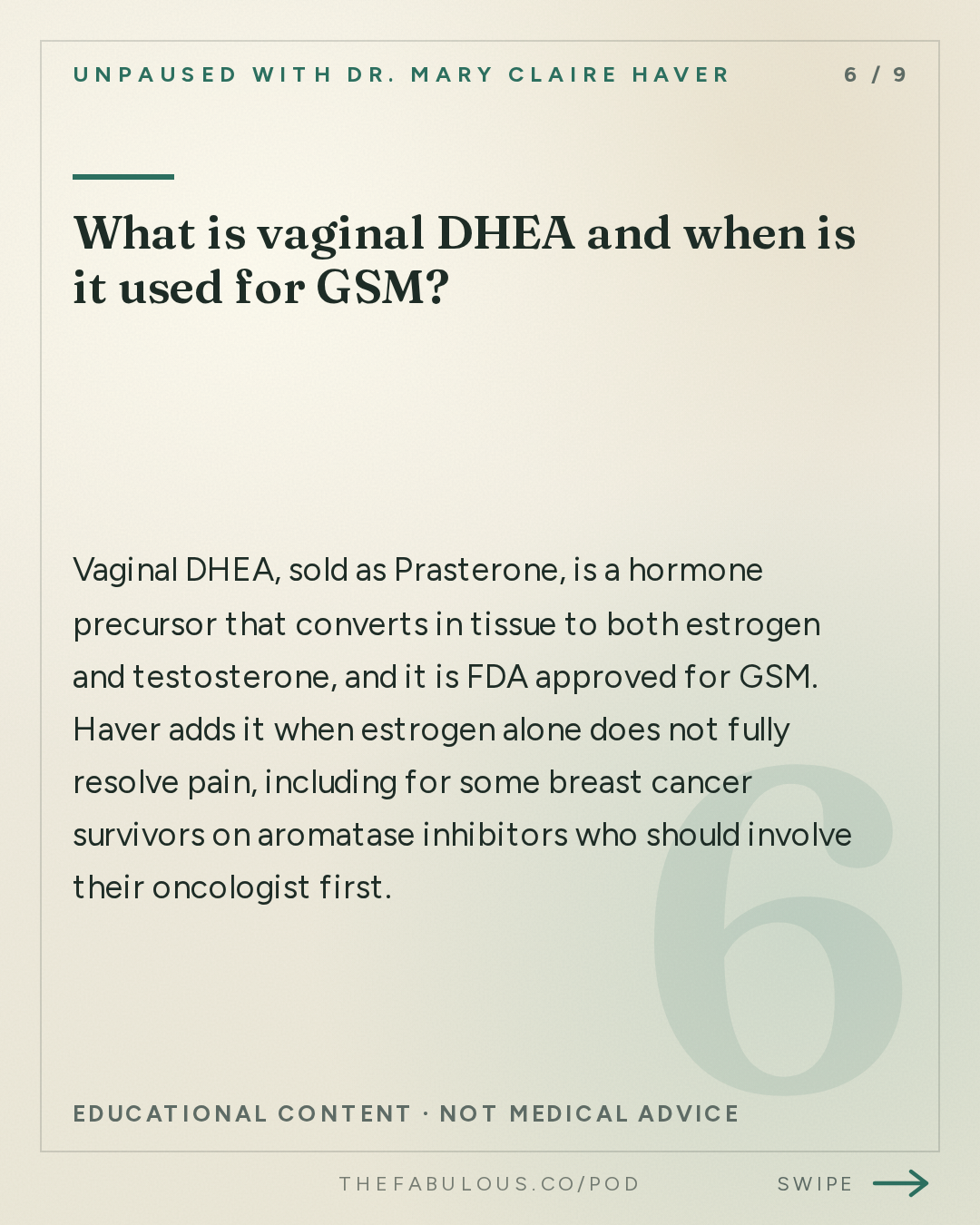
Patients need about six weeks before the tissue rebuilds and symptoms ease (27:21). For pain that estrogen alone does not resolve, Haver adds vaginal DHEA, sold as Prasterone, which converts in the tissue to both estrogen and testosterone (28:43), an option she says is worth discussing with an oncologist for breast cancer survivors on aromatase inhibitors (30:00). An oral pill, ospemifene, exists for women who cannot or will not use a vaginal product, including bedbound patients in memory care whose caregivers are not trained to apply topical treatments, though it carries a small clotting risk (31:08). Lubricants and daily moisturizers still matter, Haver says, but only as comfort measures: they mask friction, they do nothing for UTIs, and "telling a patient to just relax or have a glass of wine are not treatment plans" (34:07). For muscle clenching around pain, pelvic floor physical therapy breaks the cycle that cream alone cannot touch (33:39).
What makes the whole picture frustrating, in Haver's telling, is how little stands between the current state and something much better. The treatment is already approved, already cheap, already safer by her account than aspirin or Tylenol (23:53). What is missing is a habit: doctors offering it first, and patients knowing to ask. Her proposed script is three sentences long: say you think you have genitourinary syndrome of menopause, say you want to try low-dose vaginal estrogen, and ask whether your clinician will prescribe it (43:26). If the answer is no, she says, find someone whose answer is yes.
Ask this episode anything
Pod's AI answers from the episode itself, with the minute mark so you can hear it yourself.
Or start with one of these
Ask this episode
Pod's AI listens to the whole episode to answer, and points you to the minute it comes from.
The rest of this answer, and any question after it
Answers come from the episode itself, never from a summary of it.
ContinueKey takeaways
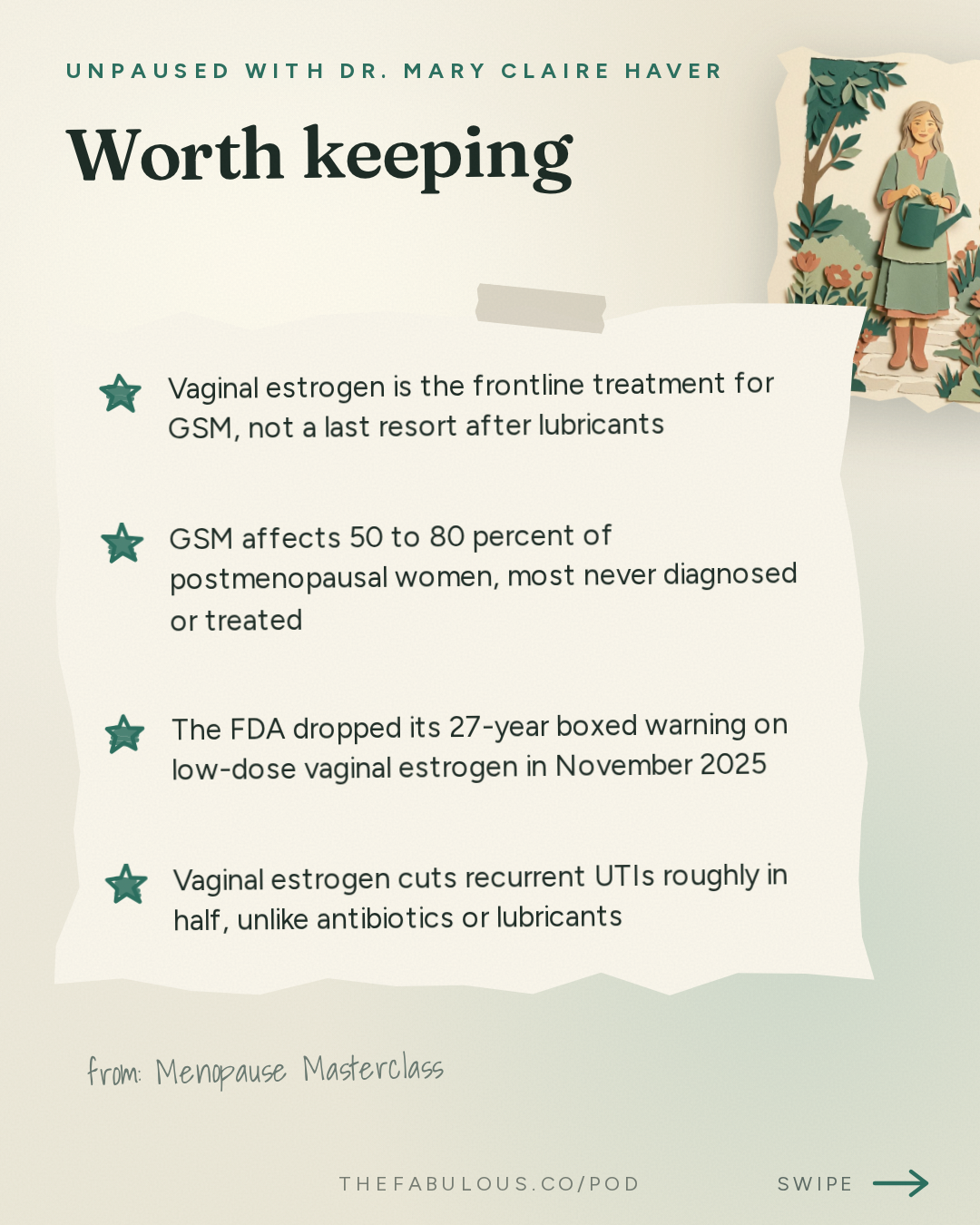
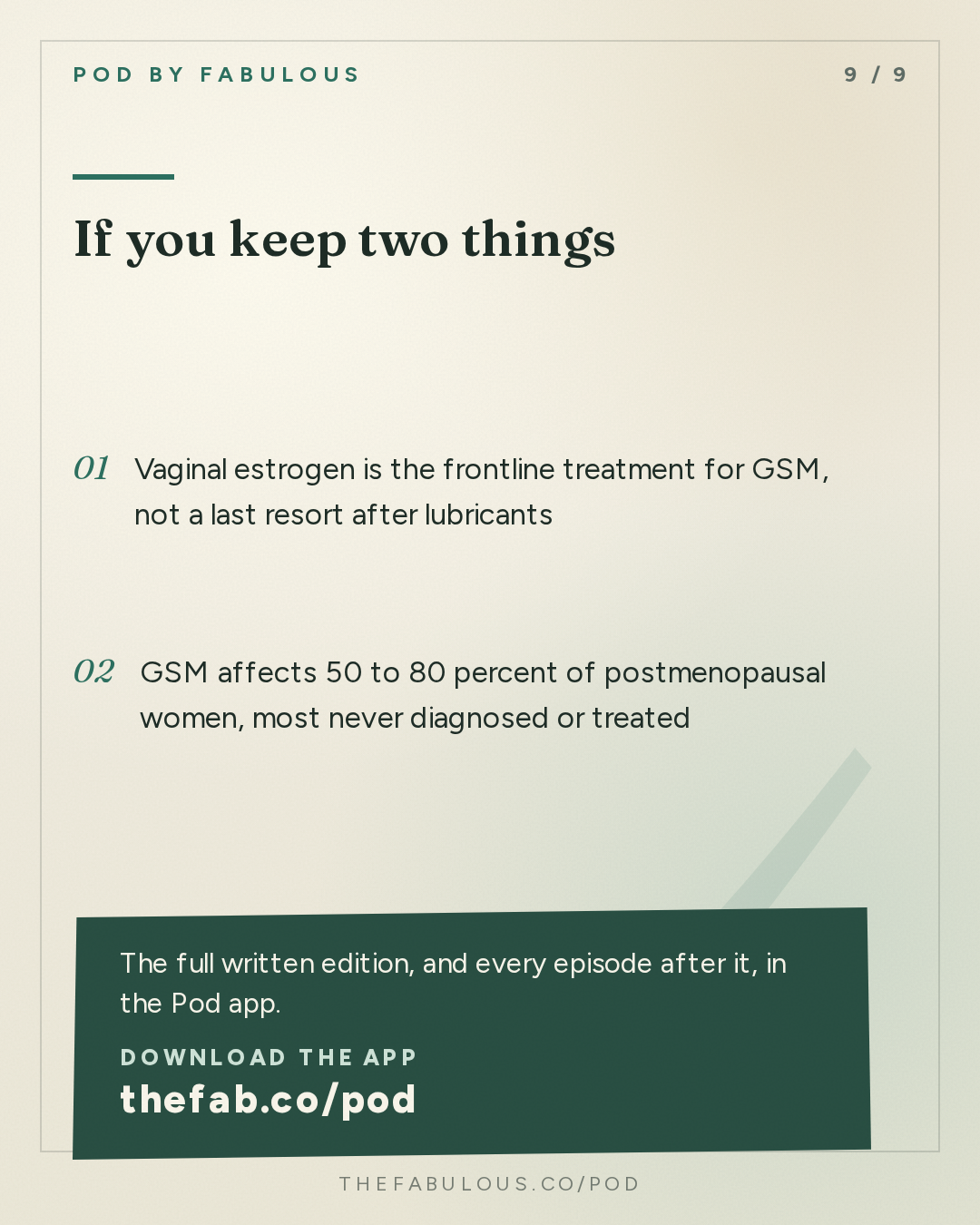
- Vaginal estrogen is the frontline treatment for GSM, not a last resort after lubricants
- GSM affects 50 to 80 percent of postmenopausal women, most never diagnosed or treated
- The FDA dropped its 27-year boxed warning on low-dose vaginal estrogen in November 2025
- Vaginal estrogen cuts recurrent UTIs roughly in half, unlike antibiotics or lubricants
- Only 7 percent of women diagnosed with GSM are actually prescribed vaginal estrogen
The episode in cards

By the numbers
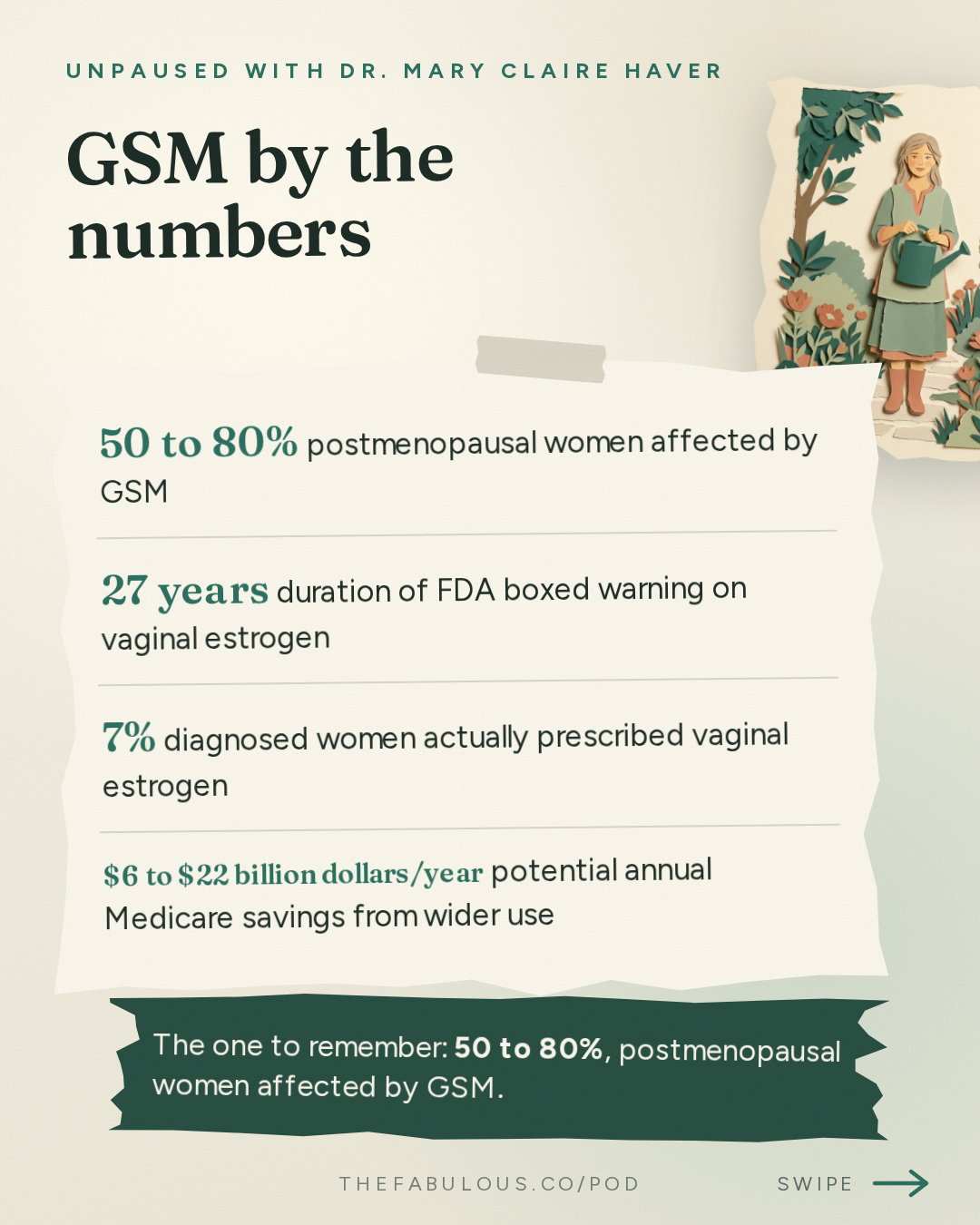
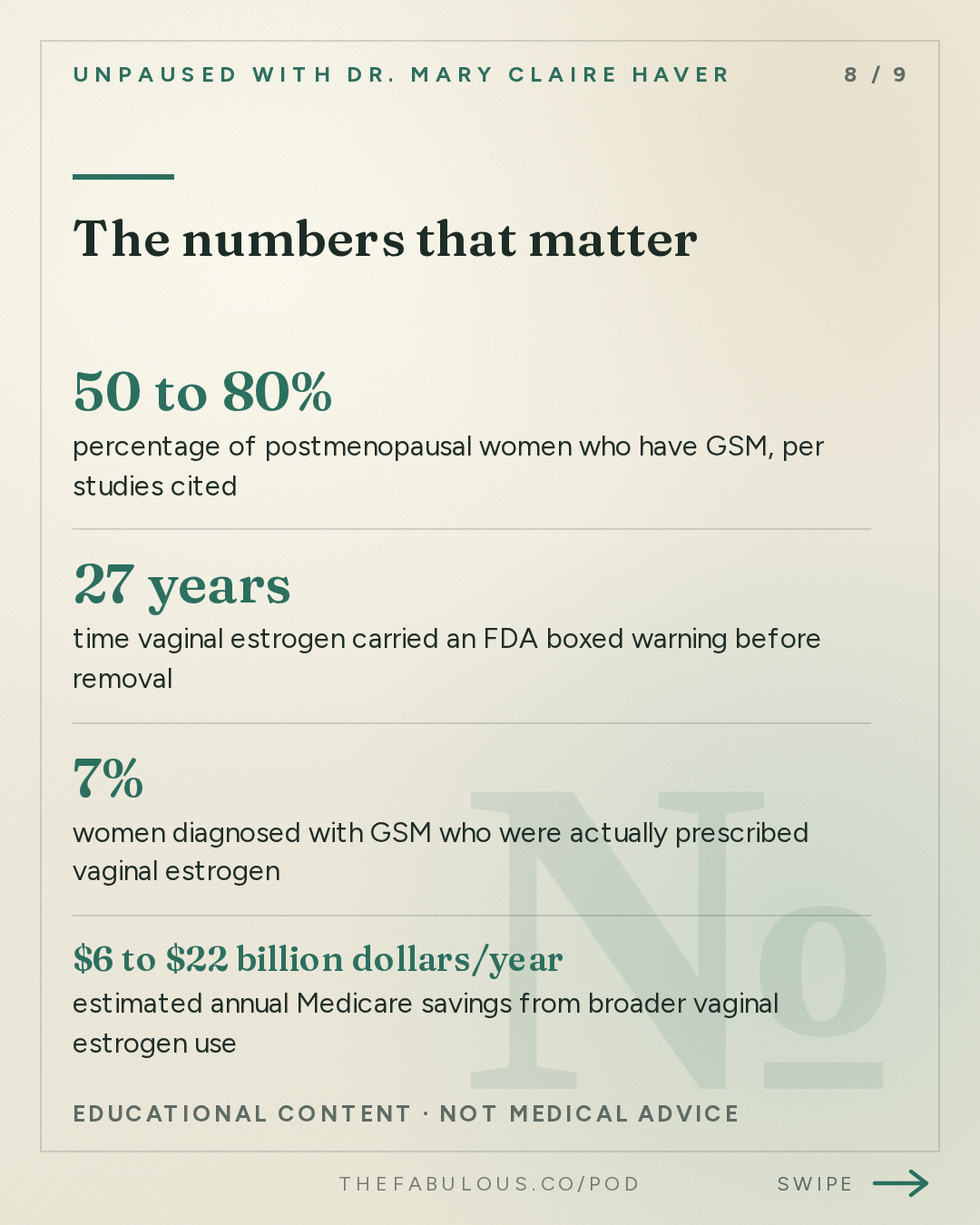
- 50 to 80% percentage of postmenopausal women who have GSM, per studies cited
- 27 years time vaginal estrogen carried an FDA boxed warning before removal
- 7% women diagnosed with GSM who were actually prescribed vaginal estrogen
- $6 to $22 billion dollars/year estimated annual Medicare savings from broader vaginal estrogen use
- 6 weeks time needed for vaginal tissue to heal after starting vaginal estrogen
- $13 to $20 dollars cost of a tube of generic vaginal estrogen cream lasting several weeks
In their words
“If you wouldn't put it in your eye or put it in your mouth, don't put it in your vagina.”
“Common doesn't mean normal, and it's not anyone's fault. It's biology.”
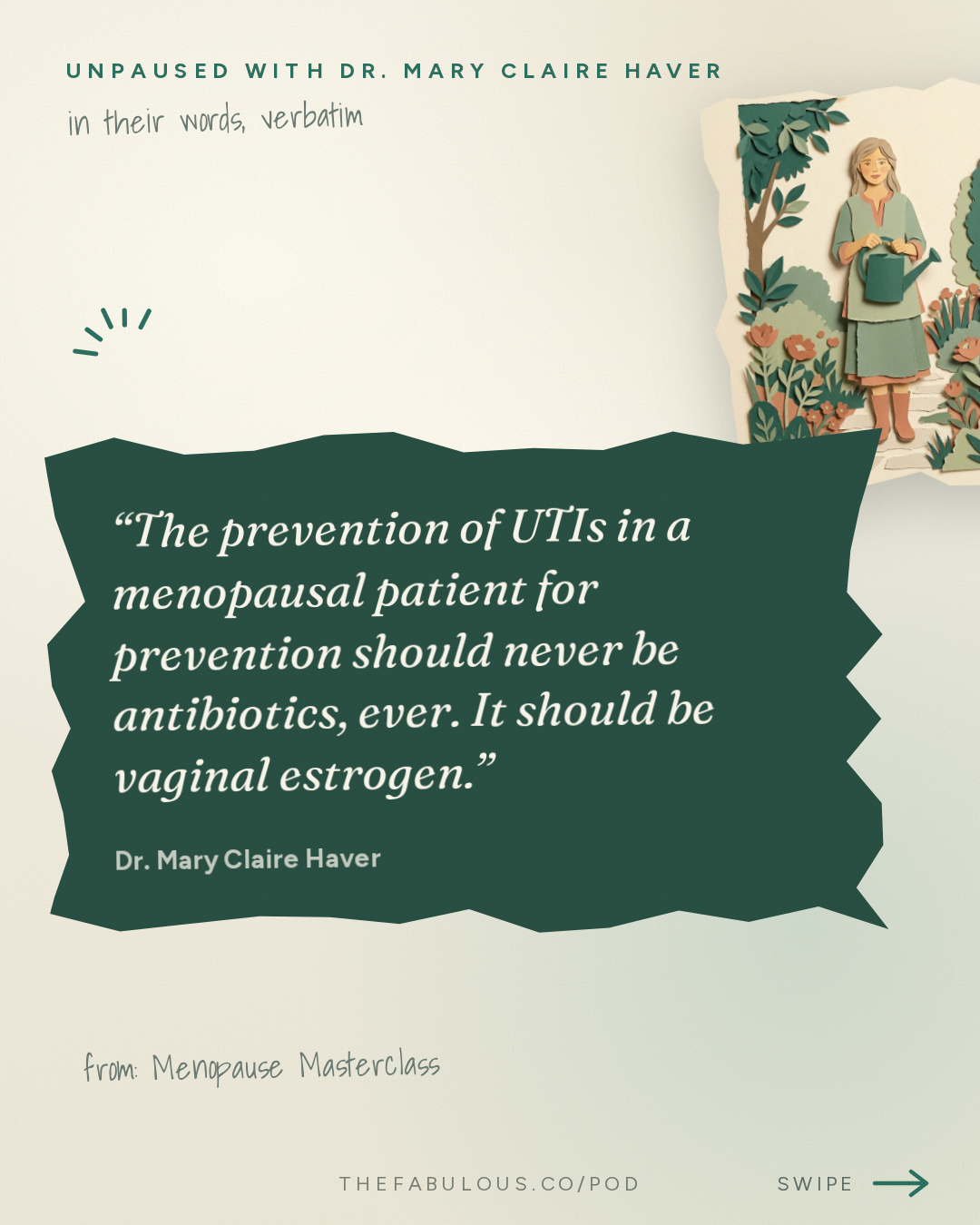
“The prevention of UTIs in a menopausal patient for prevention should never be antibiotics, ever. It should be vaginal estrogen.”
“It is safer than aspirin. It is safer than Tylenol.”
“Treat the entire neighborhood, not just one block.”
Protocols
-
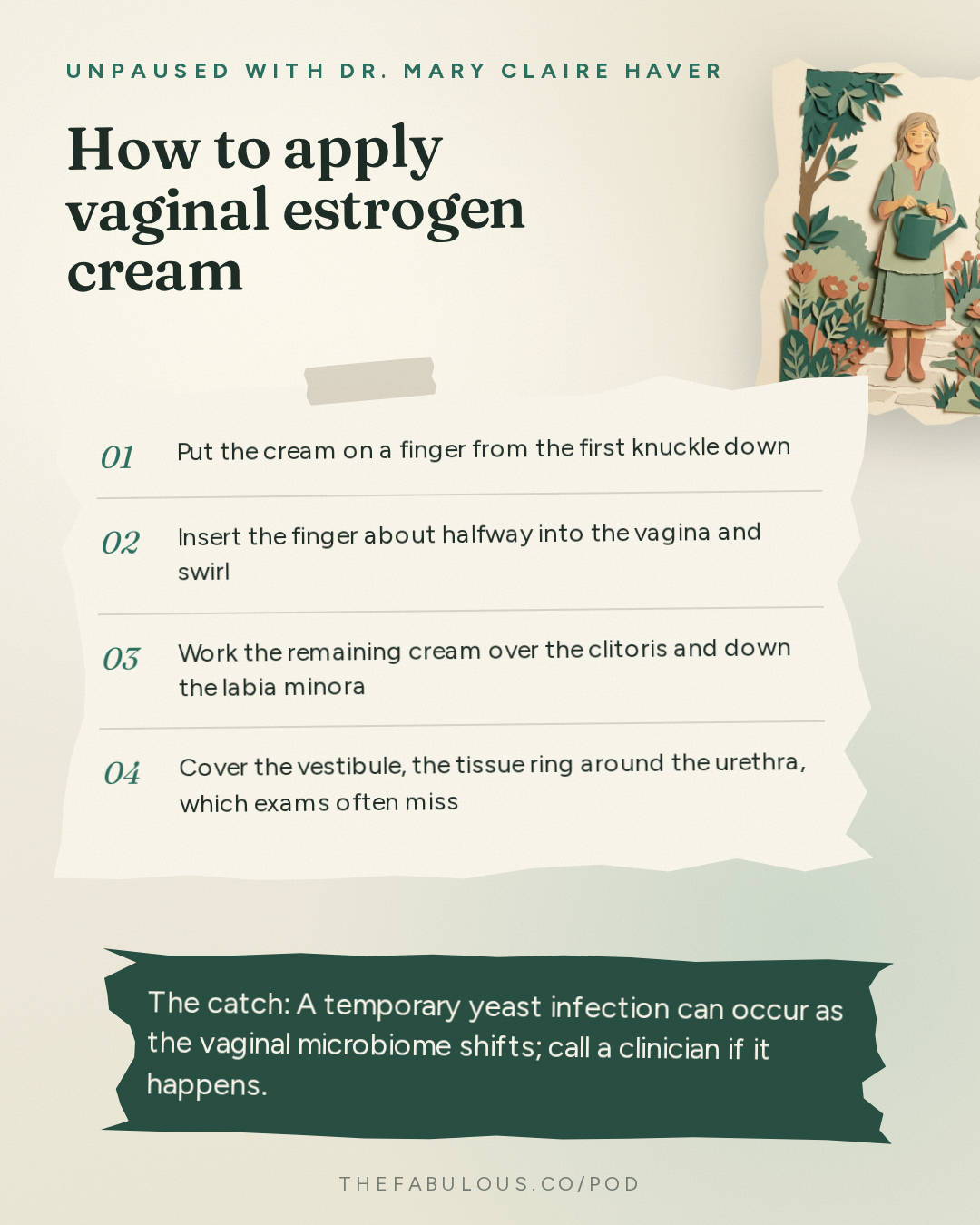
Applying vaginal estrogen cream
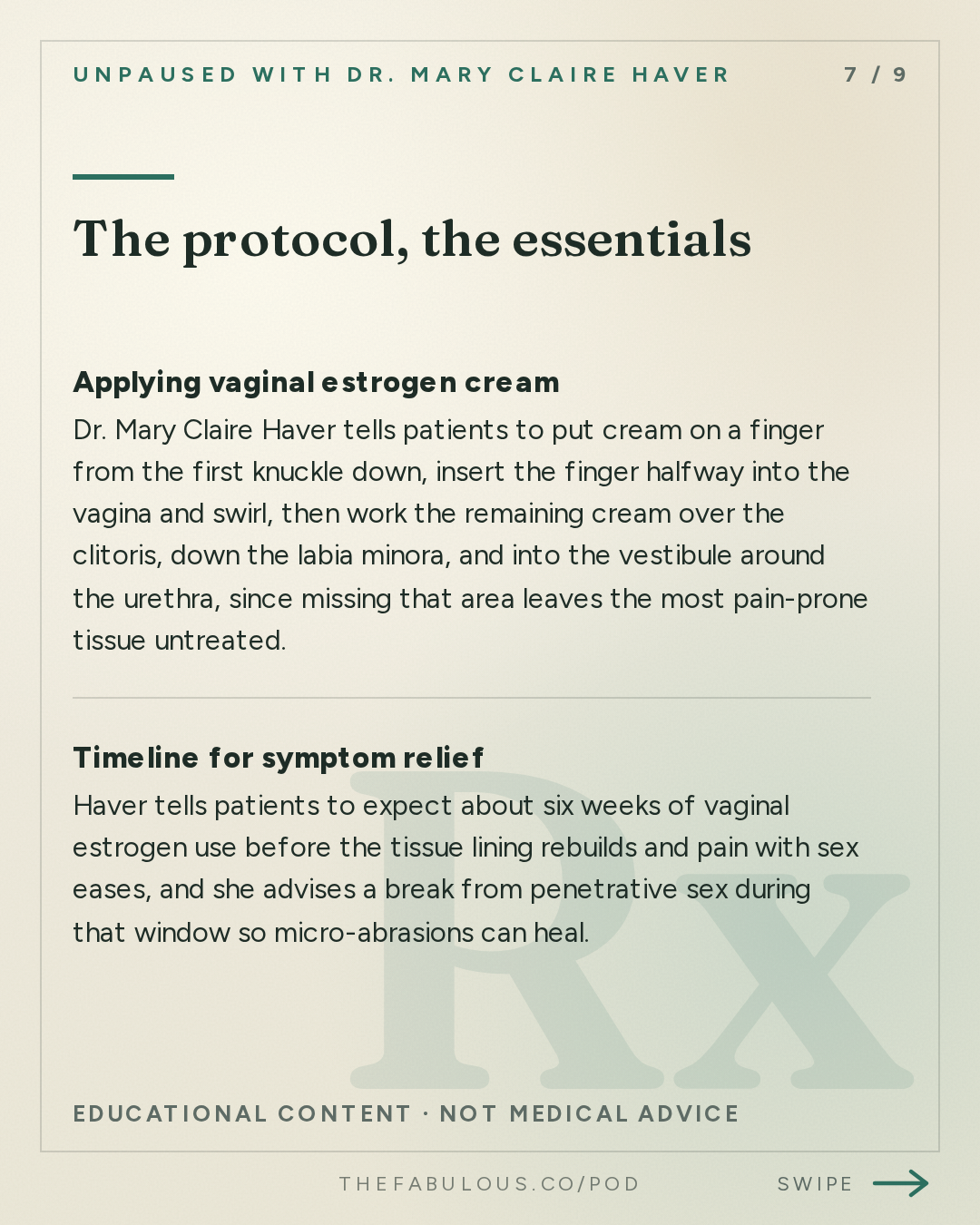
Dr. Mary Claire Haver tells patients to put cream on a finger from the first knuckle down, insert the finger halfway into the vagina and swirl, then work the remaining cream over the clitoris, down the labia minora, and into the vestibule around the urethra, since missing that area leaves the most pain-prone tissue untreated.
Twice weekly, using a 0.01% estradiol cream, one gram per application
-
Timeline for symptom relief
Haver tells patients to expect about six weeks of vaginal estrogen use before the tissue lining rebuilds and pain with sex eases, and she advises a break from penetrative sex during that window so micro-abrasions can heal.
Reassess after six weeks of consistent use
-
Adding vaginal DHEA for unresolved pain
Haver adds vaginal DHEA (Prasterone) when estrogen alone does not fully resolve pain or delayed orgasm, and she tells breast cancer survivors on aromatase inhibitors to clear this option with their oncologist first since it converts locally into both estrogen and testosterone.
As an add-on once estrogen response plateaus
-
UTI prevention in menopausal patients
Haver says recurrent UTI prevention in a menopausal patient should never be antibiotics, and vaginal estrogen should be used instead since it restores the tissue and microbiome that antibiotics do not address.
Ongoing use for women with a history of two or more UTIs in six months
Questions this episode answers
What is genitourinary syndrome of menopause (GSM)?
GSM is the 2014 rename for what doctors used to call atrophic vaginitis, covering hormone-driven changes in the vulva, vagina, clitoris, urethra, and bladder (03:03). It affects 50 to 80% of postmenopausal women and can also appear during breastfeeding, low-weight exercise states, or birth control pill use, since all three lower estrogen levels (11:00, 10:07).
Is vaginal estrogen safe?
Low-dose vaginal estrogen stays almost entirely local to the tissue and, according to OB-GYN Dr. Mary Claire Haver, has no documented harm when used as directed; she calls it safer than aspirin or Tylenol (23:53). The FDA removed its 27-year boxed warning from low-dose vaginal estrogen products on November 10, 2025 (15:20).
Can vaginal estrogen prevent UTIs?
Vaginal estrogen cuts recurrent urinary tract infections roughly in half by restoring vaginal tissue and a healthier microbiome (38:36). Haver argues prophylactic antibiotics, the common alternative, should never be the first choice for preventing UTIs in menopausal women (09:12).
How do you apply vaginal estrogen cream?
Haver instructs patients to apply cream on a finger from the first knuckle down, insert it halfway into the vagina, then spread the rest over the clitoris, labia minora, and vestibule, twice a week (25:16, 26:52). She tells patients to expect about six weeks before tissue heals and symptoms improve (27:21).
What is vaginal DHEA and when is it used for GSM?
Vaginal DHEA, sold as Prasterone, is a hormone precursor that converts in tissue to both estrogen and testosterone, and it is FDA approved for GSM (28:43). Haver adds it when estrogen alone does not fully resolve pain, including for some breast cancer survivors on aromatase inhibitors who should involve their oncologist first (29:26, 30:00).
Why don't more women get treated for GSM?
In a Medicare analysis, only about 7% of women diagnosed with GSM were prescribed vaginal estrogen (37:09). Haver traces the gap to fear left over from 2002 Women's Health Initiative headlines and an FDA boxed warning that was never based on data for local vaginal products (12:05, 15:20).
The full read, in cards
Go deeper
- Women's Health Initiative — 2002 results linking hormone therapy to breast cancer risk triggered decades of fear around all estrogen products
- American Urological Association GSM guidelines — updated guidelines naming vaginal estrogen, not lubricants, as frontline GSM treatment
- Medicare cost-savings analysis on vaginal estrogen — estimated $6 to $22 billion in annual Medicare savings from broader vaginal estrogen use, co-authored by Dr. Rachel Rubin
Mentioned
Dr. Mary Claire Haver · Dr. Rachel Rubin · Dr. Kelly Casperson · Dr. Jim Simon · Women's Health Initiative · FDA · Medicare · American Urological Association · Prasterone · Ospemifene · ISSWSH
More from this show and category

Dense Breasts and Real Breast Cancer Risk
Most breast cancer is not hereditary, only 5 to 10% of cases are (01:58). Oncologist Eleonora Teplinsky explains how family history, genetic testing, and breast density shape real risk, and why previvors with BRCA mutations can safely use hormone therapy after their ovaries are removed.
GSM: Menopause's Most Undertreated Condition
Genitourinary syndrome of menopause (GSM) is a cluster of vaginal, vulvar, and urinary changes caused by falling estrogen and testosterone, affecting 50% to 80% of postmenopausal women (11:00). Low-dose vaginal estrogen is the frontline treatment, cuts recurrent UTIs in half, and lost its FDA black box warning on November 10, 2025, after 27 years (14:54, 38:36).
Can Breast Cancer Previvors Safely Use HRT?
Most breast cancers are not inherited, but oncologist Dr. Eleonora Teplinsky says risk assessment should start at 25, since 5 to 10% of cases trace to a gene mutation and a 20% lifetime score marks someone as high risk (02:03, 03:31). She also confirms previvors with BRCA mutations can safely use hormone therapy after ovary removal (15:04).

Pelvic Floor Health and Menopause: Daily Habits
Pelvic floor therapist Sarah Reardon says menopause pelvic problems need two fixes: estrogen for tissue, muscle training for strength. She covers power peeing, Squatty Potties, pessaries, GSM, vaginismus, and why the $5 billion vaginal rejuvenation industry skips the muscle work that actually prevents prolapse and leakage.
