unPAUSED with Dr. Mary Claire Haver
Dense Breasts and Real Breast Cancer Risk
Dense Breasts, Family History and Your Mammogram: How to Know your Real Risk
▶ Listen to the full episode More from unPAUSED with Dr. Mary Claire Haver
The brief
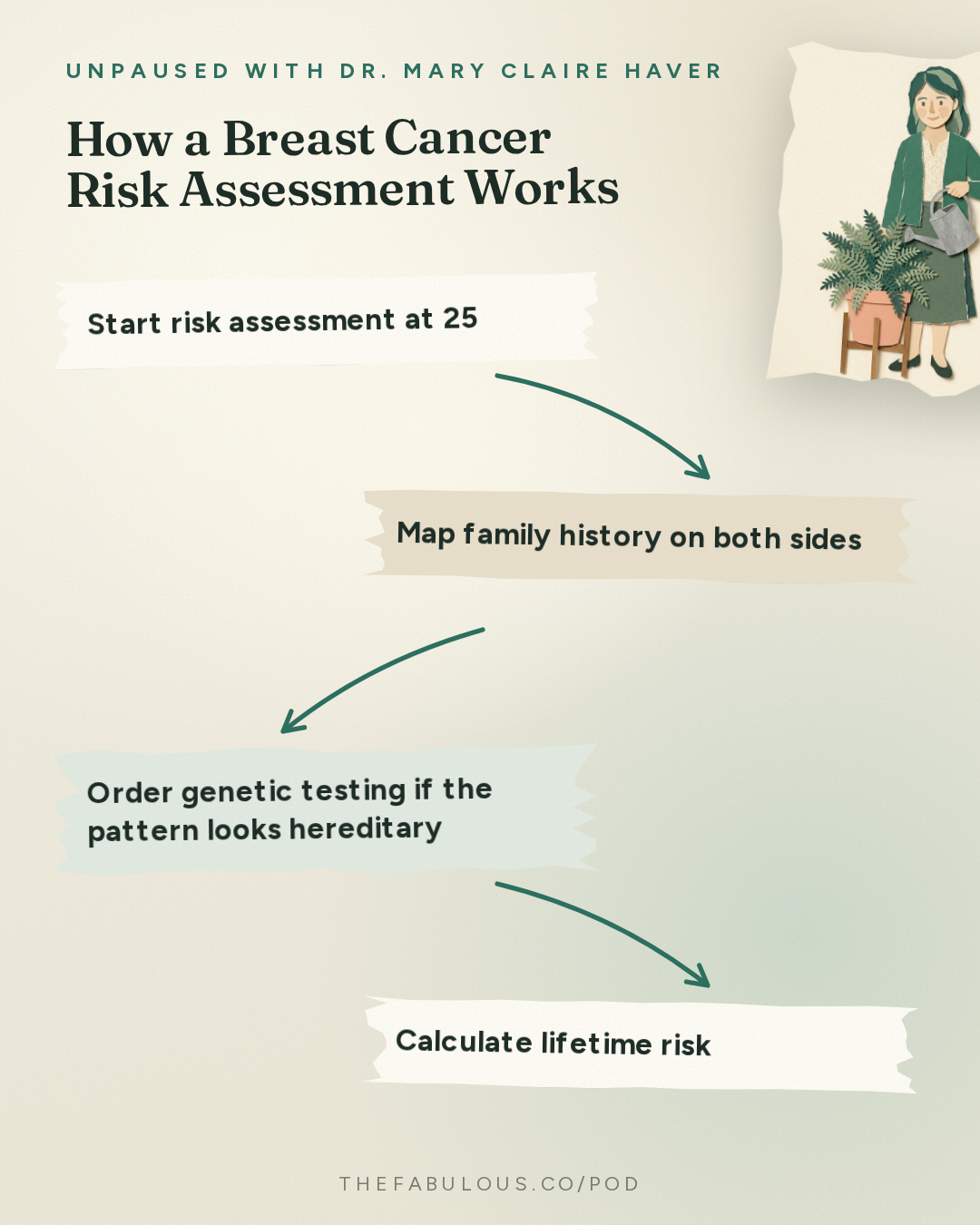
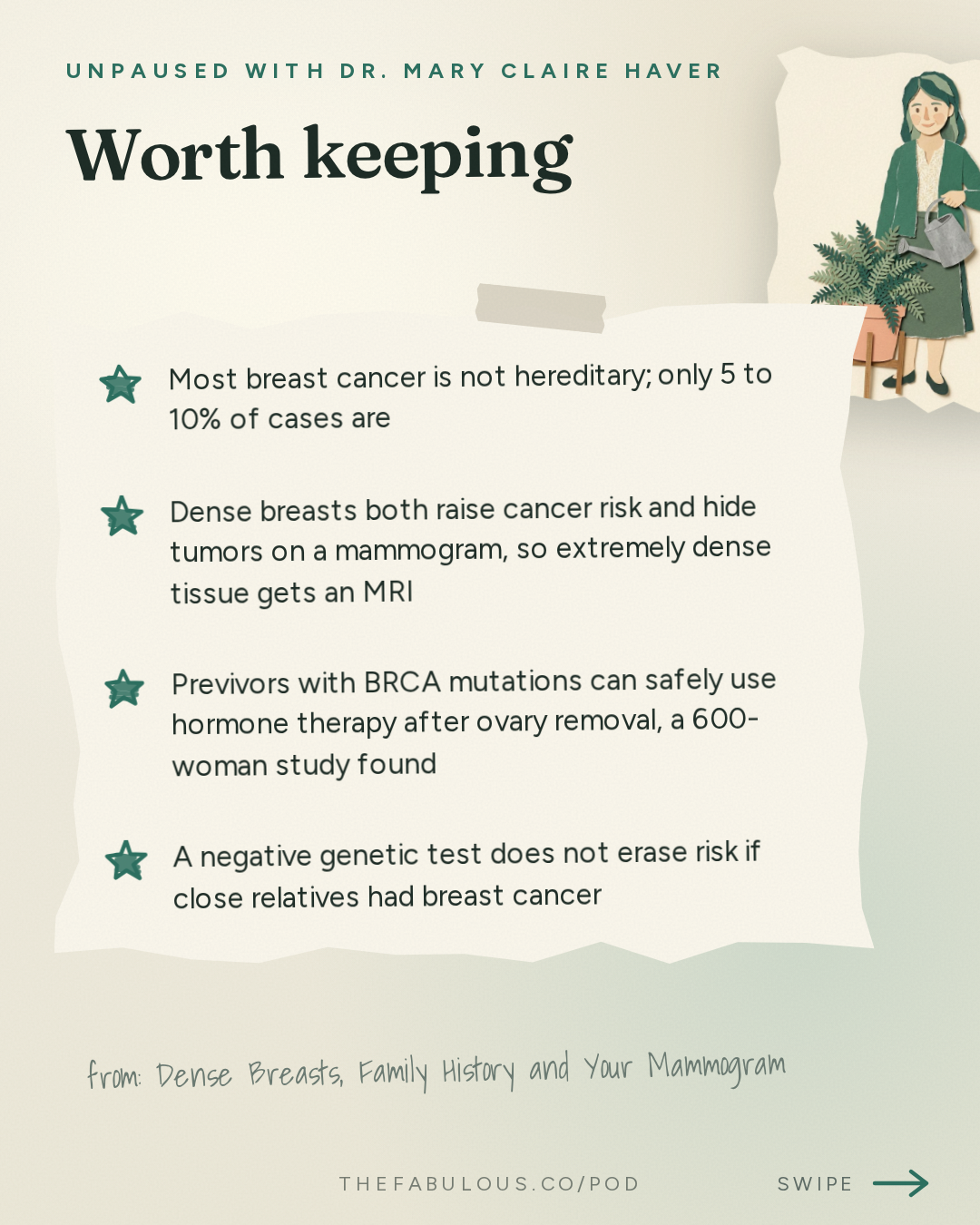
Most breast cancer is not hereditary, only 5 to 10% of cases are (01:58). Oncologist Eleonora Teplinsky explains how family history, genetic testing, and breast density shape real risk, and why previvors with BRCA mutations can safely use hormone therapy after their ovaries are removed.
Here is a number that surprises most people: only 5 to 10 percent of breast cancers are hereditary (01:58). Everything else, the overwhelming majority, happens without a known genetic mutation or a dramatic family tree. Yet oncologist Eleonora Teplinsky, talking with OB-GYN Mary Claire Haver, says she routinely meets patients who skip mammograms for years because no one in their family has had the disease. "Is that a mistake?" Haver asks her. "One hundred percent," Teplinsky answers (01:41). The absence of family history feels like a shield. It is not one.
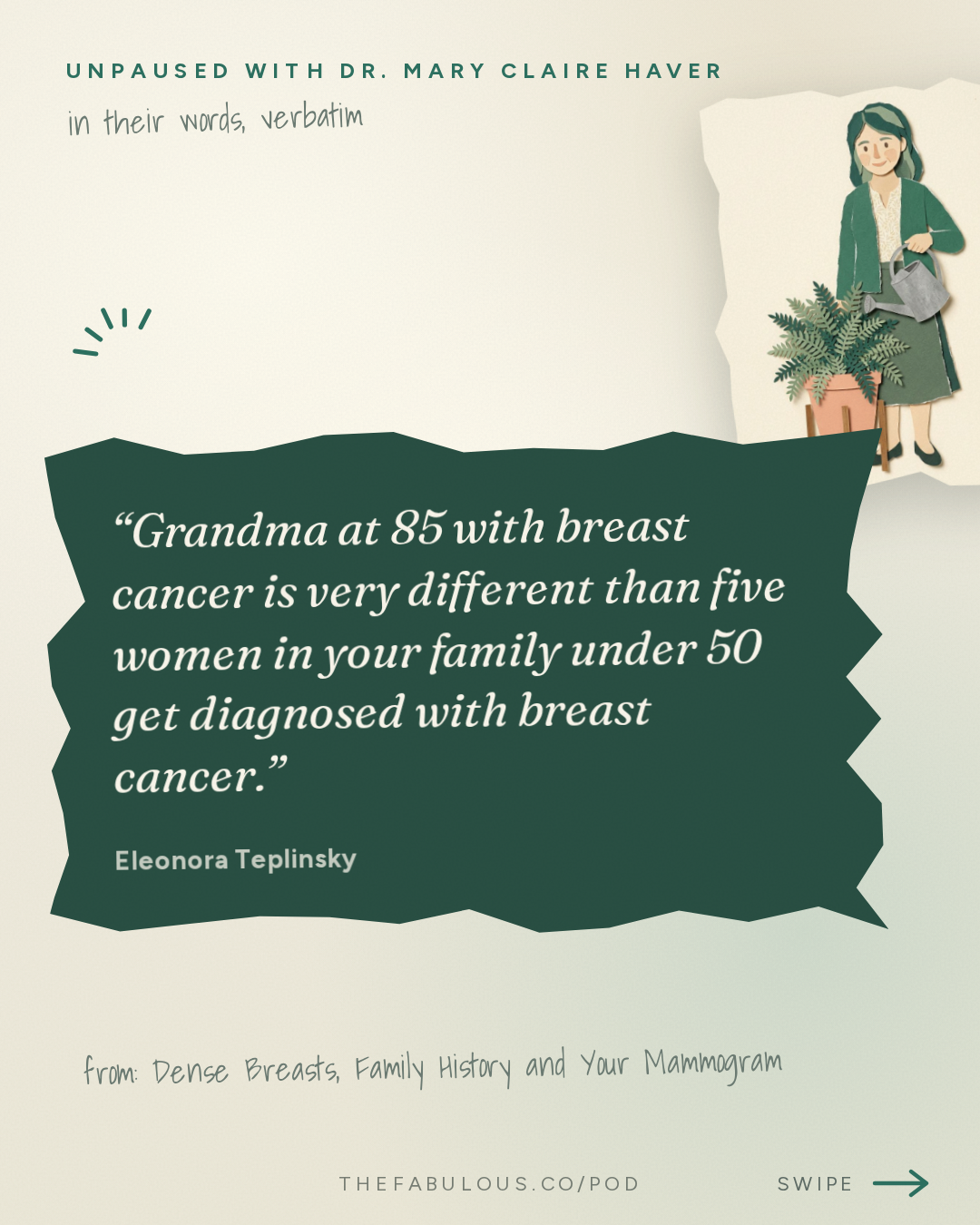
The real skill, Teplinsky argues, is reading family history correctly rather than ignoring or fearing it. A grandmother diagnosed at 85 tells a very different story than five women in one family diagnosed before 50.
"Grandma at 85 with breast cancer is very different than five women in your family under 50 get diagnosed with breast cancer." — Eleonora Teplinsky [01:10]
The second pattern, many relatives diagnosed young, points toward a hereditary cancer syndrome: a gene change passed down that raises risk across generations. The first pattern mostly reflects age, since cancer risk of almost any kind climbs as people get older. Confusing the two leads to two opposite mistakes: dismissing risk when a grandmother's age-related diagnosis gets lumped in with real genetic signal, or panicking over a single late-life case that shouldn't trigger alarm at all.
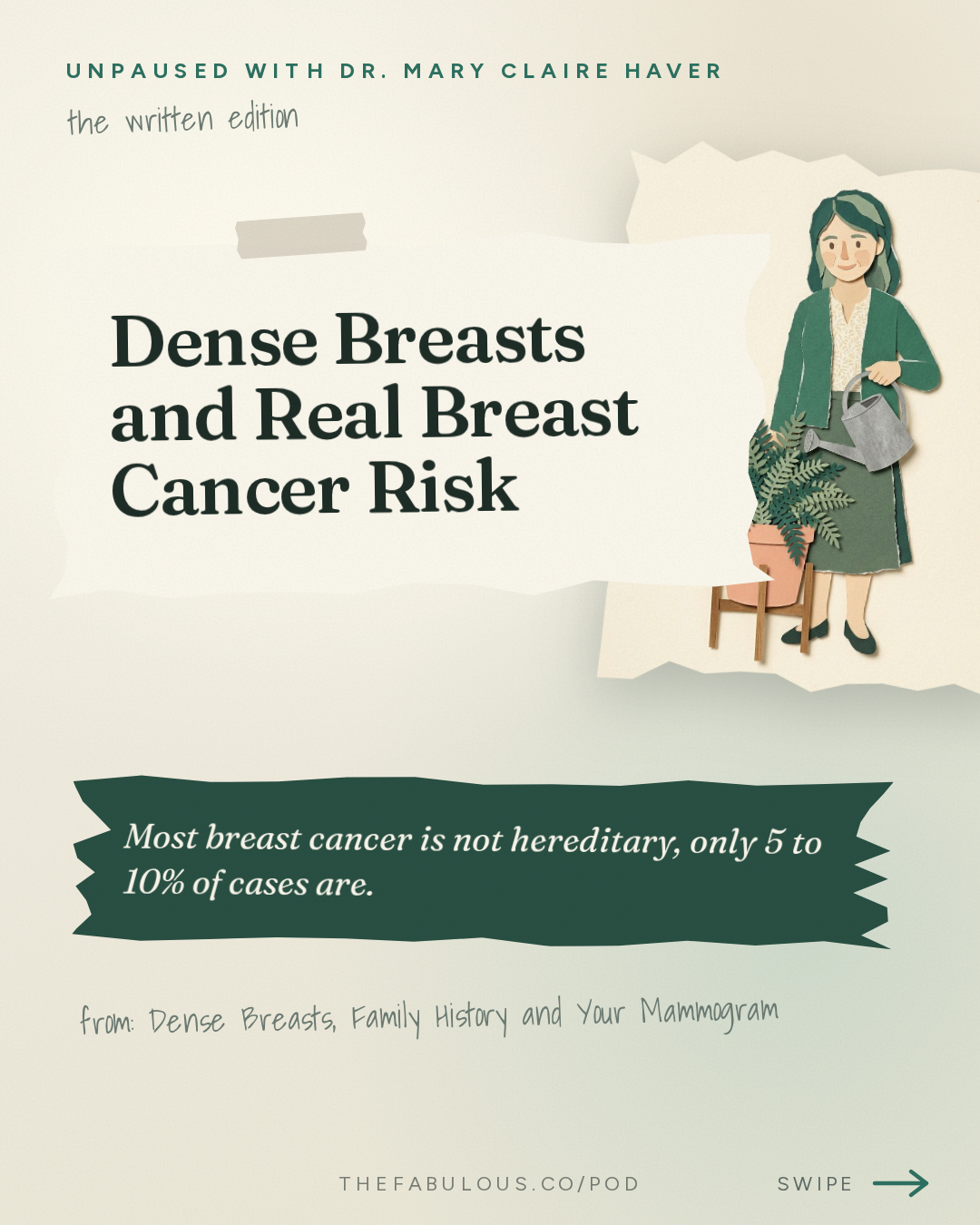
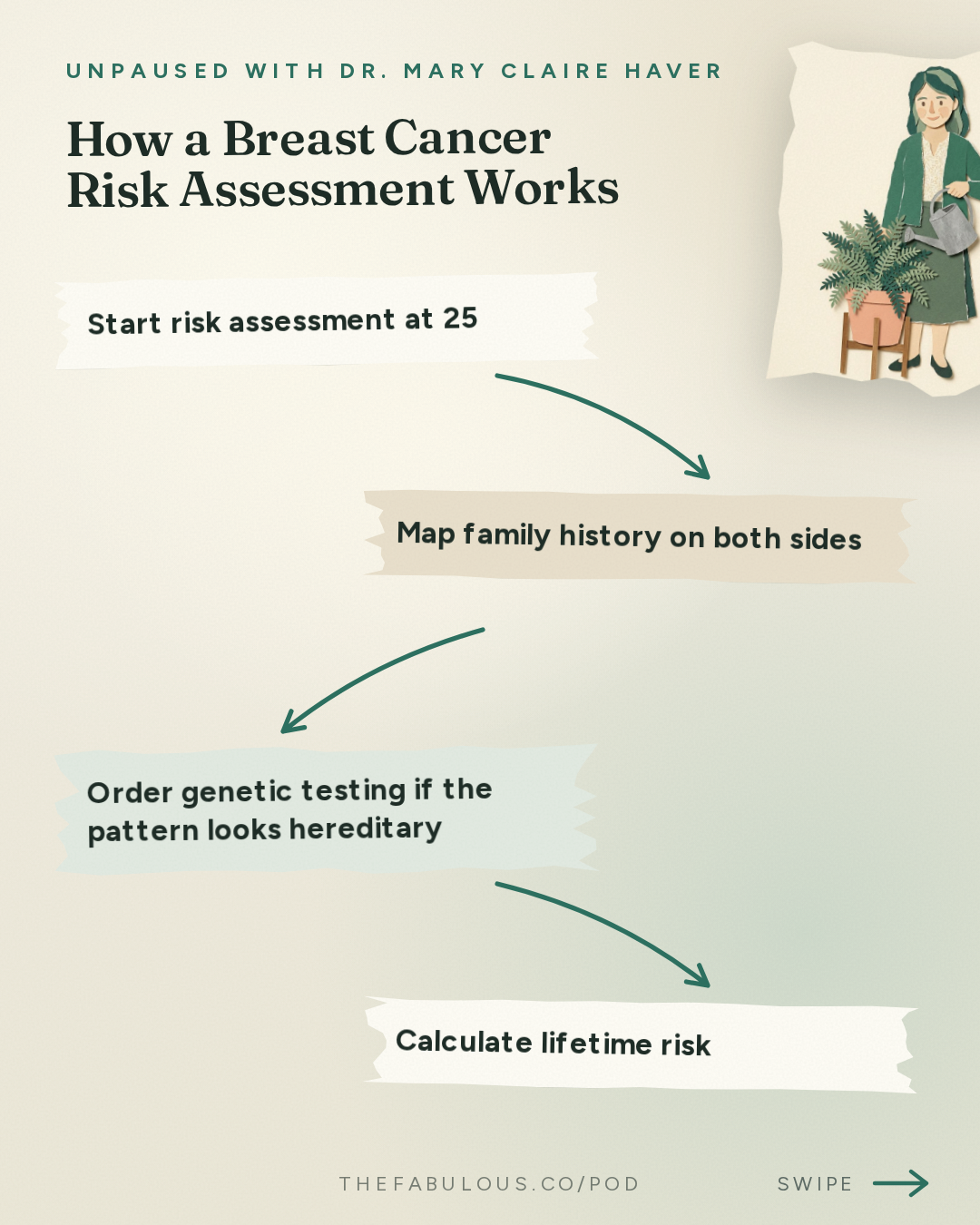
This is why Teplinsky wants breast cancer risk assessment to start at age 25 (02:45), using a free online tool like the Tyrer-Cuzick model, which factors in age at first period, family history on both the mother's and father's side, and breast density. The tool is imperfect. It misses some high-risk women and does not account for lifestyle. But it gives a number: a lifetime risk estimate. Cross 20 percent, and a woman is considered higher risk (03:45), which typically means a referral to a high-risk breast program, where mammogram alone may no longer be considered sufficient.
From there, the conversation about genetic testing opens up, and it is wider than most people assume. Testing isn't only about a mother's history. A father's side matters too, and so does a pattern that looks unrelated to breast cancer at first glance, like early-onset prostate cancer in men on either side of the family (06:01). BRCA is the mutation most people have heard of, but CHEK2, ATM, and PALB2 also raise risk, each with its own profile (05:12). Carrying a BRCA mutation specifically can mean up to an 80 percent lifetime risk of breast cancer (07:05), high enough that doctors typically raise the option of a risk-reducing mastectomy, though for women over 65 that calculation shifts and the benefit is less clear (07:12).
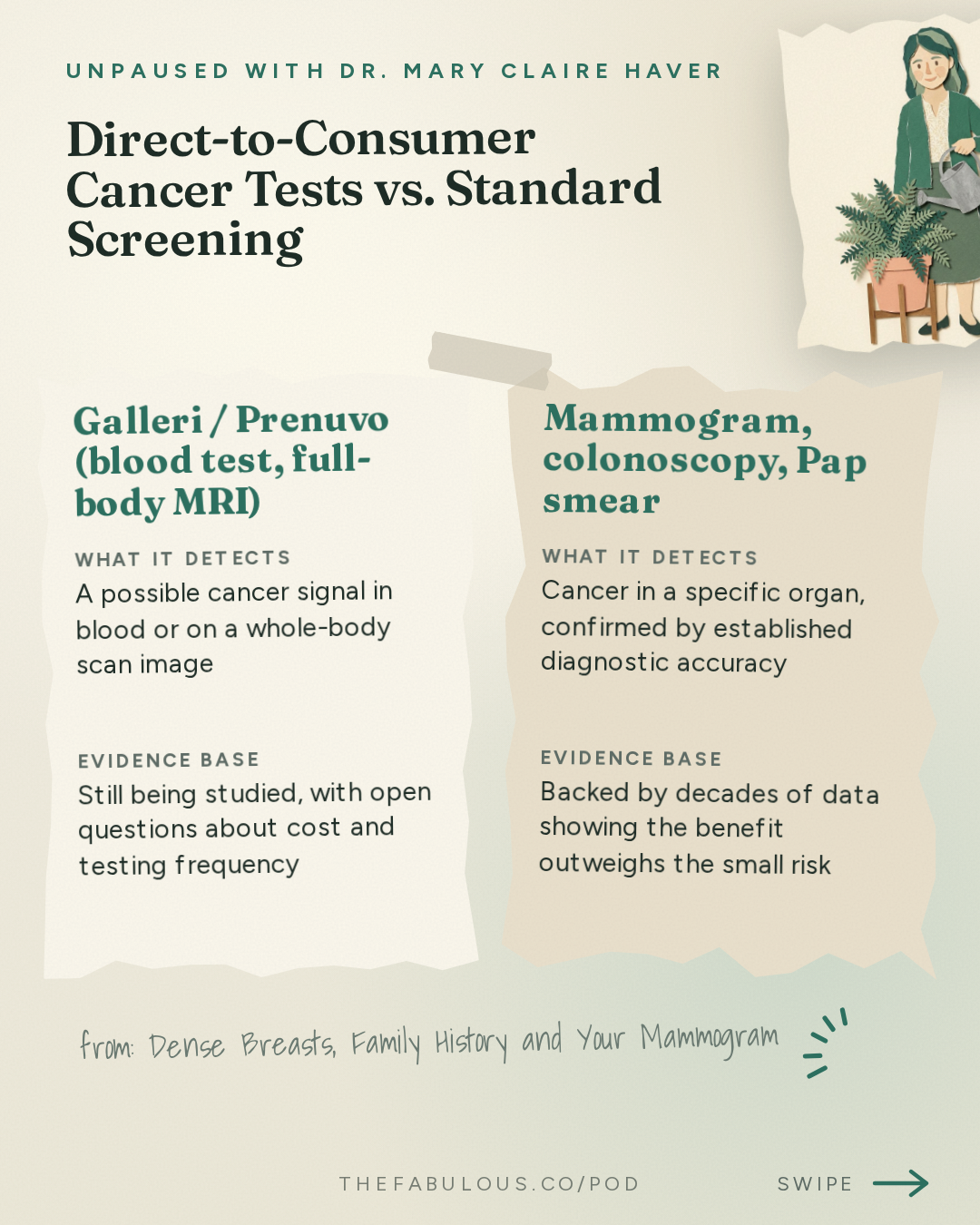
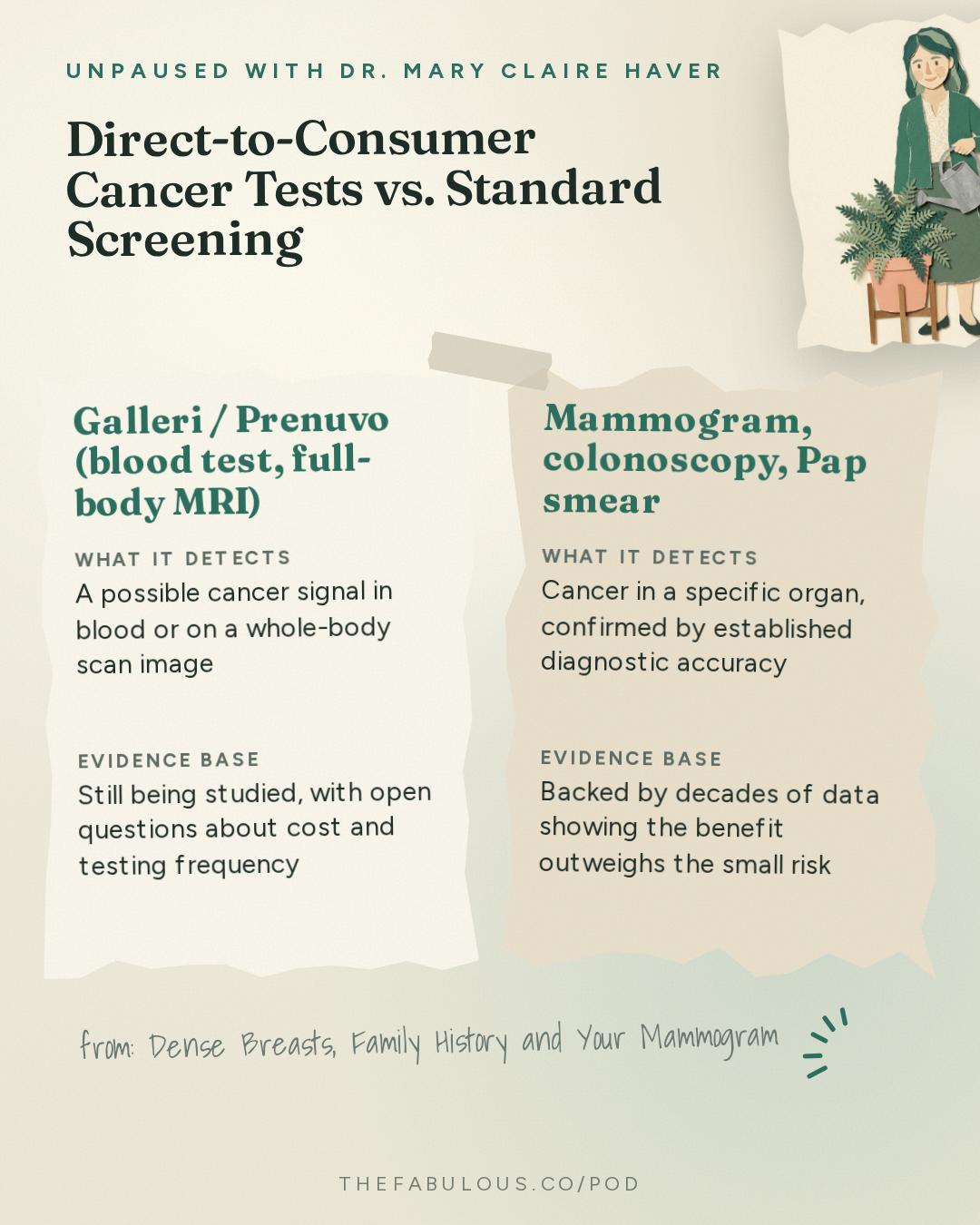
Teplinsky is careful to separate this evidence-based testing from a newer category of products marketed directly to consumers: blood tests like Galleri, which claim to detect a cancer signal from a vial of blood, and full-body MRI scans like Prenuvo, ordered without a doctor's referral. She is not dismissive. "I wanna know, right? I wanna know," she says of her own curiosity (08:43). But she is blunt about the limits: these tests can produce false positives and false negatives, they often miss early cancer confined to breast tissue, and a positive signal sends a patient hunting for the source through additional imaging and biopsies (08:59). Her bottom line is simple: these technologies should not replace proven, evidence-based screening like mammograms, colonoscopies, and Pap smears (09:40).
What Dense Breasts Actually Do
One exchange in the conversation corrects a widespread misunderstanding. Haver, herself a physician, admits she assumed dense breast tissue was a problem purely because it is harder to see through on a mammogram, hiding tumors that are there. Teplinsky's answer: "Both" (12:15). Dense tissue does make cancer harder to spot on a standard mammogram, and separately, it raises the actual risk of developing breast cancer, through a mechanism researchers still don't fully understand. About half of all women have dense breasts (12:28). They break into categories: category C, heterogeneously dense, covers roughly 40 percent of women and calls for an individualized conversation about added imaging. Category D, extremely dense, covers about 10 percent, and for those women Teplinsky says an MRI in addition to a mammogram is generally recommended (13:18).
Fear of the mammogram itself, specifically its radiation, also comes up. Teplinsky's comparison is worth remembering: the dose from a single mammogram equals roughly six to seven weeks of the background radiation a person absorbs just walking around outside (13:54). It is not zero. It is also not a reason to skip a test that catches cancer early.
The Previvor's Dilemma
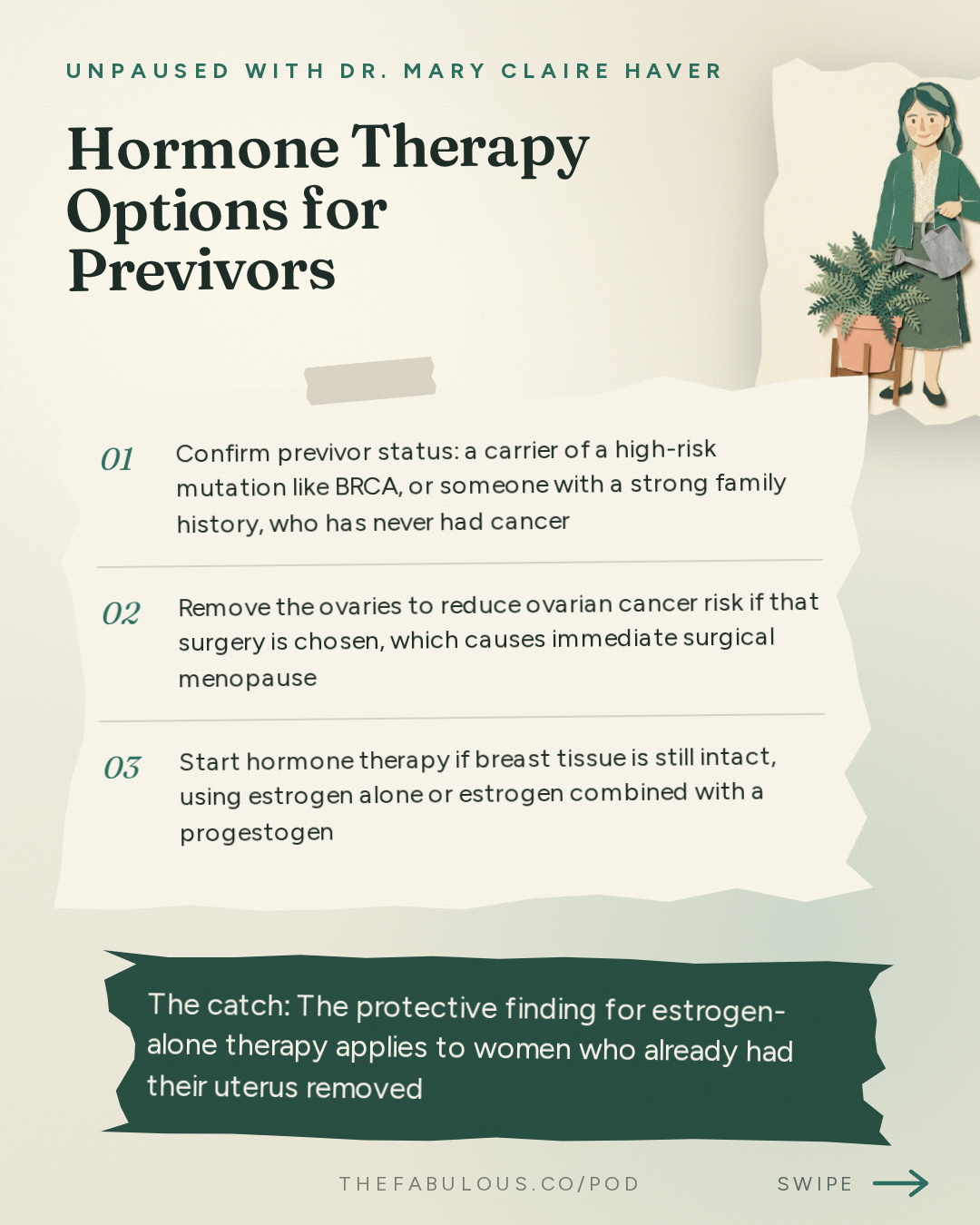
The most consequential segment of the conversation concerns women who carry a high-risk mutation but have never had cancer, a group Teplinsky calls "previvors" (14:16). Consider a 38-year-old with a BRCA mutation who removes her ovaries to cut her ovarian cancer risk, while keeping her breast tissue intact. That surgery throws her into immediate surgical menopause, decades earlier than nature would have. For years, the reflexive advice to any woman with elevated breast cancer risk has been a blanket ban on estrogen. Teplinsky says that advice is outdated and keeping it in place has a real cost: some women delay or avoid the ovary-removing surgery that would protect them from ovarian cancer because they are afraid of the menopause that follows.
"Previvors can absolutely use hormone replacement therapy. I don't think women understand this." — Eleonora Teplinsky [15:04]
She points to a study led by researcher JoAnn Katsopoulos that followed more than 600 previvors who had their ovaries removed but kept their breast tissue (15:46). Women who took estrogen alone did not have a higher risk of breast cancer; in fact, their risk was lower than those who took no hormones at all. Women who took estrogen combined with a progestogen had equal risk, not elevated risk (16:08). That is a meaningfully different message than the one most patients have absorbed. It does not mean hormone therapy is risk-free or right for everyone. Some BRCA carriers also face early, observational signals of elevated uterine cancer risk, which is reviving conversations about whether hysterectomy belongs in the same surgical decision as ovary removal (18:21). But the study reframes what used to be treated as an automatic no into an actual conversation.
Skipping that conversation carries its own cost. Premature menopause before age 45 raises long-term risk for the heart, the brain, and the skeleton (19:15). Teplinsky's message to anyone who can't or chooses not to use hormones: it is never too late to revisit the option later, and hormones are only one part of a larger plan that should also include strength training for bone health, screening for heart risk, and attention to cognitive health (19:40).
There is a parallel correction buried later in the conversation, about genetic testing that comes back negative. A negative result does not automatically return a woman to average risk if her mother or sister had breast cancer and was never tested, or tested negative herself.
"It does not mean that your risk is back to that of the average woman." — Eleonora Teplinsky [21:35]
Family history, even without an identified mutation, still carries weight in the overall risk picture.
The episode's second half tracks what treatment does to the body once cancer is diagnosed, and here the throughline is the same: unglamorous, overlooked side effects deserve the same rigor as the headline treatment decisions. Chemotherapy-induced ovarian failure can drop lumbar spine bone density by 4 percent in just six months (22:00), and aromatase inhibitors, a class of hormone-blocking drugs, add another 2 percent of bone loss per year on top of that. Teplinsky's practical fix is a baseline bone density scan, ideally for anyone starting chemotherapy or endocrine therapy, not only those on hormone-blocking medication (23:36). Radiation carries its own quiet cardiac cost: a 2013 study found major coronary events rose about 7.5 percent after radiation for breast cancer, since the breast sits directly in front of the heart (27:36). Radiation oncologists now use a technique called the deep inspiratory breath hold, asking a patient to hold a deep breath during treatment so the heart shifts out of the radiation field (28:10).
What ties the whole conversation together is less a single statistic than a stance: that uncertainty should be met with better conversations, not blanket rules. A negative test is not a clean bill of health. A family history is not a sentence. A previvor is not required to live in menopause without options. The through-line, as Teplinsky puts it near the end, is that "everyone deserves a conversation" about their risk, their side effects, and their options (33:41). The data she cites throughout, on hereditary risk, on dense tissue, on hormone therapy after ovary removal, on bone density, on cardiac protection, exists specifically to make that conversation more honest than fear alone ever could.
Ask this episode anything
Pod's AI answers from the episode itself, with the minute mark so you can hear it yourself.
Or start with one of these
Ask this episode
Pod's AI listens to the whole episode to answer, and points you to the minute it comes from.
The rest of this answer, and any question after it
Answers come from the episode itself, never from a summary of it.
ContinueKey takeaways
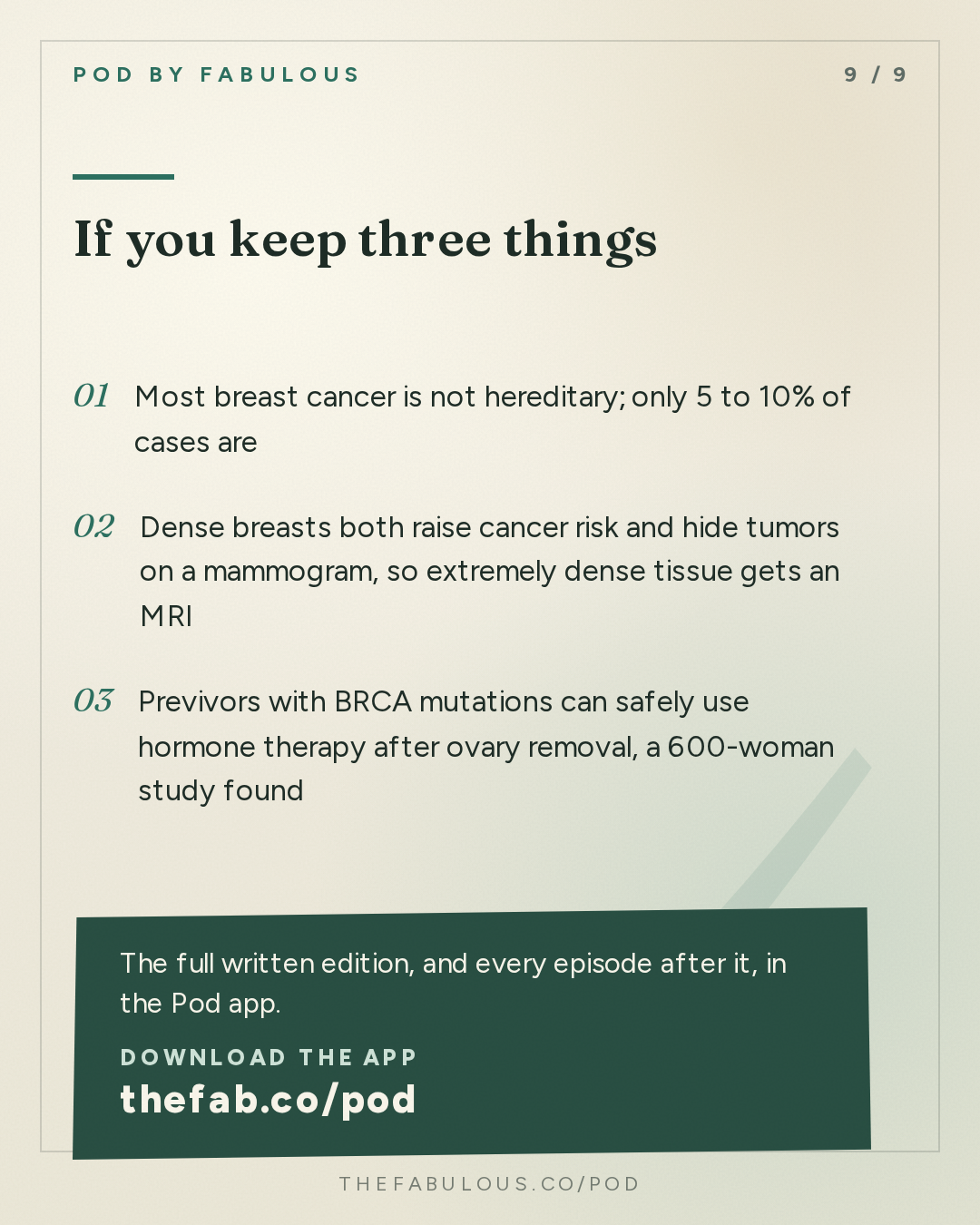
- Most breast cancer is not hereditary; only 5 to 10% of cases are
- Dense breasts both raise cancer risk and hide tumors on a mammogram, so extremely dense tissue gets an MRI
- Previvors with BRCA mutations can safely use hormone therapy after ovary removal, a 600-woman study found
- A negative genetic test does not erase risk if close relatives had breast cancer
- Chemotherapy can drop bone density 4% in six months, so a baseline bone scan is recommended before treatment
The episode in cards

By the numbers
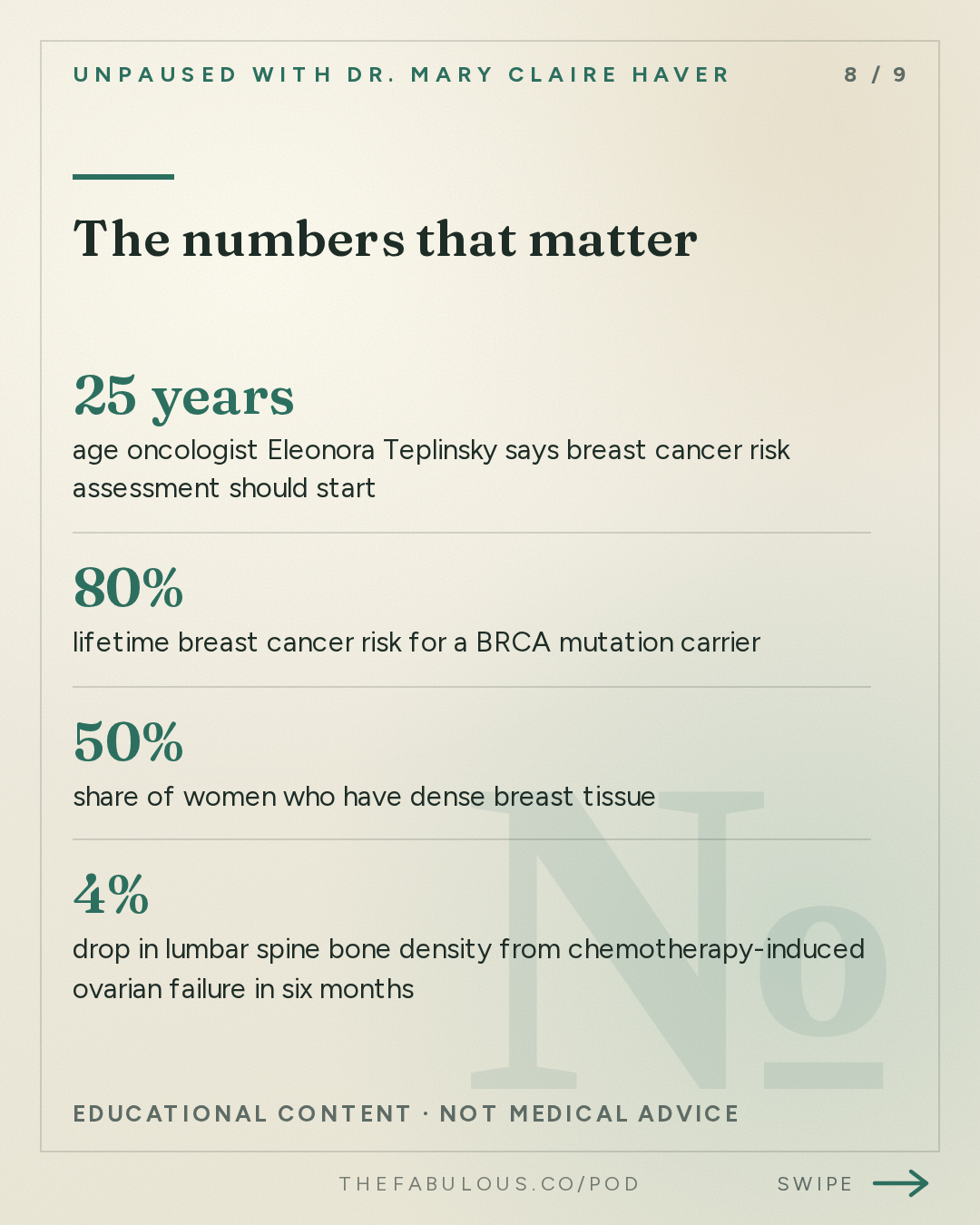
- 25 years age oncologist Eleonora Teplinsky says breast cancer risk assessment should start
- 80% percent lifetime breast cancer risk for a BRCA mutation carrier
- 50% percent share of women who have dense breast tissue
- 4% percent drop in lumbar spine bone density from chemotherapy-induced ovarian failure in six months
- 7.5% percent rise in major coronary events after breast cancer radiation
In their words
“Grandma at 85 with breast cancer is very different than five women in your family under 50 get diagnosed with breast cancer.”
“Most breast cancers are not hereditary.”
“Previvors can absolutely use hormone replacement therapy”
“The radiation from a mammogram is the equivalent to about six or seven weeks of the background radiation you get exposed to just from walking around the street”
“It does not mean that your risk is back to that of the average woman”
Protocols
-
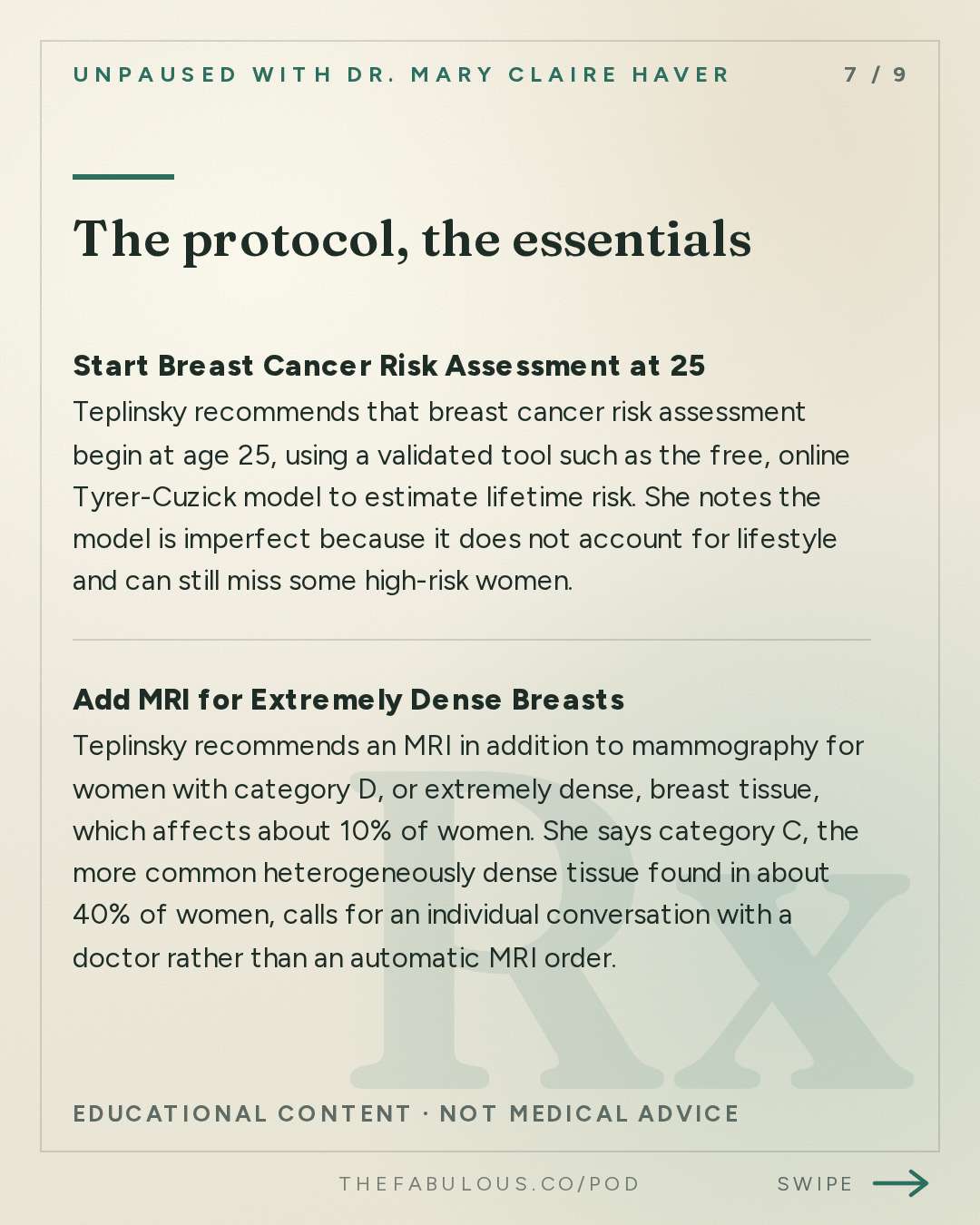
Start Breast Cancer Risk Assessment at 25
Teplinsky recommends that breast cancer risk assessment begin at age 25, using a validated tool such as the free, online Tyrer-Cuzick model to estimate lifetime risk. She notes the model is imperfect because it does not account for lifestyle and can still miss some high-risk women.
Starting at age 25, reassessed as family history or breast density findings change
-
Add MRI for Extremely Dense Breasts
Teplinsky recommends an MRI in addition to mammography for women with category D, or extremely dense, breast tissue, which affects about 10% of women. She says category C, the more common heterogeneously dense tissue found in about 40% of women, calls for an individual conversation with a doctor rather than an automatic MRI order.
Alongside annual mammography for category D breasts
-
Baseline Bone Density Scan Before Cancer Treatment
Teplinsky recommends a baseline bone density scan for anyone starting chemotherapy or endocrine therapy such as tamoxifen, aromatase inhibitors, or Lupron. She says this $99 baseline lets a care team track the bone loss that chemotherapy-induced ovarian failure can cause and plan calcium, vitamin D, exercise, or bone medication afterward.
Once before treatment starts, with follow-up scans as needed
-
Breath-Hold to Protect the Heart During Radiation
Teplinsky explains that radiation oncologists use a technique called the deep inspiratory breath hold during left-sided breast radiation, asking the patient to hold a deep breath so the heart shifts away from the radiation field. She describes this as one of several steps clinicians take to lower the cardiovascular risk that radiation carries.
During each radiation session
-
Hormone Therapy for Previvors After Ovary Removal
Teplinsky states that previvors, women who carry a high-risk mutation like BRCA but have never had cancer, can use hormone replacement therapy after their ovaries are surgically removed. She cites a study of more than 600 women led by researcher JoAnn Katsopoulos in which estrogen-alone therapy did not raise breast cancer risk and estrogen combined with a progestogen also did not raise it.
Ongoing after surgical menopause, reassessed with a care team
Questions this episode answers
Does a family history of breast cancer rule out hormone therapy?
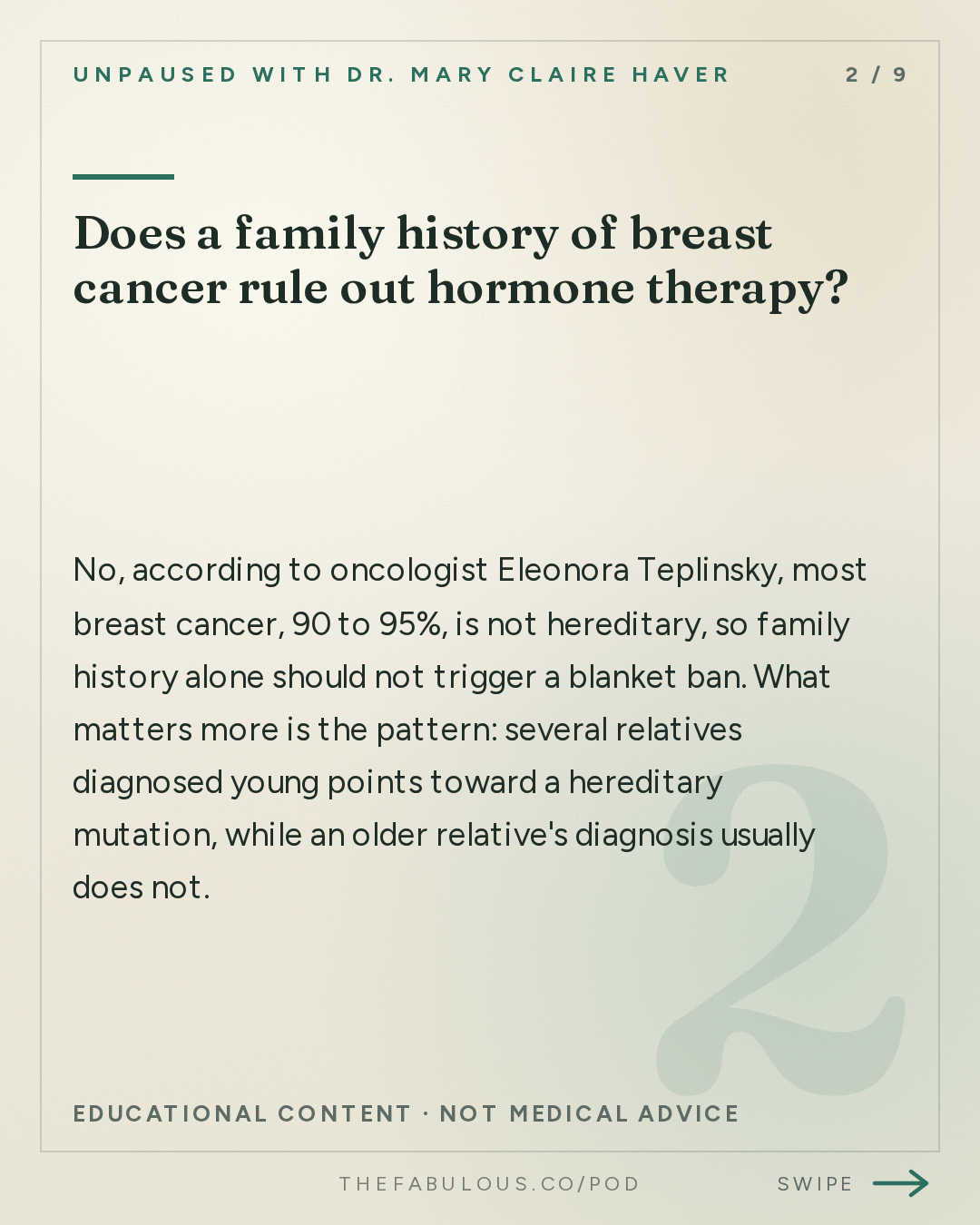
No, according to oncologist Eleonora Teplinsky, most breast cancer, 90 to 95%, is not hereditary (01:58), so family history alone should not trigger a blanket ban. What matters more is the pattern: several relatives diagnosed young points toward a hereditary mutation, while an older relative's diagnosis usually does not (01:10).
What age should breast cancer risk assessment start?
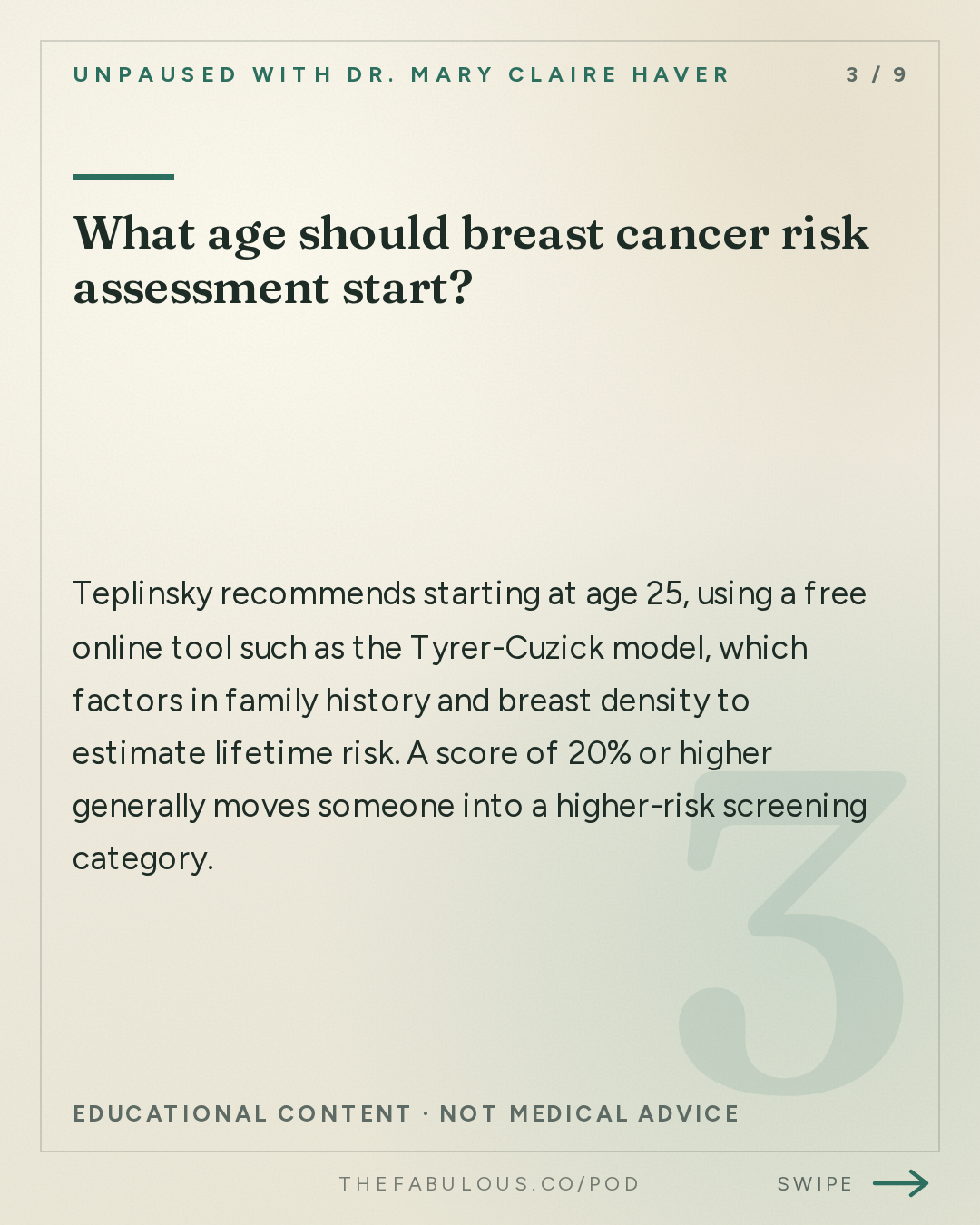
Teplinsky recommends starting at age 25 (02:45), using a free online tool such as the Tyrer-Cuzick model, which factors in family history and breast density to estimate lifetime risk. A score of 20% or higher generally moves someone into a higher-risk screening category (03:45).
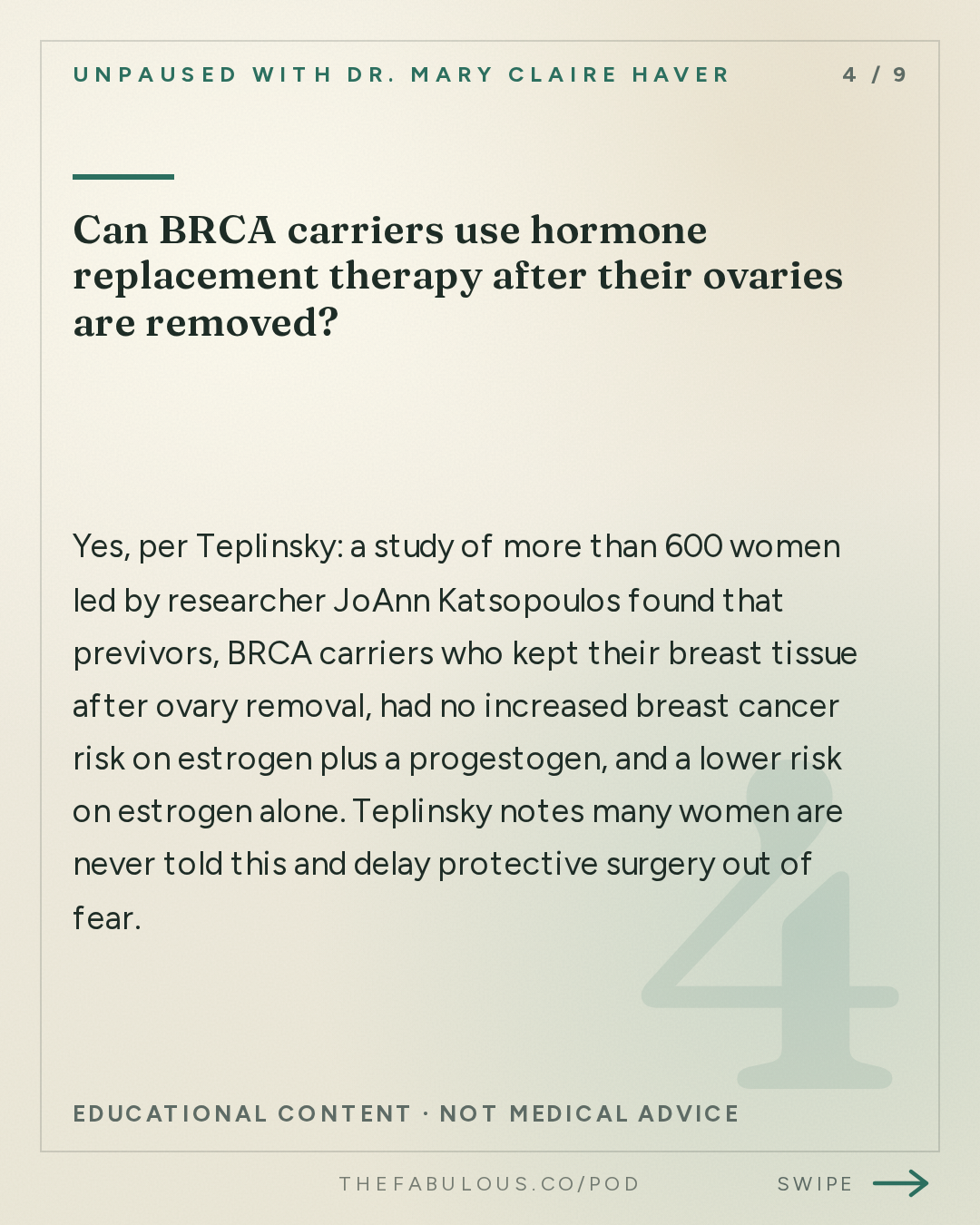
Can BRCA carriers use hormone replacement therapy after their ovaries are removed?
Yes, per Teplinsky: a study of more than 600 women led by researcher JoAnn Katsopoulos found that previvors, BRCA carriers who kept their breast tissue after ovary removal, had no increased breast cancer risk on estrogen plus a progestogen, and a lower risk on estrogen alone (16:08). Teplinsky notes many women are never told this and delay protective surgery out of fear (15:04).
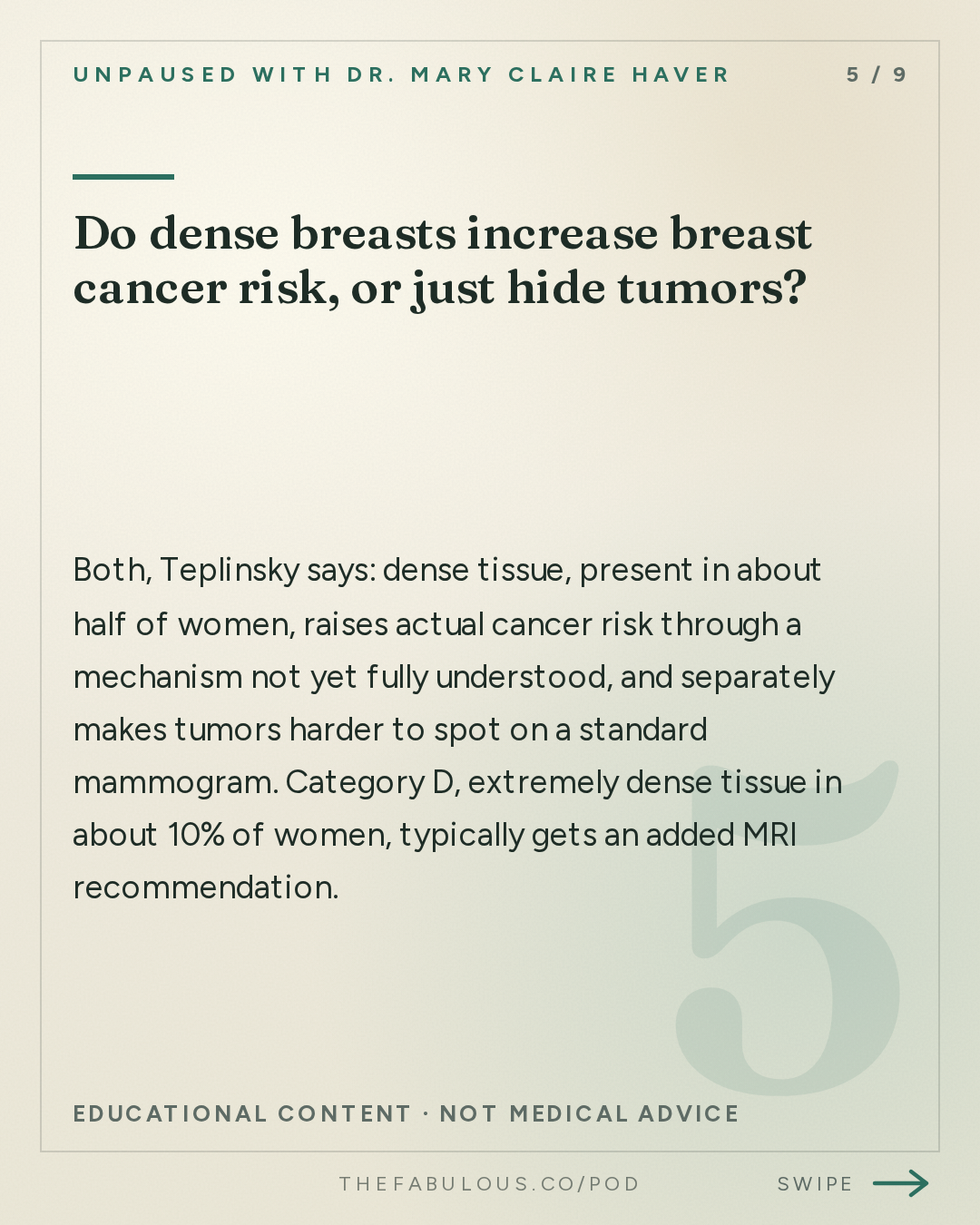
Do dense breasts increase breast cancer risk, or just hide tumors?
Both, Teplinsky says: dense tissue, present in about half of women, raises actual cancer risk through a mechanism not yet fully understood, and separately makes tumors harder to spot on a standard mammogram (12:15, 12:28). Category D, extremely dense tissue in about 10% of women, typically gets an added MRI recommendation (13:18).
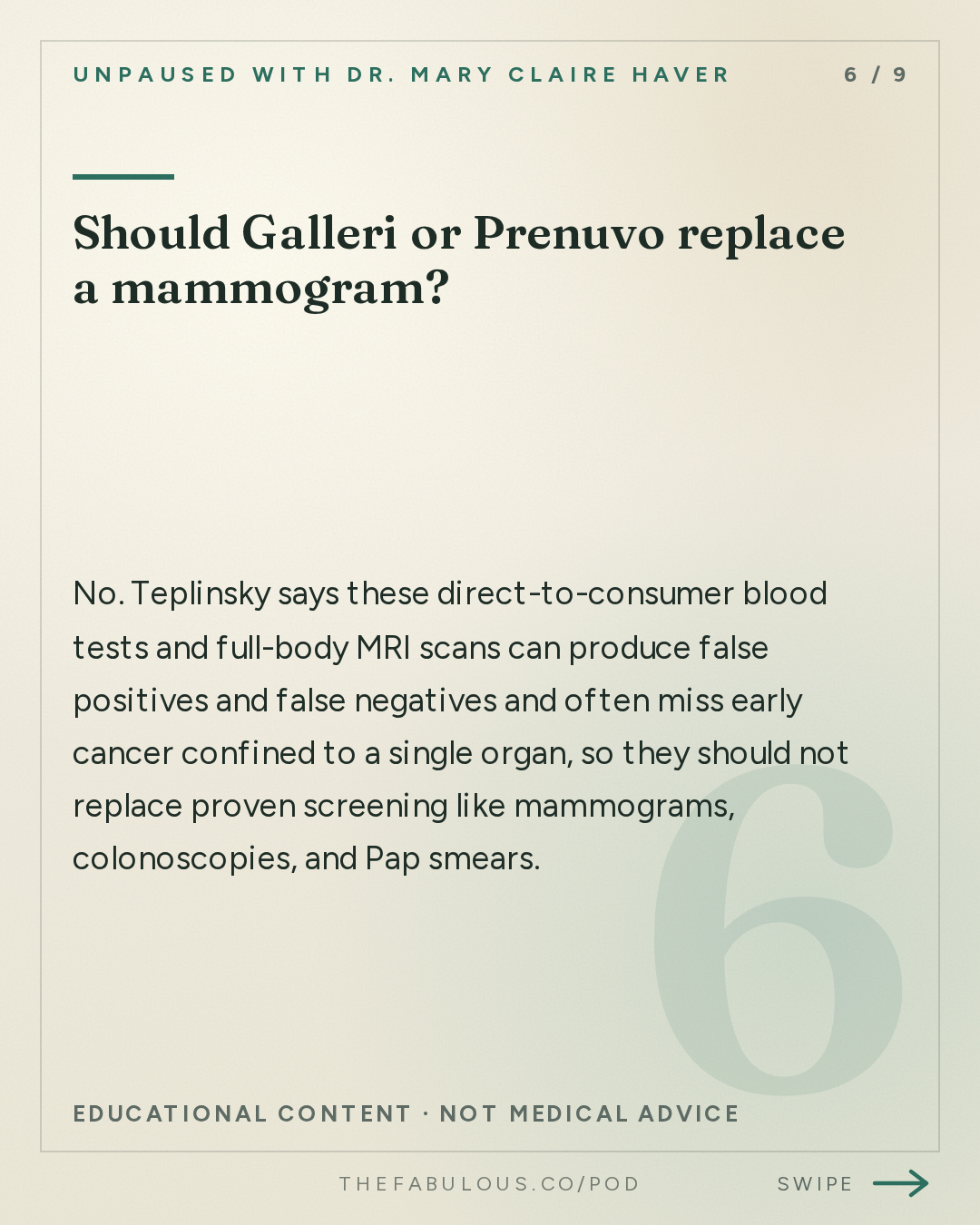
Should Galleri or Prenuvo replace a mammogram?
No. Teplinsky says these direct-to-consumer blood tests and full-body MRI scans can produce false positives and false negatives and often miss early cancer confined to a single organ, so they should not replace proven screening like mammograms, colonoscopies, and Pap smears (09:30, 09:40).
Does a negative genetic test mean average breast cancer risk?
Not necessarily. Teplinsky explains that if a mother or sister had breast cancer but was never genetically tested, a patient's own negative test does not return her risk to that of an average woman, because family history itself still raises risk even without a known mutation (21:35).
The full read, in cards
Go deeper
- Katsopoulos et al. study on hormone therapy in previvors — found estrogen-alone therapy did not raise, and may lower, breast cancer risk in over 600 BRCA mutation carriers who kept their breast tissue after ovary removal
- Darby et al., New England Journal of Medicine, 2013 — found major coronary events rose about 7.5% after radiation therapy for breast cancer
- Shapiro, 2001 — found chemotherapy-induced ovarian failure drops lumbar spine bone density 4% within six months
- Beyond the Pink: Navigating Life, Health, and Breast Cancer — Eleonora Teplinsky's book compiling evidence-based guidance on breast cancer, hormones, and family history
Mentioned
Eleonora Teplinsky · Mary Claire Haver · Tyrer-Cuzick model · Gail model · BRCA · Clariti · Beyond the Pink · Galleri · Prenuvo · JoAnn Katsopoulos
More from this show and category
GSM Treatment: Vaginal Estrogen Explained
Genitourinary syndrome of menopause (GSM) affects 50 to 80% of postmenopausal women but only 7% of those diagnosed are prescribed its safest fix, vaginal estrogen (37:09, 11:00). The FDA dropped a 27-year boxed warning on low-dose vaginal estrogen in November 2025, and OB-GYN Dr. Mary Claire Haver says the condition is cheap and almost always treatable.
GSM: Menopause's Most Undertreated Condition
Genitourinary syndrome of menopause (GSM) is a cluster of vaginal, vulvar, and urinary changes caused by falling estrogen and testosterone, affecting 50% to 80% of postmenopausal women (11:00). Low-dose vaginal estrogen is the frontline treatment, cuts recurrent UTIs in half, and lost its FDA black box warning on November 10, 2025, after 27 years (14:54, 38:36).
Can Breast Cancer Previvors Safely Use HRT?
Most breast cancers are not inherited, but oncologist Dr. Eleonora Teplinsky says risk assessment should start at 25, since 5 to 10% of cases trace to a gene mutation and a 20% lifetime score marks someone as high risk (02:03, 03:31). She also confirms previvors with BRCA mutations can safely use hormone therapy after ovary removal (15:04).
Pelvic Floor Health and Menopause: Daily Habits
Pelvic floor therapist Sarah Reardon says menopause pelvic problems need two fixes: estrogen for tissue, muscle training for strength. She covers power peeing, Squatty Potties, pessaries, GSM, vaginismus, and why the $5 billion vaginal rejuvenation industry skips the muscle work that actually prevents prolapse and leakage.
