
unPAUSED with Dr. Mary Claire Haver
GSM: Menopause's Most Undertreated Condition
Menopause Masterclass: Recurrent UTIs and the Genitourinary Syndrome of Menopause (GSM)
▶ Listen to the full episode More from unPAUSED with Dr. Mary Claire Haver
The brief
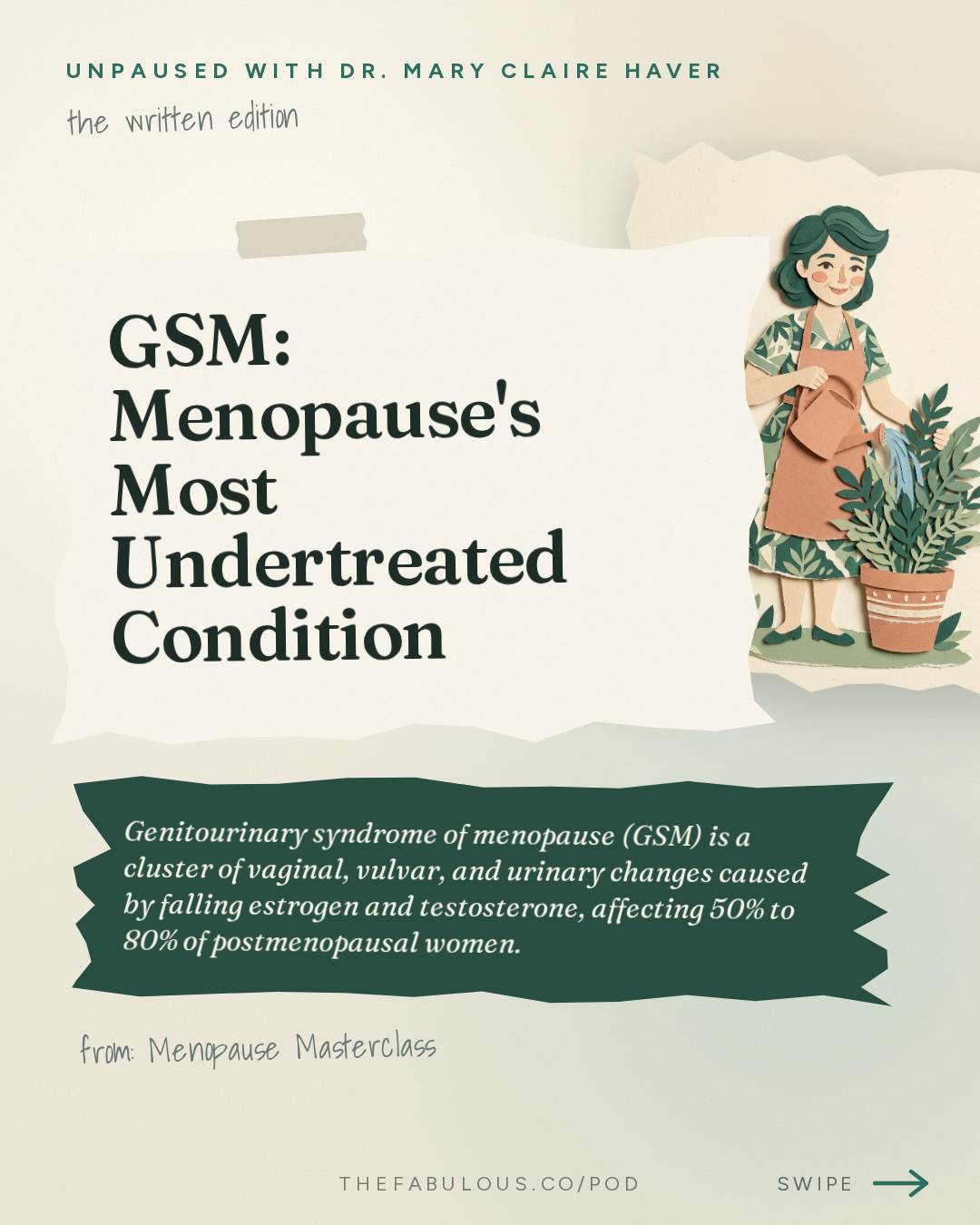
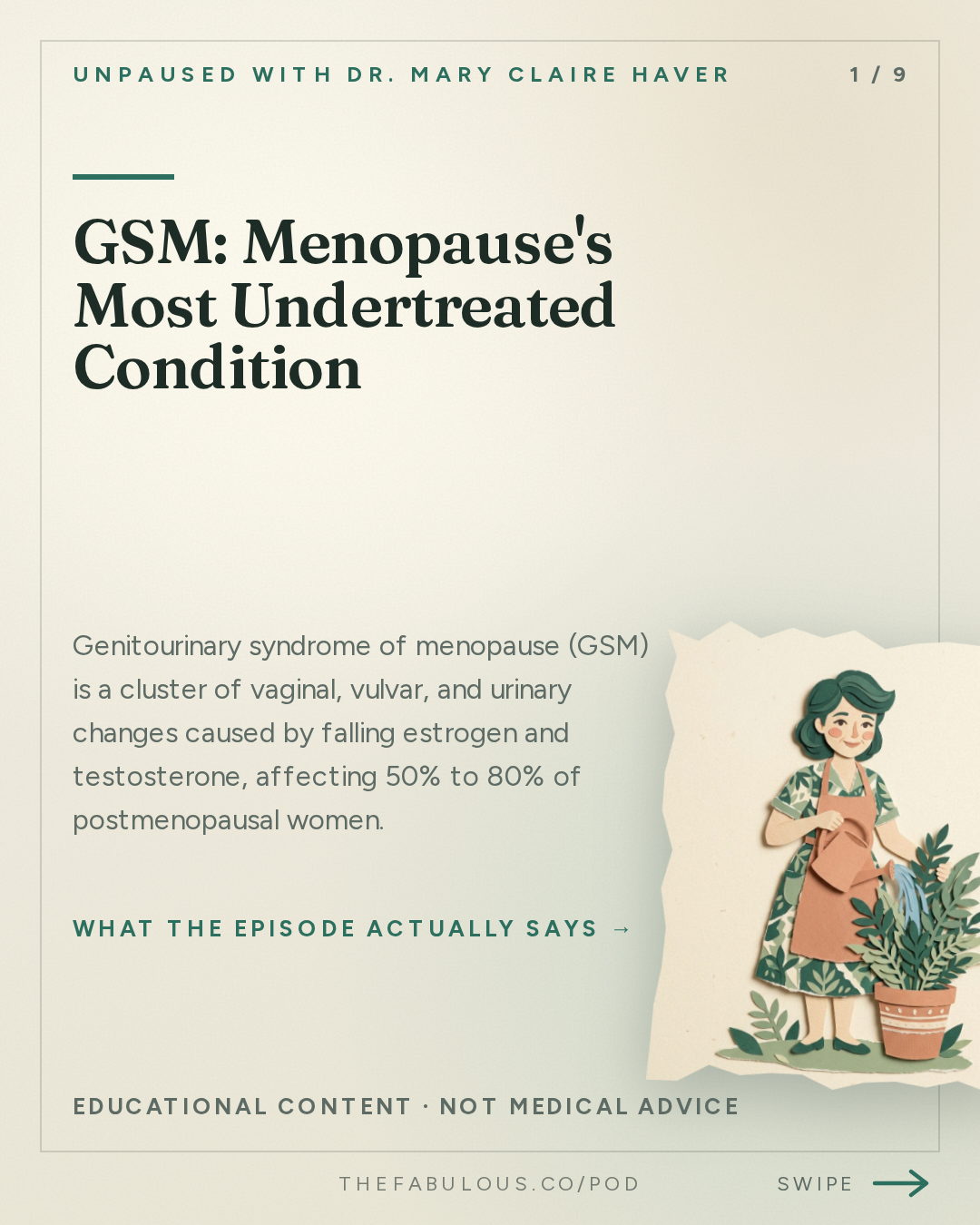
Genitourinary syndrome of menopause (GSM) is a cluster of vaginal, vulvar, and urinary changes caused by falling estrogen and testosterone, affecting 50% to 80% of postmenopausal women (11:00). Low-dose vaginal estrogen is the frontline treatment, cuts recurrent UTIs in half, and lost its FDA black box warning on November 10, 2025, after 27 years (14:54, 38:36).
In 1998 the FDA fast-tracked approval for a small blue pill that fixes a blood flow problem in the penis. It took twenty-seven more years for regulators to strip a warning label off a cream that does something similar for the vagina, bladder, and vulva, a label that told millions of women the medicine could cause cancer, strokes, and dementia (14:01). That gap, between how fast medicine moves when the patient is a man and how slowly it moves when the patient is a woman, sits at the center of this conversation. The host, Dr. Mary Claire Haver, a board certified obstetrician-gynecologist, certified menopause practitioner, and adjunct professor at the University of Texas Medical Branch, calls the condition genitourinary syndrome of menopause, or GSM. She describes it as the single most undertreated condition of midlife, and also the easiest to fix (00:53).
GSM is not one symptom. It is a set of changes in the vulva, vagina, clitoris, urethra, and bladder that follow the drop in estrogen and testosterone at menopause (03:31). Haver cites research putting the prevalence at 50 to 80 percent of postmenopausal women, though she suspects the true number is closer to everyone who lives long enough (11:00). The symptom list is long and easy to misread as something else entirely: dryness, burning, pain at the entrance of the vagina, a harder or absent orgasm, urinary urgency, waking at night to urinate, and recurrent urinary tract infections that in frail older women can progress to delirium, falls, hip fracture, and sepsis (07:30, 22:32). Haver missed the diagnosis in herself. She spent months blaming stress and aging for a delayed orgasm until a colleague, physician Dr. Rachel Rubin, asked over text how much vaginal estrogen she was using. The answer was none (05:03).
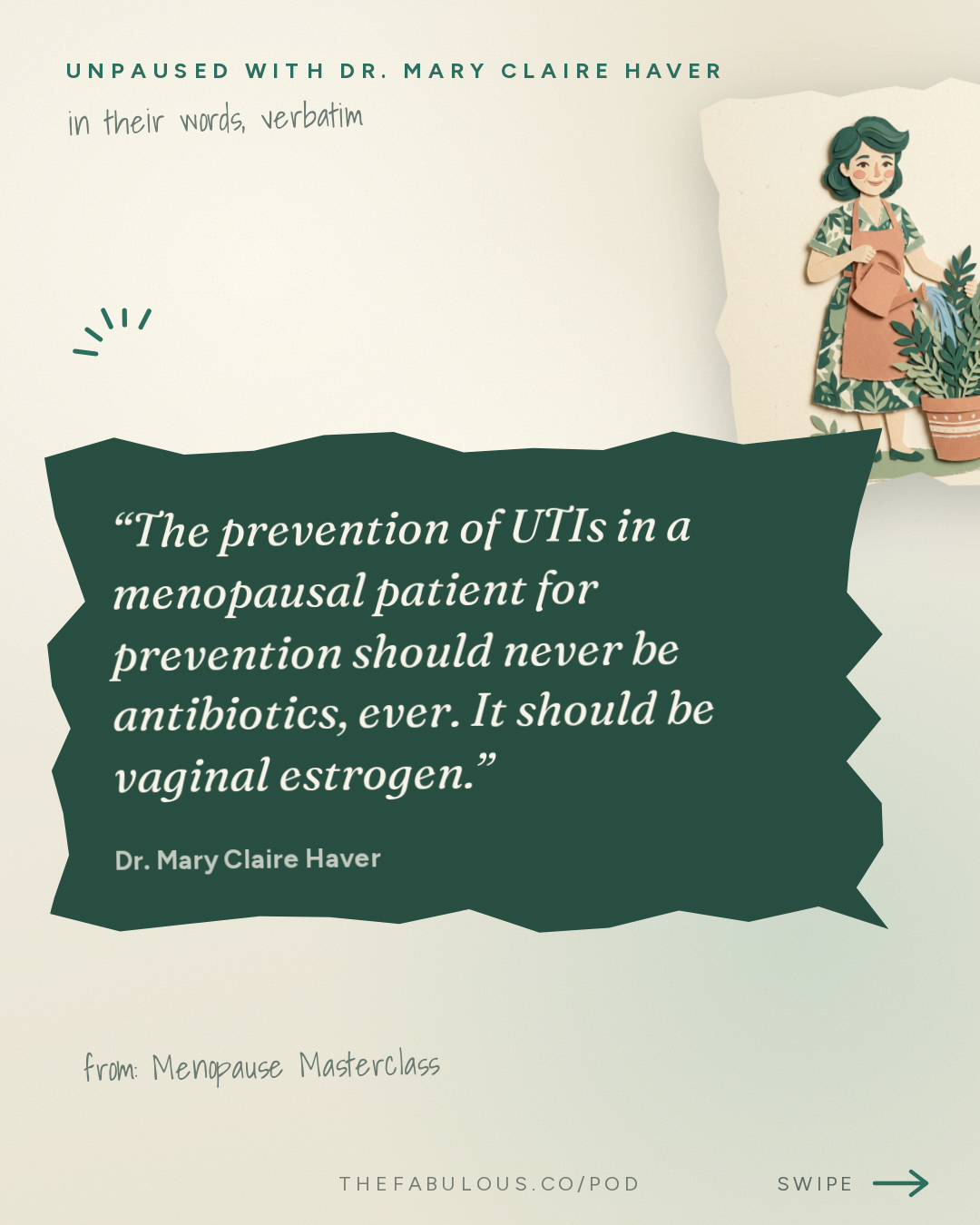
"The prevention of UTIs in a menopausal patient for prevention should never be antibiotics, ever. It should be vaginal estrogen." — Dr. Mary Claire Haver [09:12]
A Label That Outlived Its Evidence
The name itself has a history worth sitting with. Before Haver's time, doctors called this condition "the senile vagina." Later it became "atrophic vaginitis," a term that still sounds like a diagnosis of decay. In 2014 a group of specialists renamed it genitourinary syndrome of menopause, adding the word "urinary" to a condition that had always involved the bladder, not just the vagina (02:33). The new name matters because it points to a new idea: this is a syndrome of low hormones affecting a whole connected system, not a cosmetic complaint about dryness.
The bigger obstacle has been regulatory. In 2002, headlines from the Women's Health Initiative study linked hormone therapy to breast cancer, a link Haver says was overstated and widely misunderstood. Before those headlines, roughly 30 to 40 percent of menopausal women used some form of systemic hormone therapy. Afterward, use collapsed, and by 2023 only about 4 percent of eligible women were getting a prescription (11:35, 12:05). In response, the FDA placed a sweeping black box warning, the strongest label the agency issues, on every estrogen product: pills, patches, and also the trace-dose vaginal creams meant to treat local tissue, with no distinction between the two (12:05). Viagra, by contrast, had already been approved in 1998 under fast-track status. Vaginal estrogen carried its scare label for more than 27 years before an FDA expert panel called for its removal in July 2025. The agency finally dropped the warning from low-dose vaginal products on November 10, 2025 (14:54). "The data didn't change," Haver says. "The data had been there for decades" (15:20). What changed was tens of thousands of letters, social media pressure, and a panel willing to look at the evidence again.
"Two dirty words: vagina and estrogen." — Dr. Mary Claire Haver [39:10]
The label has changed, but prescribing habits have not caught up, partly because systemic hormone therapy and local vaginal estrogen get confused. Haver stresses that systemic therapy, the pill or patch used to treat hot flashes, is a microdose compared with what the ovaries once produced, and it was never designed to fully protect genital and urinary tissue (05:26). Most women on systemic therapy, Haver included, still need a topical vaginal estrogen layered on top. She did not realize this about her own body until the diagnosis landed on her, which is partly why she tells the story: if a menopause specialist can miss it, anyone can.
Treating the Whole Neighborhood
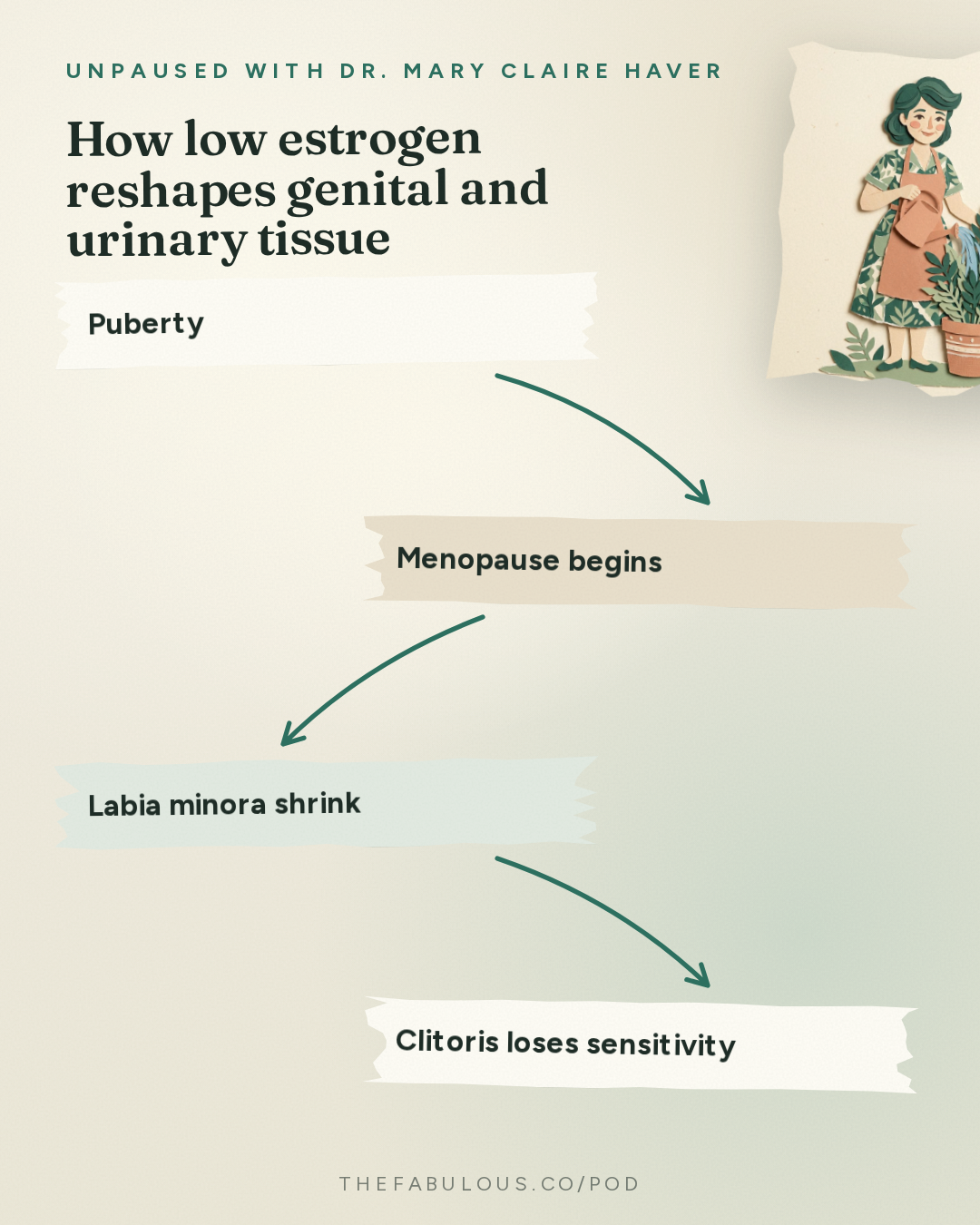
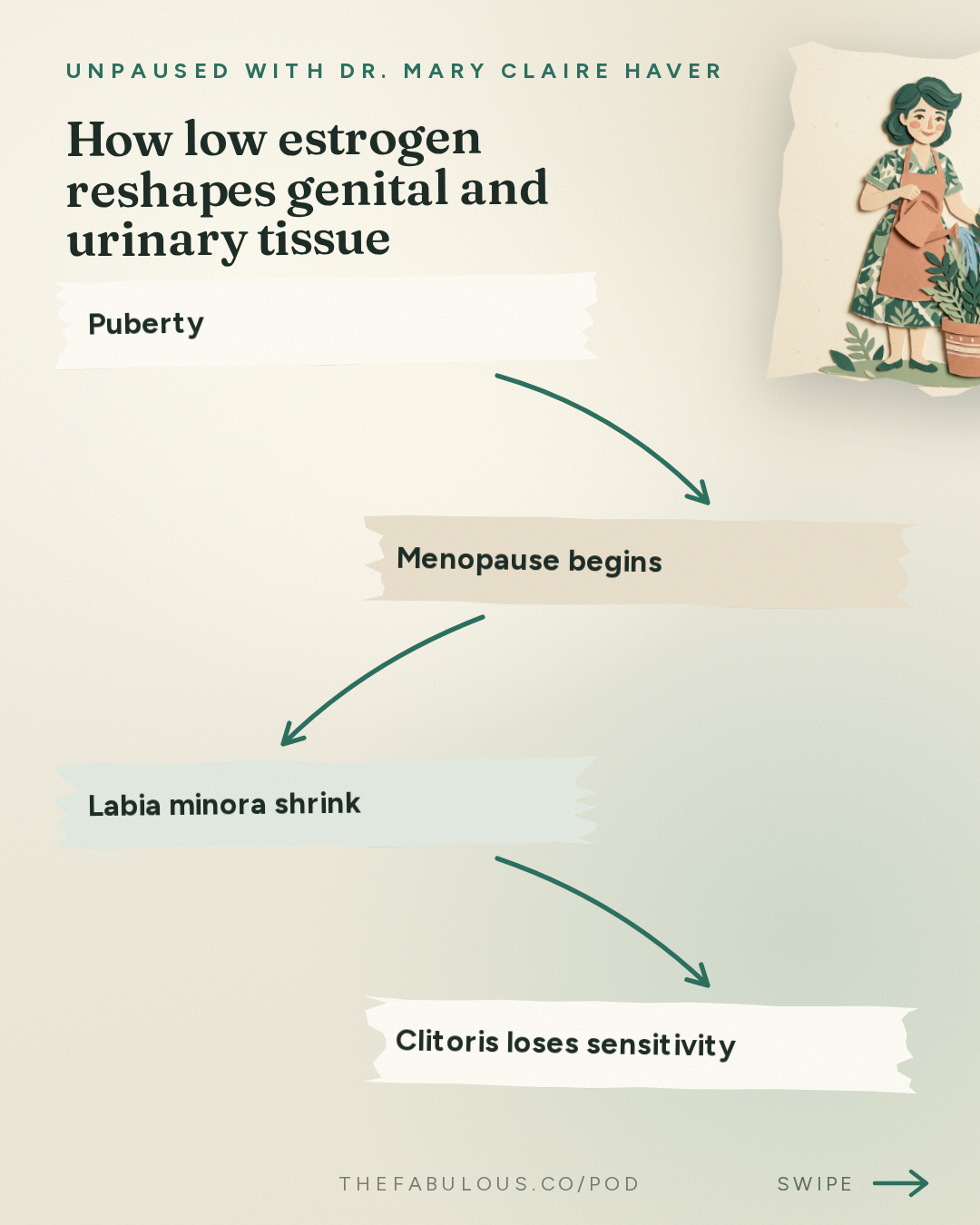
The mechanism is straightforward once it is named. Haver compares hormones to water for a plant: at puberty, estrogen and testosterone flood the genital tissue and it blossoms, the vaginal lining thickens and folds, and a healthy microbiome takes hold. At menopause, the water stops, and the process partly runs backward (16:22). The vaginal lining thins and flattens, natural lubrication drops, and the labia minora can gradually shrink over five to twenty years, a slow process that a viral video by Dr. Rachel Rubin made famous, though Haver is careful to note the tissue does not detach or fall off (18:27). The clitoris, which is driven heavily by testosterone, also shrinks and loses blood flow and nerve responsiveness as testosterone declines, a process that Haver says begins in a woman's 30s, long before menopause itself (18:55). The clinical result is often delayed or absent orgasm, a symptom few women connect to hormones.
One structure gets missed most often: the vulvar vestibule, the ring of tissue surrounding the urethra that urologists call the "ring of fire." It is not vaginal tissue; embryologically it is closer to the inside of the cheek, and it is packed with both estrogen and androgen receptors (20:14). A standard speculum exam bypasses it entirely, so clinicians usually find it with a cotton swab test that maps exactly where pain with penetration originates (21:18). The bladder and urethra share a wall lined with the same hormone receptors, which is why low estrogen also produces urgency, frequency, and a microbiome shift that makes recurrent UTIs more likely in menopause (21:41).
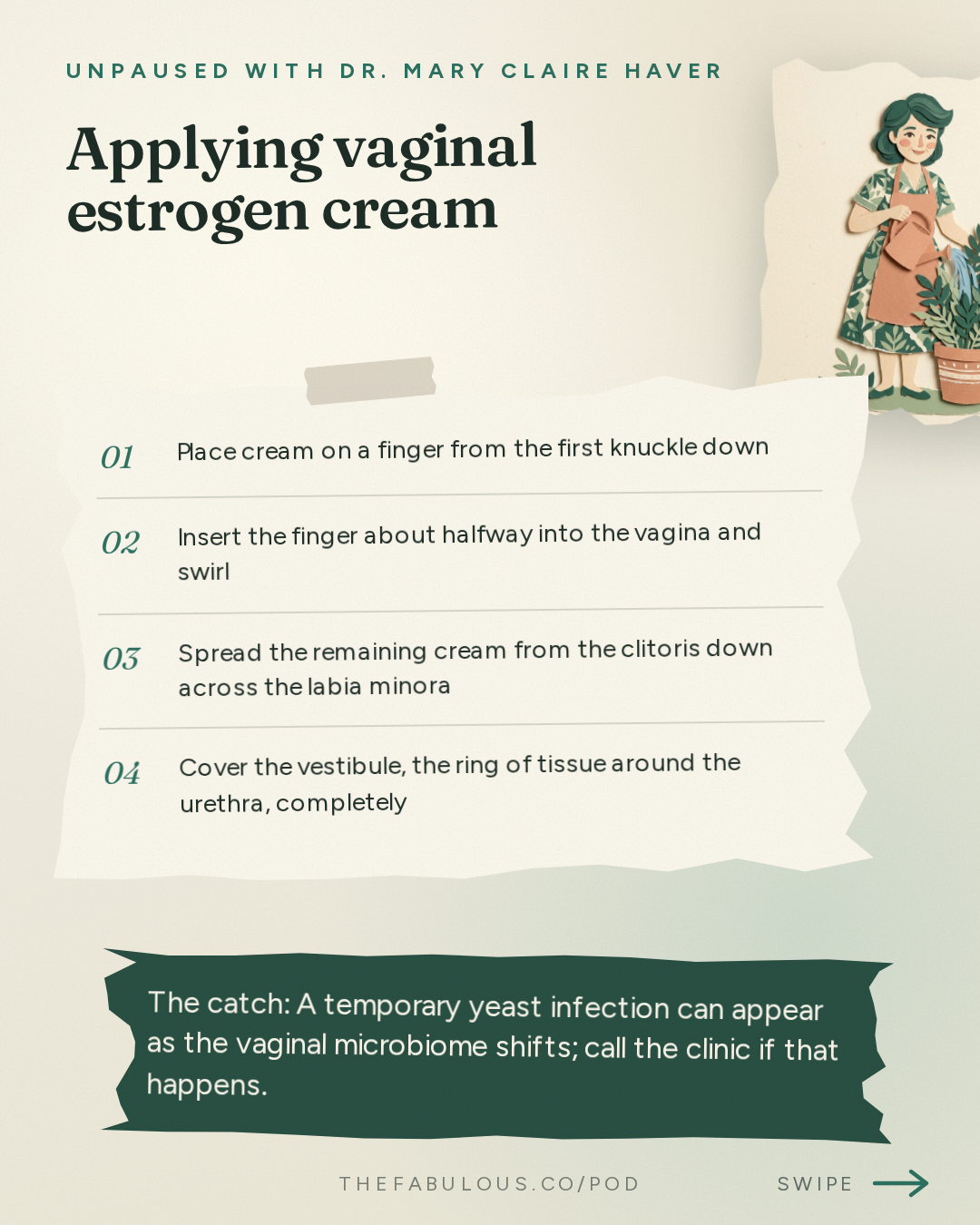
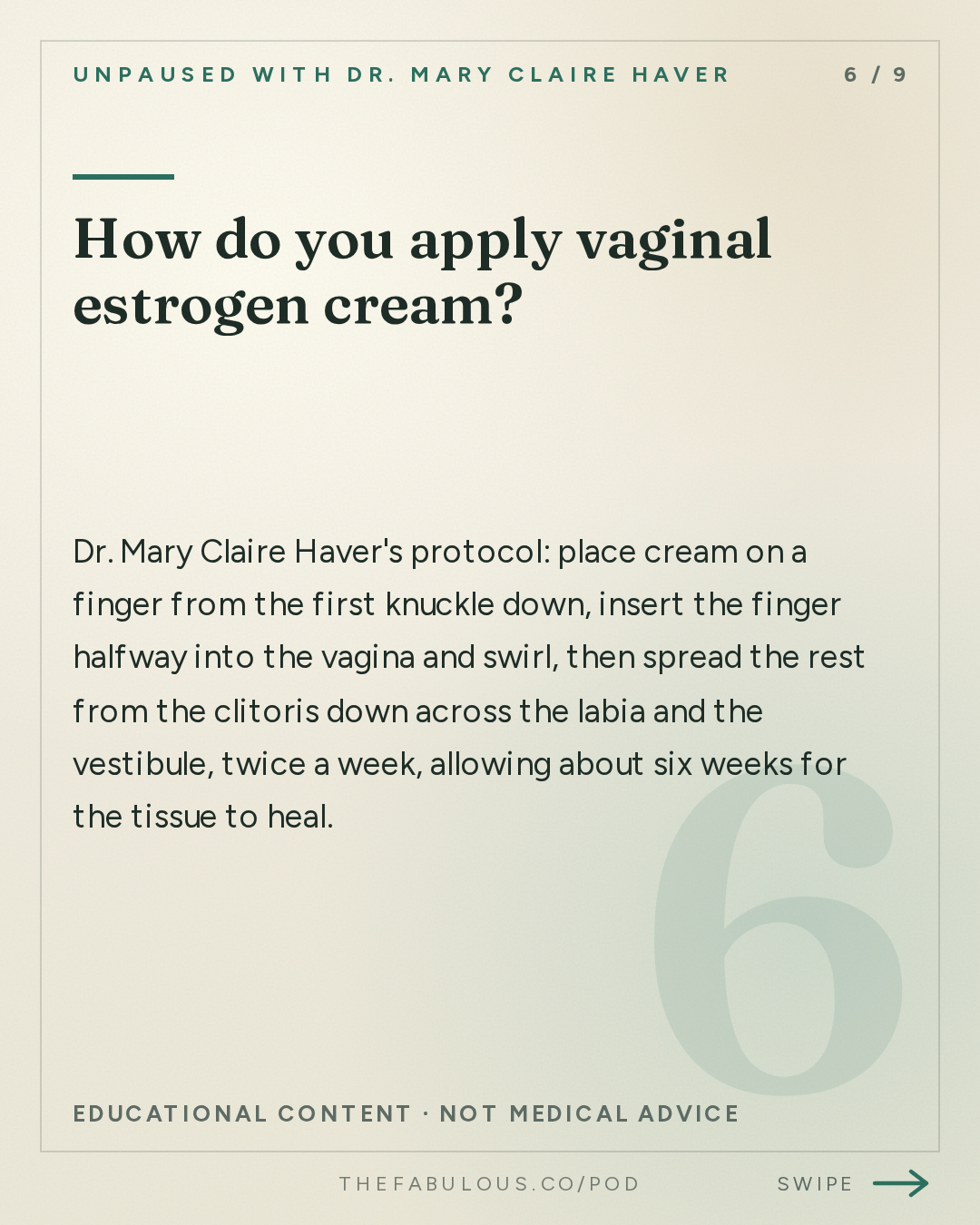
Given all that, Haver argues the old standard of care, handing out lubricants and requiring women to fail them before considering hormones, treats the symptom while the tissue keeps deteriorating. The current frontline treatment, following updated American Urological Association guidance, is vaginal estrogen itself, which she calls safer than aspirin or Tylenol (23:37). It comes as a cream, tablet, insert, or ring; her clinic favors the generic cream because it is cheap, costing $13 to $20 a tube at Cost Plus, and because it can be applied precisely to the areas that actually hurt (26:01). Her instructions are specific: apply cream from the first knuckle down, insert a finger about halfway into the vagina and swirl, then spread the rest from the clitoris down across the labia and the vestibule, twice a week.
"Treat the entire neighborhood, not just one block." — Dr. Mary Claire Haver [28:43]
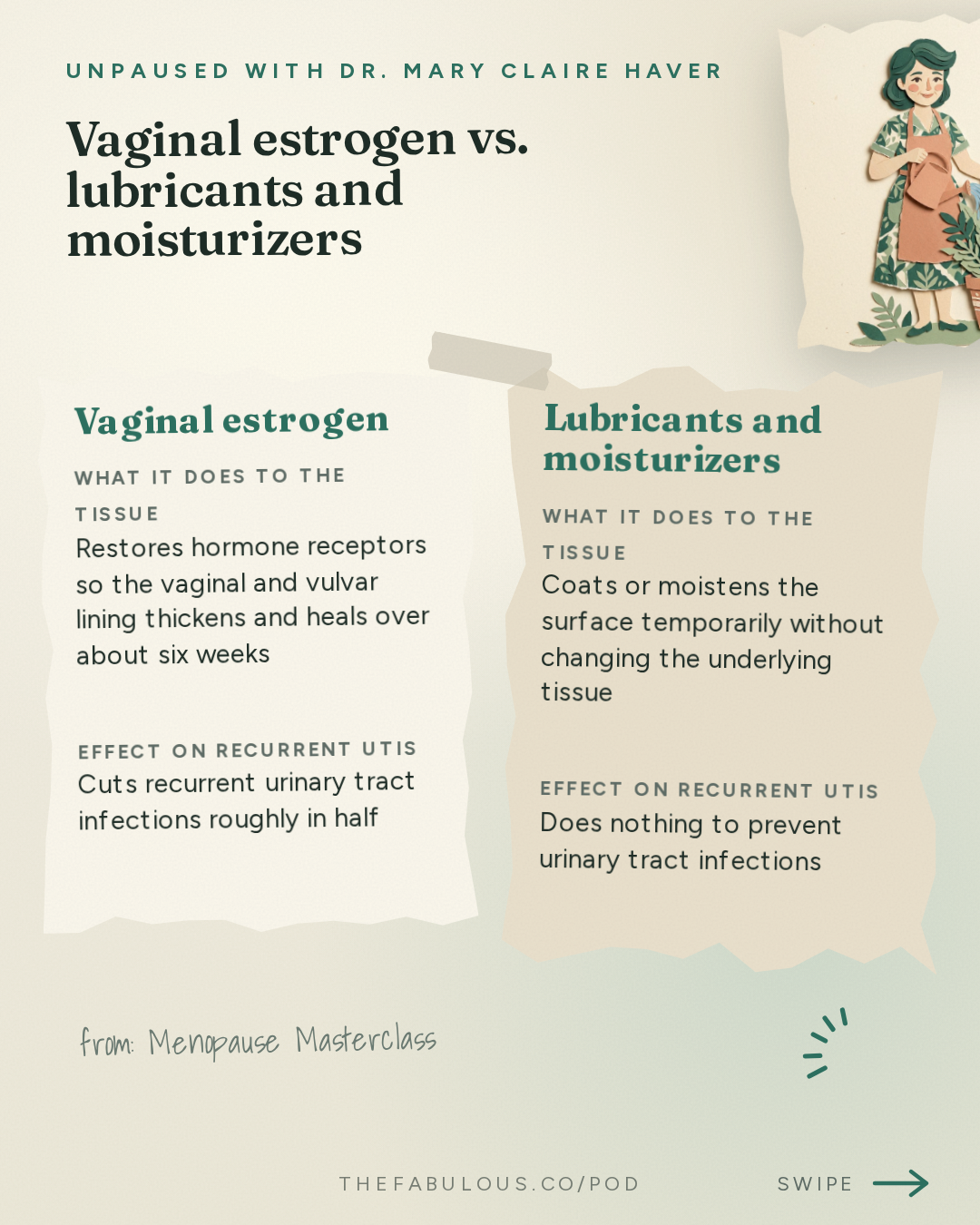
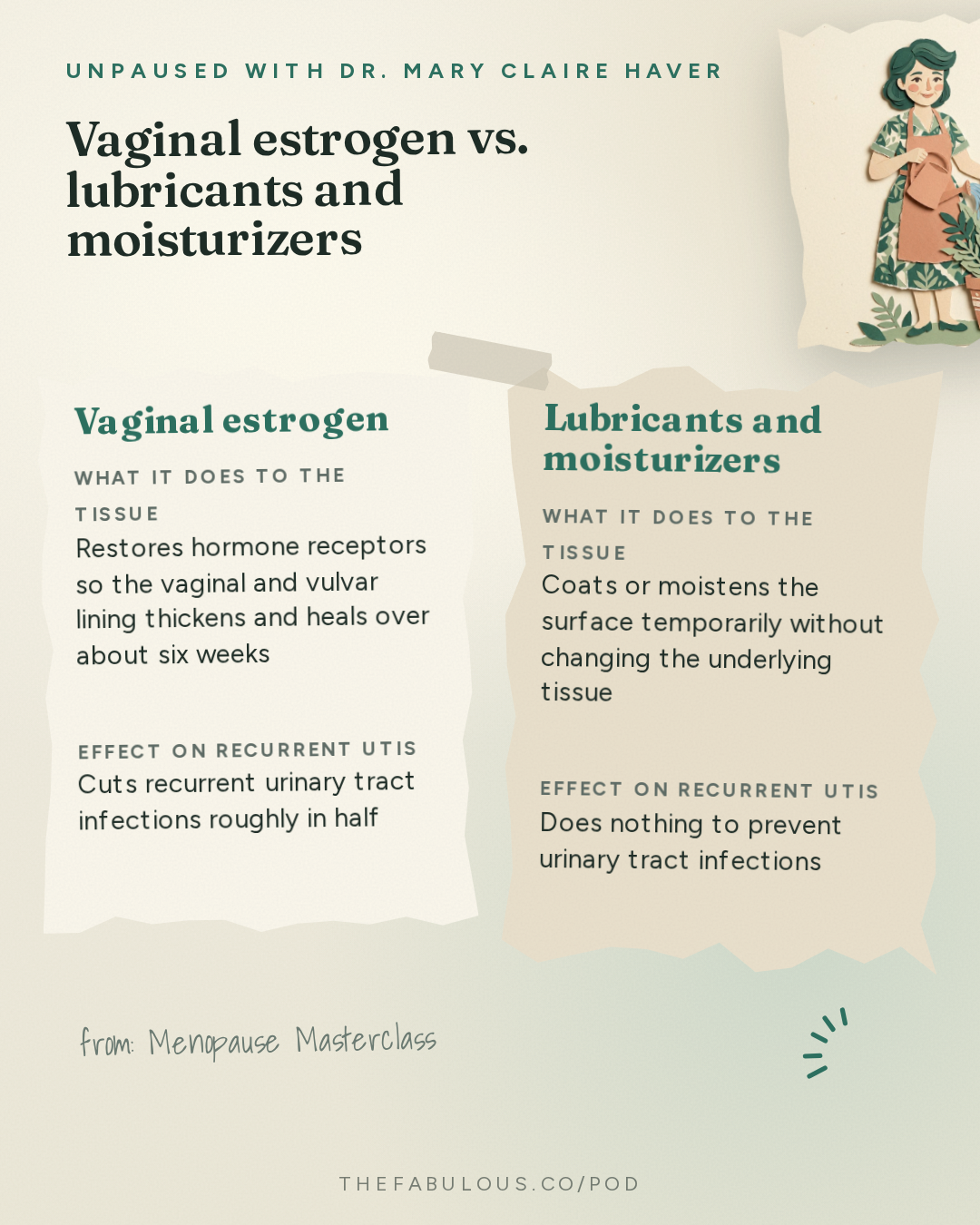
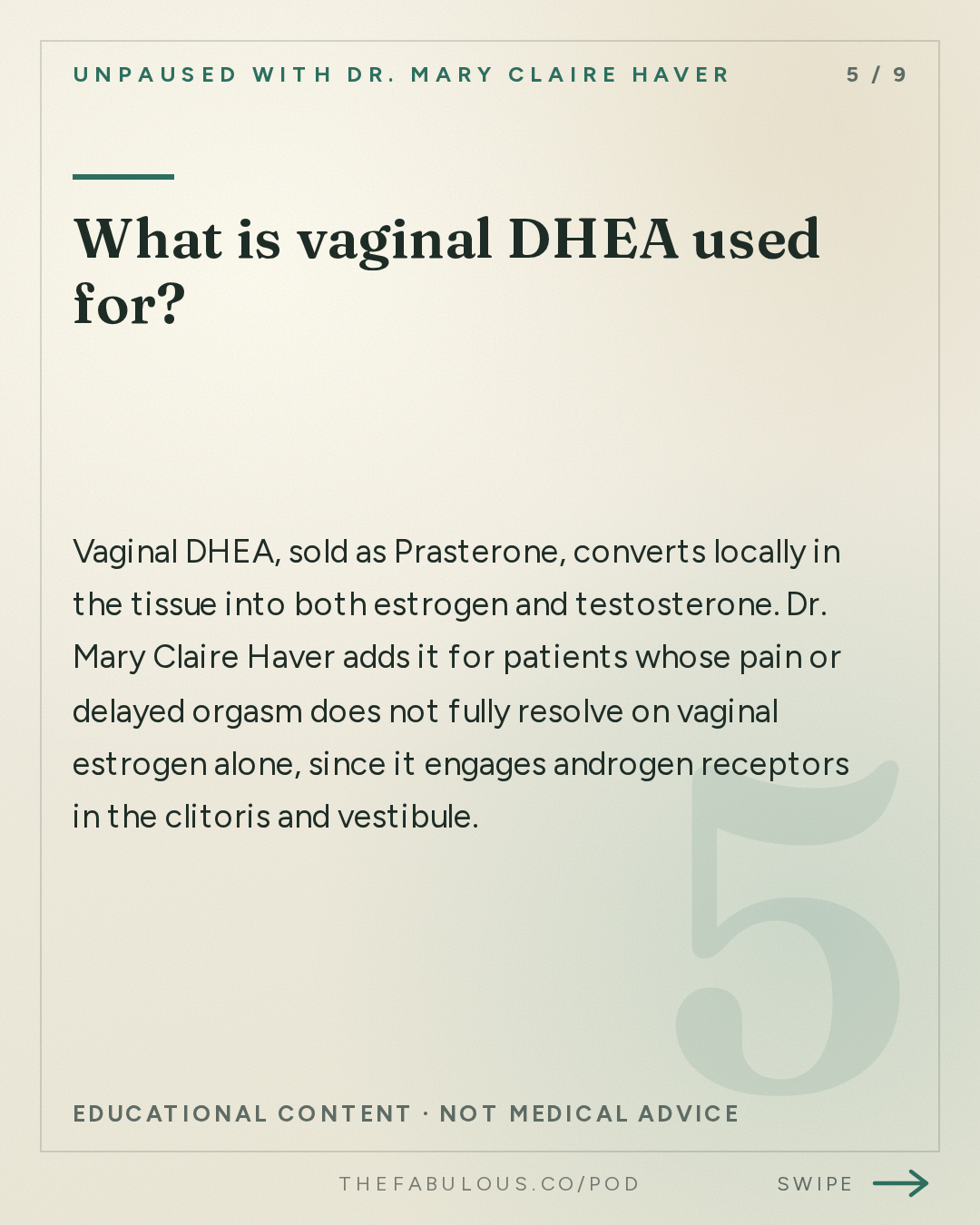
She tells patients to expect about six weeks before the tissue visibly heals, since the vagina needs time to regrow its lining and regain the ability to produce mucus (27:21). For pain or delayed orgasm that persists after estrogen alone, she sometimes adds vaginal DHEA, sold as Prasterone, a precursor hormone that converts locally into both estrogen and testosterone and can engage androgen receptors in the clitoris and vestibule that estrogen alone does not reach (28:43). She draws a sharp line between all of this and over-the-counter products: lubricants reduce friction during sex but do nothing for urinary tract infections, and daily moisturizers, usually built on hyaluronic acid, which can pull about 100 times its own weight in water, ease daily dryness without touching the underlying hormone deficiency (35:07). Neither is a substitute for estrogen; both are useful alongside it.
The financial case for fixing this is large and almost entirely untapped. Among Medicare patients who actually received a GSM diagnosis, only about 7 percent were prescribed vaginal estrogen (37:09), and Haver believes real-world use is lower still, since many women received the prescription and were too frightened by the old warning label to fill it. Research she cites, co-authored by Dr. Rachel Rubin, estimates that broad use of vaginal estrogen could save Medicare 6 to 22 billion dollars a year, mostly by preventing the UTIs, hospitalizations, and hip fractures that follow untreated infections in frail older women (38:10). Vaginal estrogen itself cuts recurrent UTIs roughly in half (38:36). Haver's closing advice is almost defiantly simple: ask for it by name, print the updated guidelines, and do not accept a conversation that starts and ends with a tube of lubricant. Common, she keeps repeating, does not mean normal.
Ask this episode anything
Pod's AI answers from the episode itself, with the minute mark so you can hear it yourself.
Or start with one of these
Ask this episode
Pod's AI listens to the whole episode to answer, and points you to the minute it comes from.
The rest of this answer, and any question after it
Answers come from the episode itself, never from a summary of it.
ContinueKey takeaways
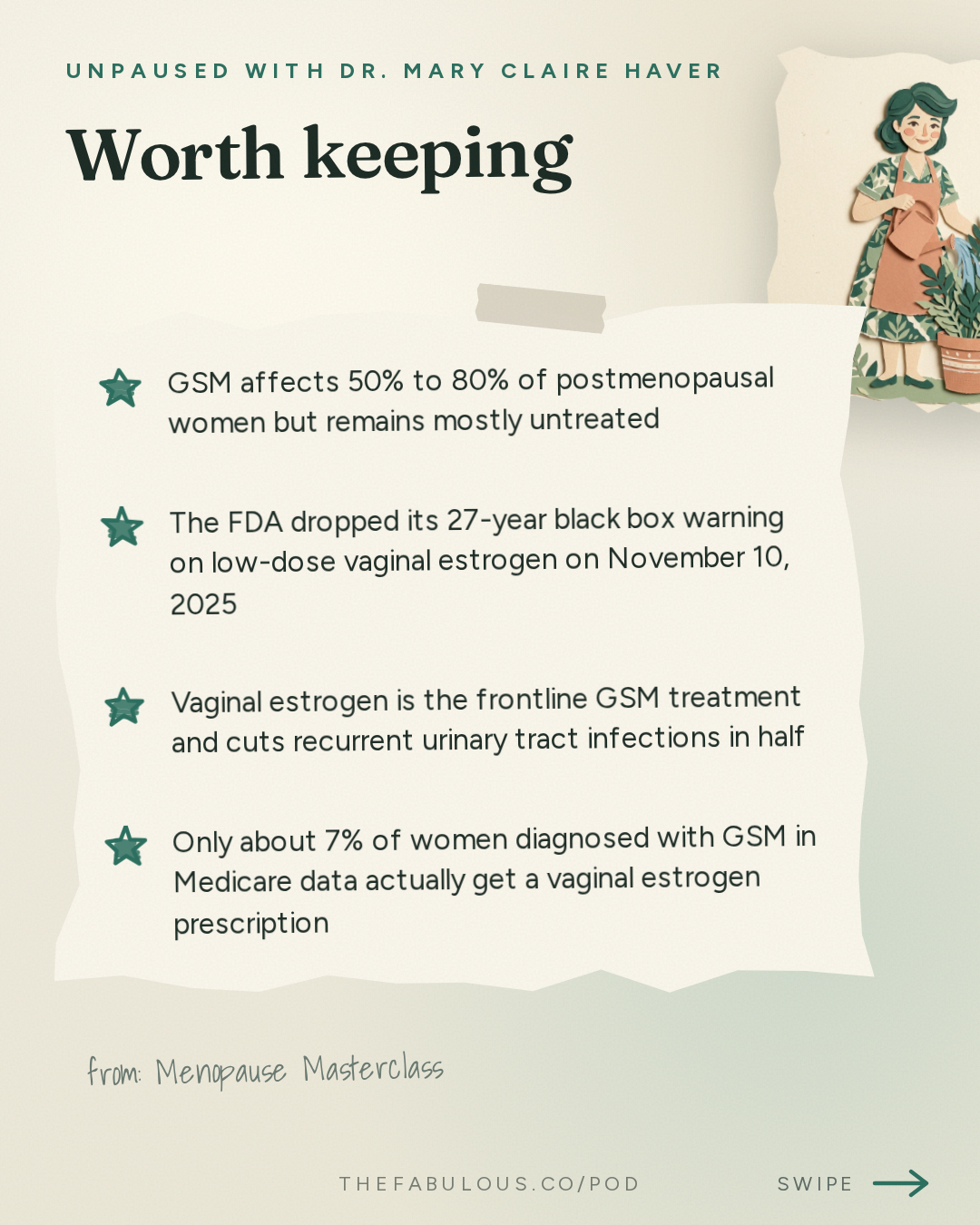
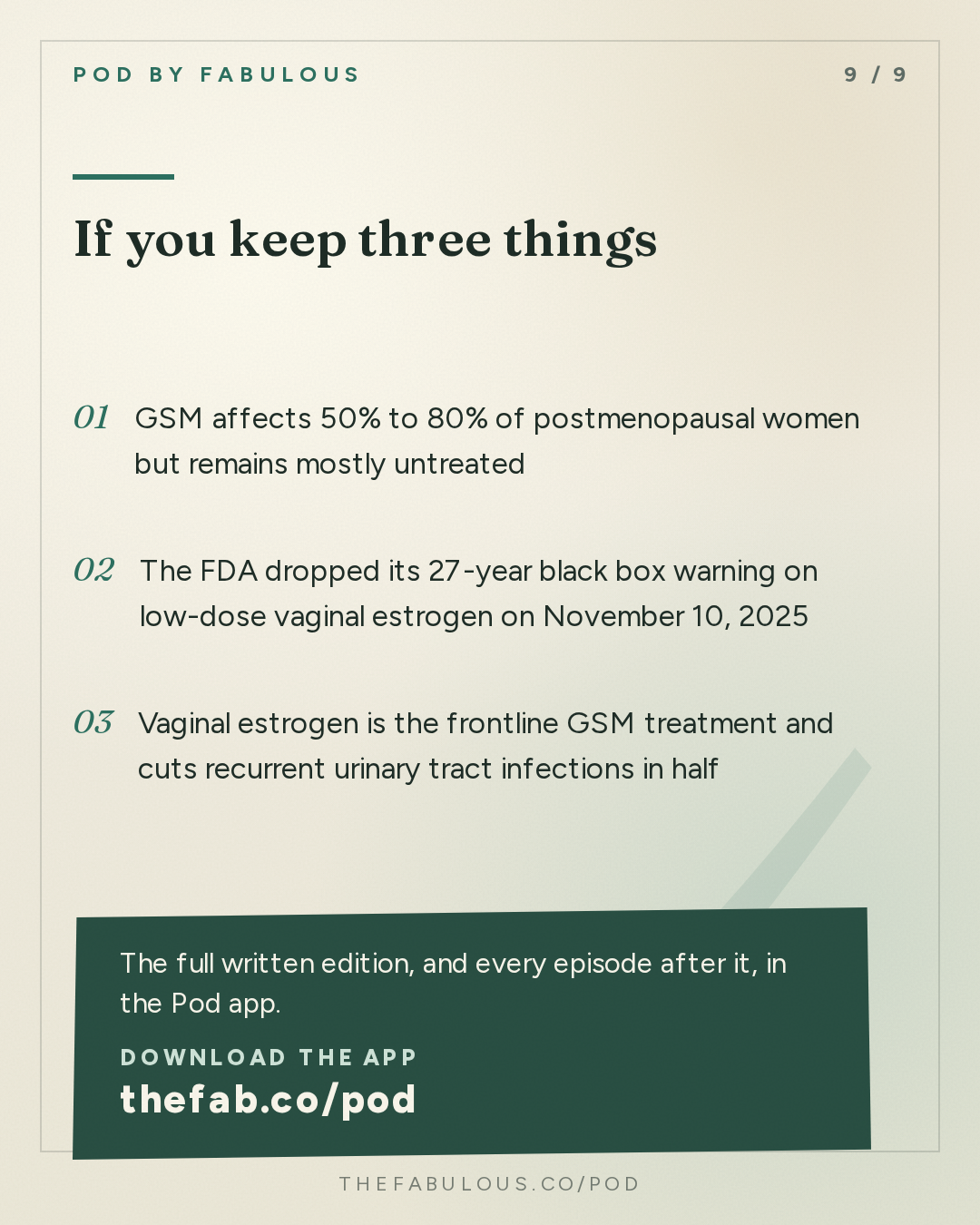
- GSM affects 50% to 80% of postmenopausal women but remains mostly untreated
- The FDA dropped its 27-year black box warning on low-dose vaginal estrogen on November 10, 2025
- Vaginal estrogen is the frontline GSM treatment and cuts recurrent urinary tract infections in half
- Only about 7% of women diagnosed with GSM in Medicare data actually get a vaginal estrogen prescription
- Generic vaginal estrogen cream costs $13 to $20 a tube and needs about six weeks to heal tissue
The episode in cards

By the numbers
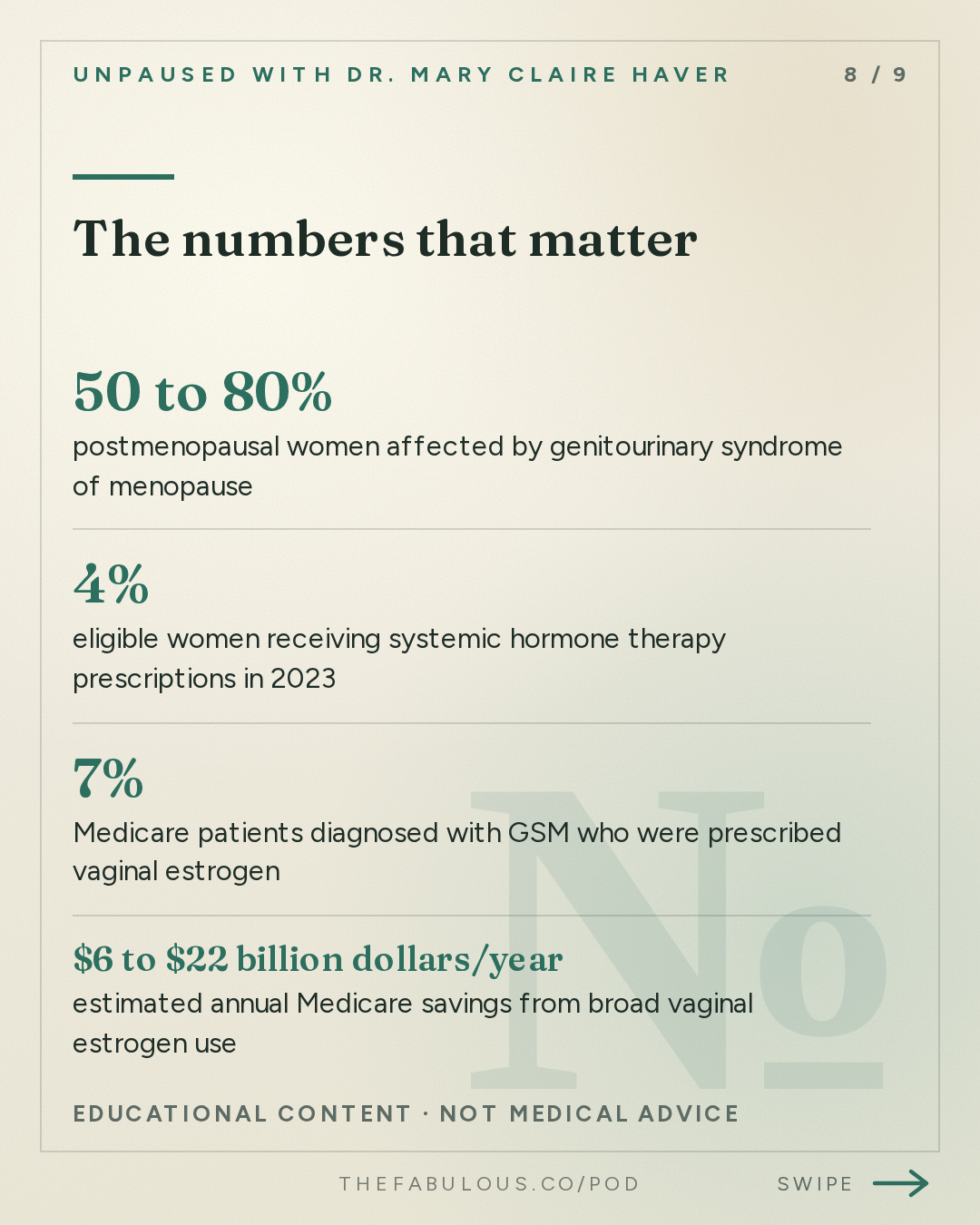
- 50 to 80% percent postmenopausal women affected by genitourinary syndrome of menopause
- 4% percent eligible women receiving systemic hormone therapy prescriptions in 2023
- 7% percent Medicare patients diagnosed with GSM who were prescribed vaginal estrogen
- $6 to $22 billion dollars/year estimated annual Medicare savings from broad vaginal estrogen use
- 50% percent reduction in recurrent urinary tract infections from vaginal estrogen
- $13 to $20 dollars cost of a generic tube of vaginal estrogen cream at Cost Plus
In their words
“The prevention of UTIs in a menopausal patient for prevention should never be antibiotics, ever. It should be vaginal estrogen.”
“Hormones are like water to a plant, uh, for your genital and urinary tissues”
“Treat the entire neighborhood, not just one block.”
“Two dirty words: vagina and estrogen.”
Protocols
-
Applying vaginal estrogen cream
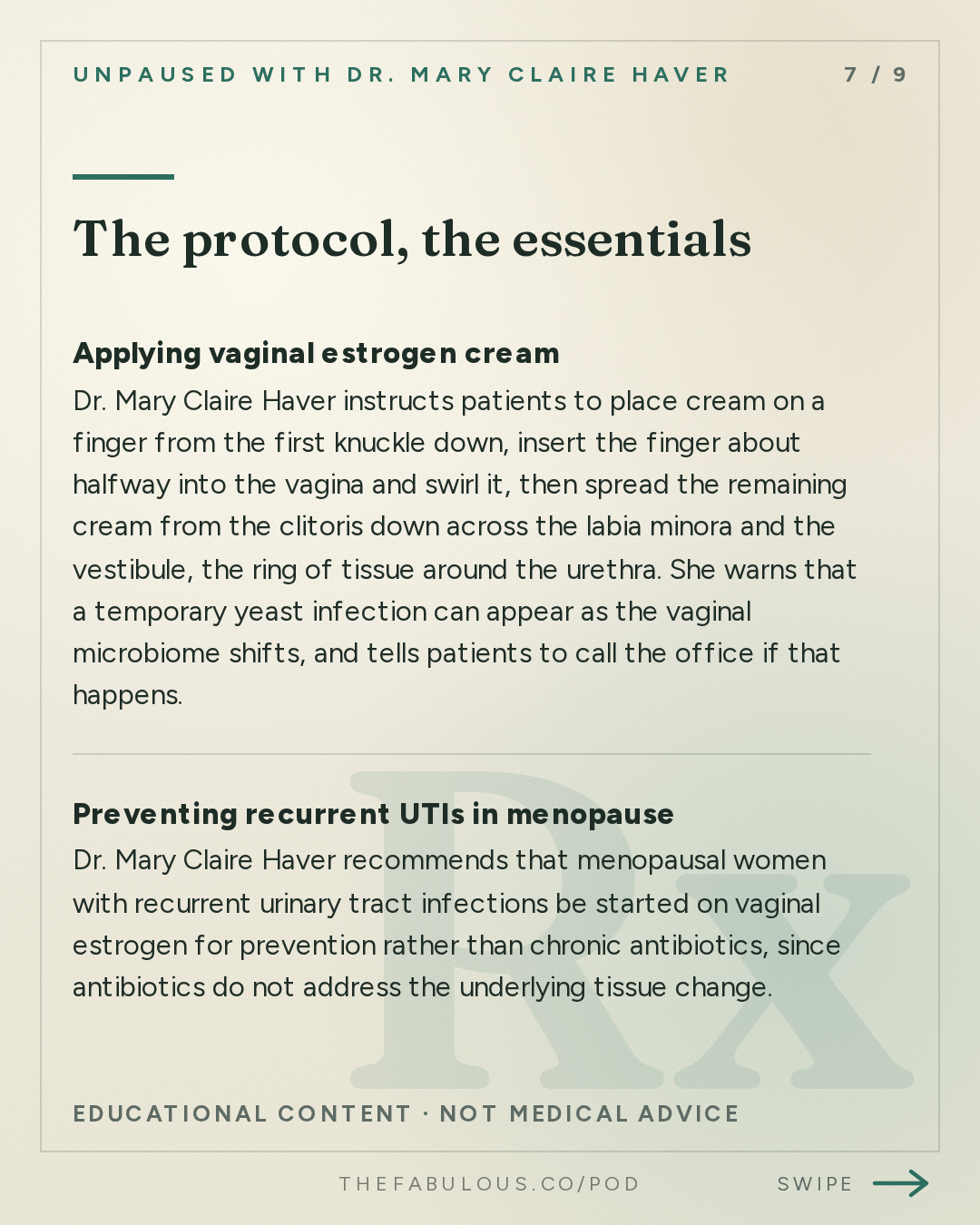
Dr. Mary Claire Haver instructs patients to place cream on a finger from the first knuckle down, insert the finger about halfway into the vagina and swirl it, then spread the remaining cream from the clitoris down across the labia minora and the vestibule, the ring of tissue around the urethra. She warns that a temporary yeast infection can appear as the vaginal microbiome shifts, and tells patients to call the office if that happens.
Twice weekly, with about six weeks needed before the tissue heals
-
Preventing recurrent UTIs in menopause
Dr. Mary Claire Haver recommends that menopausal women with recurrent urinary tract infections be started on vaginal estrogen for prevention rather than chronic antibiotics, since antibiotics do not address the underlying tissue change.
Ongoing, as prescribed by a clinician
-
Adding vaginal DHEA for persistent pain
Dr. Mary Claire Haver adds vaginal DHEA, sold as Prasterone, when pain or delayed orgasm does not fully resolve on vaginal estrogen alone, because DHEA converts locally in the tissue into both estrogen and testosterone and can engage androgen receptors in the clitoris and vestibule.
Daily, per product labeling
Questions this episode answers
What is genitourinary syndrome of menopause (GSM)?
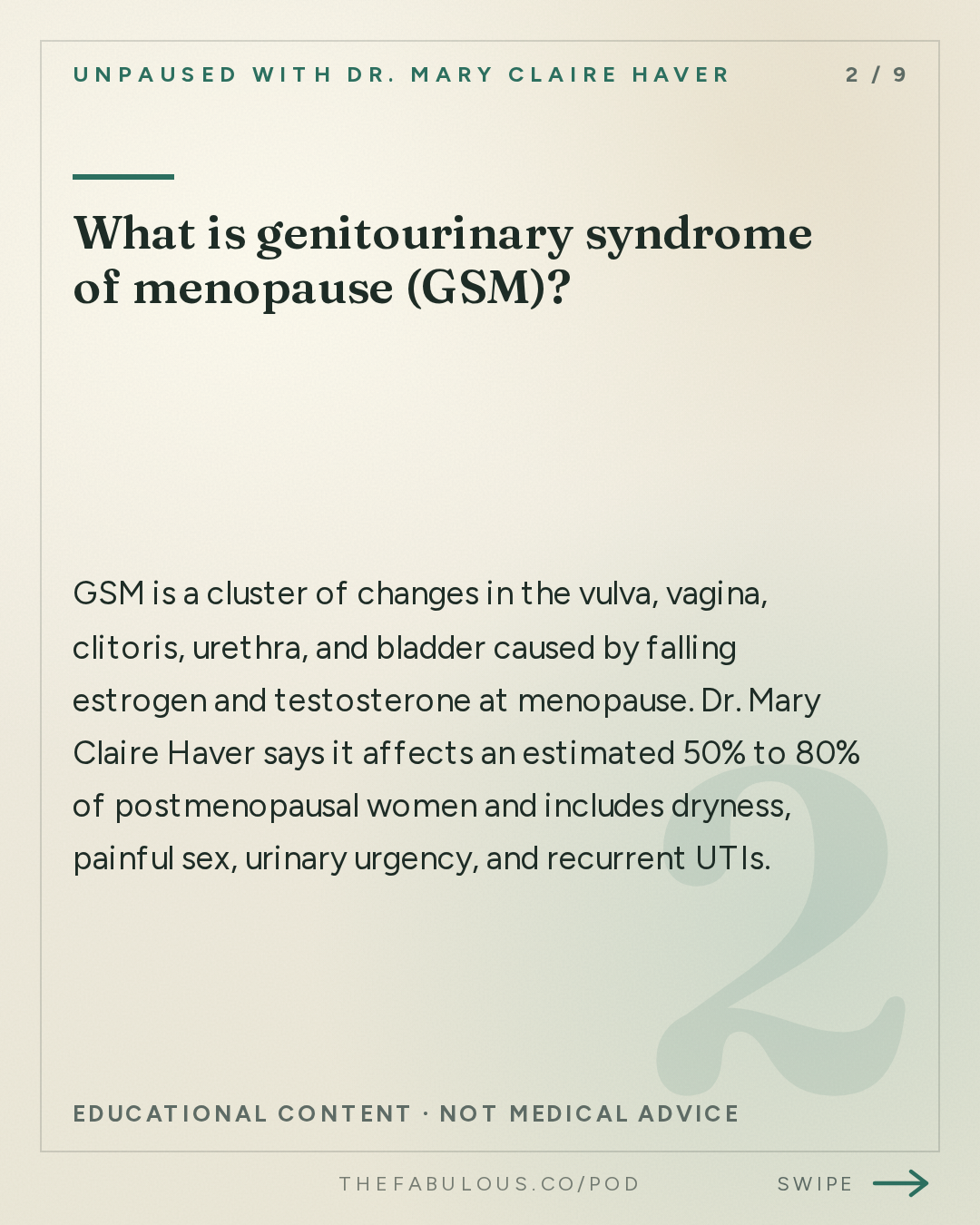
GSM is a cluster of changes in the vulva, vagina, clitoris, urethra, and bladder caused by falling estrogen and testosterone at menopause. Dr. Mary Claire Haver says it affects an estimated 50% to 80% of postmenopausal women and includes dryness, painful sex, urinary urgency, and recurrent UTIs (11:00).
Can vaginal estrogen prevent recurrent urinary tract infections?
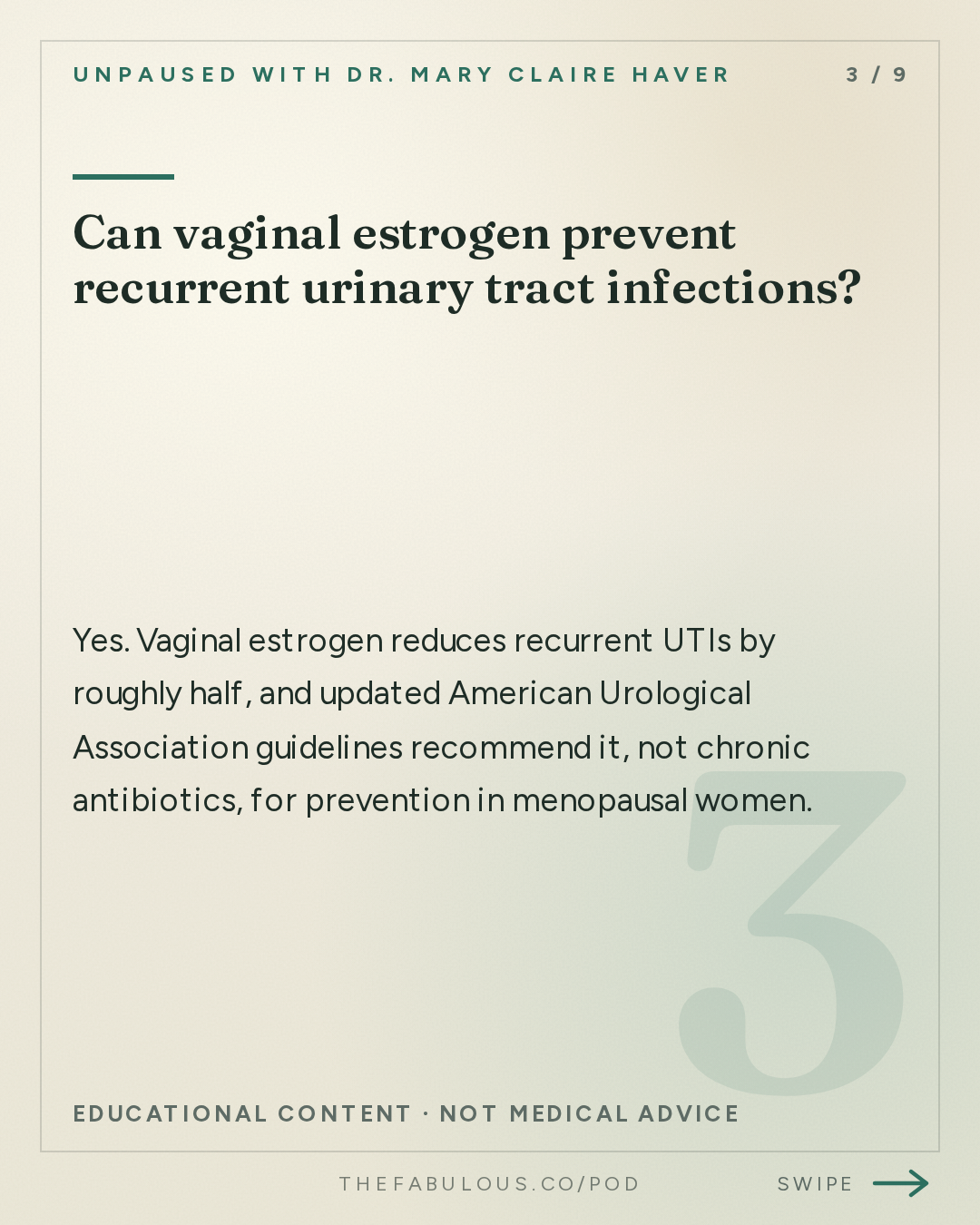
Yes. Vaginal estrogen reduces recurrent UTIs by roughly half, and updated American Urological Association guidelines recommend it, not chronic antibiotics, for prevention in menopausal women (38:36, 09:12).
Is the vaginal estrogen black box warning still in effect?
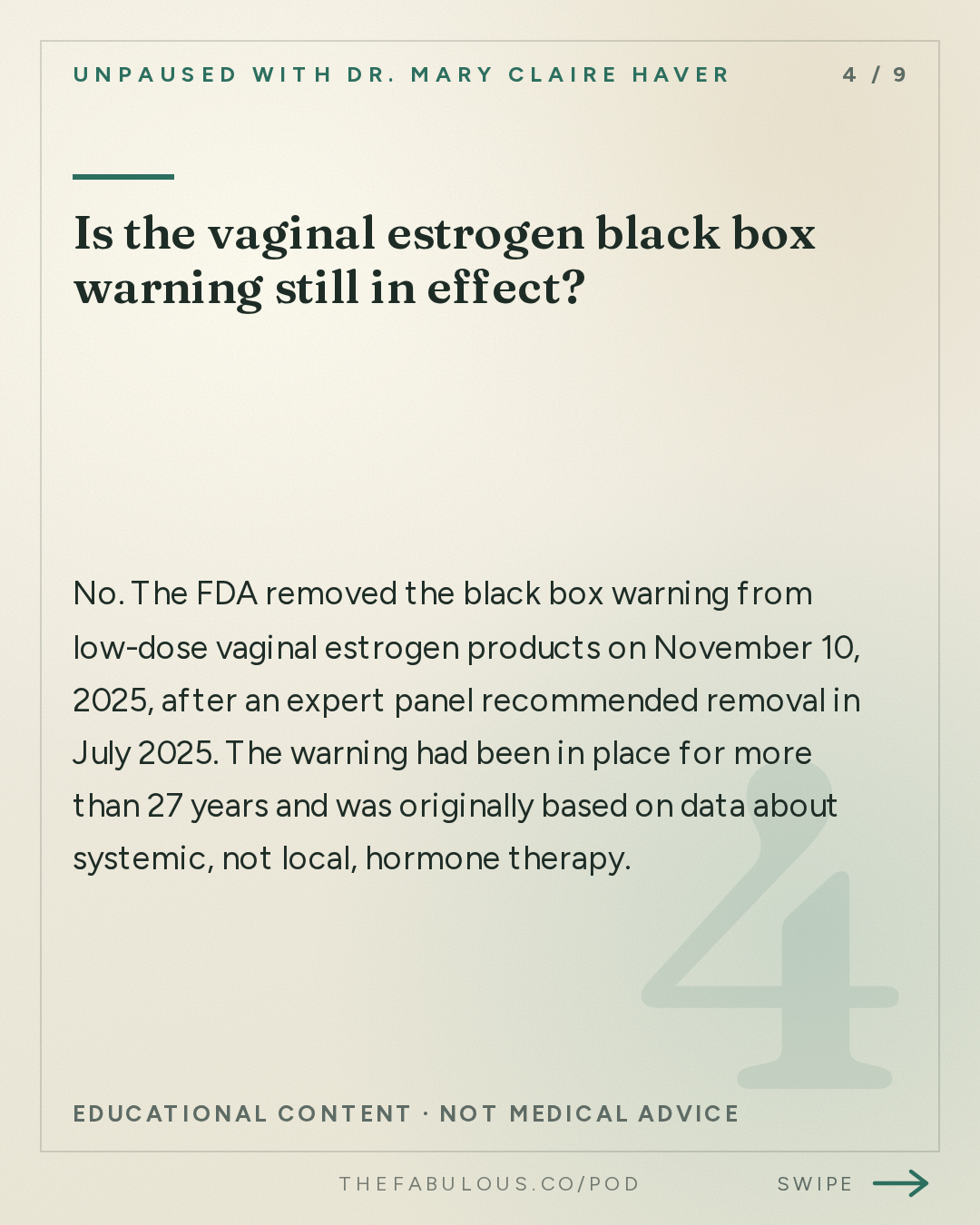
No. The FDA removed the black box warning from low-dose vaginal estrogen products on November 10, 2025, after an expert panel recommended removal in July 2025. The warning had been in place for more than 27 years and was originally based on data about systemic, not local, hormone therapy (14:54).
What is vaginal DHEA used for?
Vaginal DHEA, sold as Prasterone, converts locally in the tissue into both estrogen and testosterone. Dr. Mary Claire Haver adds it for patients whose pain or delayed orgasm does not fully resolve on vaginal estrogen alone, since it engages androgen receptors in the clitoris and vestibule (28:43).
How do you apply vaginal estrogen cream?
Dr. Mary Claire Haver's protocol: place cream on a finger from the first knuckle down, insert the finger halfway into the vagina and swirl, then spread the rest from the clitoris down across the labia and the vestibule, twice a week, allowing about six weeks for the tissue to heal (25:16, 27:21).
What are the symptoms of clitoral atrophy in menopause?
Clitoral atrophy shows up as delayed or absent orgasm in women who used to climax easily, caused by declining testosterone shrinking the clitoris and reducing blood flow and nerve sensitivity. Dr. Mary Claire Haver notes this testosterone decline starts in a woman's 30s, well before menopause (18:55).
The full read, in cards
Go deeper
- Women's Health Initiative — 2002 findings linking hormone therapy to breast cancer risk, which Haver says were overstated and tanked hormone prescribing
- American Urological Association updated GSM guidelines — named as the current clinical standard recommending vaginal estrogen as frontline GSM treatment
- Medicare cost savings analysis co-authored by Dr. Rachel Rubin — estimated $6 to $22 billion in annual Medicare savings from broader vaginal estrogen use
Mentioned
Dr. Mary Claire Haver · Dr. Rachel Rubin · Dr. Jim Simon · Kelly Casperson · FDA · American Urological Association · ISSWSH · Women's Health Initiative · Medicare
More from this show and category

Can Breast Cancer Previvors Safely Use HRT?
Most breast cancers are not inherited, but oncologist Dr. Eleonora Teplinsky says risk assessment should start at 25, since 5 to 10% of cases trace to a gene mutation and a 20% lifetime score marks someone as high risk (02:03, 03:31). She also confirms previvors with BRCA mutations can safely use hormone therapy after ovary removal (15:04).

Pelvic Floor Health and Menopause: Daily Habits
Pelvic floor therapist Sarah Reardon says menopause pelvic problems need two fixes: estrogen for tissue, muscle training for strength. She covers power peeing, Squatty Potties, pessaries, GSM, vaginismus, and why the $5 billion vaginal rejuvenation industry skips the muscle work that actually prevents prolapse and leakage.

Pelvic Floor Therapy for Menopause Explained
Pelvic floor therapist Dr. Sarah Reardon says one in three women has a pelvic floor disorder, and most can self-refer for therapy without a doctor's note. She explains why verbal Kegel instructions fail more than half the time, how vaginal estrogen cuts recurrent UTI rates nearly twelvefold, and why nighttime bathroom trips raise fracture risk in menopause.

Mark Cuban on the Estrogen Patch Shortage
Estrogen patch prescriptions have nearly tripled in two years, while specialty manufacturing requirements keep supply from catching up. Entrepreneur Mark Cuban explains how his Cost Plus Drugs company sells at a flat 15% markup, and how pharmacy benefit managers can push a brand drug's price from $300 to $600 through rebate demands.
