unPAUSED with Dr. Mary Claire Haver
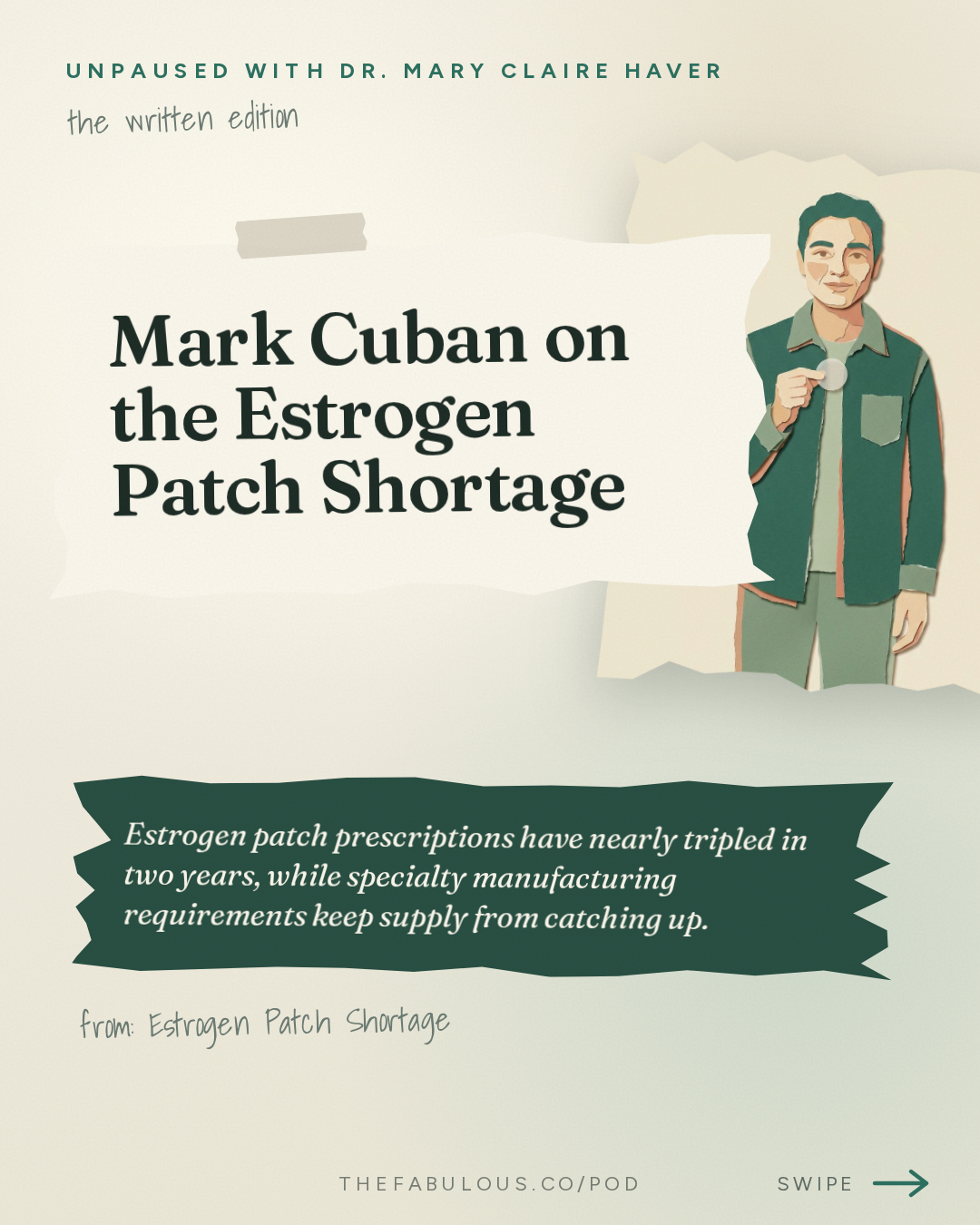
Mark Cuban on the Estrogen Patch Shortage
Estrogen Patch Shortage: Who Profits From Your Prescriptions with Mark Cuban
▶ Listen to the full episode More from unPAUSED with Dr. Mary Claire Haver
The brief
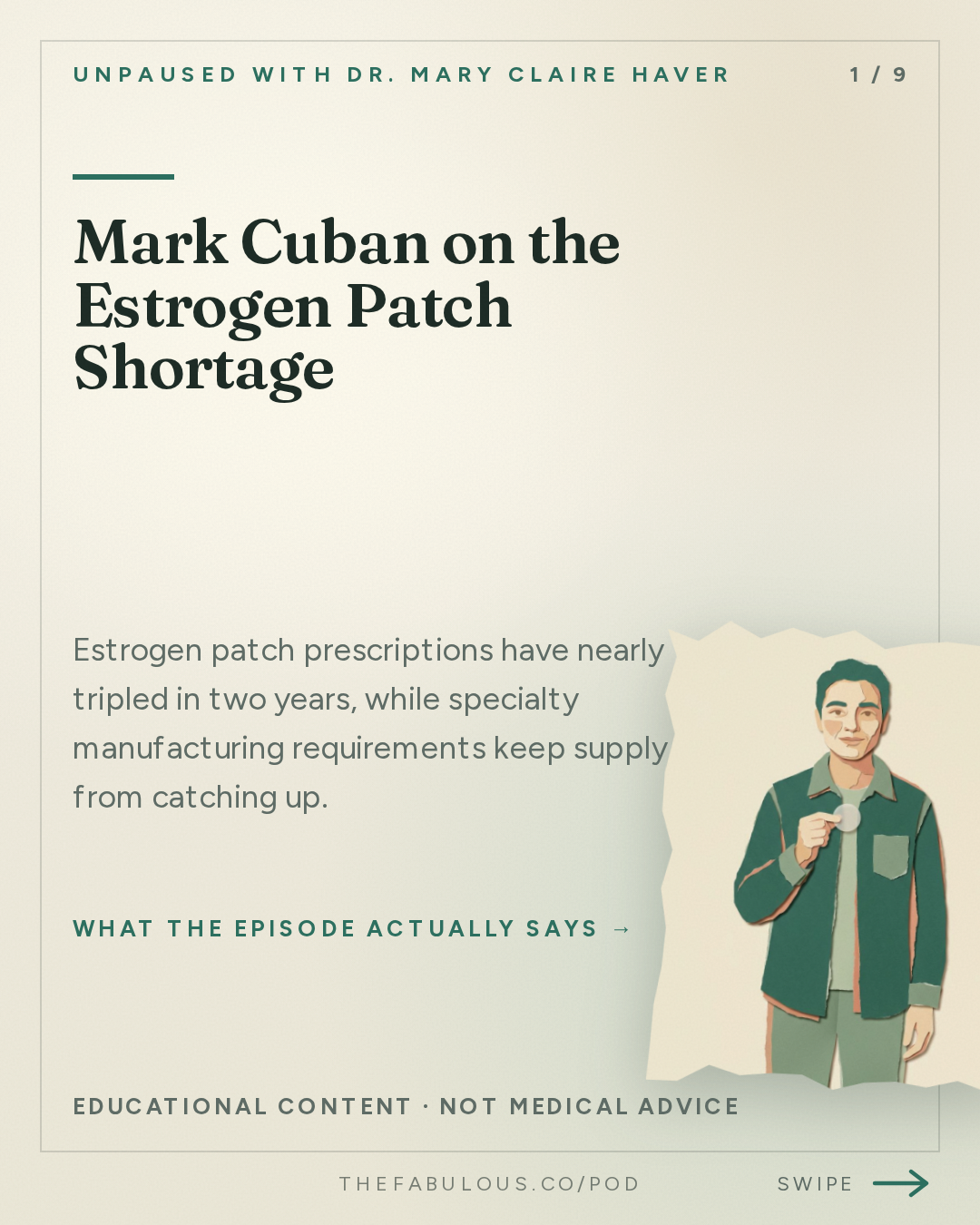
Estrogen patch prescriptions have nearly tripled in two years, while specialty manufacturing requirements keep supply from catching up. Entrepreneur Mark Cuban explains how his Cost Plus Drugs company sells at a flat 15% markup, and how pharmacy benefit managers can push a brand drug's price from $300 to $600 through rebate demands.
Two women post about their hormone prescriptions on social media. One pays $14 for her estrogen patch. The other pays $90 for the identical drug, the same dose, filled in the same country (01:12). Neither can explain the gap. That confusion is the real subject of Dr. Mary Claire Haver's conversation with entrepreneur Mark Cuban, who co-founded the Mark Cuban Cost Plus Drug Company in 2022 after years of studying how American drug pricing actually works (02:02).
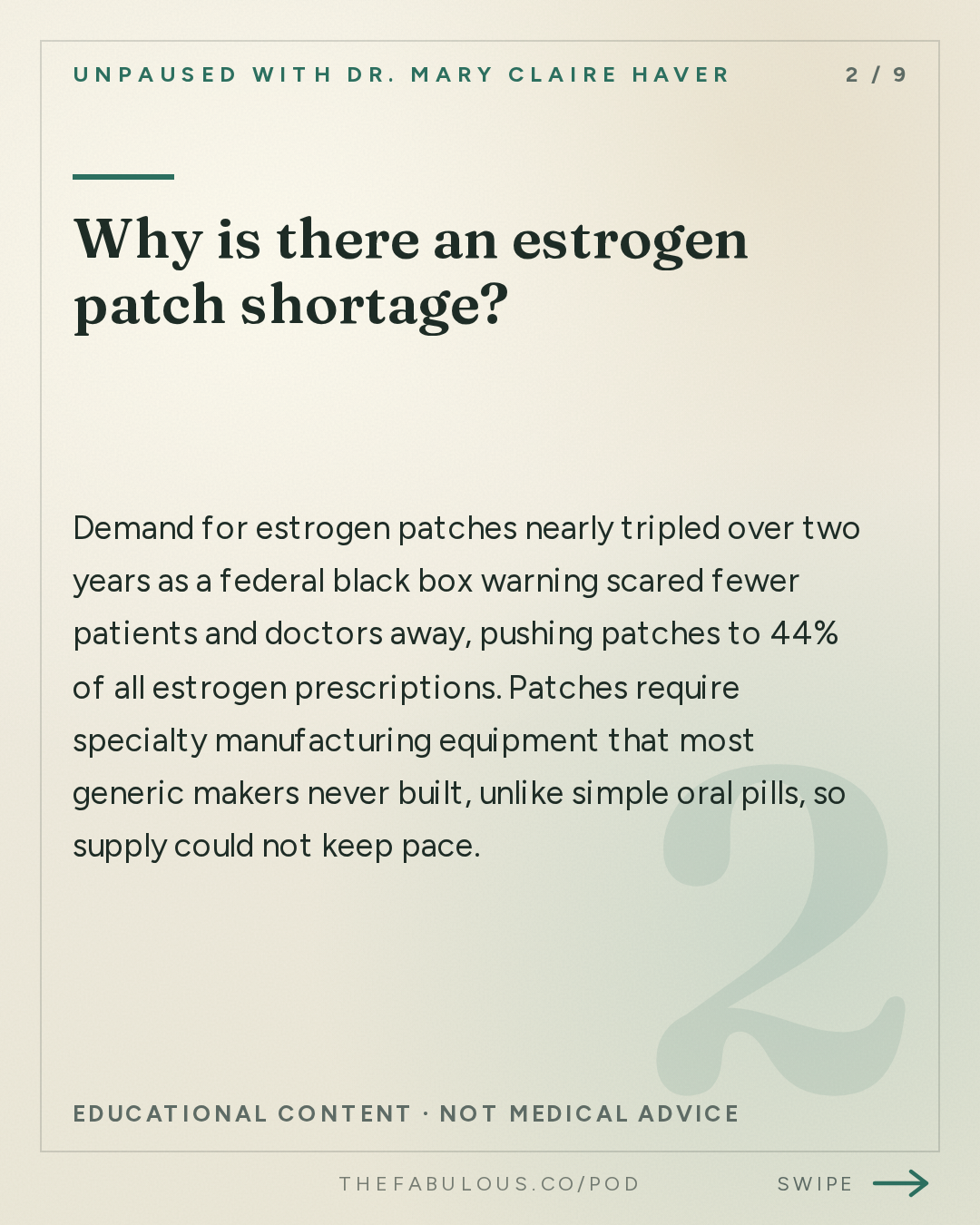
The episode opens with a number that explains the current crisis: estrogen patch prescriptions have nearly tripled in the United States over the past two years (00:00). At Cuban's pharmacy, the increase has been steeper still, "at least 10X" (05:43). The cause is straightforward. A federal black box warning on hormone therapy, once a source of fear for patients and doctors, stopped scaring as many people away, and demand climbed fast enough that patches now make up 44% of all estrogen prescriptions (05:59). Supply did not follow. Oral estrogen is simple to manufacture. Patches need specialty manufacturing equipment that most generic drug makers never built, because nobody expected the demand curve to bend this sharply (06:13). Building a new plant, Cuban says, would take roughly five years (06:13), so the country is stuck wanting a therapy it cannot fully make.
What makes the shortage worse is a detail that sounds almost too cynical to be true: raising the price is often easier than raising the supply. "It's on short supply because money," Cuban says near the top of the episode (00:20). A manufacturer that has sold the same volume of a generic drug for years has little incentive to expand a factory. Only after public pressure, including a letter-writing campaign aimed at the FDA, did the agency's public language shift from insisting there was no shortage to acknowledging it was working with six manufacturers to add capacity (07:10).
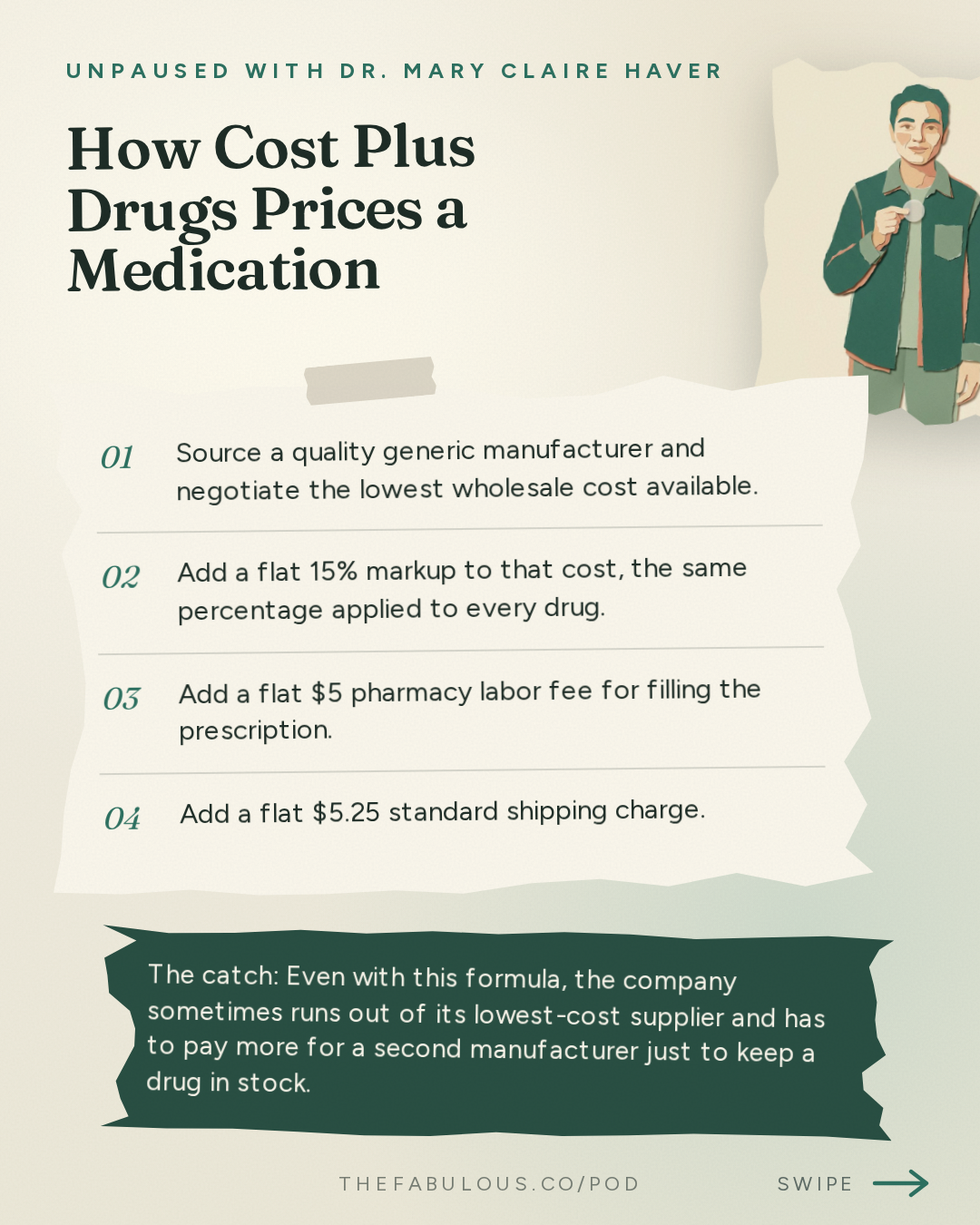
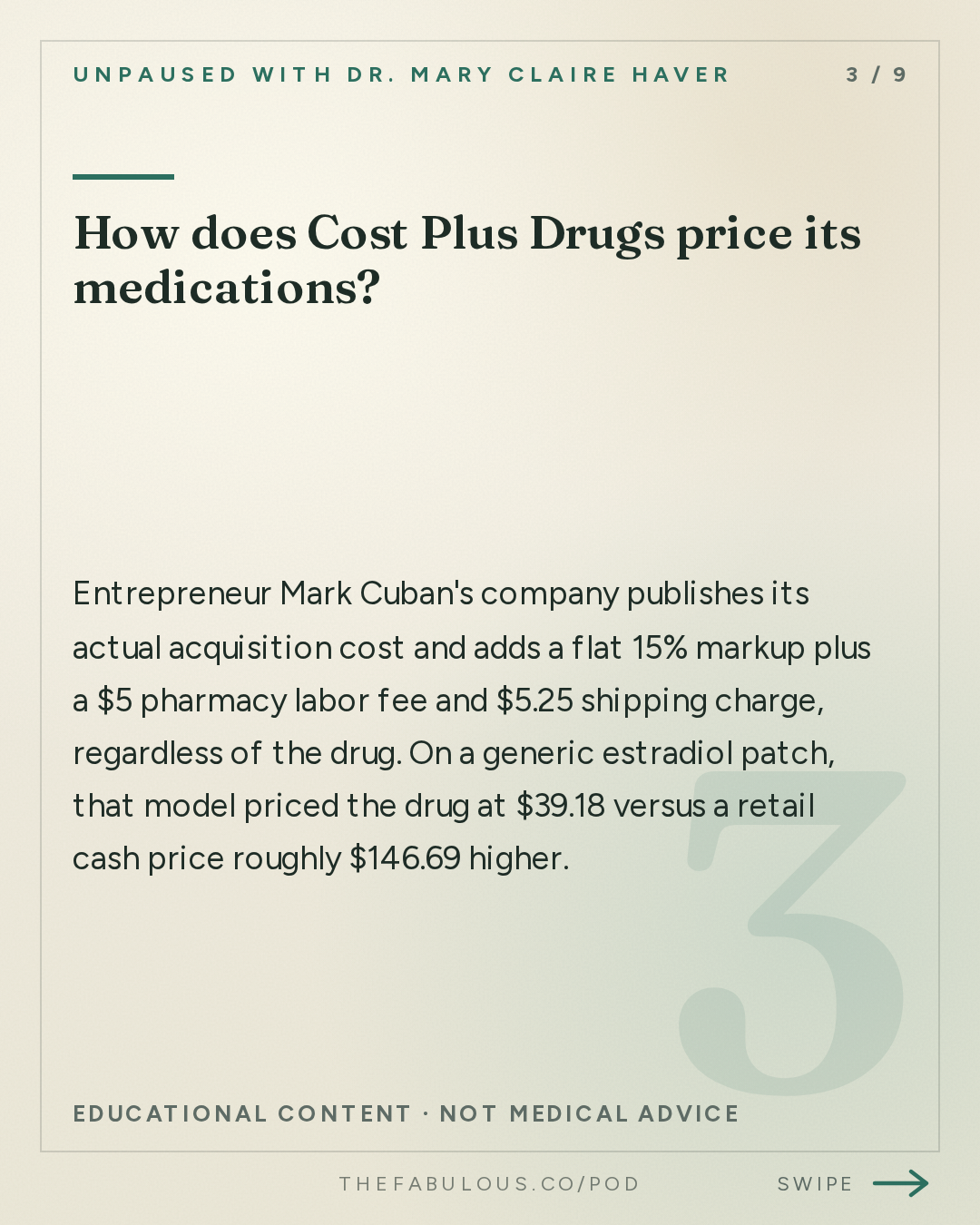
Cost Plus Drugs tries to patch the gap by buying as much manufacturer inventory as it can find, sometimes paying more for a second source just to keep any patch in stock (05:04). The tradeoff shows up on the company's website: a generic estradiol patch lists at $39.18, versus a retail cash price Haver calculates would run $146.69 more at a typical pharmacy (10:05). The company's standard markup, Cuban says, is a flat 15% over its own acquisition cost.
"Trust equals transparency divided by self-interest, and we're the only pharmacy anywhere in the world where you can go to our site and it shows you what our actual cost is." Mark Cuban, entrepreneur and founder of Cost Plus Drugs, [12:48]
Where the Extra $146 Goes
Haver's question about that $146.69 gap turns the conversation toward the real machinery behind American drug prices. Cuban traces it to a layer of companies most patients never think about: pharmacy benefit managers, or PBMs, which were originally built to process insurance claims. Because PBMs built the formularies, the lists of drugs an insurance plan will cover, and because a handful of them now manage tens of millions of lives, they ended up able to charge manufacturers for a spot on that list (25:51). Three PBMs control most of the country's drug volume, and three wholesale distributors control 95% of pharmacy transactions (32:31).
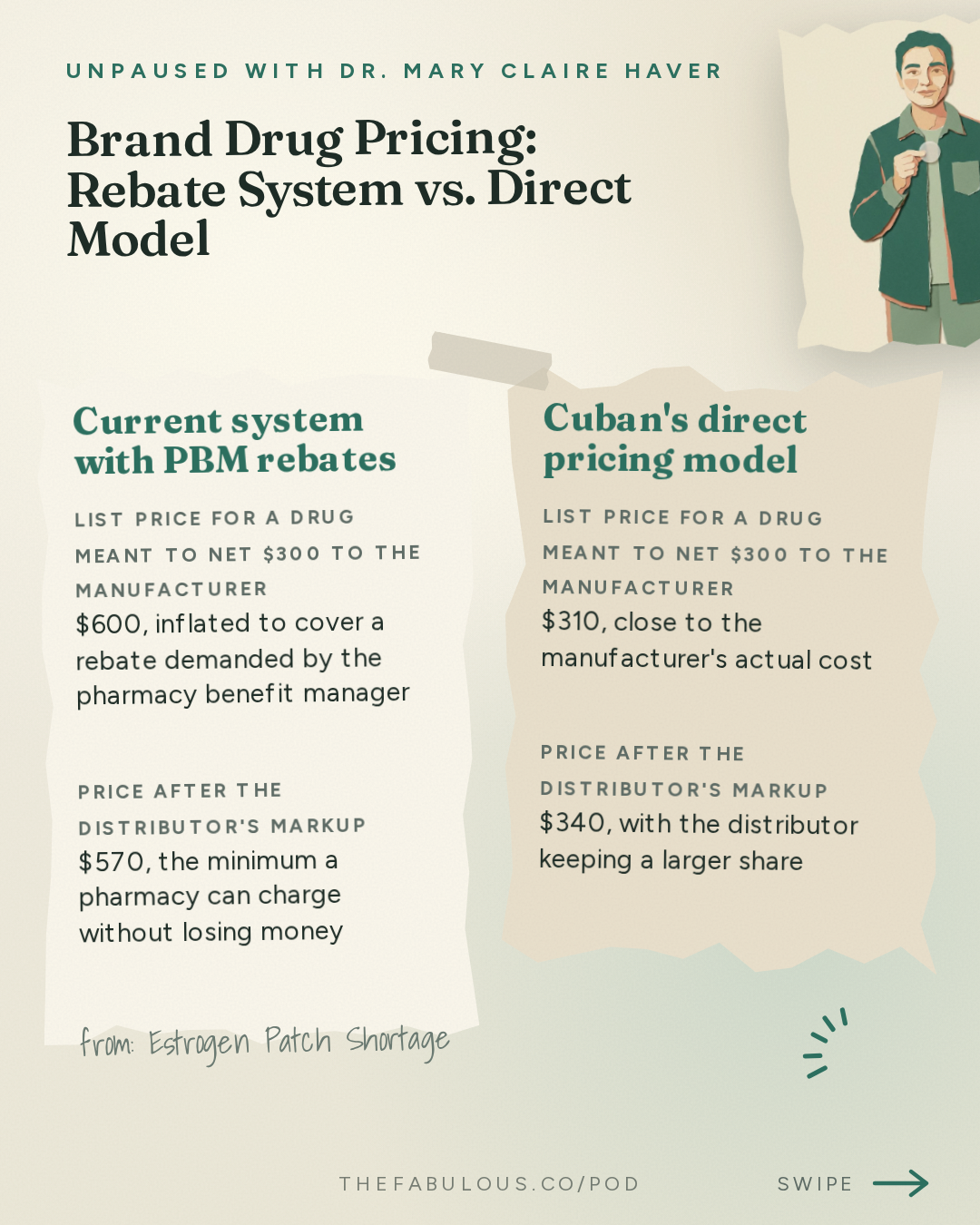
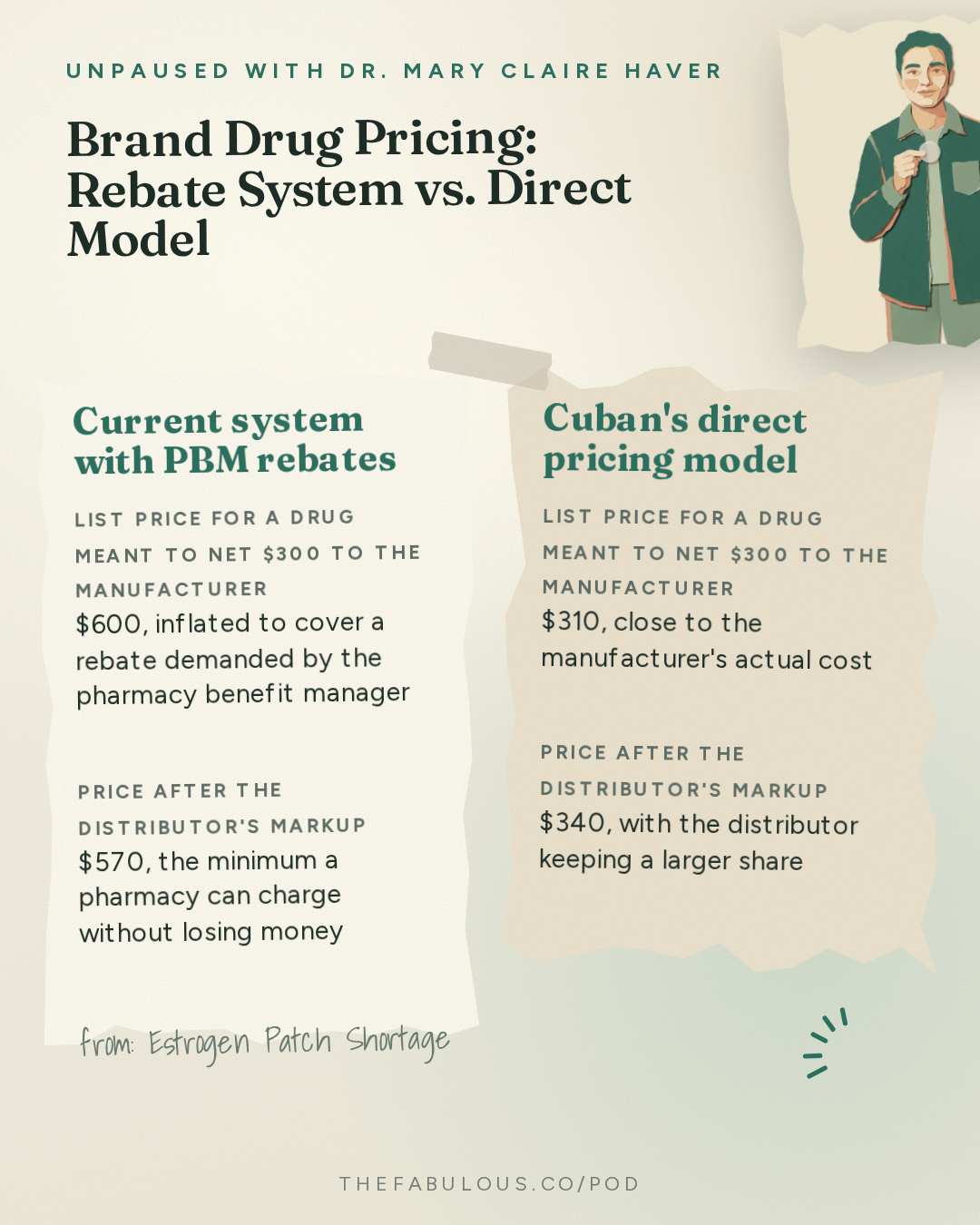
Cuban walks through a hypothetical to show how that leverage moves a price. A manufacturer wants to net $300 on a brand drug. A PBM tells the manufacturer that unless the list price rises, with most of the increase returned as a rebate, the drug will not make the formulary, or worse, the manufacturer's entire product line will be excluded (34:58). So the list price becomes $600. By the time a distributor and pharmacy take their own cuts, a patient without insurance, or one still inside a deductible, ends up paying close to the full $570 to $600 (33:22). None of that extra money reaches the company that made the drug. Cuban says he heard this directly from a manufacturer of a non-opioid pain medication called Combigesic: PBMs told the company to raise its price from under $200 to $700, mostly rebate, or be blocked from formularies entirely (31:05).
The same logic runs through hospital systems and insurers that own each other. CVS, for instance, owns the insurer Aetna and the pharmacy benefit manager Caremark (23:32). Under the Affordable Care Act's medical loss ratio rule, insurers must spend at least 85% of premium revenue on healthcare (23:07). Pay a subsidiary more for a drug or service, and a company hits that 85% threshold faster while keeping the profit inside its own family of companies, what Cuban calls "left pocket, right pocket" (24:21). The largest of these conglomerates has more than 3,000 subsidiaries and moves more than $160 billion a year in transfers between them (23:07).
The Funding Gap Behind the Gold Rush
The conversation turns personal when Haver raises a statistic she cites often in her own work: less than 9% of NIH grant money went to women's health over the last decade (00:20). Cuban's explanation is blunt.
"It's run by men." Mark Cuban, [41:17]
He describes a system where most people inside medicine, government, and large companies simply take the path of least resistance, and where gaps in research funding are less a conspiracy than an absence of anyone whose job it is to notice. That absence has consequences he can point to directly. There is still no FDA-approved testosterone product for women in the United States, so prescribers borrow the men's version off label, even though men generally need ten times the dose (44:24). Endometriosis still takes seven to ten years to diagnose on average, a delay that can cost a woman her fertility window while her pain is dismissed as ordinary cramping (45:36). In the United Kingdom, where researchers have tracked the workplace effect of untreated menopause more carefully than in the United States, one in five women leave their jobs over symptoms, and that figure counts only hot flashes, not brain fog or the other symptoms that are harder to measure (49:53).
One bright counterexample threads through the episode: vaginal estrogen cream, now priced at $13.21 on Cost Plus Drugs, down from what used to cost patients hundreds of dollars a tube (37:03). The cream is a primary preventative treatment against recurrent urinary tract infections and the sepsis they can cause in postmenopausal women (37:03). Cuban credits Dr. Rachel Rubin, a physician who reached out to him directly, with first explaining the scale of the problem (36:43).
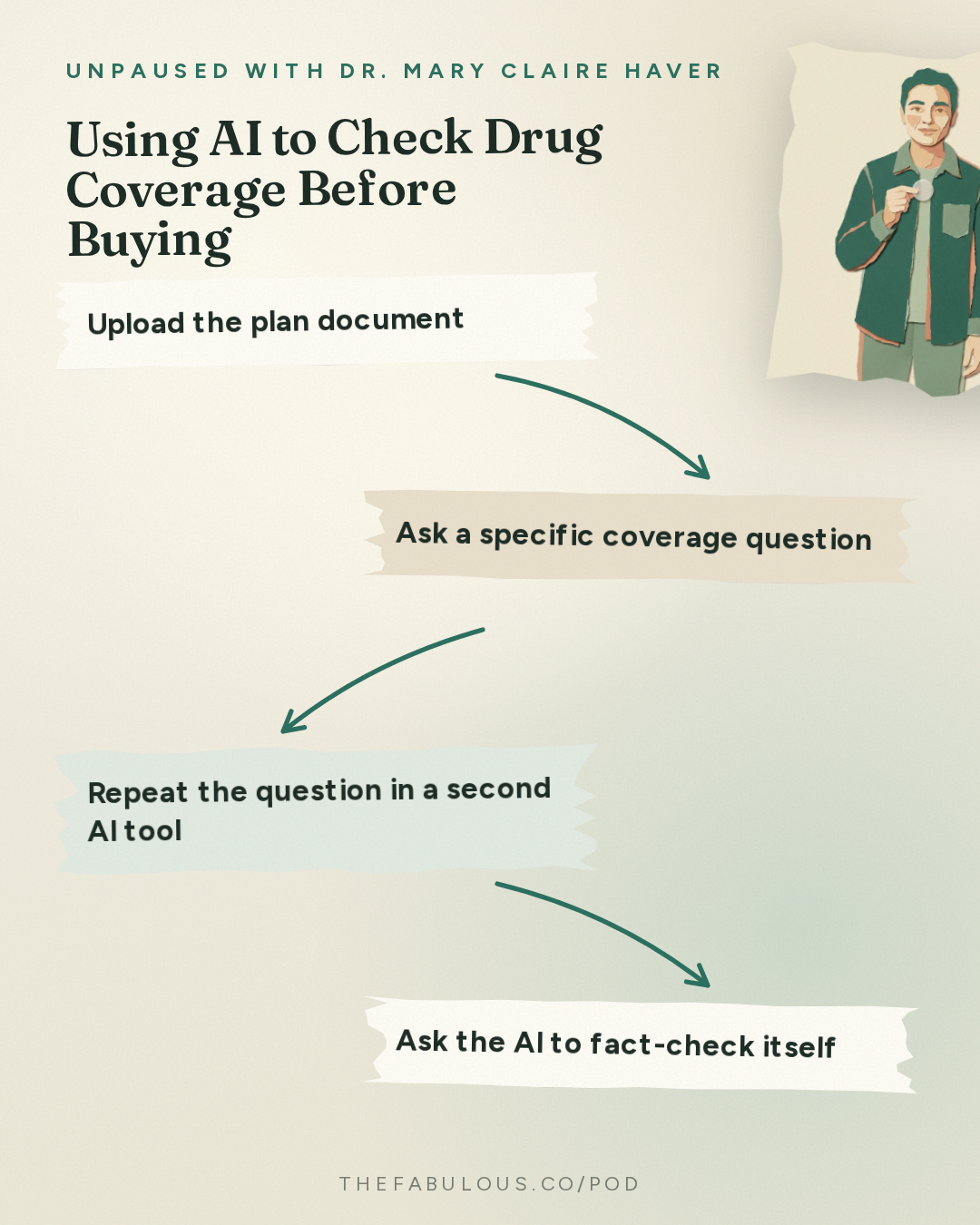
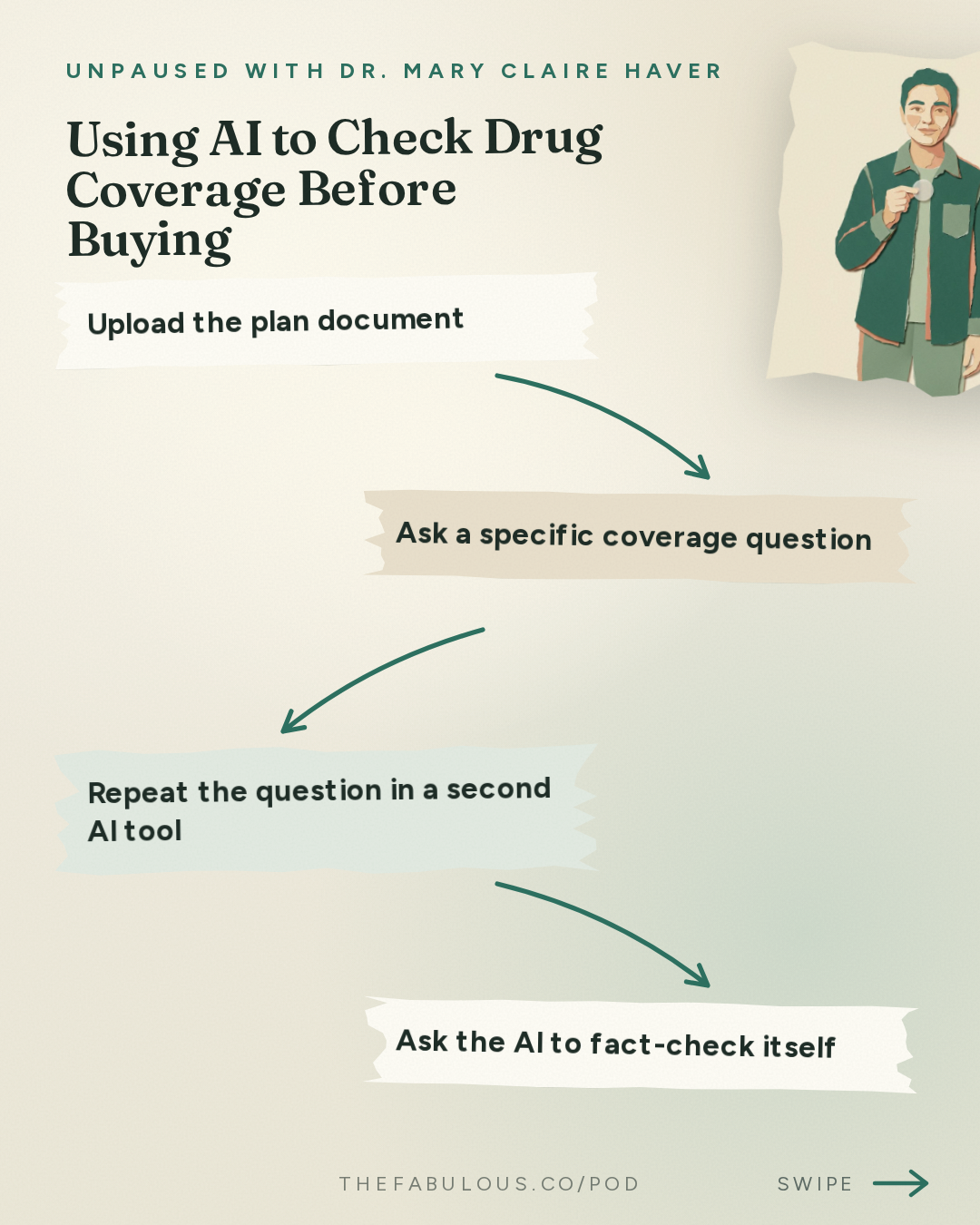
Toward the end of the conversation, Cuban offers something closer to practical advice than market analysis. A nonprofit hospital, he explains, is legally required to offer charity care or a payment plan to a patient who cannot afford treatment, a provision few patients know exists (52:06). For coverage questions, he recommends uploading an insurance plan's fine print into an AI chatbot such as ChatGPT or Claude and asking it directly whether a given drug is covered, and at what tier (53:48). He adds a caveat: ask the same question of more than one chatbot, since none of them will be entirely right, and have each one check the others' answers before trusting any single one (55:13).
The thread connecting the patch shortage, the rebate math, and the NIH funding gap is the one Cuban names early on: a system built on the assumption that most people will not look closely enough to notice. His own fix is modest by comparison, a pharmacy that shows its receipts. It does not solve the shortage, and it does not restructure the PBMs. But it gives a patient something the rest of the system rarely offers: a number she can trust before she reaches the counter.
Ask this episode anything
Pod's AI answers from the episode itself, with the minute mark so you can hear it yourself.
Or start with one of these
Ask this episode
Pod's AI listens to the whole episode to answer, and points you to the minute it comes from.
The rest of this answer, and any question after it
Answers come from the episode itself, never from a summary of it.
ContinueKey takeaways
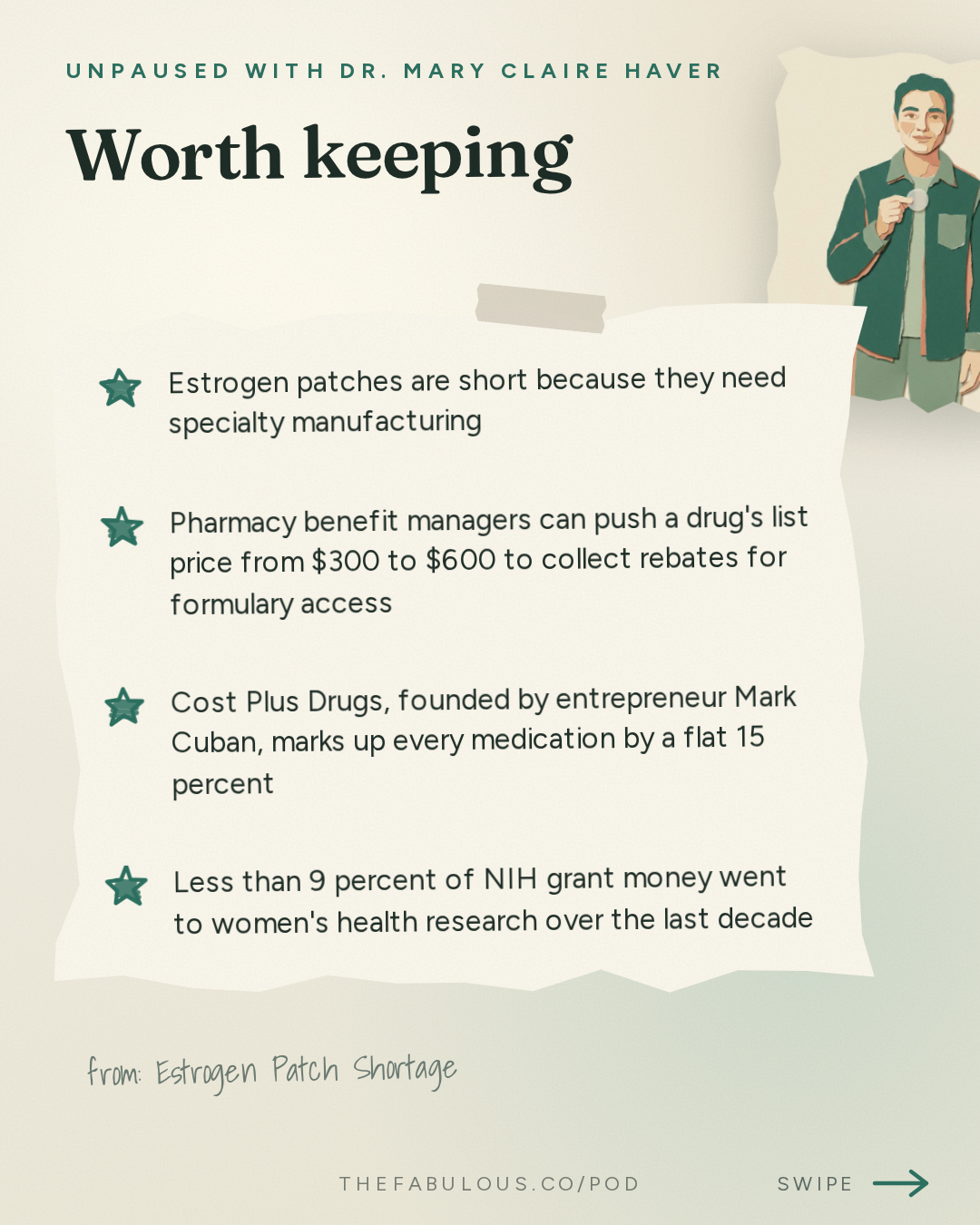
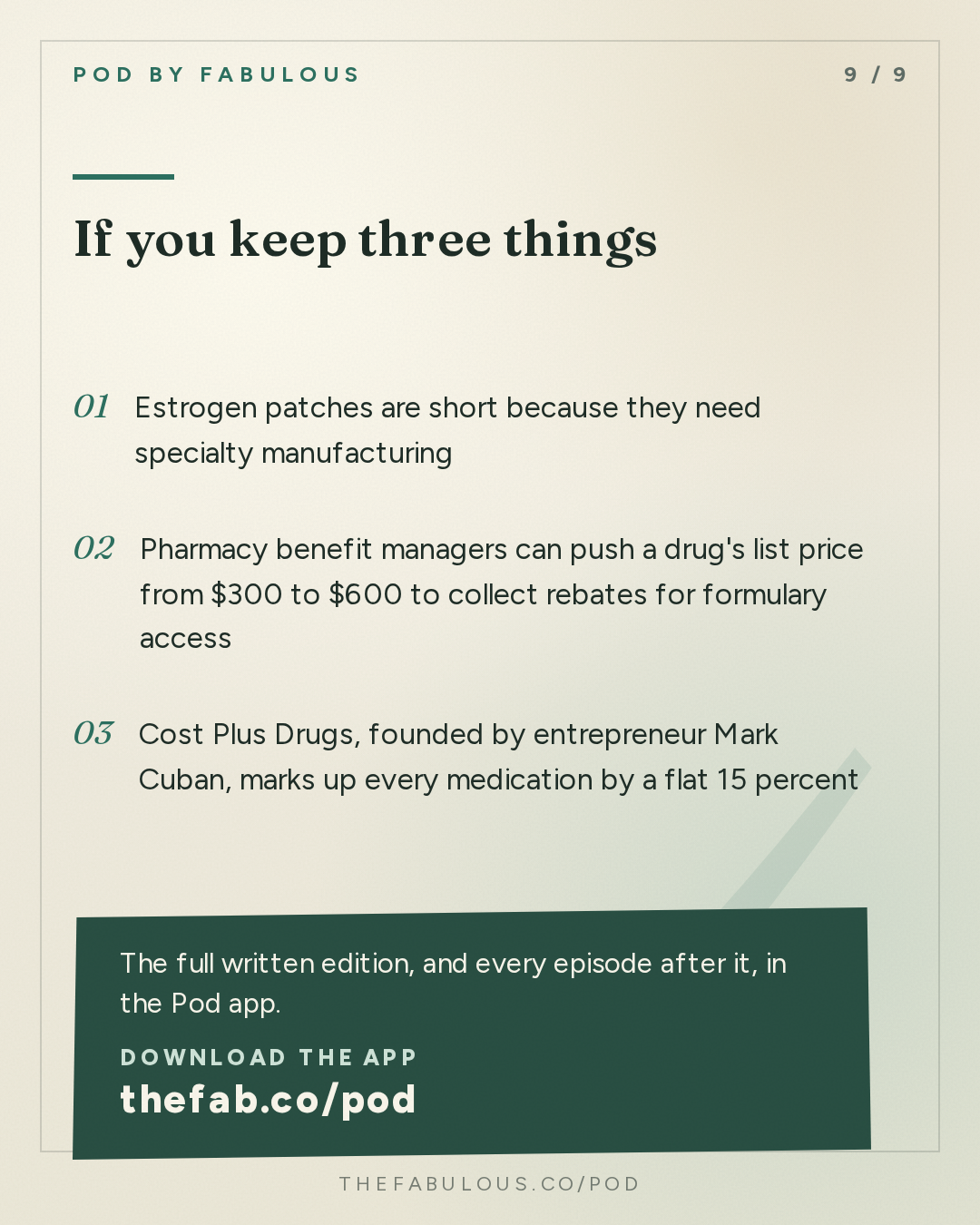
- Estrogen patches are short because they need specialty manufacturing
- Pharmacy benefit managers can push a drug's list price from $300 to $600 to collect rebates for formulary access
- Cost Plus Drugs, founded by entrepreneur Mark Cuban, marks up every medication by a flat 15 percent
- Less than 9 percent of NIH grant money went to women's health research over the last decade
- Vaginal estrogen cream costs $13.21 on Cost Plus Drugs and helps prevent recurrent UTIs in postmenopausal women
The episode in cards

By the numbers
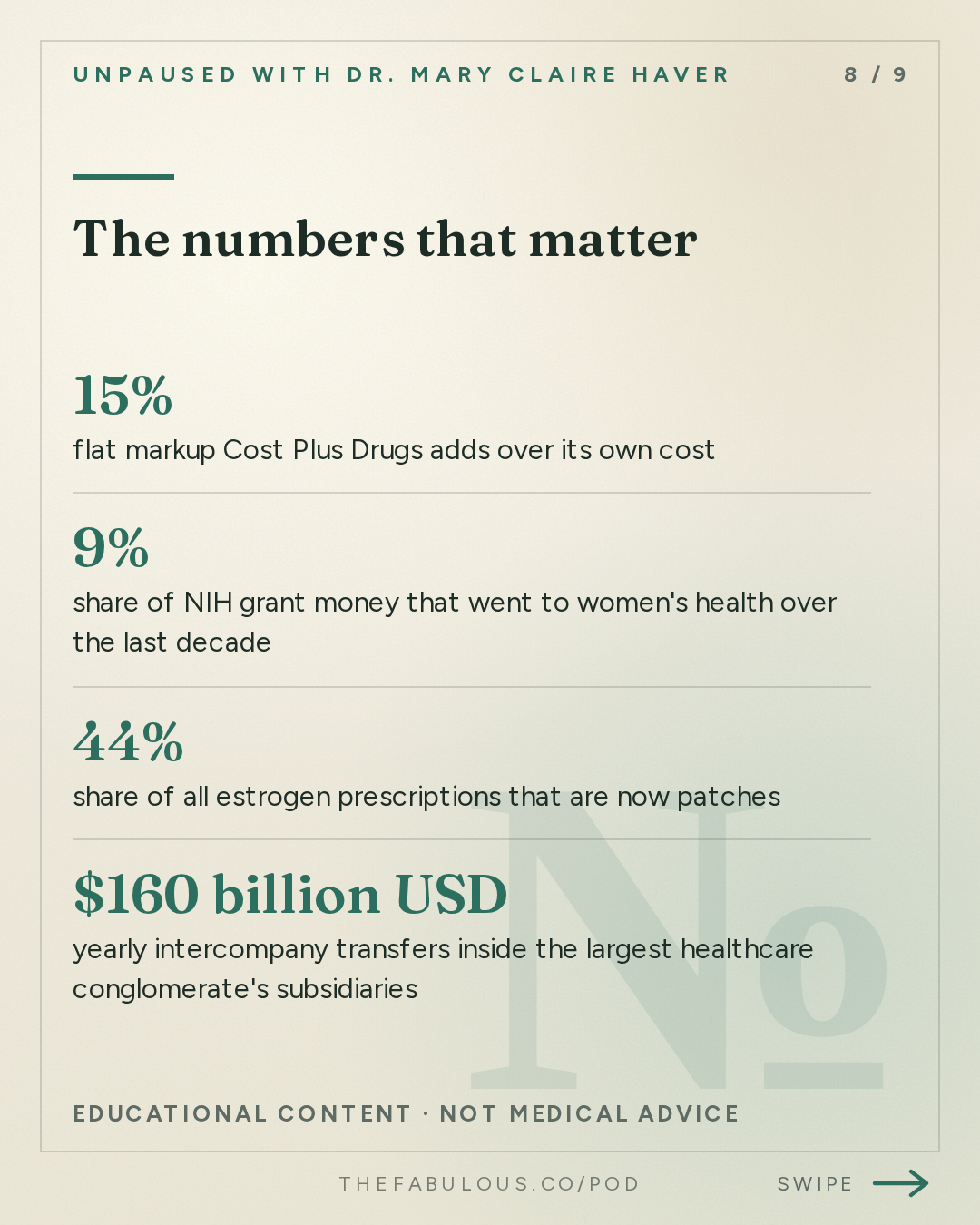
- 15% percent flat markup Cost Plus Drugs adds over its own cost
- 9% percent share of NIH grant money that went to women's health over the last decade
- 44% percent share of all estrogen prescriptions that are now patches
- $160 billion USD yearly intercompany transfers inside the largest healthcare conglomerate's subsidiaries
- 92% percent share of US prescriptions that are generic drugs
- $13.21 USD price of vaginal estrogen cream on Cost Plus Drugs
In their words
“Trust equals transparency divided by self-interest, and we're the only pharmacy th- anywhere in, in the world where you can go to our site and it shows you what our actual cost”
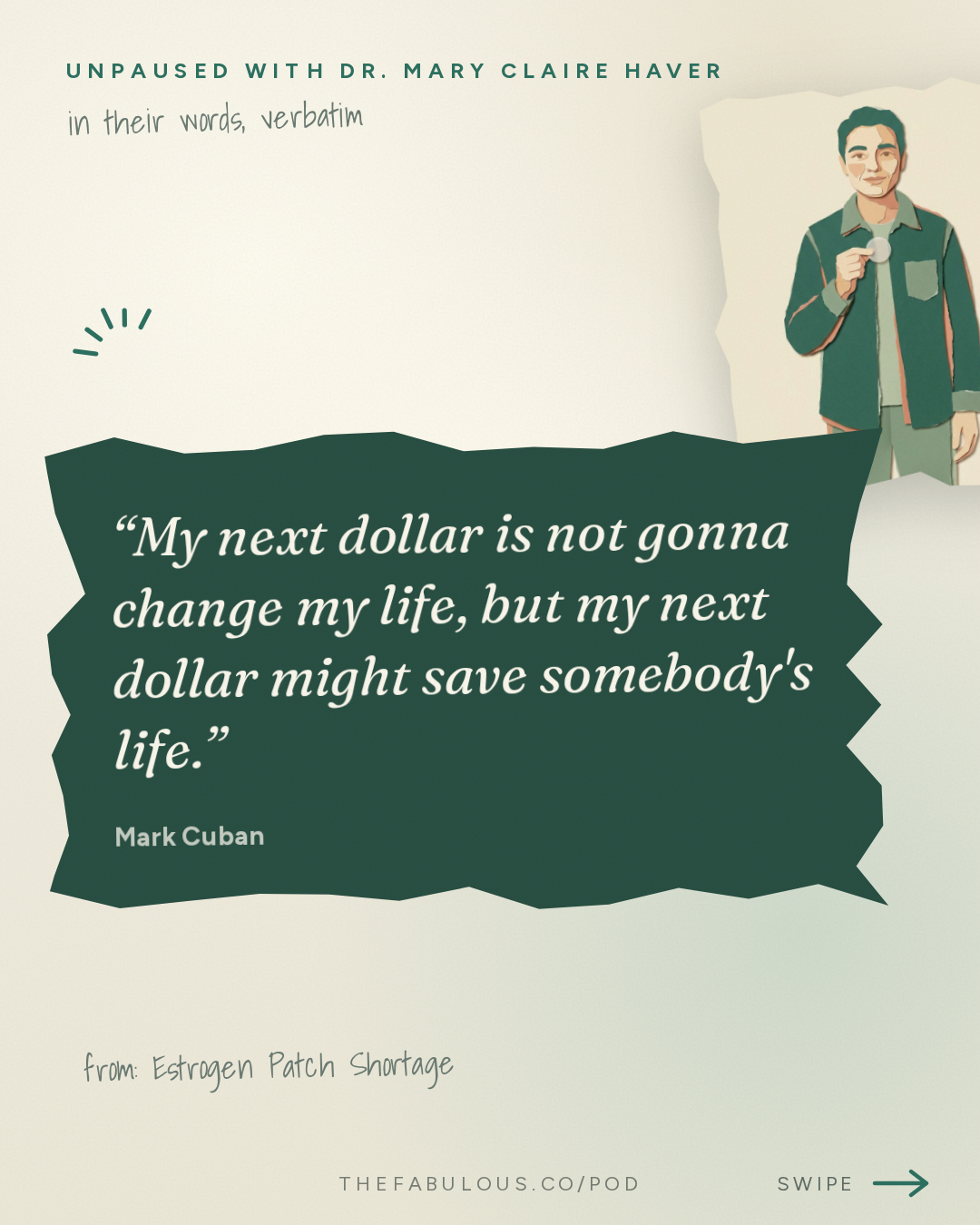
“My next dollar is not gonna change my life, but my next dollar might save somebody's life.”
“A specialty drug is whatever a PBM decides is a specialty drug. Okay. That's it”
“These big, huge healthcare conglomerates are too big to care.”
Protocols
-
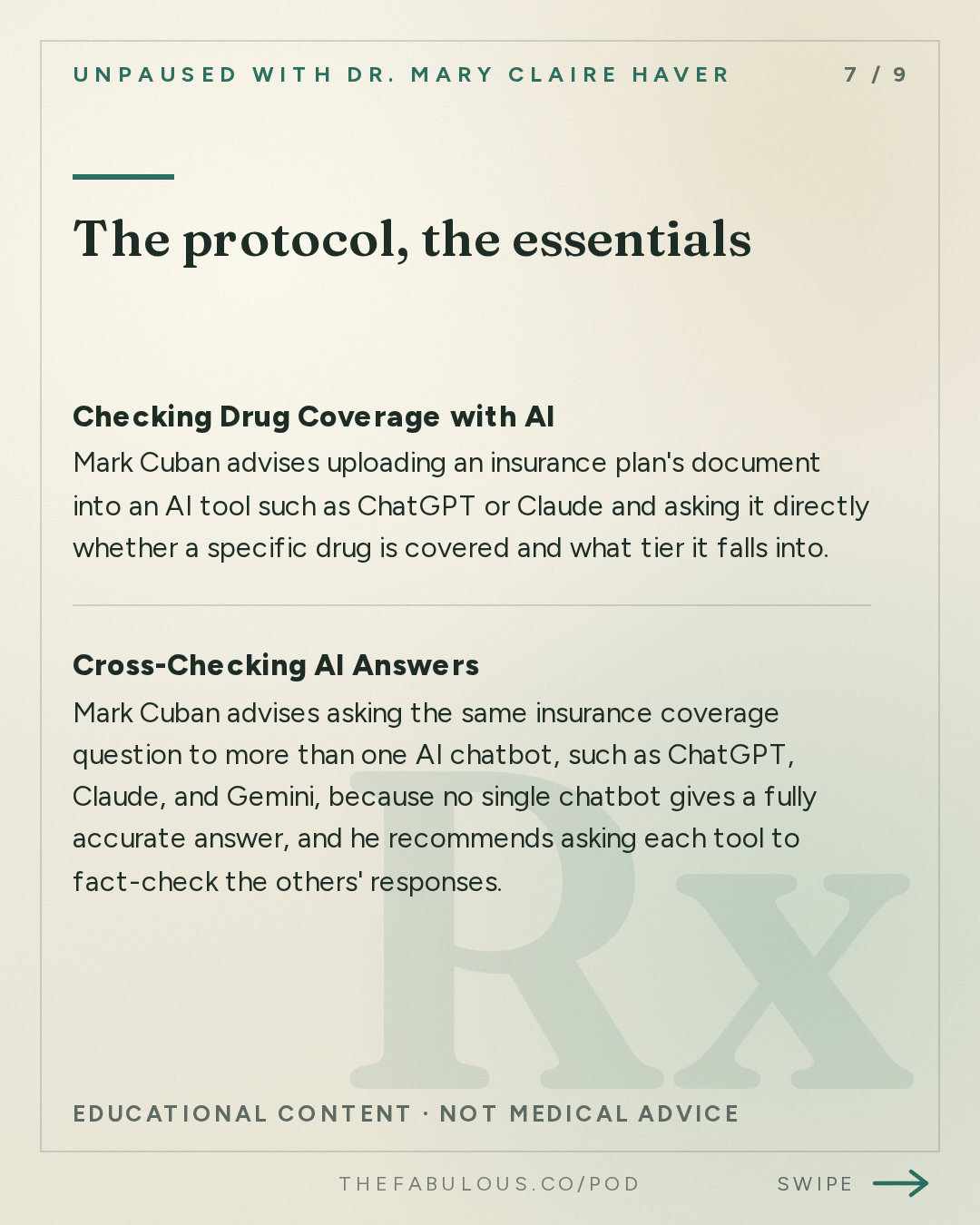
Checking Drug Coverage with AI
Mark Cuban advises uploading an insurance plan's document into an AI tool such as ChatGPT or Claude and asking it directly whether a specific drug is covered and what tier it falls into.
whenever reviewing or choosing a health plan
-
Cross-Checking AI Answers
Mark Cuban advises asking the same insurance coverage question to more than one AI chatbot, such as ChatGPT, Claude, and Gemini, because no single chatbot gives a fully accurate answer, and he recommends asking each tool to fact-check the others' responses.
each time a coverage question comes up
-
Requesting Charity Care
Mark Cuban advises patients who cannot afford treatment to approach a nonprofit hospital directly and ask for a payment plan, since nonprofit hospitals are legally required to offer charity care or a payment plan in order to keep their tax-exempt status.
when facing a bill that cannot be paid
Questions this episode answers
Why is there an estrogen patch shortage?
Demand for estrogen patches nearly tripled over two years as a federal black box warning scared fewer patients and doctors away, pushing patches to 44% of all estrogen prescriptions (05:59). Patches require specialty manufacturing equipment that most generic makers never built, unlike simple oral pills, so supply could not keep pace (06:13).
How does Cost Plus Drugs price its medications?
Entrepreneur Mark Cuban's company publishes its actual acquisition cost and adds a flat 15% markup plus a $5 pharmacy labor fee and $5.25 shipping charge, regardless of the drug (00:20, 10:46). On a generic estradiol patch, that model priced the drug at $39.18 versus a retail cash price roughly $146.69 higher (10:05).
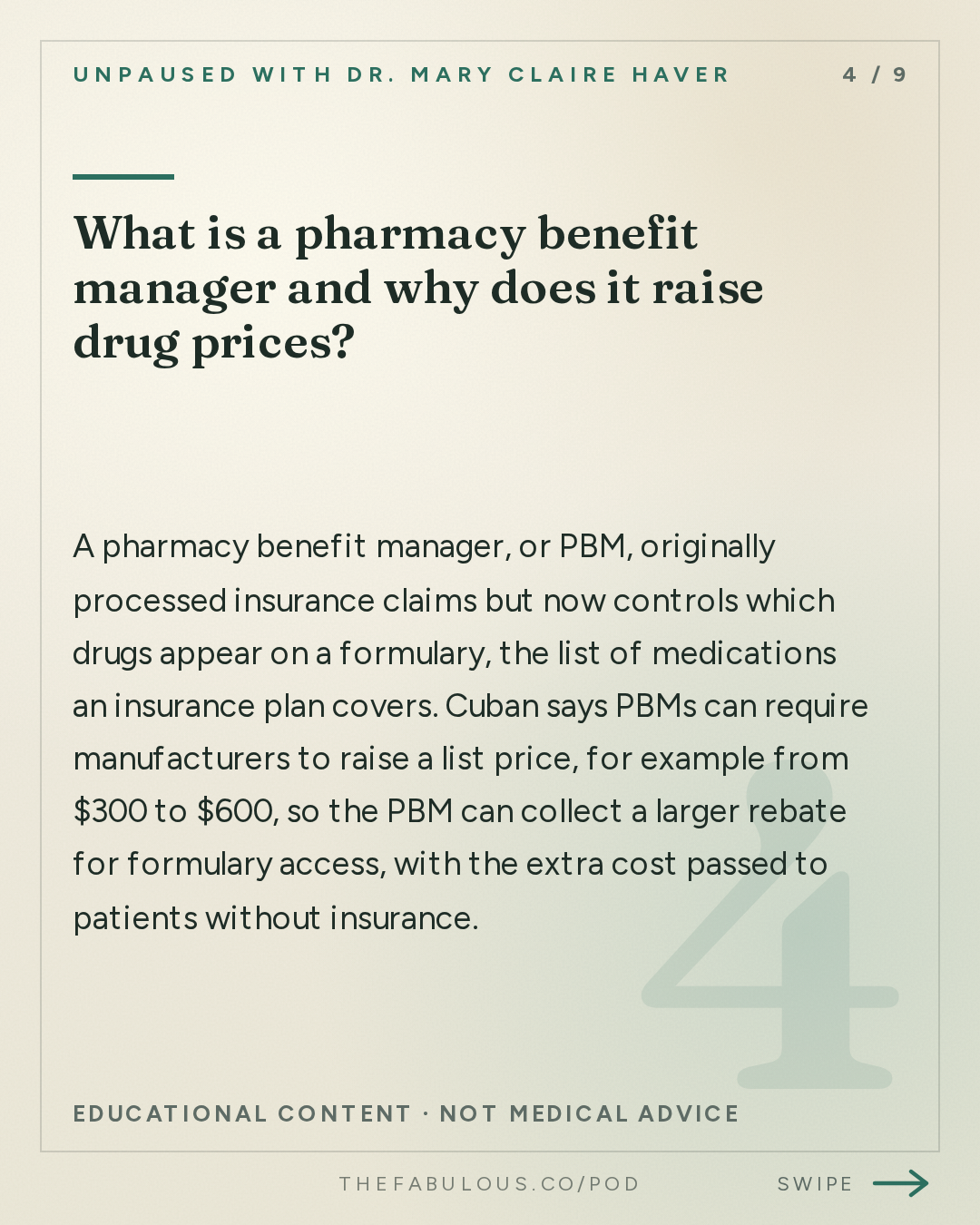
What is a pharmacy benefit manager and why does it raise drug prices?
A pharmacy benefit manager, or PBM, originally processed insurance claims but now controls which drugs appear on a formulary, the list of medications an insurance plan covers (25:51). Cuban says PBMs can require manufacturers to raise a list price, for example from $300 to $600, so the PBM can collect a larger rebate for formulary access, with the extra cost passed to patients without insurance (31:05, 34:58).
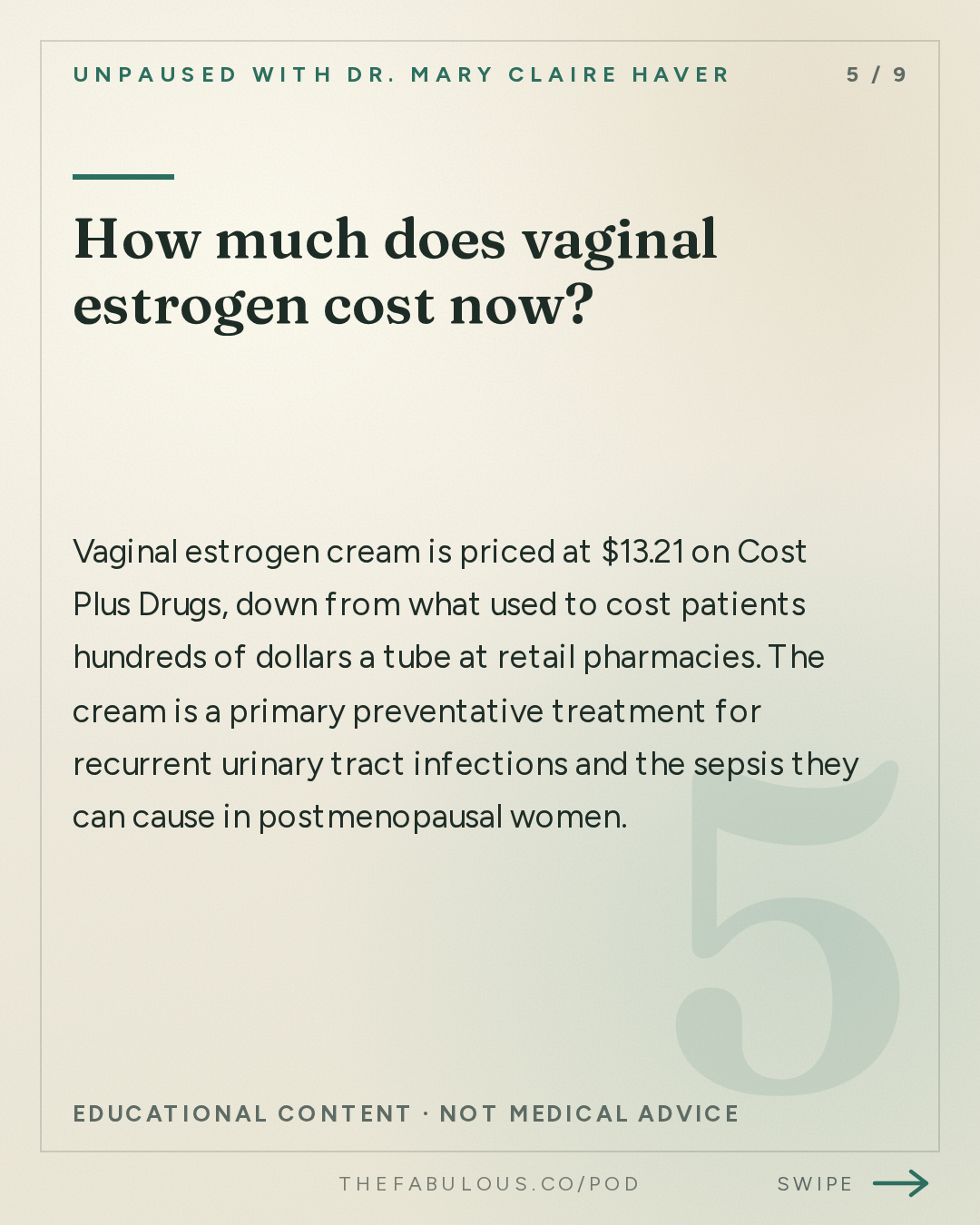
How much does vaginal estrogen cost now?
Vaginal estrogen cream is priced at $13.21 on Cost Plus Drugs, down from what used to cost patients hundreds of dollars a tube at retail pharmacies (37:03). The cream is a primary preventative treatment for recurrent urinary tract infections and the sepsis they can cause in postmenopausal women (37:03).
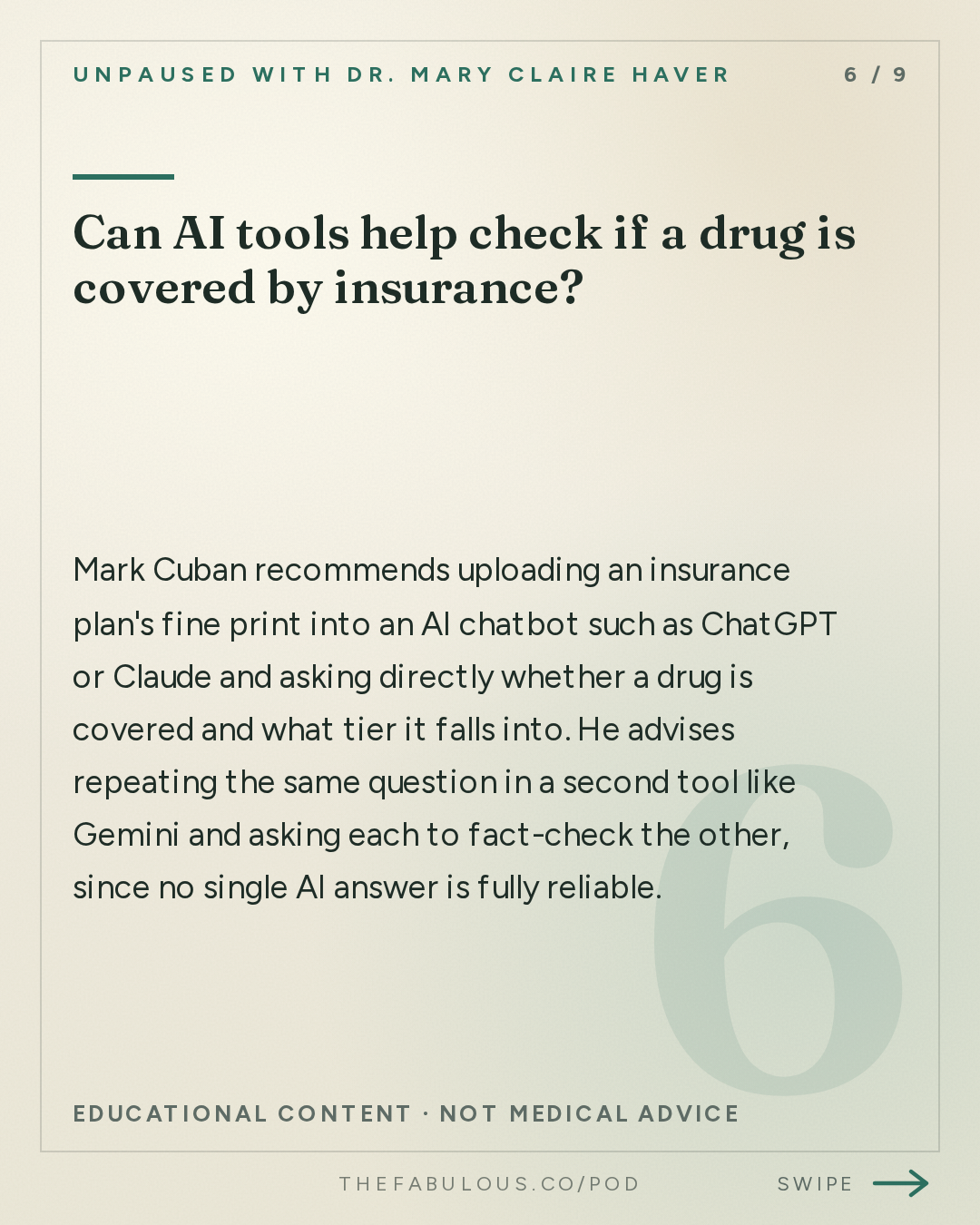
Can AI tools help check if a drug is covered by insurance?
Mark Cuban recommends uploading an insurance plan's fine print into an AI chatbot such as ChatGPT or Claude and asking directly whether a drug is covered and what tier it falls into (53:48). He advises repeating the same question in a second tool like Gemini and asking each to fact-check the other, since no single AI answer is fully reliable (55:13).
How much of NIH funding goes to women's health research?
Less than 9% of NIH grant money went to women's health research over the last decade, a figure Dr. Mary Claire Haver and Mark Cuban discuss as part of a broader pattern of underfunded research, including an average seven to ten year wait for an endometriosis diagnosis (00:20, 45:36).
The full read, in cards
Go deeper
- FDA open hearing on testosterone for women — Eight hours of clinician and patient testimony on the lack of an FDA-approved testosterone product for women
- NIH grant funding data on women's health — Shows less than 9% of NIH grant money went to women's health research over the last decade
Mentioned
Mark Cuban · Dr. Mary Claire Haver · Mark Cuban Cost Plus Drug Company · CVS · Aetna · Caremark · Red Oak · FDA · NIH · Dr. Rachel Rubin · Dr. Allison Galvani · ChatGPT · Claude · Gemini
More from this show and category
Postpartum OCD vs Psychosis: Key Differences
Postpartum OCD causes unwanted, intrusive thoughts about harming a baby, not a desire to act. CNN anchor Pamela Brown and OB-GYN Dr. Mary Claire Haver distinguish it from postpartum psychosis, a break from reality involving voices (42:59), and cover GLP-1 fertility effects, testosterone therapy, and vaginal estrogen's role preventing UTIs (35:52).
How Menopause Affects Gut Health and Bloating
Menopause changes gut health because falling estrogen slows motility, raises pain sensitivity, and shifts the microbiome's estrobolome. Harvard gastroenterologist Trisha Pasricha explains why bloating, IBS, and fecal incontinence rise after menopause, and lays out fiber, screening, and bidet protocols that actually help.
Menopause Skin Changes: What Actually Helps
Dermatologist Erica Kelly tells Dr. Mary Claire Haver that menopausal skin needs lighter Botox doses, daily sunscreen, and realistic expectations for collagen and hair treatments. Hormone therapy may preserve skin firmness for decades, oral minoxidil treats hair loss but causes a two-month shed, and vaginal moisturizers differ from lubricants.
Menopause Skin Changes: Causes and Fixes
Menopause triggers a 30% collagen loss in skin within five years, driven by falling estrogen and steady testosterone levels. Dermatologist Erica Kelly explains the barrier breakdown behind dryness and jawline acne, and recommends sunscreen and retinoids as the best-evidenced treatments, with topical estriol and spironolactone for targeted fixes.
