unPAUSED with Dr. Mary Claire Haver
Menopause Skin Changes: What Actually Helps
Menopause Skin Treatments: Botox, Lasers and Lifestyle
▶ Listen to the full episode More from unPAUSED with Dr. Mary Claire Haver
The brief
Dermatologist Erica Kelly tells Dr. Mary Claire Haver that menopausal skin needs lighter Botox doses, daily sunscreen, and realistic expectations for collagen and hair treatments. Hormone therapy may preserve skin firmness for decades, oral minoxidil treats hair loss but causes a two-month shed, and vaginal moisturizers differ from lubricants.
A dermatologist can sometimes guess, just by looking at a patient's skin, whether she started hormone therapy at menopause. Dermatologist Erica Kelly says this happens often enough in her Galveston practice that she now asks. "If I have a woman that comes in to see me who is in their 70s, 80s, 90s that looks... her skin looks really good for her age, and there's, like, not a lot of sagging, I always ask and usually discover that she was placed on hormones at menopause," she tells Dr. Mary Claire Haver on unPAUSED (21:37). It is an anecdote, not a trial, but it sets the tone for the whole conversation: skin is not vanity, it is a readable record of what has happened inside the body.
Kelly starts where most people actually live, which is sunscreen. There are two families. Chemical sunscreens absorb into skin and convert ultraviolet light into heat. That is why they need a head start: Kelly tells listeners to apply them 30 minutes before going outside, so the active ingredients have time to penetrate (00:46). Mineral sunscreens, made from zinc oxide or titanium dioxide, sit on the surface and scatter light instead of absorbing it. They used to be chalky and white; now they are micronized and tinted. Kelly's actual rule cuts through the debate over which is better. "The bottom line is I recommend the one you will use. So if I recommend some sticky sunscreen that you hate and you're not gonna apply it, I'd much rather you apply one that you like and not burn," she says (01:51).
The stakes behind that advice are higher than cosmetic. Ultraviolet light is an officially classified carcinogen. It causes a signature DNA mutation called a pyrimidine dimer, a kink in the genetic code that the body usually repairs (03:44). Kelly illustrates how much that repair matters with a rare genetic disease, xeroderma pigmentosum, in which one broken enzyme leaves patients unable to fix that UV damage. The result is a 10,000-fold increase in non-melanoma skin cancer (04:09). Nobody in the audience has that mutation, but everybody is running the same repair machine, just with a working copy.
From there the conversation turns to routine-building, and Kelly offers a simple frame: mornings protect, evenings treat. "I think of morning as more your protect. You're protecting with your antioxidant and your sunscreen. In the evening, I think of it more as your treat," she says, describing a basic sequence of cleanser, retinoid, and moisturizer at night (06:31).
What the Evidence Actually Supports
Inside that basic structure sit newer ingredients with thinner data. Exosomes, which Kelly uses herself in a product called Plated, are nano-sized vesicles that cells use to communicate with each other. Small studies, strongest in platelet-derived versions, suggest they can upregulate the genes for collagen and elastin (08:00). A newer category, including a product called ReQ that Kelly is personally trialing, claims to work on the same mTOR pathway that the longevity drug rapamycin targets, though she is candid that there is no published data behind it yet (09:45).
Collagen supplements get a more interesting treatment, because Kelly says her own opinion has shifted. She used to assume collagen, a large protein, would simply get broken down into amino acids in the gut and never reach the skin. New research complicates that: small collagen fragments called di- and tripeptides do cross the gut barrier and turn up in skin tissue (11:07). A 2023 meta-analysis of 26 randomized trials covering 1,700 women found statistically significant improvement in hydration and collagen production (11:26), and a larger analysis of roughly 7,000 patients found the same pattern (11:53). But a 2025 reanalysis flagged some of the underlying trials as industry-funded or low quality, and the benefit shrank once those were removed. Kelly's honest summary: the evidence trends toward benefit, but it is not settled (12:20).
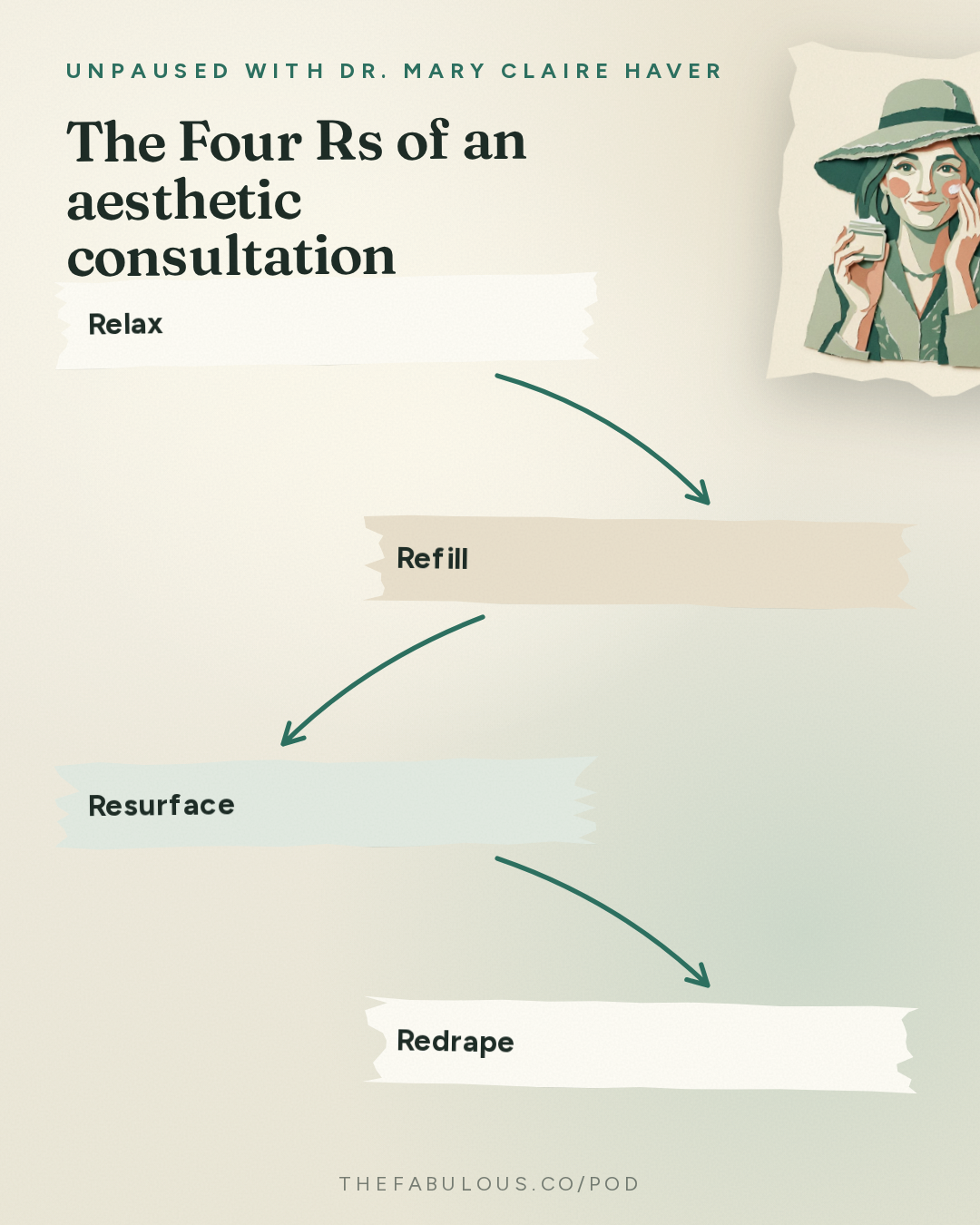
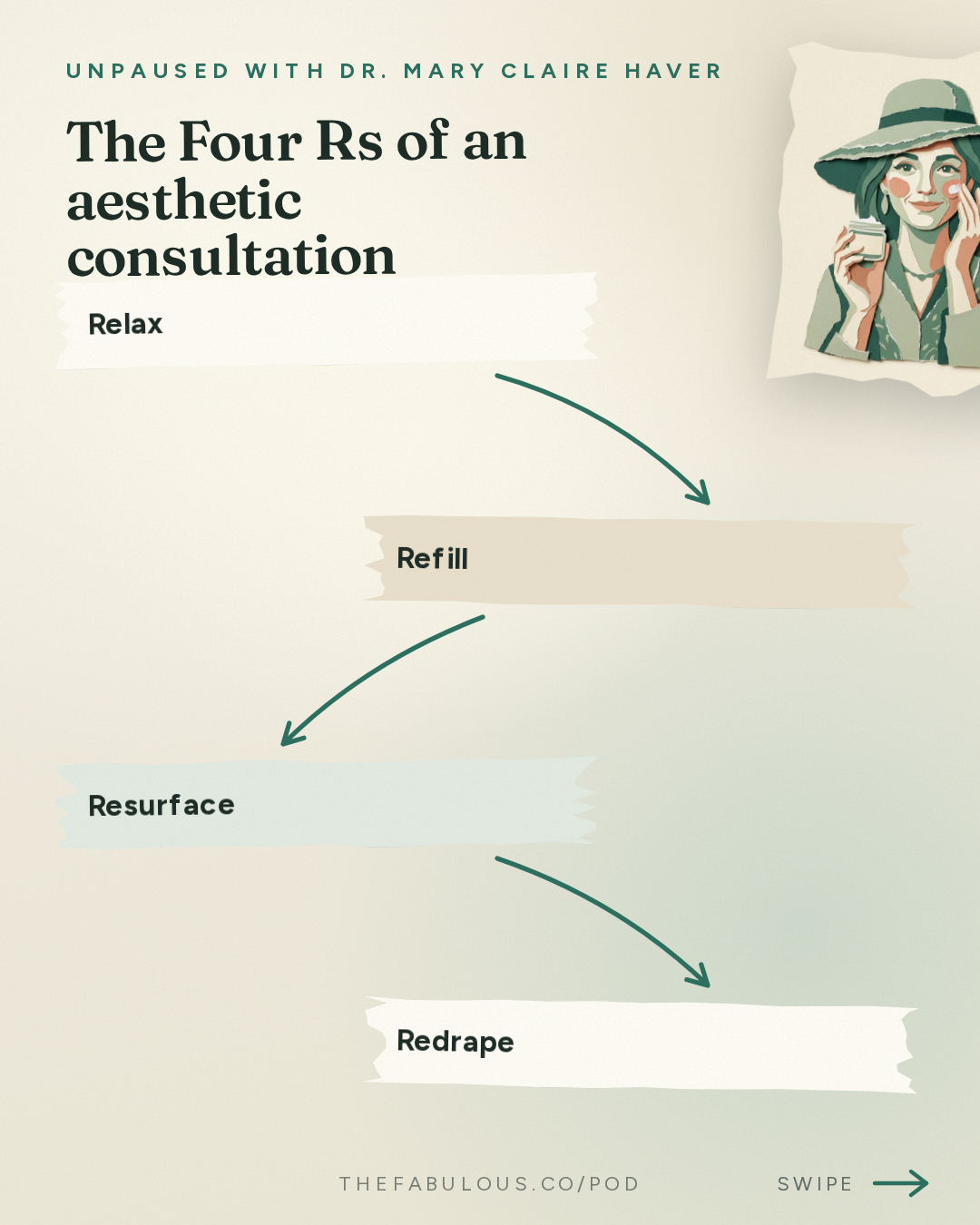
For in-office work, Kelly organizes consultations around what she calls the Four Rs: relax muscles with a neuromodulator like Botox, refill lost volume with filler, resurface the skin surface with peels or lasers, or redrape loose skin surgically (13:26). Menopause changes the calculus on the first of those. The frontalis is the only muscle that lifts the eyebrows, so as skin loses elasticity, injectors have to be more conservative with forehead Botox or patients lose the ability to raise their brows and see clearly (15:43). Kelly treats the muscles that pull brows down, the corrugators and orbicularis oculi, more aggressively, so the brow "floats up" instead of being flattened. She also notes that Botox technique has matured since the early 2000s, moving away from the frozen look toward lower, more natural doses sometimes called micro Botox (19:53).
Beyond the Face
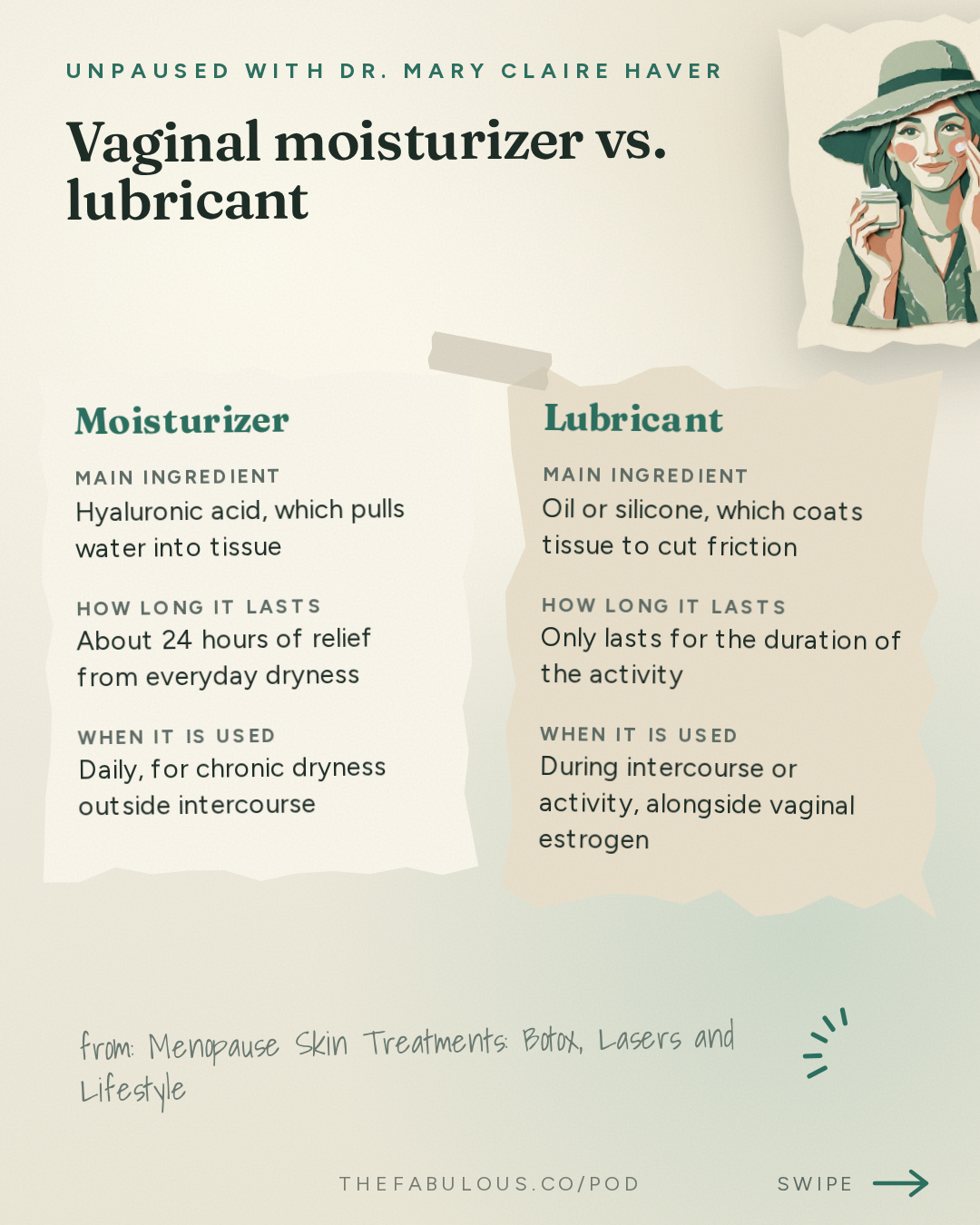
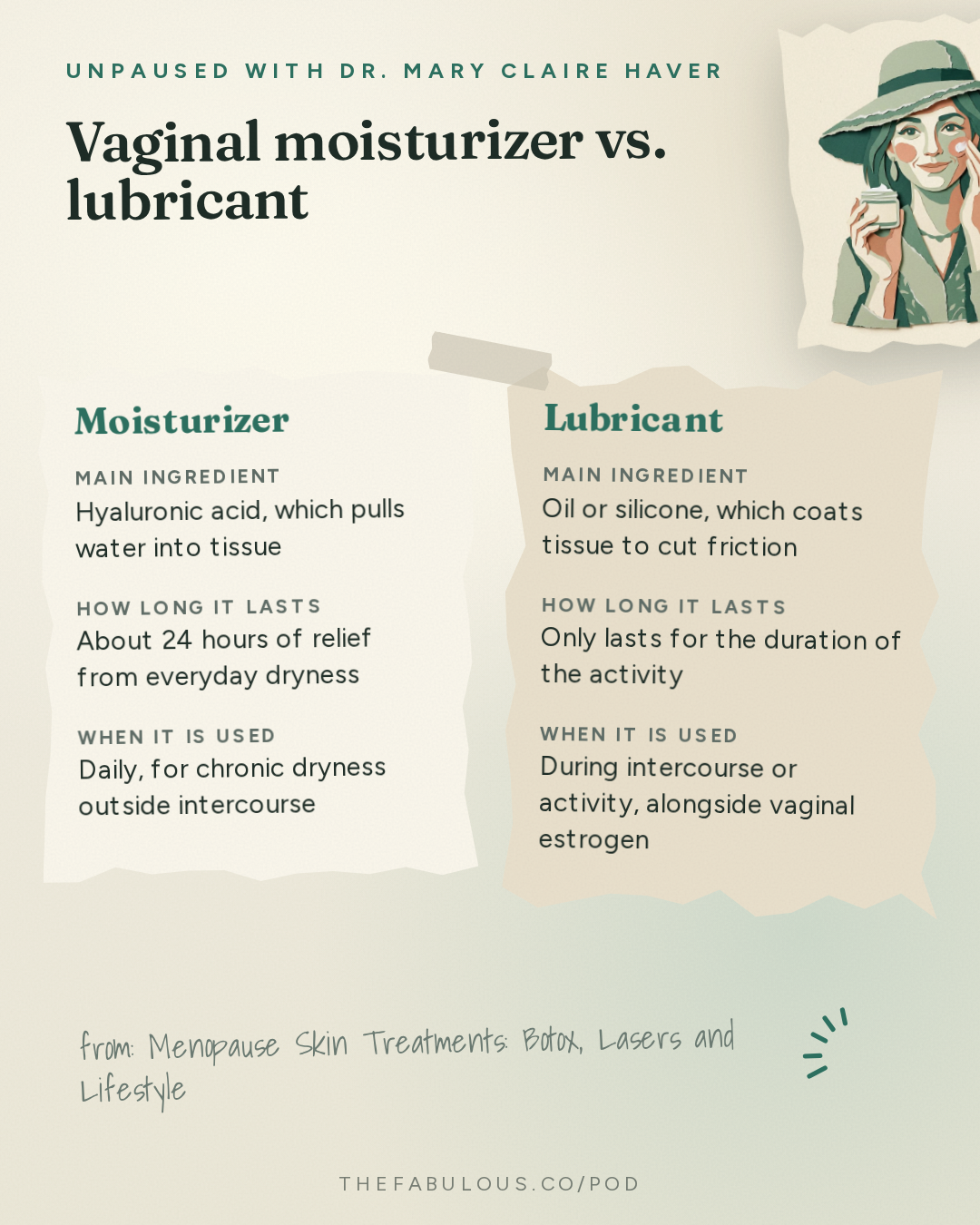
Menopause's effect on tissue is not limited to the face. Kelly says it is most pronounced in the vulvovaginal area, and she draws a distinction many patients, and even many dermatologists, have never heard: a vaginal moisturizer is not a lubricant. A moisturizer is essentially hyaluronic acid, which pulls water into tissue and gives roughly 24 hours of relief from everyday dryness (24:11). A lubricant is oil- or silicone-based and reduces friction during activity. Kelly's position is that every woman should consider a lubricant during menopause, even if she is already using vaginal estrogen, because estrogen treats tissue health but does not replace lubrication (23:53).
Diet enters the picture through sugar. Refined sugar binds to proteins in skin through a process called glycation, the same chemical reaction, the Maillard reaction, that browns meat in a pan or darkens self-tanner. It stiffens collagen and elastin fibers so they cannot form their normal triple helix, producing a sallow, less resilient complexion. "Sugars, refined sugars can cause glycation. They will bind to the proteins in our skin and make them more stiff. That's the Maillard reaction," Kelly explains (25:15). Sleep matters through a different mechanism: disrupted sleep raises cortisol, which suppresses collagen production and increases inflammation (26:23). Skin even appears to carry its own circadian clock, run by light-sensing opsin cells similar to those in the retina (26:44).
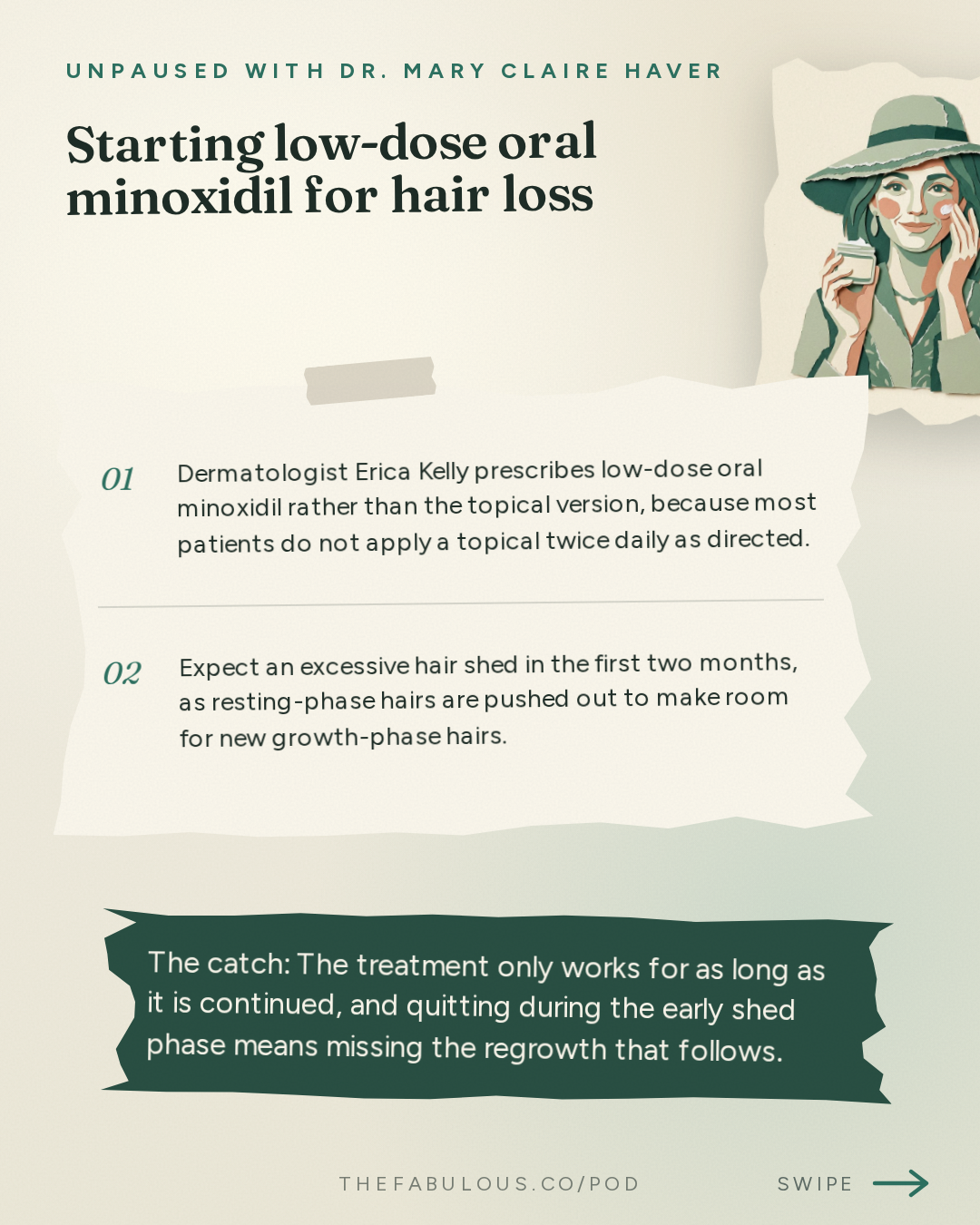
Hair loss closes the episode, and the numbers are stark. By age 50, about 50% of women show some degree of androgenetic alopecia, the medical term for pattern hair loss. By 70 that rises to 70%, and by 80 it is nearly universal (28:40). The mechanism runs through estrogen: as estrogen declines, more testosterone converts to DHT (dihydrotestosterone), which miniaturizes hair follicles and shortens the growth phase. Kelly's preferred treatment, which she takes herself, is low-dose oral minoxidil rather than the topical version most people know as Rogaine, because patients rarely apply topical minoxidil consistently enough for it to work (29:49). The catch is psychological as much as physical: starting oral minoxidil triggers a shed of resting hairs for about two months before new growth phase hairs come in, and patients who quit during that window never see the benefit (31:15).
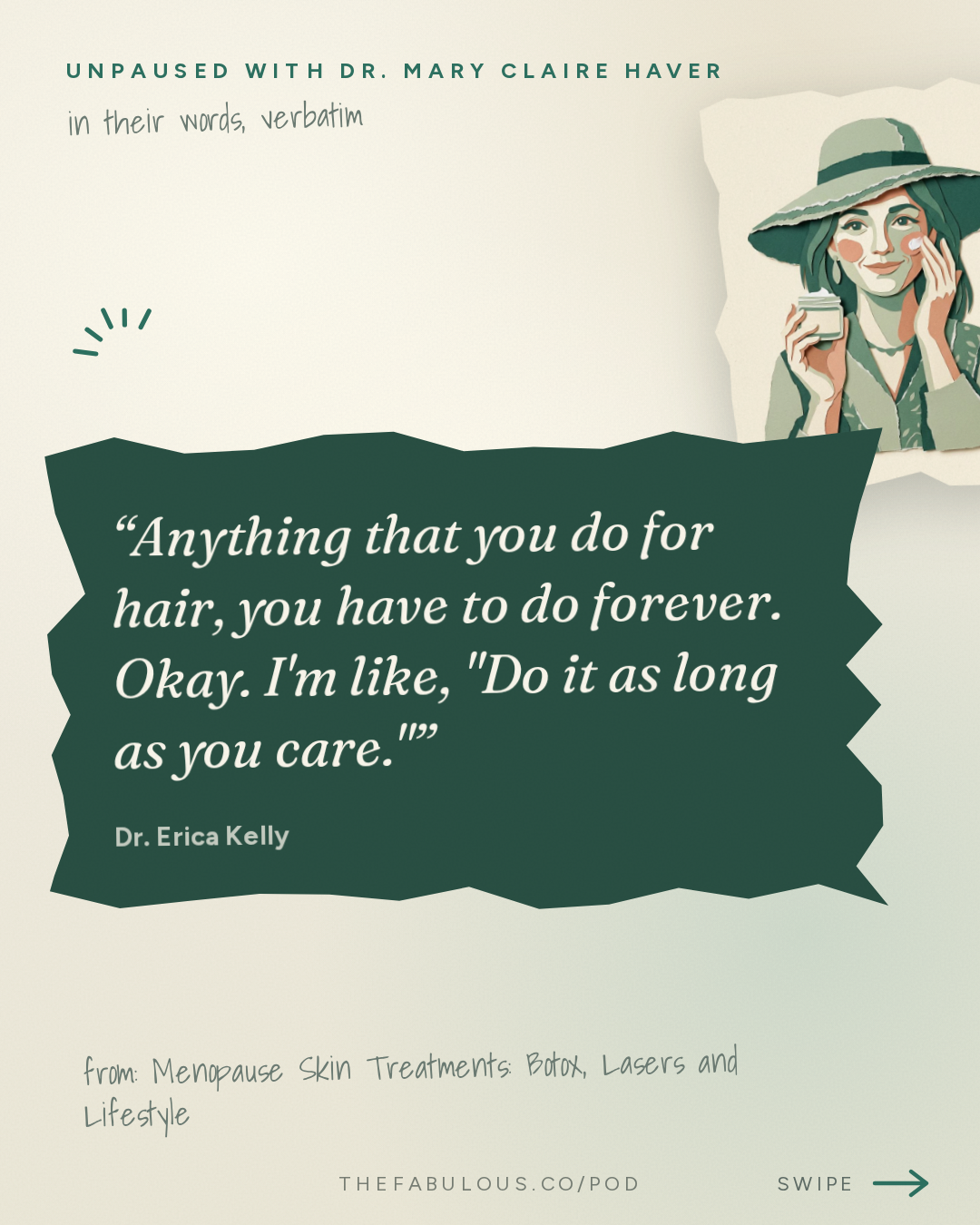
What ties the whole conversation together is a kind of patience that runs against the instant-results culture around skincare ads. "Anything that you do for hair, you have to do forever. I'm like, 'Do it as long as you care,'" Kelly says (31:34). The same logic applies to sunscreen, to Botox, to hormone therapy. None of it reverses time. All of it, applied consistently, changes what time does to the body.
Ask this episode anything
Pod's AI answers from the episode itself, with the minute mark so you can hear it yourself.
Or start with one of these
Ask this episode
Pod's AI listens to the whole episode to answer, and points you to the minute it comes from.
The rest of this answer, and any question after it
Answers come from the episode itself, never from a summary of it.
ContinueKey takeaways
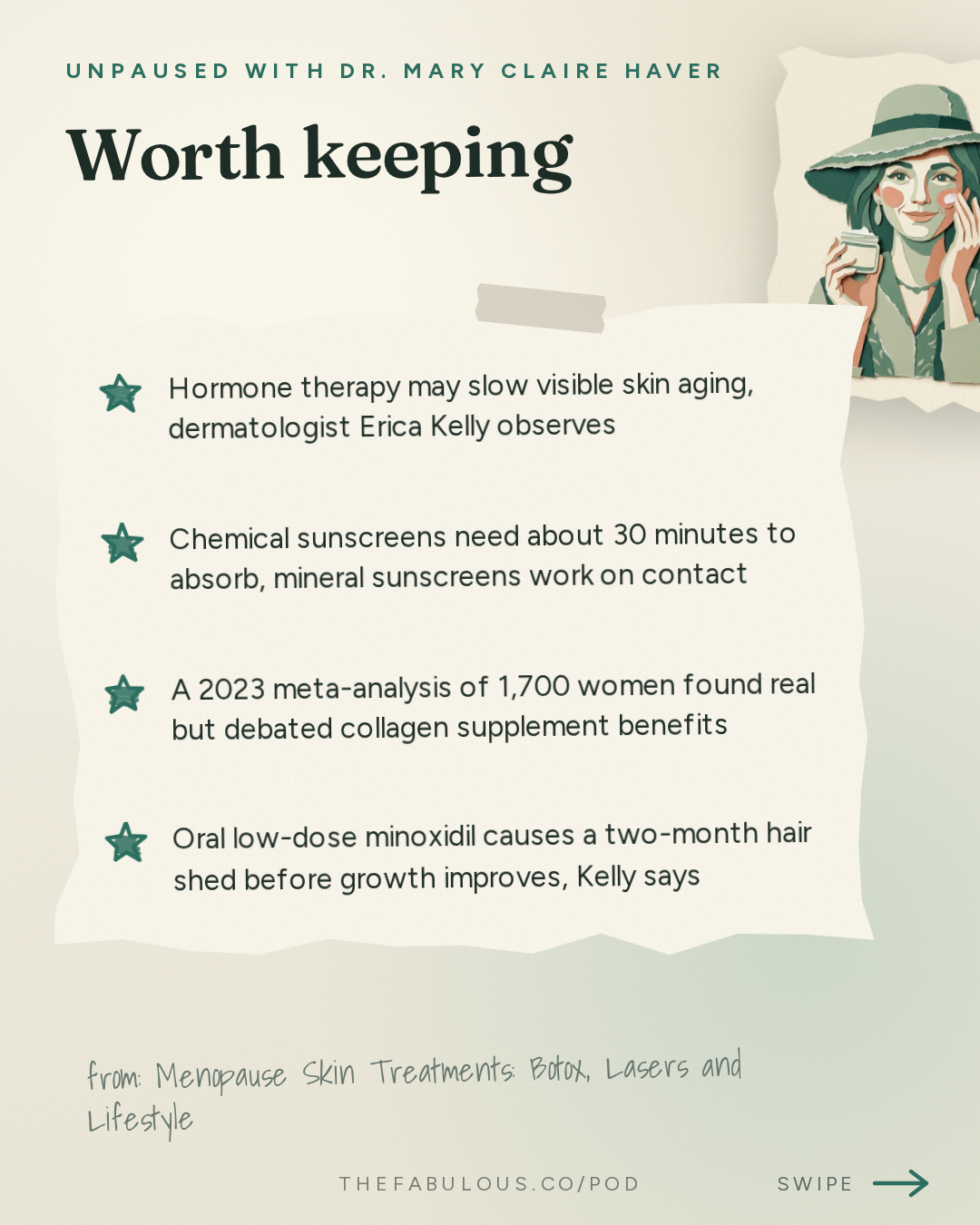
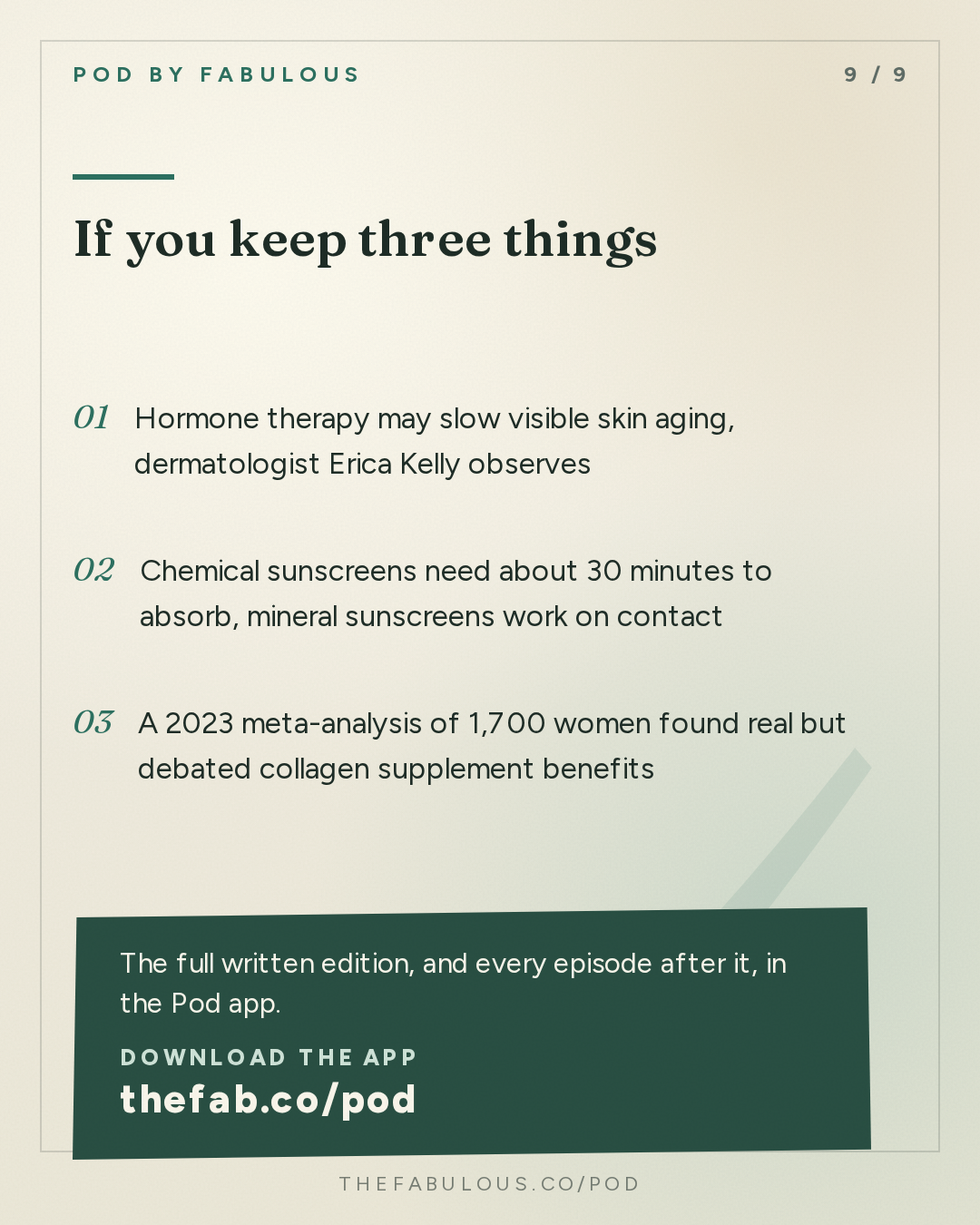
- Hormone therapy may slow visible skin aging, dermatologist Erica Kelly observes
- Chemical sunscreens need about 30 minutes to absorb, mineral sunscreens work on contact
- A 2023 meta-analysis of 1,700 women found real but debated collagen supplement benefits
- Oral low-dose minoxidil causes a two-month hair shed before growth improves, Kelly says
- Half of women show pattern hair loss by age 50, rising to 70% by age 70
The episode in cards

By the numbers
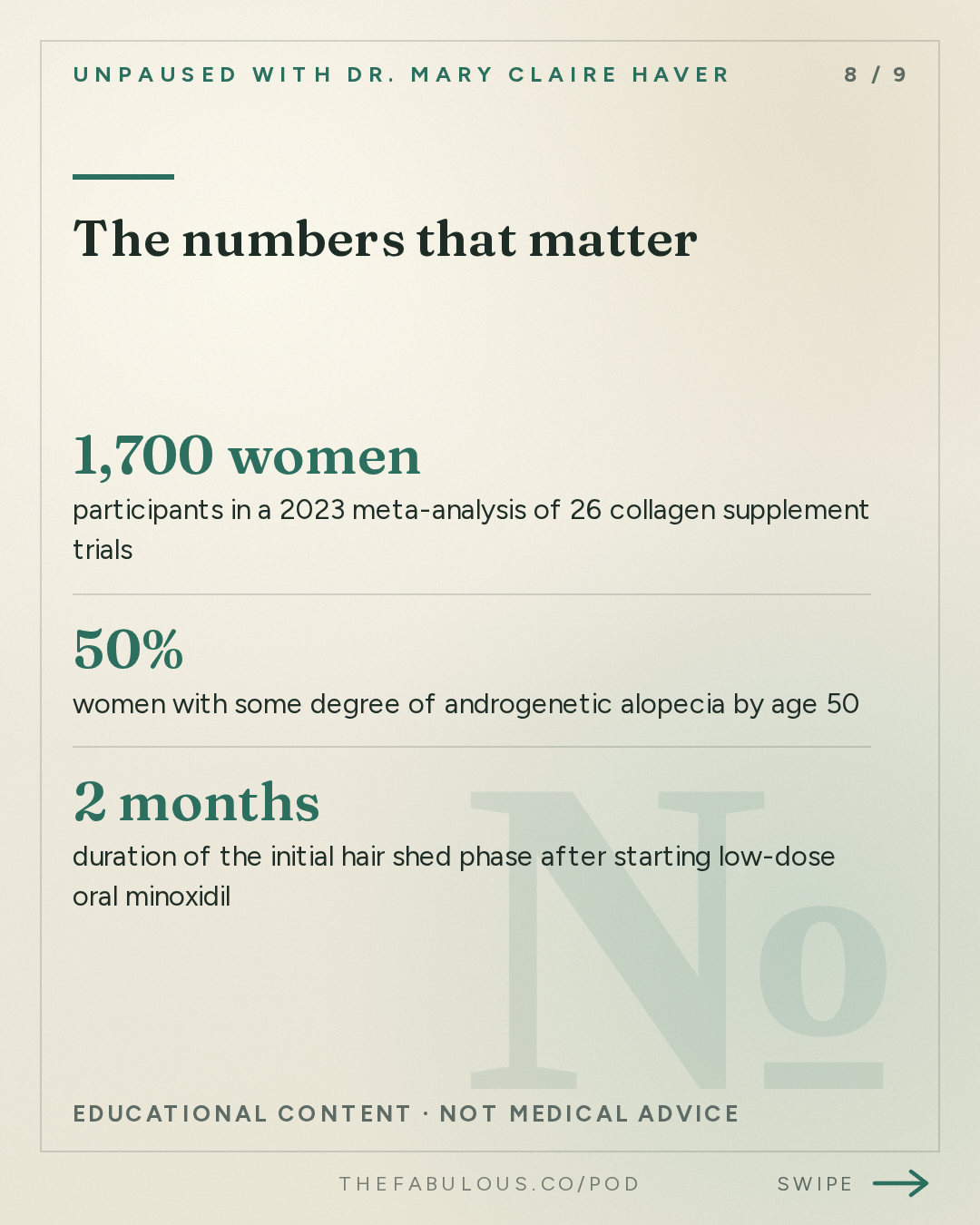
- 1,700 women participants in a 2023 meta-analysis of 26 collagen supplement trials
- 50% percent women with some degree of androgenetic alopecia by age 50
- 2 months duration of the initial hair shed phase after starting low-dose oral minoxidil
In their words
“The bottom line is I recommend the one you will use. So if I recommend some sticky sunscreen that you hate and you're not gonna apply it, I'd much rather you apply one that you like- Mm-hmm ... and not”
“If I have a woman that comes in to see me who is in their 70s, 80s, 90s that looks... her skin looks really good for her age, and there's, like, not a lot of sagging, I always ask and usually discover that she was placed on hormones at menopause.”
“Sugars, refined sugars can cause glycation. Mm-hmm. So, um, they will bind to the proteins in our skin and make them more stiff. That's”
“Anything that you do for hair, you have to do forever. Okay. I'm like, "Do it as long as you care."”
Protocols
-
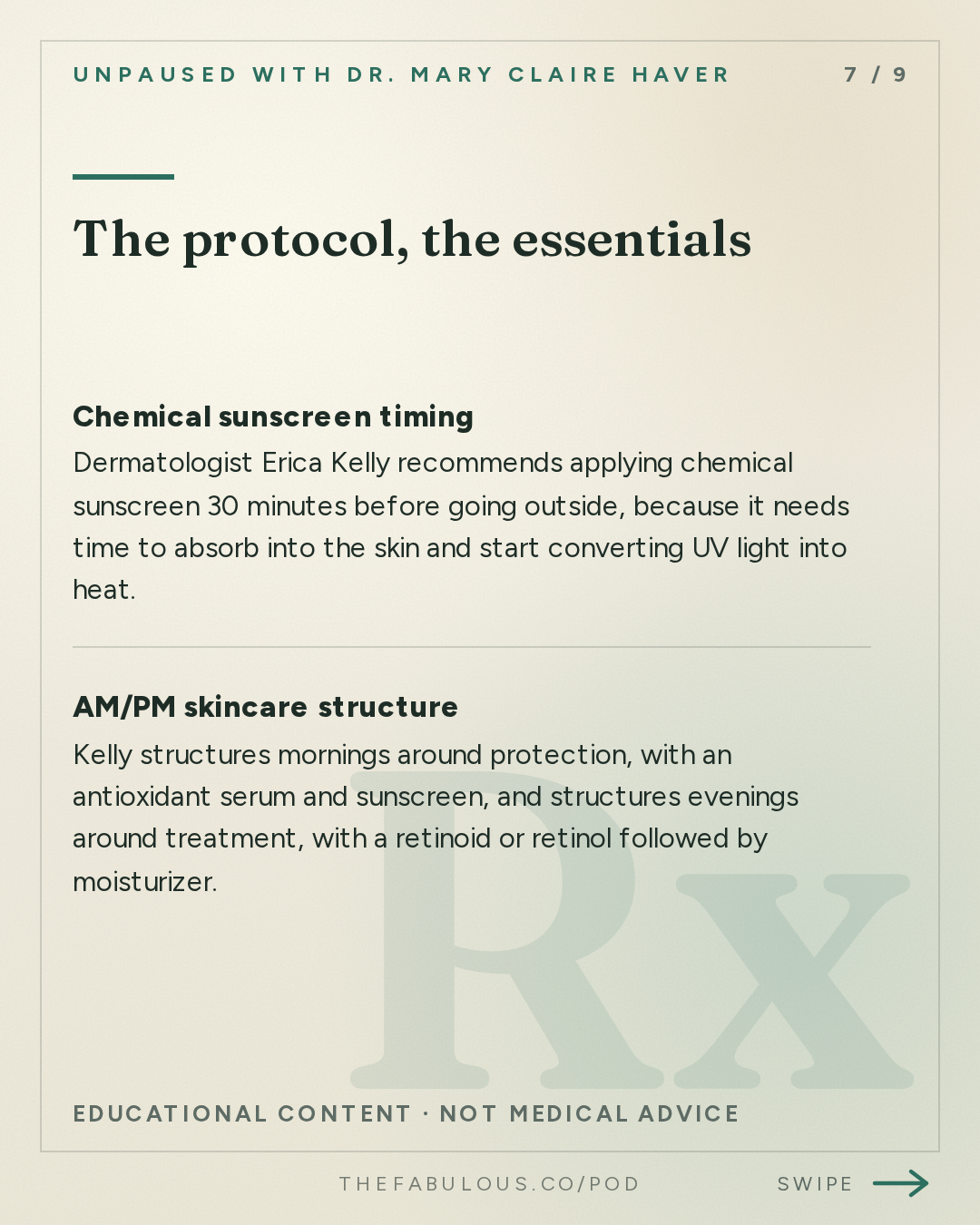
Chemical sunscreen timing
Dermatologist Erica Kelly recommends applying chemical sunscreen 30 minutes before going outside, because it needs time to absorb into the skin and start converting UV light into heat.
every time before sun exposure
-
AM/PM skincare structure
Kelly structures mornings around protection, with an antioxidant serum and sunscreen, and structures evenings around treatment, with a retinoid or retinol followed by moisturizer.
daily, twice a day
-
Conservative forehead Botox after menopause
Kelly lowers forehead Botox doses in postmenopausal patients and treats the brow depressor muscles more fully instead, because the frontalis is the only muscle that lifts the brow and thinning skin leaves less room for error.
ongoing, adjusted at each visit
-
Pair vaginal estrogen with a lubricant
Kelly recommends every menopausal woman consider a lubricant in addition to vaginal estrogen, because vaginal estrogen treats tissue health but does not reduce friction the way a lubricant does.
as needed with activity
-
Oral minoxidil for hair loss
Kelly prescribes low-dose oral minoxidil for menopausal hair loss and tells patients to expect an excessive shed for about two months, which signals the hair is transitioning into its growth phase, and to continue treatment since stopping early means losing the benefit.
daily, ongoing indefinitely
Questions this episode answers
Does hormone therapy help menopausal skin?
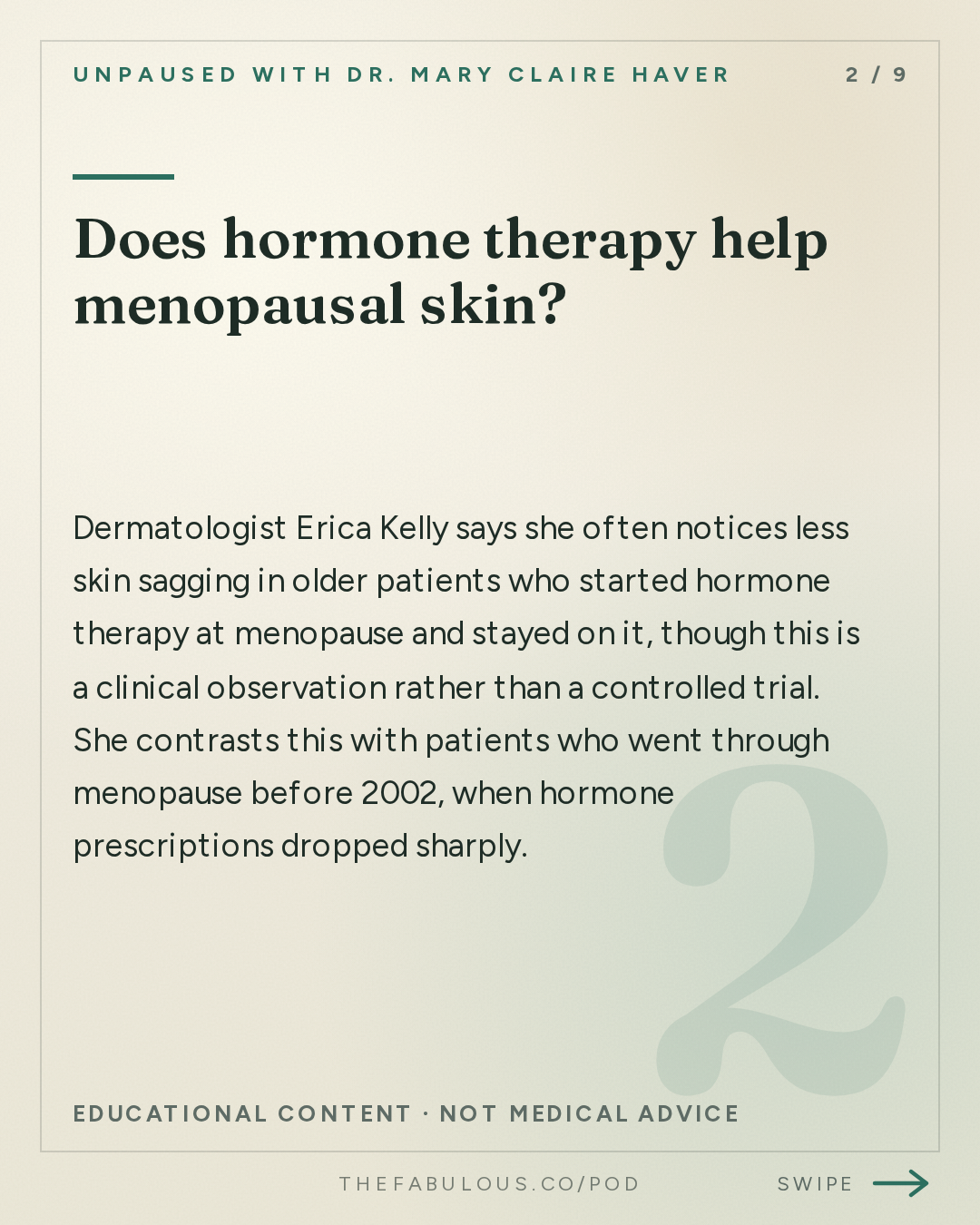
Dermatologist Erica Kelly says she often notices less skin sagging in older patients who started hormone therapy at menopause and stayed on it, though this is a clinical observation rather than a controlled trial (21:37). She contrasts this with patients who went through menopause before 2002, when hormone prescriptions dropped sharply.
Do collagen supplements actually work for skin?
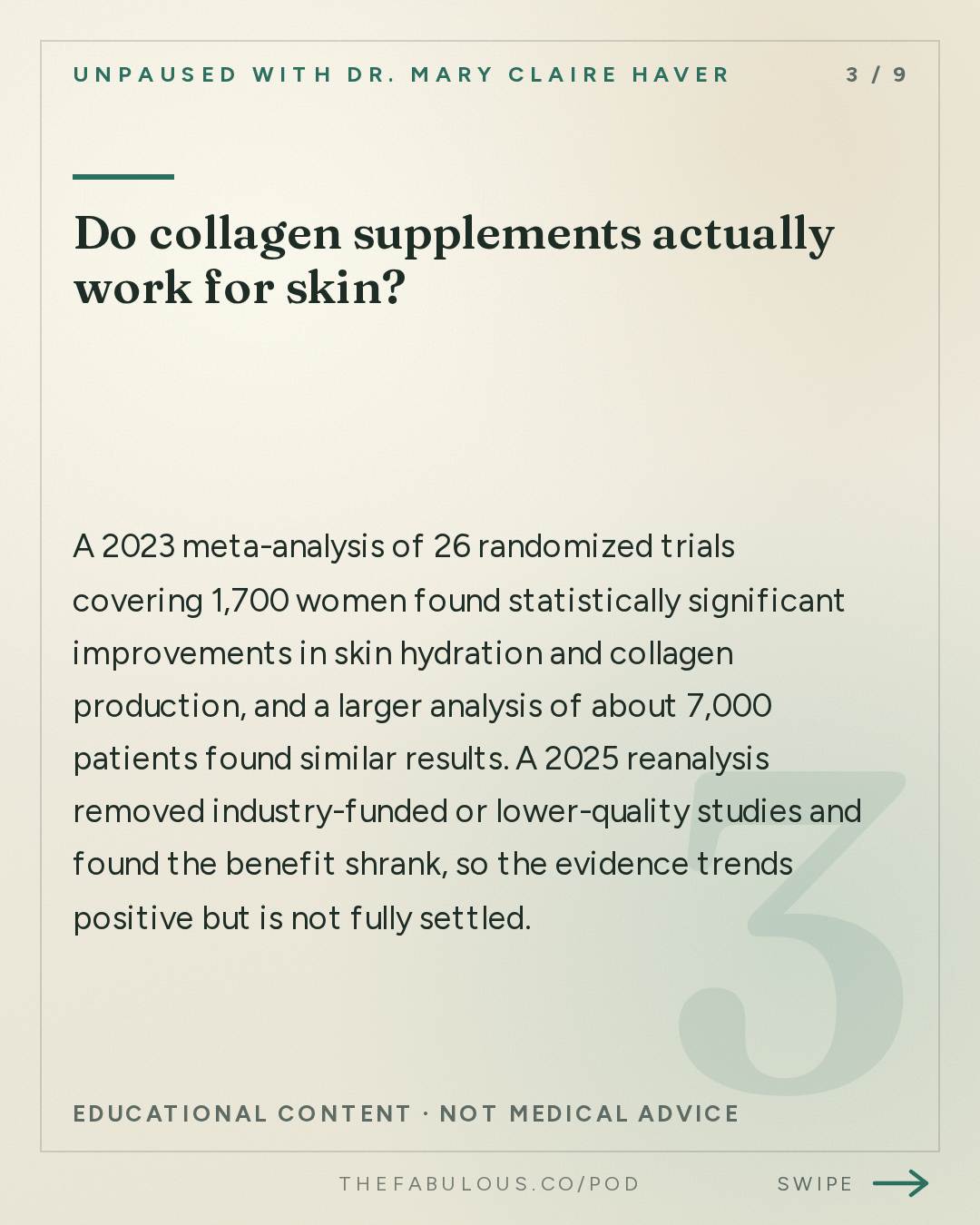
A 2023 meta-analysis of 26 randomized trials covering 1,700 women found statistically significant improvements in skin hydration and collagen production (11:26), and a larger analysis of about 7,000 patients found similar results (11:53). A 2025 reanalysis removed industry-funded or lower-quality studies and found the benefit shrank, so the evidence trends positive but is not fully settled (12:20).
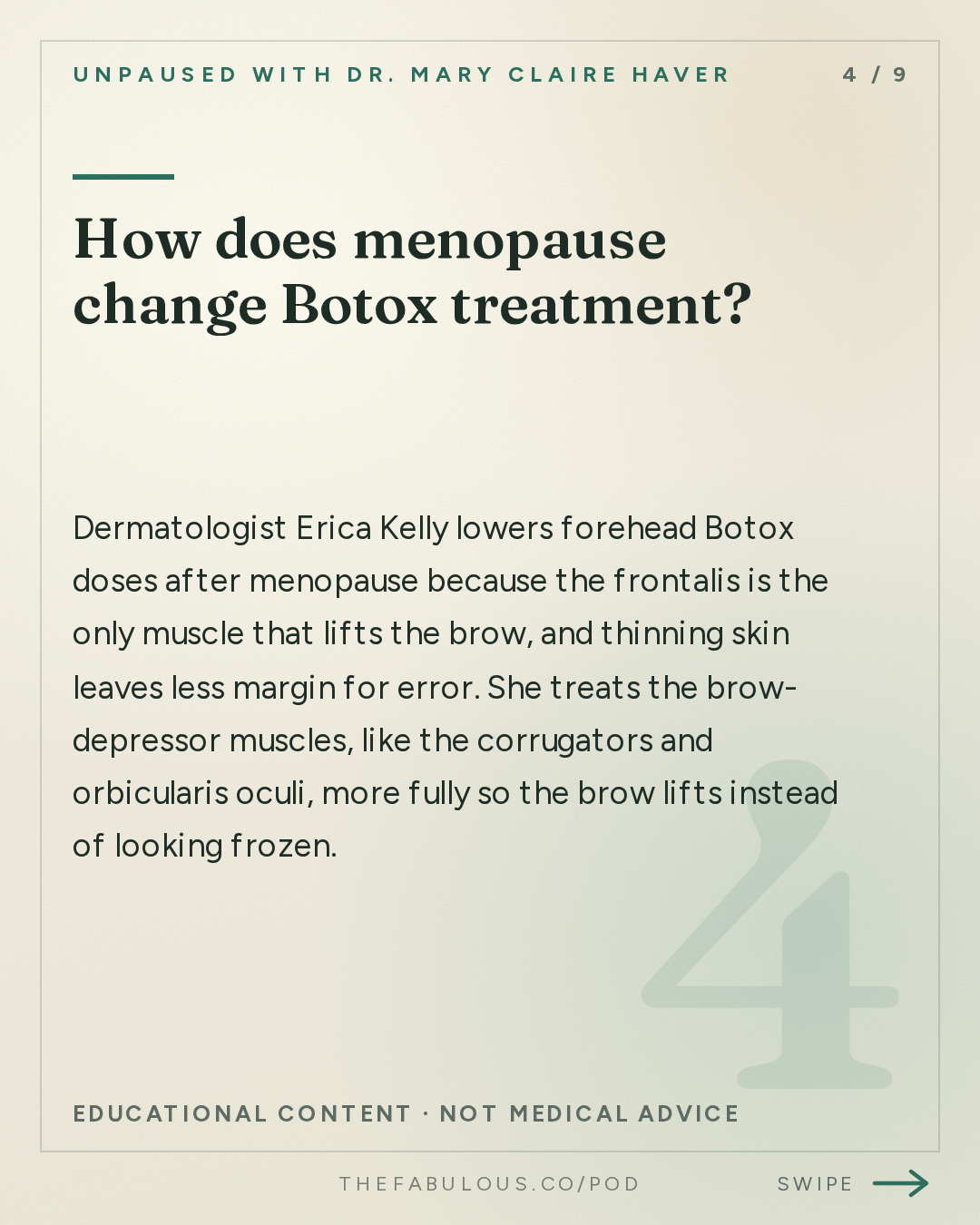
How does menopause change Botox treatment?
Dermatologist Erica Kelly lowers forehead Botox doses after menopause because the frontalis is the only muscle that lifts the brow, and thinning skin leaves less margin for error (15:43). She treats the brow-depressor muscles, like the corrugators and orbicularis oculi, more fully so the brow lifts instead of looking frozen.
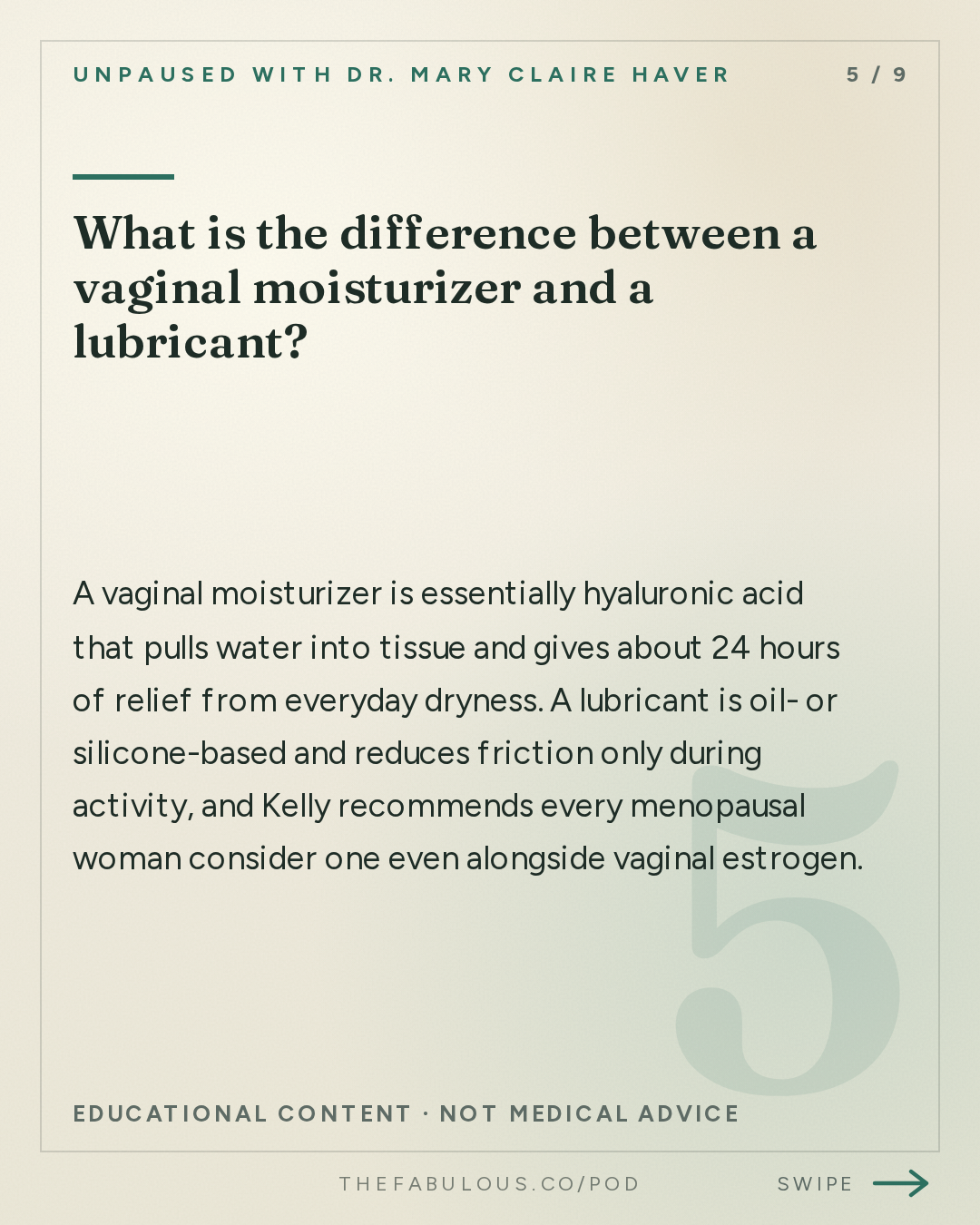
What is the difference between a vaginal moisturizer and a lubricant?
A vaginal moisturizer is essentially hyaluronic acid that pulls water into tissue and gives about 24 hours of relief from everyday dryness (24:11). A lubricant is oil- or silicone-based and reduces friction only during activity, and Kelly recommends every menopausal woman consider one even alongside vaginal estrogen (23:53).
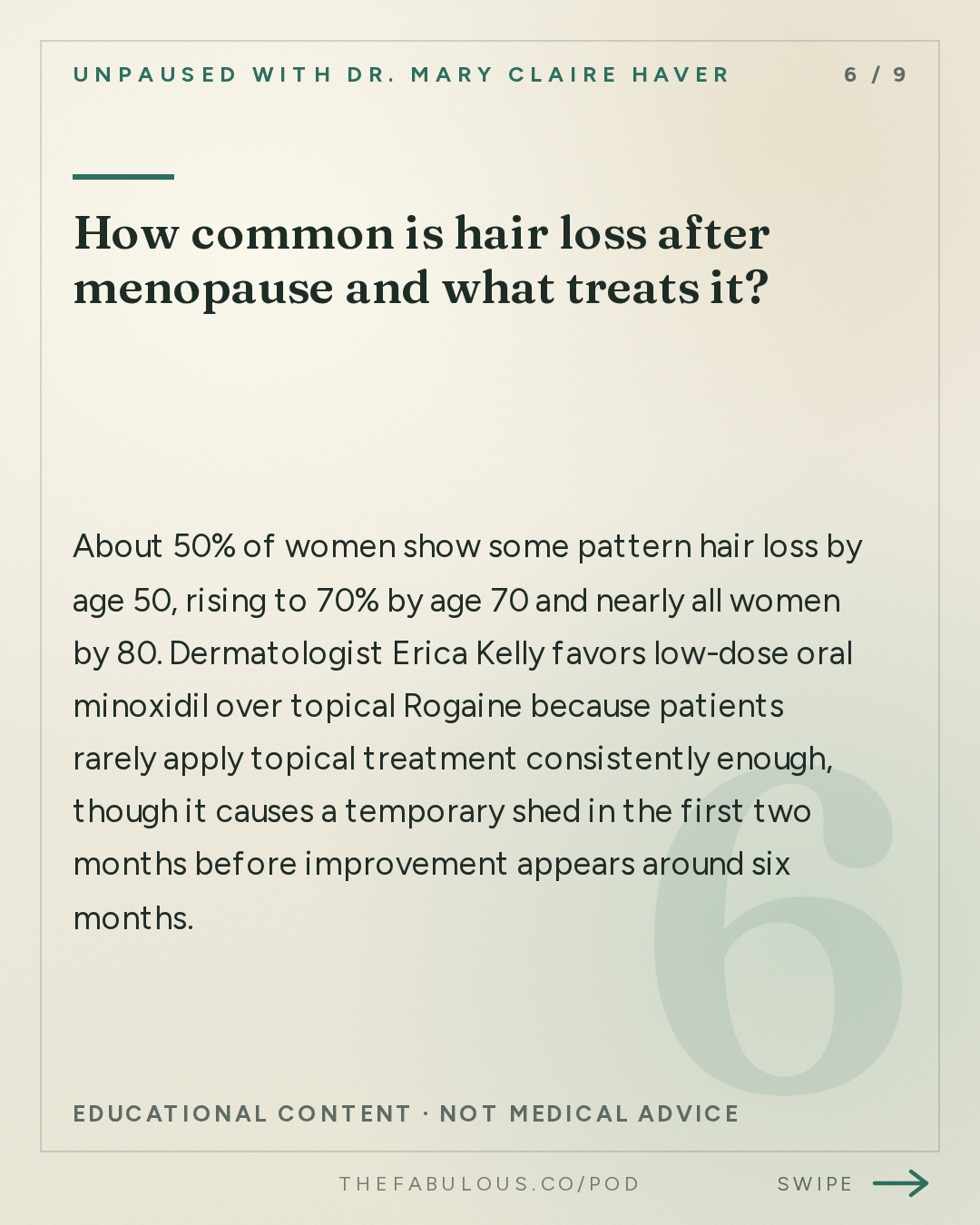
How common is hair loss after menopause and what treats it?
About 50% of women show some pattern hair loss by age 50, rising to 70% by age 70 and nearly all women by 80 (28:40). Dermatologist Erica Kelly favors low-dose oral minoxidil over topical Rogaine because patients rarely apply topical treatment consistently enough, though it causes a temporary shed in the first two months before improvement appears around six months (31:15).
The full read, in cards
Go deeper
- 2023 meta-analysis of 26 randomized trials on collagen supplementation — found statistically significant improvement in skin hydration and collagen production across 1,700 women
- 2025 meta-analysis reassessing collagen supplement trials — removed industry-funded or low-quality studies and found the benefit shrank
Mentioned
Dr. Erica Kelly · CeraVe · La Roche-Posay · SkinCeuticals · SkinMedica · ISDIN · Botox · Minoxidil · Rogaine · Fraxel · AmLactin · Plated · ReQ · Xeroderma pigmentosum
More from this show and category
Menopause Skin Changes: Causes and Fixes
Menopause triggers a 30% collagen loss in skin within five years, driven by falling estrogen and steady testosterone levels. Dermatologist Erica Kelly explains the barrier breakdown behind dryness and jawline acne, and recommends sunscreen and retinoids as the best-evidenced treatments, with topical estriol and spironolactone for targeted fixes.
Gabrielle Lyon: Muscle Is the Longevity Organ
Dr. Gabrielle Lyon argues that skeletal muscle, not body fat, is the organ that determines how well women age. She explains that muscle drives glucose disposal, releases hormone-like myokines, and needs at least 100 grams of daily protein plus resistance training to stay healthy after midlife.
Protein Needs for Muscle in Menopause: Dr. Lyon's Guide
Dr. Gabrielle Lyon says women need 30 to 50 grams of protein in their first meal after an overnight fast to switch on muscle building. She explains why aging muscle grows resistant to protein and exercise, why resistance training beats hormone therapy for long-term independence, and why suppressing mTOR is the wrong longevity strategy.
Why Lifting Heavy Was Called Dangerous
In 1985 a panel of obstetricians banned pregnant women from raising their heart rate past 140 beats per minute, a number invented by consensus, not data (00:01). The same pattern, rules built on vibes rather than evidence, shaped a century of bans on heavy lifting for women, children, and anyone squatting below parallel, until later studies quietly reversed nearly all of them.
