unPAUSED with Dr. Mary Claire Haver
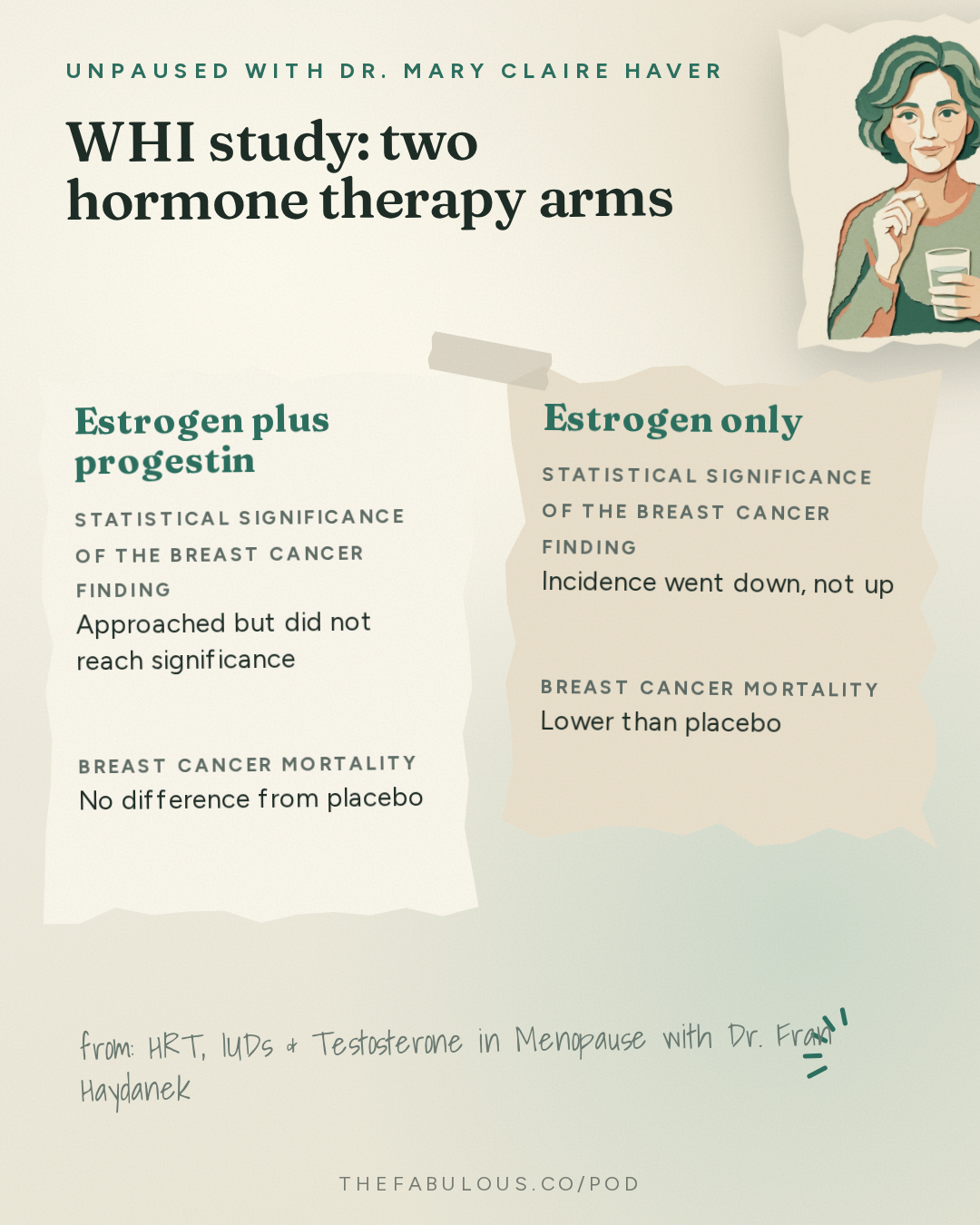
IUD for Perimenopause Symptoms and HRT
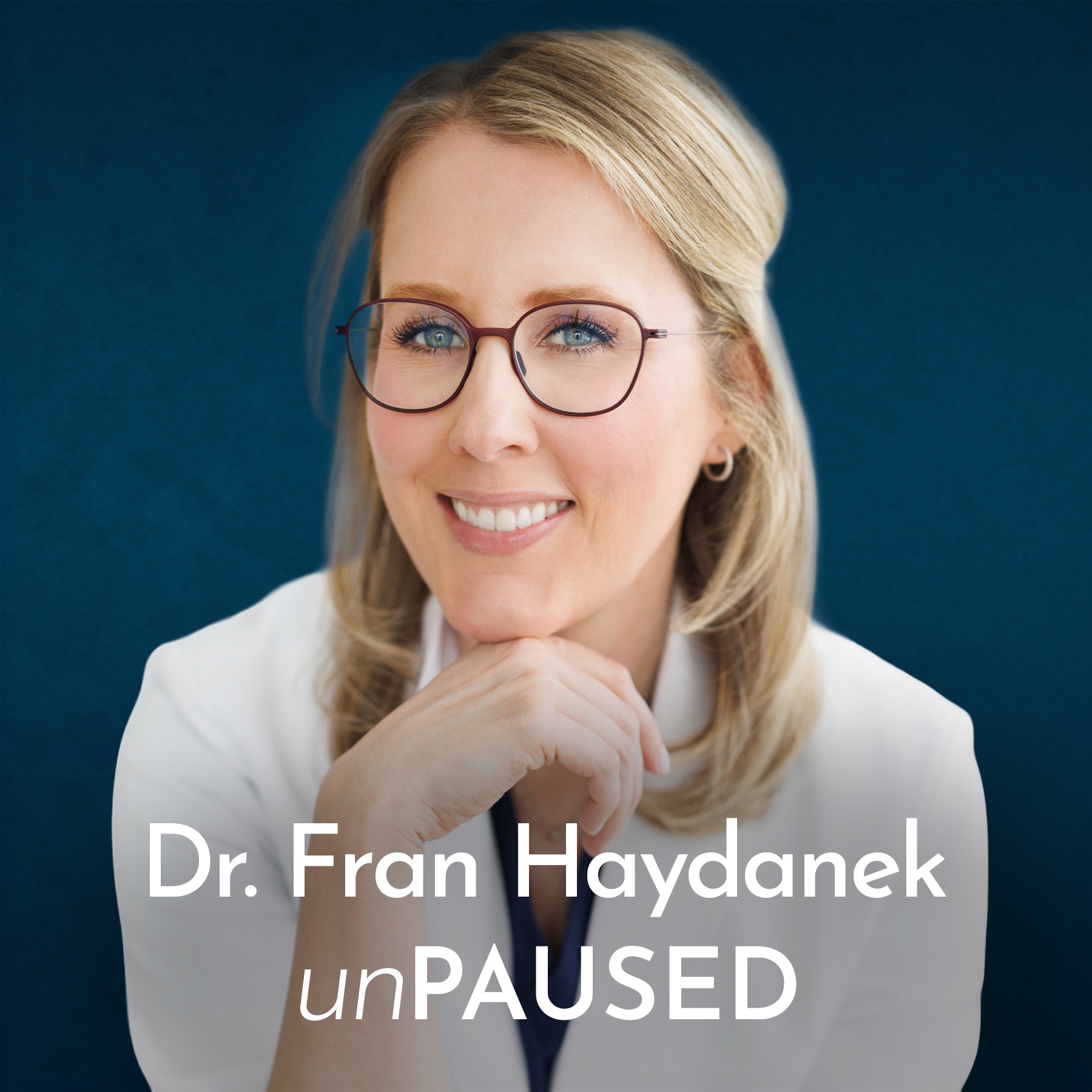
HRT, IUDs & Testosterone in Menopause with Dr. Fran Haydanek
▶ Listen to the full episode More from unPAUSED with Dr. Mary Claire Haver
The brief
An IUD thins the uterine lining, protects it during hormone therapy, and prevents pregnancy, a three-in-one fix for perimenopause. OB-GYN Dr. Fran Haydanek also flags abnormal bleeding as a cancer red flag, notes PCOS raises endometrial cancer risk five times, and cites WHI data showing only nine extra breast cancers per 10,000 women yearly on combined hormone therapy.
A woman can be eight months postpartum, exhausted, still bleeding on an unpredictable schedule, and nobody, not even her doctor, can say for certain whether her body is recovering from childbirth or already sliding into perimenopause, the years of hormonal turbulence before menopause. That ambiguity, it turns out, is not a gap in medicine. It is the whole terrain. In this conversation, OB-GYN Dr. Fran Haydanek, who also hosts the podcast I Did My Own Research, walks Dr. Mary Claire Haver through the signals that actually matter when a woman's cycle changes, and the ones that get dismissed.
When a Period Stops Being Just a Period
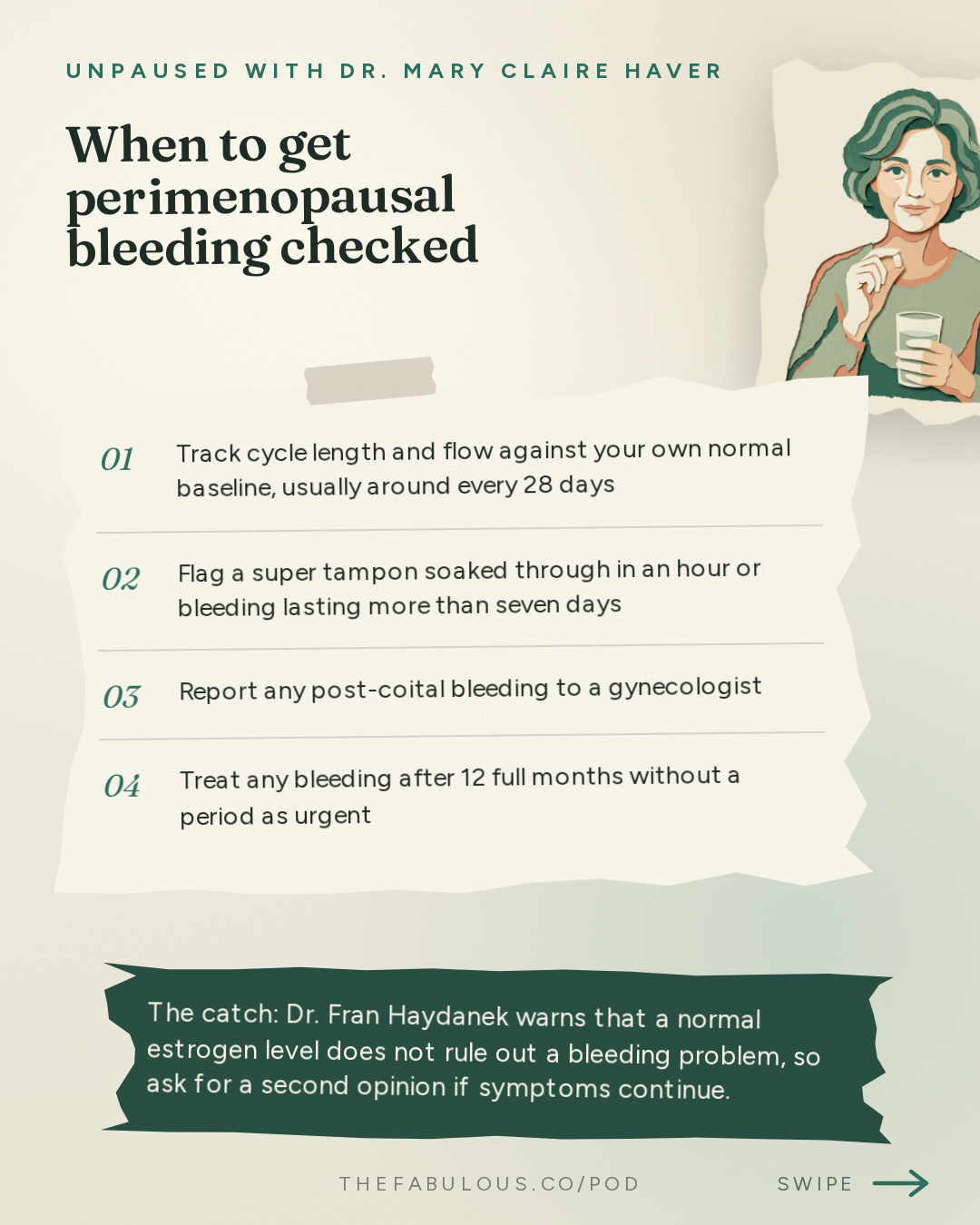
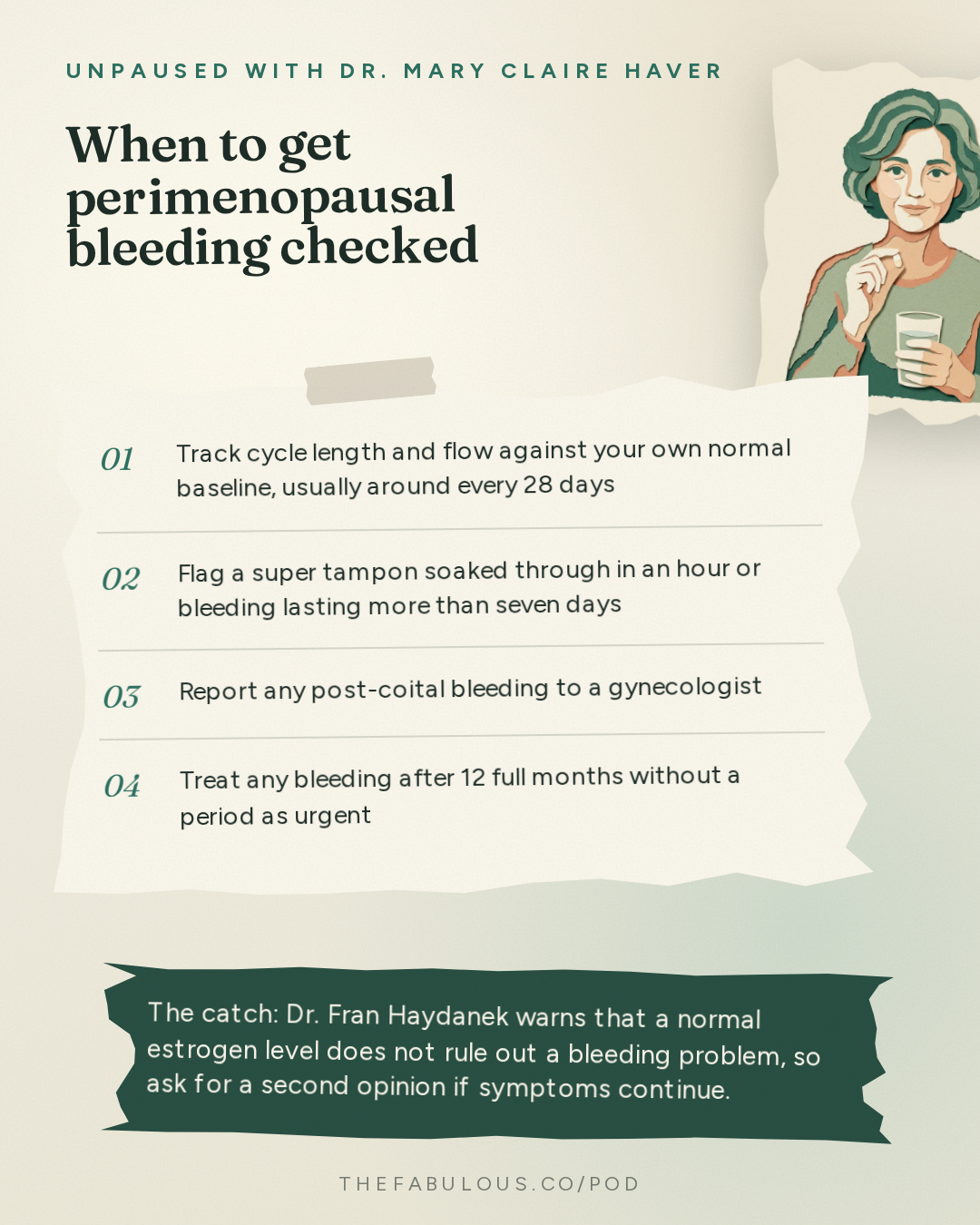
Haydanek starts with a baseline: a period every 28 days, lasting about three days, manageable with a few tampons, is the expected pattern for a woman without other conditions (00:53). What she watches for in perimenopause is change in either direction, longer or shorter cycles, and especially heavier bleeding. Her bright line is specific: soaking a super tampon every hour, or bleeding for seven days instead of three, is a signal to look for fibroids, polyps, or cancer, not just hormones spacing out (01:32). The stakes are sharper for women with PCOS, polycystic ovary syndrome, a hormonal condition marked by irregular ovulation. Haydanek says patients with PCOS have five times the risk of endometrial cancer before menopause, because chronic anovulation (not releasing an egg) lets the uterine lining build up unchecked (01:54). Any bleeding after twelve full months without a period, she adds, is a 100 percent reason to book a problem visit for an ultrasound and likely a tissue biopsy (03:15).
She is equally blunt about what a normal lab result should and should not settle.
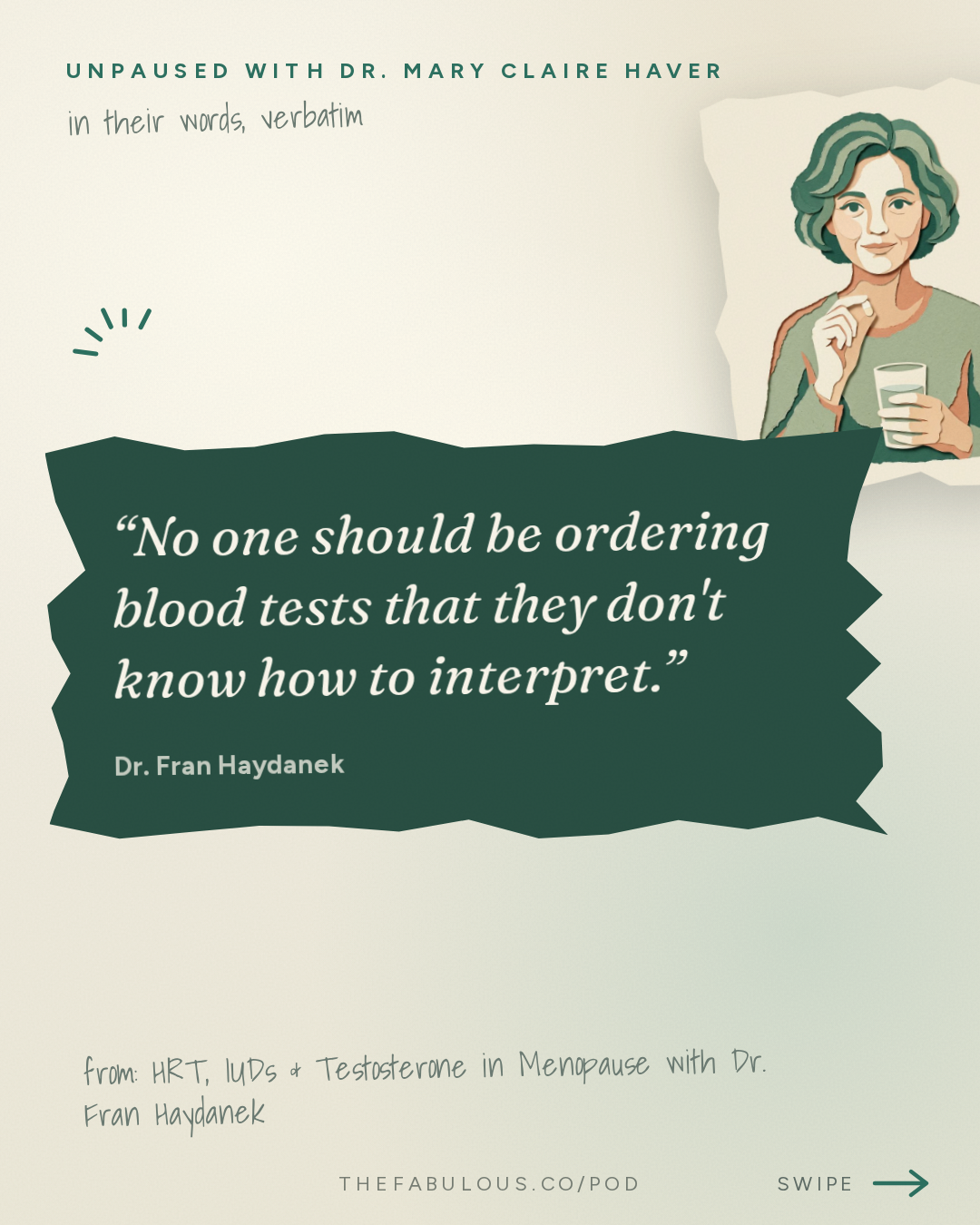
No one should be ordering blood tests that they don't know how to interpret.
— Dr. Fran Haydanek (03:49)
Her point is that a clinician who orders an estrogen level to appease a patient, without knowing how to read it in context, can leave a real problem unaddressed. A second opinion, she says, is always valid.
That same uncertainty shows up in a demographic shift: the birth rate for women aged 40 to 44 is now 12.7 per 1,000, the highest since 1965, meaning one in 24 American births is to a woman in that age band (05:48). Many of these women are postpartum and sliding into perimenopause at the same time, and Haydanek treats the overlap as both, not either/or, tailoring care to how recently someone gave birth and whether she is still breastfeeding (06:12). The same caution applies to the so called tired mom trap, where exhaustion, anxiety, and poor sleep in a woman's 40s get blamed on her schedule. Haydanek checks for sleep apnea and a low ferritin level (a measure of iron storage), both of which can mimic perimenopausal symptoms like hair loss and restless legs (09:38).
Contraception timing is another place where confusion causes real risk. Ovulation can still happen in perimenopause, so Haydanek tells patients not to treat the transition itself as birth control, and is equally direct that hormone therapy for symptoms is not a contraceptive: "It is not birth control. It is not a high enough dose to suppress ovulation" (12:45). The practical fix she reaches for constantly is an intrauterine device, or IUD. It thins the uterine lining, which eases heavy perimenopausal bleeding, it protects the uterus from the cancer risk of unopposed estrogen therapy, and it prevents pregnancy, three functions in one device (13:58). For symptoms beyond bleeding, she lays out a menu: estrogen patches paired with a progestin (micronized progesterone, an IUD, or another form) to protect the uterus, plus non-hormonal options like SSRIs, gabapentin, or the newer medication Veozah for patients who cannot or do not want hormones (15:49).
PCOS itself does not end at menopause, and Haydanek wants that remembered. "PMOS, I want people to remember, is a lifelong condition," she says, using the term interchangeably with PCOS (19:17). The insulin resistance and metabolic risk continue after ovulation stops, which means A1C, lipid panels, and blood pressure still need monitoring in menopause. The gap in care is stark: 10 to 20 percent of women have PCOS, yet there are zero FDA-approved medications for the condition itself (20:13). GLP-1 drugs, a class including semaglutide used for weight loss and blood sugar control, are helping some patients, though Haydanek tells those trying to conceive to stop them two months before attempting pregnancy, since safety in pregnancy has not been established (21:28).
Haver also walks through the Menopause Society's 2023 non-hormone position statement, which lists cognitive behavioral therapy, SSRIs, gabapentin, Veozah, and weight loss as supported options for hot flashes, and explicitly does not recommend exercise, yoga, dietary changes, or acupuncture for that purpose (22:06). Her read is not that those practices are worthless generally, but that a clinician who defaults to "try yoga" instead of naming hormone therapy as the gold standard may simply not know how to manage menopause, and should refer the patient to someone who does (24:41).
The Number Behind the Fear
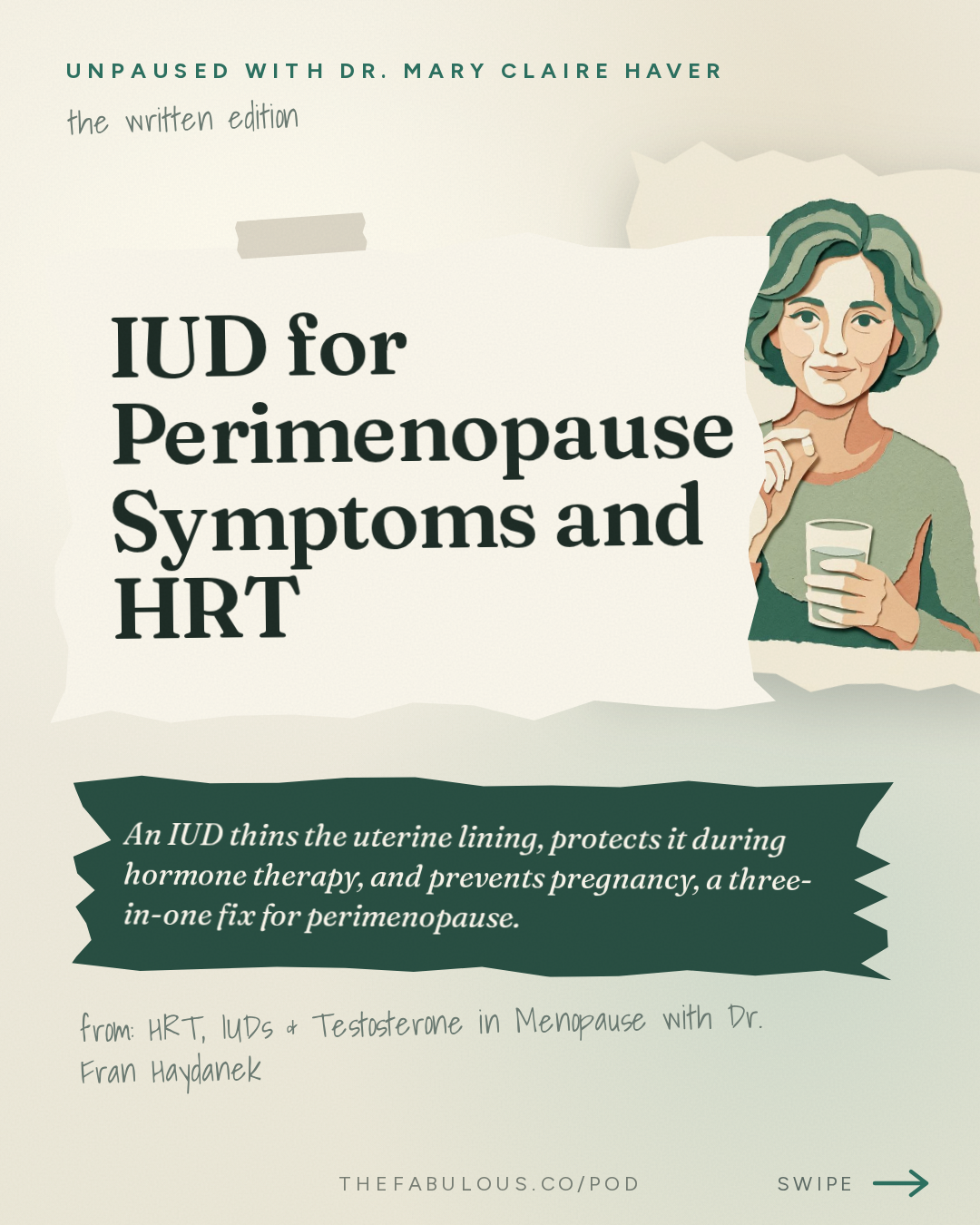
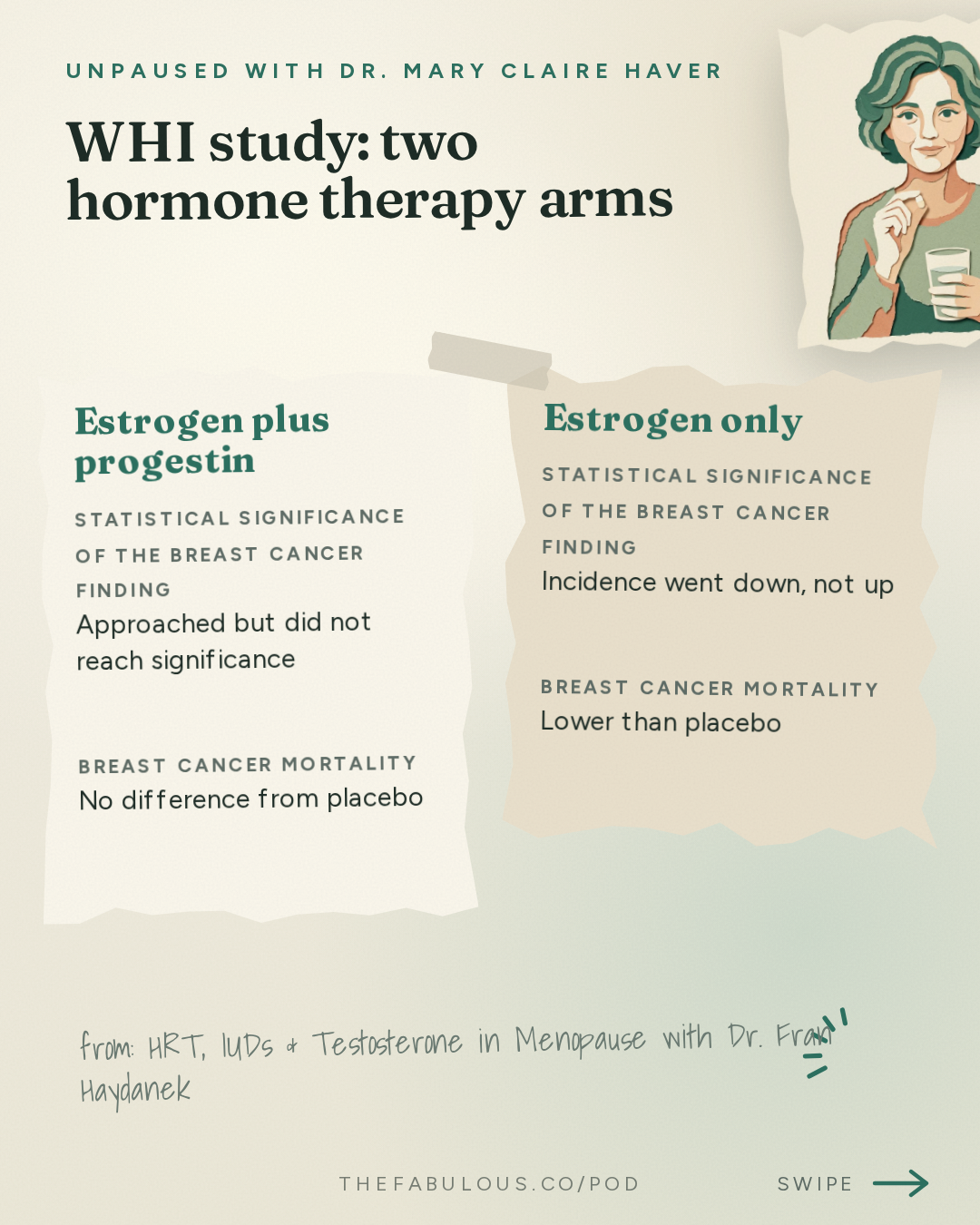
No topic carries more inherited fear than the Women's Health Initiative, or WHI, a large federal study from the early 2000s that shaped two decades of hormone therapy practice. Haver breaks down what it actually found: in the arm combining estrogen and a synthetic progestin, there were about nine extra breast cancer cases per 10,000 women per year compared with placebo, a difference that approached but did not reach statistical significance, with no difference in breast cancer mortality (28:41). In the estrogen-only arm, given to women without a uterus, breast cancer incidence was actually lower than placebo, 30 cases versus 37 per 10,000 (29:00). Haver, who was a chief resident when the study broke in 2002, has watched the fallout split along generational lines: younger patients, without the historical memory, tend to be more open to hormone therapy, while older patients who were pulled off medication decades ago are often angry.
I would be upset, too, if I was on a medication that really helped me and then my doctor told me, "You're gonna get cancer and you have to stop," and then 20 years later I'm still suffering.
— Dr. Fran Haydanek (30:16)
Her counseling approach is to replace a vague warning with the actual numbers, so a patient can weigh a small, specific risk against a daily quality of life she understands.
The conversation closes on a place where Haydanek thinks the internet got something right: pain during IUD insertions and endometrial biopsies. She traces part of the problem to history, IUDs were first studied mostly in women who had recently given birth, whose cervixes tolerate the procedure differently than those who have not (32:56). When patients without that history reported severe pain, Haydanek says, they were often not believed. Social media changed that, pushing ACOG, the American College of Obstetricians and Gynecologists, to finally issue pain management guidance only in the last year or two (34:18). Haydanek learned techniques like the paracervical block, a numbing injection around the cervix, from watching other physicians online rather than from her own residency training, where pain management for these procedures was simply not discussed (35:19). It is a small, specific example of a larger theme running through the hour: patients describing their own bodies loudly enough, for long enough, to change what medicine is willing to treat as real.
Ask this episode anything
Pod's AI answers from the episode itself, with the minute mark so you can hear it yourself.
Or start with one of these
Ask this episode
Pod's AI listens to the whole episode to answer, and points you to the minute it comes from.
The rest of this answer, and any question after it
Answers come from the episode itself, never from a summary of it.
ContinueKey takeaways
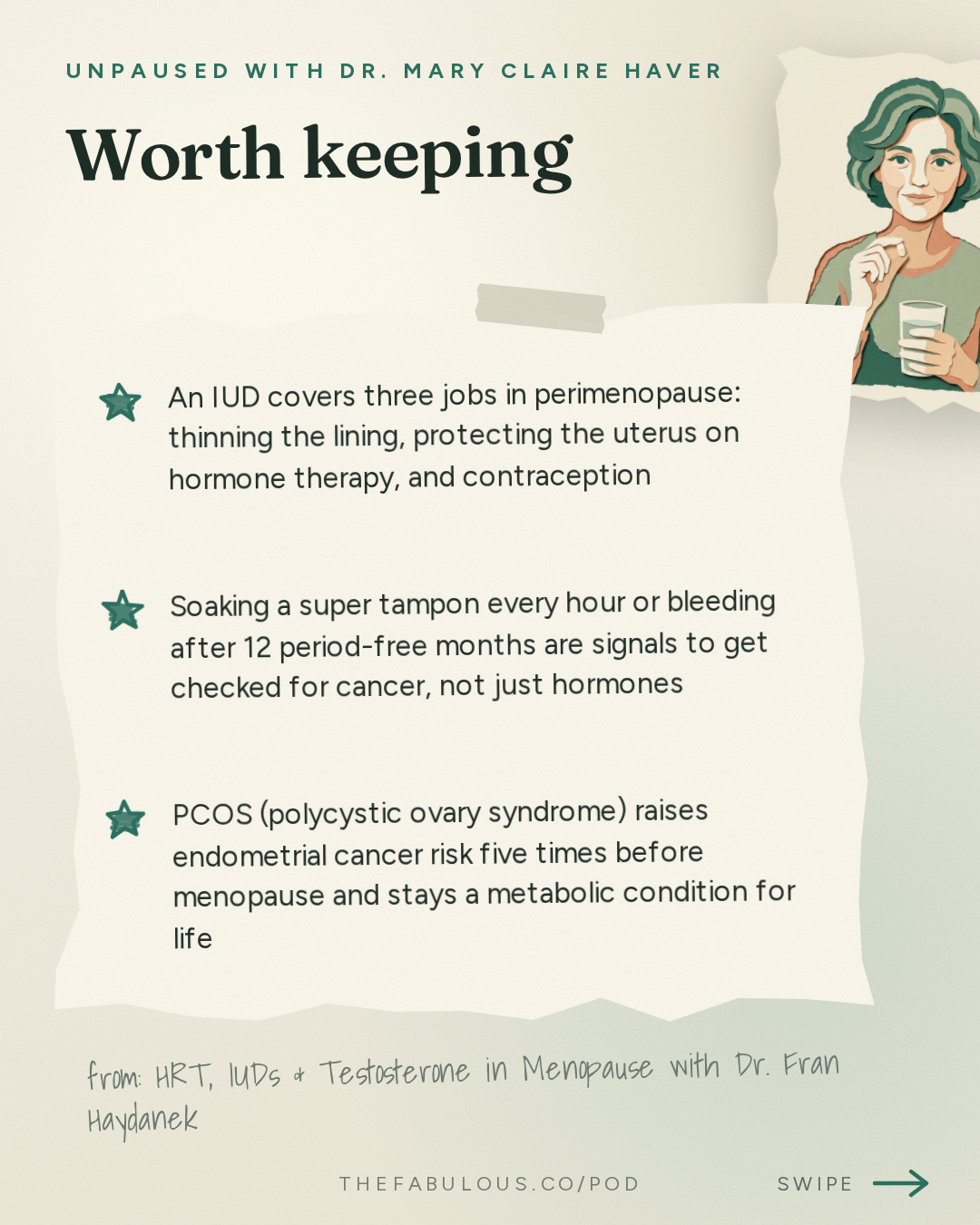
- An IUD covers three jobs in perimenopause: thinning the lining, protecting the uterus on hormone therapy, and contraception
- Soaking a super tampon every hour or bleeding after 12 period-free months are signals to get checked for cancer, not just hormones
- PCOS (polycystic ovary syndrome) raises endometrial cancer risk five times before menopause and stays a metabolic condition for life
- The WHI study found about nine extra breast cancers per 10,000 women yearly on combined hormone therapy, with no mortality difference
- Zero FDA-approved medications exist for PCOS, a condition affecting 10 to 20 percent of women, says OB-GYN Dr. Fran Haydanek
The episode in cards

By the numbers
- 55 years old age by which 90 to 95 percent of women have completed menopause
In their words
“No one should be ordering blood tests that they don't know how to interpret.”
“It is not birth control. It is not a high enough dose to suppress ovulation.”
“PMOS, I want people to remember, is a lifelong condition.”
“I would be upset, too, if I was on a medication that I, r- really helped me and then my doctor told me, "You're gonna get cancer and you have to stop," and then 20 years later I'm still”
Protocols
-
Investigate changed bleeding patterns
Dr. Fran Haydanek advises scheduling a problem visit for an ultrasound and likely a biopsy if a period becomes much heavier than before, lasts far longer than usual, soaks a super tampon every hour, or involves post-coital bleeding.
as soon as the bleeding pattern changes
-
Treat post-menopausal bleeding as urgent
Haydanek says any bleeding that occurs after 12 consecutive months without a period is a 100 percent reason to book a problem visit with a gynecologist for an ultrasound and tissue biopsy.
immediately, once
-
Use an IUD to cover three perimenopausal needs at once
Haydanek recommends an intrauterine device, or IUD, for perimenopausal patients because it thins the uterine lining to ease heavy bleeding, protects the uterus during estrogen therapy, and provides contraception in a single device.
ongoing, replaced per device label
-
Stop GLP-1 medication before trying to conceive
Haydanek tells patients trying to get pregnant to stop GLP-1 medications, a drug class including semaglutide used for weight loss and blood sugar control, two months before attempting conception, because safety during pregnancy has not been established.
two months before conception
-
Prefer transdermal estrogen over oral
Haydanek starts most patients on transdermal estrogen, delivered by patch or gel, rather than oral pills, to lower the risk of VTE (a blood clot in the veins), reserving oral forms mainly for low-risk patients already stable on them for decades.
ongoing
Questions this episode answers
Can an IUD help with perimenopause symptoms?
An IUD thins the uterine lining, which eases heavy perimenopausal bleeding, protects the uterus from the cancer risk of unopposed estrogen therapy, and provides contraception at the same time, says OB-GYN Dr. Fran Haydanek (13:58).
What bleeding pattern in perimenopause signals a problem?
Soaking a super tampon every hour, bleeding for more than seven days when three used to be normal, post-coital bleeding, or any bleeding after 12 full months without a period are signals Dr. Fran Haydanek says warrant an ultrasound and likely a biopsy (01:32, 03:15).
Does PCOS increase endometrial cancer risk?
Yes. Dr. Fran Haydanek says patients with PCOS have five times the risk of endometrial cancer before menopause because chronic lack of ovulation lets the uterine lining build up unchecked (01:54).
Is hormone therapy safe after the WHI study scare?
The Women's Health Initiative found about nine extra breast cancer cases per 10,000 women per year in the combined estrogen plus progestin arm, a difference that approached but did not reach statistical significance, with no mortality difference, while the estrogen-only arm showed fewer cases than placebo (28:41, 29:00).
Can menopause hormone therapy be used as birth control?
No. Dr. Fran Haydanek says menopausal hormone therapy is dosed too low to suppress ovulation, so contraception is still needed until 12 months after the final period (12:45).
Why do IUD insertions hurt more for some patients?
Dr. Fran Haydanek says IUDs were first studied mainly in women who had recently given birth, whose cervixes respond differently to the procedure than those who have not, which left pain in other patients under-recognized until social media pushed ACOG to issue updated pain management guidance (32:56, 34:18).
The full read, in cards
Go deeper
- Women's Health Initiative (WHI) — large federal trial comparing estrogen plus progestin, estrogen alone, and placebo, used to quantify actual breast cancer risk
- The Menopause Society 2023 Non-Hormone Position Statement — lists which non-hormonal therapies have evidence for hot flashes and which do not
- CDC Medical Eligibility Criteria for contraceptive use — guidance on how long combined hormonal contraceptives can be used into the menopause transition
- ACOG pain management guidance for IUD insertion — newer recommendations issued after patients publicly reported severe procedural pain
Mentioned
Dr. Fran Haydanek · Dr. Mary Claire Haver · The Menopause Society · ACOG · Veozah · Slynd · Nextstellis · Premarin · WHI · Heather Hirsch · Dr. Karen Taub · I Did My Own Research
More from this show and category
GSM Treatment: Vaginal Estrogen Explained
Genitourinary syndrome of menopause (GSM) affects 50 to 80% of postmenopausal women but only 7% of those diagnosed are prescribed its safest fix, vaginal estrogen (37:09, 11:00). The FDA dropped a 27-year boxed warning on low-dose vaginal estrogen in November 2025, and OB-GYN Dr. Mary Claire Haver says the condition is cheap and almost always treatable.
Dense Breasts and Real Breast Cancer Risk
Most breast cancer is not hereditary, only 5 to 10% of cases are (01:58). Oncologist Eleonora Teplinsky explains how family history, genetic testing, and breast density shape real risk, and why previvors with BRCA mutations can safely use hormone therapy after their ovaries are removed.
GSM: Menopause's Most Undertreated Condition
Genitourinary syndrome of menopause (GSM) is a cluster of vaginal, vulvar, and urinary changes caused by falling estrogen and testosterone, affecting 50% to 80% of postmenopausal women (11:00). Low-dose vaginal estrogen is the frontline treatment, cuts recurrent UTIs in half, and lost its FDA black box warning on November 10, 2025, after 27 years (14:54, 38:36).
Can Breast Cancer Previvors Safely Use HRT?
Most breast cancers are not inherited, but oncologist Dr. Eleonora Teplinsky says risk assessment should start at 25, since 5 to 10% of cases trace to a gene mutation and a 20% lifetime score marks someone as high risk (02:03, 03:31). She also confirms previvors with BRCA mutations can safely use hormone therapy after ovary removal (15:04).
