unPAUSED with Dr. Mary Claire Haver
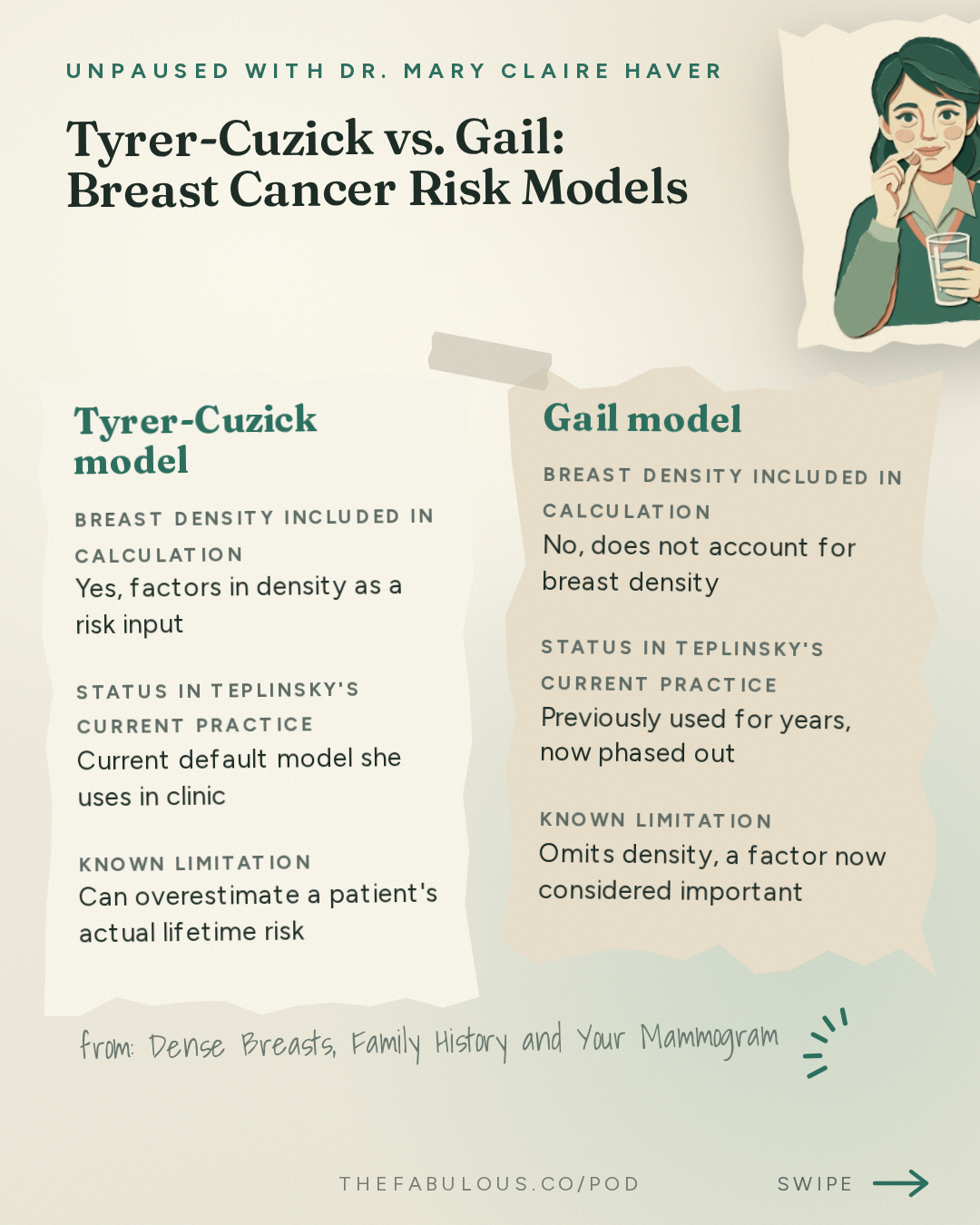
Can Breast Cancer Previvors Safely Use HRT?
Dense Breasts, Family History and Your Mammogram: How to Know your Real Risk
▶ Listen to the full episode More from unPAUSED with Dr. Mary Claire Haver
The brief
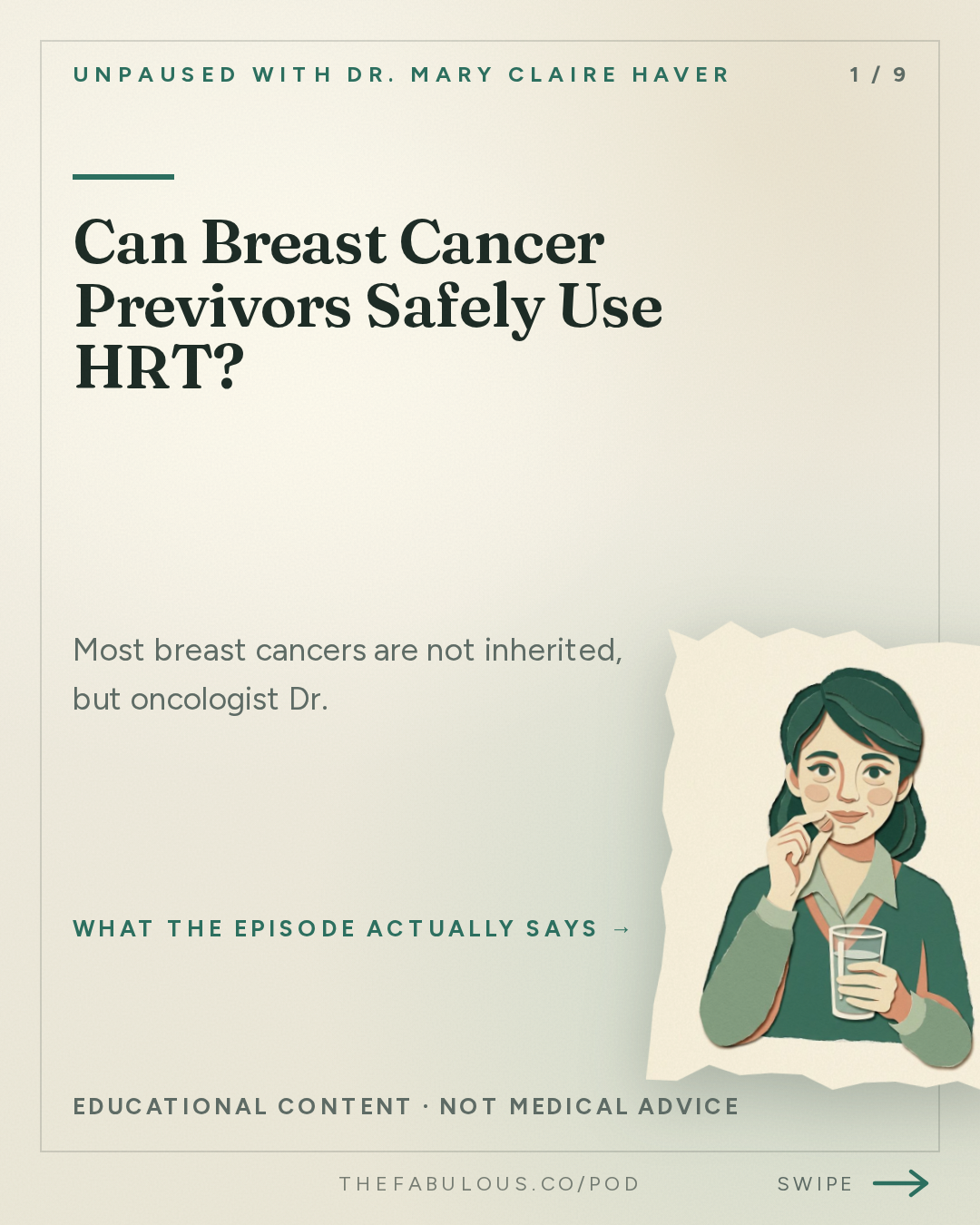
Most breast cancers are not inherited, but oncologist Dr. Eleonora Teplinsky says risk assessment should start at 25, since 5 to 10% of cases trace to a gene mutation and a 20% lifetime score marks someone as high risk (02:03, 03:31). She also confirms previvors with BRCA mutations can safely use hormone therapy after ovary removal (15:04).
A woman tells her doctor she skips mammograms because nobody in her family has ever had breast cancer. It sounds like sound reasoning. It is also wrong, most of the time. Only 5 to 10 percent of breast cancers come from an inherited gene mutation (02:03). The rest show up in women with no family history at all, which is exactly the gap that worries oncologist Dr. Eleonora Teplinsky, author of the book Beyond the Pink, in the second half of her conversation with Dr. Mary Claire Haver on the podcast unPAUSED.
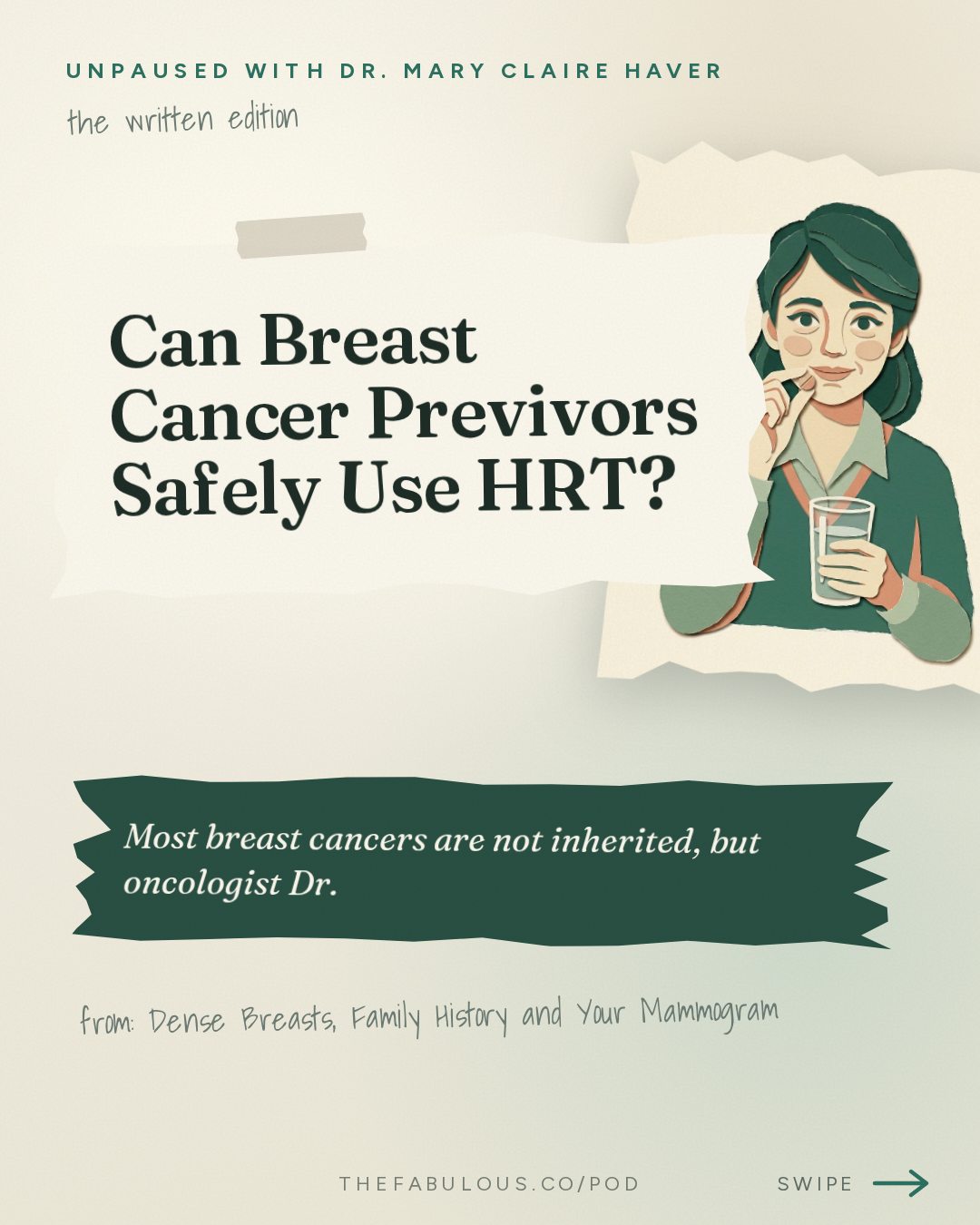
Family history still matters, Teplinsky says, but it needs translation. A grandmother diagnosed at 85 is a very different signal than five relatives diagnosed before 50 (01:00). The second pattern points toward a hereditary cancer syndrome, something genetic testing can confirm. The first is closer to ordinary aging. Teplinsky's broader point is that breast cancer risk assessment is not a family story. It is a calculation, and it should start at age 25 (02:53), using tools like the Tyrer-Cuzick model, a free online questionnaire that factors in menstrual history, family history, and breast density to estimate a woman's chance of developing breast cancer over her lifetime. A result of 20 percent or higher moves a woman into the high-risk category, which usually means supplementing a mammogram with MRI or ultrasound (03:31).
The Myth That Protects No One
Density turns out to be a double problem, not a single one. Many women assume dense breast tissue simply hides tumors on a mammogram, the way a flashlight struggles to find something white in a white room. Teplinsky corrects that assumption directly.
"Both. Wow. Mm-hmm. And we don't entirely know how dense breasts increase breast cancer risk. There's a lot of research going on, but it's both." — Dr. Eleonora Teplinsky [12:14]
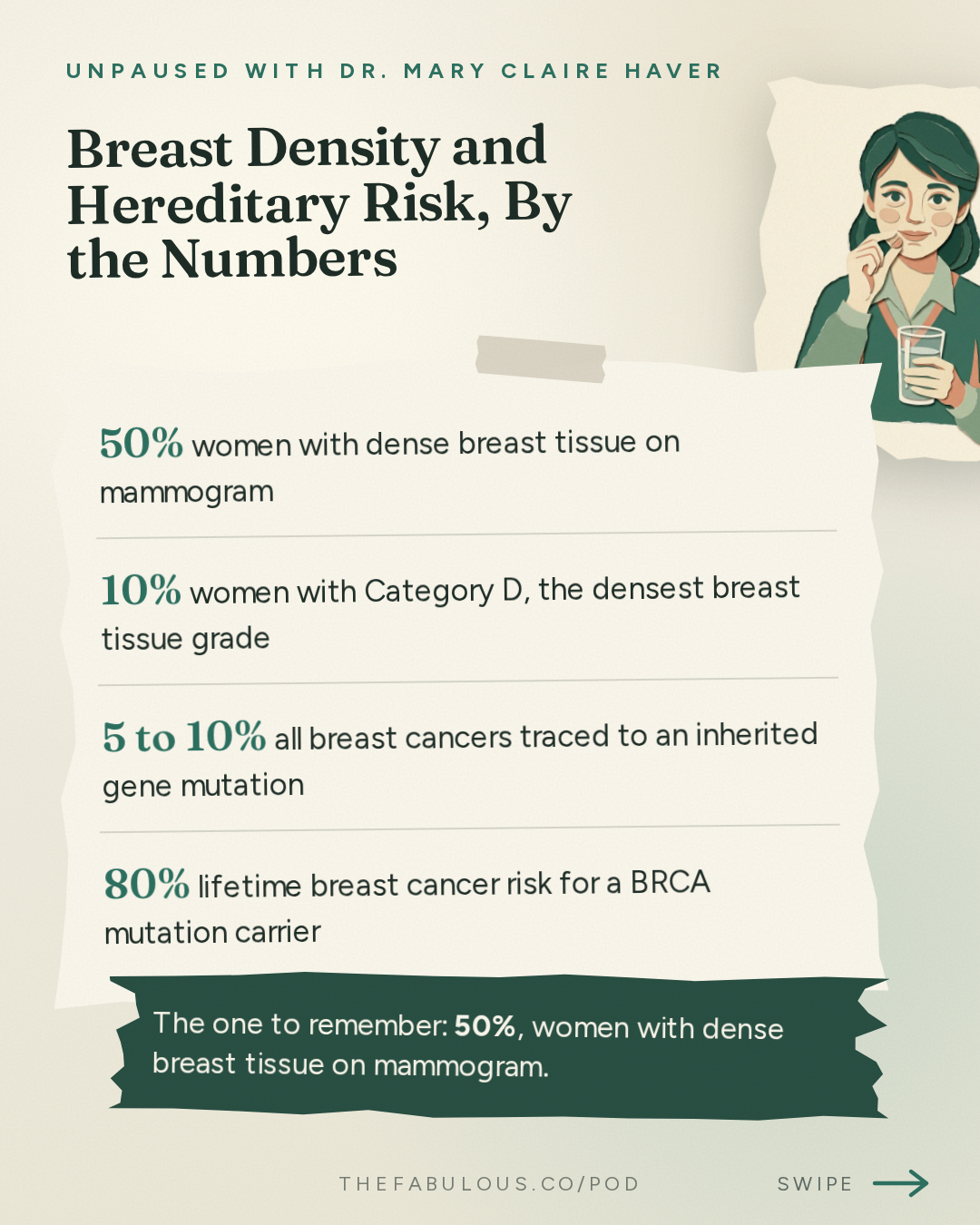
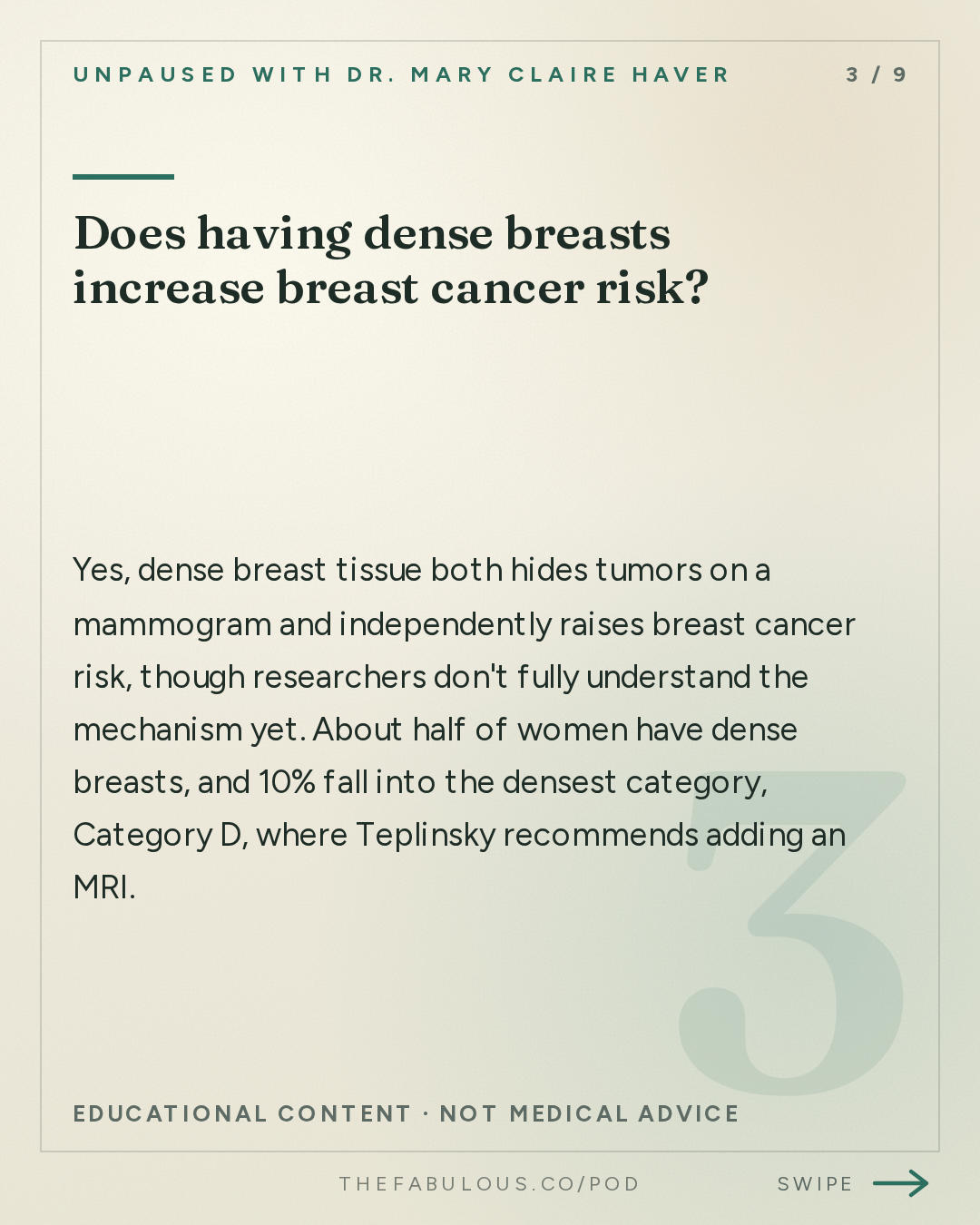
Roughly half of women have dense breast tissue, and about 10 percent fall into the densest category, called Category D (13:22). For that group, Teplinsky recommends adding an MRI, though current guidelines do not yet mandate it broadly. She is candid about the limits of her own favorite model. The Tyrer-Cuzick tool replaced the older Gail model specifically because it accounts for density, yet it can also overestimate a woman's actual risk (10:47). A newer AI tool called Clariti is being piloted in Massachusetts to estimate five-year risk directly from a mammogram image, with coverage guidelines now recommending it starting at age 35 (11:34). None of this, Teplinsky warns, should be confused with direct-to-consumer blood tests like Galleri, which look for a cancer signal in a vial of blood. Those tests can produce false positives and false negatives and often miss early cancers confined to breast tissue. "They should not replace screening," she says, naming mammograms, colonoscopies, and Pap smears as the proven baseline (09:18).
For women who do carry a mutation such as BRCA, CHEK2, ATM, or PALB2 (05:12), the numbers shift dramatically. A BRCA mutation carries up to an 80 percent lifetime risk of breast cancer, high enough that doctors typically discuss risk-reducing mastectomy, though that calculus changes after age 65 (07:12). It is a conversation, Teplinsky stresses, not an automatic verdict, and one she says should include people of color more often than it currently does. Most genetic testing databases were built on Eastern European ancestry data, which means women of color are more likely to receive an ambiguous result called a variant of uncertain significance, a genetic change whose effect on cancer risk simply is not known yet (20:25). And a negative test does not erase risk if close relatives were never tested themselves. Family history, even without a known mutation, still raises risk above average (21:21).
Nowhere does the fear outpace the evidence more than around hormones. Teplinsky describes a 38-year-old BRCA carrier who removes her ovaries to cut ovarian cancer risk but keeps her breast tissue intact, a status called previvor, someone who carries high cancer risk but has never had a diagnosis (14:16). The old assumption was that any brush with elevated breast cancer risk meant lifetime estrogen avoidance.
"But here's the thing. Previvors can absolutely use hormone replacement therapy." — Dr. Eleonora Teplinsky [15:04]
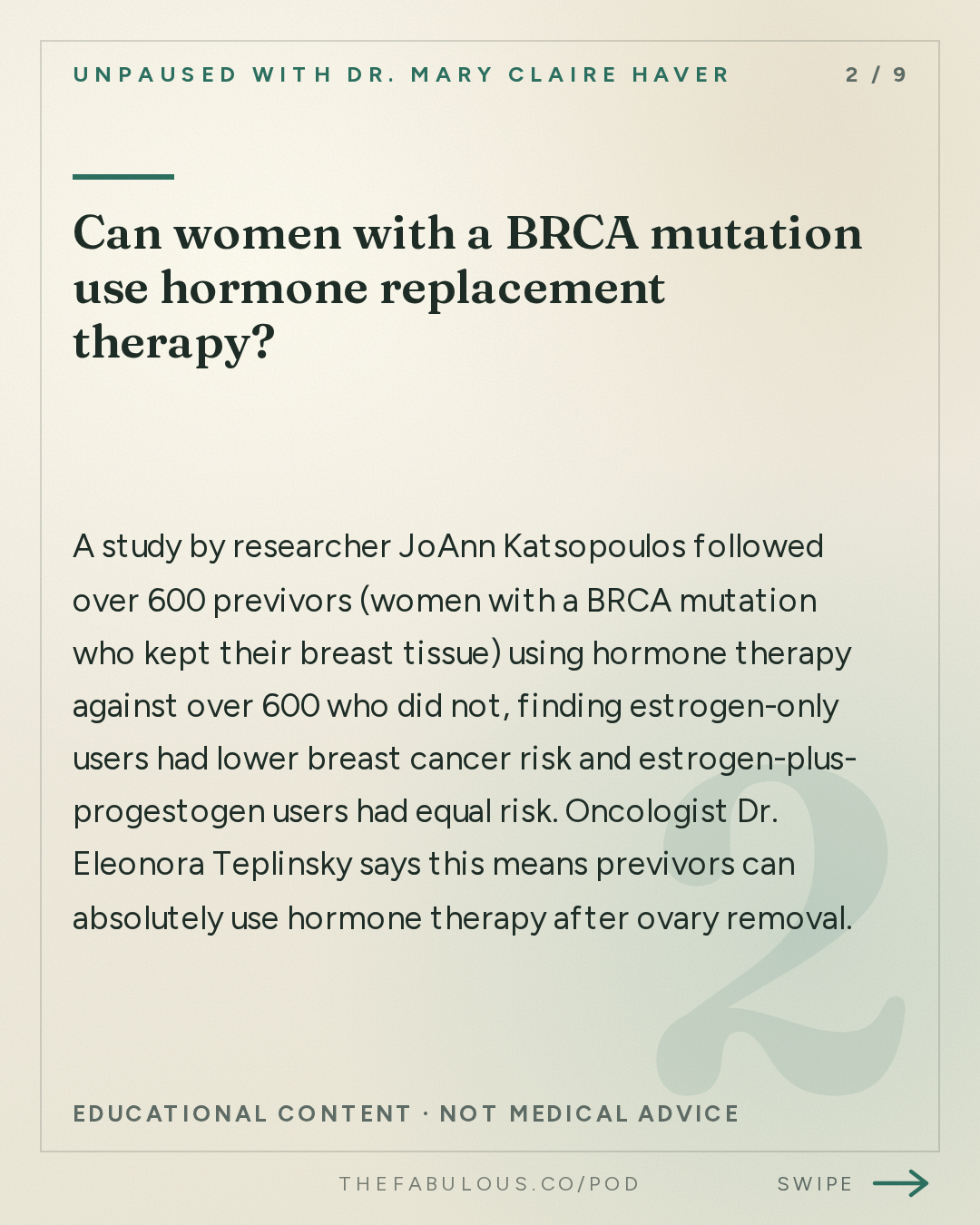
She points to a recent study by researcher JoAnn Katsopoulos that followed more than 600 previvors who used hormone therapy after ovary removal against more than 600 who did not. Women on estrogen alone actually had a lower breast cancer risk than those not on hormones. Women on estrogen plus a progestogen had equal risk, not elevated risk (15:46). That distinction between "equal" and "protective" is new information, and it matters because premature surgical menopause before age 45 raises cardiovascular, cognitive, and musculoskeletal risk on its own (19:06).
The Body After Treatment
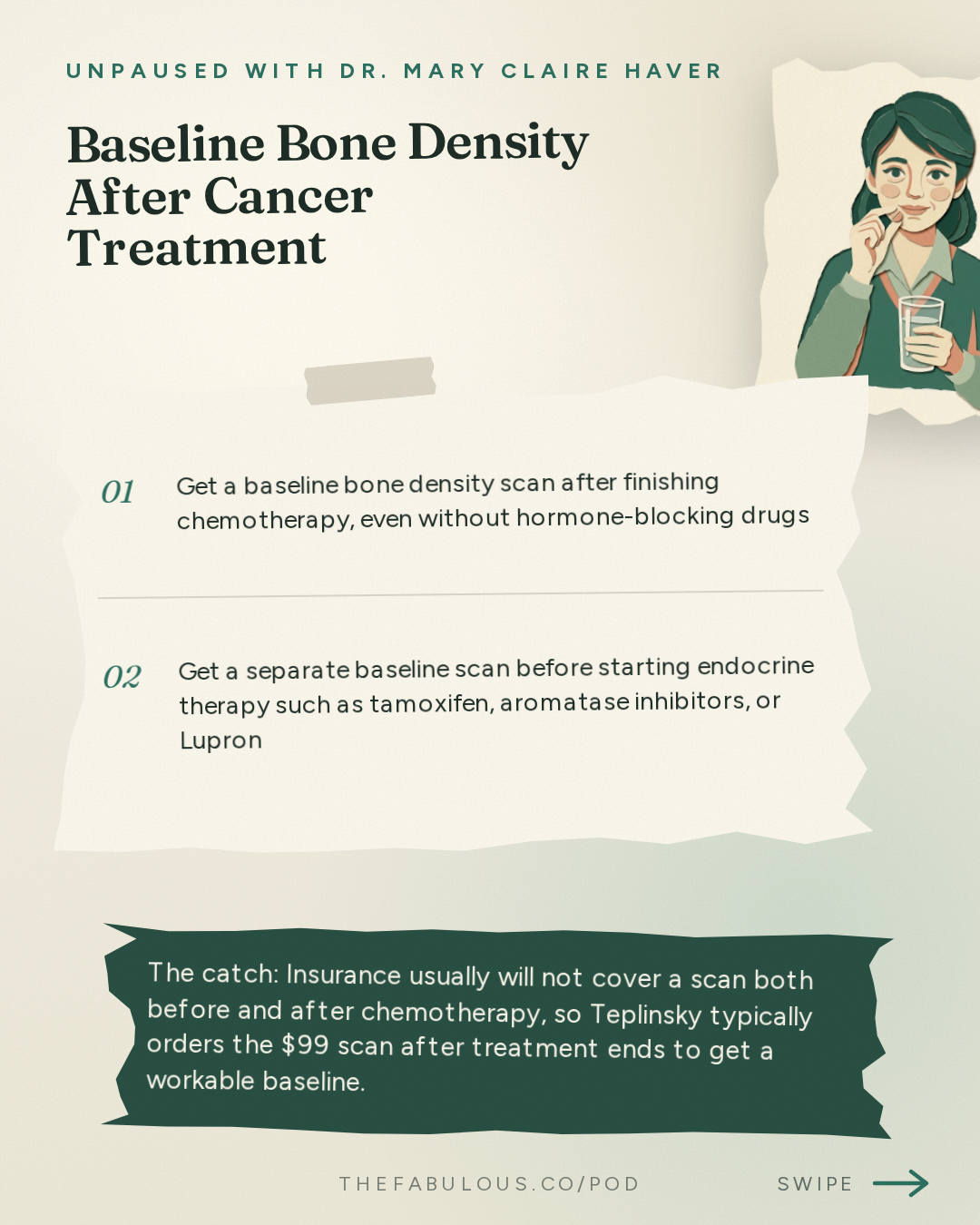
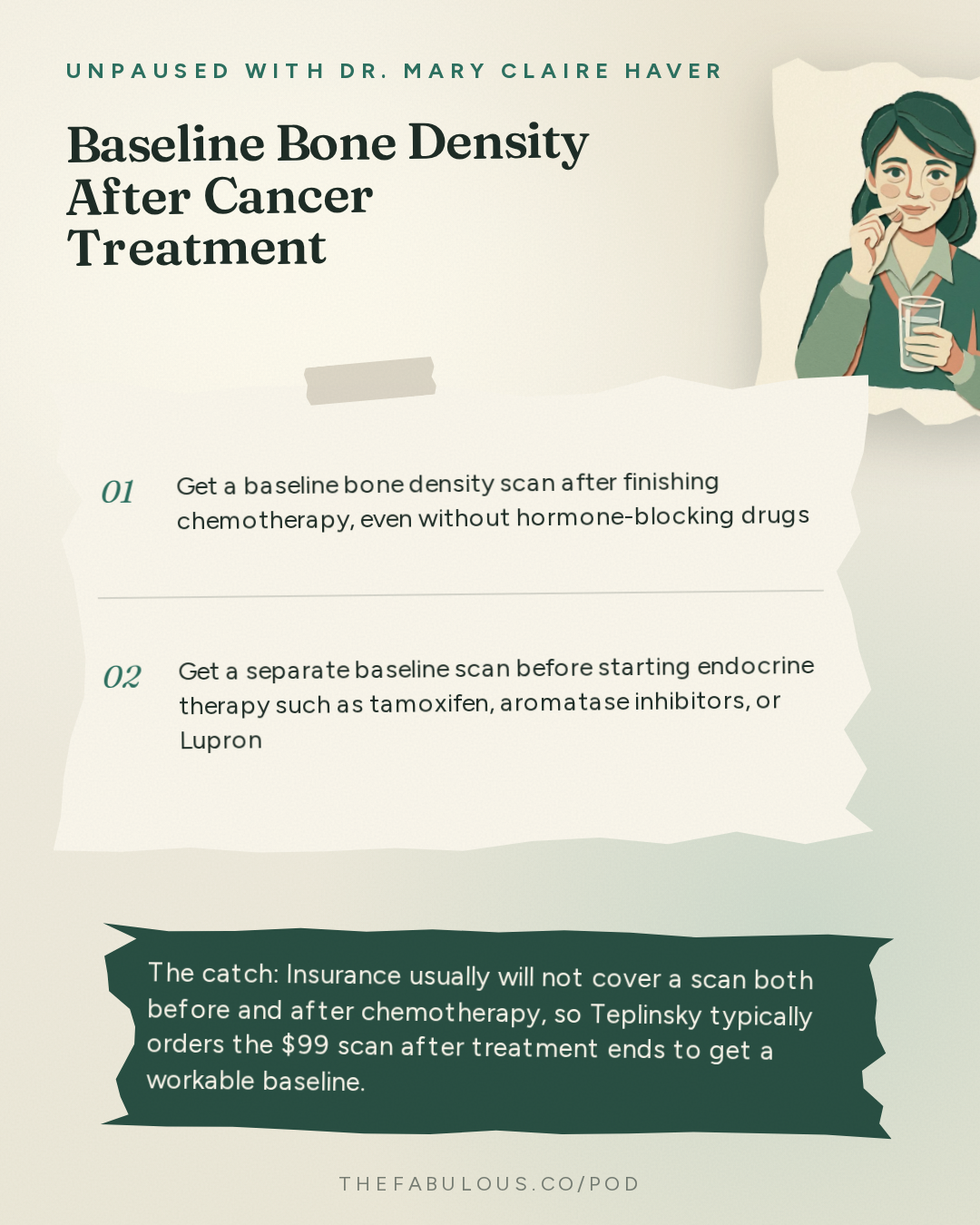
Cancer treatment does not end when the chemotherapy port comes out. Teplinsky walks through a chain of consequences that rarely gets explained up front. Chemotherapy-induced ovarian failure can drop lumbar spine bone density by 4 percent within six months, a finding first published by researcher Shapiro in 2001, and aromatase inhibitors, a class of drugs that block estrogen production, add another 2 percent loss per year on top of that (21:46). Her response is procedural: everyone who receives chemotherapy is eligible for a baseline bone density scan, not only people on hormone-blocking drugs, because chemotherapy alone can cause bone and muscle loss (22:20). She usually orders the $99 scan after chemotherapy ends rather than before, since insurance rarely covers both.
"If you've had chemo, you should also be getting a baseline bone density." — Dr. Eleonora Teplinsky [23:36]
The heart carries its own hidden bill. A 2013 study in the New England Journal of Medicine by researcher Darby found major coronary events rose about 7.5 percent after radiation treatment for breast cancer, largely because the breast sits directly in front of the heart (27:37). Radiation oncologists now use a technique called the deep inspiratory breath hold, which has patients breathe in a specific way during left-sided radiation to physically move the heart out of the beam's path (28:00). Chemotherapy drugs, premature menopause, and aromatase inhibitors can each affect cholesterol independently, which is why Teplinsky urges survivors to ask their medical team directly whether a cardio-oncologist should be monitoring them.
Cognition gets less structured support. What patients call "chemo brain" is formally known as cancer-related cognitive impairment, and it often escapes detection because standard cognitive tests are built to catch dementia, not the subtler slowdown a high-functioning professional might notice in her own work (25:06). There is no diagnostic code for it. The same holds for the psychological aftermath of surgery. Teplinsky describes a technique called the mirror program, in which patients reintroduce themselves to their post-mastectomy bodies gradually, starting with a small mirror before facing a full-length one (32:04), a small act of pacing meant to replace a surprise with a plan.
What ties the whole conversation together is a shift from fear to information. Teplinsky's closing advice is almost administrative: write down current side effects, write down long-term worries, and bring both lists to the next appointment (34:05). It is a modest request, built on a simple premise, that nobody should be told no without first being told why, or what the alternative actually is.
Ask this episode anything
Pod's AI answers from the episode itself, with the minute mark so you can hear it yourself.
Or start with one of these
Ask this episode
Pod's AI listens to the whole episode to answer, and points you to the minute it comes from.
The rest of this answer, and any question after it
Answers come from the episode itself, never from a summary of it.
ContinueKey takeaways
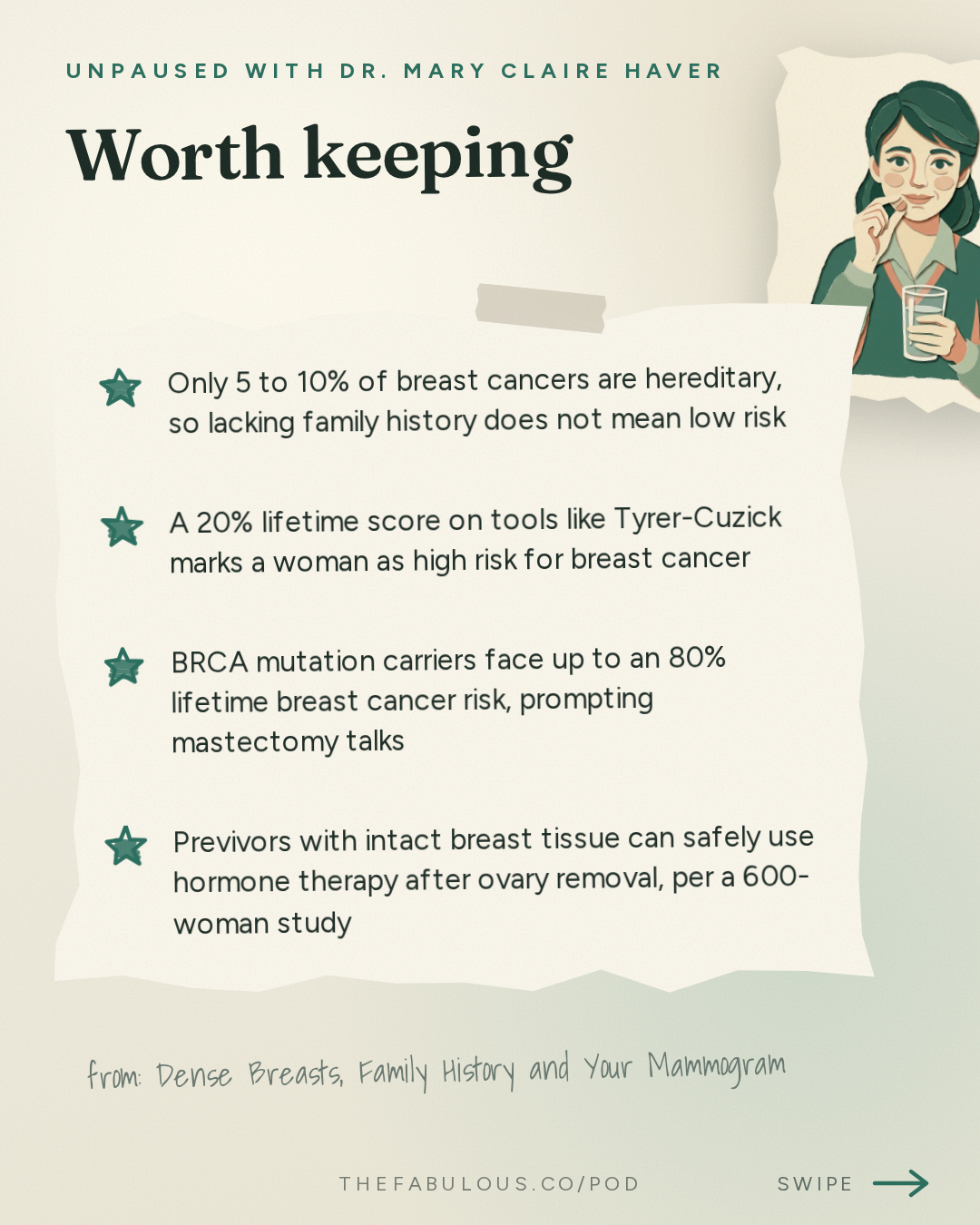
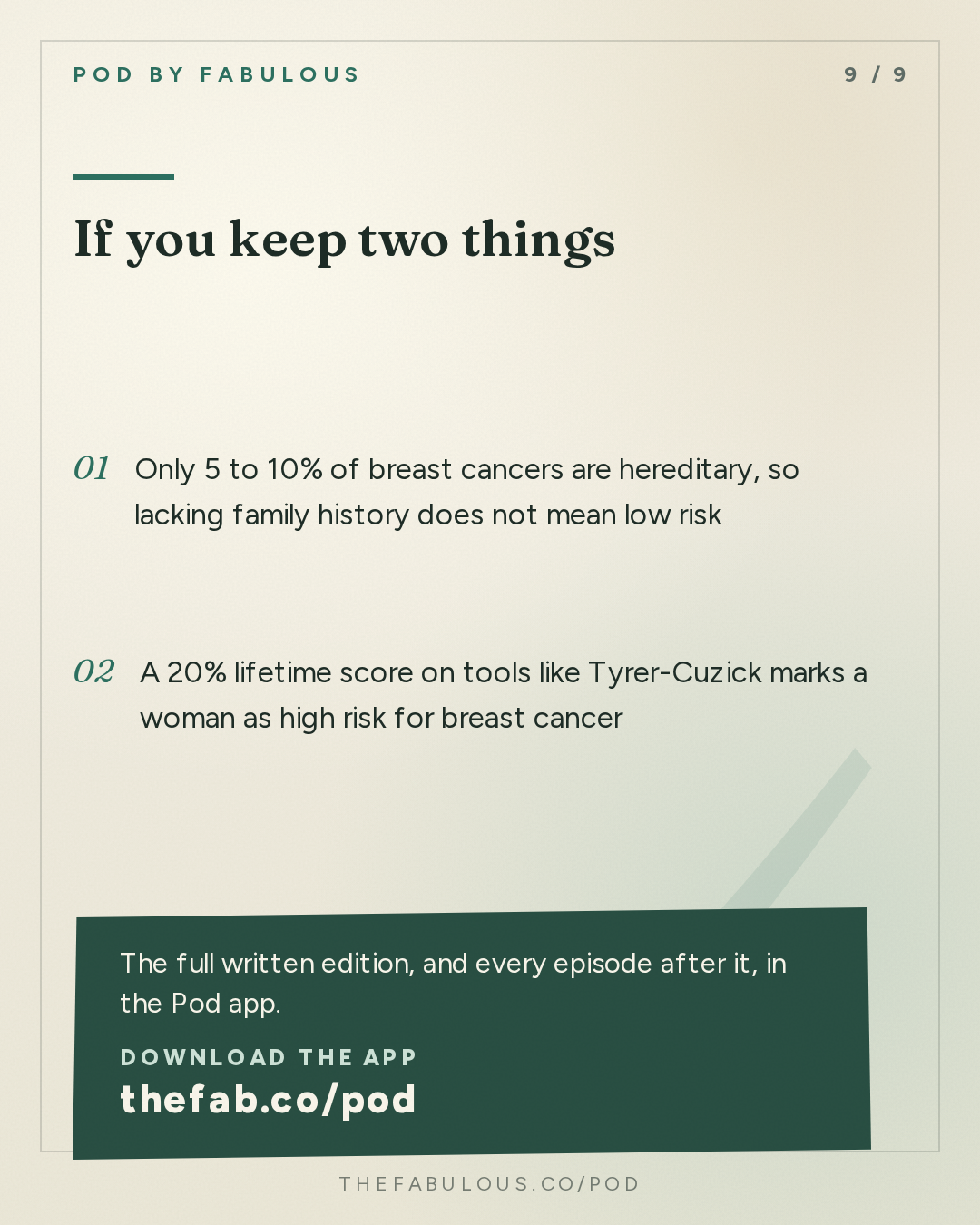
- Only 5 to 10% of breast cancers are hereditary, so lacking family history does not mean low risk
- A 20% lifetime score on tools like Tyrer-Cuzick marks a woman as high risk for breast cancer
- BRCA mutation carriers face up to an 80% lifetime breast cancer risk, prompting mastectomy talks
- Previvors with intact breast tissue can safely use hormone therapy after ovary removal, per a 600-woman study
- Chemotherapy alone, even without hormone-blocking drugs, can drop bone density and justify a baseline DEXA scan
The episode in cards

By the numbers
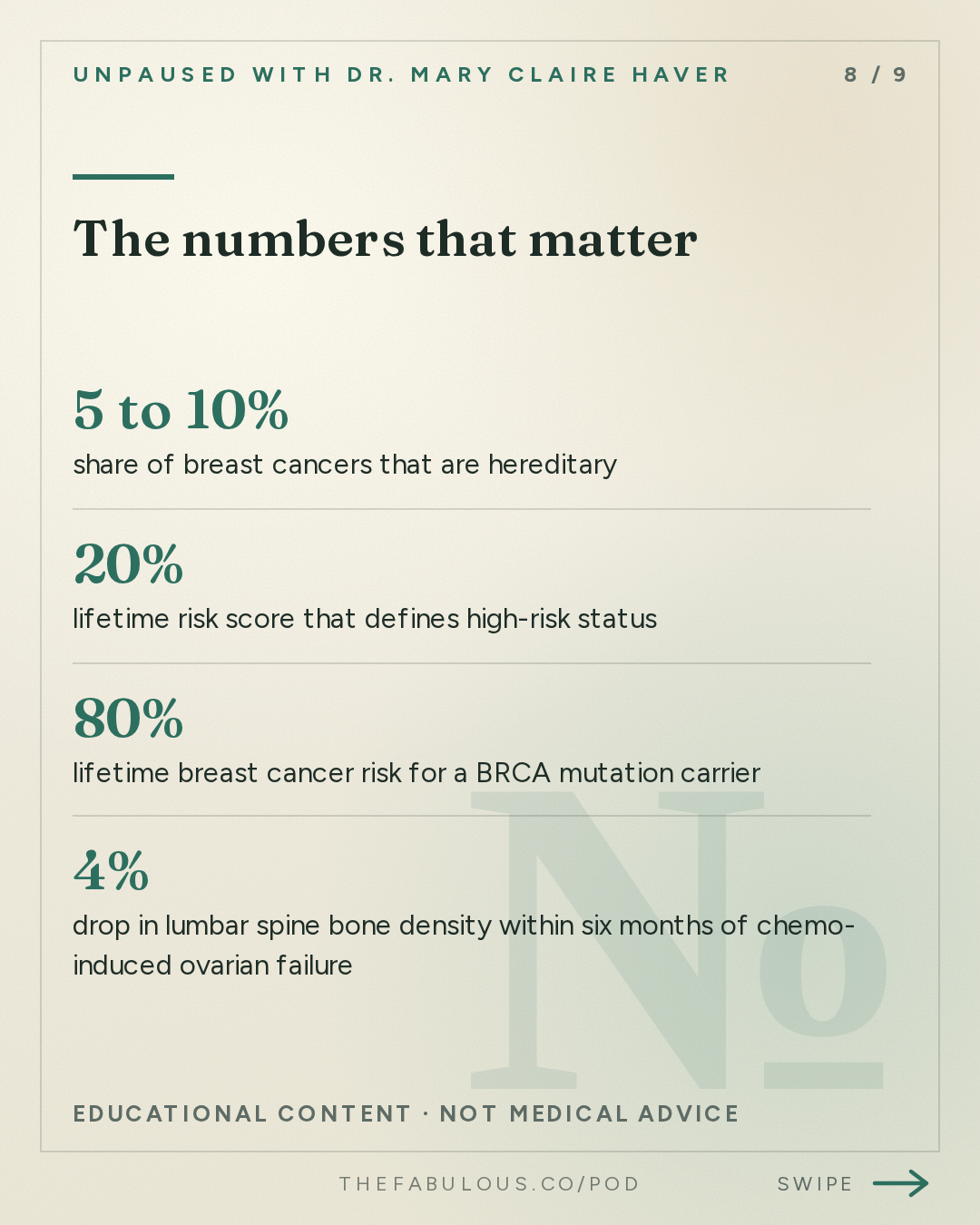
- 5 to 10% percent share of breast cancers that are hereditary
- 20% percent lifetime risk score that defines high-risk status
- 80% percent lifetime breast cancer risk for a BRCA mutation carrier
- 4% percent drop in lumbar spine bone density within six months of chemo-induced ovarian failure
- 7.5% percent rise in major coronary events after breast cancer radiation
In their words
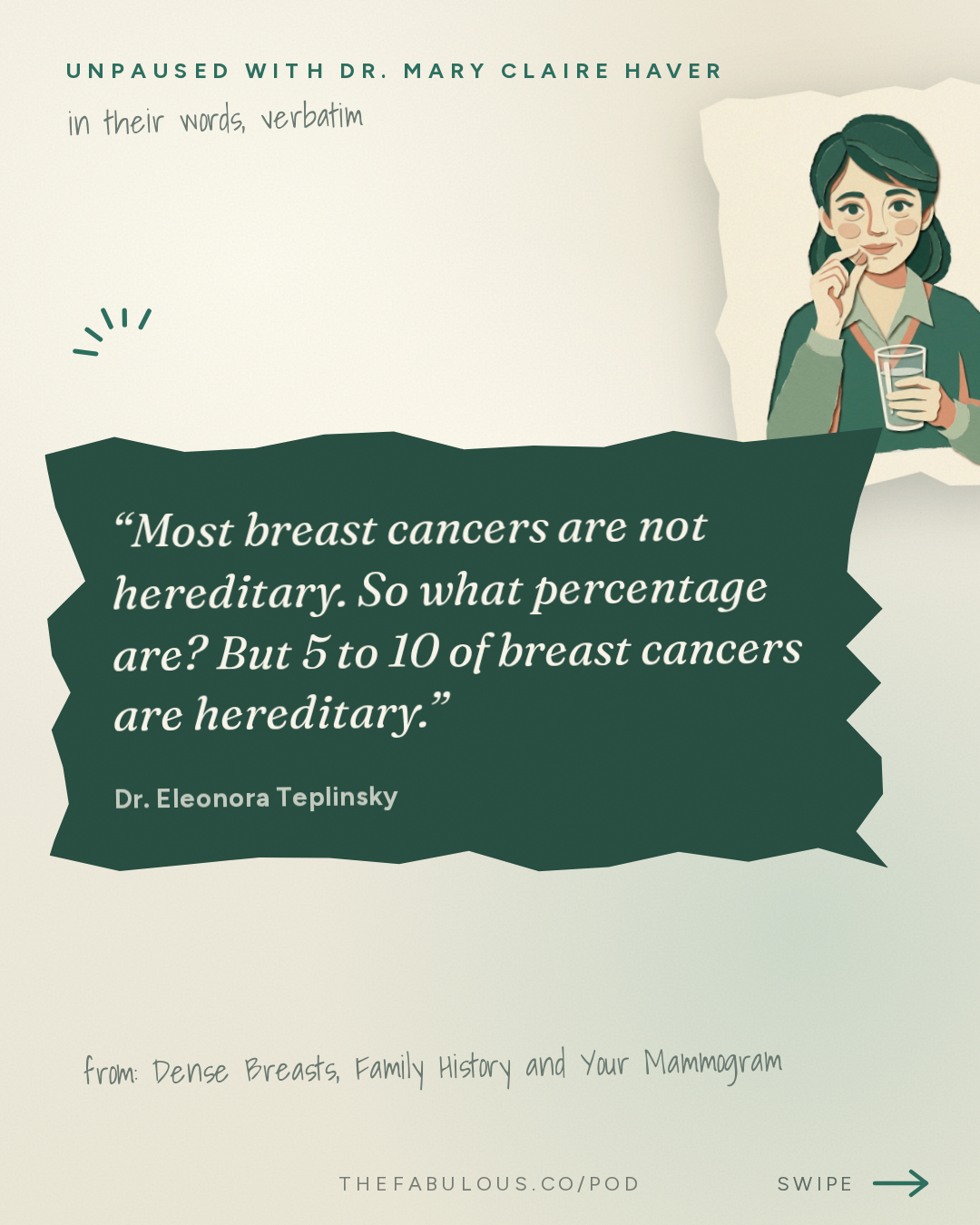
“Most breast cancers are not hereditary. So what percentage are? But 5 to 10 of breast cancers are hereditary.”
“The radiation from a mammogram is the equivalent to about six or seven weeks of the background radiation you get exposed to just from walking around the street.”
“But here's the thing. Previvors can absolutely use hormone replacement therapy.”
“If you've had chemo, you should also be getting a baseline- Mm ... bone density”
Protocols
-
Baseline bone scan after chemotherapy
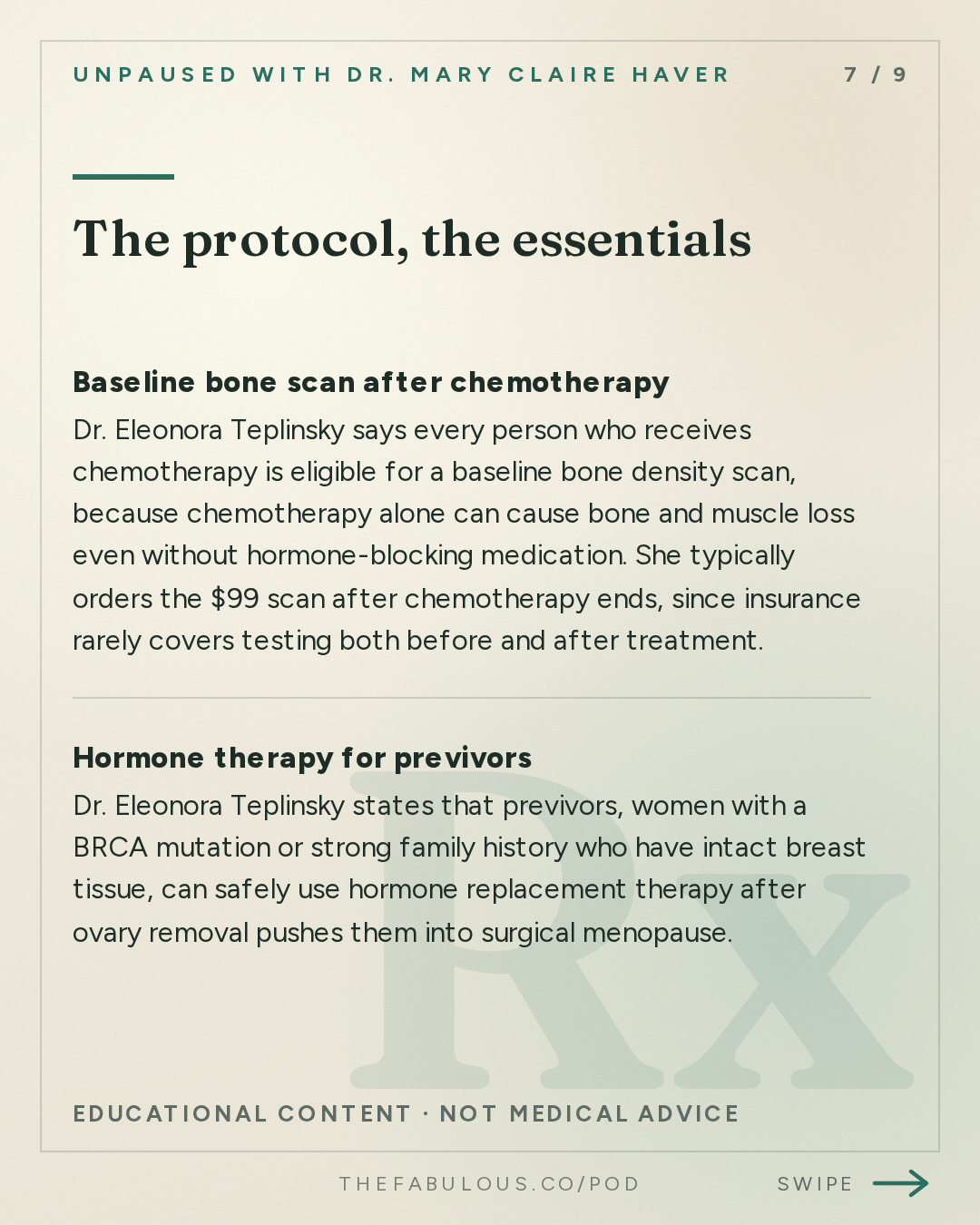
Dr. Eleonora Teplinsky says every person who receives chemotherapy is eligible for a baseline bone density scan, because chemotherapy alone can cause bone and muscle loss even without hormone-blocking medication. She typically orders the $99 scan after chemotherapy ends, since insurance rarely covers testing both before and after treatment.
once, after finishing chemotherapy
-
Hormone therapy for previvors
Dr. Eleonora Teplinsky states that previvors, women with a BRCA mutation or strong family history who have intact breast tissue, can safely use hormone replacement therapy after ovary removal pushes them into surgical menopause.
ongoing, as part of menopause management
-
Breast cancer risk assessment starting at 25
Dr. Eleonora Teplinsky recommends that breast cancer risk assessment begin at age 25 using a free tool such as the Tyrer-Cuzick model, which factors in menstrual history, family history, and breast density to produce a lifetime risk estimate.
starting at age 25, reassessed over time
Questions this episode answers
Can women with a BRCA mutation use hormone replacement therapy?
A study by researcher JoAnn Katsopoulos followed over 600 previvors (women with a BRCA mutation who kept their breast tissue) using hormone therapy against over 600 who did not, finding estrogen-only users had lower breast cancer risk and estrogen-plus-progestogen users had equal risk (15:46). Oncologist Dr. Eleonora Teplinsky says this means previvors can absolutely use hormone therapy after ovary removal (15:04).
Does having dense breasts increase breast cancer risk?
Yes, dense breast tissue both hides tumors on a mammogram and independently raises breast cancer risk, though researchers don't fully understand the mechanism yet (12:14). About half of women have dense breasts, and 10% fall into the densest category, Category D, where Teplinsky recommends adding an MRI (13:22).
What percentage of breast cancers are hereditary?
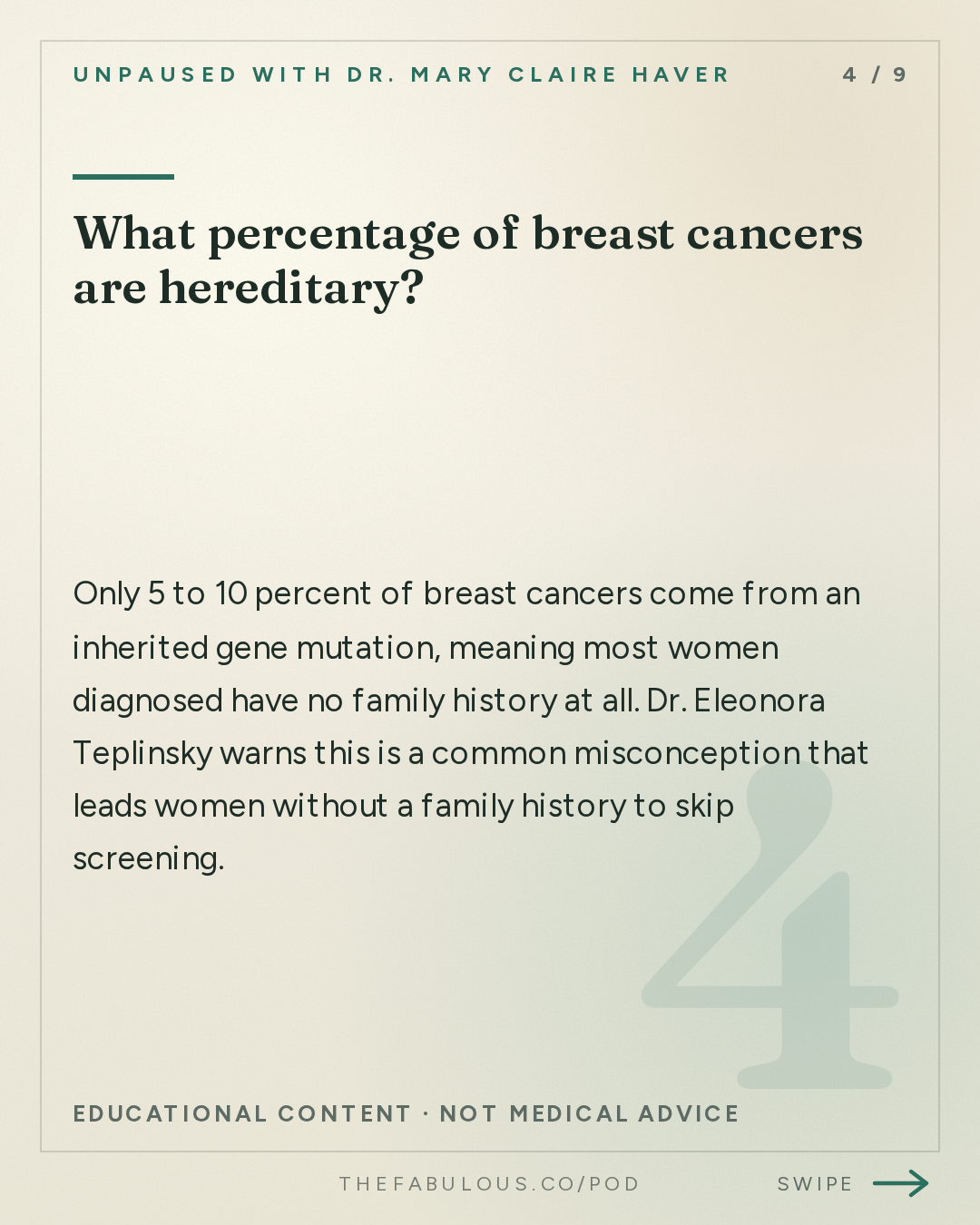
Only 5 to 10 percent of breast cancers come from an inherited gene mutation, meaning most women diagnosed have no family history at all (02:03). Dr. Eleonora Teplinsky warns this is a common misconception that leads women without a family history to skip screening.
Does chemotherapy affect bone density even without hormone-blocking drugs?
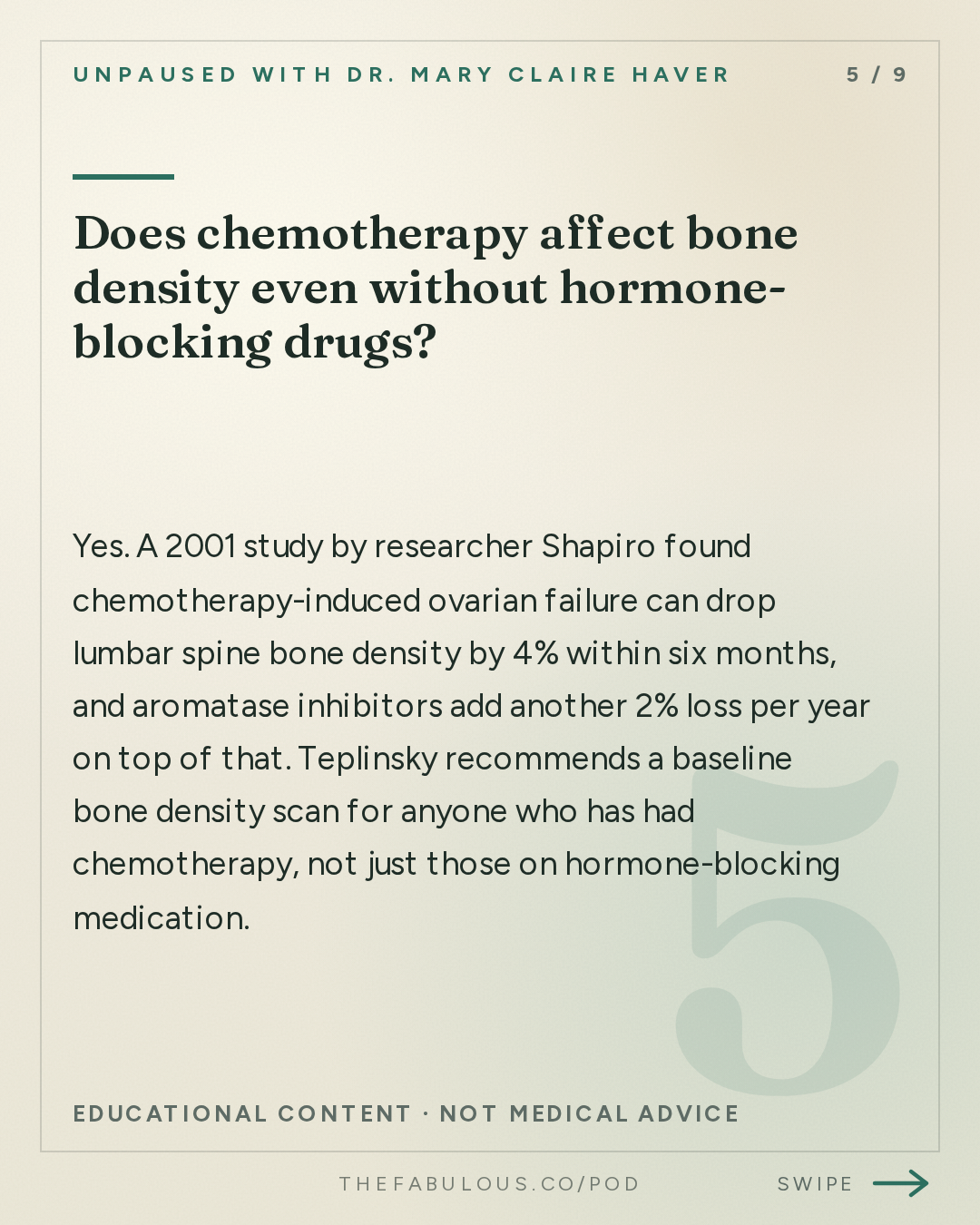
Yes. A 2001 study by researcher Shapiro found chemotherapy-induced ovarian failure can drop lumbar spine bone density by 4% within six months, and aromatase inhibitors add another 2% loss per year on top of that (21:46). Teplinsky recommends a baseline bone density scan for anyone who has had chemotherapy, not just those on hormone-blocking medication (23:36).
Is radiation for breast cancer safe for the heart?
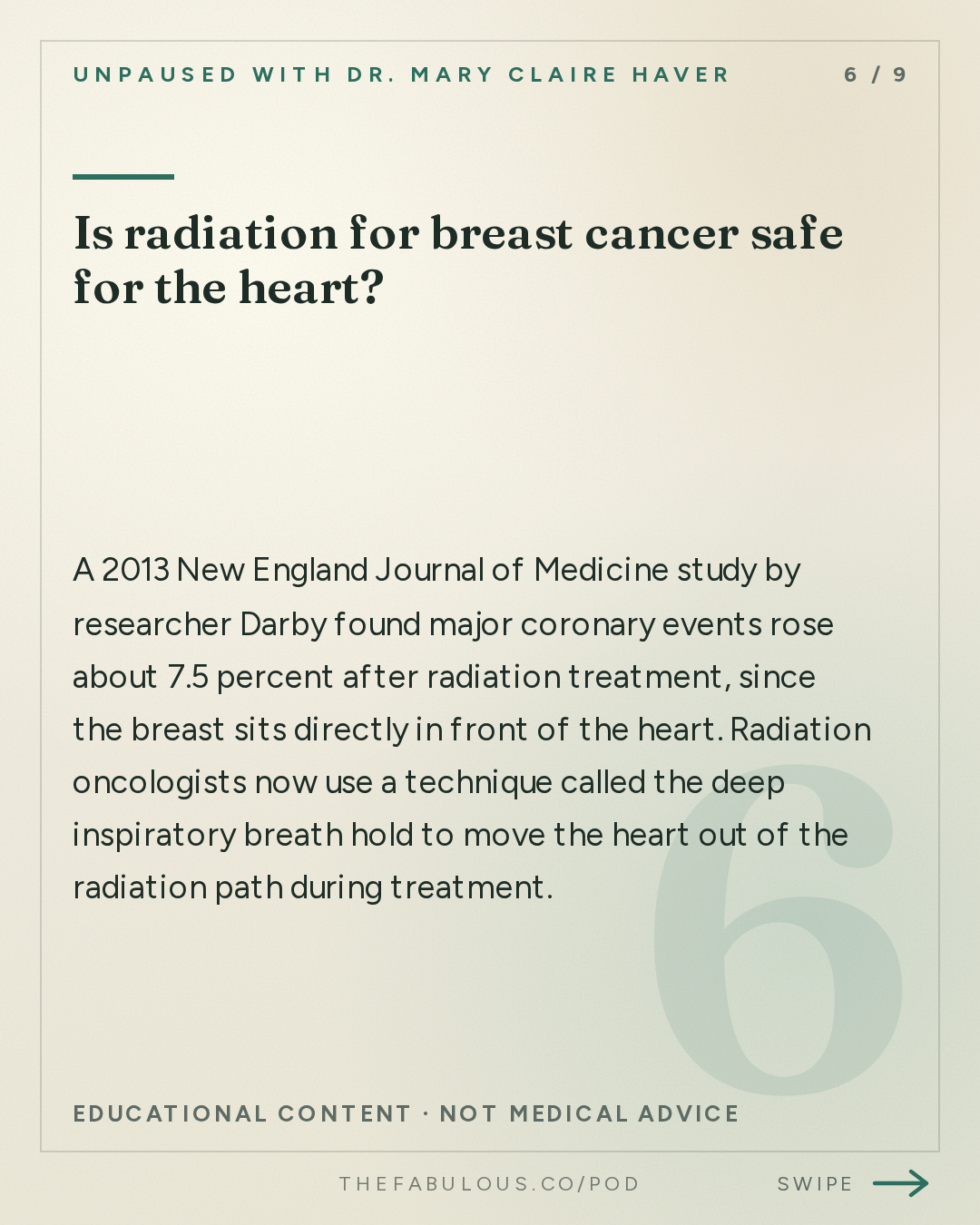
A 2013 New England Journal of Medicine study by researcher Darby found major coronary events rose about 7.5 percent after radiation treatment, since the breast sits directly in front of the heart (27:37). Radiation oncologists now use a technique called the deep inspiratory breath hold to move the heart out of the radiation path during treatment (28:00).
Which breast cancer risk model is more accurate, Tyrer-Cuzick or Gail?
Neither model is perfect, but Teplinsky prefers Tyrer-Cuzick because it includes breast density, which the older Gail model does not (10:47). She notes Tyrer-Cuzick can sometimes overestimate a patient's actual lifetime risk (11:10).
The full read, in cards
Go deeper
- Beyond the Pink: Navigating Life, Health, and Breast Cancer — Teplinsky's comprehensive patient guide covering hormone therapy, survivorship, and treatment side effects
- Katsopoulos study on hormone therapy in BRCA previvors — followed over 600 previvors on hormone therapy against over 600 who were not, finding equal or lower breast cancer risk
- Shapiro 2001 study on chemotherapy-induced bone loss — found chemo-induced ovarian failure drops lumbar spine density 4% within six months
- Darby 2013 New England Journal of Medicine study — found major coronary events rose about 7.5% after radiation for breast cancer
Mentioned
Dr. Eleonora Teplinsky · Dr. Mary Claire Haver · Tyrer-Cuzick model · Gail model · BRCA · Prenuvo · Galleri · Clariti · Beyond the Pink · JoAnn Katsopoulos
More from this show and category
Pelvic Floor Health and Menopause: Daily Habits
Pelvic floor therapist Sarah Reardon says menopause pelvic problems need two fixes: estrogen for tissue, muscle training for strength. She covers power peeing, Squatty Potties, pessaries, GSM, vaginismus, and why the $5 billion vaginal rejuvenation industry skips the muscle work that actually prevents prolapse and leakage.
Pelvic Floor Therapy for Menopause Explained
Pelvic floor therapist Dr. Sarah Reardon says one in three women has a pelvic floor disorder, and most can self-refer for therapy without a doctor's note. She explains why verbal Kegel instructions fail more than half the time, how vaginal estrogen cuts recurrent UTI rates nearly twelvefold, and why nighttime bathroom trips raise fracture risk in menopause.
Mark Cuban on the Estrogen Patch Shortage
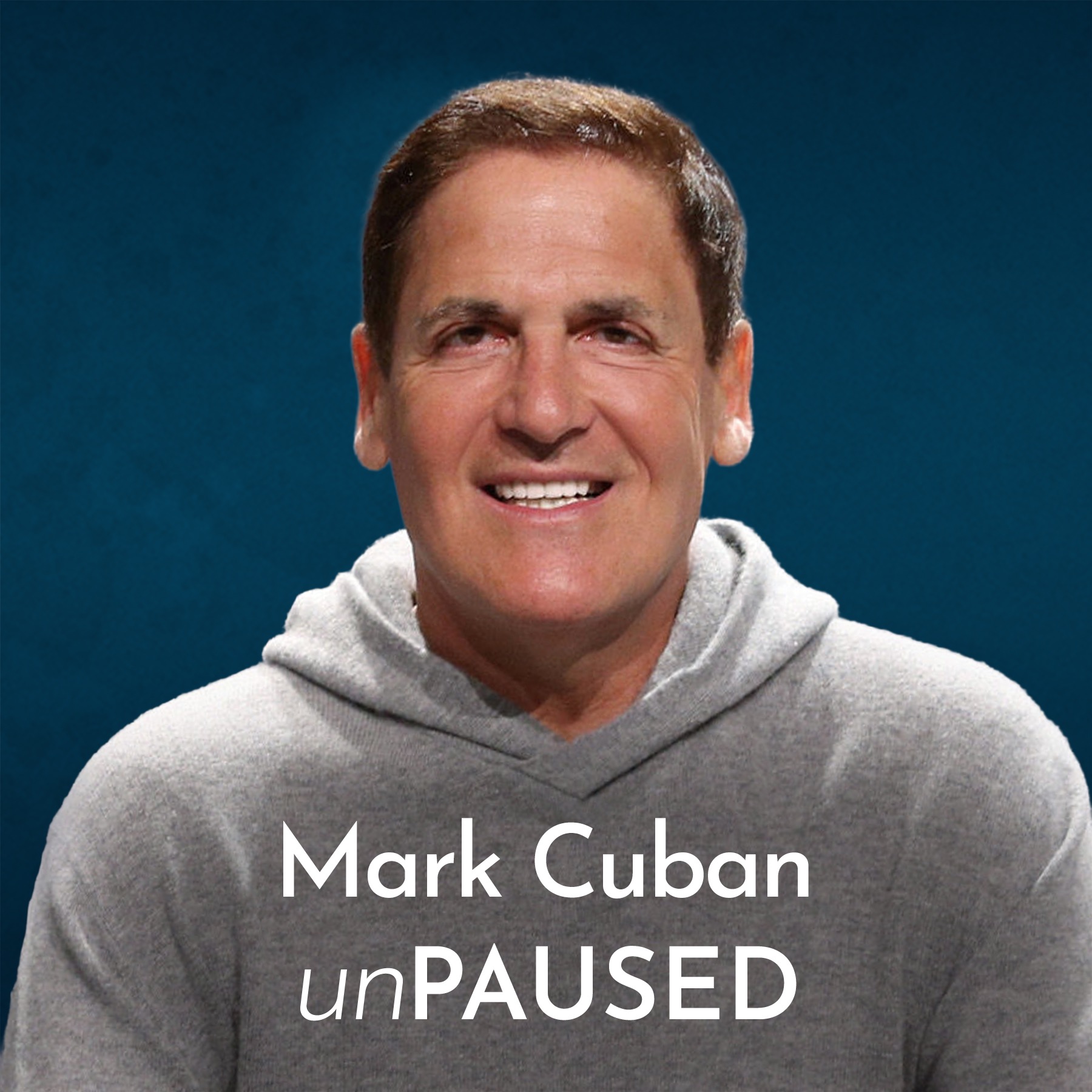
Estrogen patch prescriptions have nearly tripled in two years, while specialty manufacturing requirements keep supply from catching up. Entrepreneur Mark Cuban explains how his Cost Plus Drugs company sells at a flat 15% markup, and how pharmacy benefit managers can push a brand drug's price from $300 to $600 through rebate demands.

Postpartum OCD vs Psychosis: Key Differences
Postpartum OCD causes unwanted, intrusive thoughts about harming a baby, not a desire to act. CNN anchor Pamela Brown and OB-GYN Dr. Mary Claire Haver distinguish it from postpartum psychosis, a break from reality involving voices (42:59), and cover GLP-1 fertility effects, testosterone therapy, and vaginal estrogen's role preventing UTIs (35:52).
