unPAUSED with Dr. Mary Claire Haver
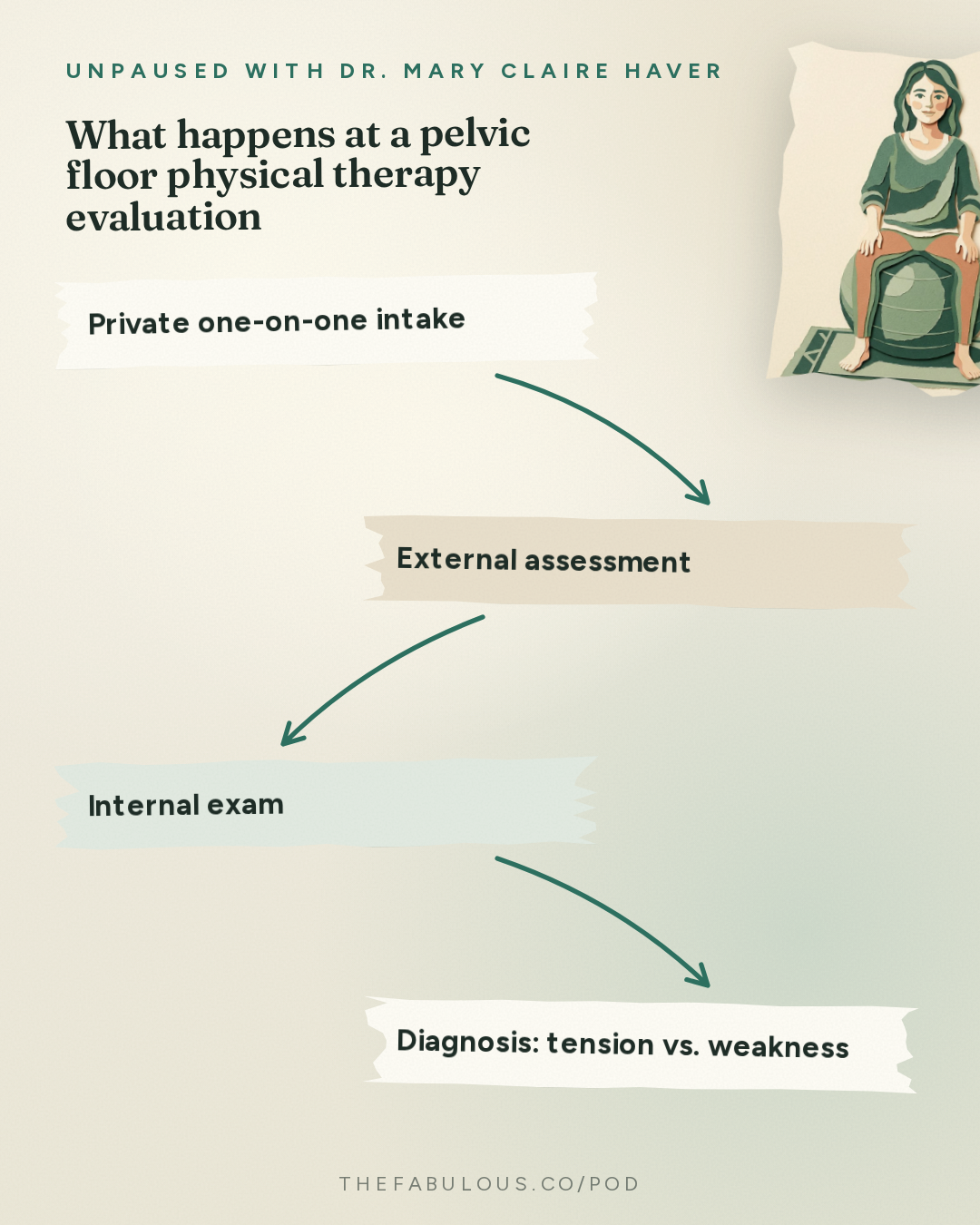
Pelvic Floor Therapy for Menopause Explained
Bladder Leaks, UTIs & Pelvic Floor Health with the Vagina Whisperer
▶ Listen to the full episode More from unPAUSED with Dr. Mary Claire Haver
The brief
Pelvic floor therapist Dr. Sarah Reardon says one in three women has a pelvic floor disorder, and most can self-refer for therapy without a doctor's note. She explains why verbal Kegel instructions fail more than half the time, how vaginal estrogen cuts recurrent UTI rates nearly twelvefold, and why nighttime bathroom trips raise fracture risk in menopause.
Mary Claire Haver's mother had three separate surgeries for urinary incontinence, and none of them fixed the problem. She wore pantyhose as her underwear, and on a family trip to Disney World she once padded her shoulders with extra pads because her bag could not hold enough (06:45). She lived that way for thirty years. Nobody ever told her there might be another path. Haver tells this story on her podcast, Unpaused, as the opening wound behind an entire episode about pelvic health, and it sets the tone for everything her guest says next.
That guest is Dr. Sarah Reardon, a board certified pelvic floor physical therapist, founder of the education platform The Vagina Whisperer, and author of the book Floored. Reardon has spent two decades examining a part of the body most women are never taught to name. Haver opens the episode with a number that explains the silence: 68% of post-menopausal women surveyed did not know what a pelvic floor even was (01:36). Nearly one in three women lives with some form of pelvic floor disorder, from leakage to prolapse to painful sex, and the United States spends over $20 billion a year managing those symptoms rather than resolving them (01:09). About 30% of women who have surgery for a pelvic floor problem need a second surgery for the same condition (01:09).
The pelvic floor itself is simple to picture once someone finally draws it. It is a basket of muscles that stretches from the pubic bone in front to the tailbone in back, holding up the bladder, uterus, and rectum the way a hammock holds weight (04:12). Reardon explains that with prolapse, nothing is actually falling out: it is the vaginal walls that get pushed in by the organ as the supporting tissue stretches (16:16). The NHANES national health survey shows any pelvic floor disorder affects half of women by age 80 (05:15). The fear that comes with a diagnosis like "your bladder is falling out" is almost always worse than the mechanics actually are.
One fact in this episode does more work than any other: women do not need a doctor's referral to get help. Reardon describes watching more patients find her through word of mouth and social media now that the option is better known.
"In every state in the United States, you can self-refer to physical therapy for your pelvic floor, and it's covered under insurance like every other type of physical therapy." — Dr. Sarah Reardon [09:48]
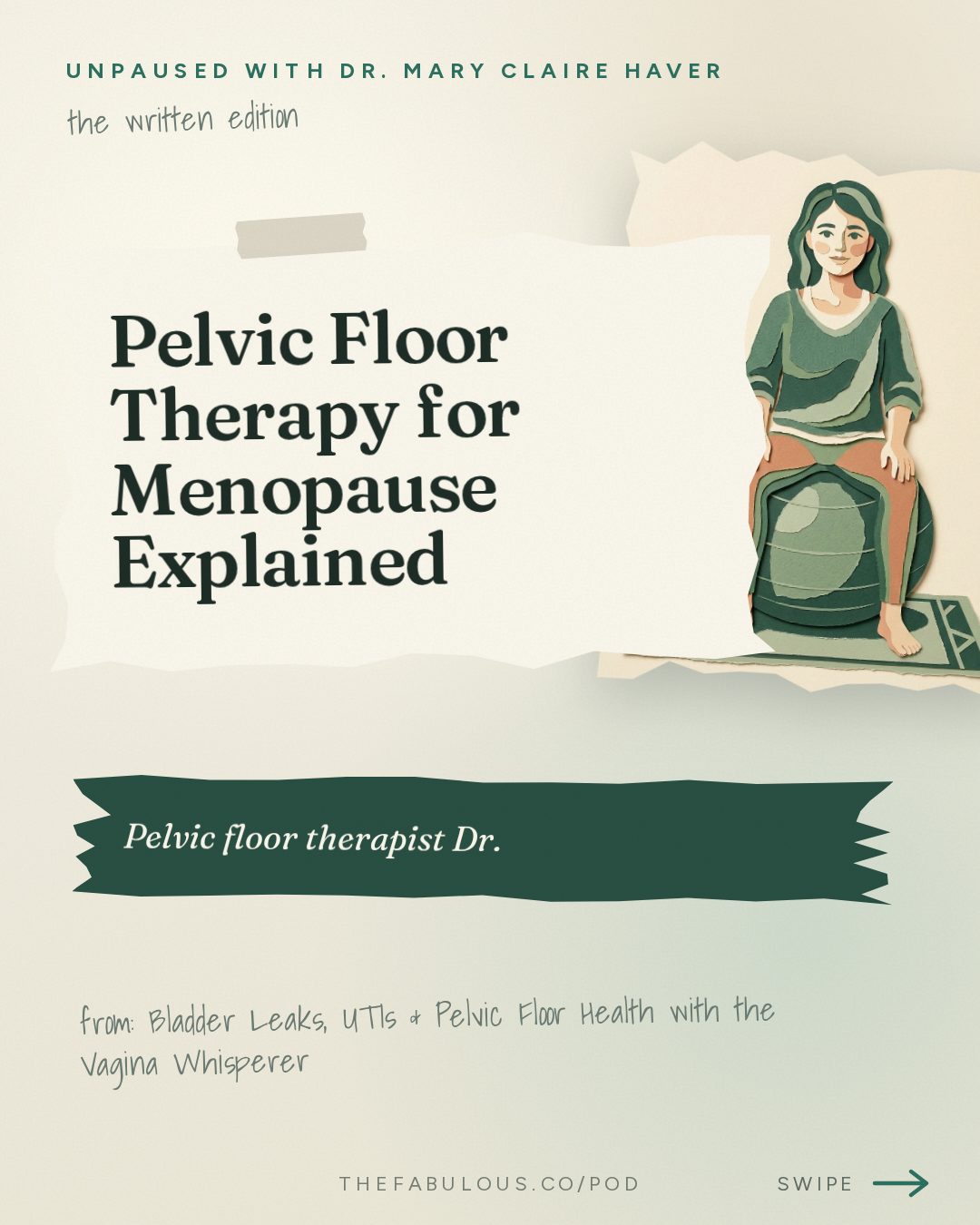
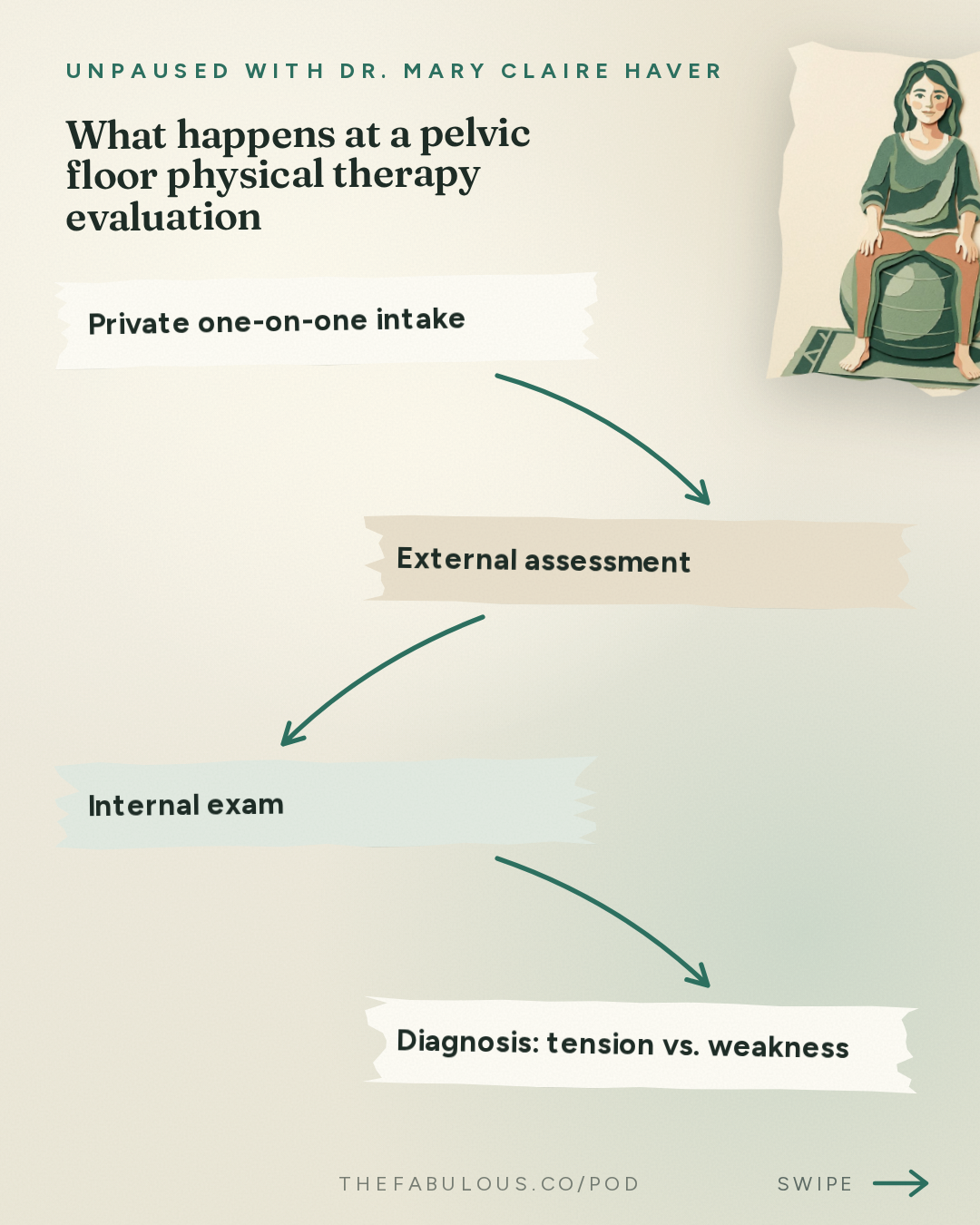
A pelvic floor evaluation, she explains, starts as a conversation, not an exam. The therapist asks about bowel habits, bladder habits, childbirth, sex, and medications before ever doing a physical assessment, because the pelvic floor muscles are tied into all of those systems at once (11:06). The internal exam that follows, a gloved and lubricated finger testing the muscles on each side of the vaginal opening, simply confirms what the history already suggested (12:05).
The Myth of the Universal Kegel
Much of the episode works to undo eighty years of bad advice. Arnold Kegel, the physician who gave his name to the pelvic floor contraction exercise, built his original pressure measuring device in the 1940s, largely from research on postpartum patients (18:06). Since then, Reardon says, "do your Kegels" has become the answer to almost any pelvic complaint, the equivalent of telling every back pain patient to do more crunches (18:06). The problem is that over 50% of women are not doing Kegels correctly when they are only given verbal instructions (13:03), and a Cochrane review found that twelve weeks of individualized, supervised pelvic floor physical therapy cured stress incontinence in 56% of women, compared with 6% who received no treatment (19:58). A pamphlet is not a protocol.
There is a second twist. Pelvic floor muscles, like any other muscle, need to relax as well as contract (18:44). Symptoms such as painful intercourse, tailbone pain, straining with bowel movements, or a weak urine stream often point to a pelvic floor that is too tight, not too weak, and doing more Kegels on a tense muscle can make things worse (18:44, 19:02). Getting a correct diagnosis, tension versus weakness, decides which exercise actually helps.
Reardon's long term view is maintenance, not a quick fix.
"I always say going to see a pelvic floor therapist is like going to see a dentist. Once you get a cavity fixed, you don't stop flossing or brushing." — Dr. Sarah Reardon [14:32]
Estrogen, Infection, and the Cost of Waiting
The conversation turns to urinary health, and the numbers there are harder to shrug off. According to data from the health system Kaiser, 34% of women over 40 wake once or twice a night to urinate, a behavior most doctors never ask about directly (22:55). The normal range is actually zero to two times a night, so this falls inside normal, but normal does not mean harmless: lost sleep compounds the brain fog, anxiety, and weight gain many women already experience in perimenopause (23:18, 23:38). Reardon also flags a safety issue most people never consider. Post-menopausal women already face higher fracture risk from bone loss, so a woman rushing to the bathroom in a dark, cluttered room at night is a fall waiting to happen (31:33). Her practical fix is almost embarrassingly simple: sleep on the side of the bed closer to the bathroom, keep the path lit and clear of rugs, and consider a bedside commode if the distance is long (32:21).
Vaginal estrogen comes up again and again as the single most underused tool in this entire conversation. A 1993 study comparing postmenopausal women with recurrent urinary tract infections found that those using vaginal estrogen had 0.5 infections per year, versus 5.9 per year on placebo, a nearly twelvefold difference (34:40). Haver says roughly half of recurrent UTIs are preventable this way (32:48). The stakes go beyond discomfort: orthopedic surgeons interviewed separately told Haver that over 60% of women arriving at the ER with a hip fracture also have a concurrent urinary tract infection, raising the question of how many of those falls started with a nighttime dash to the bathroom or early delirium from infection (35:21). Haver's own mother had a UTI at the time of the hip fracture that ended her ability to walk.
The episode does not shy from medicine's past mistakes either. Transvaginal mesh, once a common fix for prolapse and incontinence, was pulled from the market by the FDA in April 2019 after a white paper found roughly 10% of women had mesh erosion within twelve months, with longer follow up putting exposure as high as 11 to 18% over three to five years (43:10). Reardon describes treating women whose mesh eroded through the vaginal wall or migrated toward the sacrum, some of whom lost the ability to work or maintain relationships because of the resulting pain. Current prolapse surgeries lean on native tissue rather than mesh, but Reardon's point is broader: a surgical fix for a prolapsed organ, what she calls replacing the rope that suspends a boat, does nothing to raise the water level underneath it, meaning pelvic floor training still matters even after surgery (42:48).
That training rarely happens. Fewer than 10% of surgical patients receive post-operative pelvic floor physical therapy, despite the fact that ACL and shoulder surgeries routinely include rehab as a matter of course (48:14). Only about 3% of women report symptomatic prolapse, even though physical exams find some degree of it in 40 to 50% of women, a gap Reardon attributes not to ignorance but to anatomy: the lower third of the vagina carries more nerve endings, so prolapse often has to progress before a woman feels it at all (39:40).
What ties all of this together is not a single treatment but a habit of asking better questions, starting with a doctor who asks how many times a patient urinates at night instead of only whether she leaks, and continuing with a woman who knows she is allowed to walk into a pelvic floor therapist's office on her own. Reardon's closing line of reasoning is really a return to the opening story: Haver's mother was offered surgery, then another surgery, then nothing. The missing piece the whole time was ordinary, unglamorous physical therapy, available in every state, covered by insurance, and still something most women do not know to ask for.
Ask this episode anything
Pod's AI answers from the episode itself, with the minute mark so you can hear it yourself.
Or start with one of these
Ask this episode
Pod's AI listens to the whole episode to answer, and points you to the minute it comes from.
The rest of this answer, and any question after it
Answers come from the episode itself, never from a summary of it.
ContinueKey takeaways
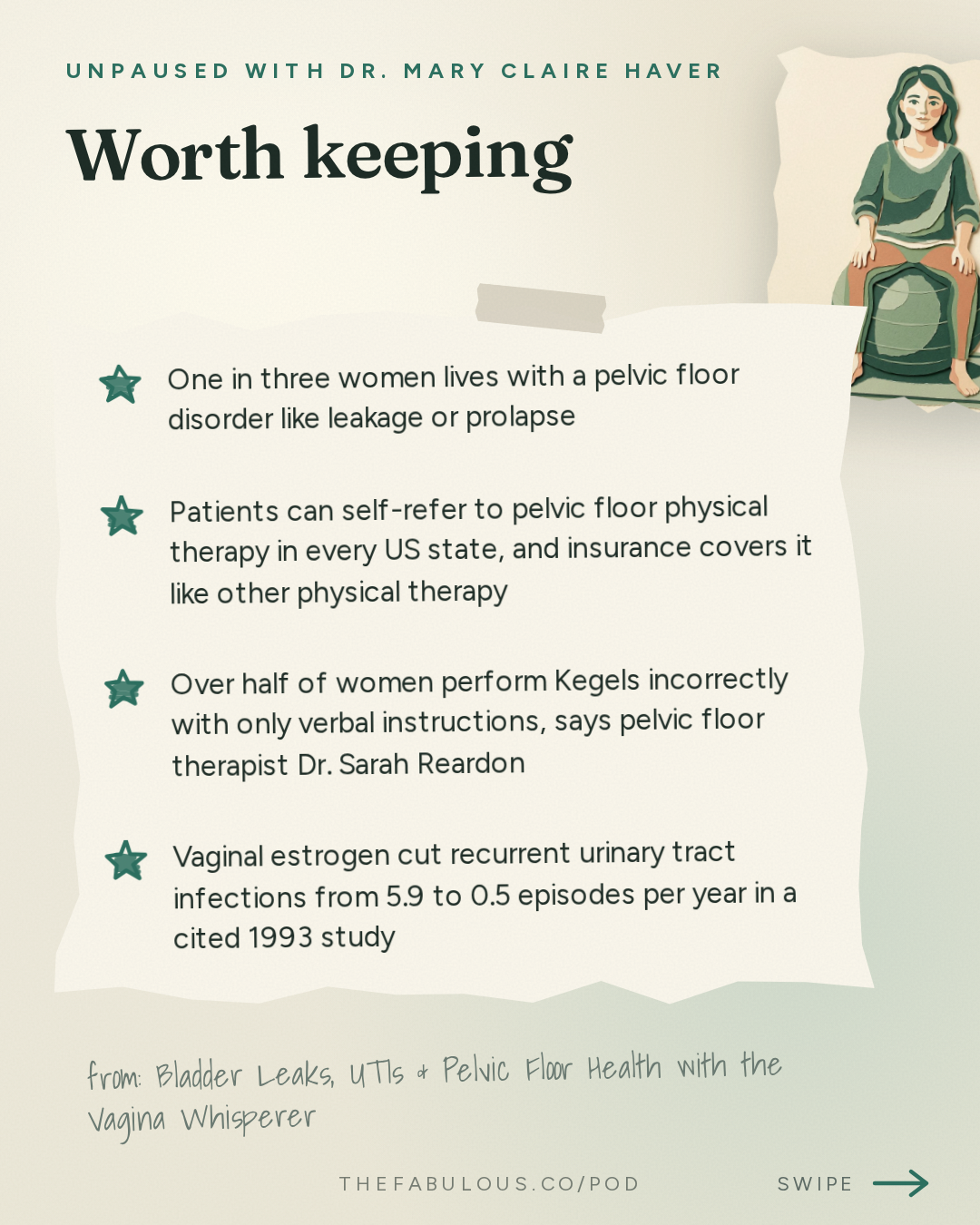
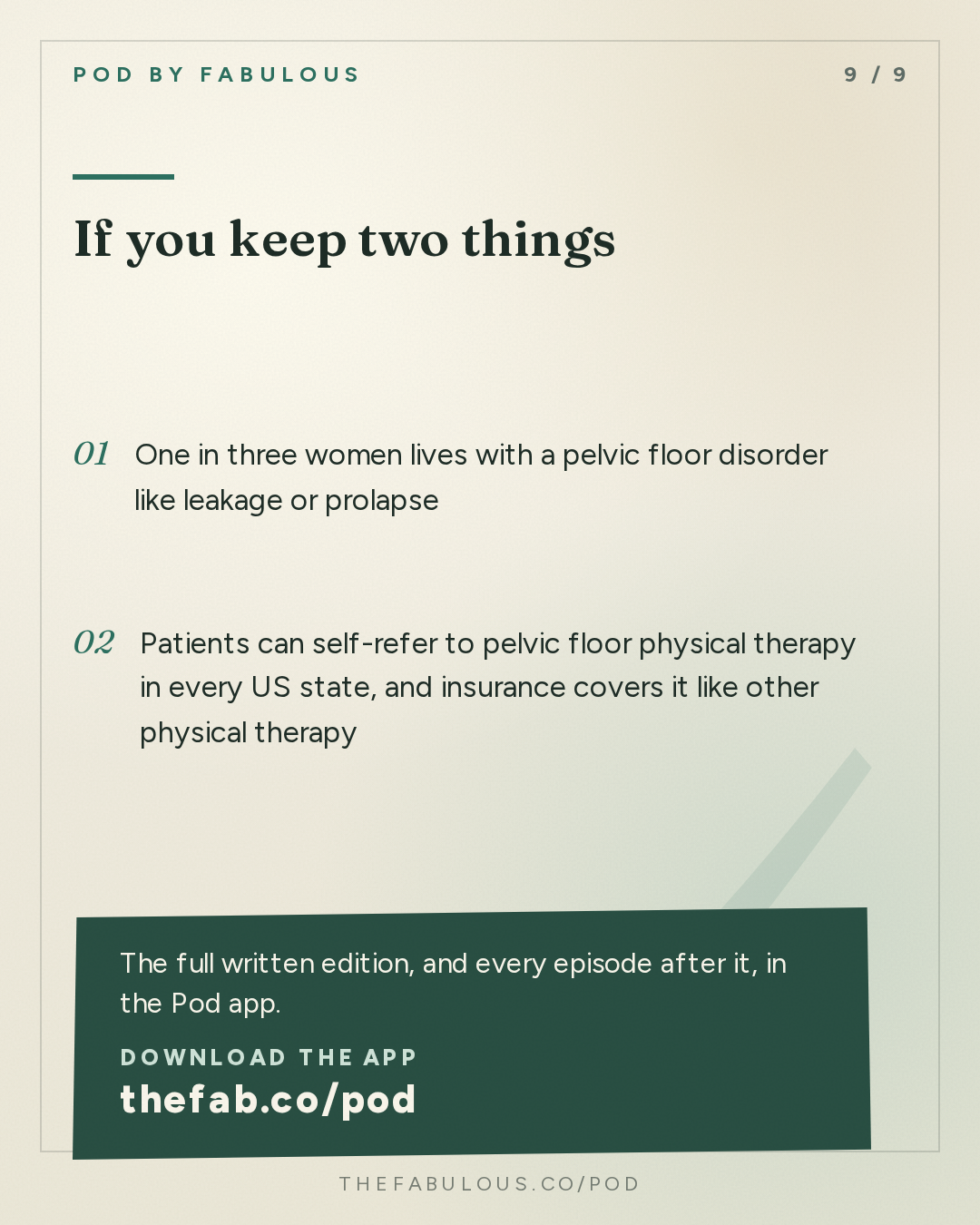
- One in three women lives with a pelvic floor disorder like leakage or prolapse
- Patients can self-refer to pelvic floor physical therapy in every US state, and insurance covers it like other physical therapy
- Over half of women perform Kegels incorrectly with only verbal instructions, says pelvic floor therapist Dr. Sarah Reardon
- Vaginal estrogen cut recurrent urinary tract infections from 5.9 to 0.5 episodes per year in a cited 1993 study
- Over 60% of women who arrive at the ER with a hip fracture also have a urinary tract infection
The episode in cards


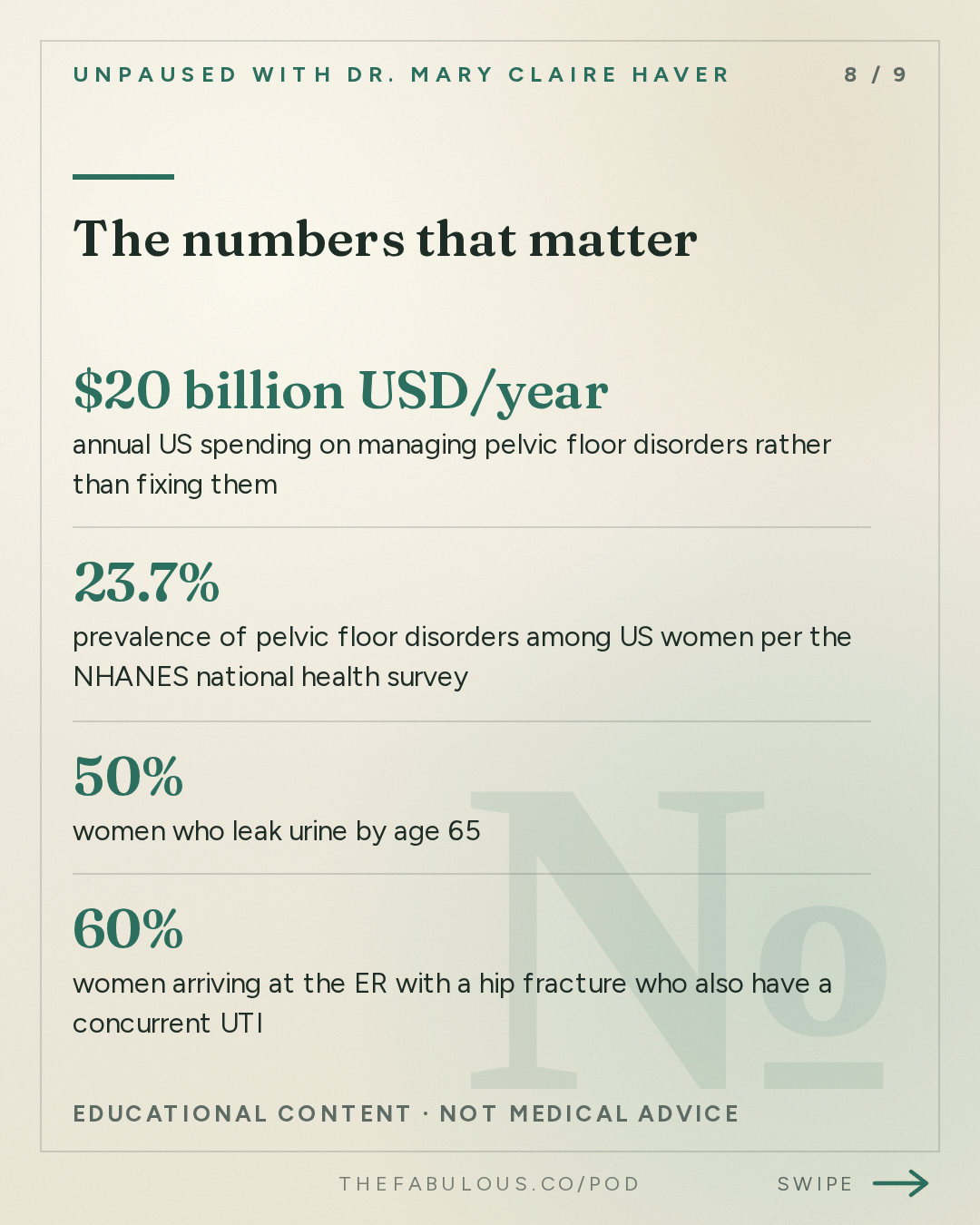
By the numbers
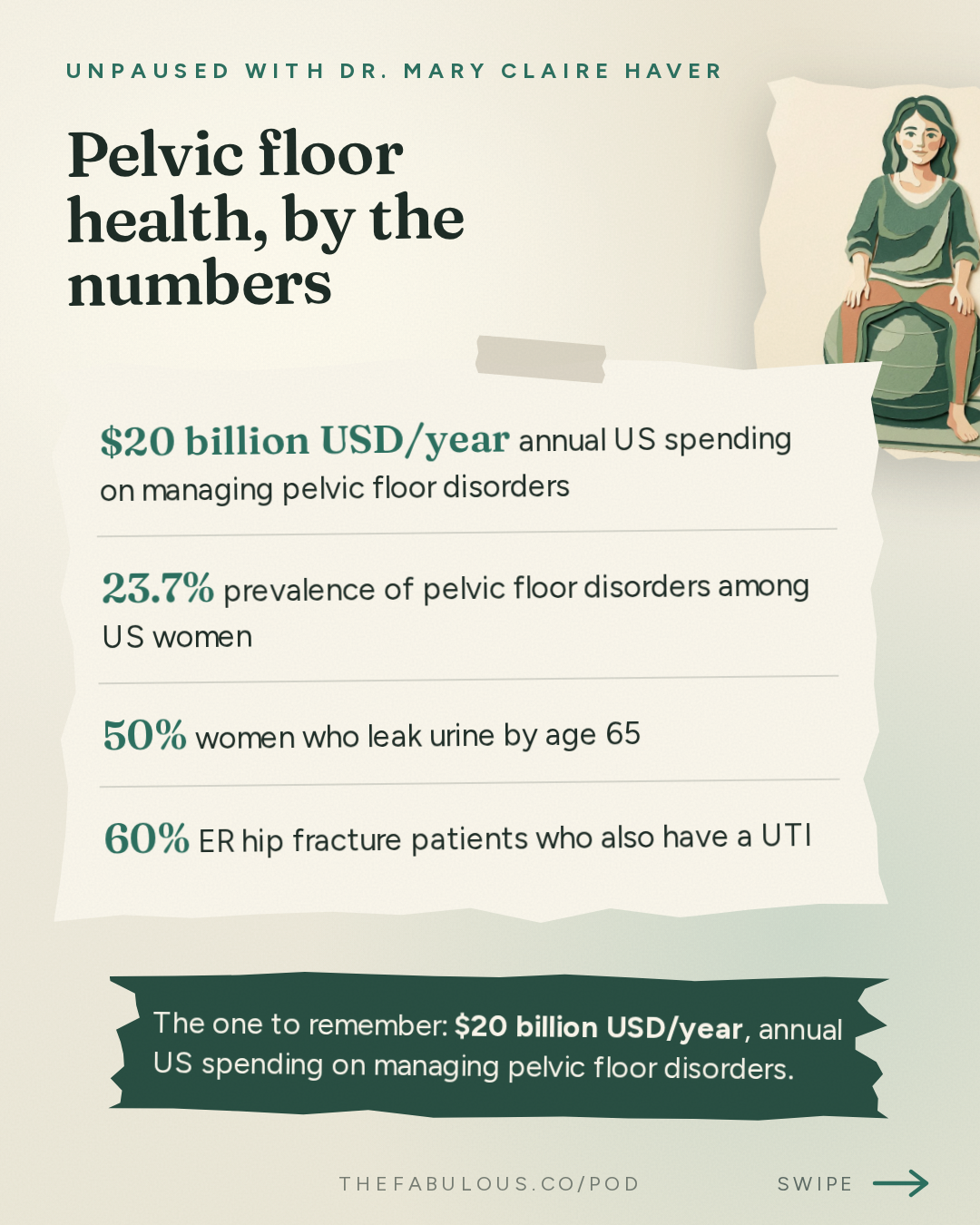
- $20 billion USD/year annual US spending on managing pelvic floor disorders rather than fixing them
- 23.7% percent prevalence of pelvic floor disorders among US women per the NHANES national health survey
- 50% percent women who leak urine by age 65
- 60% percent women arriving at the ER with a hip fracture who also have a concurrent UTI
In their words
“In every state in the United States, you can self-refer to physical therapy for your pelvic floor, and it's covered under insurance like every other type of physical therapy.”
“We have normalized the problems, but we need to normalize the conversations.”
“I always say going to see a pelvic floor therapist is like going to see a dentist. Once you get a cavity fixed, you don't stop flossing or brushing.”
“We have a whole skincare routine for our face. We need to have a vulva care routine as well.”
Protocols
-
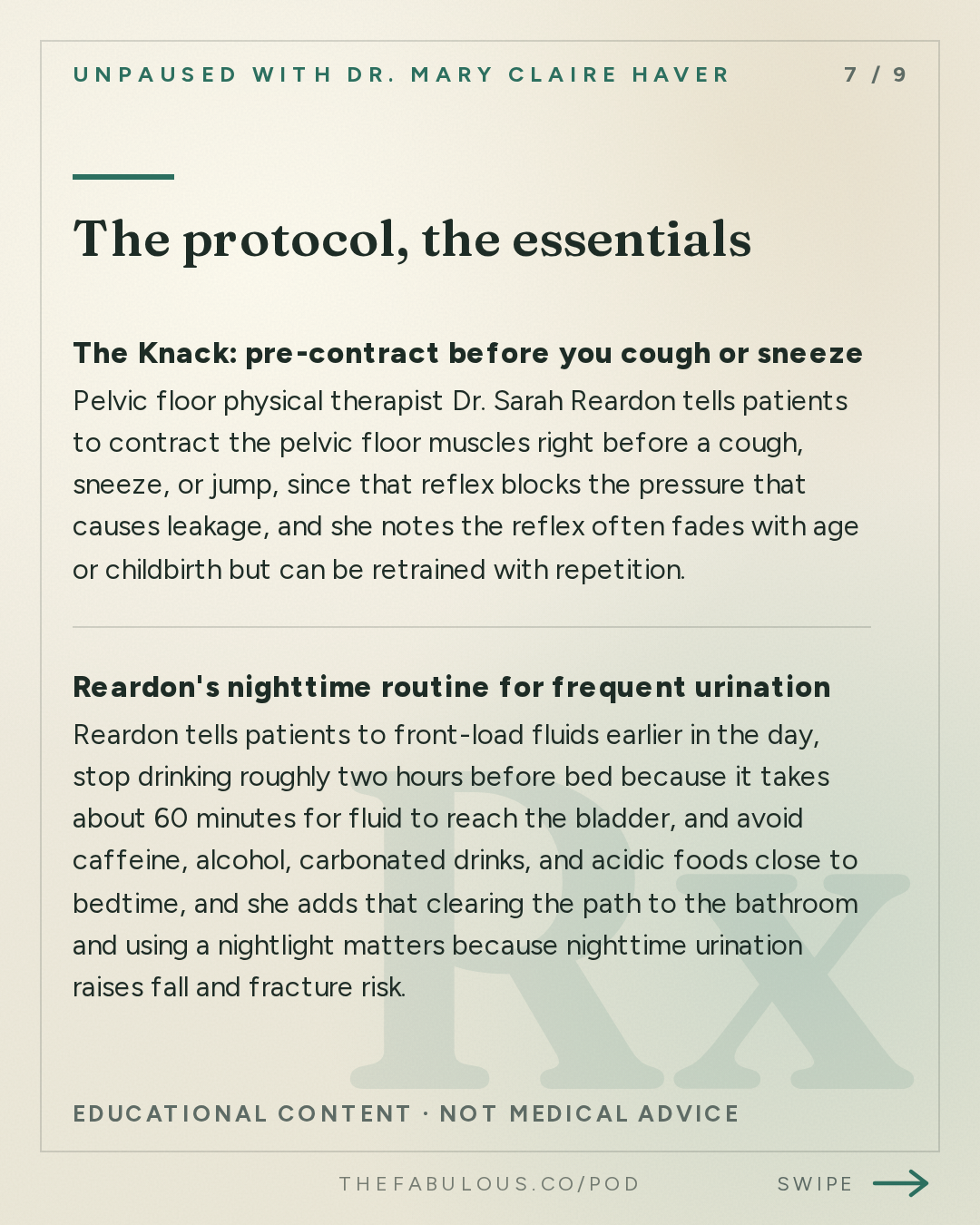
The Knack: pre-contract before you cough or sneeze
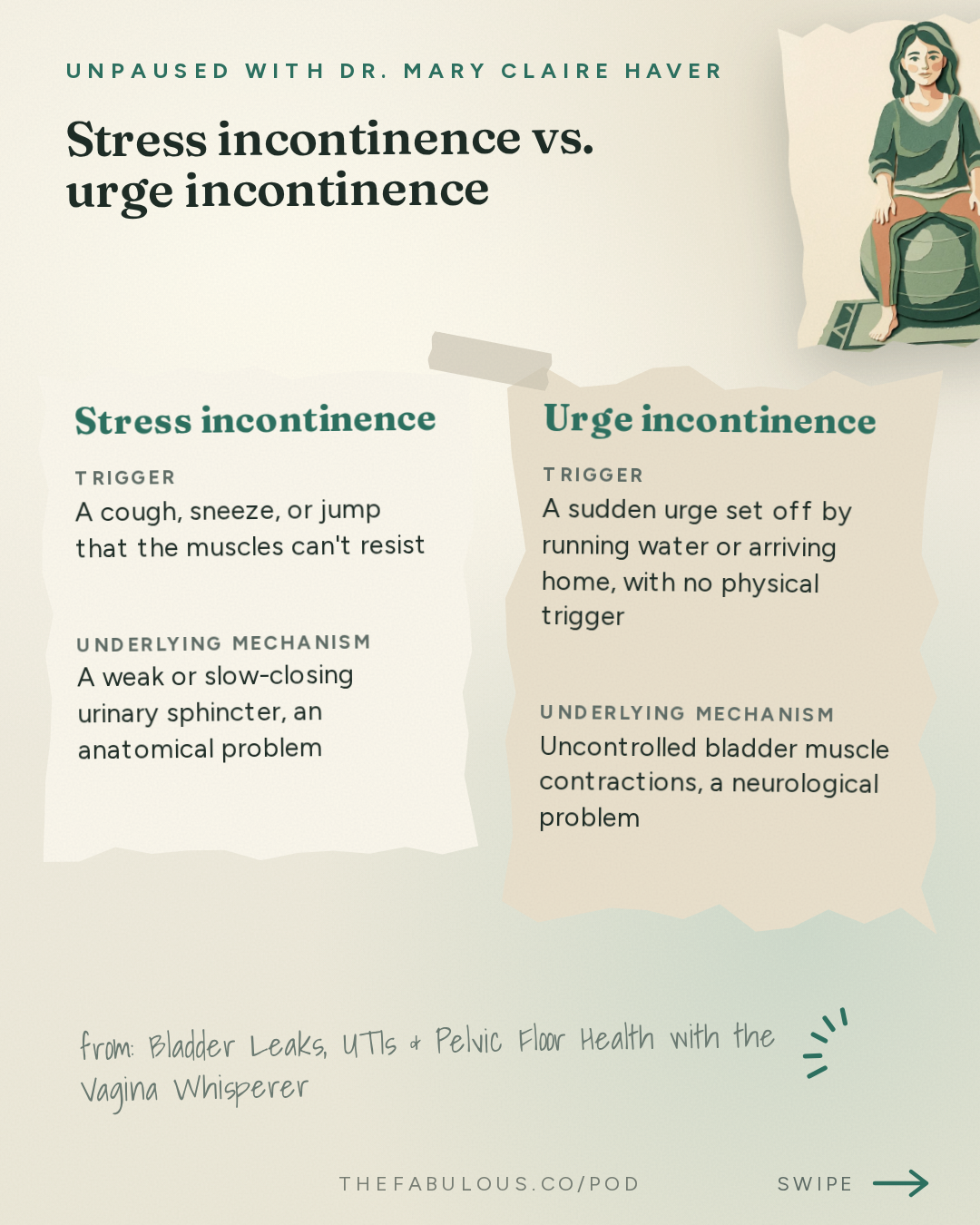
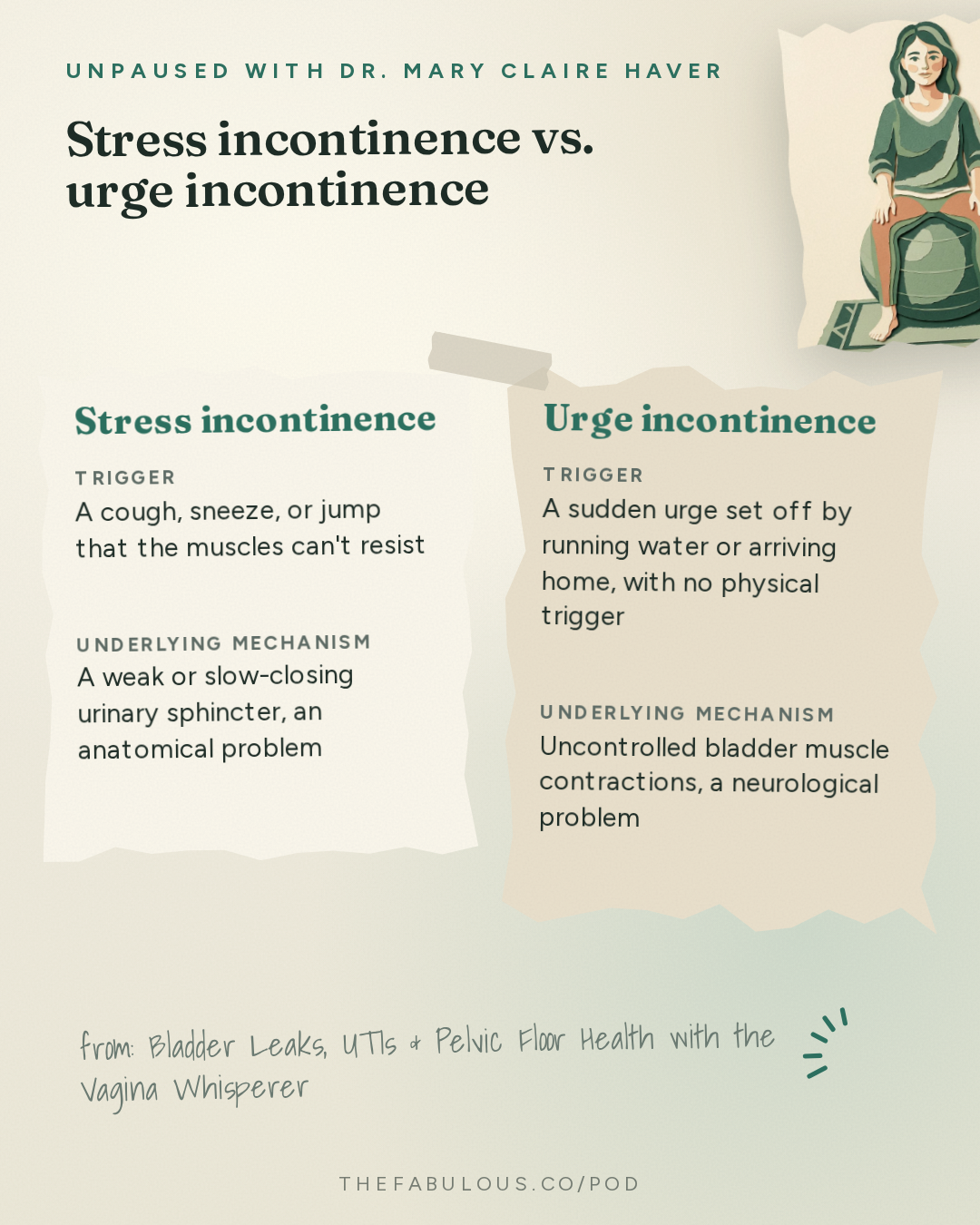
Pelvic floor physical therapist Dr. Sarah Reardon tells patients to contract the pelvic floor muscles right before a cough, sneeze, or jump, since that reflex blocks the pressure that causes leakage, and she notes the reflex often fades with age or childbirth but can be retrained with repetition.
Every time before a cough, sneeze, or jump
-
Reardon's nighttime routine for frequent urination
Reardon tells patients to front-load fluids earlier in the day, stop drinking roughly two hours before bed because it takes about 60 minutes for fluid to reach the bladder, and avoid caffeine, alcohol, carbonated drinks, and acidic foods close to bedtime, and she adds that clearing the path to the bathroom and using a nightlight matters because nighttime urination raises fall and fracture risk.
Nightly habit
-
Start vaginal estrogen in perimenopause, not after infections pile up
Dr. Mary Claire Haver and Reardon both say topical vaginal estrogen should be prescribed proactively starting in perimenopause rather than only after recurrent infections or prolapse appear, and Reardon notes a newer study shows the cream can be applied with a finger to the vulva and urethra instead of with an internal applicator and still prevent UTIs.
About twice a week
-
Rehab after pelvic surgery, the way you would after an ACL repair
Reardon recommends that women ask their surgeon about post-operative restrictions before any prolapse repair and plan on pelvic floor physical therapy afterward, since she says fewer than 10% of surgical patients currently receive it even though it functions like rehab after an ACL or shoulder surgery.
Following any pelvic floor surgery
Questions this episode answers
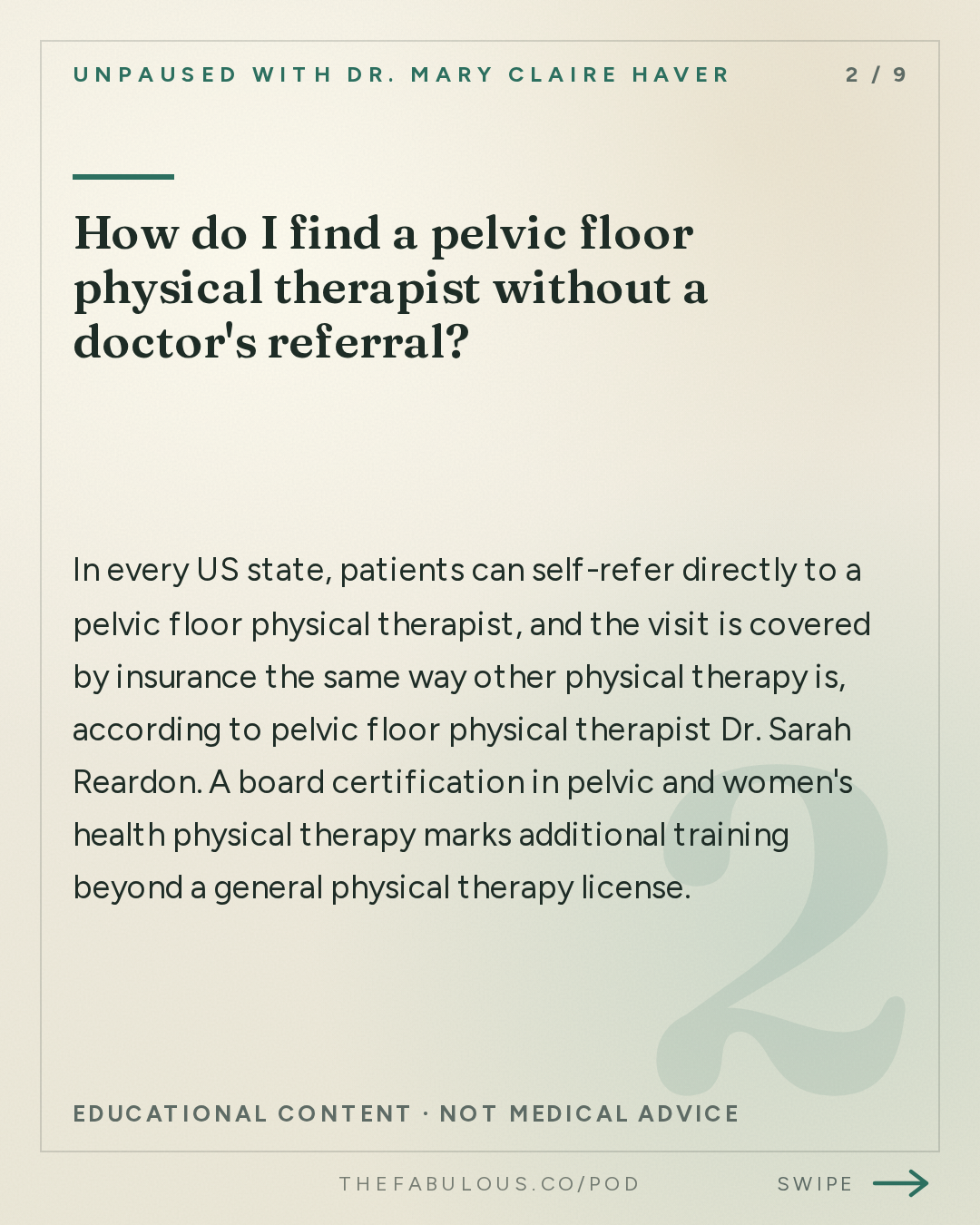
How do I find a pelvic floor physical therapist without a doctor's referral?
In every US state, patients can self-refer directly to a pelvic floor physical therapist, and the visit is covered by insurance the same way other physical therapy is, according to pelvic floor physical therapist Dr. Sarah Reardon (09:48). A board certification in pelvic and women's health physical therapy marks additional training beyond a general physical therapy license (10:06).
Can vaginal estrogen prevent recurrent UTIs?
A 1993 trial cited on the show found vaginal estrogen cut urinary tract infections from 5.9 episodes per year on placebo to 0.5 episodes per year, roughly a twelvefold reduction (34:40). Reardon notes the cream can even be applied with a finger to the vulva and urethra rather than with an internal applicator and still work for prevention (37:30).
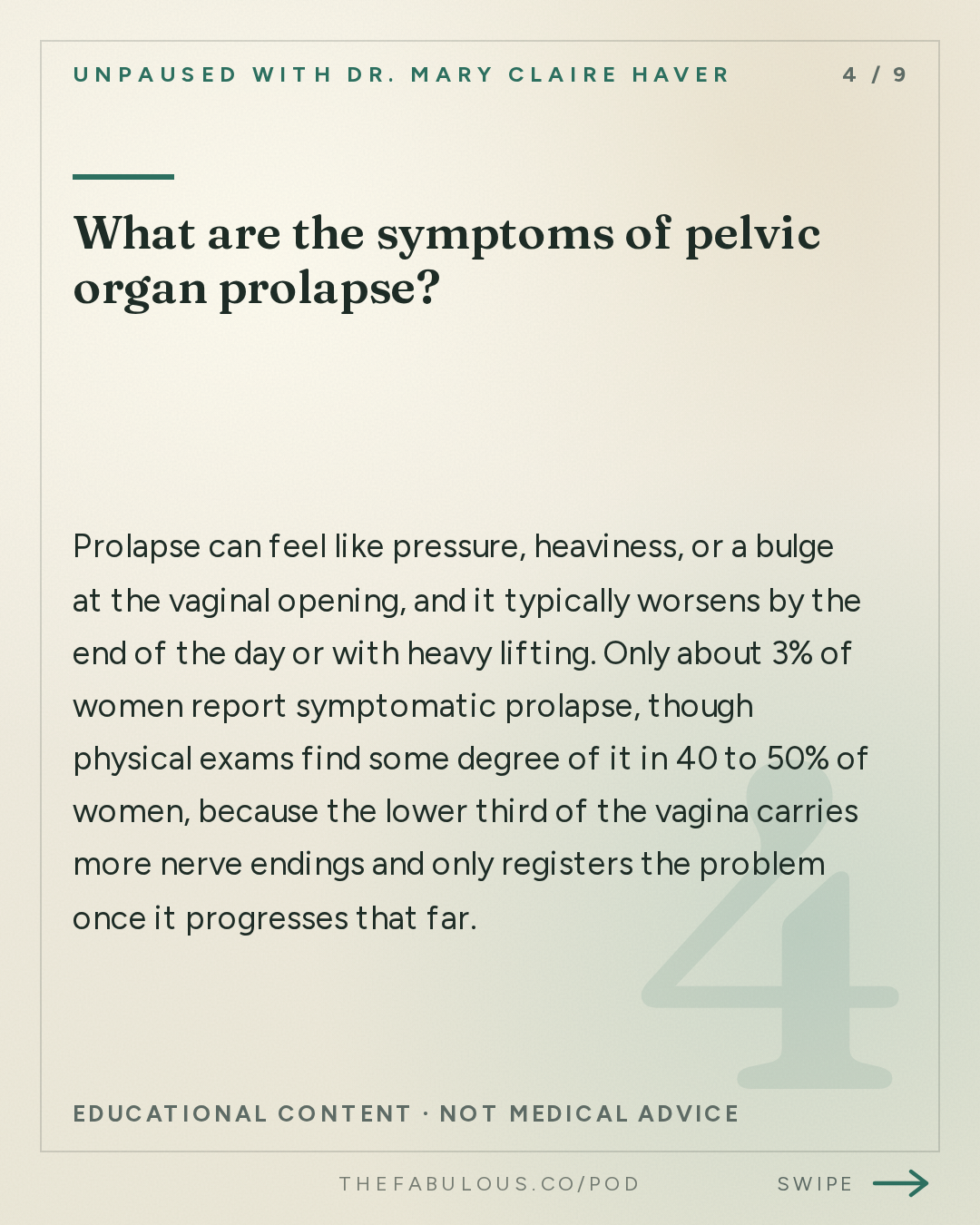
What are the symptoms of pelvic organ prolapse?
Prolapse can feel like pressure, heaviness, or a bulge at the vaginal opening, and it typically worsens by the end of the day or with heavy lifting (39:01). Only about 3% of women report symptomatic prolapse, though physical exams find some degree of it in 40 to 50% of women, because the lower third of the vagina carries more nerve endings and only registers the problem once it progresses that far (39:40).
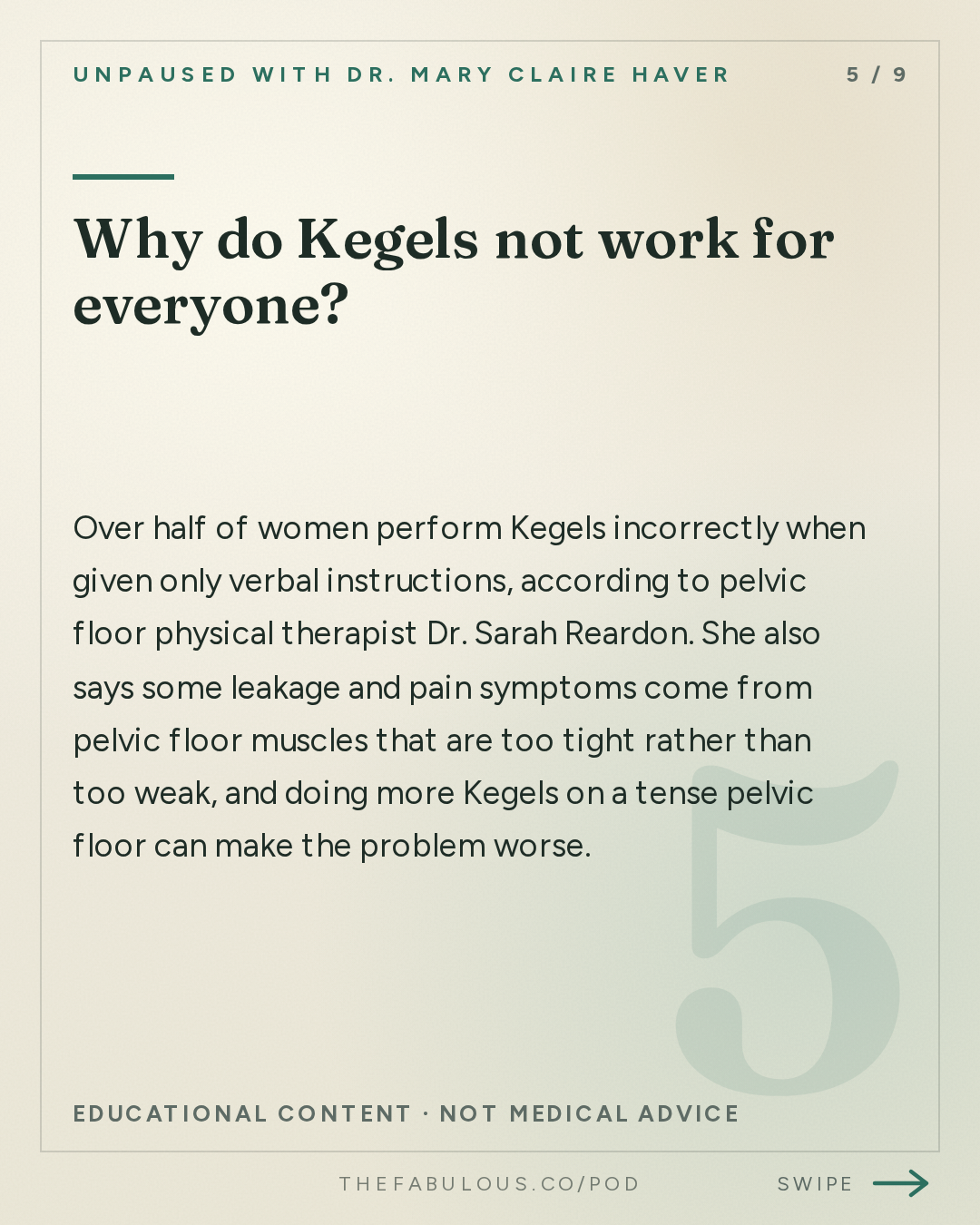
Why do Kegels not work for everyone?
Over half of women perform Kegels incorrectly when given only verbal instructions, according to pelvic floor physical therapist Dr. Sarah Reardon (13:03). She also says some leakage and pain symptoms come from pelvic floor muscles that are too tight rather than too weak, and doing more Kegels on a tense pelvic floor can make the problem worse (18:44).
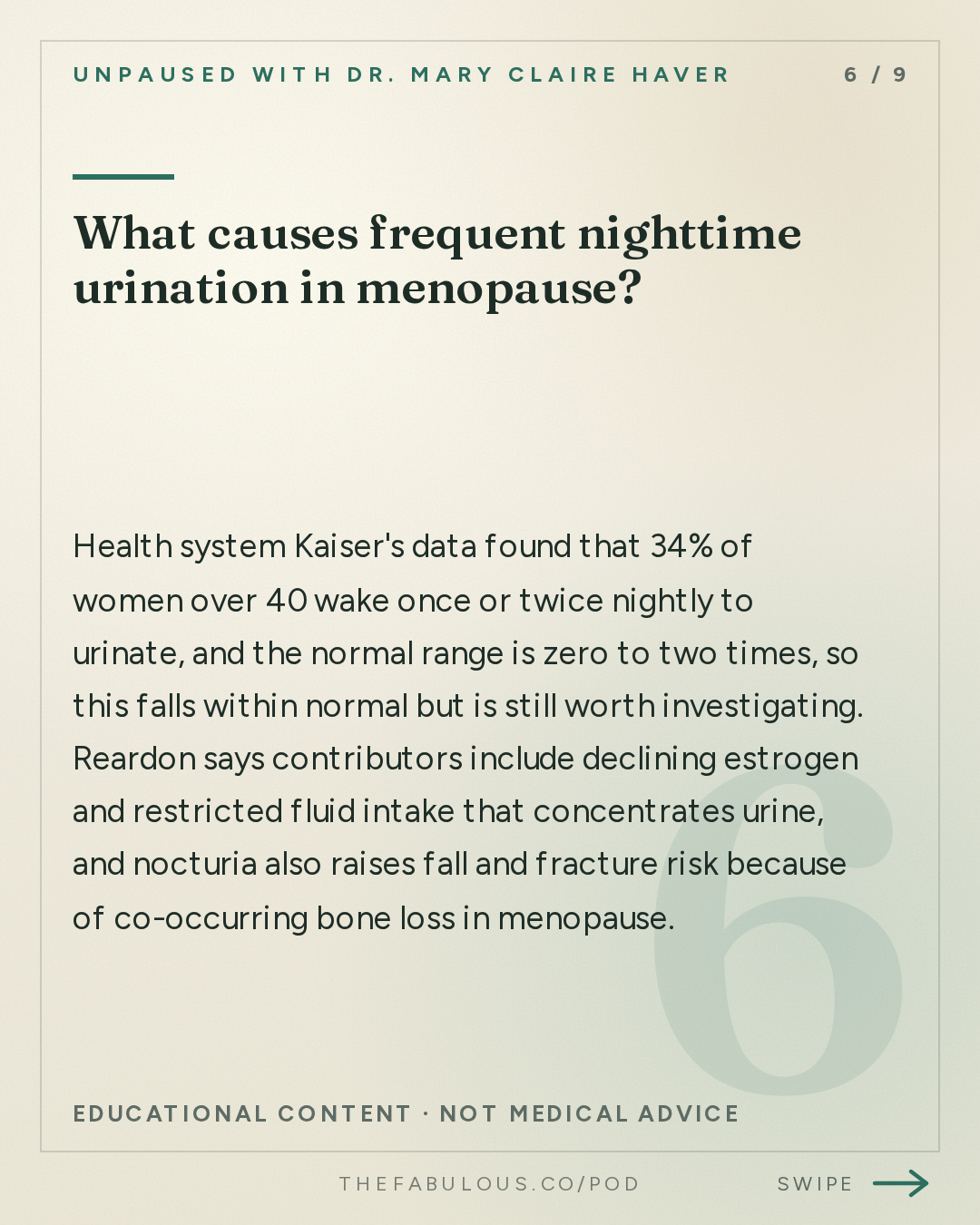
What causes frequent nighttime urination in menopause?
Health system Kaiser's data found that 34% of women over 40 wake once or twice nightly to urinate, and the normal range is zero to two times, so this falls within normal but is still worth investigating (22:55). Reardon says contributors include declining estrogen and restricted fluid intake that concentrates urine, and nocturia also raises fall and fracture risk because of co-occurring bone loss in menopause (23:18).
The full read, in cards

Go deeper
- NHANES (National Health and Nutrition Examination Survey) — found pelvic floor disorders affect 23.7% of US women, rising past 50% by age 80
- Cochrane review on pelvic floor muscle training — found 12 weeks of individualized therapy cured stress incontinence in 56% of women versus 6% with no treatment
- 1993 vaginal estrogen trial for recurrent UTIs — found vaginal estrogen reduced infections to 0.5 per year versus 5.9 per year on placebo
- FDA white paper on transvaginal mesh — documented erosion in roughly 10% of women within 12 months and up to 18% by three to five years, prompting removal from the market in 2019
- Floored: A Woman's Guide to Pelvic Health at Every Age and Stage — Reardon's book, which includes a symptom checklist to bring to a doctor's appointment
Mentioned
Dr. Sarah Reardon · The Vagina Whisperer · Floored: A Woman's Guide to Pelvic Health at Every Age and Stage · NHANES · Arnold Kegel · Kaiser · American Urological Association · V Hive · Dr. Rachel Rubin
More from this show and category

Mark Cuban on the Estrogen Patch Shortage
Estrogen patch prescriptions have nearly tripled in two years, while specialty manufacturing requirements keep supply from catching up. Entrepreneur Mark Cuban explains how his Cost Plus Drugs company sells at a flat 15% markup, and how pharmacy benefit managers can push a brand drug's price from $300 to $600 through rebate demands.

Postpartum OCD vs Psychosis: Key Differences
Postpartum OCD causes unwanted, intrusive thoughts about harming a baby, not a desire to act. CNN anchor Pamela Brown and OB-GYN Dr. Mary Claire Haver distinguish it from postpartum psychosis, a break from reality involving voices (42:59), and cover GLP-1 fertility effects, testosterone therapy, and vaginal estrogen's role preventing UTIs (35:52).

How Menopause Affects Gut Health and Bloating
Menopause changes gut health because falling estrogen slows motility, raises pain sensitivity, and shifts the microbiome's estrobolome. Harvard gastroenterologist Trisha Pasricha explains why bloating, IBS, and fecal incontinence rise after menopause, and lays out fiber, screening, and bidet protocols that actually help.

Menopause Skin Changes: What Actually Helps
Dermatologist Erica Kelly tells Dr. Mary Claire Haver that menopausal skin needs lighter Botox doses, daily sunscreen, and realistic expectations for collagen and hair treatments. Hormone therapy may preserve skin firmness for decades, oral minoxidil treats hair loss but causes a two-month shed, and vaginal moisturizers differ from lubricants.
