
unPAUSED with Dr. Mary Claire Haver
How Menopause Affects Gut Health and Bloating
How Menopause Changes Your Gut Health with a Leading Gastroenterologist
▶ Listen to the full episode More from unPAUSED with Dr. Mary Claire Haver
The brief
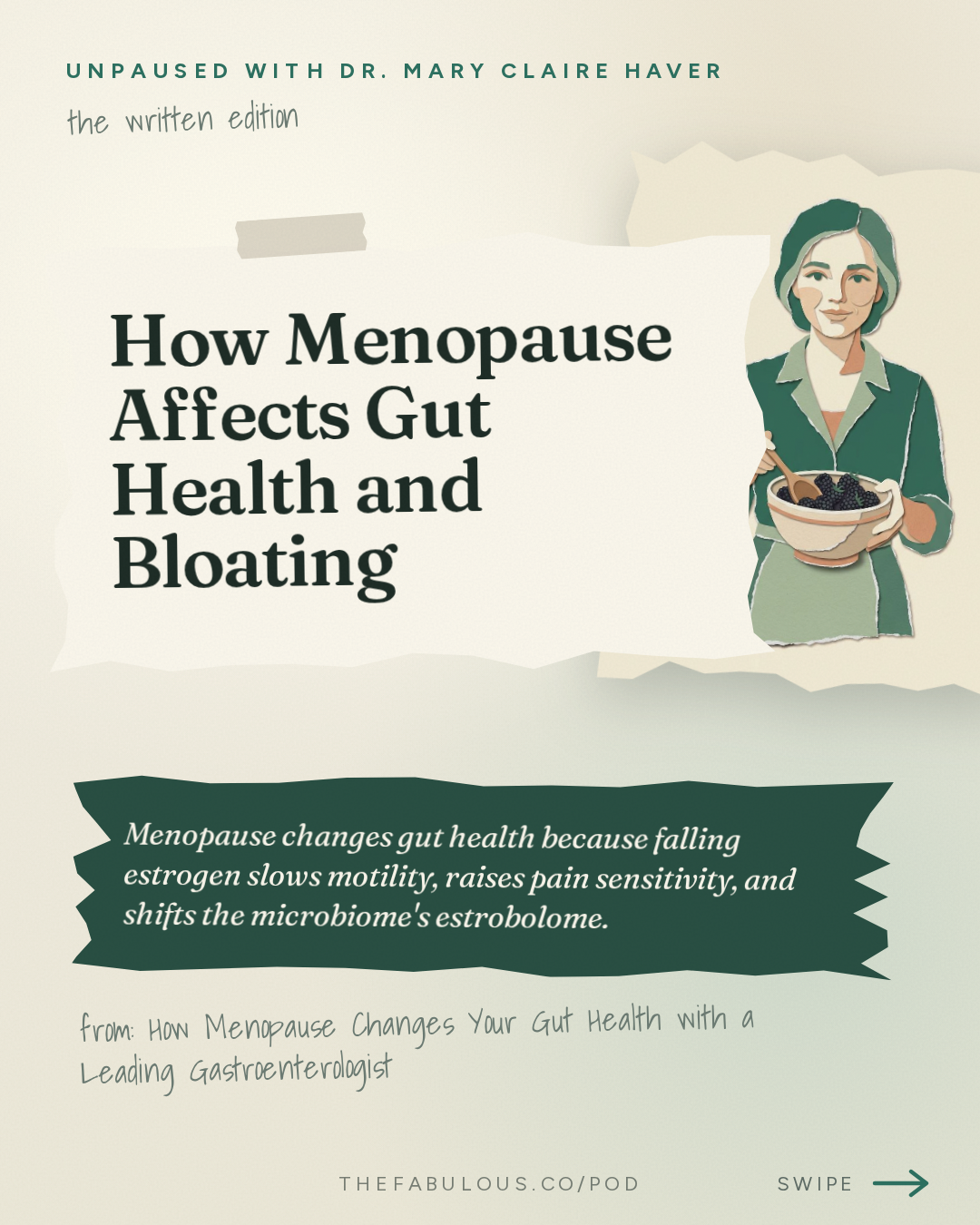
Menopause changes gut health because falling estrogen slows motility, raises pain sensitivity, and shifts the microbiome's estrobolome. Harvard gastroenterologist Trisha Pasricha explains why bloating, IBS, and fecal incontinence rise after menopause, and lays out fiber, screening, and bidet protocols that actually help.
A jellyfish has no brain behind its eyes. And yet it decides things. It swims toward food and away from danger. It does this with a nerve net concentrated in its gut, a kind of original brain that predates the one later species grew inside a skull. Humans kept a version of that system. It sits in the lining of the digestive tract, and it runs on roughly 500 million nerve cells, more than live in the entire human spinal cord (63:03). Gastroenterologist Trisha Pasricha, a physician-scientist at Beth Israel Deaconess Medical Center and assistant professor at Harvard Medical School, calls this the enteric nervous system, and she has spent her career arguing that most of medicine still treats it like plumbing.
That argument is the spine of her conversation with Dr. Mary Claire Haver, an OB-GYN and certified menopause practitioner, on the podcast unPAUSED. Pasricha is also the author of a book called You've Been Pooping All Wrong, and she writes the Ask a Doctor column for the Washington Post. Her specialty, neurogastroenterology, studies how the gut and the brain talk to each other, and for over a century the assumption was that the brain did most of the talking, sending stress down into an unhappy stomach. Pasricha's research points the other way. Roughly 80 percent of the traffic on the vagus nerve, the long cranial nerve that links gut to brain, runs from the gut upward (60:59). The butterflies are not imaginary. They are data arriving from below.
This matters for a very practical reason. For decades, women who told doctors their digestion had fallen apart in midlife were handed the same diagnosis: stress, age, it's in your head. Haver has heard it from a thousand women. Pasricha's rebuttal doubles as the episode's thesis.
"It's not the stress causing the symptoms, it's the symptoms causing the stress." — Trisha Pasricha [00:24]
Irritable bowel syndrome, or IBS, a condition defined by pain and altered bowel habits with no abnormal test to point to, affects 10 to 15 percent of Americans, and it is roughly twice as common in women as in men (09:23). Pasricha's explanation is biological, not psychological. Estrogen receptors sit inside the nervous system of the gut itself.
The Pain Switch Called Estrogen
Estrogen does two separate jobs in the digestive tract, and they can pull in opposite directions. First, it slows things down. Women on hormone replacement therapy sometimes notice their stomach empties more slowly and their gut gets a little more sluggish, a direct effect of estrogen on motility, the speed at which food and waste move through the system (21:44). Second, and more surprising, estrogen turns up the volume on pain. It stimulates serotonin-producing cells in the gut lining, which send signals up sensory nerves telling the brain "we are in pain." In mouse studies, removing the ovaries dulls that gut pain signal; injecting estrogen back in restores it (22:53). That is the biological reason IBS skews female and skews younger: more circulating estrogen means a gut primed to report pain. As estrogen falls after menopause, that particular signal often quiets down, even though changes happening in the brain's own estrogen receptors can sometimes override the improvement, which is why some postmenopausal IBS patients report symptoms as severe as ever (24:28).
Running underneath all of this is something called the estrobolome, a term for the specific gut bacteria that can chemically modify estrogen after the liver has tagged it for excretion. Those bacteria strip the tag off, letting some estrogen get reabsorbed into the body rather than leaving in stool (20:01). It is, Pasricha says, an emerging field, with no settled answer yet on why some people host more of these bacteria than others or what it ultimately means for health (20:42). What is firmer is the downstream list of changes menopause brings: accidental bowel leakage, which clinicians call fecal incontinence, affects postmenopausal women an average of one to two times a month (10:39), a number so common Pasricha wants it said out loud rather than hidden in shame. Bloating has at least three distinct biological roots, she says: diet, subtle changes in bowel habits, and a frequently missed culprit called abdominophrenic dyssynergia, in which the abdominal wall and diaphragm muscles stop coordinating and simply push the belly outward with nothing new actually inside it (15:45).
What the Checklist Actually Looks Like
Pasricha's prescriptions are concrete. For fecal incontinence, she points to psyllium husk, a soluble fiber studied in Harvard's Nurses' Health Study, which bulks the stool and appears to heighten sensitivity near the sphincter so the body recognizes an incoming bowel movement in time to respond (13:42). For hemorrhoids, which worsen with age and childbirth, she recommends keeping bathroom visits under five minutes and leaving the phone outside, since her own lab's research found smartphone use on the toilet raises hemorrhoid risk, likely because people simply sit longer (34:10). For hygiene, she is blunt about her preference.
"I'm Team Bidet. I'm Team Bidet all the way." — Trisha Pasricha [28:44]
Her reasoning: toilet paper is abrasive, and the perianal tissue, the skin around the anus, thins with age the same way vaginal tissue does during menopause, so repeated wiping causes small, accumulating injuries.
On medication for slow bowels, Pasricha pushes back against stigma directly, comparing laxative use to insulin for diabetes: a tool to use without shame when needed, paired with a doctor's judgment about whether something underlying is being missed (26:22). For iron deficiency anemia, a common but under-investigated symptom in women, her message is pointed: doctors too often blame periods by default, but the condition should be worked up as a possible GI issue, including a colonoscopy and upper endoscopy when no clear cause is found (43:46). She also offers a small fix for a common complaint: oral iron supplements can be taken every other day rather than daily, delivering similar absorption with fewer GI side effects (49:46).
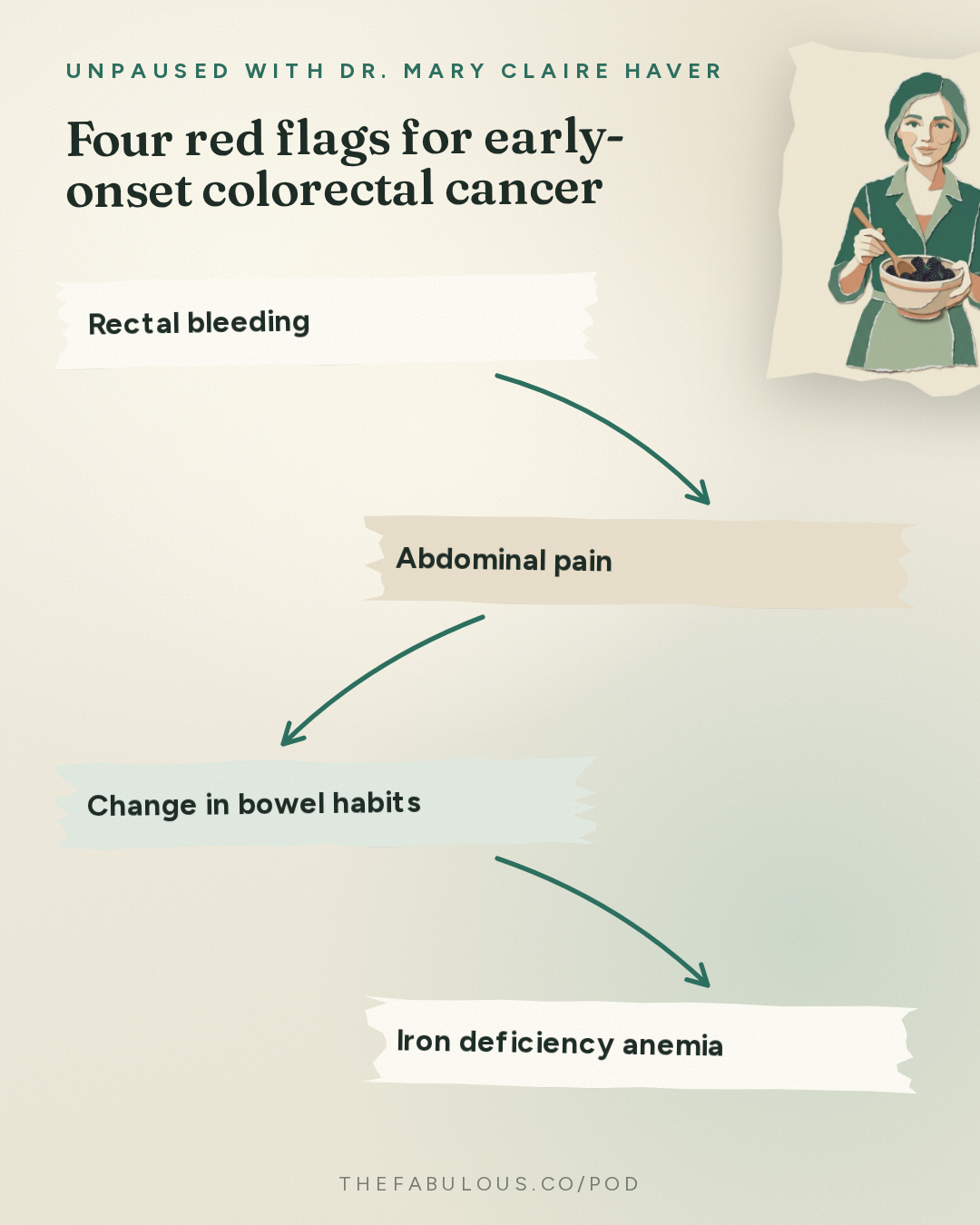
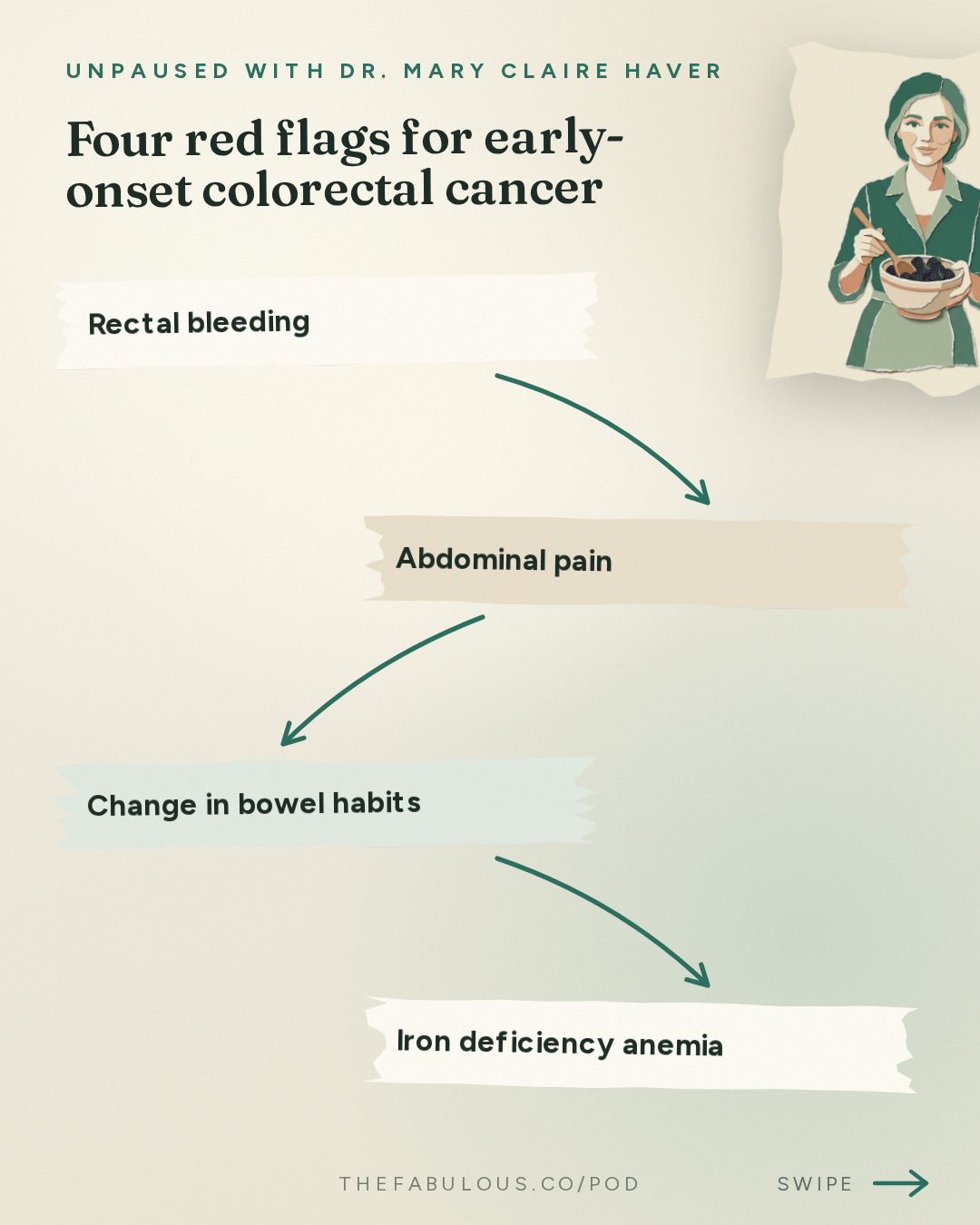
The clearest number in the whole conversation concerns colon cancer screening. Average-risk adults should start colonoscopies at 45, not 50, under newer guidelines (53:05). The reason a colonoscopy matters more than other screening options, Pasricha argues, is that it is the only test that prevents the cancer rather than just detecting it: doctors go in looking for polyps, precancerous growths, and remove them on the spot, which matters because 5 to 10 percent of untreated polyps become cancerous over time (53:45). She also names four red flags tied to a sixfold higher risk of early-onset colorectal cancer when three or four appear together: rectal bleeding, abdominal pain, a change in bowel habits, and unexplained iron deficiency anemia (39:19). None of these, she stresses, needs to be dramatic to be worth a message to a doctor.
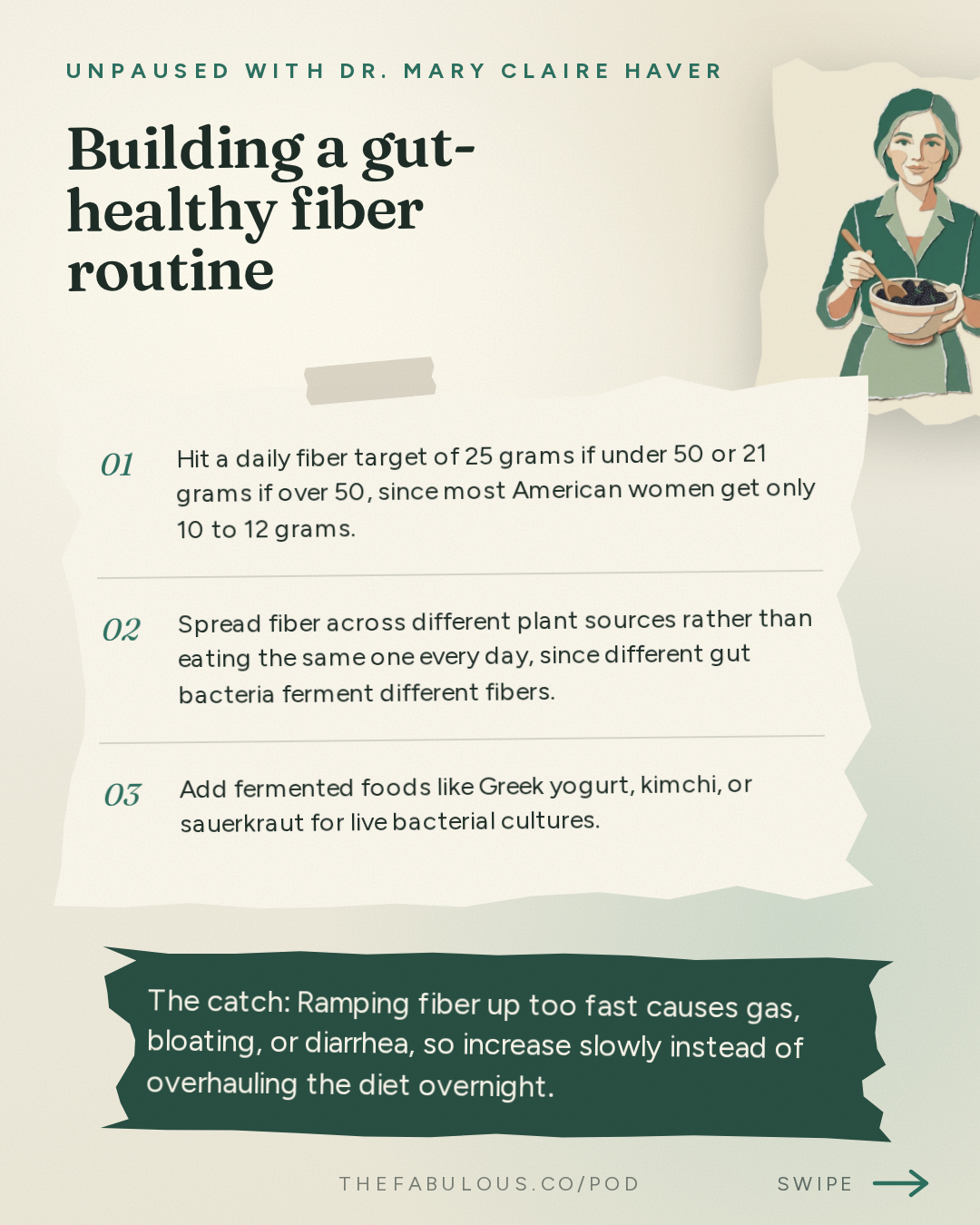
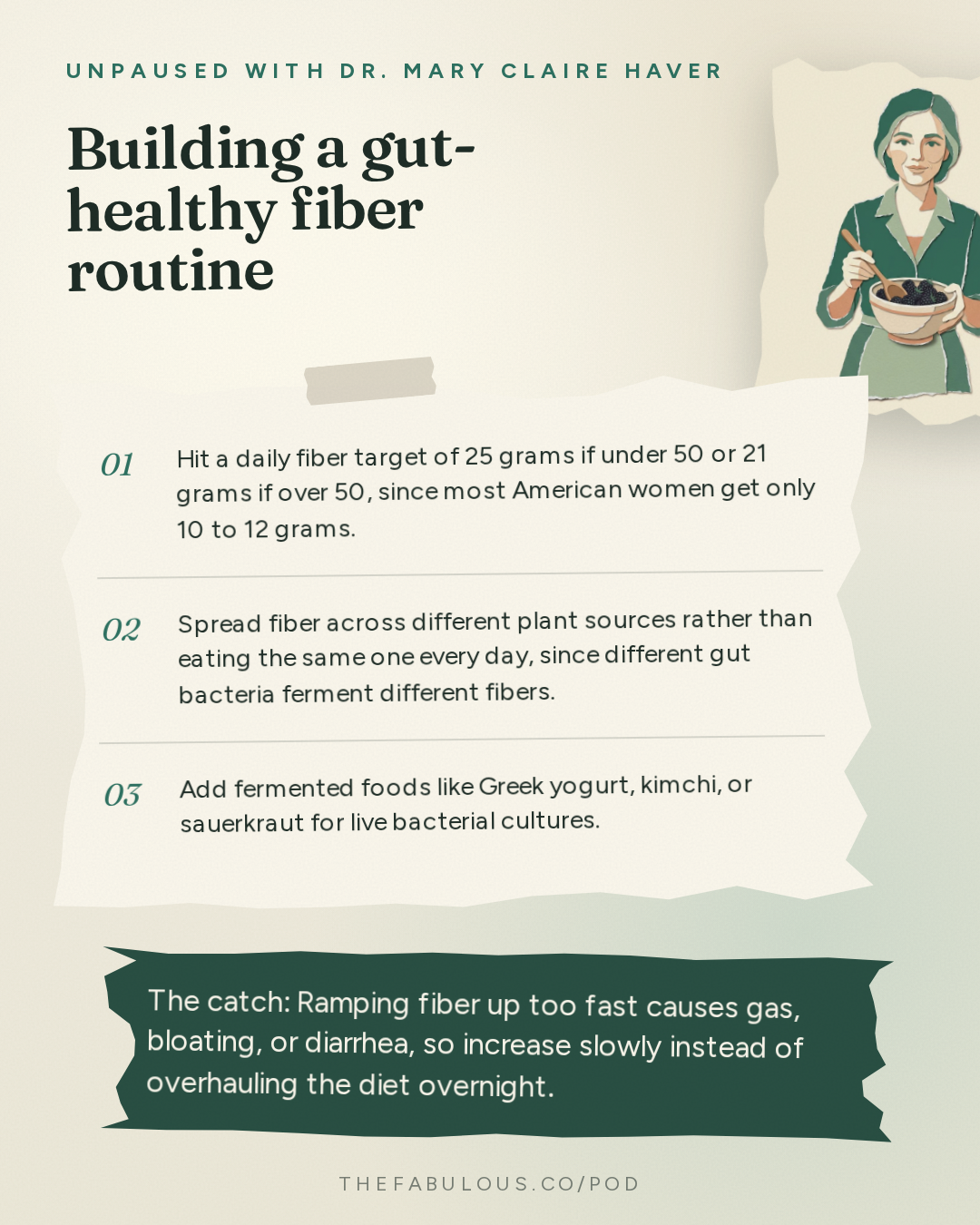
On diet, her numbers are simple and discouraging: the average American woman eats 10 to 12 grams of fiber a day (66:20), against a target of 25 grams for women under 50 and 21 grams for women over 50 (67:26). Her framing of why fiber matters is the kind of line that resets how people think about food.
"Fiber is not for you. Fiber is for your microbes." — Trisha Pasricha [66:38]
A Stanford trial she cites found that people who added fermented foods, not supplements but foods like yogurt, kimchi, and sauerkraut, saw 19 different inflammatory proteins in their blood drop within 10 weeks (69:11). Ultra-processed foods work in the opposite direction: emulsifiers in them thin the gut's protective mucus barrier and trigger local inflammation, and roughly 60 percent of the average American diet now comes from these foods (76:03).
Toward the end, Haver asks for one closing idea. Pasricha returns to where she started: stop treating the gut like a trash can and start treating it like the second brain it is. New, persistent bloating in a postmenopausal woman, she adds, is not a symptom to wait out, since ovarian cancer has no reliable screening test and tends to announce itself first through vague gastrointestinal complaints (81:29). The gut, in other words, has been trying to send a signal for a long time. The science is only now catching up to translate it.
Ask this episode anything
Pod's AI answers from the episode itself, with the minute mark so you can hear it yourself.
Or start with one of these
Ask this episode
Pod's AI listens to the whole episode to answer, and points you to the minute it comes from.
The rest of this answer, and any question after it
Answers come from the episode itself, never from a summary of it.
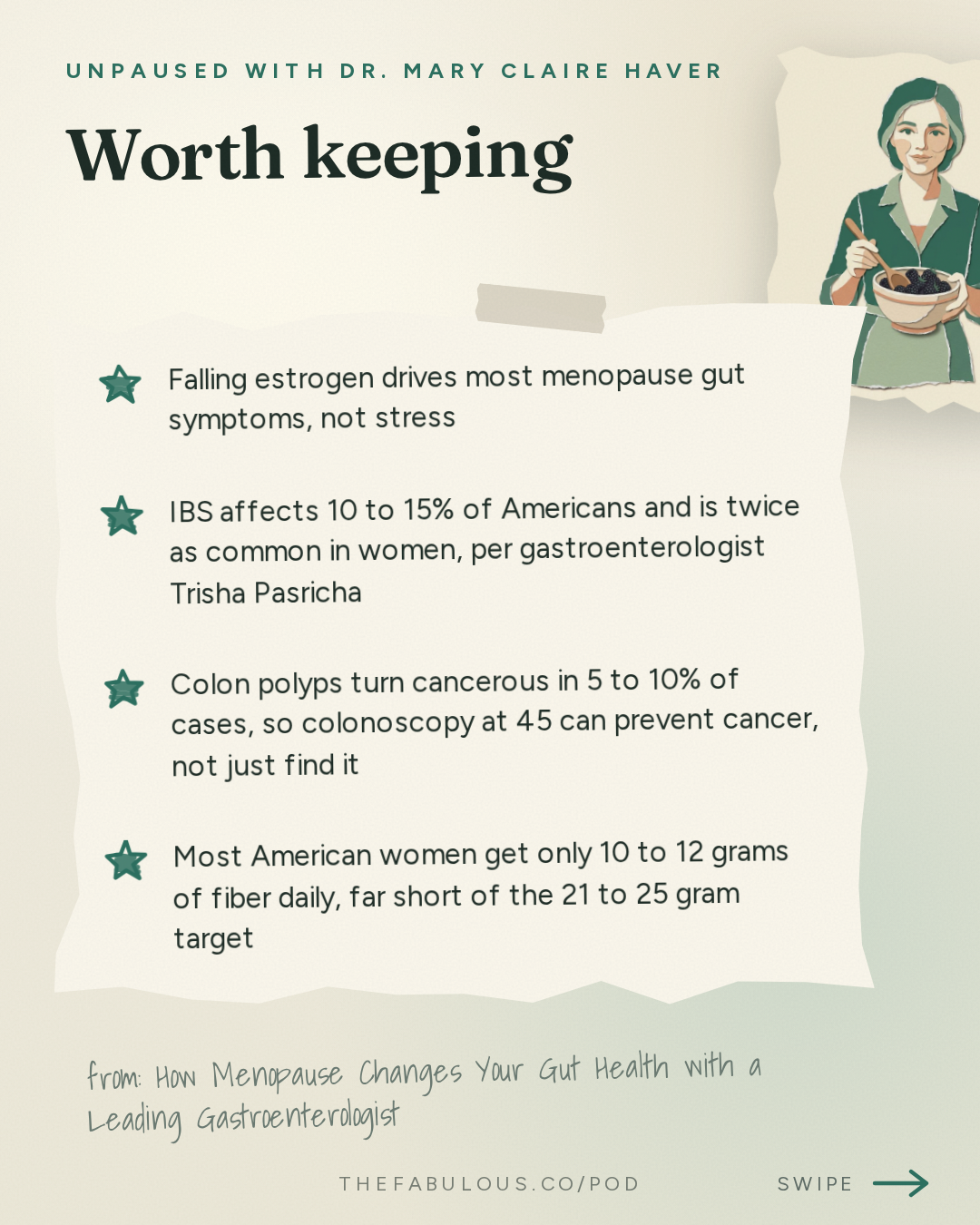
ContinueKey takeaways
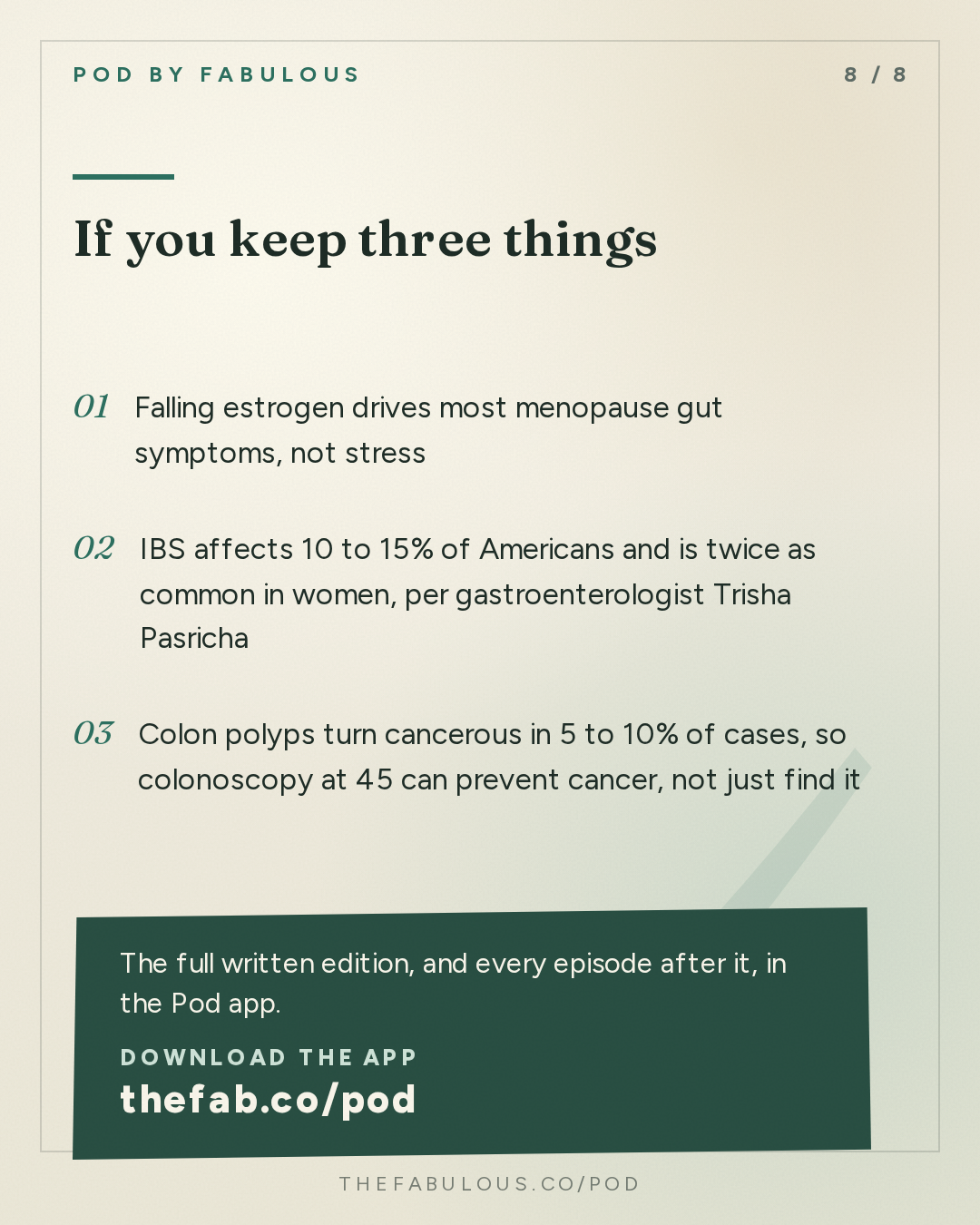
- Falling estrogen drives most menopause gut symptoms, not stress
- IBS affects 10 to 15% of Americans and is twice as common in women, per gastroenterologist Trisha Pasricha
- Colon polyps turn cancerous in 5 to 10% of cases, so colonoscopy at 45 can prevent cancer, not just find it
- Most American women get only 10 to 12 grams of fiber daily, far short of the 21 to 25 gram target
- New bloating after menopause should prompt an ovarian cancer check, since there is no screening test for it
The episode in cards
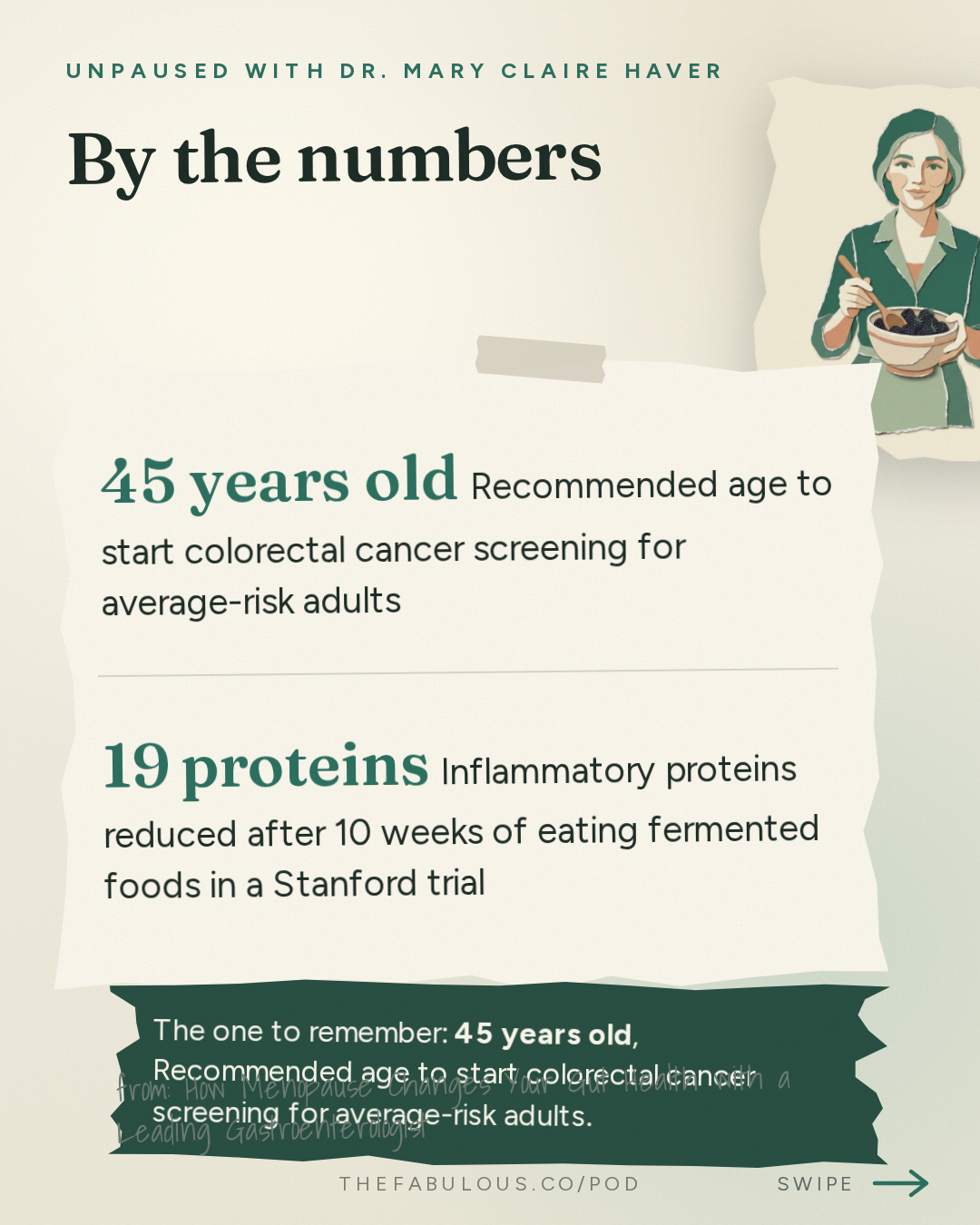

By the numbers
- 45 years old Recommended age to start colorectal cancer screening for average-risk adults
- 19 proteins Inflammatory proteins reduced after 10 weeks of eating fermented foods in a Stanford trial
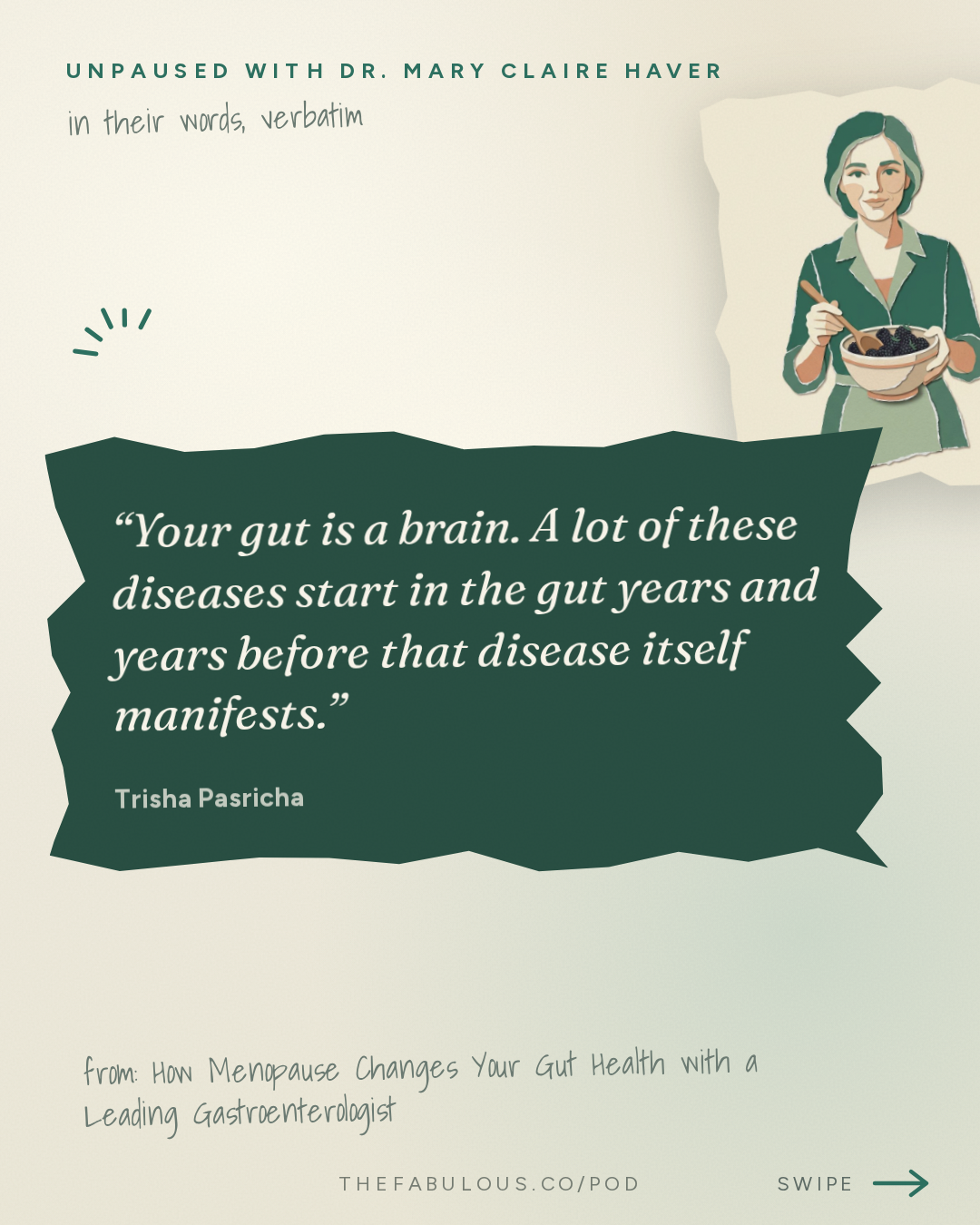
In their words
“Your gut is a brain. A lot of these diseases start in the gut years and years before that disease itself manifests.”
“It's not the stress causing the symptoms, it's the symptoms causing the stress.”
“Fiber is not for you. Fiber is for your microbes”
“I'm Team Bidet. I'm Team Bidet all the way.”
“We don't shame people with diabetes for taking insulin. Why would we do that?”
Protocols
-
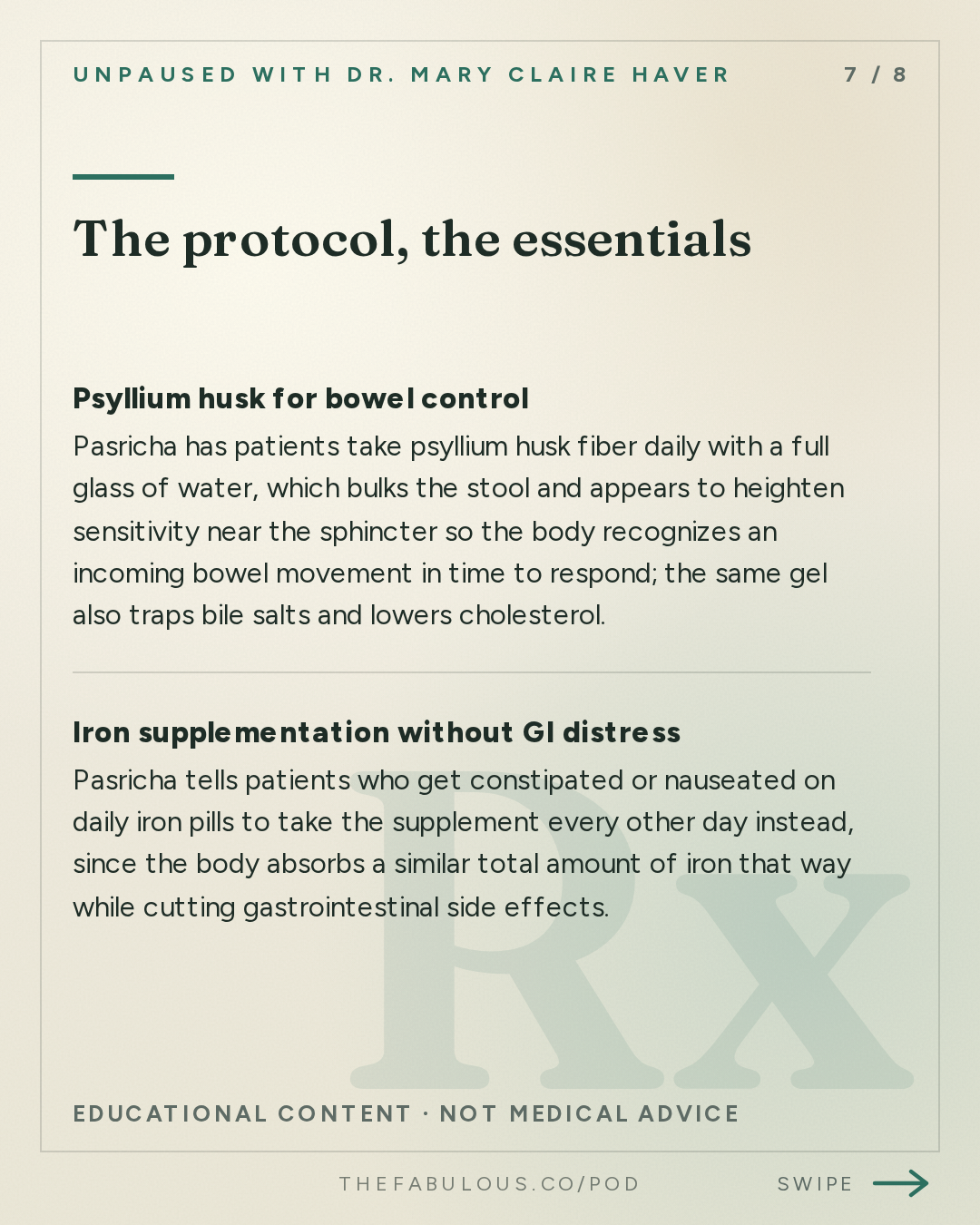
Psyllium husk for bowel control
Pasricha has patients take psyllium husk fiber daily with a full glass of water, which bulks the stool and appears to heighten sensitivity near the sphincter so the body recognizes an incoming bowel movement in time to respond; the same gel also traps bile salts and lowers cholesterol.
Daily, started at a half teaspoon and increased slowly
-
Iron supplementation without GI distress
Pasricha tells patients who get constipated or nauseated on daily iron pills to take the supplement every other day instead, since the body absorbs a similar total amount of iron that way while cutting gastrointestinal side effects.
Every other day
-
Start colorectal screening at 45
Pasricha recommends that average-risk adults get a first colonoscopy at age 45 rather than waiting for symptoms, because the procedure removes precancerous polyps before the 5 to 10 percent that would otherwise turn into cancer, and newer low-volume prep options make the process easier than the older gallon-jug prep.
Once at 45, then roughly every 10 years if the result is clear
-
Limit toilet time and skip the phone
Pasricha advises keeping bathroom visits under five minutes and leaving the smartphone outside, since her own lab's research found that longer sitting time, especially while scrolling, raises the risk of hemorrhoids.
Every bathroom visit
-
Treat new bloating after menopause as a red flag
Pasricha tells postmenopausal women with new, persistent bloating to get it checked right away rather than dismissing it, because ovarian cancer has no reliable screening test and often announces itself first through vague gastrointestinal symptoms.
As soon as the symptom appears
Questions this episode answers
Why does menopause cause bloating and digestive changes?
Estrogen stimulates serotonin-producing cells in the gut lining that send pain signals to the brain, and it also slows gut motility, so falling estrogen after menopause changes both how much pain the gut reports and how fast things move through it (21:44, 22:53). Gastroenterologist Trisha Pasricha stresses this is biological, not a sign that symptoms are stress-driven (00:24).
How much fiber do women need after menopause?
The target is 21 grams a day for women over 50 and 25 grams for women under 50, while the average American woman currently eats only 10 to 12 grams (67:26, 66:20). Fermented foods like yogurt and kimchi can add a second benefit, since a Stanford trial found they reduced 19 inflammatory blood proteins within 10 weeks (69:11).
When should women start colon cancer screening?
Guidelines now recommend colonoscopy at age 45 for average-risk adults, down from the older standard of 50 (53:05). A colonoscopy is the only test that prevents colorectal cancer rather than just detecting it, because doctors remove precancerous polyps on the spot, and 5 to 10 percent of untreated polyps go on to become cancer (53:45).
Are bidets better than toilet paper for hemorrhoids?
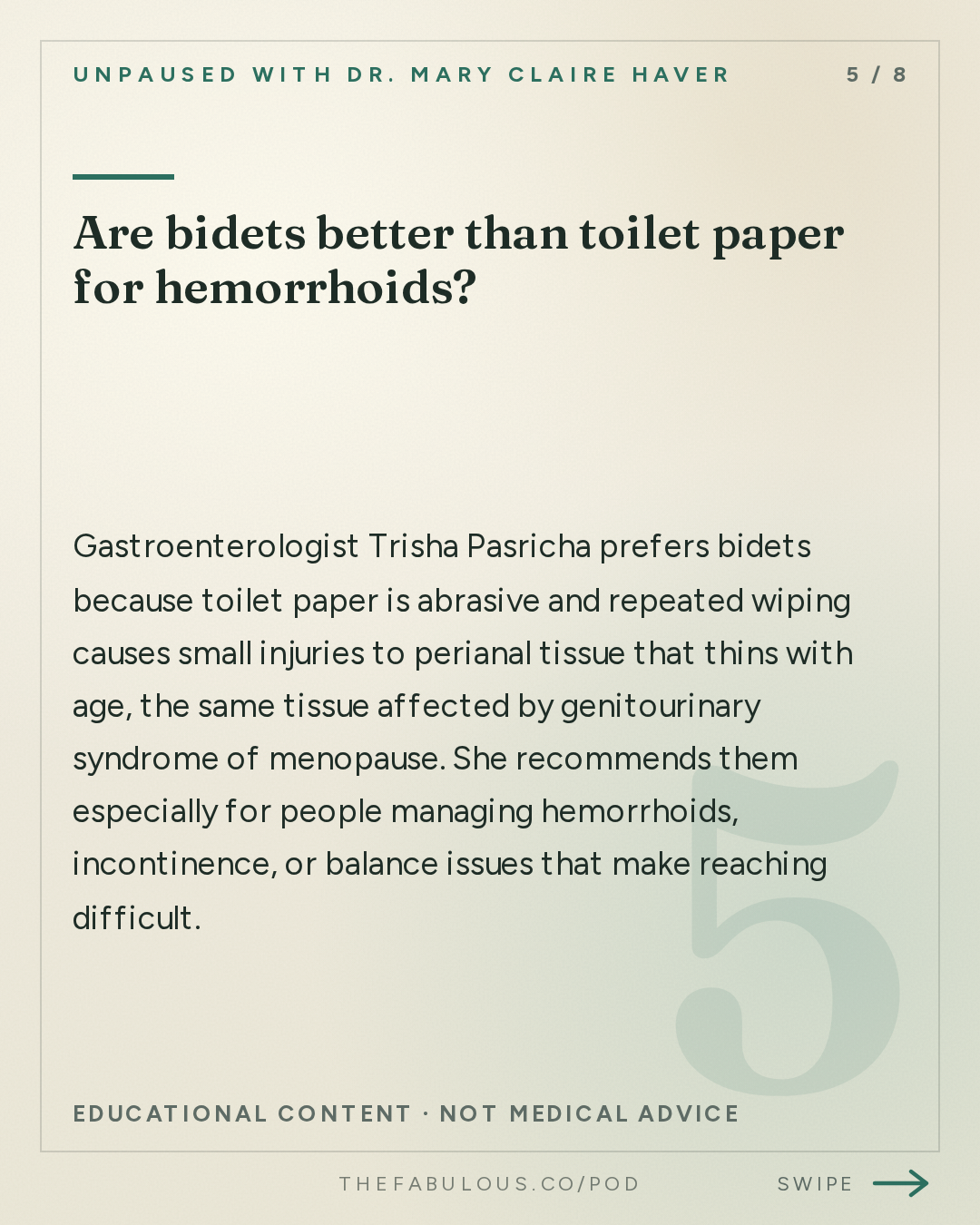
Gastroenterologist Trisha Pasricha prefers bidets because toilet paper is abrasive and repeated wiping causes small injuries to perianal tissue that thins with age, the same tissue affected by genitourinary syndrome of menopause (28:44). She recommends them especially for people managing hemorrhoids, incontinence, or balance issues that make reaching difficult.
What are the red flags for early-onset colorectal cancer in women?
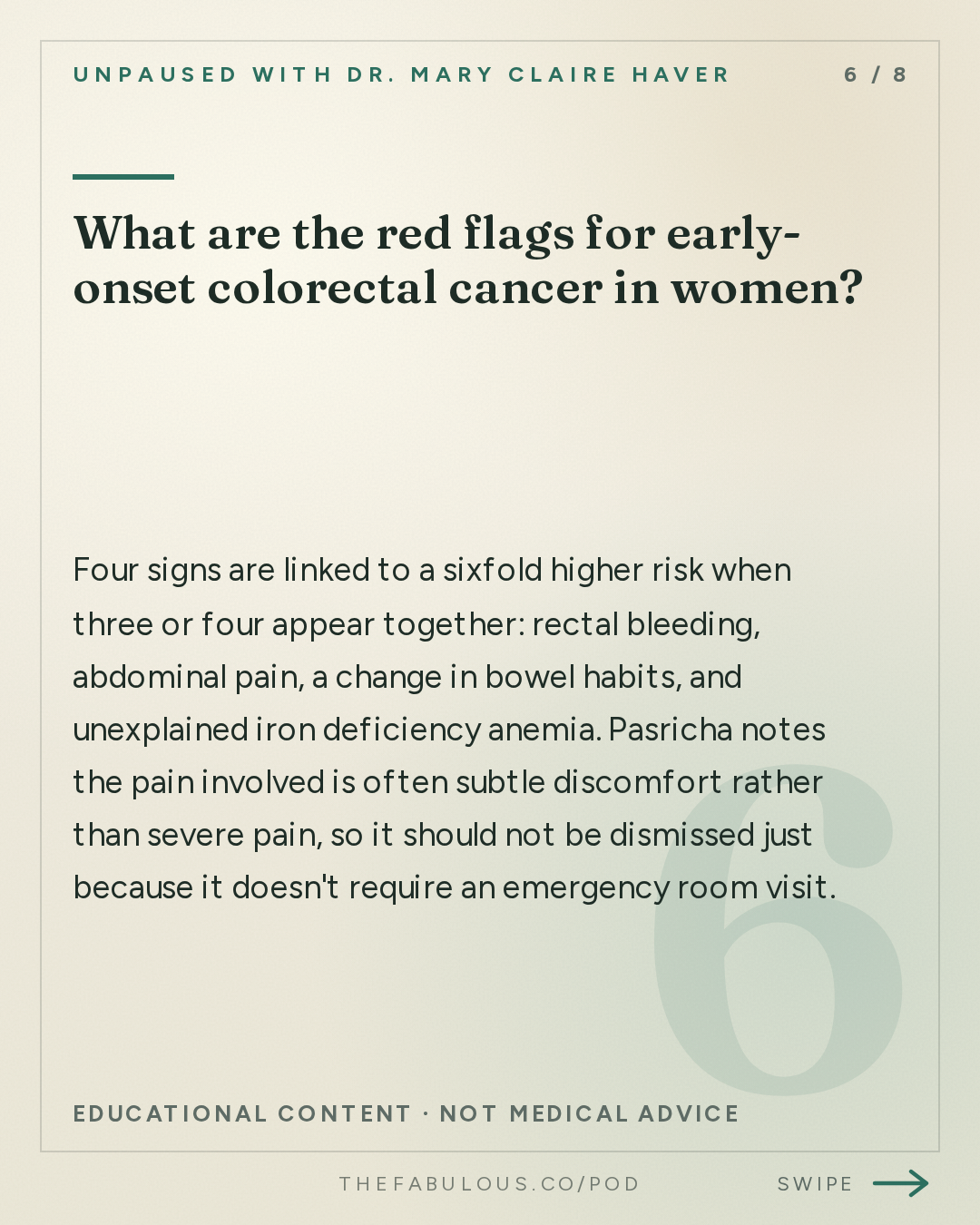
Four signs are linked to a sixfold higher risk when three or four appear together: rectal bleeding, abdominal pain, a change in bowel habits, and unexplained iron deficiency anemia (39:19). Pasricha notes the pain involved is often subtle discomfort rather than severe pain, so it should not be dismissed just because it doesn't require an emergency room visit (41:46).
Does GLP-1 medication change digestion during menopause?
GLP-1 drugs slow the stomach and colon, which commonly causes constipation and sometimes diarrhea, with side effects usually peaking in the first one to two weeks of dose increases before easing (37:32, 37:51). Pasricha notes her lab also found GLP-1 use is associated with a lower risk of 13 cancers, including colorectal cancer (36:52).
The full read, in cards
Go deeper
- Nurses' Health Study — Harvard cohort study showing psyllium husk fiber intake is linked to decreased fecal incontinence
- Stanford fermented foods trial — Randomized trial finding fermented foods boosted microbiome diversity and lowered 19 inflammatory blood proteins in 8 to 10 weeks
- New England Journal of Medicine colorectal cancer blood test studies — Recent studies supporting a blood test that can flag colorectal cancer but not early precancerous polyps
- You've Been Pooping All Wrong — Trisha Pasricha's book on digestive health and common misconceptions about bowel habits
Mentioned
Trisha Pasricha · You've Been Pooping All Wrong · Beth Israel Deaconess Medical Center · Harvard Medical School · Nurses' Health Study · Psyllium husk · Bidet · GLP-1 · American Gastroenterological Association · Lisa Mosconi
More from this show and category

Menopause Skin Changes: What Actually Helps
Dermatologist Erica Kelly tells Dr. Mary Claire Haver that menopausal skin needs lighter Botox doses, daily sunscreen, and realistic expectations for collagen and hair treatments. Hormone therapy may preserve skin firmness for decades, oral minoxidil treats hair loss but causes a two-month shed, and vaginal moisturizers differ from lubricants.

Menopause Skin Changes: Causes and Fixes
Menopause triggers a 30% collagen loss in skin within five years, driven by falling estrogen and steady testosterone levels. Dermatologist Erica Kelly explains the barrier breakdown behind dryness and jawline acne, and recommends sunscreen and retinoids as the best-evidenced treatments, with topical estriol and spironolactone for targeted fixes.

Gabrielle Lyon: Muscle Is the Longevity Organ
Dr. Gabrielle Lyon argues that skeletal muscle, not body fat, is the organ that determines how well women age. She explains that muscle drives glucose disposal, releases hormone-like myokines, and needs at least 100 grams of daily protein plus resistance training to stay healthy after midlife.

Protein Needs for Muscle in Menopause: Dr. Lyon's Guide
Dr. Gabrielle Lyon says women need 30 to 50 grams of protein in their first meal after an overnight fast to switch on muscle building. She explains why aging muscle grows resistant to protein and exercise, why resistance training beats hormone therapy for long-term independence, and why suppressing mTOR is the wrong longevity strategy.
