
Peter Attia's Blood Pressure Protocol Explained
Blood pressure: how to measure, manage, and treat high blood pressure (AMA #48 rebroadcast)
▶ Listen to the full episode More from The Peter Attia Drive
The brief
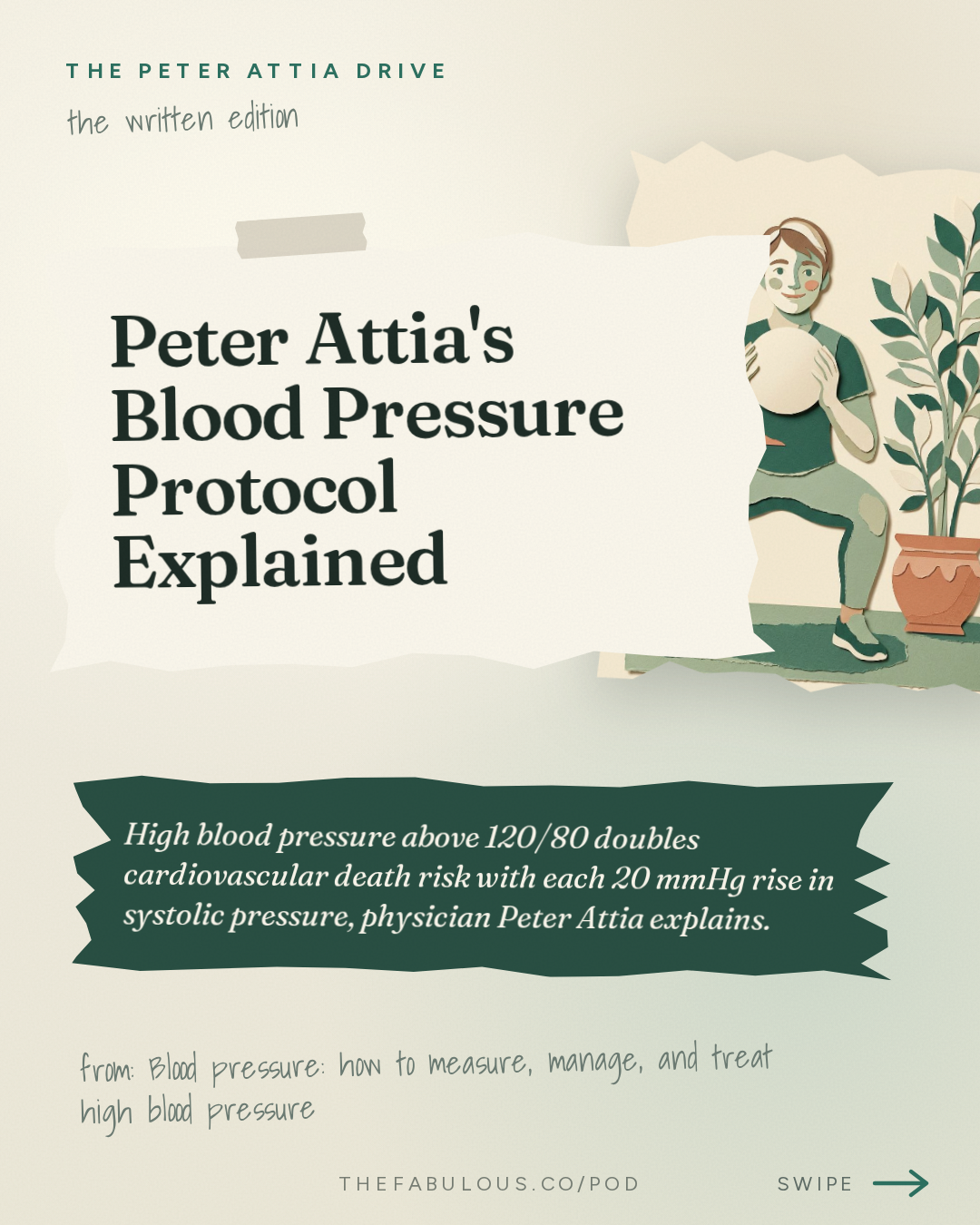
High blood pressure above 120/80 doubles cardiovascular death risk with each 20 mmHg rise in systolic pressure, physician Peter Attia explains. He breaks down what the SPRINT and STEP trials proved about aggressive treatment, how to measure blood pressure correctly at home, and why weight loss, exercise, sleep, and sodium timing can lower it as much as medication.
A number with no feeling attached to it is easy to ignore. Blood pressure is exactly that kind of number. There is no ache, no fatigue, no warning sign that tells a person their arteries are under mechanical strain every time the heart beats. Physician Peter Attia calls this the central problem of the condition on this AMA rebroadcast.
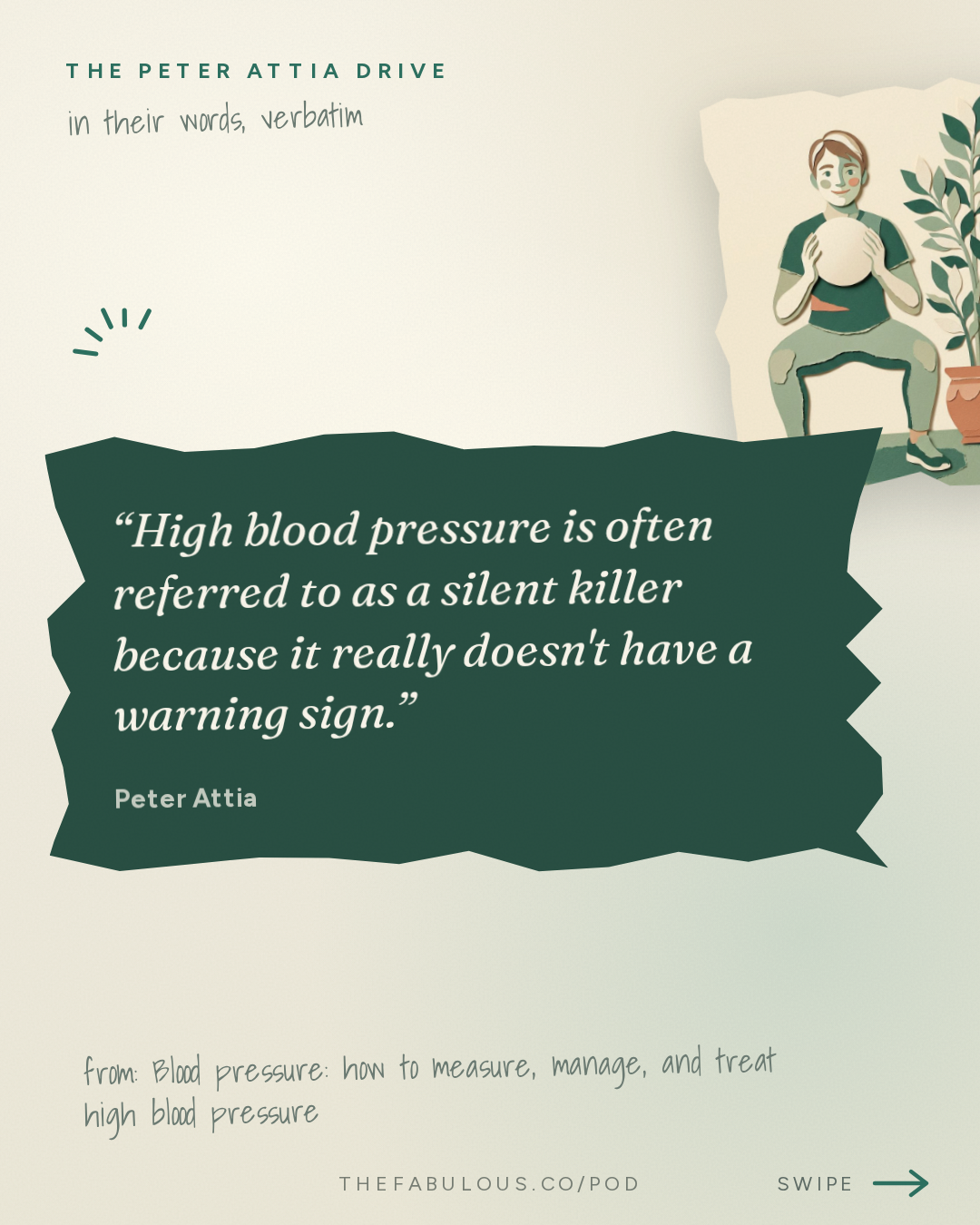
High blood pressure is often referred to as a silent killer because it really doesn't have a warning sign. (Peter Attia, [38:12])
Everything else in the episode follows from that sentence. If the body will not tell someone their blood pressure is a problem, someone has to go find out, and then has to know what to do about it.
What the two numbers actually mean
Every blood pressure reading has two phases. The first is systole, when the heart's main pumping chamber, the left ventricle, squeezes and pushes blood out to the body. That produces the higher number. The second is diastole, when the heart relaxes and refills, and the pressure inside the arteries, though lower, never drops to zero (06:13). A reading of 120 over 80 describes those two moments in a single heartbeat.
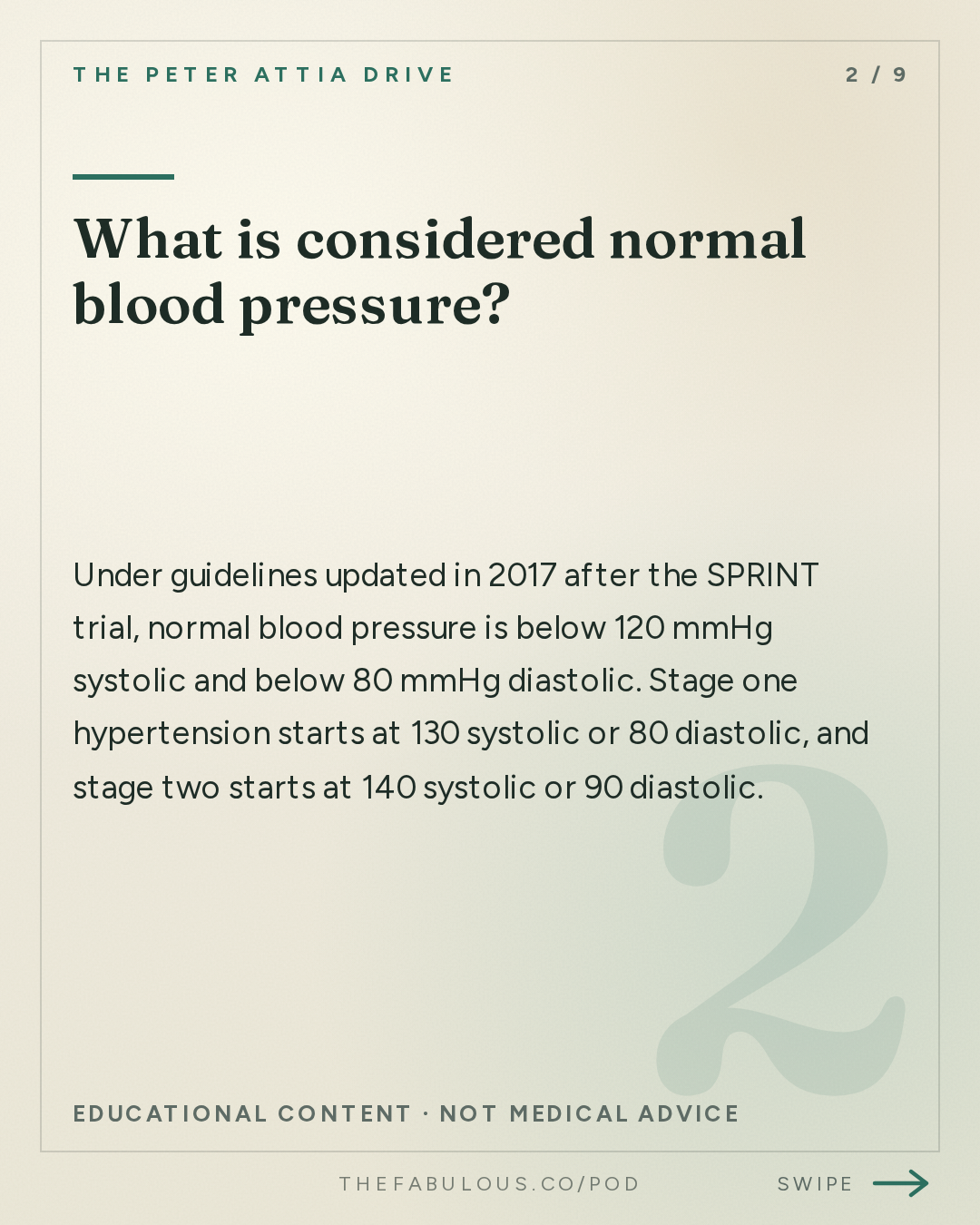
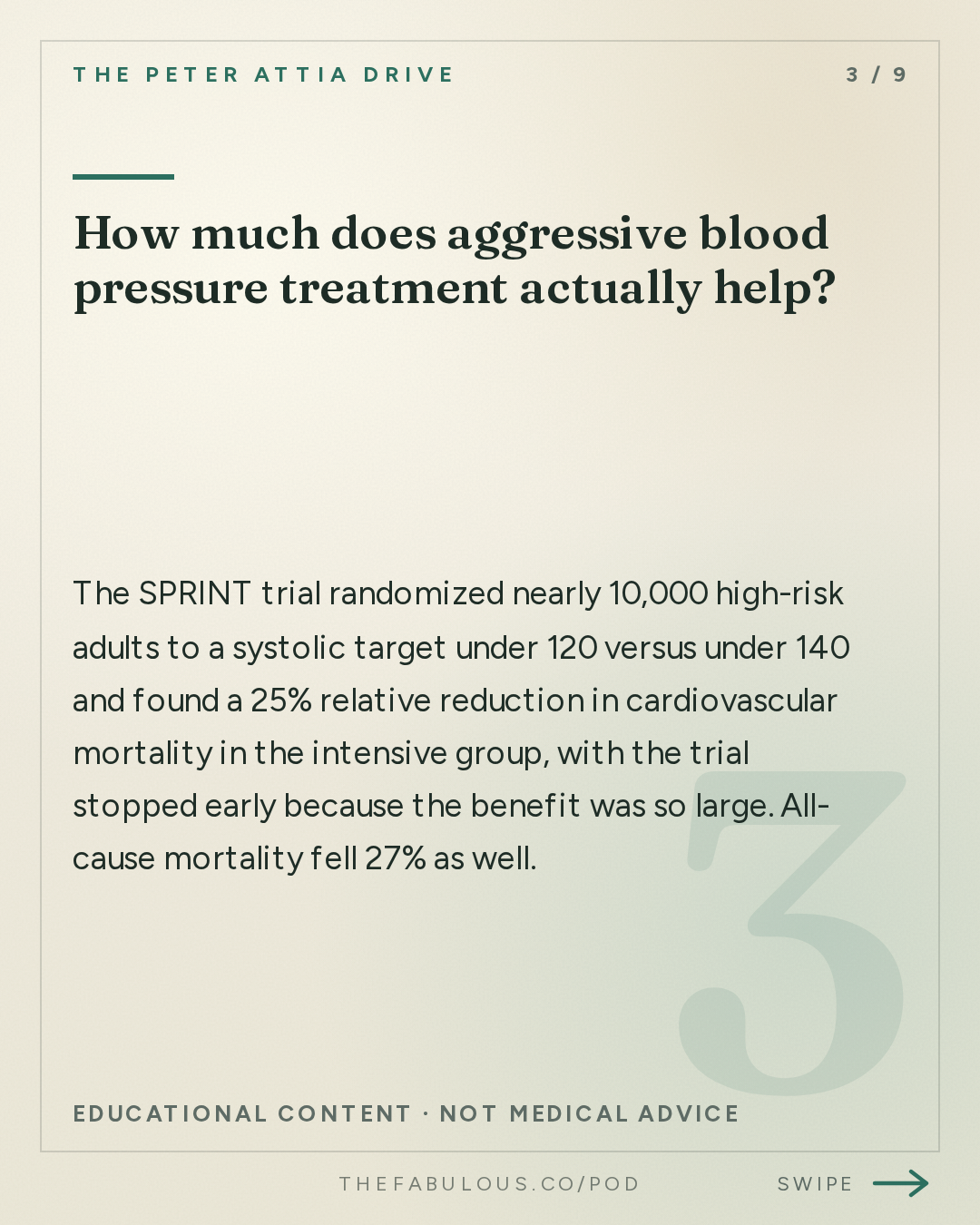
Guidelines for what counts as normal changed in 2017, after a trial called SPRINT reshaped how doctors think about treatment (11:03). Under the current definitions, normal is under 120 systolic and under 80 diastolic. Elevated is 120 to 129 with diastolic still under 80. Stage one hypertension starts at 130 systolic or 80 diastolic. Stage two begins at 140 systolic or 90 diastolic (11:38). The SPRINT trial itself, published in 2015, randomized nearly 10,000 high cardiovascular risk adults without type 2 diabetes to a systolic target under 120 or a standard target under 140 (13:19). The intensive group's risk of the primary composite outcome fell by roughly 25 percent, and the trial was stopped early because the benefit was too large to justify continuing the standard-care arm (16:33). All-cause mortality fell too, by 27 percent, a result Attia says caught researchers off guard.
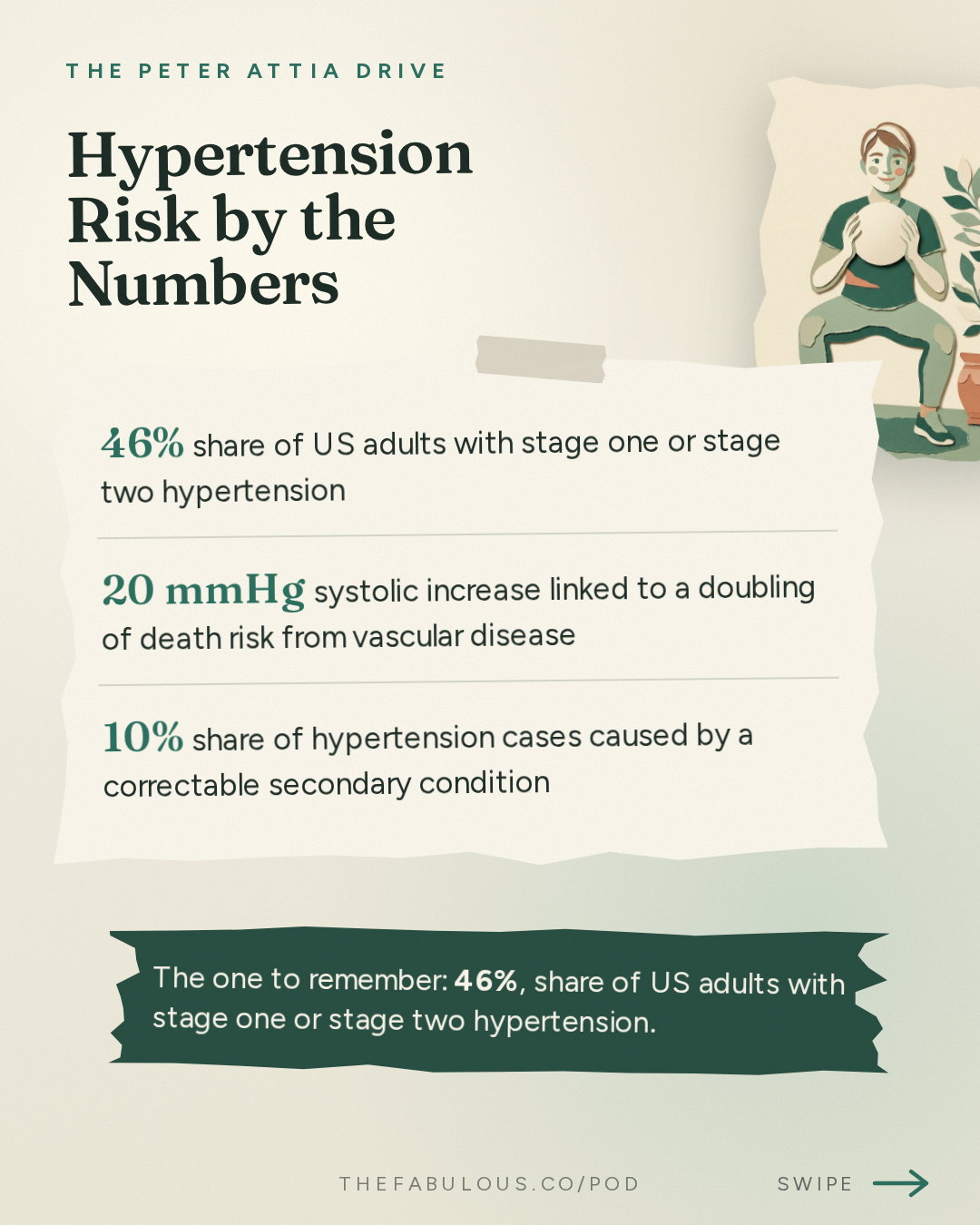
The reason a few points of blood pressure matter so much becomes clearer with a related figure: each 20 mmHg increase in systolic pressure is linked to a doubling in the risk of death from stroke, heart disease, or other vascular disease (29:17). Attia frames chronically elevated pressure as a mechanical injury, not a chemical one.
Compounding is insanely powerful when it comes to this type of biology, whether it be smoking, ApoB, or blood pressure. (Peter Attia, [20:57])
ApoB is the cholesterol-carrying particle behind atherosclerosis, and Attia draws a direct comparison: smoking chemically damages the endothelium, the thin layer of cells lining blood vessels, ApoB particles pass through that damaged lining, and high blood pressure physically batters it (21:20). Run that process for forty years instead of three, and the SPRINT numbers look conservative.
Nearly half the country is living inside that process. Roughly 46 percent of American adults meet the criteria for stage one or stage two hypertension (24:49), and prevalence climbs steadily with age, reaching past 80 percent among people 75 and older. Three organs take the brunt of it: the heart, the brain, and the kidneys. The kidneys are especially exposed. They weigh about one to two percent of body weight but receive 20 to 25 percent of cardiac output with every heartbeat (33:02), which makes their small blood vessels unusually vulnerable to pressure damage. Attia says he watches a marker called cystatin C, which he considers a better gauge of kidney function than the standard test, creatinine, because it catches decline in patients whose glomerular filtration rate, a measure of how well the kidneys filter blood, looks technically normal but is too low for their age (34:03). On the brain side, the SPRINT Mind sub-study found that intensive blood pressure lowering cut the relative risk of dementia by about 16 percent (35:03).
If you care about your brain, if you care about your heart, and if you care about your kidneys, you need low blood pressure. (Peter Attia, [35:27])
Measuring it right, and lowering it without a pill
Attia's frustration with office blood pressure readings runs through much of the conversation. He says he ignores his own office numbers because the conditions are wrong: he has usually just walked in, is not seated according to protocol, and may have the cuff placed incorrectly. His fix is to put the burden of accurate measurement on the patient.
Don't be lazy and check your blood pressure over your clothing. If you can't roll your sleeves all the way up, take your shirt off. (Peter Attia, [40:50])
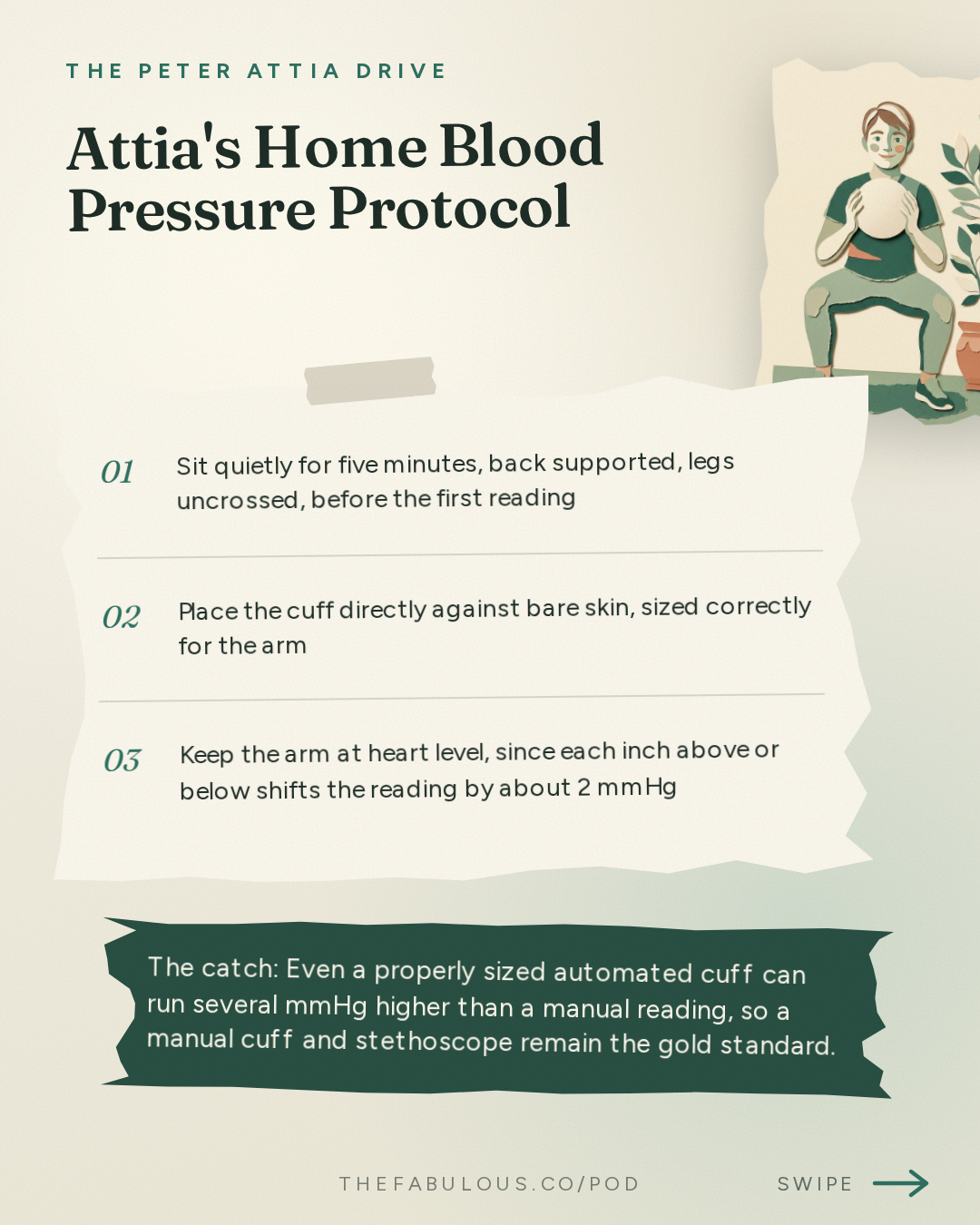
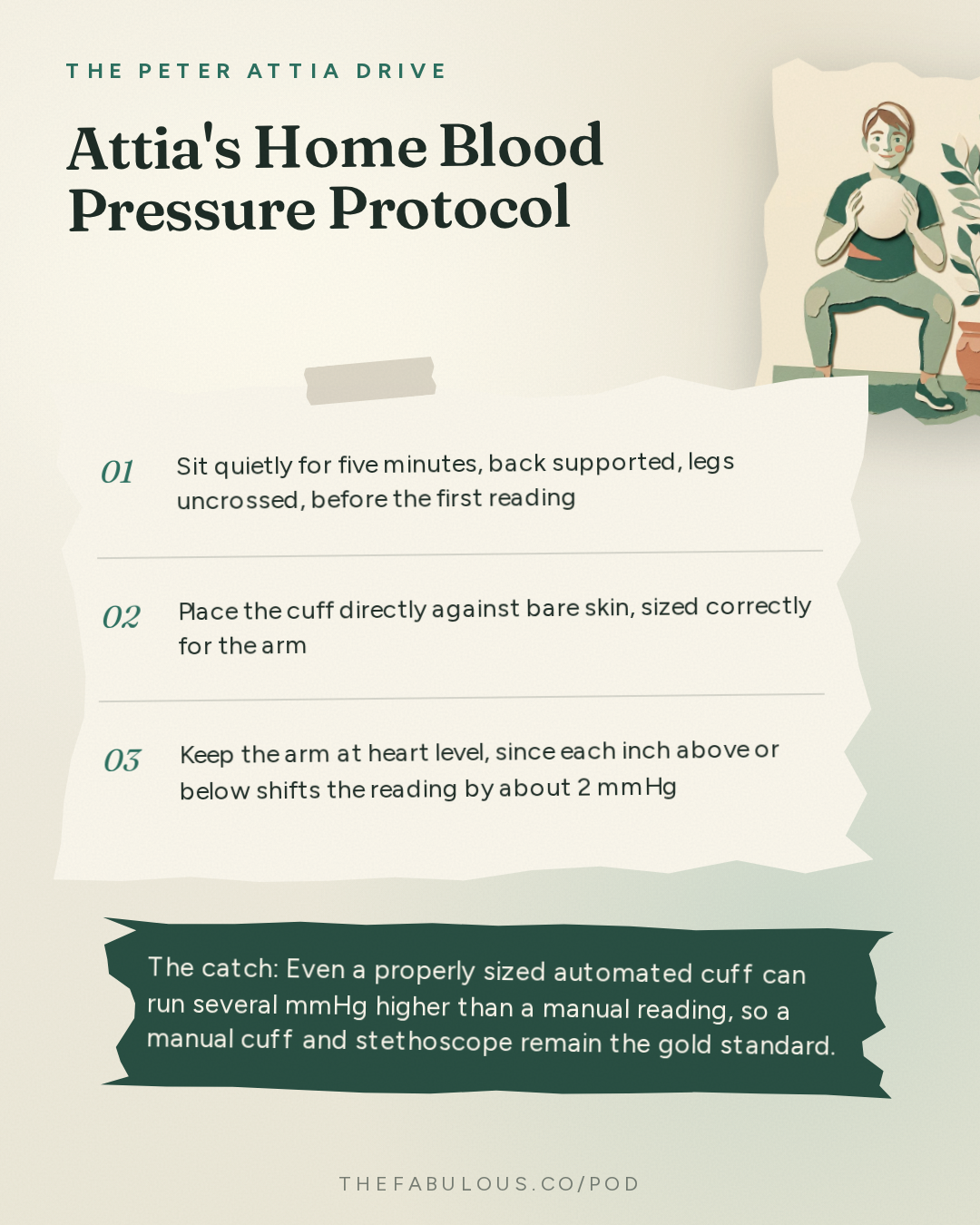
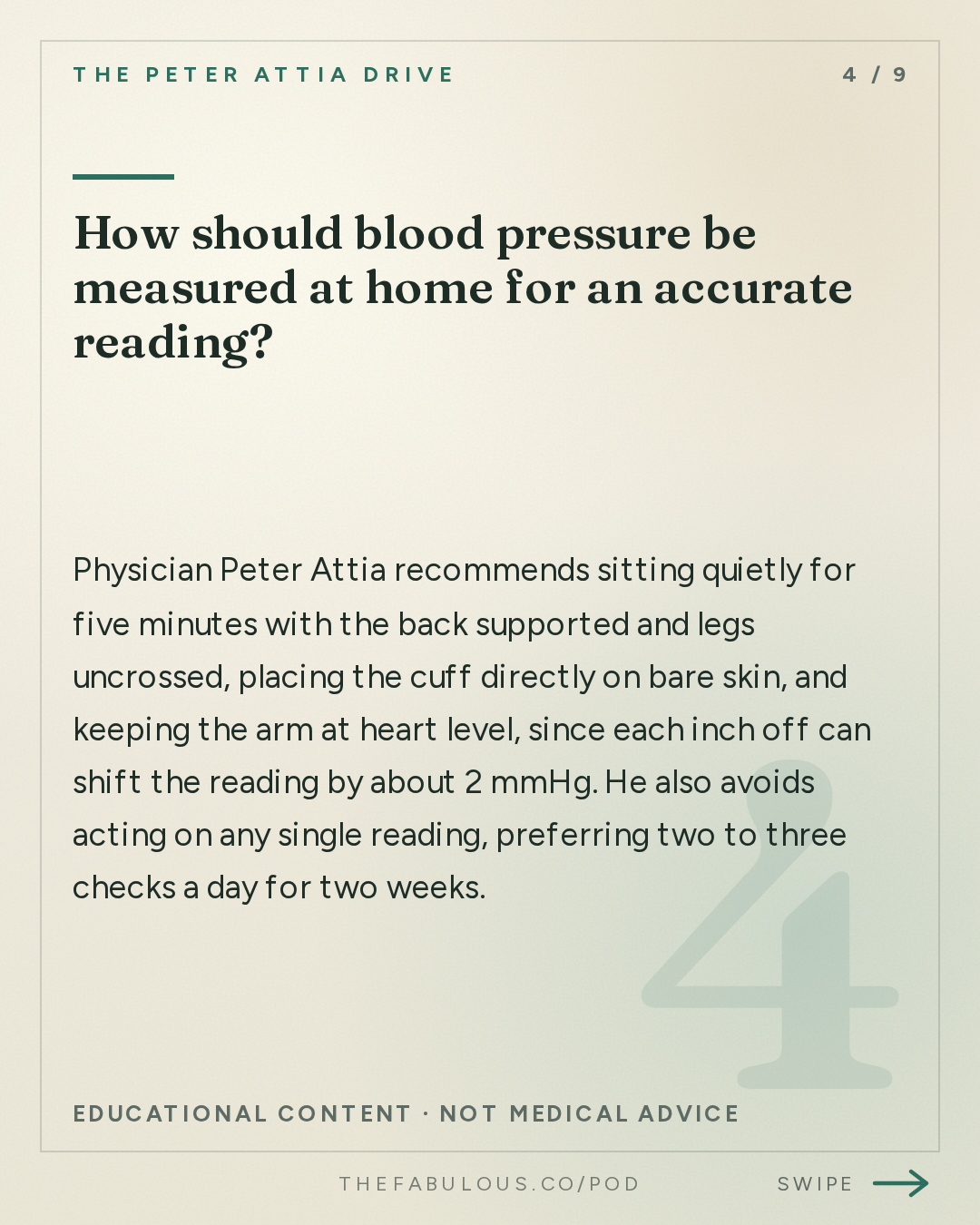
The list of things that can distort a reading is long: a poorly fitted cuff, a cuff over clothing, an unsupported back, crossed legs (a five to eight mmHg swing), skipping the five-minute rest period (up to 10 to 20 mmHg), talking during the reading (10 to 15 points), being in pain (10 to 30 mmHg), and a full bladder, which alone can raise both heart rate and blood pressure by 10 to 15 points (39:17 to 42:19). Arm position matters too: every inch the arm sits above or below heart level shifts the reading by about 2 mmHg. Attia trusts manual readings, taken with a cuff and stethoscope, over automated cuffs, which he has found tend to run higher, though he admits he cannot fully explain why (46:46). His broader rule is that no single reading should drive a medical decision. He wants two to three checks a day for two weeks before deciding anything.
With ApoB you can't go too low. With blood pressure, you can go too low. (Peter Attia, [23:19])
That asymmetry, unlike a lipid marker where lower is simply better, is why Attia is cautious about medicating borderline numbers. About 10 percent of hypertension cases have a secondary cause, a correctable medical condition such as a tumor of the adrenal gland, kidney artery narrowing, or a thyroid problem (52:07). Attia recounts a friend whose blood pressure would not respond to medication until doctors found and removed a pheochromocytoma, a catecholamine-secreting adrenal tumor, after which his numbers normalized completely (54:15).
For the other 90 percent, the primary cases, Attia argues lifestyle change carries unusual weight.
Lifestyle is a far greater hammer on blood pressure than it is on lipids. (Peter Attia, [58:25])
Weight loss alone produces about one mmHg of systolic reduction per kilogram lost (59:50). Sodium is more contested: nephrologist Rick Johnson told Attia on a separate episode that drinking water with or before a salty meal blunts the pressure spike that follows, because thirst after salt signals the spike has already begun (61:08). Cutting sodium to extremes, as low as 1,500 milligrams a day against an average American intake of 3.5 to 4.5 grams, may lower blood pressure by five to six mmHg but is linked to higher all-cause mortality in recent meta-analysis, so Attia treats aggressive sodium restriction with caution (62:38). Exercise has cleaner data: 90 to 150 minutes a week of aerobic training at 65 to 75 percent of maximum heart rate, the zone Attia calls zone two, lowers systolic pressure by as much as eight mmHg. Resistance training adds a smaller effect, and isometric resistance training, holding a static contraction rather than lifting through a range of motion, produced the largest resistance-based drop his team found, about six mmHg systolic (63:15 to 64:36). Poor sleep matters as well: sleeping less than five hours a night is linked to a 40 percent higher risk of hypertension (67:11).
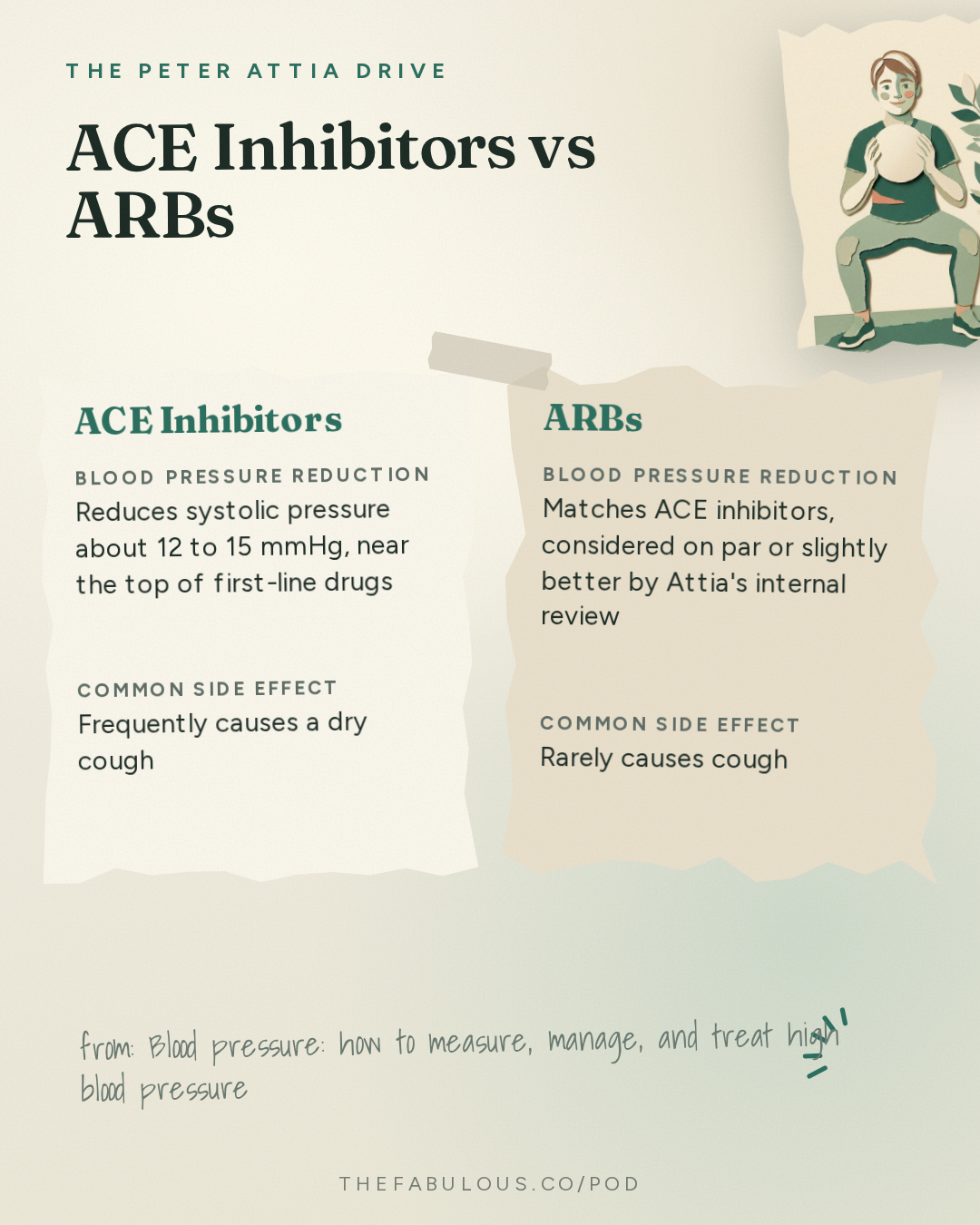
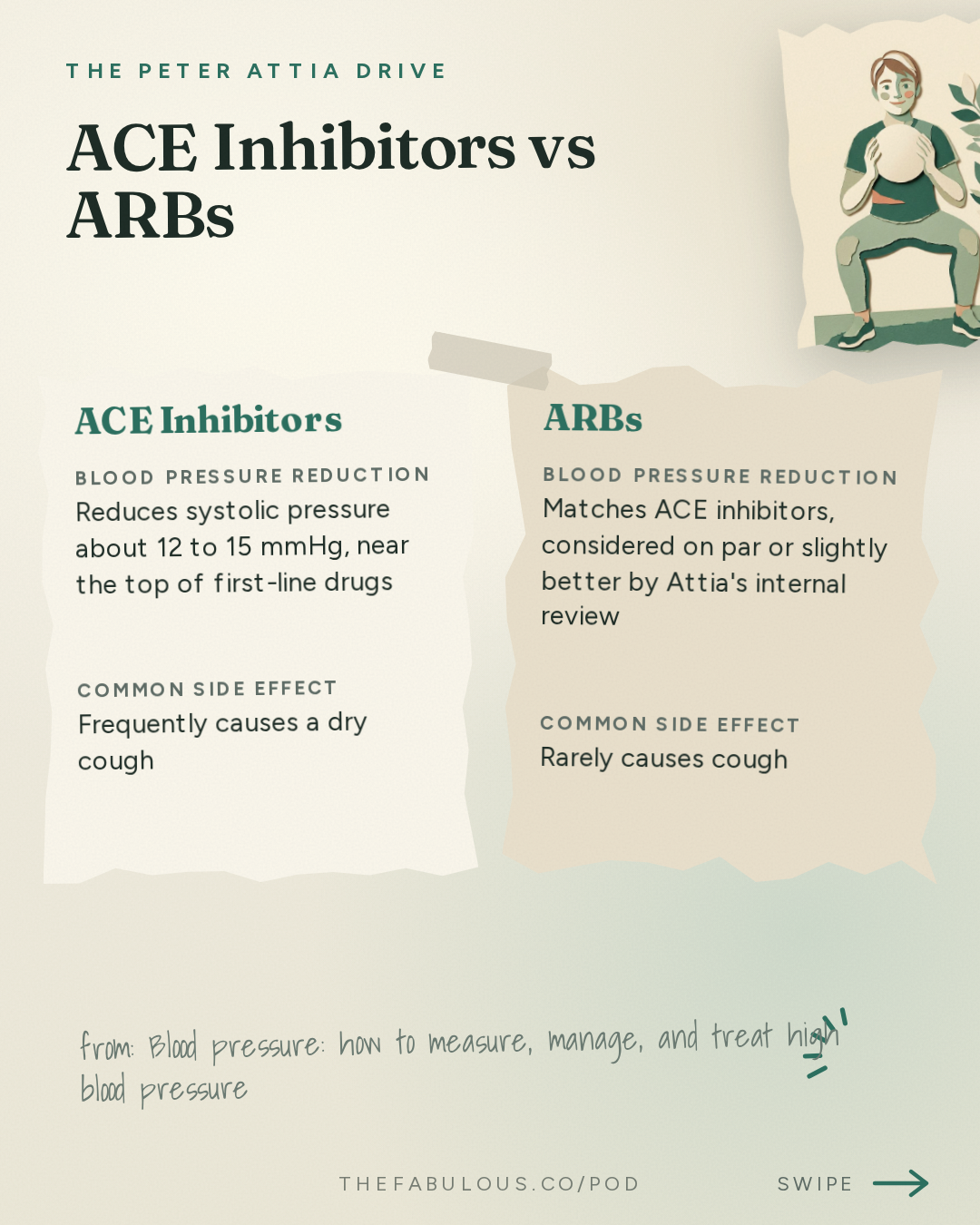
When lifestyle is not enough, four drug classes make up first-line treatment: thiazide diuretics, calcium channel blockers, ACE inhibitors, and ARBs. Attia's team ran an internal review and concluded ARBs edge out ACE inhibitors on side effects, mainly a lower rate of cough, while matching them on efficacy, though ACE inhibitors remain cheaper and more likely to be covered by insurance (68:08 to 70:20). In African American patients specifically, thiazide diuretics and calcium channel blockers appear to reduce cardiovascular events more effectively than ACE inhibitors, ARBs, or beta blockers (73:23).
What stays with a listener is not any single number but Attia's closing comment, that none of this is glamorous.
It's just bread and butter primary care medicine, but it's so needle moving. (Peter Attia, [75:09])
No senescent cells, no rapamycin, no biohacking story. Just a cuff, five quiet minutes, and the discipline to look at the number even though it never asks to be looked at.
Ask this episode anything
Pod's AI answers from the episode itself, with the minute mark so you can hear it yourself.
Or start with one of these
Ask this episode
Pod's AI listens to the whole episode to answer, and points you to the minute it comes from.
The rest of this answer, and any question after it
Answers come from the episode itself, never from a summary of it.
ContinueKey takeaways
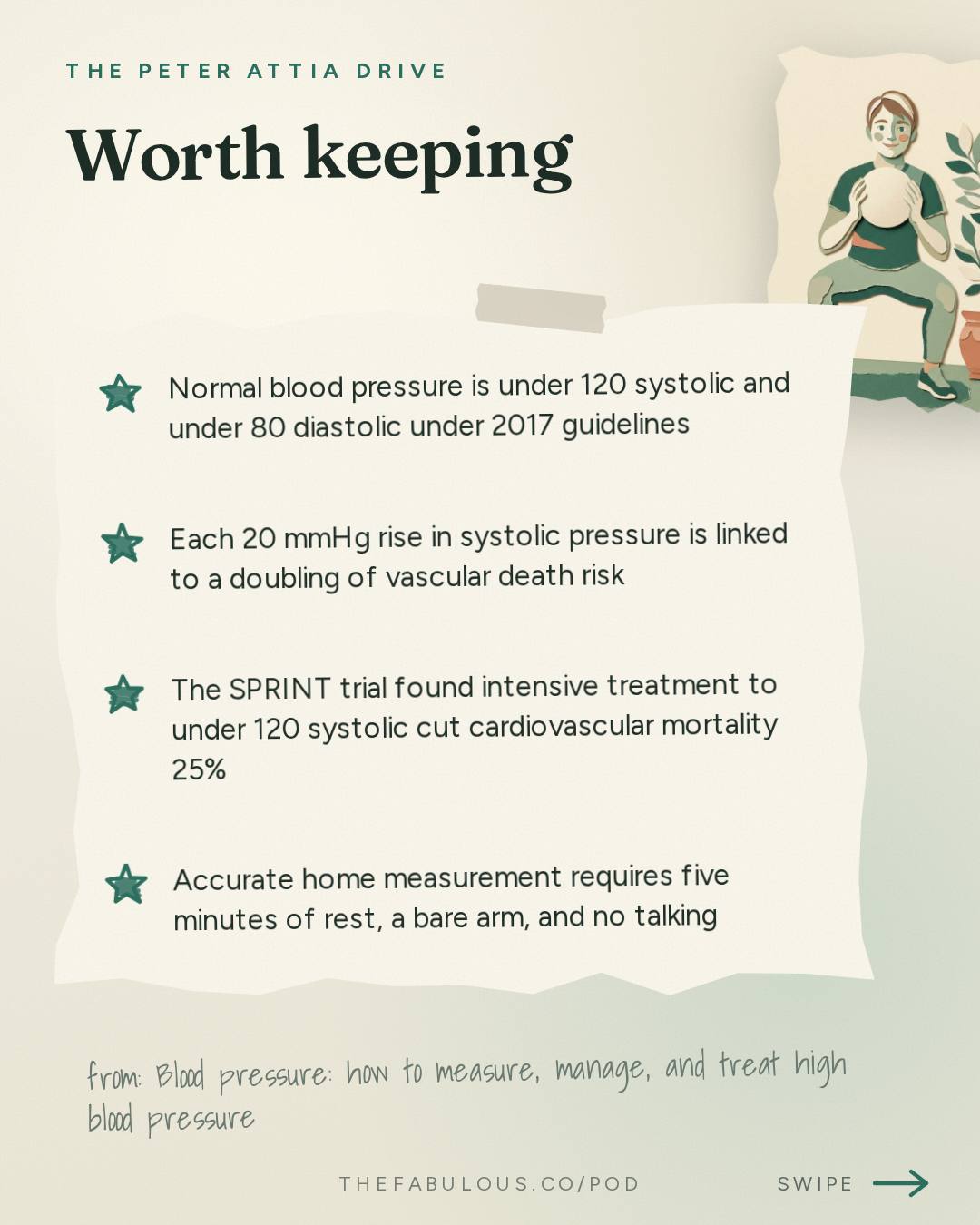
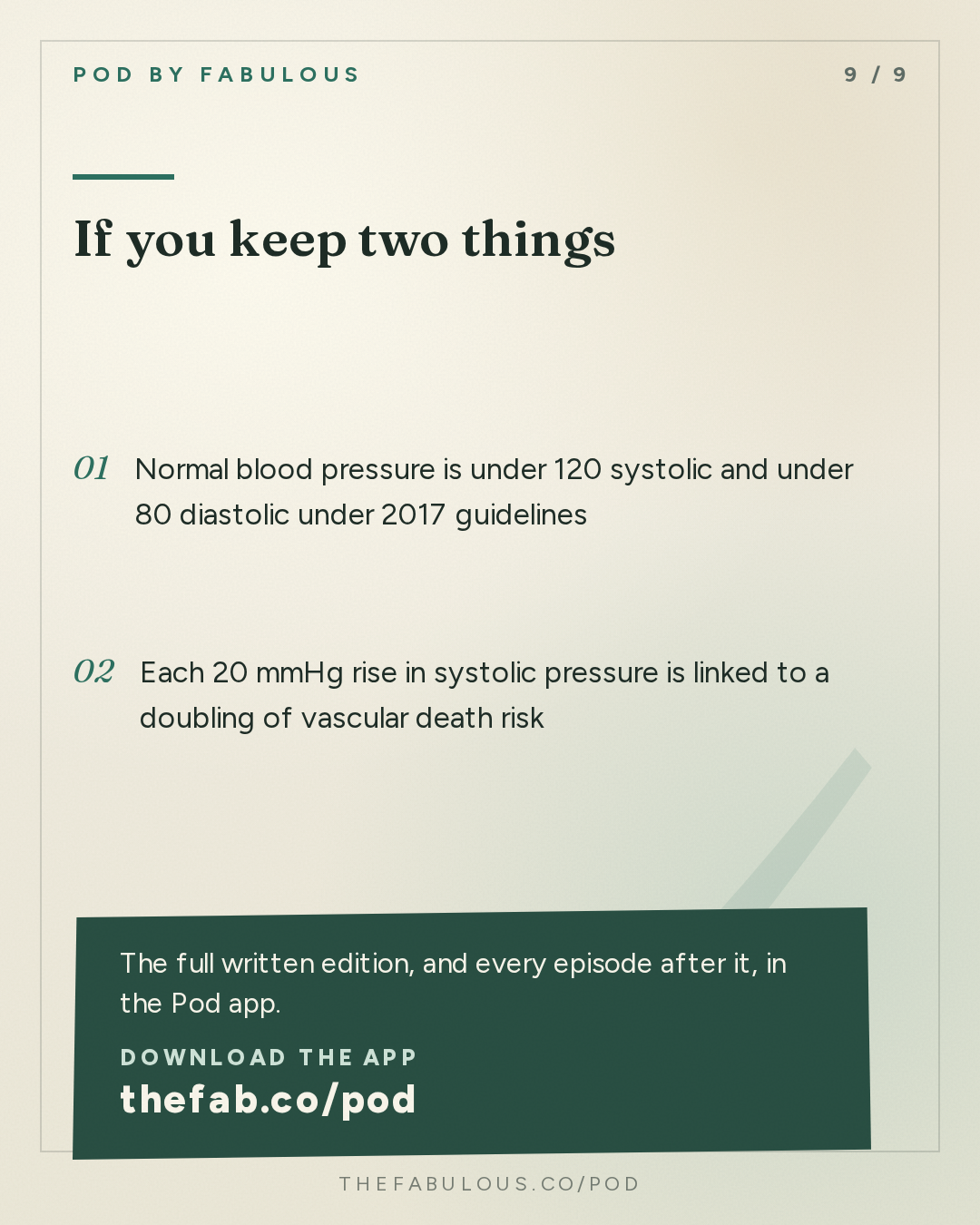
- Normal blood pressure is under 120 systolic and under 80 diastolic under 2017 guidelines (11:38)
- Each 20 mmHg rise in systolic pressure is linked to a doubling of vascular death risk (29:17)
- The SPRINT trial found intensive treatment to under 120 systolic cut cardiovascular mortality 25% (16:33)
- Accurate home measurement requires five minutes of rest, a bare arm, and no talking (39:17)
- About 10% of hypertension cases have a correctable secondary cause like a tumor (52:07)
The episode in cards

By the numbers
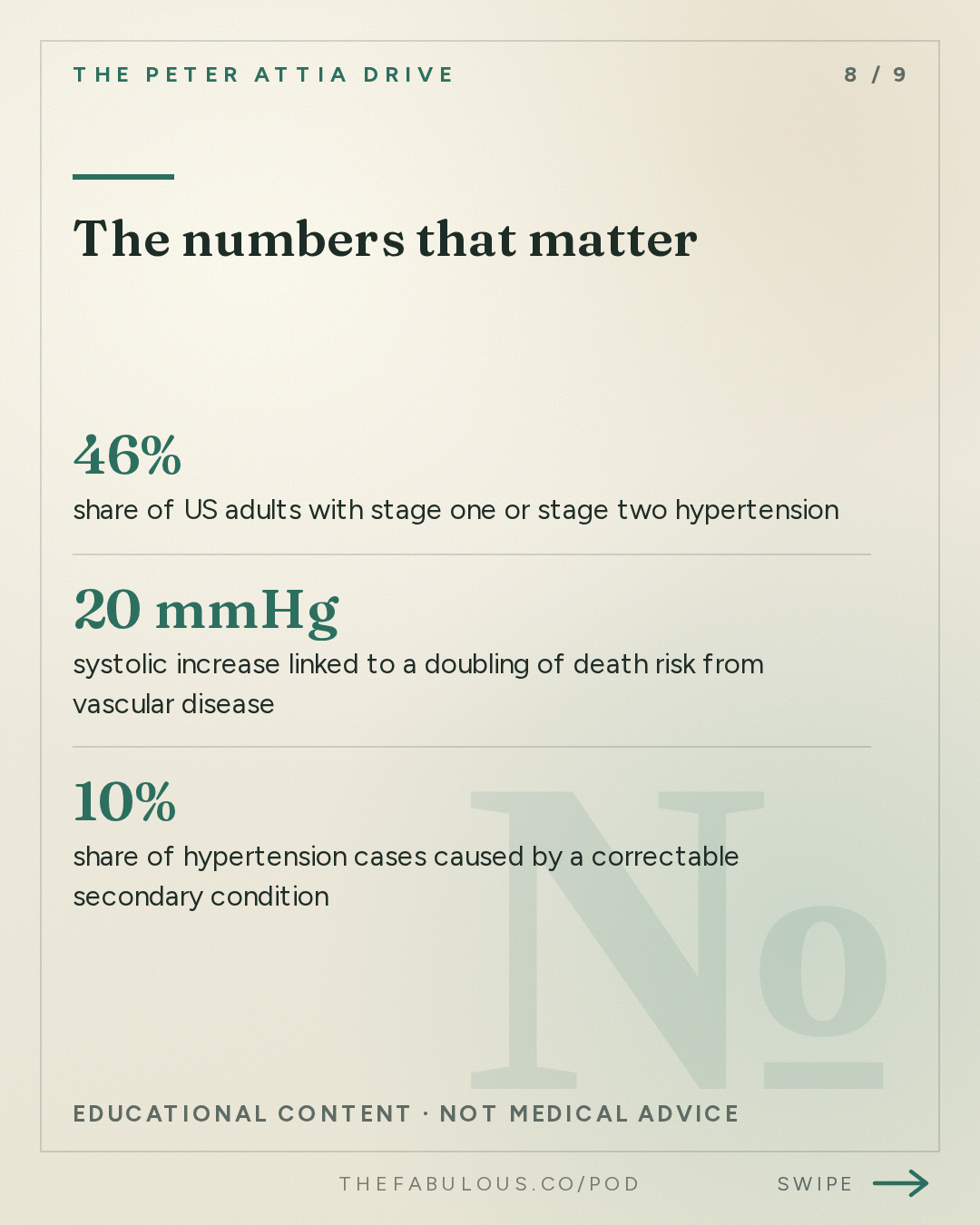
- 46% percent share of US adults with stage one or stage two hypertension
- 20 mmHg systolic increase linked to a doubling of death risk from vascular disease
- 10% percent share of hypertension cases caused by a correctable secondary condition
In their words
“Compounding is insanely powerful when it comes to this type of biology, whether it be smoking, ApoB, or blood pressure.”
“With ApoB you can't go too low. With blood pressure, you can go too low.”
“High blood pressure is often referred to as a silent killer because it really doesn't have a warning sign.”
“Don't be lazy and check your blood pressure over your clothing. If you can't roll your sleeves all the way up, take your shirt off.”
“Lifestyle is a far greater hammer on blood pressure than it is on lipids.”
Protocols
-
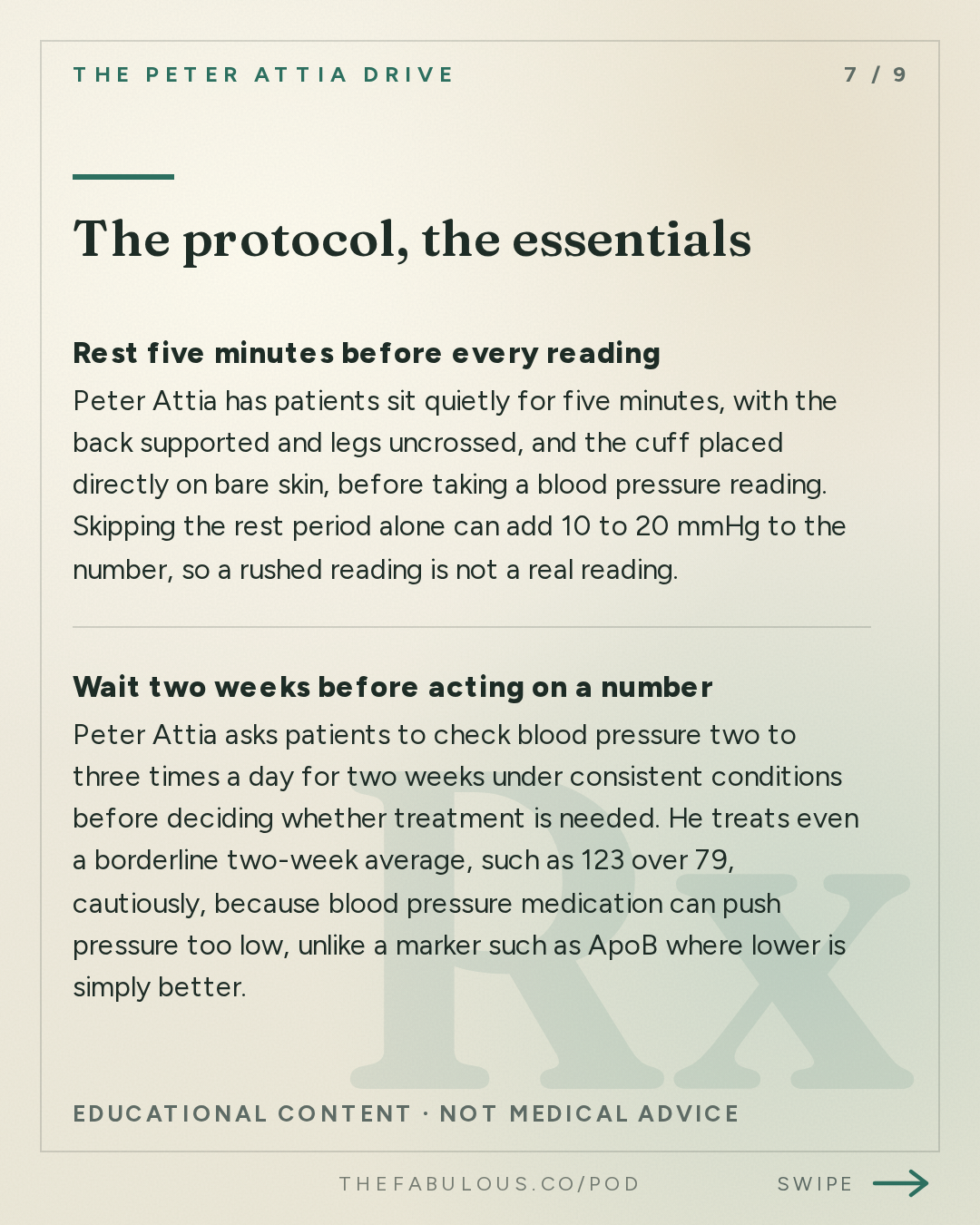
Rest five minutes before every reading
Peter Attia has patients sit quietly for five minutes, with the back supported and legs uncrossed, and the cuff placed directly on bare skin, before taking a blood pressure reading. Skipping the rest period alone can add 10 to 20 mmHg to the number, so a rushed reading is not a real reading.
Every time blood pressure is checked
-
Wait two weeks before acting on a number
Peter Attia asks patients to check blood pressure two to three times a day for two weeks under consistent conditions before deciding whether treatment is needed. He treats even a borderline two-week average, such as 123 over 79, cautiously, because blood pressure medication can push pressure too low, unlike a marker such as ApoB where lower is simply better.
Two to three times daily for two weeks
-
Drink water before a salty meal
Nephrologist Rick Johnson advises pairing water with, or ahead of, a salty meal, because thirst after eating salt signals that sodium has already spiked and blood pressure has likely risen with it. This mainly helps people who are sodium sensitive, a group that skews toward African Americans, older adults, and people with metabolic syndrome, diabetes, or chronic kidney disease.
With salty meals
-
Train in zone two for at least three hours a week
Peter Attia recommends 90 to 150 minutes of aerobic exercise weekly at 65 to 75 percent of maximum heart rate, the zone two range, to lower systolic blood pressure by as much as 8 mmHg. Resistance training adds a smaller benefit on top of this, roughly 2 to 6 mmHg depending on whether it is dynamic or isometric, so the two types complement rather than replace each other.
Weekly, ideally 3 hours total
Questions this episode answers
What is considered normal blood pressure?
Under guidelines updated in 2017 after the SPRINT trial, normal blood pressure is below 120 mmHg systolic and below 80 mmHg diastolic (11:38). Stage one hypertension starts at 130 systolic or 80 diastolic, and stage two starts at 140 systolic or 90 diastolic.
How much does aggressive blood pressure treatment actually help?
The SPRINT trial randomized nearly 10,000 high-risk adults to a systolic target under 120 versus under 140 and found a 25% relative reduction in cardiovascular mortality in the intensive group, with the trial stopped early because the benefit was so large (16:33). All-cause mortality fell 27% as well (18:19).
How should blood pressure be measured at home for an accurate reading?
Physician Peter Attia recommends sitting quietly for five minutes with the back supported and legs uncrossed, placing the cuff directly on bare skin, and keeping the arm at heart level, since each inch off can shift the reading by about 2 mmHg (39:17). He also avoids acting on any single reading, preferring two to three checks a day for two weeks.
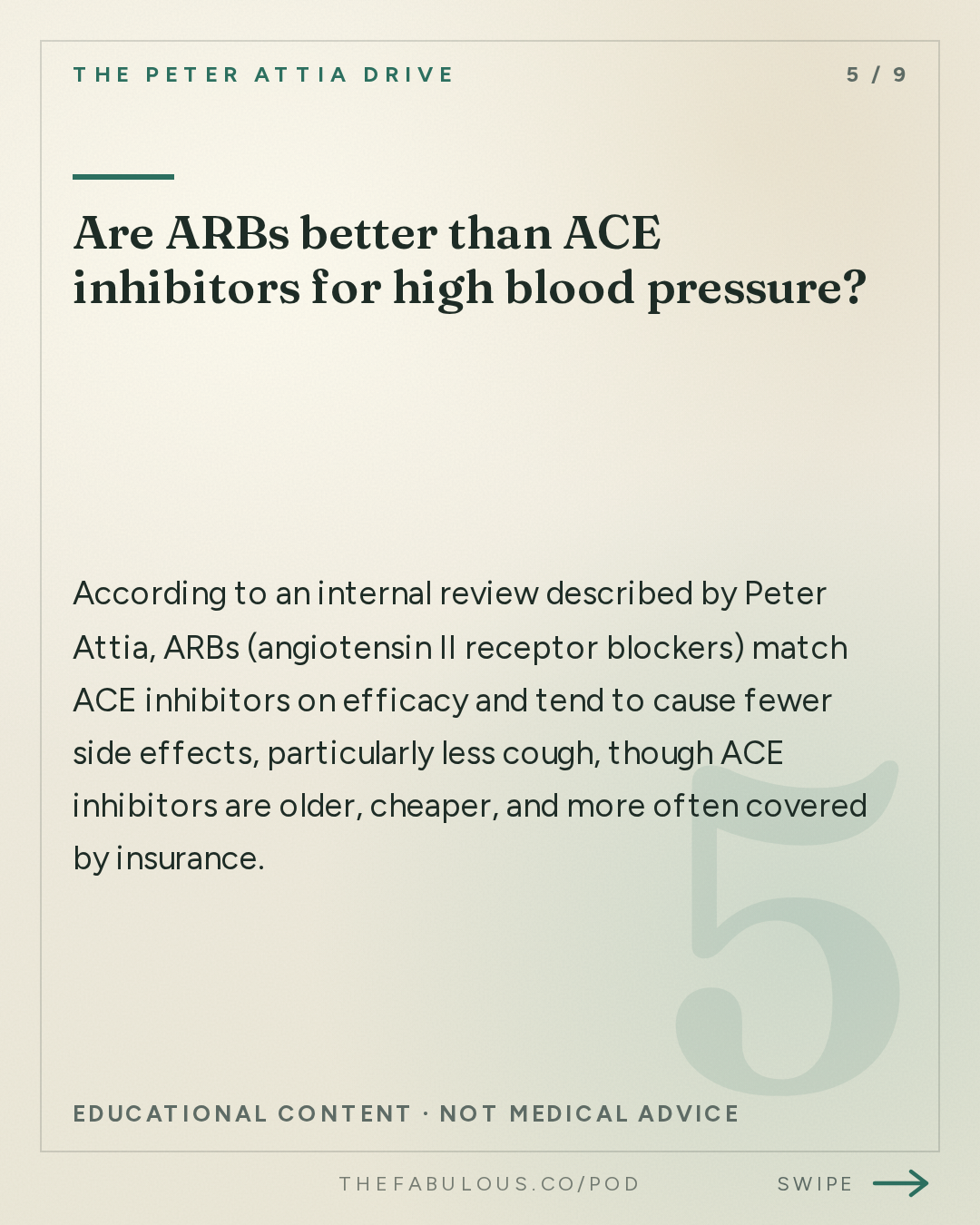
Are ARBs better than ACE inhibitors for high blood pressure?
According to an internal review described by Peter Attia, ARBs (angiotensin II receptor blockers) match ACE inhibitors on efficacy and tend to cause fewer side effects, particularly less cough, though ACE inhibitors are older, cheaper, and more often covered by insurance (70:20).
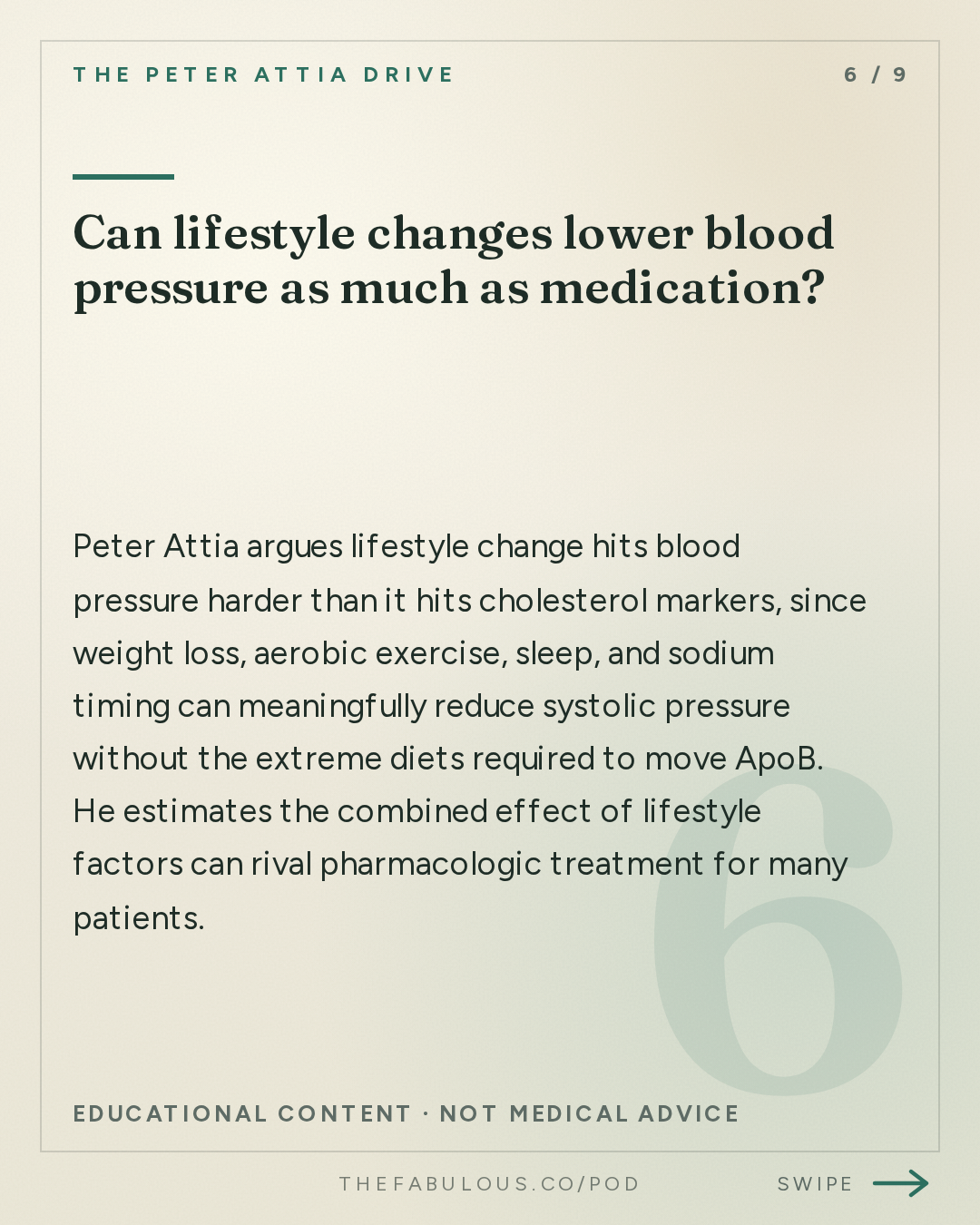
Can lifestyle changes lower blood pressure as much as medication?
Peter Attia argues lifestyle change hits blood pressure harder than it hits cholesterol markers, since weight loss, aerobic exercise, sleep, and sodium timing can meaningfully reduce systolic pressure without the extreme diets required to move ApoB (58:25). He estimates the combined effect of lifestyle factors can rival pharmacologic treatment for many patients (71:14).
What causes secondary hypertension?
Secondary hypertension is high blood pressure driven by a correctable medical condition, such as an adrenal tumor called a pheochromocytoma, renal artery narrowing, or thyroid disease, and it accounts for about 10% of hypertension cases (52:07). Attia describes a patient whose severe hypertension resolved completely after surgery removed a pheochromocytoma (54:59).
The full read, in cards
Go deeper
- SPRINT trial — Randomized nearly 10,000 high-risk adults to intensive vs standard blood pressure targets and found a 25% reduction in cardiovascular mortality with intensive treatment
- STEP trial — Repeated the SPRINT design in Chinese adults aged 60 to 80 and found a 26% reduction in cardiovascular outcomes with intensive treatment
- Framingham Heart Study — Early data from the 1960s linking reduced blood pressure to lower rates of stroke, heart failure, and heart attack
- SPRINT Mind trial — Sub-study of SPRINT finding a 16% relative reduction in dementia risk with intensive blood pressure lowering
Mentioned
Peter Attia · Ethan Weiss · Rick Johnson · Lane Norton · SPRINT trial · STEP trial · Framingham Heart Study · SPRINT Mind trial · Institute of Medicine · Cystatin C · ACE inhibitors · ARBs
More from this show and category
Siddhartha Mukherjee on Cancer's New Science
Oncologist Siddhartha Mukherjee tells Peter Attia that cancer's old "bad luck" story is being replaced by a more precise one: inflammation acts as the trigger that wakes dormant, mutation-carrying "sleeper cells" into tumors, which reframes prevention, treatment, and how we think about aging itself.
Why Peter Attia Changed His Mind on Keto
Peter Attia now says keto works by curbing energy intake, not lowering insulin, while he still requires 1.4 g/kg of protein (09:42, 11:44). He also walks back his extended fasting protocol, once seven to ten days quarterly, after weighing autophagy evidence against the practical cost (12:36, 15:09).
Preeclampsia and Long-Term Heart Risk Explained
Pregnancy stresses the heart, kidneys, and metabolism so hard that its complications predict a woman's cardiovascular and diabetes risk decades later. Maternal-fetal medicine specialist Kathryn Gray explains how plasma volume surges 50%, how preeclampsia's placental biology works, and why half of gestational diabetes cases become type 2 diabetes.
Lloyd Klickstein on How New Drugs Get Made
Physician-scientist Lloyd Klickstein maps the full arc of drug development, from spotting an unmet need to FDA approval, using the muscle drug bimagrumab as his case study. Paired with semaglutide, it cut body fat by 45.7% over 72 weeks (125:28), rivaling bariatric surgery, while exposing the economics of patents, manufacturing, and phase one risk.
