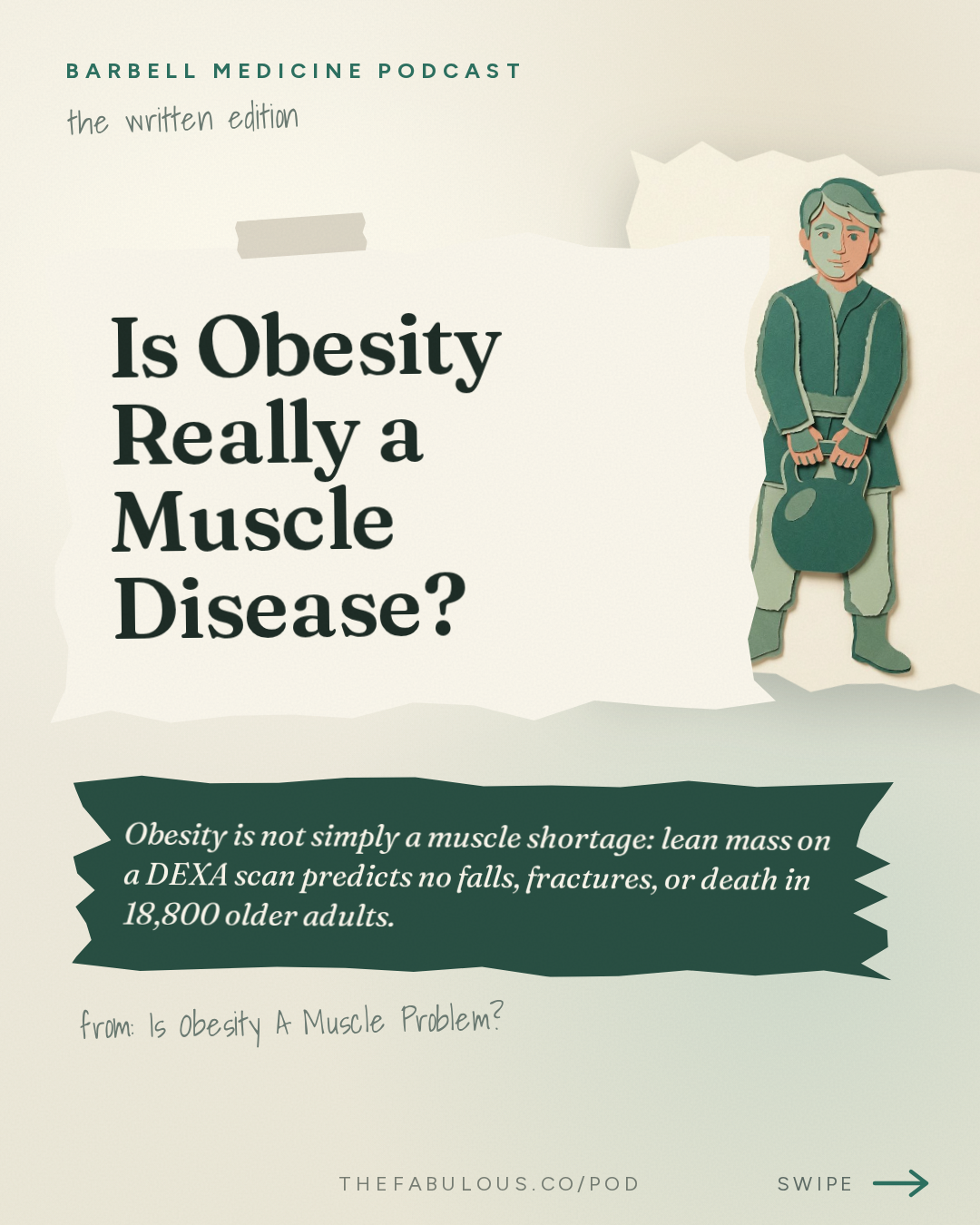
Is Obesity Really a Muscle Disease?
Is Obesity A Muscle Problem?
The brief
Obesity is not simply a muscle shortage: lean mass on a DEXA scan predicts no falls, fractures, or death in 18,800 older adults (21:44). Barbell Medicine host Dr. Jordan Feigenbaum argues the real damage comes from where fat lands, what molecular form it takes, and how fast it moves, drawing on GLUT4 transporter mechanics and GLP-1 trial data.
In 1989, six healthy young men in Denmark agreed to have one leg exercised while the other sat still. Four hours later, researchers threaded catheters into both femoral veins, infused insulin, and measured how much glucose each leg pulled from the blood. The exercised leg took up more glucose than the resting one, even though both legs belonged to the same man, carried the same amount of muscle, and saw the same insulin at the same concentration (00:00). The only thing that differed was what the tissue had done recently, not how much of it there was.
That result sits at the center of this episode of the Barbell Medicine Podcast, hosted by physician and powerlifter Dr. Jordan Feigenbaum. His target is Muscle Centric Medicine, the framework built by physician Dr. Gabrielle Lyon, who argues that obesity is, in her words, a disease of the muscle, and that people with obesity are simply undermuscled (00:47). Feigenbaum agrees with two of her premises: muscle is the body's largest site of insulin-driven glucose disposal, and muscle insulin resistance shows up years before blood sugar looks abnormal (01:10). What he disputes is the conclusion that follows, that building more muscle mass fixes the underlying problem.
The doors in the wall
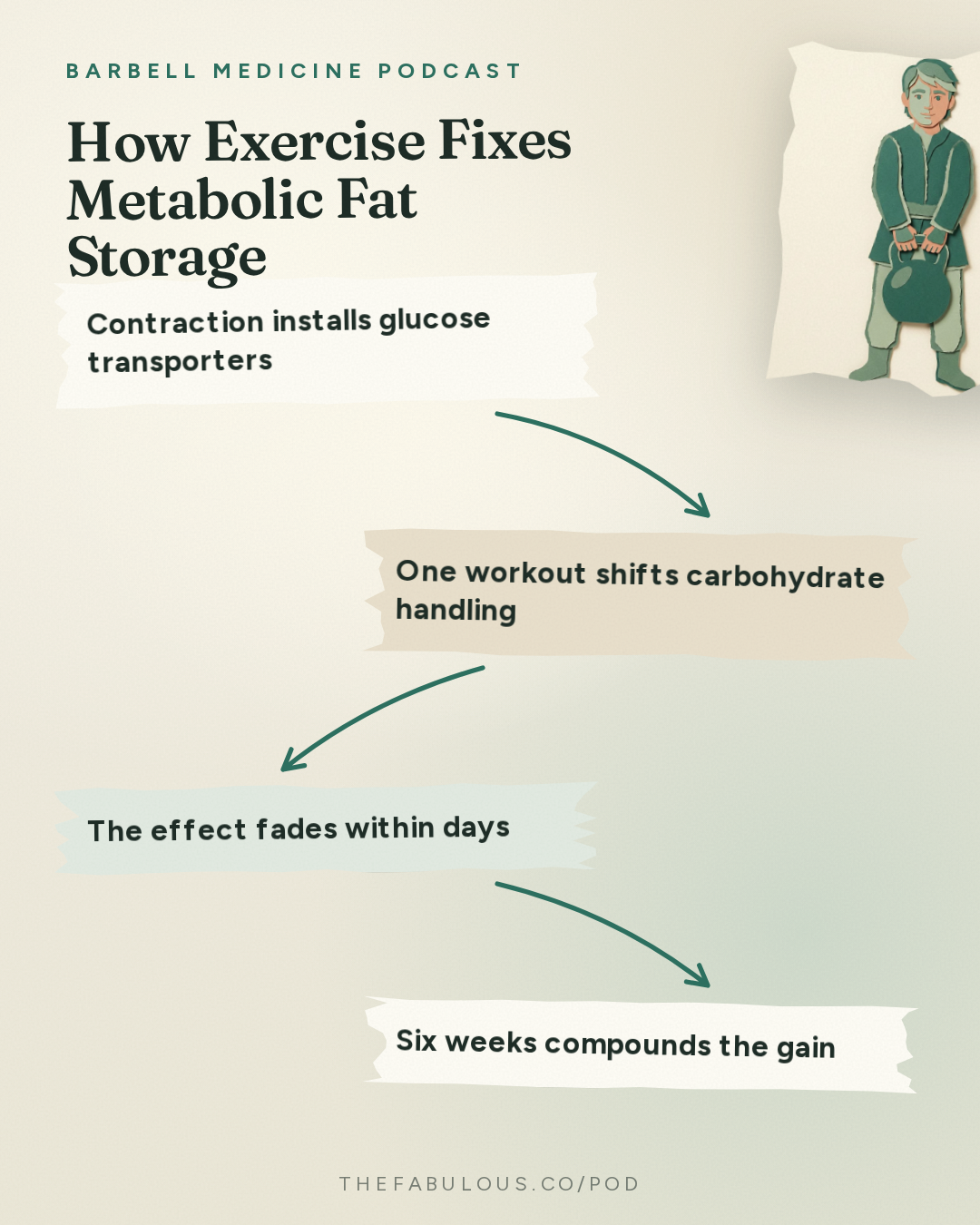
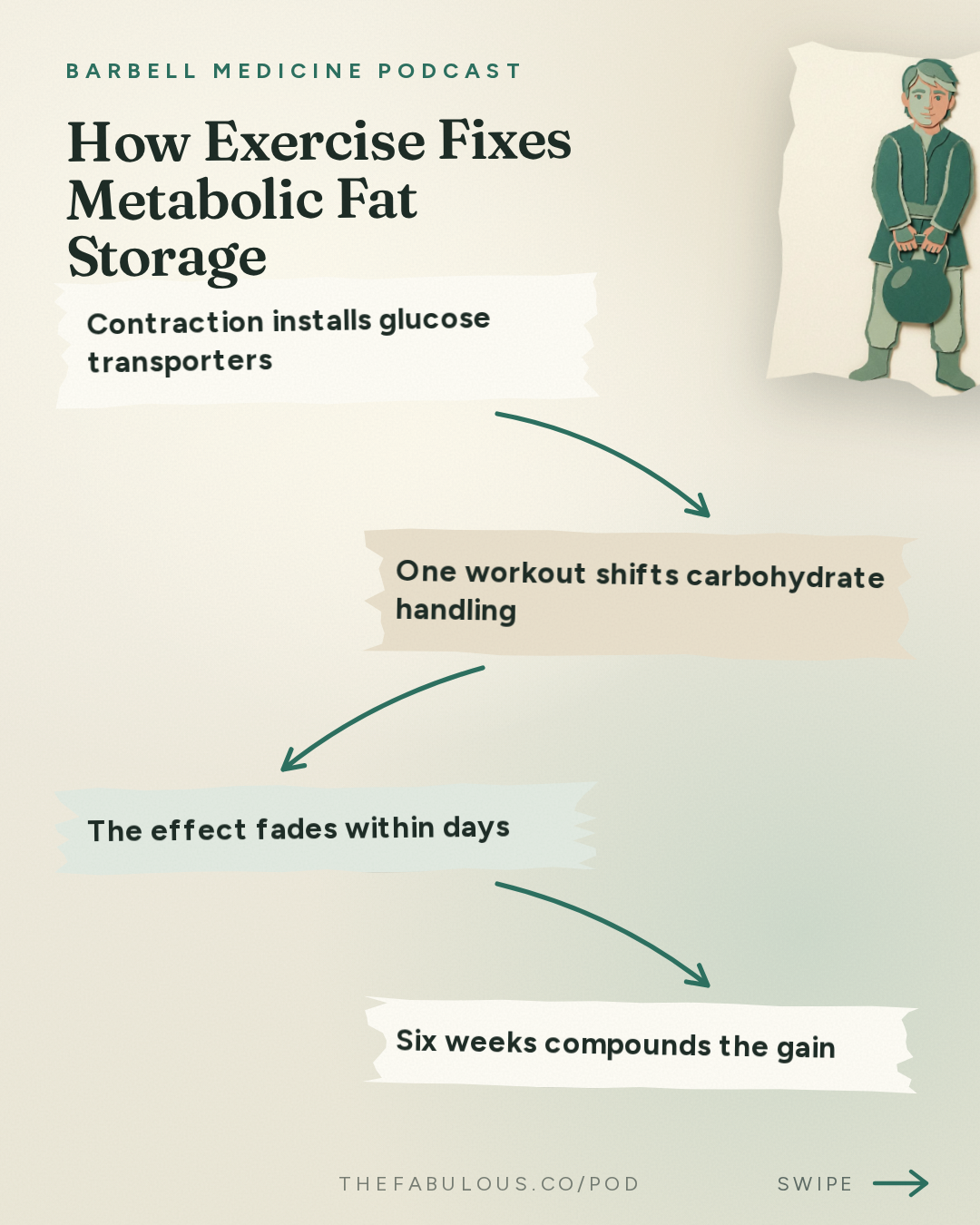
Glucose cannot cross a cell membrane on its own. It needs a transporter, a piece of protein sitting in the cell wall that lets it through. Most of a muscle cell's transporters are not hanging in that wall at rest; more than nine in ten sit stored inside the cell, waiting to be installed (05:18). Insulin can install them. So can muscle contraction, through a separate pathway that does not need insulin's permission (05:52). That is what happened to the Danish leg: the same transporters, installed by exercise instead of insulin.
This distinction undoes the arithmetic behind "more muscle equals more glucose disposal." Under a lab test called a clamp, 80 to 90 percent of infused glucose ends up in skeletal muscle (06:39), the figure Lyon's case leans on. But the physiologist who produced that number, endocrinologist Dr. Ralph DeFronzo, also found that under ordinary eating conditions, the gut and liver claim 30 to 40 percent of glucose before muscle ever sees it (07:30). A clamp isolates muscle; breakfast does not. And because training increases the number of transporters a cell owns without necessarily increasing the cell's size (08:16), a muscle can get much better at handling sugar while staying exactly the same size. The effect also expires: insulin sensitivity gained from a single workout was still present at 48 hours but gone by five days (13:40).
"A large well built muscle that hasn't contracted in five days is, by this measure, an untrained one," says Dr. Jordan Feigenbaum [14:02].
The strongest evidence against the muscle-mass theory comes from the Sarcopenia Definitions and Outcomes Consortium, which pooled 18,800 community-dwelling older adults and tested which body-composition measures predicted falls, fractures, mobility loss, and death. Grip strength and gait speed predicted all four outcomes. Lean mass measured by a DEXA scan, the standard imaging test for body composition, predicted none of them (21:20). "Knowing how much lean mass somebody had told you nothing about whether they fall, break something, lose mobility, or die," Feigenbaum says (21:44). The panel that convened to define sarcopenia, a word that literally means muscle loss, ended up recommending that the muscle-mass measurement be removed from its own definition.
Odder still, people with obesity carry more absolute muscle mass than lean people do, and they are stronger in raw force, across ages from adolescence through old age (22:48). What they have less of is muscle quality, meaning force produced per kilogram of tissue, because fat infiltrating the muscle, a condition called myosteatosis, degrades performance without shrinking the tissue (18:33). The population supposedly suffering from a muscle deficiency has, on average, extra muscle. What it has is muscle that works worse.
Location, type, and whether the boxes are moving
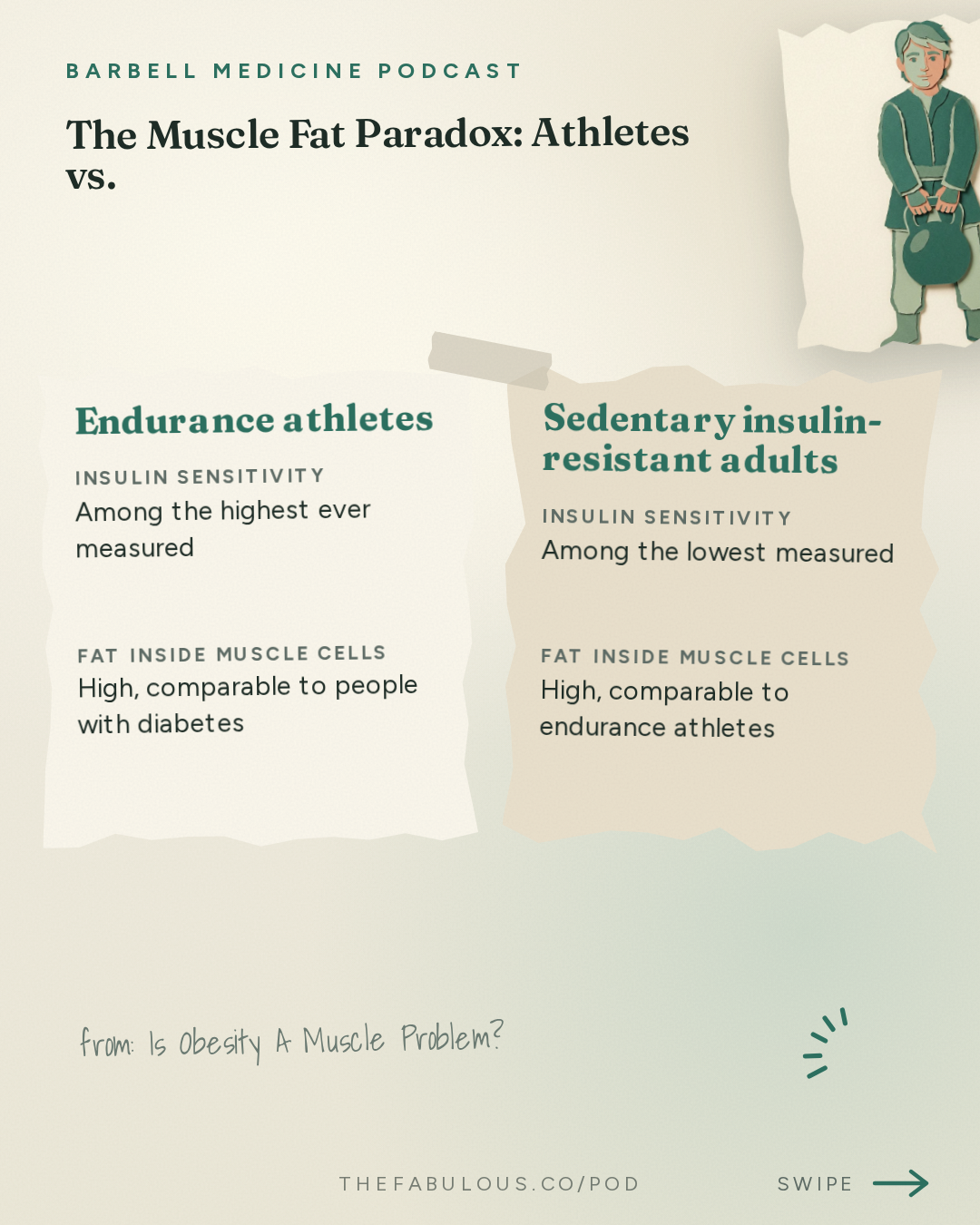
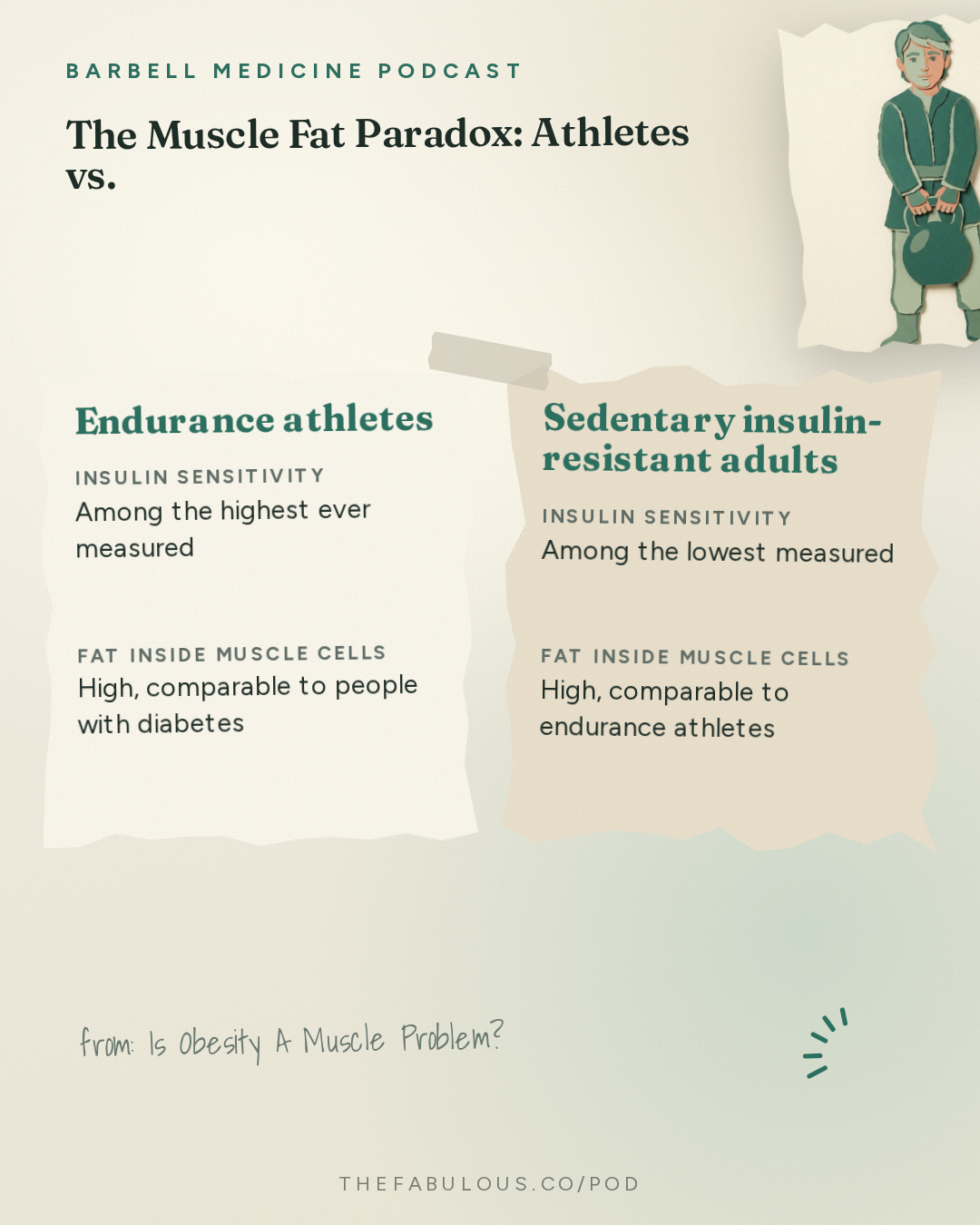
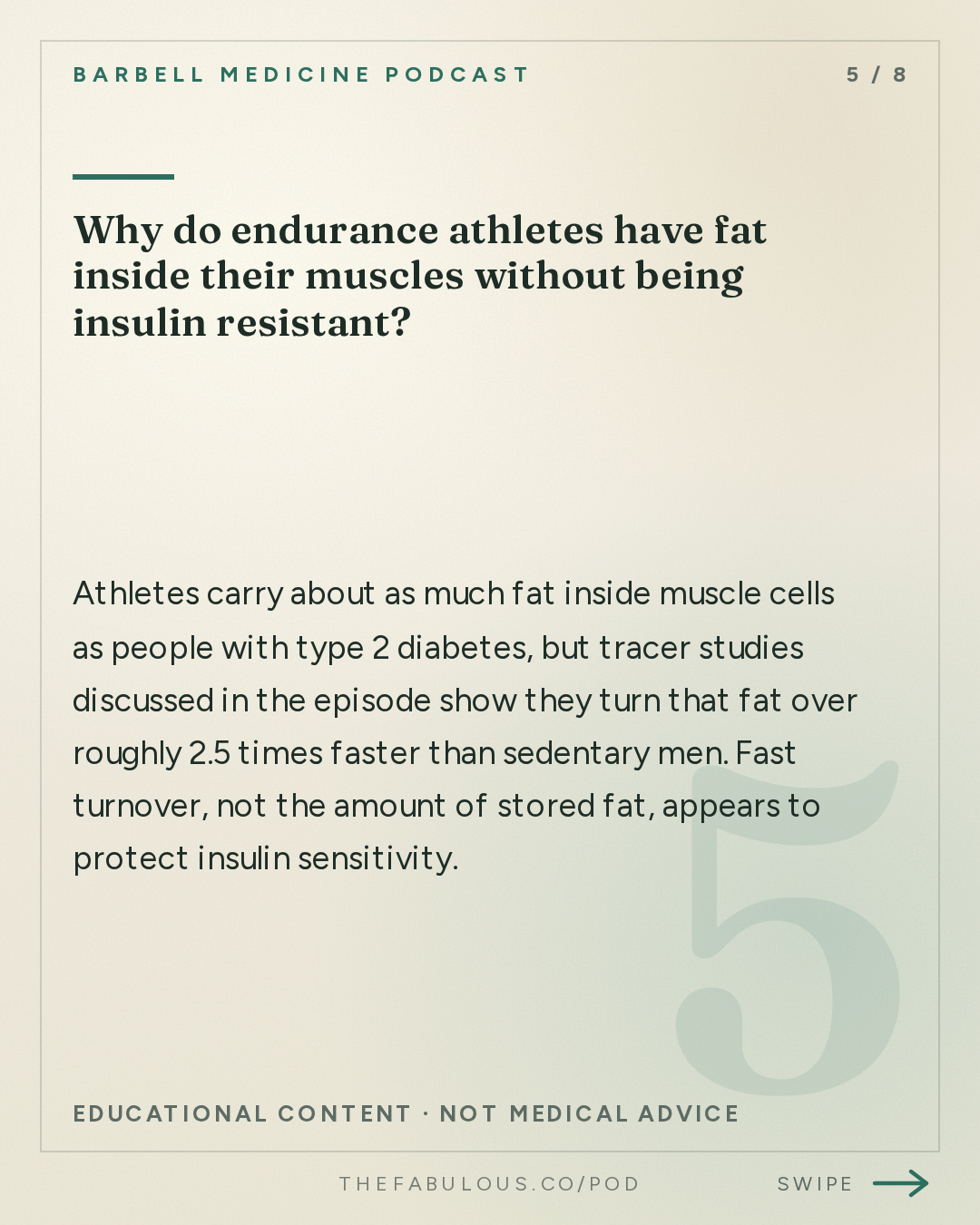
Why does fat inside muscle sometimes wreck insulin sensitivity and sometimes not? Endurance athletes carry about as much fat inside their muscle cells as people with type 2 diabetes, yet they are among the most insulin-sensitive people ever measured (28:07). The variable is not how much fat sits there. It is how fast that fat is broken down and rebuilt: athletes turn over their muscle fat about 2.5 times faster than sedentary men (29:22). Feigenbaum's analogy runs through the whole episode: sedentary muscle is boxes sitting untouched on a staircase, trained muscle is boxes being carried up and down all day.
The liver tells a similar story. Among 133 people who had their livers scanned and then clamped, having any liver fat at all raised insulin resistance, but among people who already had liver fat, having 6 percent or 25 percent made no difference (31:46). What seems to matter is the type of fat molecule. Triglyceride, the storage form reported on lab tests, is largely inert. Diacylglycerol, an intermediate step in building triglyceride, is a signaling molecule that can jam the insulin receptor. Block the enzyme that finishes that conversion in a rat's liver and total liver fat drops, yet the animal becomes more insulin resistant, because the half-built molecule piles up and interferes with signaling (32:55). Less fat, worse metabolic health, a result that only makes sense once type, not just amount, enters the picture.
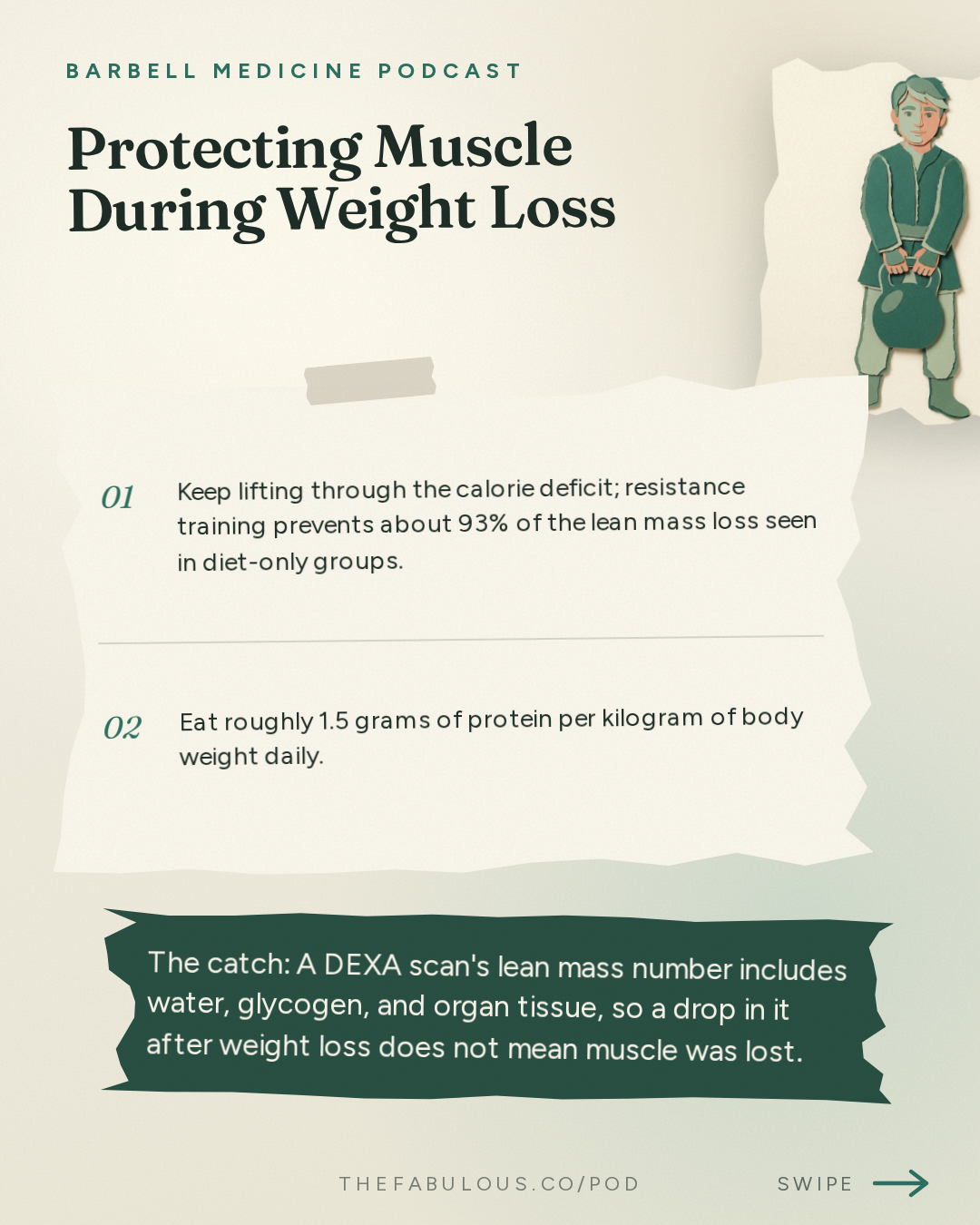
Feigenbaum applies the same lens to GLP-1 drugs, short for glucagon-like peptide-1 receptor agonists, the class that includes semaglutide and tirzepatide. Trial data show people losing roughly 40 percent of their total weight loss as lean mass on DEXA scans (56:49), a figure that has fueled worry about muscle wasting. But a DEXA scan's lean category includes water, glycogen, organ tissue, and roughly 15 percent of what used to be fat tissue itself, none of which is contractile muscle (57:41). In the year-long SEMILEAN trial, people taking semaglutide without exercising still gained about 4.5 kilograms of grip strength (59:49), a functional gain the scan could only register as loss.
"The scan is counting that success as a loss," says Dr. Jordan Feigenbaum [59:02].
None of this argues against lifting weights. Feigenbaum trains and coaches lifters for a living, and he repeats that resistance training lowers mortality, blood pressure, and hemoglobin A1c regardless of whether Muscle Centric Medicine's theory holds up (19:01). His point is narrower: the amount of muscle on a scan is the wrong target. What matters is what the tissue does, where fat ends up, what molecular form it takes, and how fast any of it moves.
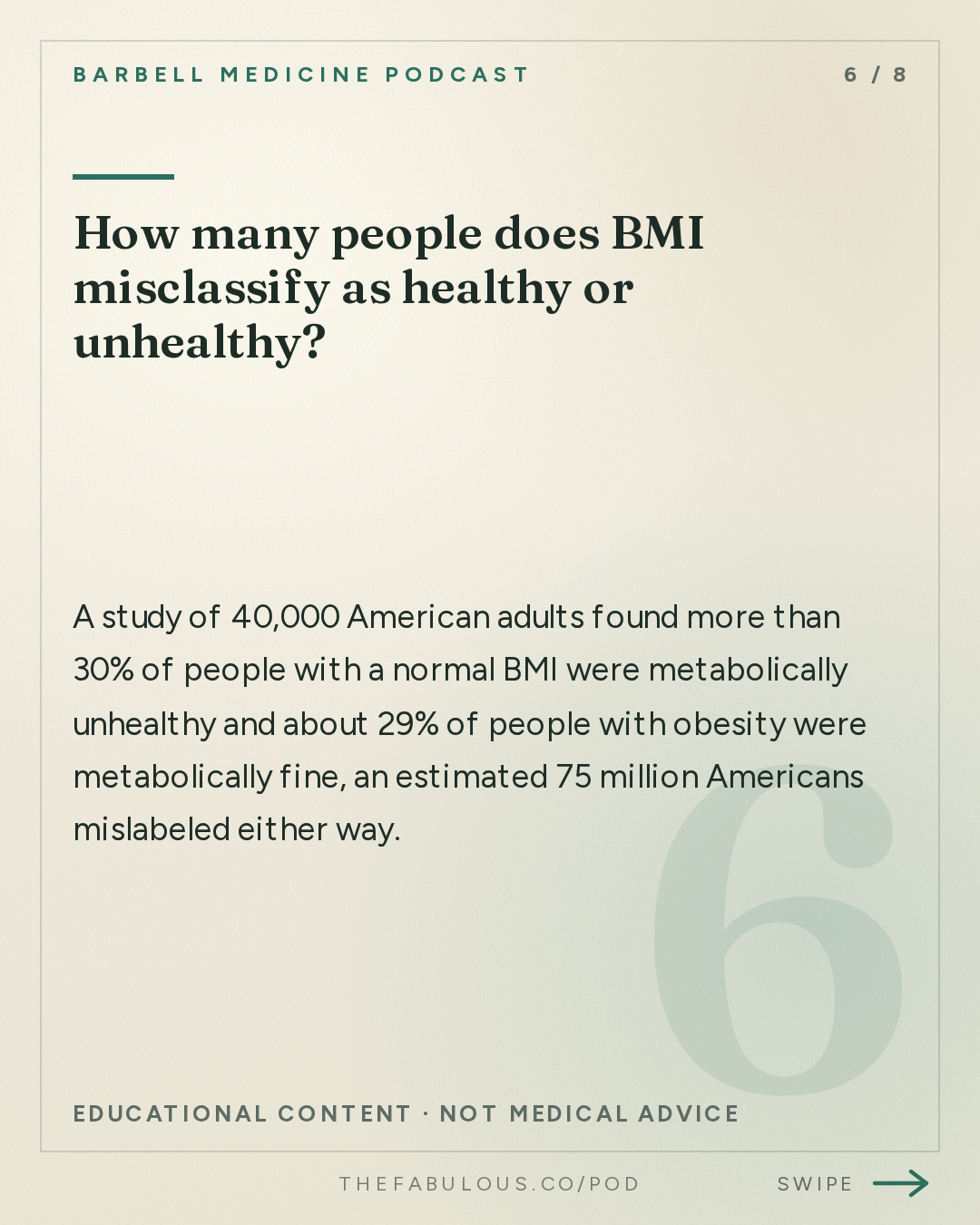
That reframing lands on a bigger diagnostic problem. Researchers sorted 40,000 American adults by body mass index, or BMI, and separately checked for real metabolic markers such as blood pressure, blood sugar, and triglycerides. More than 30 percent of people with a normal BMI were metabolically unhealthy, and about 29 percent of people classified with obesity were metabolically fine (80:28). By the study's own estimate, 75 million American adults are mislabeled either way (81:02). Feigenbaum compares obesity, as currently named, to jaundice, a visible sign rather than a mechanism. Hypertension is named for the pressure that does the damage, so doctors treat the pressure. Obesity is named for how a body looks from the outside, and for decades medicine has been treating that reflection instead of what sits behind it.
His proposed replacement is not a number a bathroom scale can give. It is three questions: where is the fat sitting, what molecular form is it in, and how fast is it moving. Muscle mass answers none of them. Muscle function, measured through strength and gait speed, gets closer. Exercise remains the most reliable lever anyone has found, because it improves location, type, and flux at the same time, without requiring a single extra kilogram of tissue.
Ask this episode anything
Pod's AI answers from the episode itself, with the minute mark so you can hear it yourself.
Or start with one of these
Ask this episode
Pod's AI listens to the whole episode to answer, and points you to the minute it comes from.
The rest of this answer, and any question after it
Answers come from the episode itself, never from a summary of it.
ContinueKey takeaways
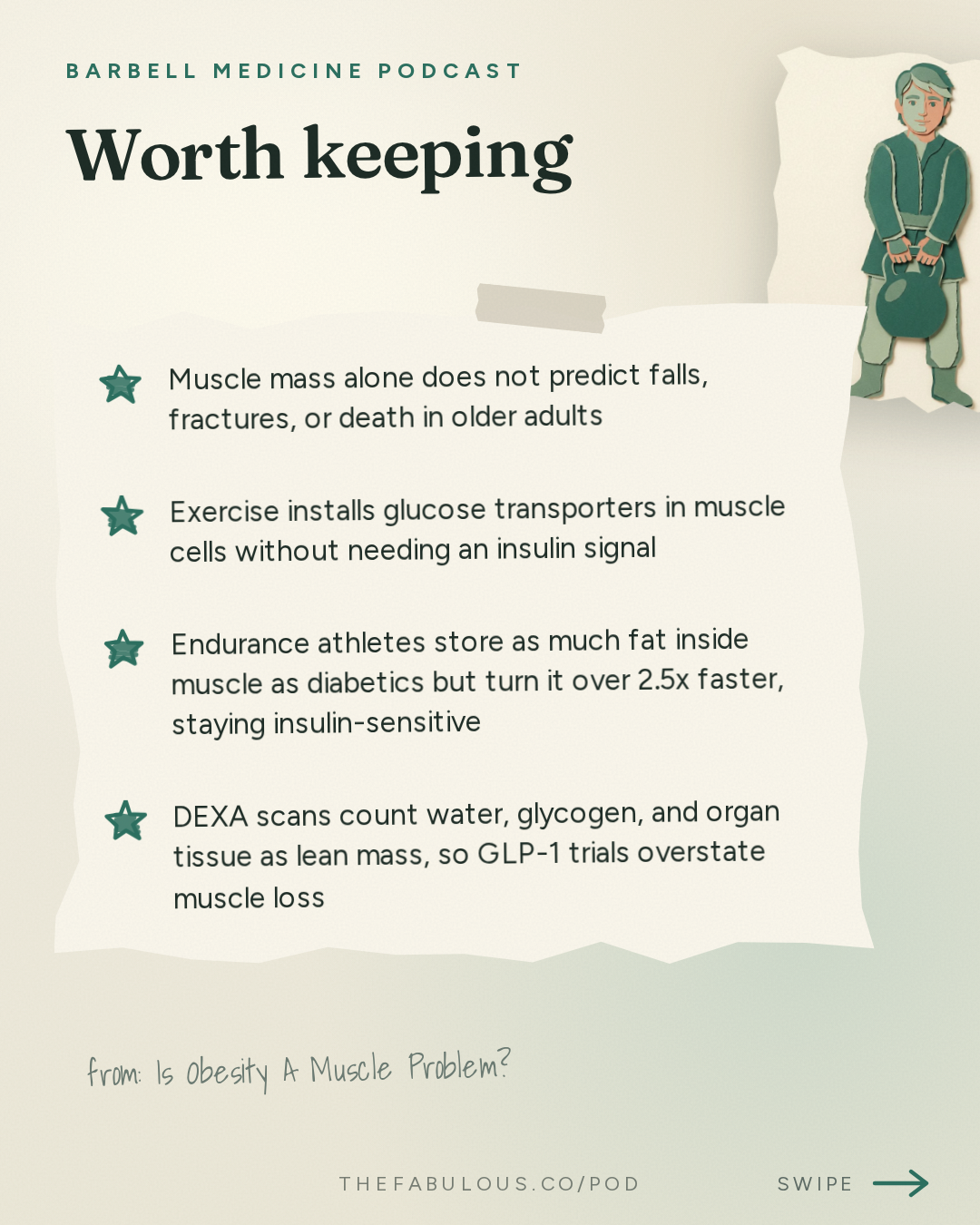
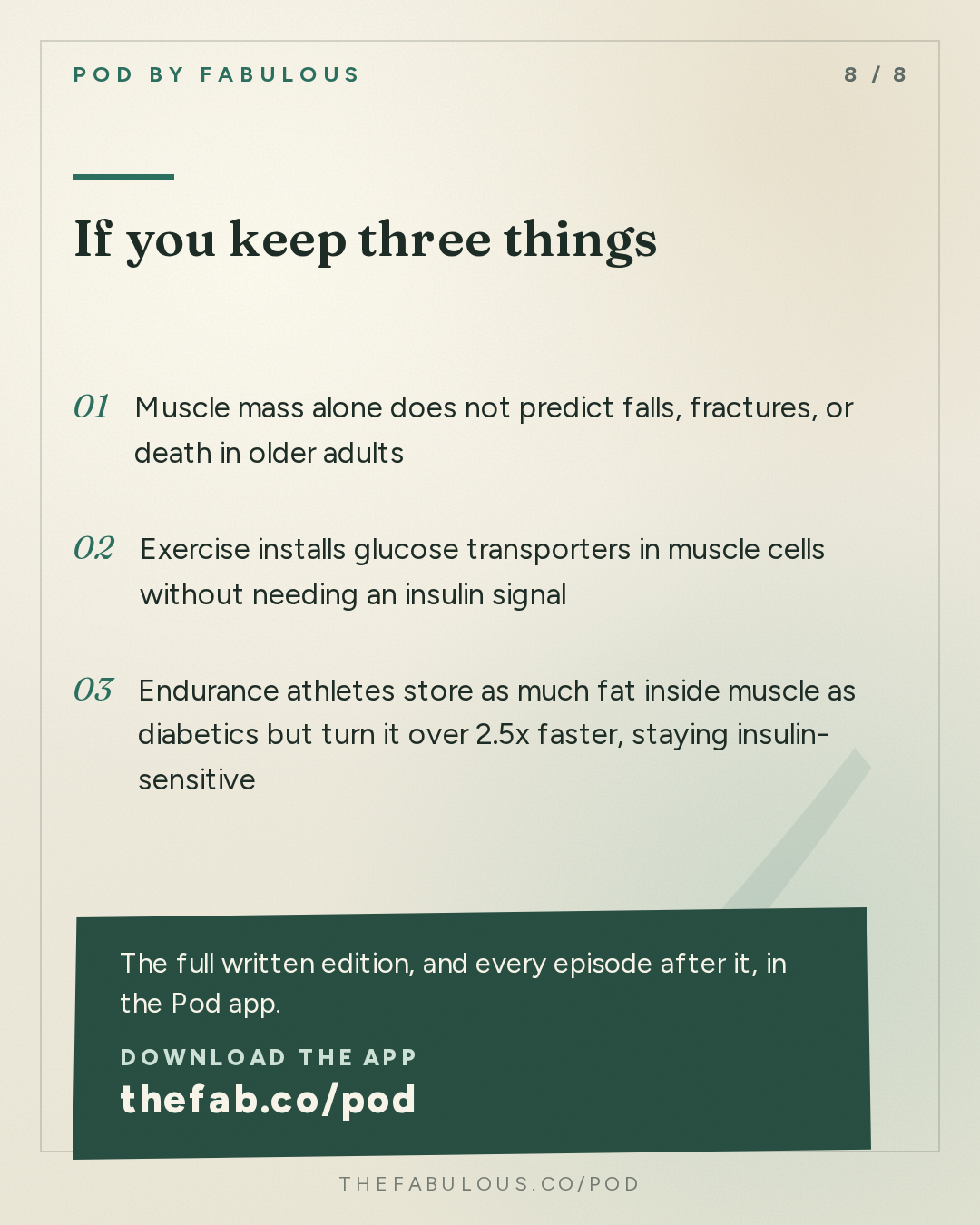
- Muscle mass alone does not predict falls, fractures, or death in older adults
- Exercise installs glucose transporters in muscle cells without needing an insulin signal (05:52)
- Endurance athletes store as much fat inside muscle as diabetics but turn it over 2.5x faster, staying insulin-sensitive (29:22)
- DEXA scans count water, glycogen, and organ tissue as lean mass, so GLP-1 trials overstate muscle loss (57:41)
- About 75 million American adults are mislabeled by BMI as either healthy or unhealthy (81:02)
The episode in cards


By the numbers
- 3,500 calories food energy required to build 1kg of muscle
- 75 million people American adults mislabeled as healthy or unhealthy by BMI category
In their words
“Any definition that can tell those two people apart isn't describing a disease. It's describing an appearance.”
“At rest more than nine out of ten of the doors that you own are sitting in that pile rather than hung in the wall.”
“Knowing how much lean mass somebody had told you nothing about whether they fall, break something, lose mobility, or die.”
“The scan is counting that success as a loss.”
Protocols
-
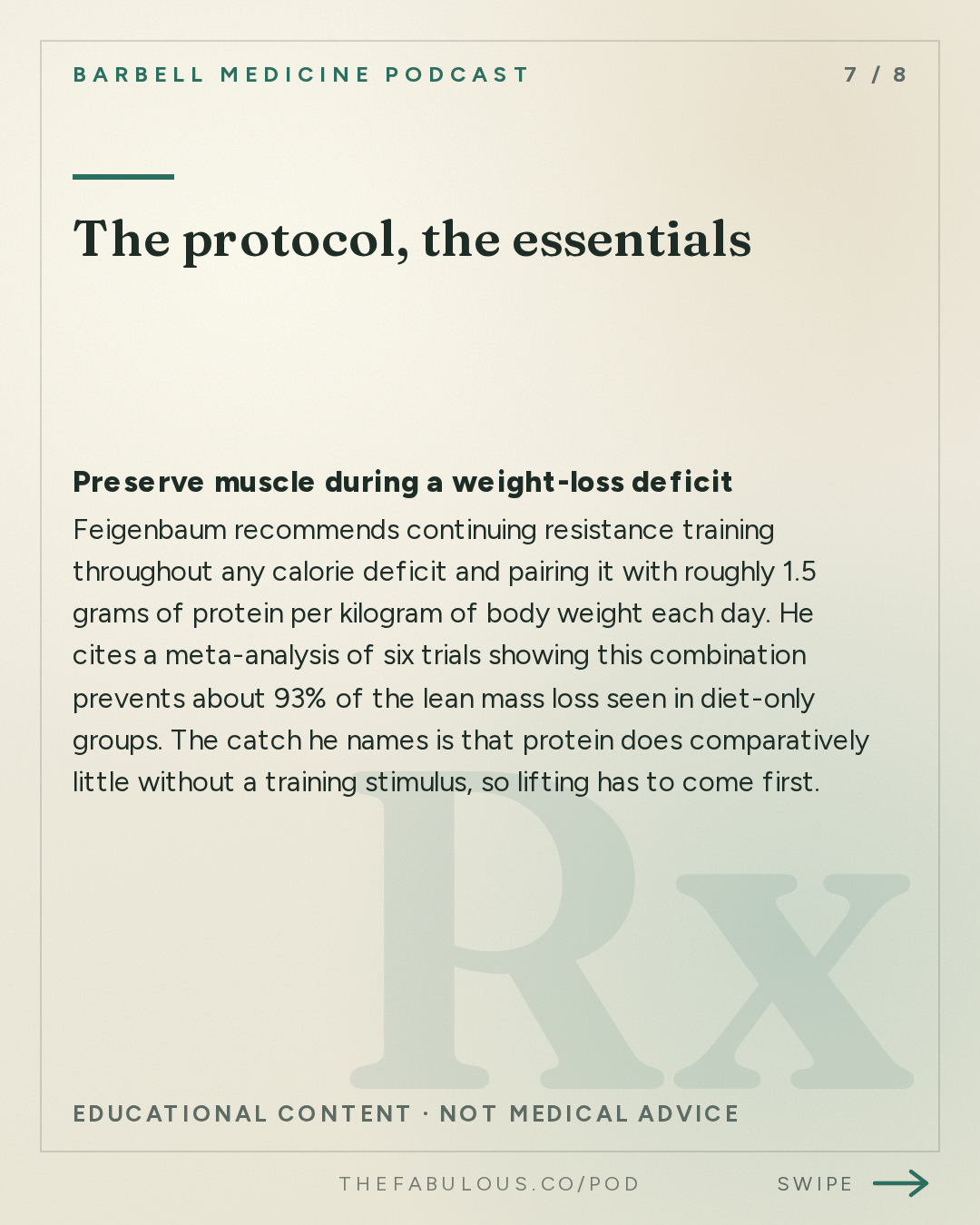
Preserve muscle during a weight-loss deficit
Feigenbaum recommends continuing resistance training throughout any calorie deficit and pairing it with roughly 1.5 grams of protein per kilogram of body weight each day. He cites a meta-analysis of six trials showing this combination prevents about 93% of the lean mass loss seen in diet-only groups. The catch he names is that protein does comparatively little without a training stimulus, so lifting has to come first.
Ongoing throughout the fat-loss phase
-
Do not eat in a surplus to build muscle before losing fat
Feigenbaum argues that people carrying excess body fat do not need a calorie surplus to build muscle, because ample stored energy means energy availability is not the limiting factor. He notes the catch that below roughly 12% body fat, deficits larger than about 500 calories a day can blunt muscle gain in older, previously untrained lifters, so leaner trained people may need a smaller deficit or maintenance calories instead.
Applies throughout any fat-loss phase for people with obesity
Questions this episode answers
Is obesity caused by too little muscle?
No. A study of 18,800 older adults found DEXA-measured lean mass predicted no falls, fractures, mobility loss, or death, while grip strength and gait speed did (21:44). Barbell Medicine host Dr. Jordan Feigenbaum argues obesity's damage comes from where fat is stored and how fast it moves, not from a shortage of muscle tissue (72:04).
Does resistance training improve insulin resistance without adding muscle?
Yes. In a study where one leg trained for six weeks and the other did not, the trained leg cleared more glucose during an insulin clamp test even though muscle size did not measurably change between the legs (25:20). The researchers concluded the improvement came from more glucose transporters and signaling proteins, not more tissue.
How much muscle do GLP-1 drugs like semaglutide and tirzepatide actually cause people to lose?
Trial data show about 40% of total weight loss on semaglutide is classified as lean mass by DEXA scans, but that category includes water, glycogen, and organ tissue, not just muscle (56:49). In the SEMILEAN trial, semaglutide users who did not exercise still gained 4.5 kilograms of grip strength despite scan-reported lean mass loss (59:49).
Why do endurance athletes have fat inside their muscles without being insulin resistant?
Athletes carry about as much fat inside muscle cells as people with type 2 diabetes, but tracer studies discussed in the episode show they turn that fat over roughly 2.5 times faster than sedentary men (29:22). Fast turnover, not the amount of stored fat, appears to protect insulin sensitivity.
How many people does BMI misclassify as healthy or unhealthy?
A study of 40,000 American adults found more than 30% of people with a normal BMI were metabolically unhealthy and about 29% of people with obesity were metabolically fine, an estimated 75 million Americans mislabeled either way (80:28, 81:02).
The full read, in cards
Go deeper
- 1989 Danish one-leg exercise clamp study — Showed the exercised leg took up more glucose than the rested leg despite identical muscle mass and insulin exposure
- Sarcopenia Definitions and Outcomes Consortium analysis — Pooled 18,800 older adults and found DEXA lean mass predicted no falls, fractures, mobility loss, or death
- Ralph DeFronzo insulin clamp research — Established the 80-90% glucose-into-muscle figure under clamp conditions, with caveats about real eating
- SEMILEAN trial — Semaglutide users without exercise gained 4.5kg grip strength despite scan-reported lean mass loss
- Minnesota Starvation Trial — Showed leaner men lost proportionally more protein nitrogen than heavier men during starvation
Mentioned
Dr. Gabrielle Lyon · Dr. Ralph DeFronzo · Dr. Jordan Feigenbaum · Sarcopenia Definitions and Outcomes Consortium · DEXA scan · GLP-1 · Semaglutide · Tirzepatide · Minnesota Starvation Trial · Dr. Eric Helms
More from this show and category
How Much Lifting Is Enough for Health?
Public health guidelines recommend lifting twice a week, but the study behind that number found three days worked better. Jordan Feigenbaum argues lifting doesn't hurt the heart, carries lower injury risk than running, and shows no real ceiling for strength, bone density, or metabolic benefits, so most people should train roughly double the current guideline.
Why Lifting Heavy Was Called Dangerous
In 1985 a panel of obstetricians banned pregnant women from raising their heart rate past 140 beats per minute, a number invented by consensus, not data (00:01). The same pattern, rules built on vibes rather than evidence, shaped a century of bans on heavy lifting for women, children, and anyone squatting below parallel, until later studies quietly reversed nearly all of them.
Is Training Safe in Wildfire Smoke?
Exercise still protects health during wildfire smoke, and lifting is safer than cardio because it barely raises breathing rate. Training right at failure isn't required for muscle growth either, since easier sets and even indirect fractional sets still add measurable stimulus, so individual response matters more than hitting an exact rep-in-reserve number.
Do You Need a Calorie Surplus to Build Muscle?
No: men above roughly 20% body fat can build muscle in a modest calorie deficit by spending stored fat as fuel. Sports scientist Eric Helms says below about 12% body fat the reverse happens, so a small surplus helps; in between, calorie balance barely matters if training and protein are dialed in.
