Dan Garner on Blood Work and Fitness Constraints
How to Reach Your Fitness Goals (Hard-to-Grow Muscles, Lose Fat, Busy Schedule & More) | Dan Garner
▶ Listen to the full episode More from Perform with Dr. Andy Galpin
The brief
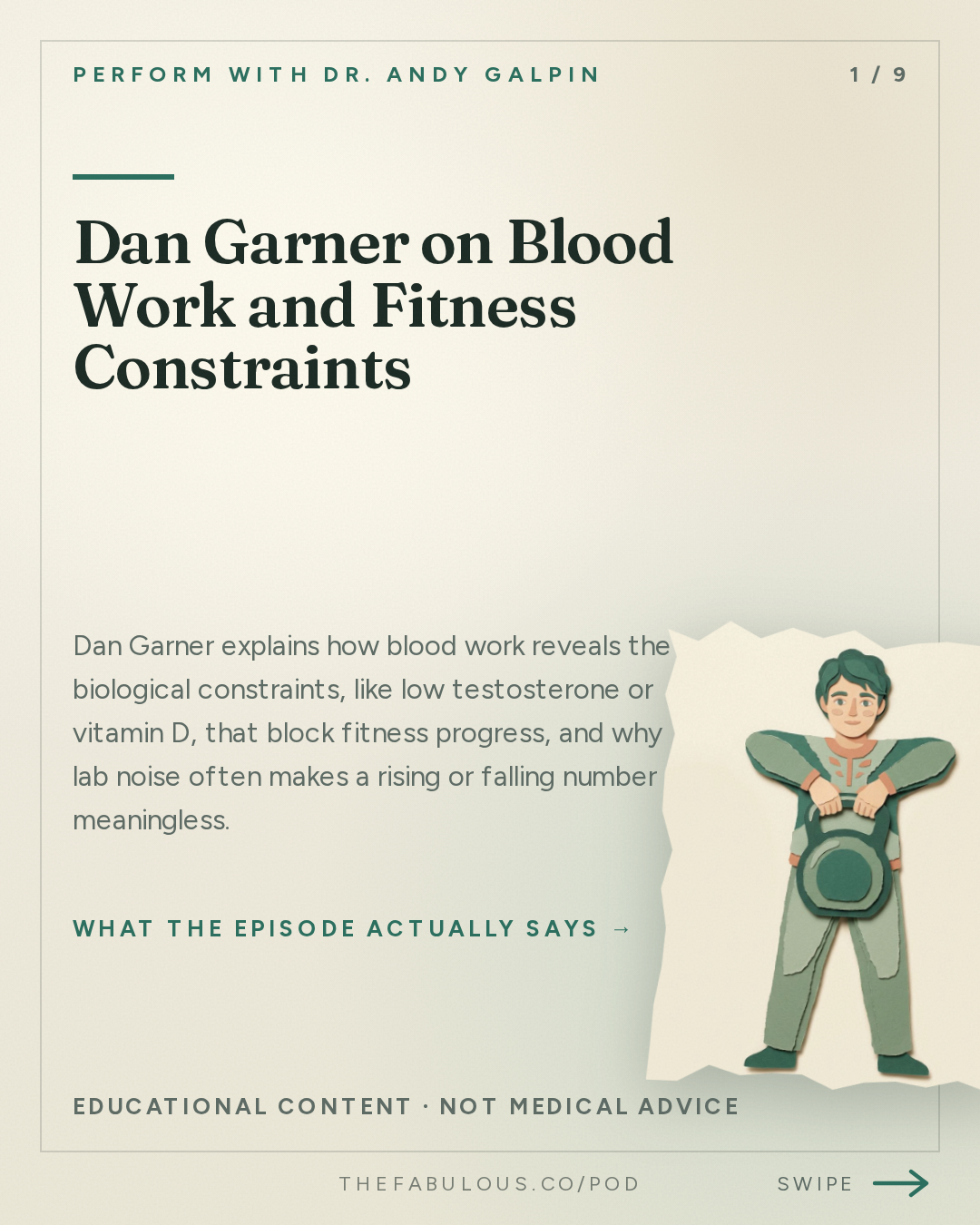
Dan Garner explains how blood work reveals the biological constraints, like low testosterone or vitamin D, that block fitness progress, and why lab noise often makes a rising or falling number meaningless. He also covers hypertrophy training splits, diet breaks, and why peptides like SS-31 sound impressive but lack real performance data.
A blood test comes back and your testosterone has jumped twenty percent since last quarter. Good news, right? Not necessarily. According to performance coach Dan Garner, that swing might be nothing more than the test itself wobbling, the way a scale reads half a pound heavier after a glass of water. Garner has spent fifteen years coaching CEOs, UFC fighters, Olympians, and ordinary people trying to get back into their bodies after having a kid, and the thread running through all of it is a simple, almost boring idea: most of what looks like progress or failure is just noise.
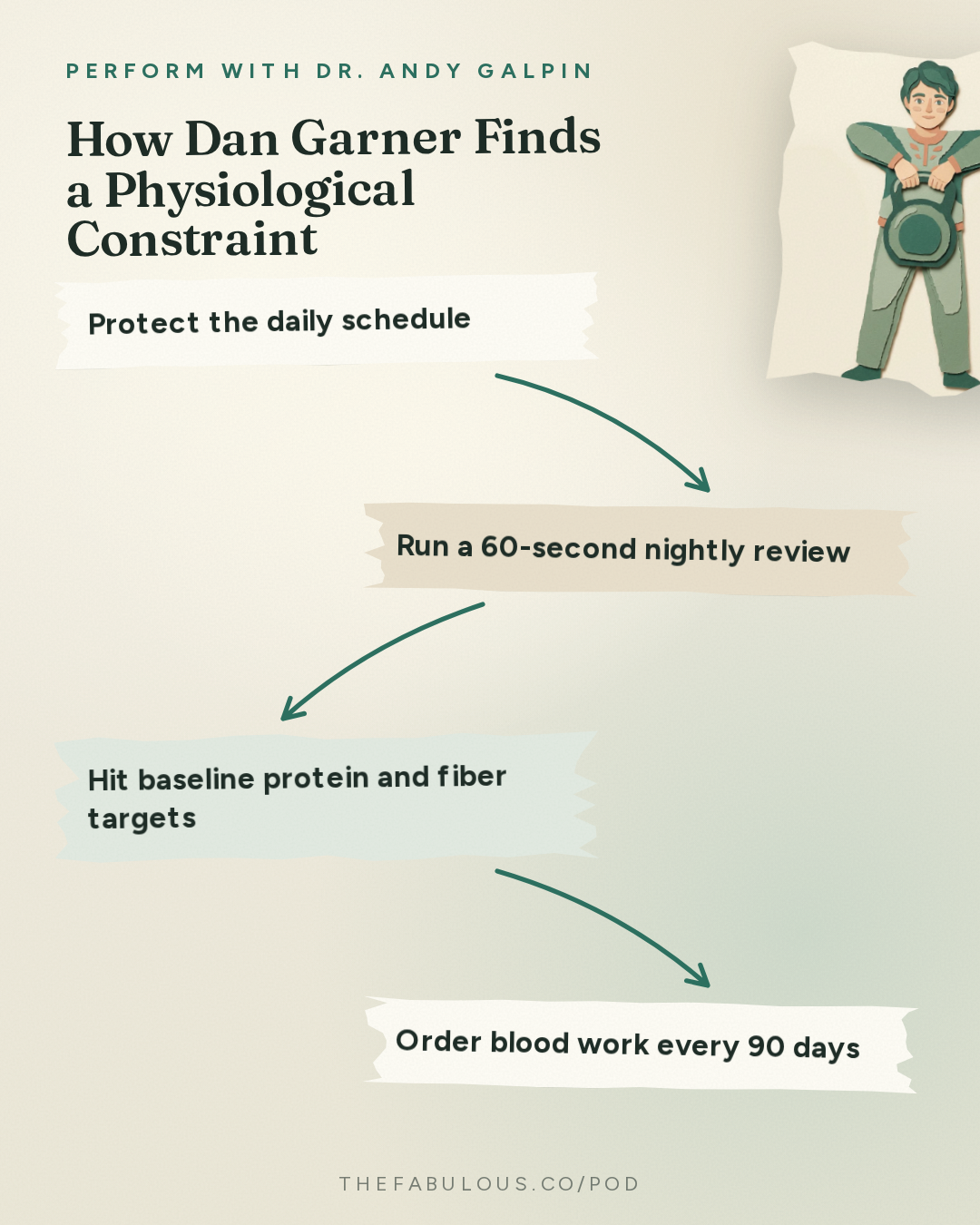
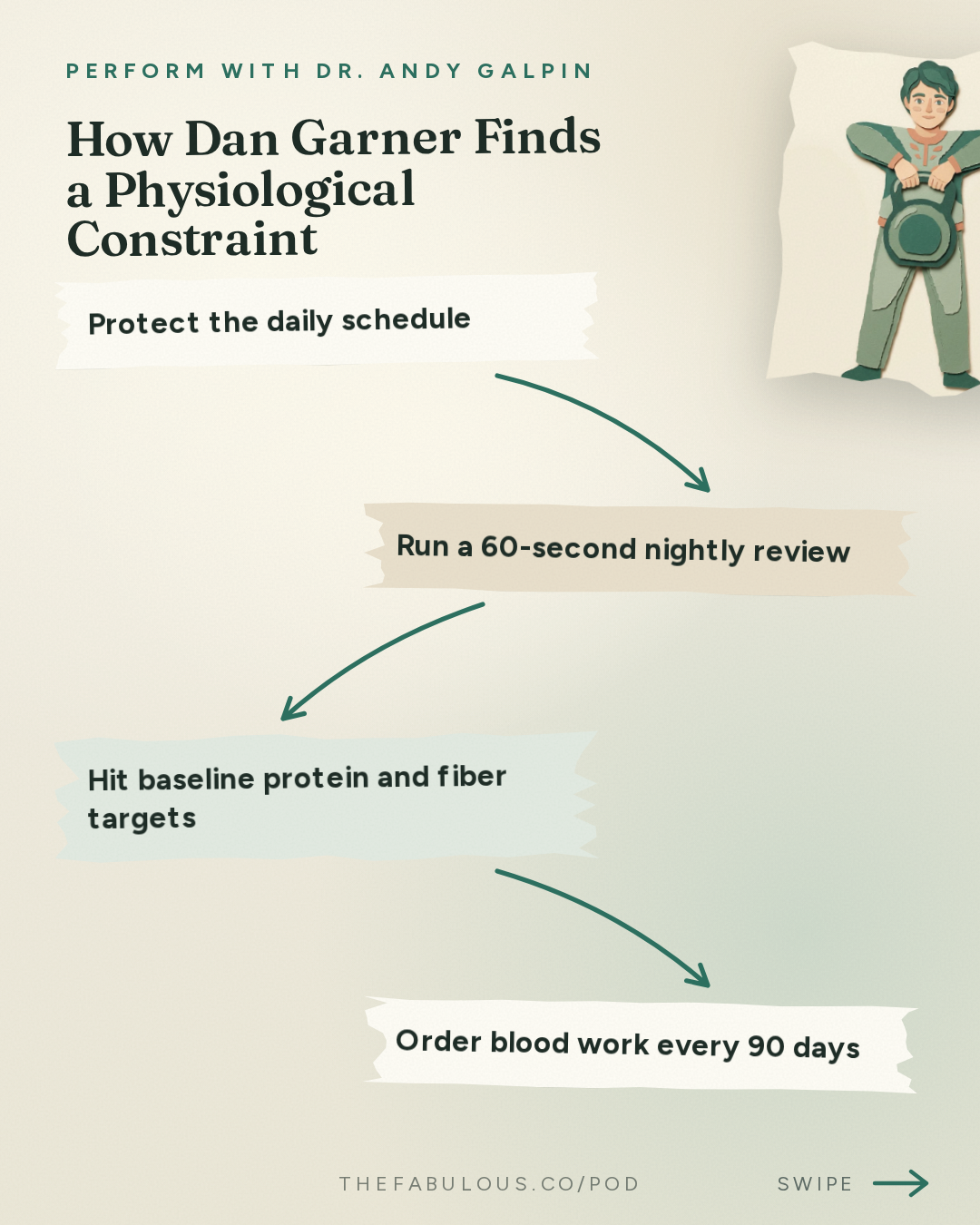
Garner, who has worked with mixed martial artists Sean O'Malley and Ronda Rousey, starts nearly every client relationship the same way, not with a diet plan, but with a look at the calendar. "I think you start with your schedule," he says, arguing that the highest performers he has coached, from CEOs to soldiers, share one habit: a routine they refuse to break (11:39). He teaches a sixty-second nightly review, lying in bed and mentally walking back through the day (13:08), not to punish yourself, but to trace how one bad decision, like hitting snooze, cascades into a missed breakfast, a rushed morning, and a bad lunch choice. The point isn't guilt. It's feedback. "Consistency beats intensity every time, 10 times out of 10," he says.
"Consistency beats intensity every time, 10 times out of 10. You will only ever get results by being consistent in what you do." — Dan Garner [14:52]
This is the setup for Garner's real specialty: reading blood work to find what he calls a person's "constraint," the single bottleneck quietly capping progress, the way a business can only grow as fast as its slowest department (58:14). Sometimes it's a joint issue. Sometimes it's low iron. Often, in his experience, it comes down to three markers people already argue about online: testosterone, vitamin D, and omega-3s (60:08).
The Noise Inside the Numbers
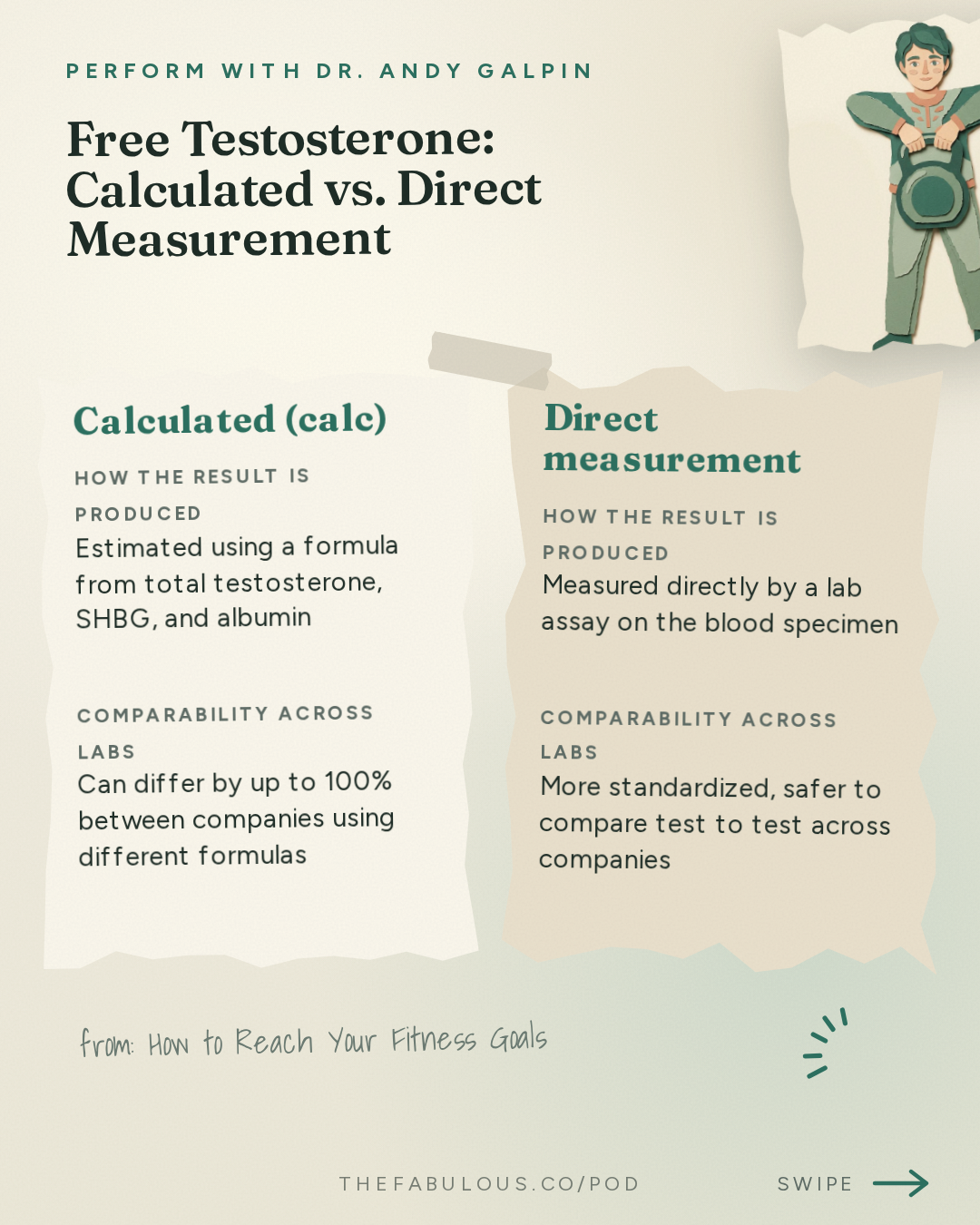
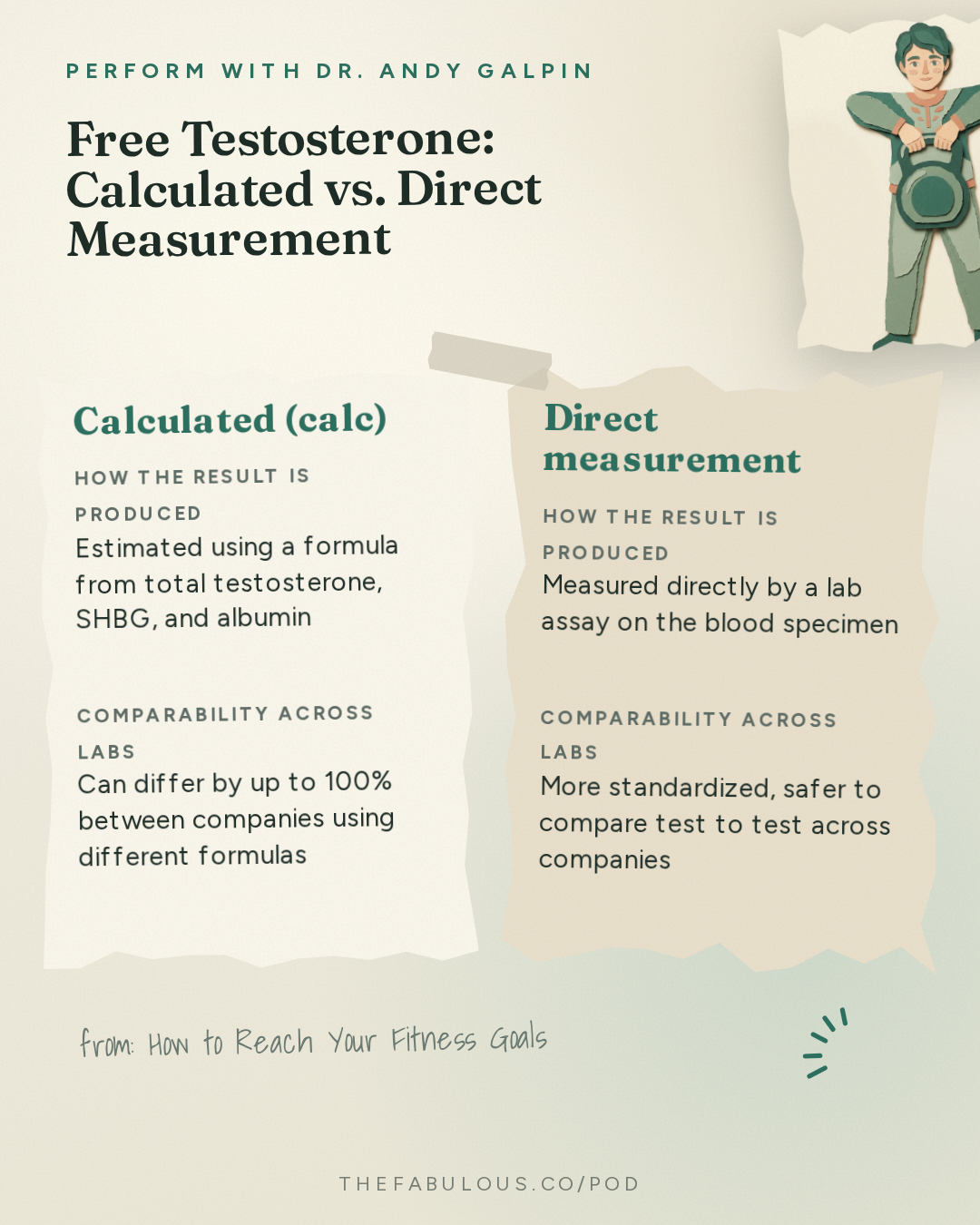
Here is where Garner gets technical, and usefully so. Every lab marker has a natural amount of jitter, called a reference change value, or RCV, the smallest change that counts as real rather than random. Testosterone, he says, has an RCV of 29 percent (63:10). That means if your testosterone reading rises 20 percent after three months of supplements, you haven't necessarily improved anything. You're still inside the noise. Vitamin D is stranger still: researcher Cavalier's 2023 study found it has no established RCV at all, because the marker drifts constantly with the seasons rather than holding steady around a baseline (64:32). The analytical variation alone, meaning the wobble introduced just by the lab machine, was 49 percent (65:00). Omega-3, by contrast, is what Garner calls "the honest clock." Because it's measured inside red blood cells, which live about 120 days, the reading is naturally averaged and stable, with a noise level of just 0.8 percent (66:59). He recommends aiming for an omega-3 index above 8 percent for cardiovascular and cognitive benefits (67:25), achieved with about 3 grams of combined EPA and DHA daily (99:44). A recent survey of 401 NCAA Division 1 athletes found zero of them above that 8 percent threshold (97:20).
Vitamin D carries one more wrinkle: it behaves like what's called an acute phase reactant, meaning inflammation artificially suppresses the reading. Garner says this alone can drop a result by 40 percent, enough to make someone look deficient right after a hard training block even though nothing is actually wrong (109:24). Military data cited by Garner found that vitamin D below 40 ng/mL is linked to as much as a tenfold higher risk of stress fracture (106:54), which is why he treats 40 as a real threshold rather than a lab default. The lesson underneath all three markers is the same: know the noise before you chase the number.
Garner applies the same skepticism to testosterone ranges. He puts the healthy range at 400 to 900 ng/dL for men and 25 to 45 ng/dL for women (71:23), but he's less interested in chasing the top of that range than in catching people who fall below it, usually because of what he calls low energy availability, a state where calorie intake can't cover both daily life and training. Left unchecked, it drops leptin and insulin first, then testosterone and thyroid hormone, in a predictable sequence (76:04). His fix is unglamorous: bring the person back up to maintenance calories, roughly body weight in pounds times 15 as a starting estimate (82:05), for a two week diet break. He says clients often get leaner during the break, not despite eating more, but because glycogen refills, sleep improves, and stress hormones fall (78:58).
Building the Body, One Constraint at a Time
The same constraint logic carries into Garner's training advice. For people chasing muscle purely for how it looks, he favors a rotating split, hitting each muscle group twice every six days rather than locking training to a seven day week (115:17), so a missed session just shifts the whole cycle forward instead of skipping a body part entirely.
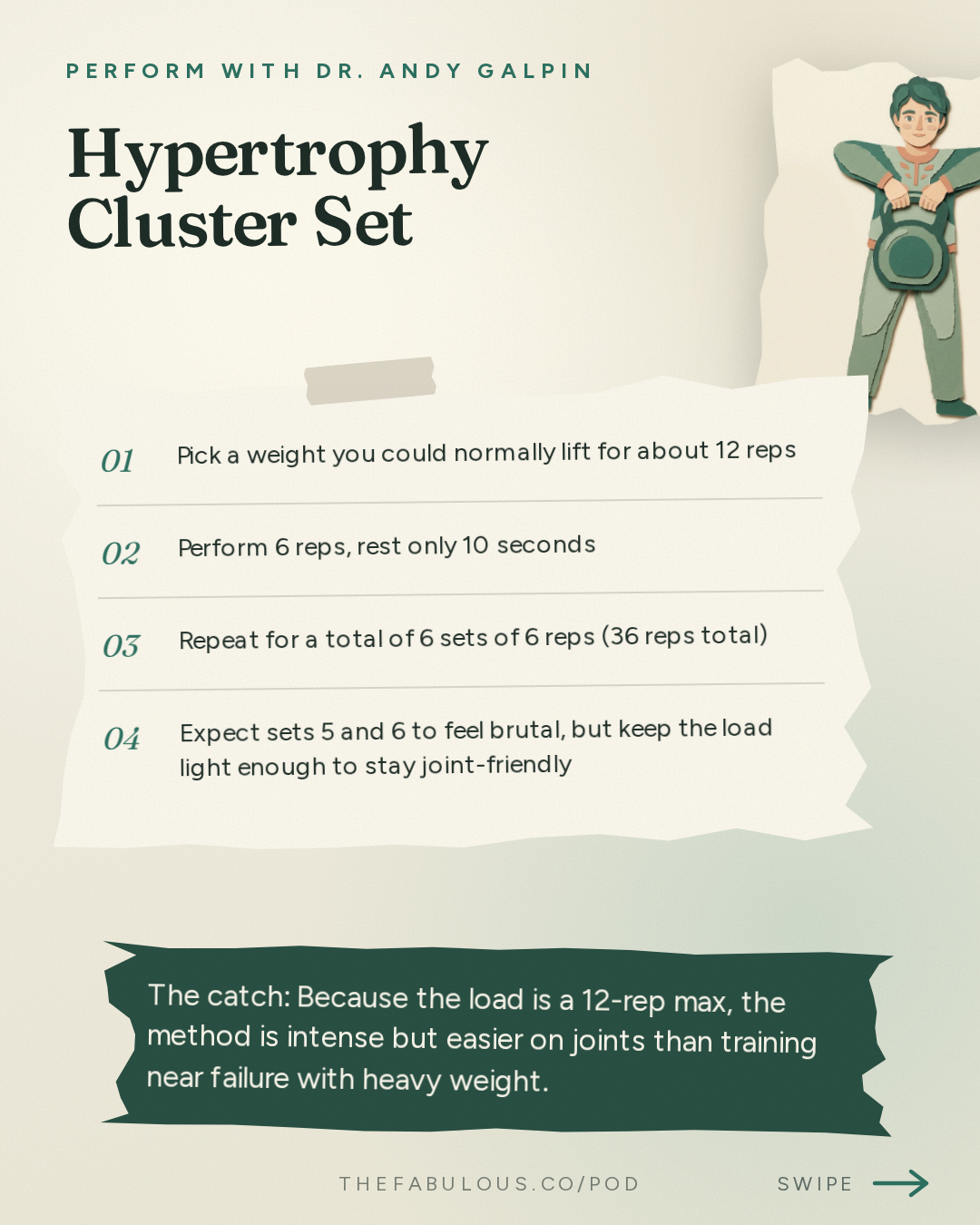
His favorite tool for a stubborn muscle group is what he calls a hypertrophy cluster: choose a weight you could lift about 12 times, then do six sets of six reps with only 10 seconds of rest between sets (140:50). By the end, you've completed 36 total reps with a load your joints can tolerate, an intense but joint-friendly way to force growth. On proximity to failure, he skips the usual debate about counting reps in reserve and gives a simpler rule: stop at "one bad rep," the first rep where form breaks down (145:47).
Garner is just as clear-eyed, and more cautious, about supplements and peptides. Caffeine, he says, helps almost every performance metric, but he tells clients to go easy on it before leg day, because high doses raise heart rate enough to inflate perceived effort and cause central fatigue before the legs themselves are actually tired (151:25). Creatine, despite showing up in pre-workout formulas, isn't a pre-workout ingredient at all. Its benefit comes from weeks of muscle saturation, not from timing it before a lift (153:57).
He's most guarded about peptides marketed on mechanism alone. SS-31, for instance, has real human clinical data and a clear mechanism, stabilizing a molecule called cardiolipin inside mitochondria, but that data comes from patients with a rare genetic mitochondrial disease, not healthy athletes chasing endurance. "We have human clinical data, we have a known mechanism," Garner says, "and we have a thing that's really sexy to talk about with absolutely zero performance data outputs from it" (168:10).
"One of the scariest things in this industry is a charismatic mechanism guy." — Dan Garner [168:53]
He's more optimistic, cautiously, about the newer weight loss drug Retatrutide, which adds a third hormone pathway (glucagon) on top of the appetite suppression mechanisms used by Ozempic and Tirzepatide, and which has shown liver fat reductions of up to 83 percent in human trials (177:19). But even there, his advice is the same as it is everywhere else in the conversation: measure what you can, admit what you can't, and don't expect a compound to replace the fundamentals.
"You can't out peptide a bad diet. You're never gonna cheat physiology. Physiology gives away no free lunches." — Dan Garner [174:55]
What makes Garner's approach hold together isn't any single number. It's the discipline of treating every marker, every training program, every supplement as a hypothesis to be tested against a person's actual life, not a verdict to be accepted on faith. The schedule you protect, the questions you ask a client instead of "how's it going," the two week break you're afraid to suggest because the client will panic, all of it is the same instinct: adherence first, mechanism second, and never mistake a noisy numbers for a fact.
Ask this episode anything
Pod's AI answers from the episode itself, with the minute mark so you can hear it yourself.
Or start with one of these
Ask this episode
Pod's AI listens to the whole episode to answer, and points you to the minute it comes from.
The rest of this answer, and any question after it
Answers come from the episode itself, never from a summary of it.
ContinueKey takeaways
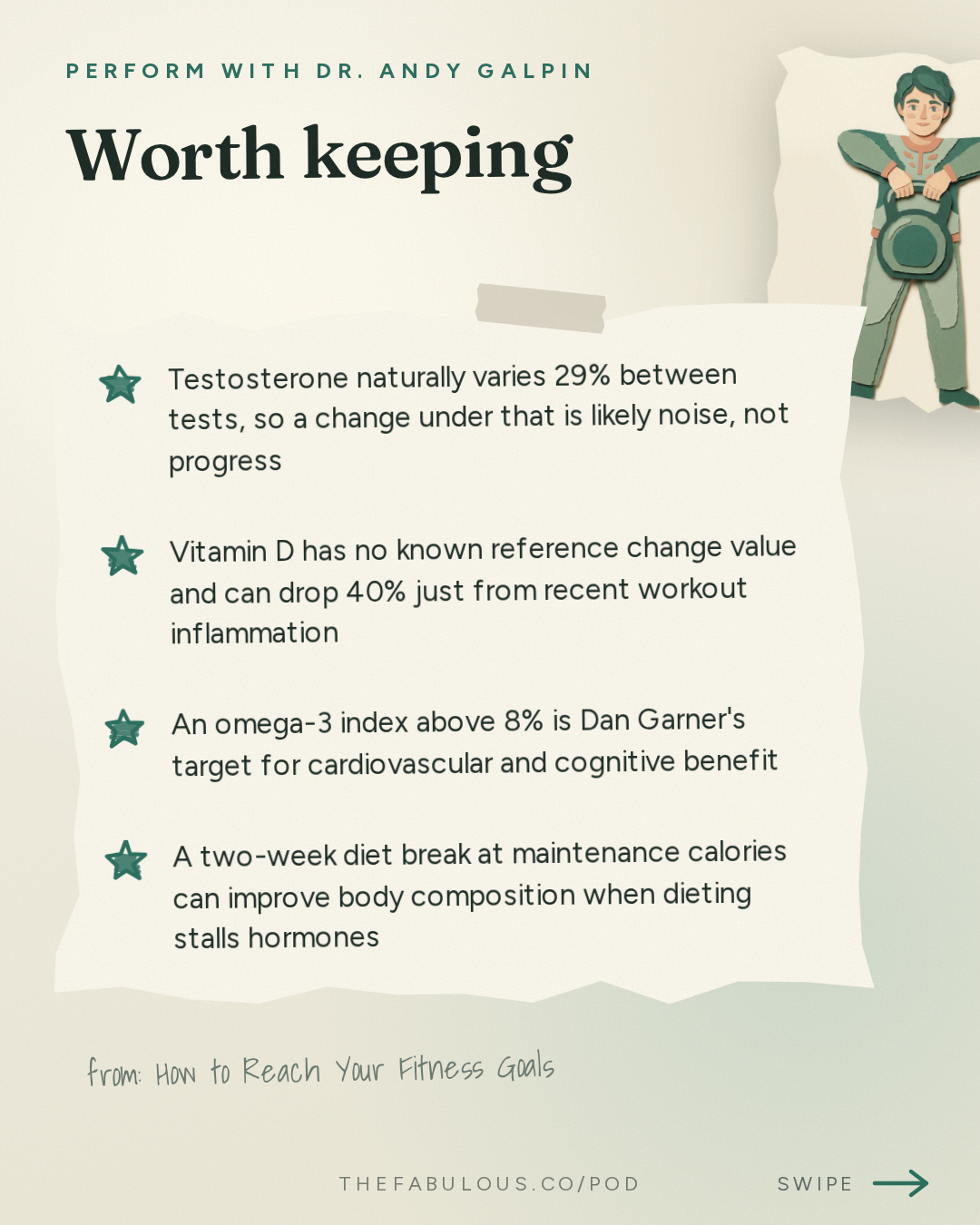
- Testosterone naturally varies 29% between tests, so a change under that is likely noise, not progress
- Vitamin D has no known reference change value and can drop 40% just from recent workout inflammation
- An omega-3 index above 8% is Dan Garner's target for cardiovascular and cognitive benefit
- A two-week diet break at maintenance calories can improve body composition when dieting stalls hormones
- Hypertrophy clusters (six sets of six reps with 10-second rests) build muscle with joint-friendly loads
The episode in cards


By the numbers
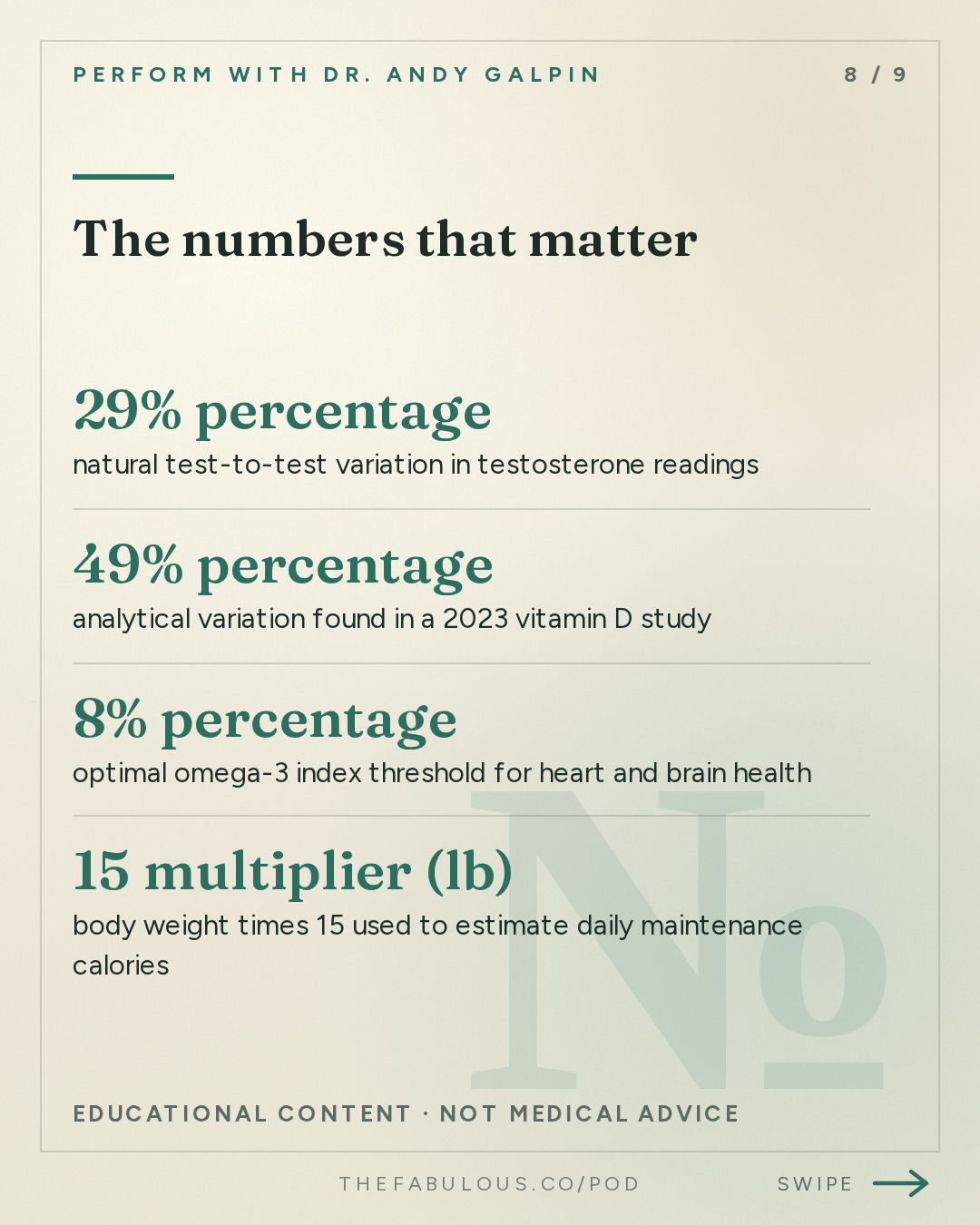
- 29% percentage natural test-to-test variation in testosterone readings
- 49% percentage analytical variation found in a 2023 vitamin D study
- 8% percentage optimal omega-3 index threshold for heart and brain health
- 15 multiplier (lb) body weight times 15 used to estimate daily maintenance calories
- 40 ng/mL vitamin D level below which stress fracture risk rises sharply
- 83% percentage liver fat reduction seen with Retatrutide in human data
In their words
“Consistency beats intensity every time, 10 times out of 10. You will only ever get results by being consistent in what you do”
“The hardest worker in the room is never the one who gets the most results. It's only the person who's able to allocate that hard work into the most intelligent areas.”
“You can't out hormone a bad diet. You're never gonna cheat physiology. Physiology gives away no free lunches”
“One of the scariest things in this industry is a charismatic mechanism guy.”
Protocols
-
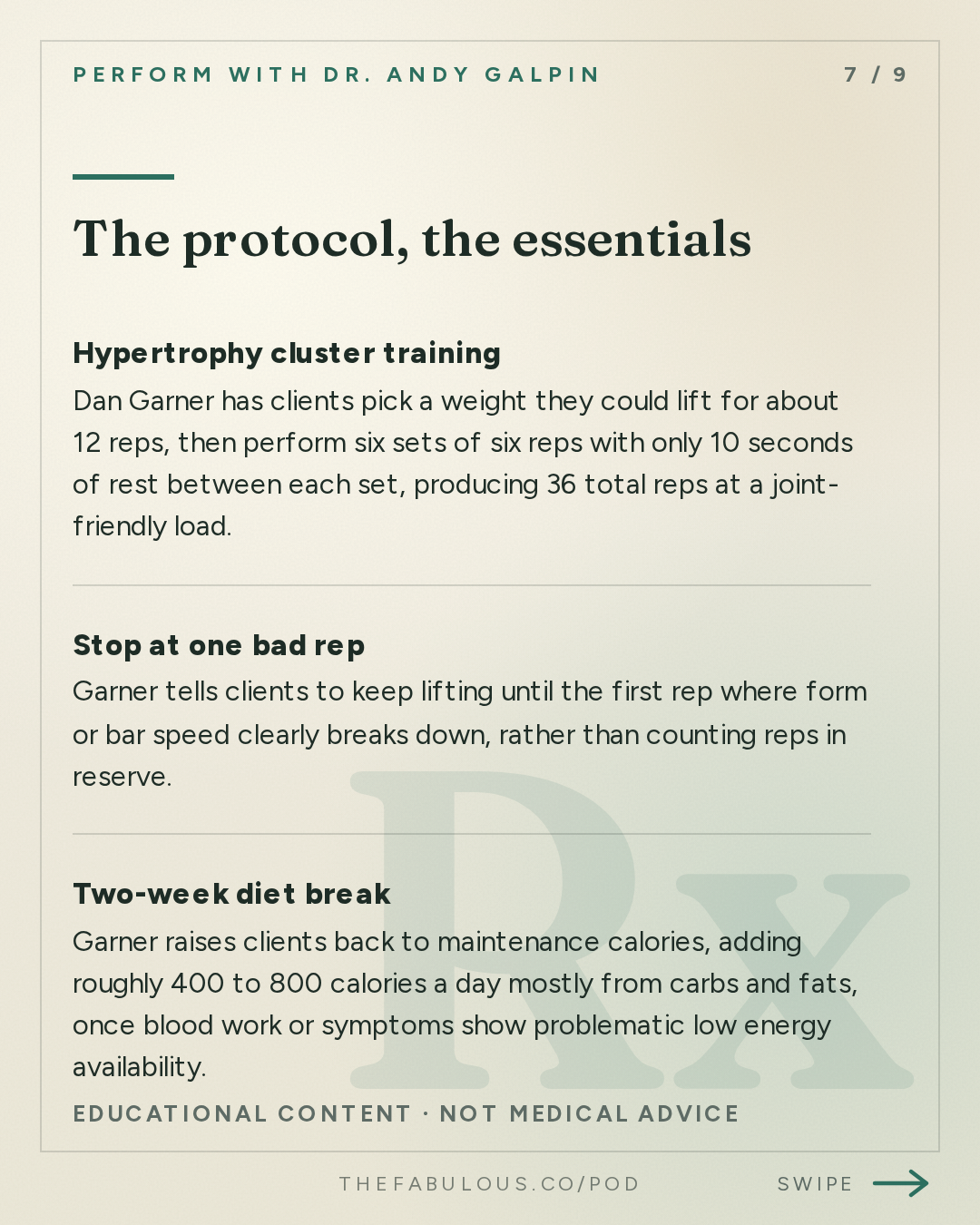
Hypertrophy cluster training
Dan Garner has clients pick a weight they could lift for about 12 reps, then perform six sets of six reps with only 10 seconds of rest between each set, producing 36 total reps at a joint-friendly load.
Once per targeted muscle group, per training session
-
Stop at one bad rep
Garner tells clients to keep lifting until the first rep where form or bar speed clearly breaks down, rather than counting reps in reserve.
Every hypertrophy set
-
Two-week diet break
Garner raises clients back to maintenance calories, adding roughly 400 to 800 calories a day mostly from carbs and fats, once blood work or symptoms show problematic low energy availability.
For two weeks, inserted partway through a longer diet
-
Estimating maintenance calories
Garner starts clients at body weight in pounds multiplied by 15 to estimate daily maintenance calories, then adjusts the number weekly based on real results.
Recalculated and adjusted weekly
-
Ease off caffeine before leg day
Garner has clients reduce caffeine before lower-body training because high doses raise heart rate and perceived effort enough to cause central fatigue before the leg muscles actually tire.
Before lower-body training sessions
Questions this episode answers
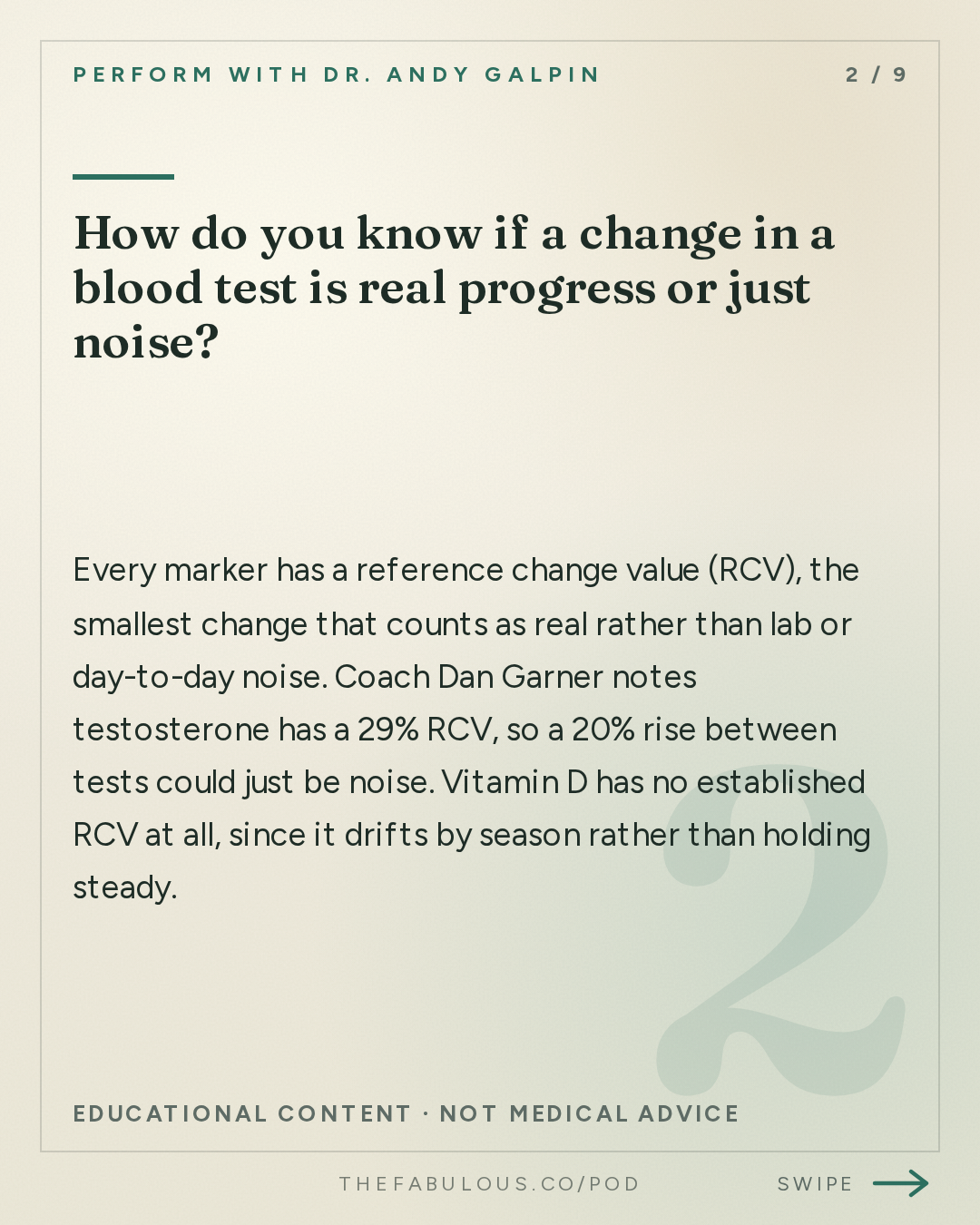
How do you know if a change in a blood test is real progress or just noise?
Every marker has a reference change value (RCV), the smallest change that counts as real rather than lab or day-to-day noise. Coach Dan Garner notes testosterone has a 29% RCV, so a 20% rise between tests could just be noise (63:10). Vitamin D has no established RCV at all, since it drifts by season rather than holding steady (64:32).
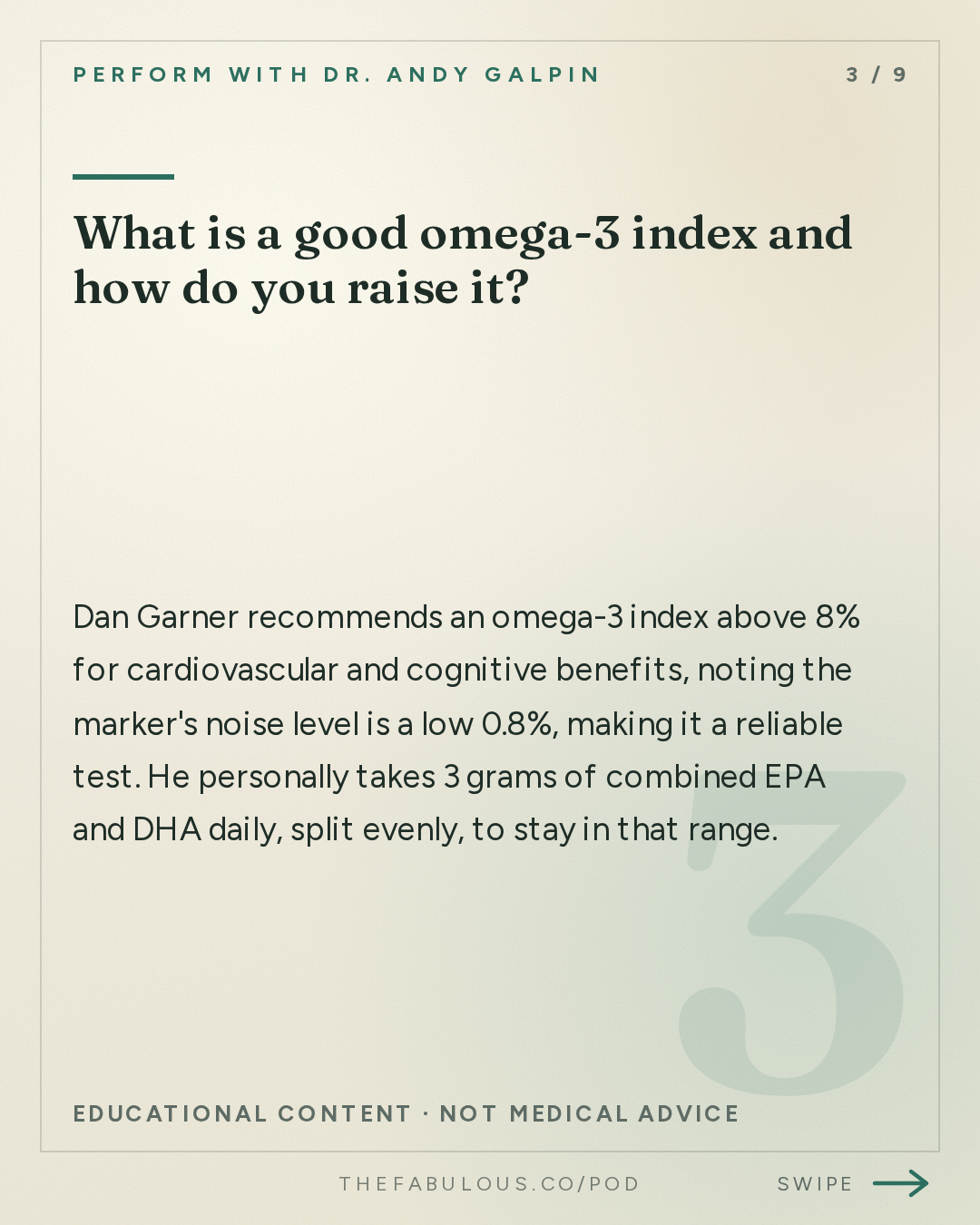
What is a good omega-3 index and how do you raise it?
Dan Garner recommends an omega-3 index above 8% for cardiovascular and cognitive benefits, noting the marker's noise level is a low 0.8%, making it a reliable test (67:25). He personally takes 3 grams of combined EPA and DHA daily, split evenly, to stay in that range (99:44).
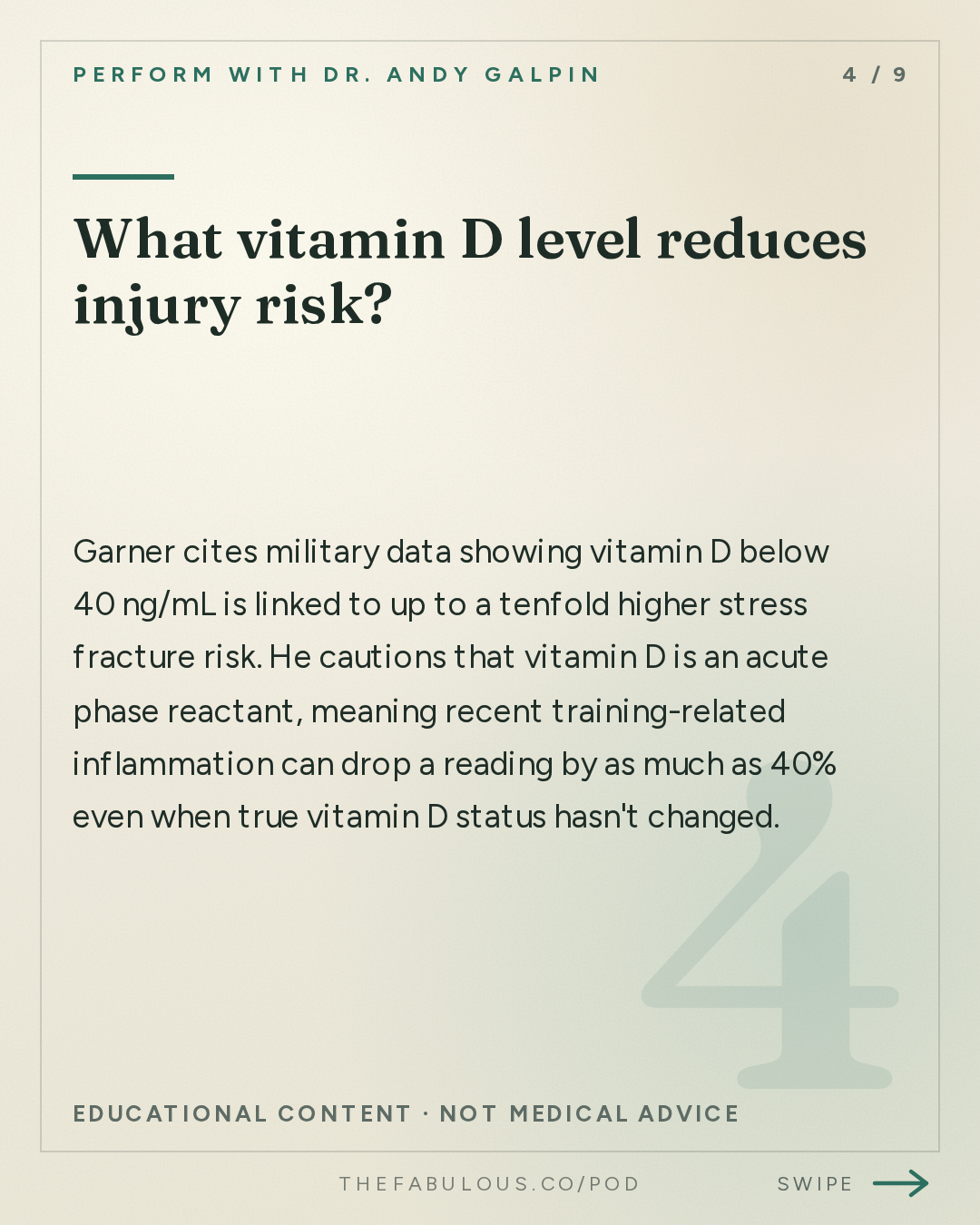
What vitamin D level reduces injury risk?
Garner cites military data showing vitamin D below 40 ng/mL is linked to up to a tenfold higher stress fracture risk (106:54). He cautions that vitamin D is an acute phase reactant, meaning recent training-related inflammation can drop a reading by as much as 40% even when true vitamin D status hasn't changed (109:24).
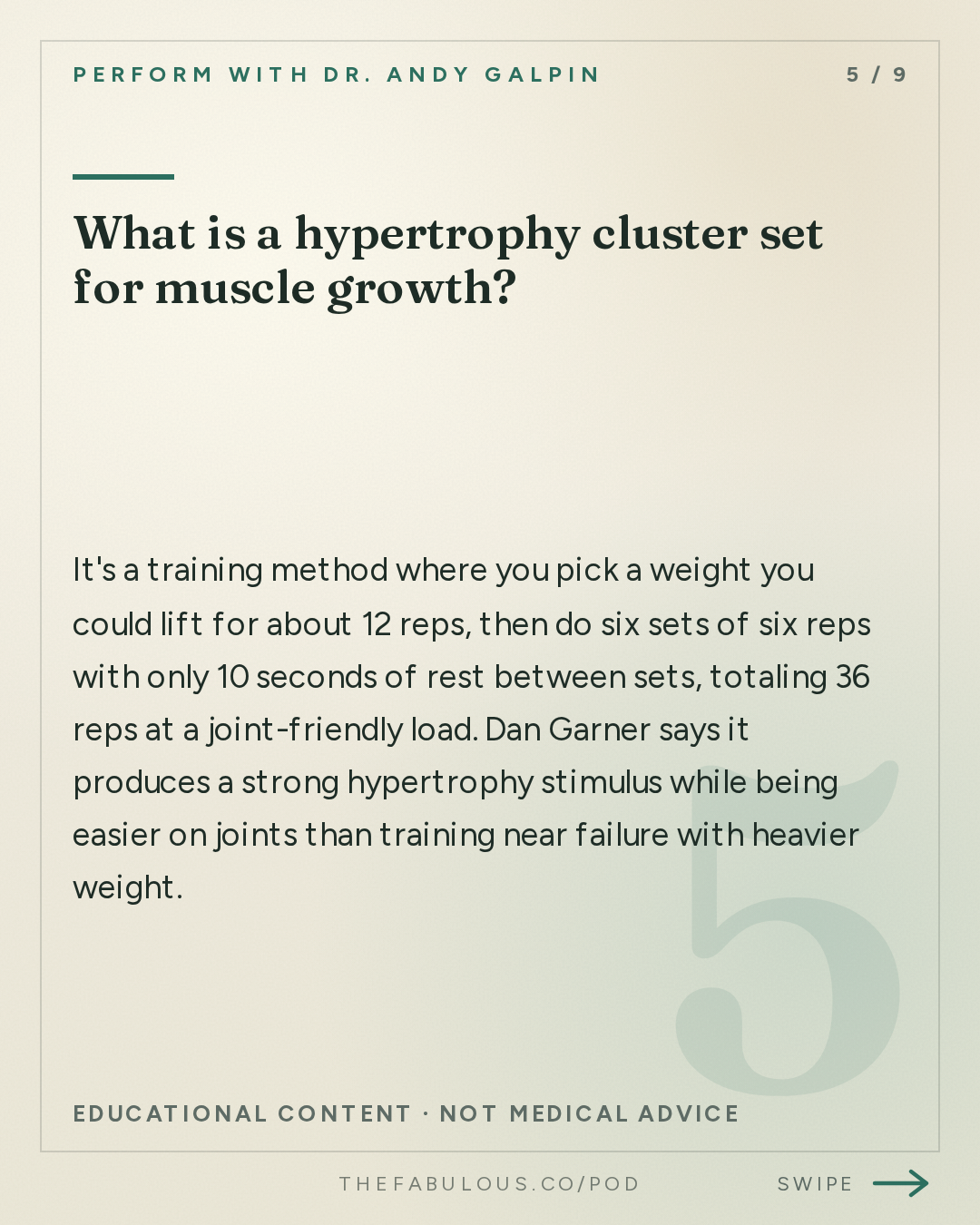
What is a hypertrophy cluster set for muscle growth?
It's a training method where you pick a weight you could lift for about 12 reps, then do six sets of six reps with only 10 seconds of rest between sets, totaling 36 reps at a joint-friendly load. Dan Garner says it produces a strong hypertrophy stimulus while being easier on joints than training near failure with heavier weight (140:50).
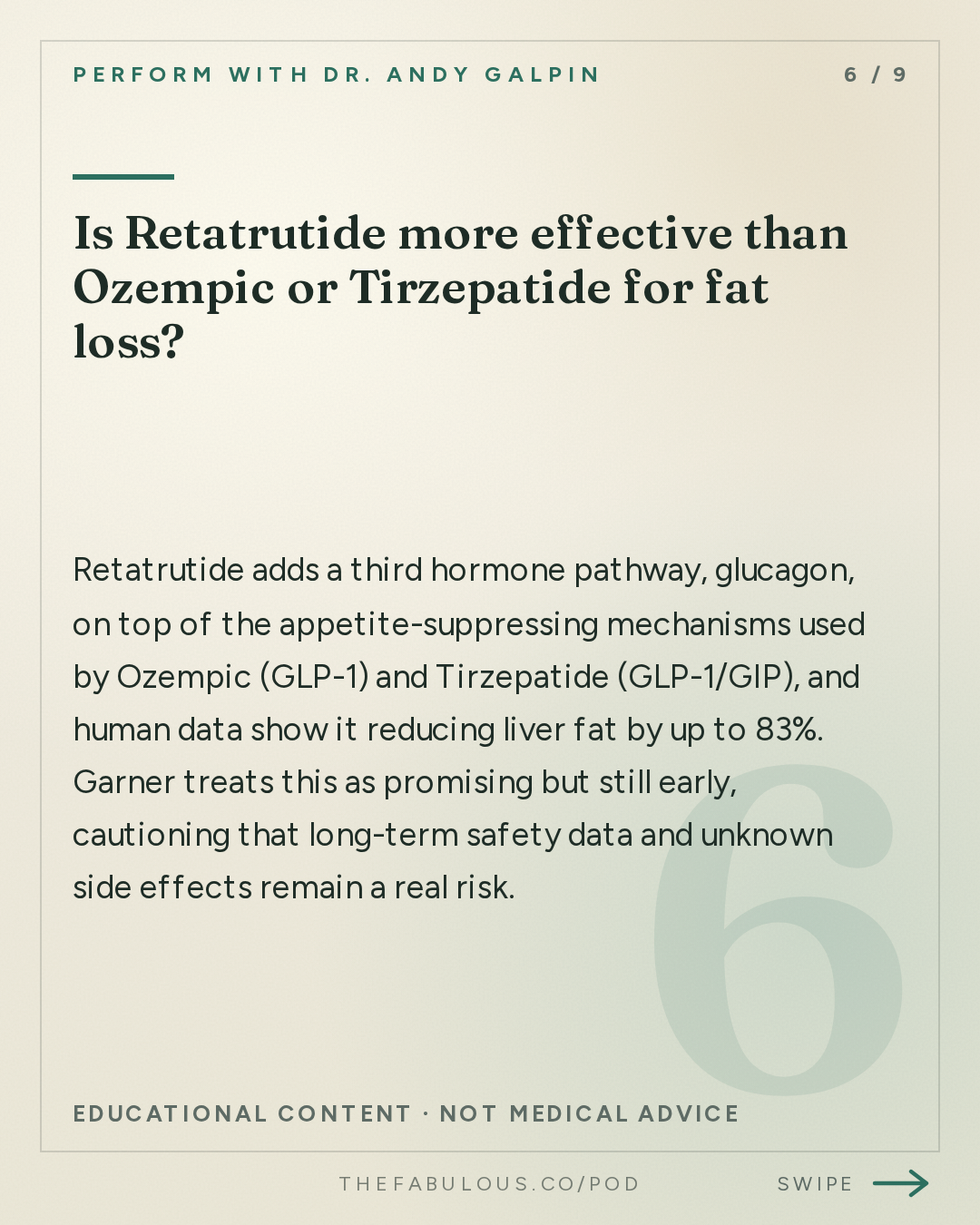
Is Retatrutide more effective than Ozempic or Tirzepatide for fat loss?
Retatrutide adds a third hormone pathway, glucagon, on top of the appetite-suppressing mechanisms used by Ozempic (GLP-1) and Tirzepatide (GLP-1/GIP), and human data show it reducing liver fat by up to 83% (177:19). Garner treats this as promising but still early, cautioning that long-term safety data and unknown side effects remain a real risk (178:35).
The full read, in cards
Go deeper
- Cavalier et al., 2023 vitamin D reference change value study — Found no established reference change value for vitamin D and an analytical variation of 49%
- NCAA Division 1 omega-3 index survey — Tested 401 college athletes and found none above the 8% optimal omega-3 index threshold
- Military vitamin D and stress fracture data — Linked vitamin D below 40 ng/mL to up to a tenfold higher stress fracture risk
Mentioned
Dan Garner · Andy Galpin · Ronda Rousey · Sean O'Malley · Ben House · Brett Contreras · Vitality · SS-31 · MOTS-c · Retatrutide
More from this show and category

Testosterone, Age, and Metabolic Health Explained
Testosterone does not fall because someone gets older; Dr. Andy Galpin says the data show obesity and metabolic dysfunction, not age itself, drive almost all of the decline. Men who hit five basic metabolic health markers have under a 1% chance of low testosterone (34:38), while obesity alone raises the risk roughly 7.5-fold (33:18).

Testosterone Explained: Low T, TRT, and Muscle Myths
Low testosterone is usually a symptom, not the disease itself: obesity, poor sleep, extreme dieting, or a blocked vein cause most cases, not age alone (76:08, 95:06). Two PhDs argue for finding the cause before reaching for a syringe, and for treating any hormone therapy with real informed consent.

Dr. John Rusin's 6-Phase Dynamic Warmup Explained
Physical therapist and performance coach Dr. John Rusin lays out a diagnostic and warmup system for training around chronic pain without surgery or years off. His six-phase, 10 to 12 minute daily sequence (24:02) turns soft tissue work, stretching, and activation drills into deliberate, measurable steps rather than vague pre-workout ritual.

Andy Galpin's Nutrition and Hydration Fundamentals
Andy Galpin argues nutrition science mostly agrees: eat whole foods, manage calories, hit protein and fiber targets, and hydrate by formula. The rest, like meal timing or keto versus low-fat, is personal preference layered on the same ten to fifteen fundamentals (03:50, 11:48, 32:37).
