
Andy Galpin's Nutrition and Hydration Fundamentals
The Fundamentals of Nutrition, Hydration & Performance Fueling
▶ Listen to the full episode More from Perform with Dr. Andy Galpin
The brief
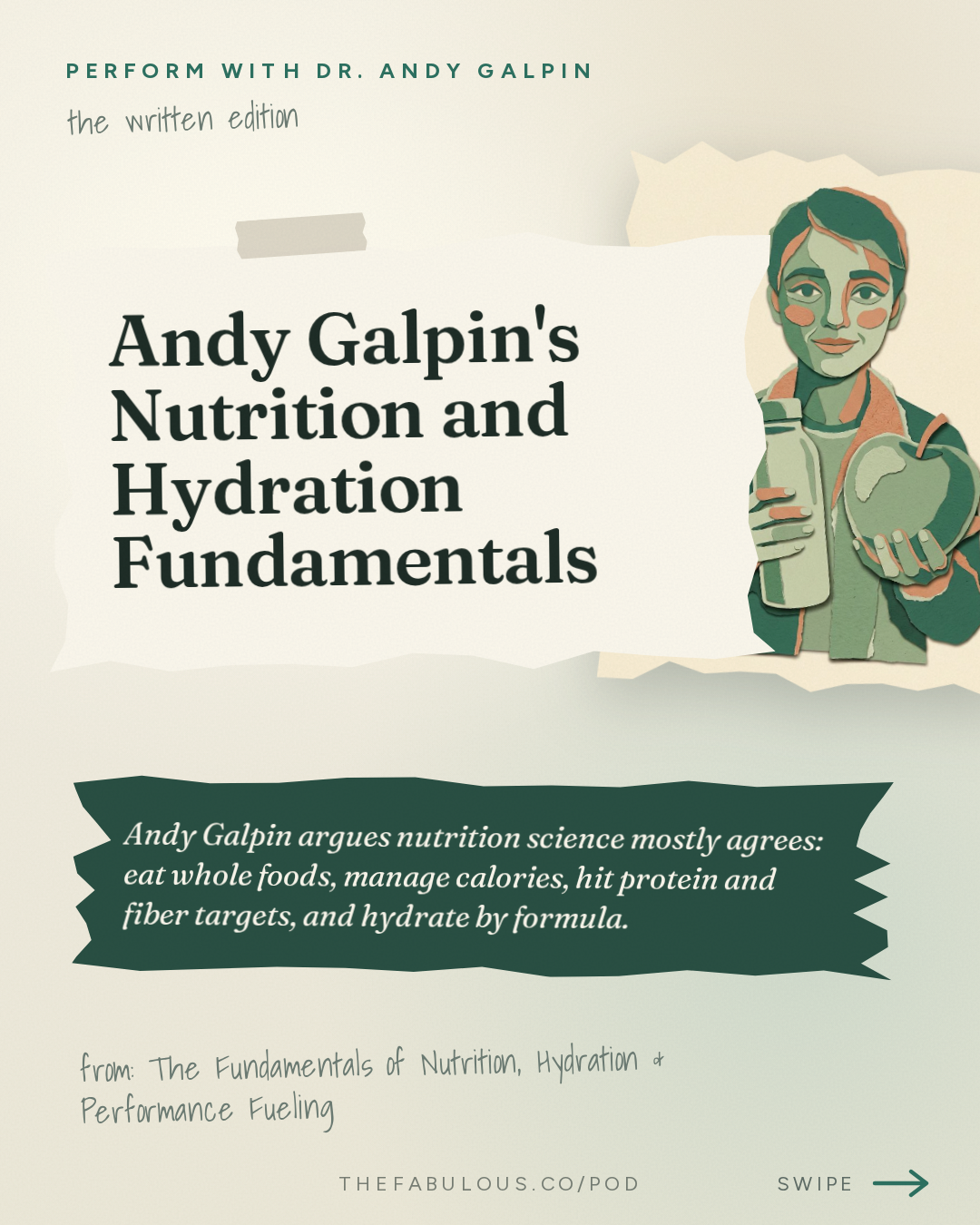
Andy Galpin argues nutrition science mostly agrees: eat whole foods, manage calories, hit protein and fiber targets, and hydrate by formula. The rest, like meal timing or keto versus low-fat, is personal preference layered on the same ten to fifteen fundamentals (03:50, 11:48, 32:37).
Ask ten nutrition coaches for the single correct diet and you will get ten different answers, delivered with the same certainty. Human performance scientist Andy Galpin, who hosts the podcast Perform, thinks this is a trick of framing. Zoom out far enough, he says, and the ten answers turn out to share the same skeleton. Different diets are just different costumes on the same body.
Galpin calls this shared skeleton "the 90%." It is his answer to the most common question he gets: just tell me the basics. Rather than picking a side in the keto-versus-Mediterranean-versus-intermittent-fasting debate, he lists the ten to fifteen things that every evidence-based eating style is quietly doing, no matter what it calls itself.
"The 90%, to me, is a way of saying, look, if you were to examine every nutrition program, every theme, every diet, every eating style, you'll start to realize there's a bunch of common themes." — Andy Galpin [03:50]
The list starts predictably: eat mostly single-ingredient, minimally processed food, and manage caloric balance, whether through counting, time-restricted eating, or cutting a food group (05:41, 08:48). It gets more specific from there. Galpin's rough rule for fiber is 13 to 15 grams for every 1,000 calories eaten, so a 2,000-calorie diet should carry roughly 25 to 30 grams (11:48). Non-starchy vegetables, the greens and colors rather than the potatoes and rice, should fill about half the physical volume of a plate (12:18). And protein deserves special attention not because it is more important than fat or carbohydrate, but because it is the macronutrient people accidentally skip.
One detail resists the tidy narrative that whole food is always better raw. Cooking spinach denatures it, which makes its iron easier to absorb, while cooking, blending, or chopping any vegetable exposes it to oxygen and burns off some antioxidants (15:10, 15:34). Galpin's answer is not a verdict but a shrug: use a mix of raw and cooked, because each method trades one nutrient for another.
The arithmetic of muscle
The most counterintuitive number in the episode is not about food quality at all. It is about the cost of tissue. Most people, if asked to guess, know that losing a pound of fat takes roughly 3,500 calories of deficit (49:29). Almost nobody knows the inverse: building a pound of new muscle costs only about 1,800 calories, a figure Galpin credits to sports scientist Eric Helms and researcher Ben House (51:07).
The gap between those numbers explains something bigger. A pound of stored body fat holds about 4,000 calories of usable energy. A pound of muscle holds only about 800, roughly a fifth as much (51:36). Fat is a cheap, efficient battery. Muscle is an expensive, high-maintenance factory that burns through protein and ATP daily just to stay in business, and gives almost nothing back if you break it down. That mismatch, Galpin argues, is exactly why muscle is hard to build and easy to lose, while fat is the reverse.
"Muscle is not a storage depot for calories, but fat truly is." — Andy Galpin [51:36]
This is also why protein needs shift depending on the goal. Galpin's baseline for muscle growth is 1.6 grams of protein per kilogram of body weight, a threshold beyond which extra protein stops adding much extra growth (53:02). He personally coaches people toward roughly 2.2 grams per kilogram, the equivalent of one gram per pound, not because the data demand it but because it helps with satiety and recovery, a distinction he frames as the difference between what the evidence "is" and what he thinks someone "ought" to do (53:56). In a caloric deficit, though, the number climbs again: protecting muscle while eating less may require closer to 3 grams per kilogram (55:58).
None of that protein matters as much as one other variable. Citing exercise physiologist Stu Phillips, Galpin is blunt that strength training, not protein intake, is the largest single driver of muscle growth, in surplus or deficit (58:13). Calories come second. Protein is the tiebreaker that matters most once someone is already lean and already training hard.
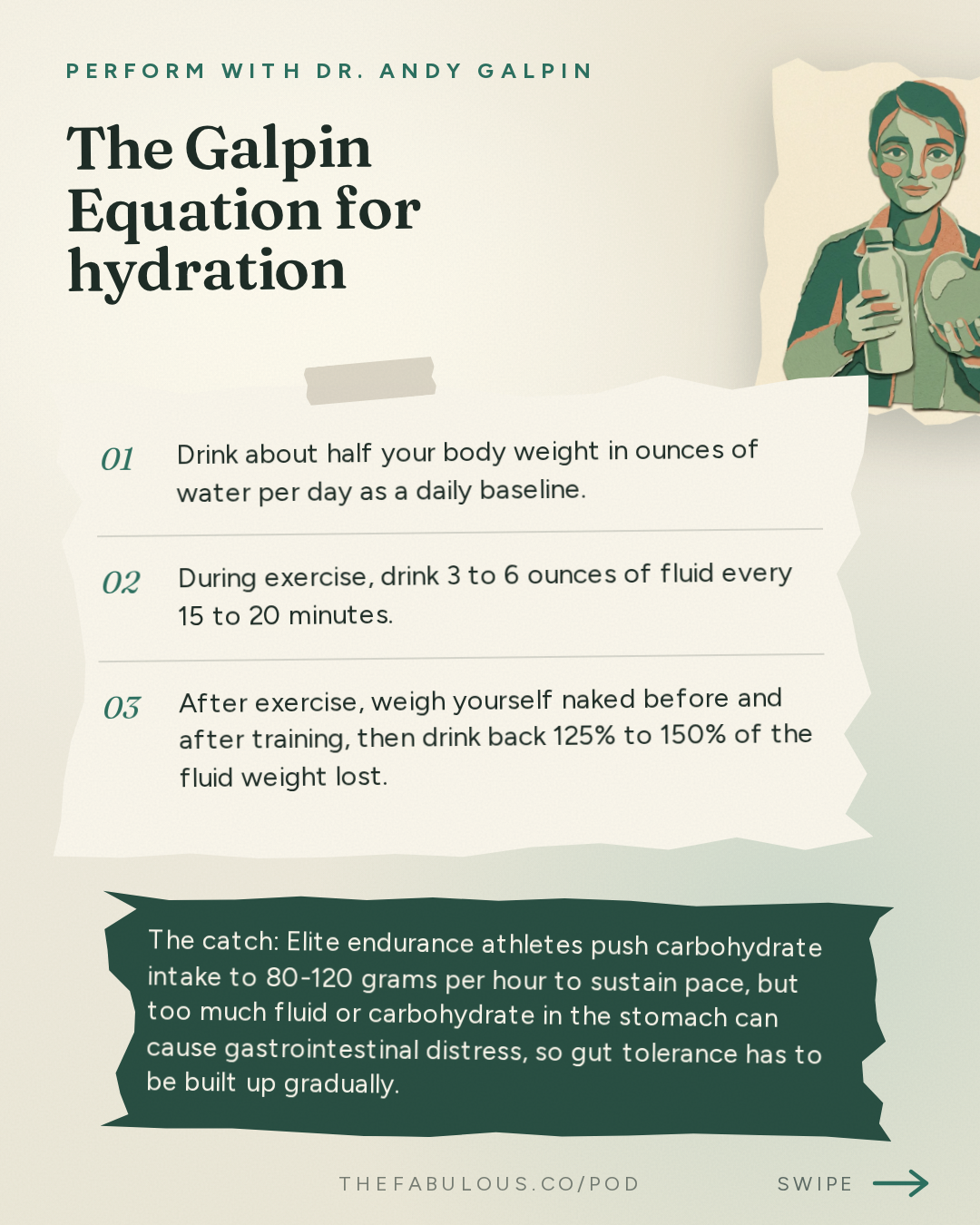
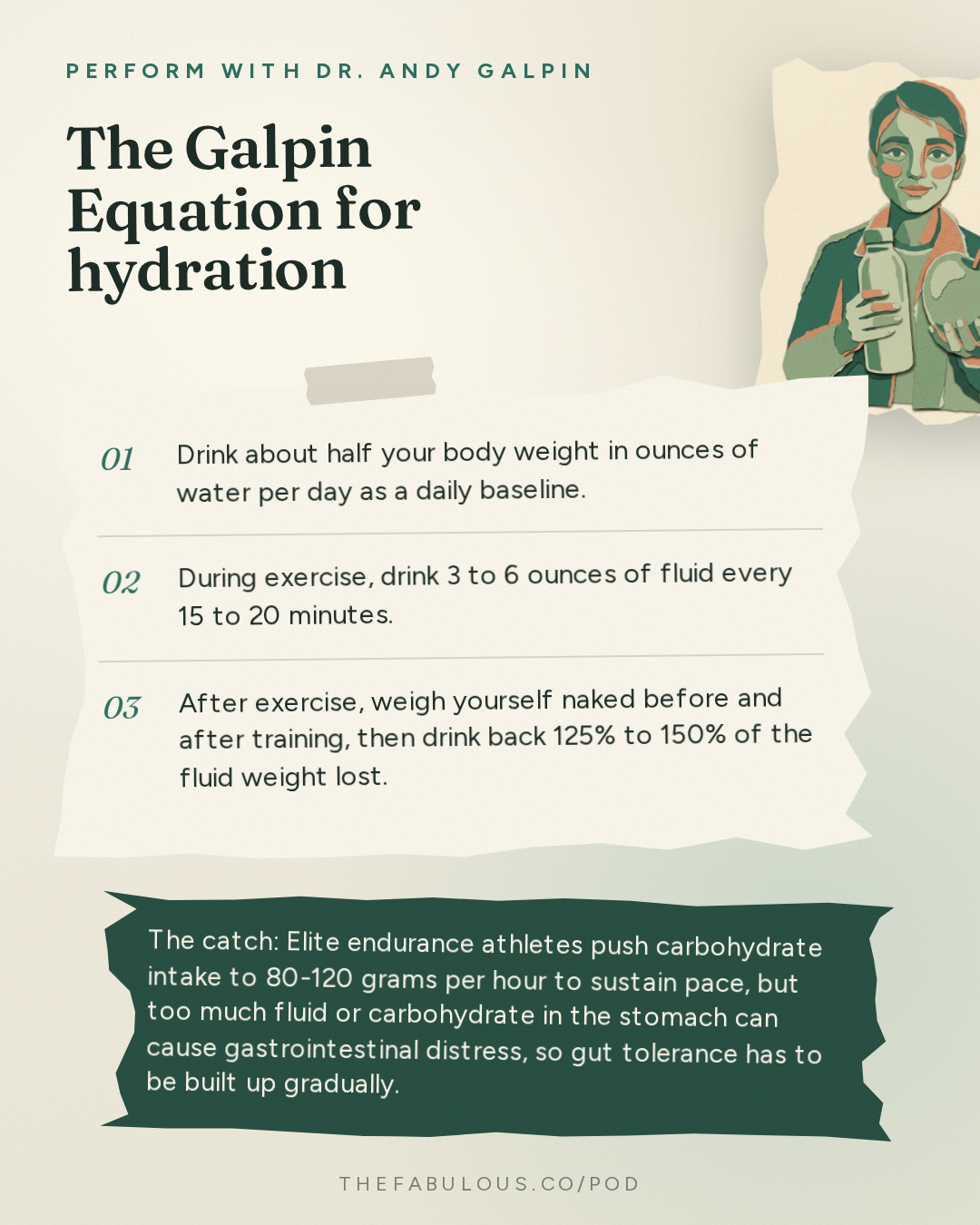
Fueling during exercise follows a similar logic of diminishing returns. Most casual exercisers, doing 30 to 45 minutes of moderate work, do not need to eat carbohydrate during a session, because there is usually enough glucose already circulating (24:38). But elite endurance athletes chasing a finish line have pushed intra-workout carbohydrate intake to 80 grams an hour, with some reportedly near 120 grams (35:42). Galpin's caveat is practical rather than physiological: that much sugar and fluid sloshing in the stomach can cause real gastrointestinal distress, so the gut has to be trained gradually, the same way a muscle would be (36:05, 37:03).
There is a second, less obvious reason carbohydrate matters for muscle. Glucose is not just fuel for the workout. Galpin describes muscle as a "donor of carbon," meaning some of the sugar eaten gets stripped of its water molecules and its carbon is stored directly inside muscle tissue as building material, not just burned for energy (25:53, 28:00). That is part of why more muscle mass improves blood sugar regulation over time: bigger muscles act as a bigger sink for glucose. Timing, however, barely matters. Research from Galpin's own lab and others suggests that as long as total protein intake over 24 hours is adequate, it does not matter whether it arrives before or after a workout (30:07).
A formula for water, and a philosophy for coaching
Hydration gets the same treatment: strip away the mysticism, replace it with a formula. Galpin's baseline, a daily habit rather than a workout rule, is to drink about half of body weight in ounces of water per day, so a 200-pound person aims for roughly 100 ounces (32:10). During exercise, the rule his colleague, Stanford neuroscientist Andrew Huberman, nicknamed the "Galpin Equation" calls for 3 to 6 ounces of fluid every 15 to 20 minutes (32:37). After the workout, the target is to replace 125 to 150 percent of whatever body weight was lost in fluid, measured with a naked weigh-in before and after, because people left to their own devices tend to drink back only about half of what they sweated out (33:25, 34:25).
The most quietly radical part of the episode is not a number at all. It is Galpin's coaching sequence for changing someone's diet, which begins by adding, not subtracting.
"I will very rarely start someone's nutrition program by eliminating foods or restricting calories. Almost always it's the opposite." — Andy Galpin [40:01]
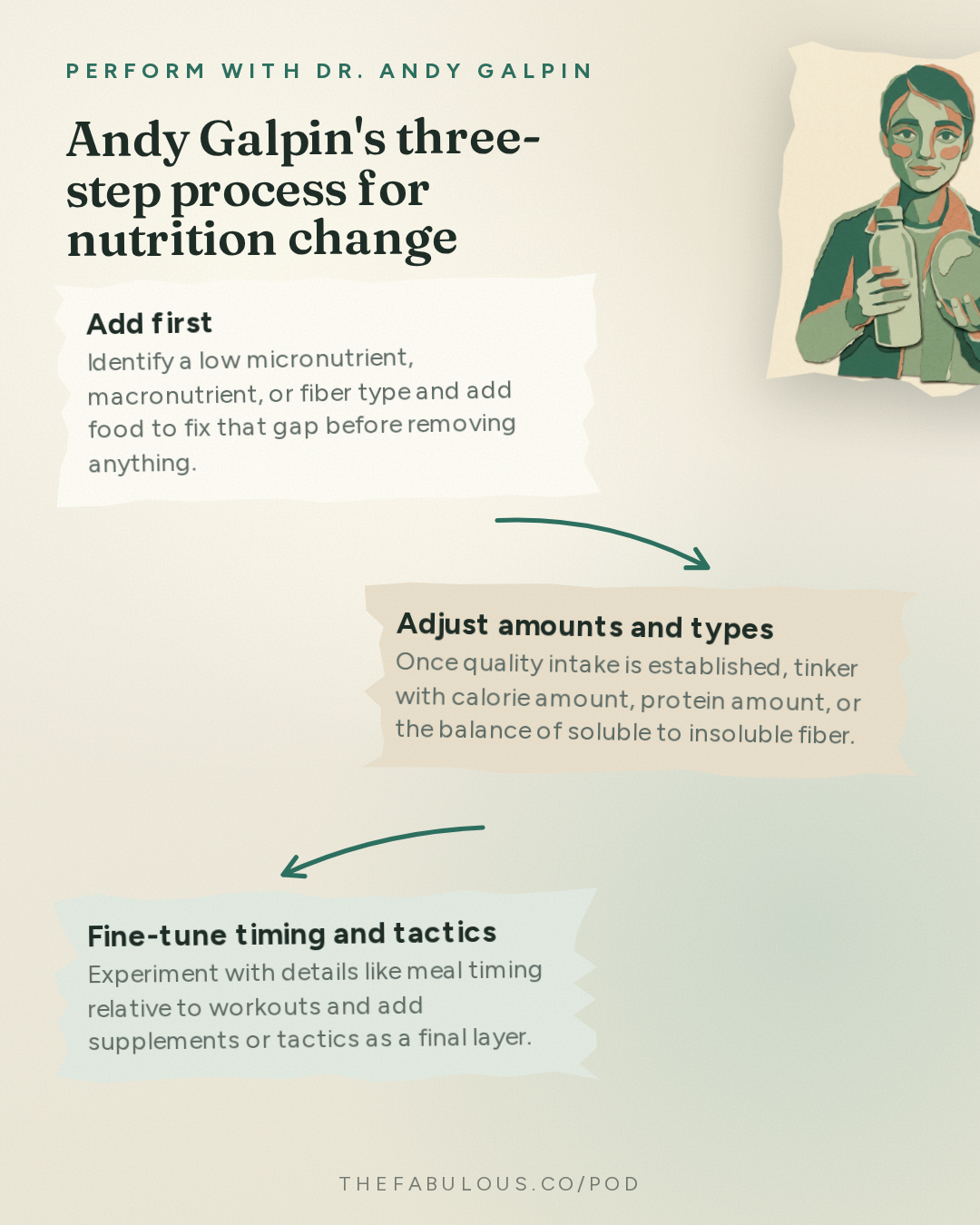
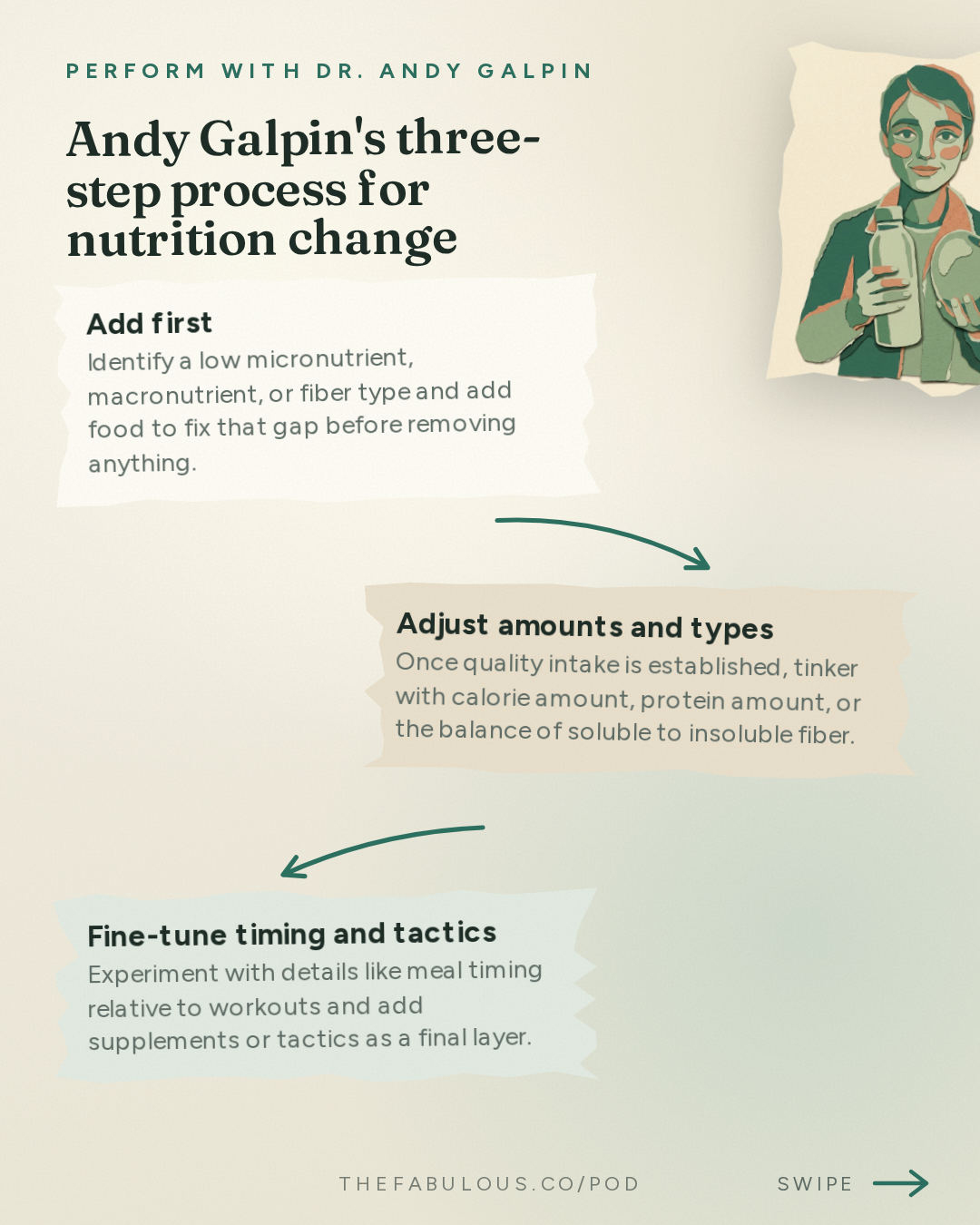
The method has three steps: first, find what is missing (a low mineral, a low fiber intake, insufficient protein) and add foods to fix it, before ever removing anything (40:01). Second, once quality intake is established, tinker with amounts and types, adjusting calories, protein, or the ratio of soluble to insoluble fiber (44:22). Third, fine-tune the details, like the exact timing of a pre-workout meal (45:05). The logic is psychological as much as physiological: crowding a plate with high-satiety, nutrient-dense food naturally displaces the junk, without the negative experience of having food taken away.
Galpin closes the episode on a claim that has nothing to do with macronutrients. He defines a high performer, athlete or not, as someone who is simply better at managing energy in all its forms: caloric, emotional, physical, cognitive.
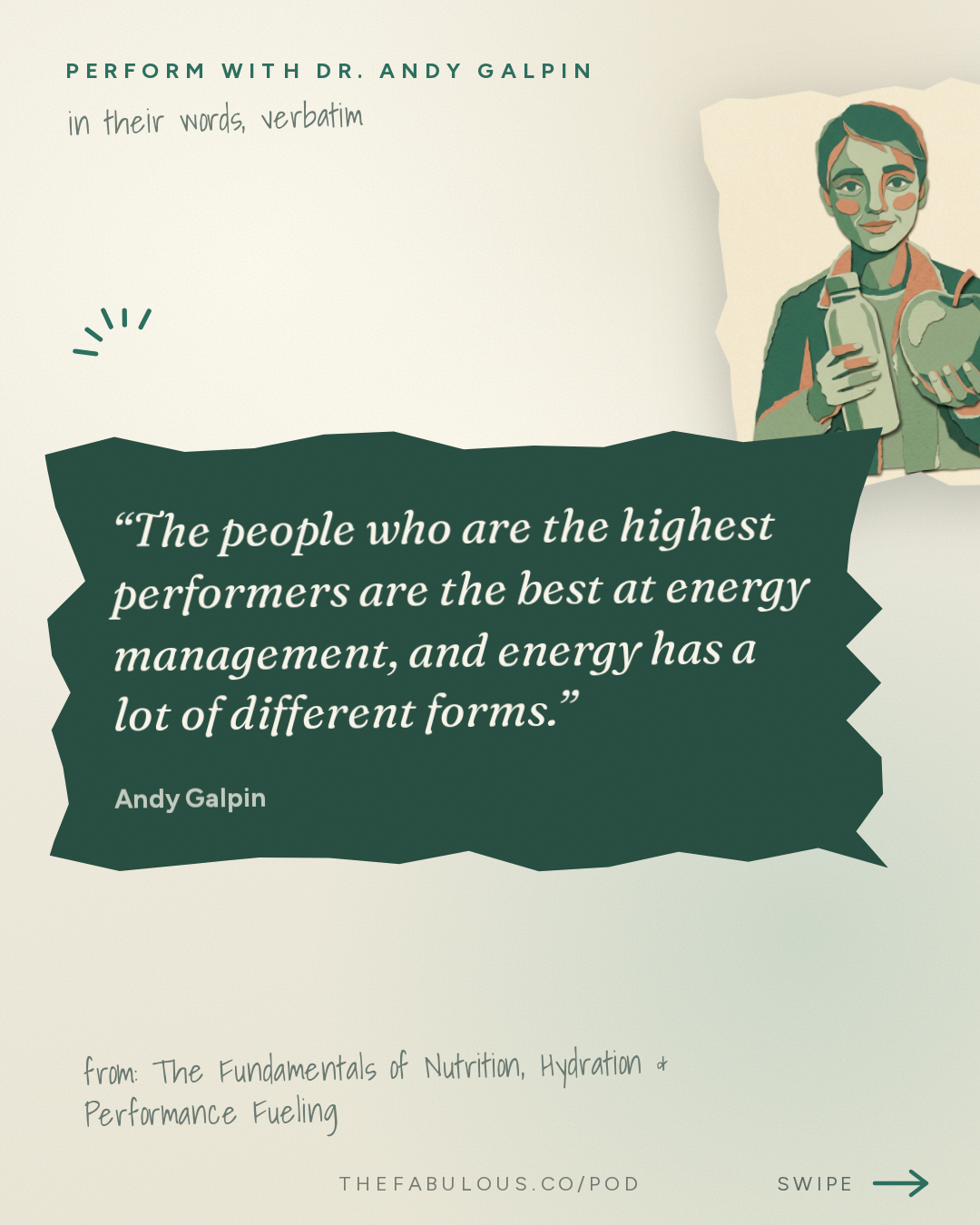
"The people who are the highest performers are the best at energy management, and energy has a lot of different forms." — Andy Galpin [62:35]
It is a fitting close for an episode built entirely on the idea that expertise is not about finding one secret trick. It is about knowing which few things actually matter, and managing them consistently, whether that thing is a calorie, a gram of protein, an ounce of water, or an hour of attention.
Ask this episode anything
Pod's AI answers from the episode itself, with the minute mark so you can hear it yourself.
Or start with one of these
Ask this episode
Pod's AI listens to the whole episode to answer, and points you to the minute it comes from.
The rest of this answer, and any question after it
Answers come from the episode itself, never from a summary of it.
ContinueKey takeaways
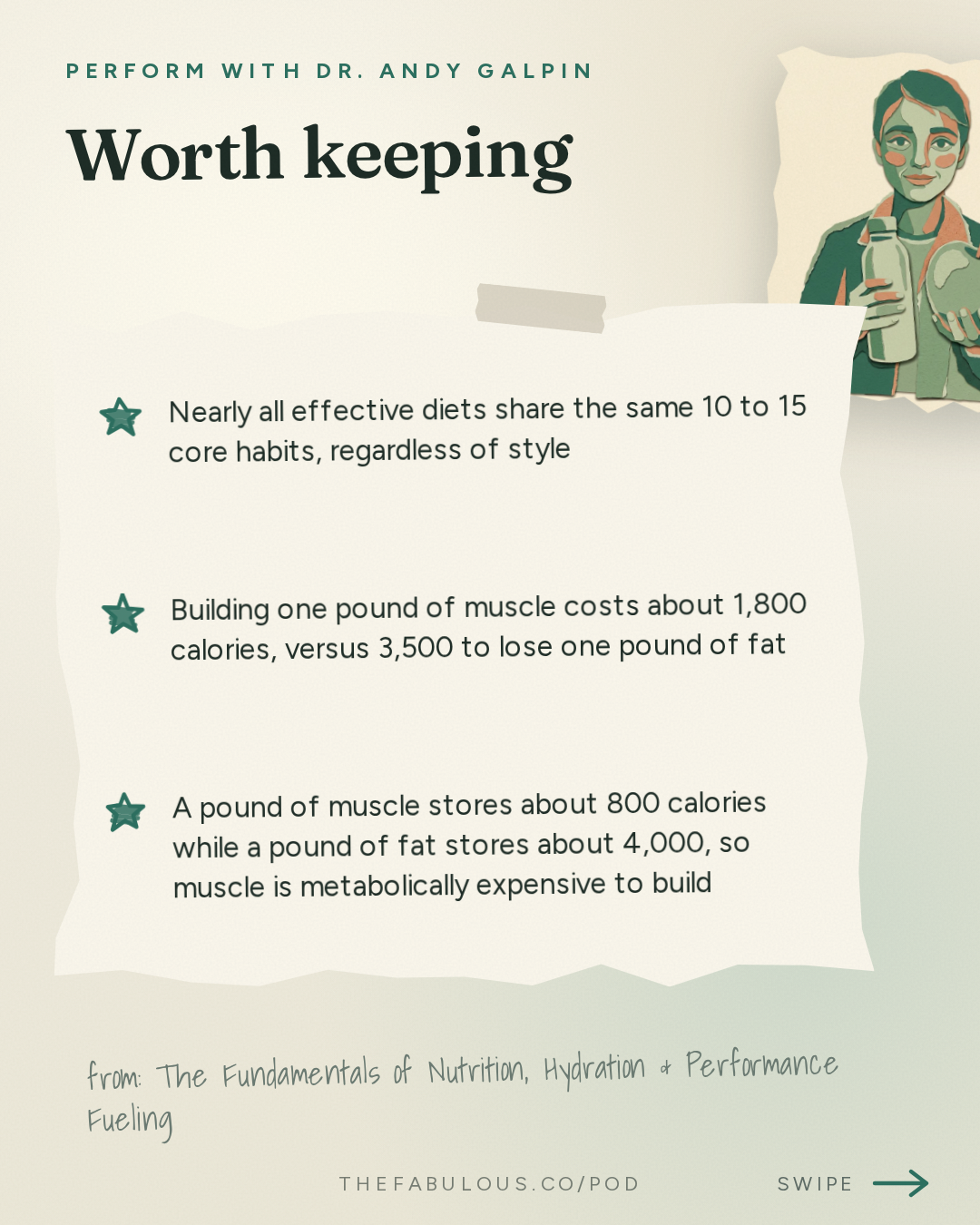
- Nearly all effective diets share the same 10 to 15 core habits, regardless of style
- Building one pound of muscle costs about 1,800 calories, versus 3,500 to lose one pound of fat
- A pound of muscle stores about 800 calories while a pound of fat stores about 4,000, so muscle is metabolically expensive to build
- Andy Galpin's hydration baseline is half your body weight in ounces of water daily, plus 3 to 6 ounces every 15 to 20 minutes of exercise
- Strength training, not protein intake, is the primary driver of muscle growth, even in a calorie deficit
The episode in cards
By the numbers
- half body weight in ounces daily water intake baseline
In their words
“The 90%, to me, is a way of saying, look, if you were to examine every nutrition program, every theme, every diet, every eating style, you'll start to realize there's a bunch of common themes.”
“I will very rarely start someone's nutrition program by eliminating foods or restricting calories. Almost always it's the opposite”
“Muscle is not a storage depot for calories, but fat truly is.”
“The people who are the highest performers are the best at energy management, and energy has a lot of different forms.”
Protocols
-
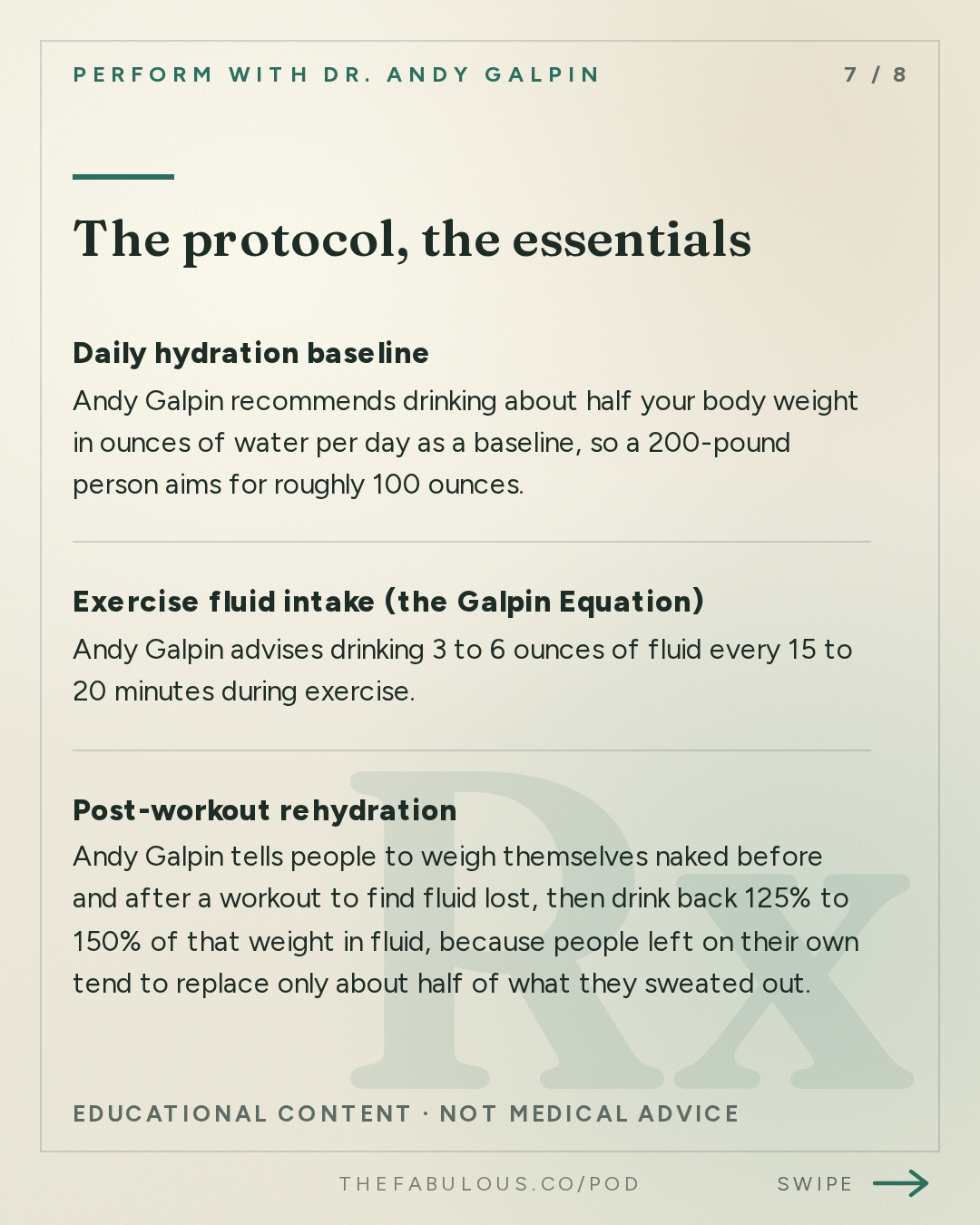
Daily hydration baseline
Andy Galpin recommends drinking about half your body weight in ounces of water per day as a baseline, so a 200-pound person aims for roughly 100 ounces.
Daily
-
Exercise fluid intake (the Galpin Equation)
Andy Galpin advises drinking 3 to 6 ounces of fluid every 15 to 20 minutes during exercise.
Every 15 to 20 minutes during exercise
-
Post-workout rehydration
Andy Galpin tells people to weigh themselves naked before and after a workout to find fluid lost, then drink back 125% to 150% of that weight in fluid, because people left on their own tend to replace only about half of what they sweated out.
After each workout
-
Protein intake for muscle growth versus deficit
Andy Galpin sets a baseline of 1.6 grams of protein per kilogram of body weight for muscle growth, and raises that target to about 3 grams per kilogram when someone is in a caloric deficit and trying to preserve muscle.
Daily
-
Three-step coaching sequence for nutrition change
Andy Galpin starts nutrition coaching by adding foods that fix a deficiency rather than removing anything, then adjusts the amount and type of calories, protein, and carbohydrate, and finally fine-tunes meal timing and tactics.
Applied in order at the start of a coaching relationship
Questions this episode answers
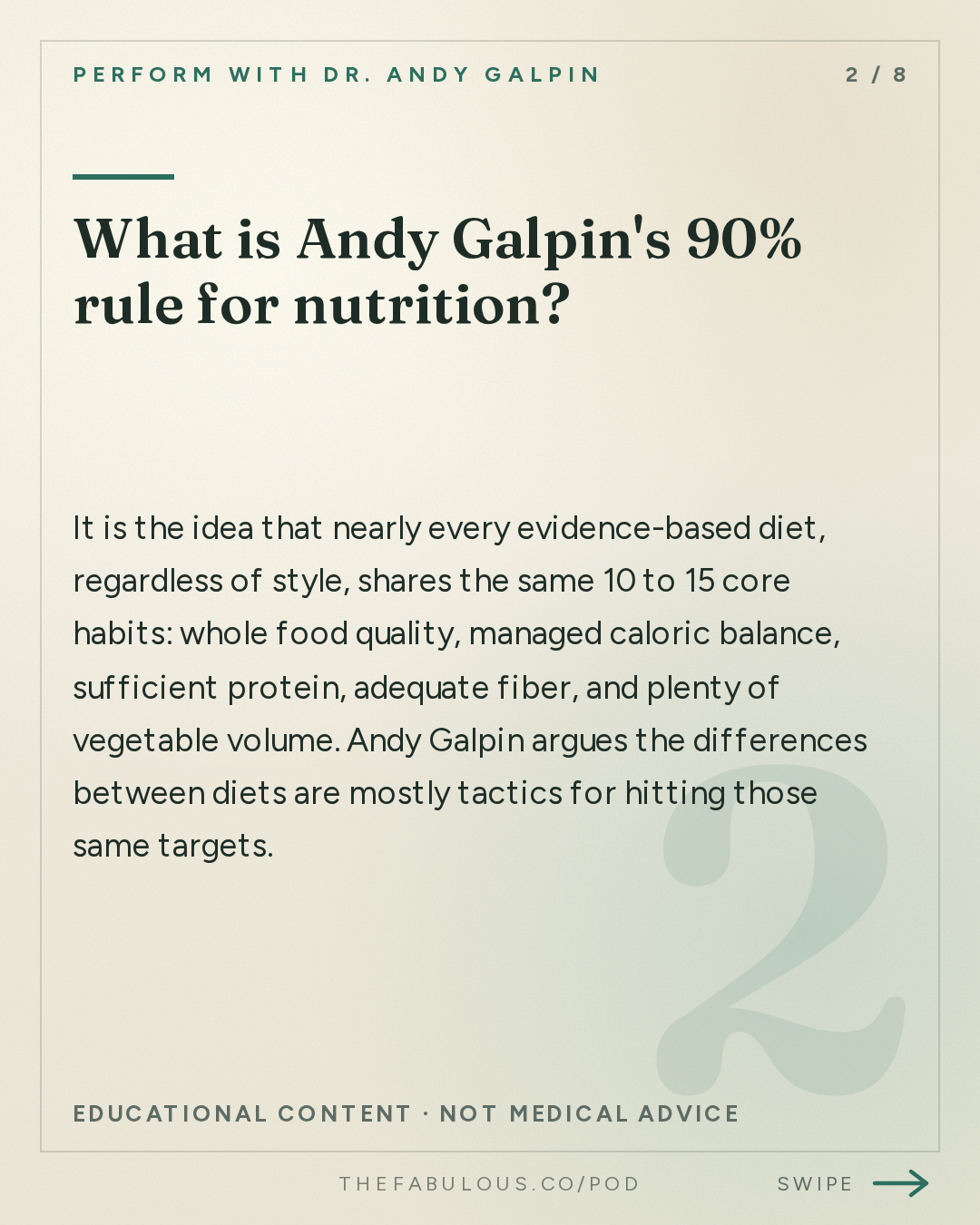
What is Andy Galpin's 90% rule for nutrition?
It is the idea that nearly every evidence-based diet, regardless of style, shares the same 10 to 15 core habits: whole food quality, managed caloric balance, sufficient protein, adequate fiber, and plenty of vegetable volume. Andy Galpin argues the differences between diets are mostly tactics for hitting those same targets (03:50, 05:14).
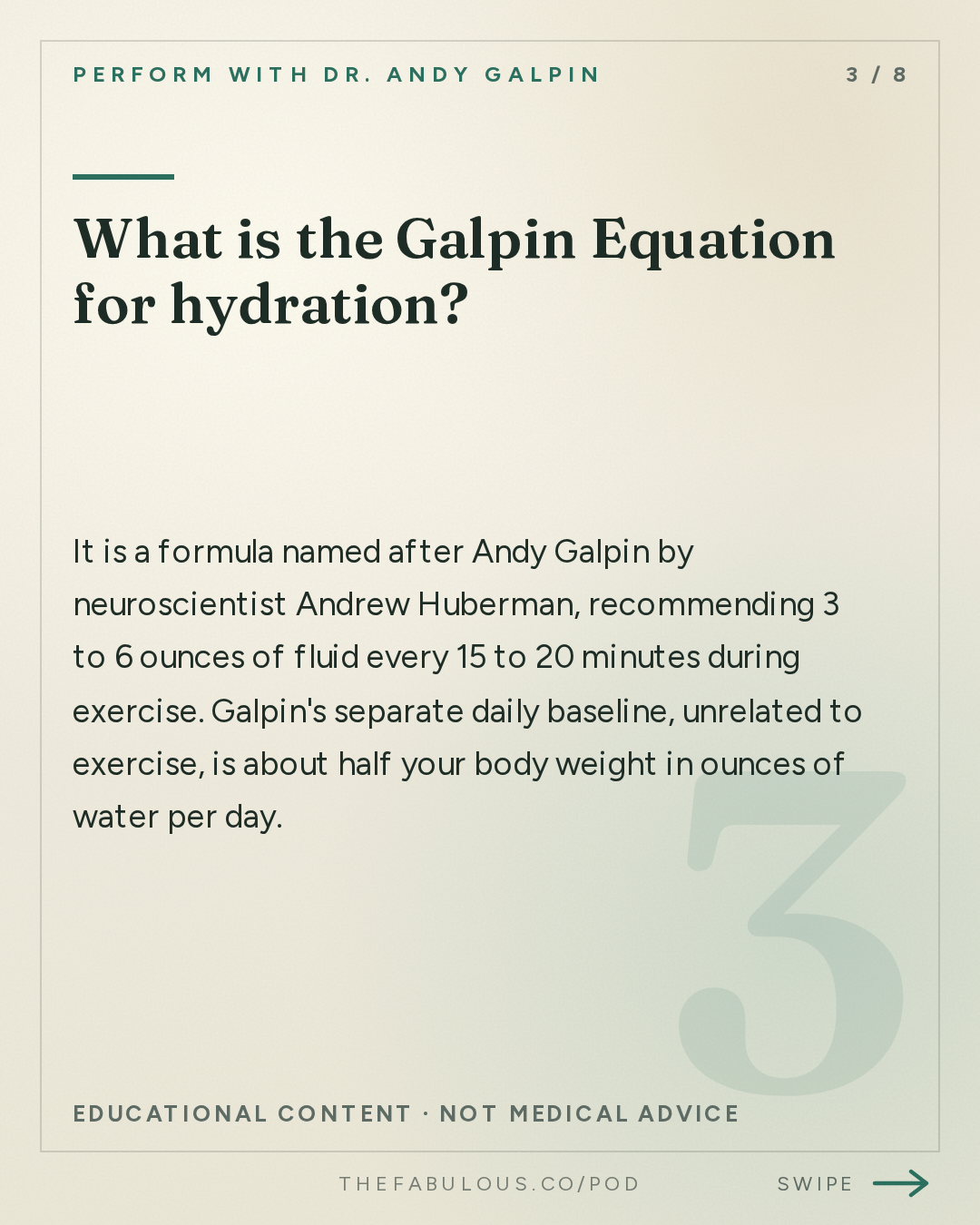
What is the Galpin Equation for hydration?
It is a formula named after Andy Galpin by neuroscientist Andrew Huberman, recommending 3 to 6 ounces of fluid every 15 to 20 minutes during exercise. Galpin's separate daily baseline, unrelated to exercise, is about half your body weight in ounces of water per day (32:10, 32:37).
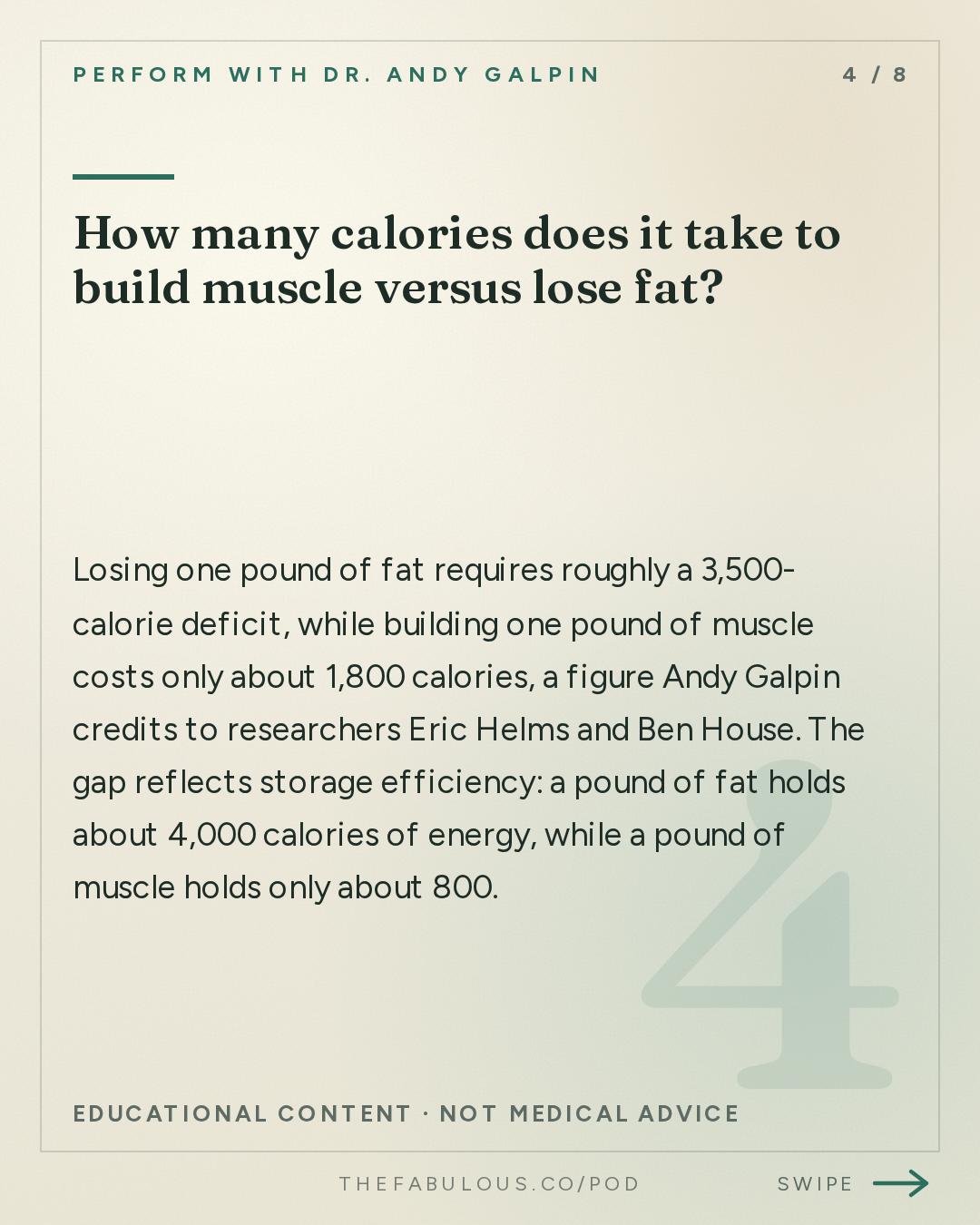
How many calories does it take to build muscle versus lose fat?
Losing one pound of fat requires roughly a 3,500-calorie deficit, while building one pound of muscle costs only about 1,800 calories, a figure Andy Galpin credits to researchers Eric Helms and Ben House. The gap reflects storage efficiency: a pound of fat holds about 4,000 calories of energy, while a pound of muscle holds only about 800 (49:29, 51:07, 51:36).
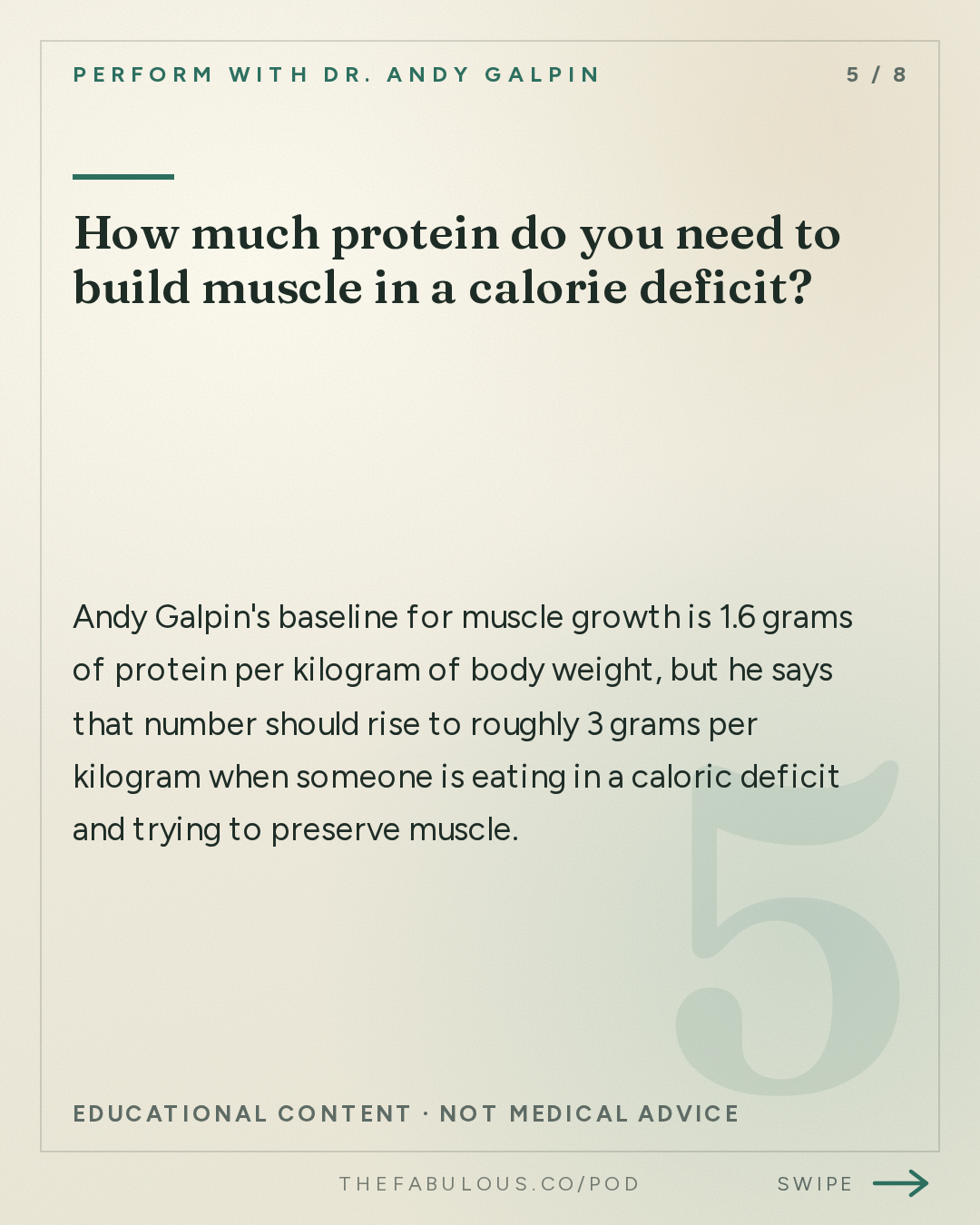
How much protein do you need to build muscle in a calorie deficit?
Andy Galpin's baseline for muscle growth is 1.6 grams of protein per kilogram of body weight, but he says that number should rise to roughly 3 grams per kilogram when someone is eating in a caloric deficit and trying to preserve muscle (53:02, 55:58).
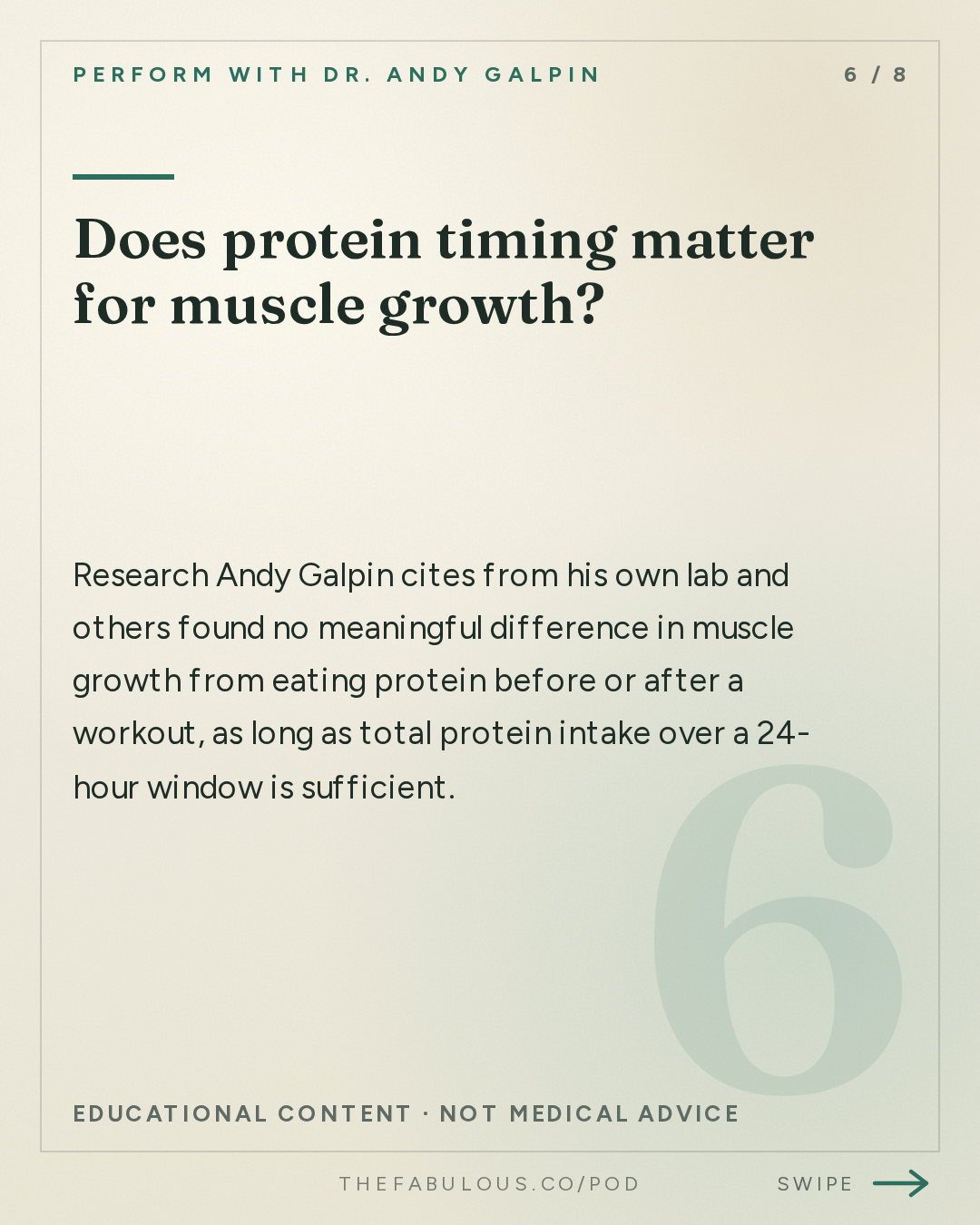
Does protein timing matter for muscle growth?
Research Andy Galpin cites from his own lab and others found no meaningful difference in muscle growth from eating protein before or after a workout, as long as total protein intake over a 24-hour window is sufficient (30:07).
What matters more for building muscle, protein or strength training?
Strength training is the bigger driver. Andy Galpin, citing exercise scientist Stu Phillips, says training stimulus outweighs protein intake as the primary signal for muscle growth, with total calories as the second most important factor (58:13).
The full read, in cards
Go deeper
- The Four S's of Recovery (open-access paper) — Updates the older three R's of recovery framework with a fourth element covering hydration and fueling
- Paper on carbohydrate and muscle protein synthesis — Describes glucose as a carbon donor that gets stored directly as building material inside muscle tissue
Mentioned
Andy Galpin · Andrew Huberman · Eric Helms · Ben House · Stu Phillips · Bill Bowerman · Momentous · LMNT · David · Perform Podcast hydration calculator
More from this show and category

Testosterone, Age, and Metabolic Health Explained
Testosterone does not fall because someone gets older; Dr. Andy Galpin says the data show obesity and metabolic dysfunction, not age itself, drive almost all of the decline. Men who hit five basic metabolic health markers have under a 1% chance of low testosterone (34:38), while obesity alone raises the risk roughly 7.5-fold (33:18).

Testosterone Explained: Low T, TRT, and Muscle Myths
Low testosterone is usually a symptom, not the disease itself: obesity, poor sleep, extreme dieting, or a blocked vein cause most cases, not age alone (76:08, 95:06). Two PhDs argue for finding the cause before reaching for a syringe, and for treating any hormone therapy with real informed consent.

Dr. John Rusin's 6-Phase Dynamic Warmup Explained
Physical therapist and performance coach Dr. John Rusin lays out a diagnostic and warmup system for training around chronic pain without surgery or years off. His six-phase, 10 to 12 minute daily sequence (24:02) turns soft tissue work, stretching, and activation drills into deliberate, measurable steps rather than vague pre-workout ritual.
Dan Garner on Blood Work and Fitness Constraints
Dan Garner explains how blood work reveals the biological constraints, like low testosterone or vitamin D, that block fitness progress, and why lab noise often makes a rising or falling number meaningless. He also covers hypertrophy training splits, diet breaks, and why peptides like SS-31 sound impressive but lack real performance data.
