
Testosterone Explained: Low T, TRT, and Muscle Myths
Testosterone Explained (Low T, Muscle Growth, Aging & TRT) | Dr. Ben House
▶ Listen to the full episode More from Perform with Dr. Andy Galpin
The brief
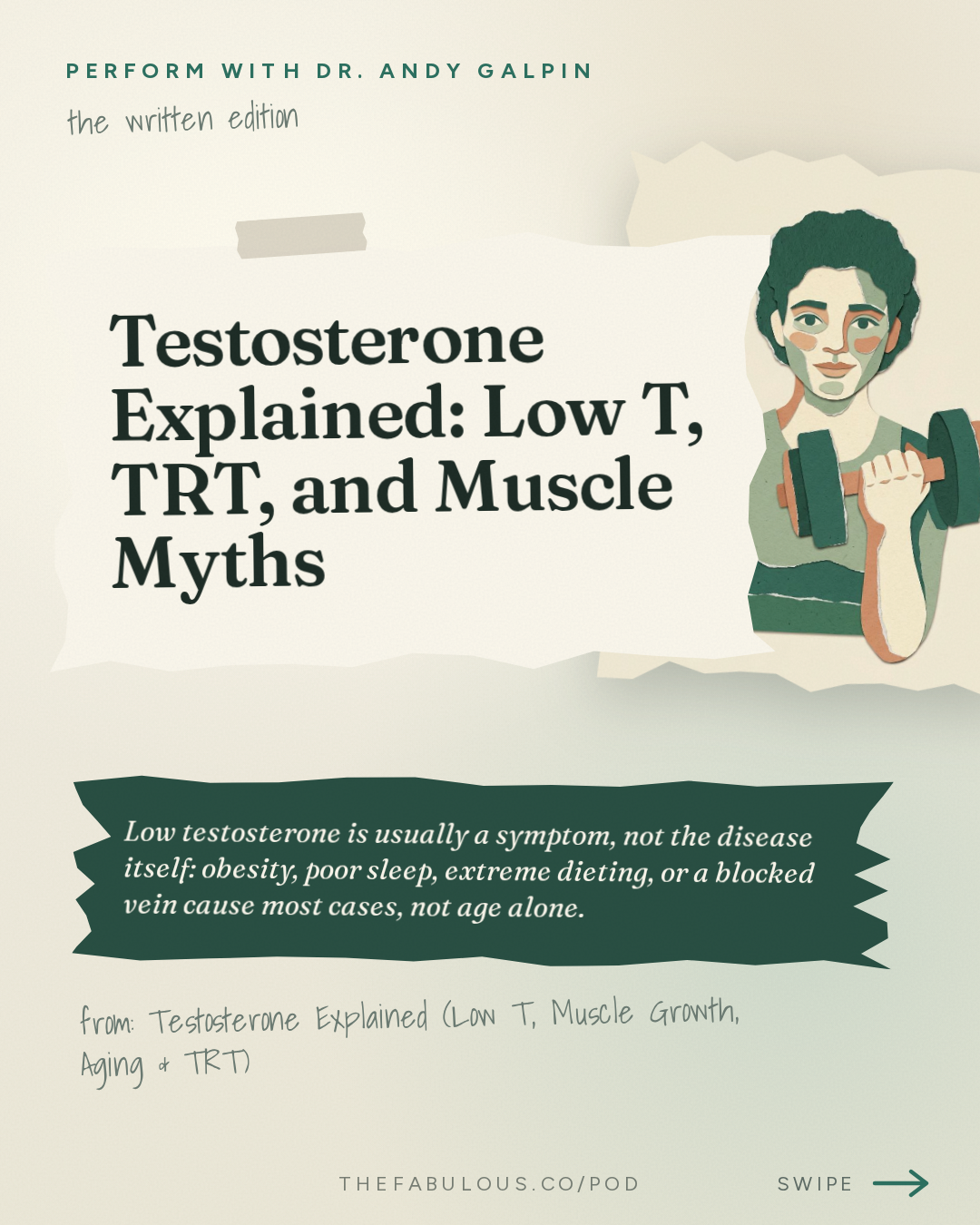
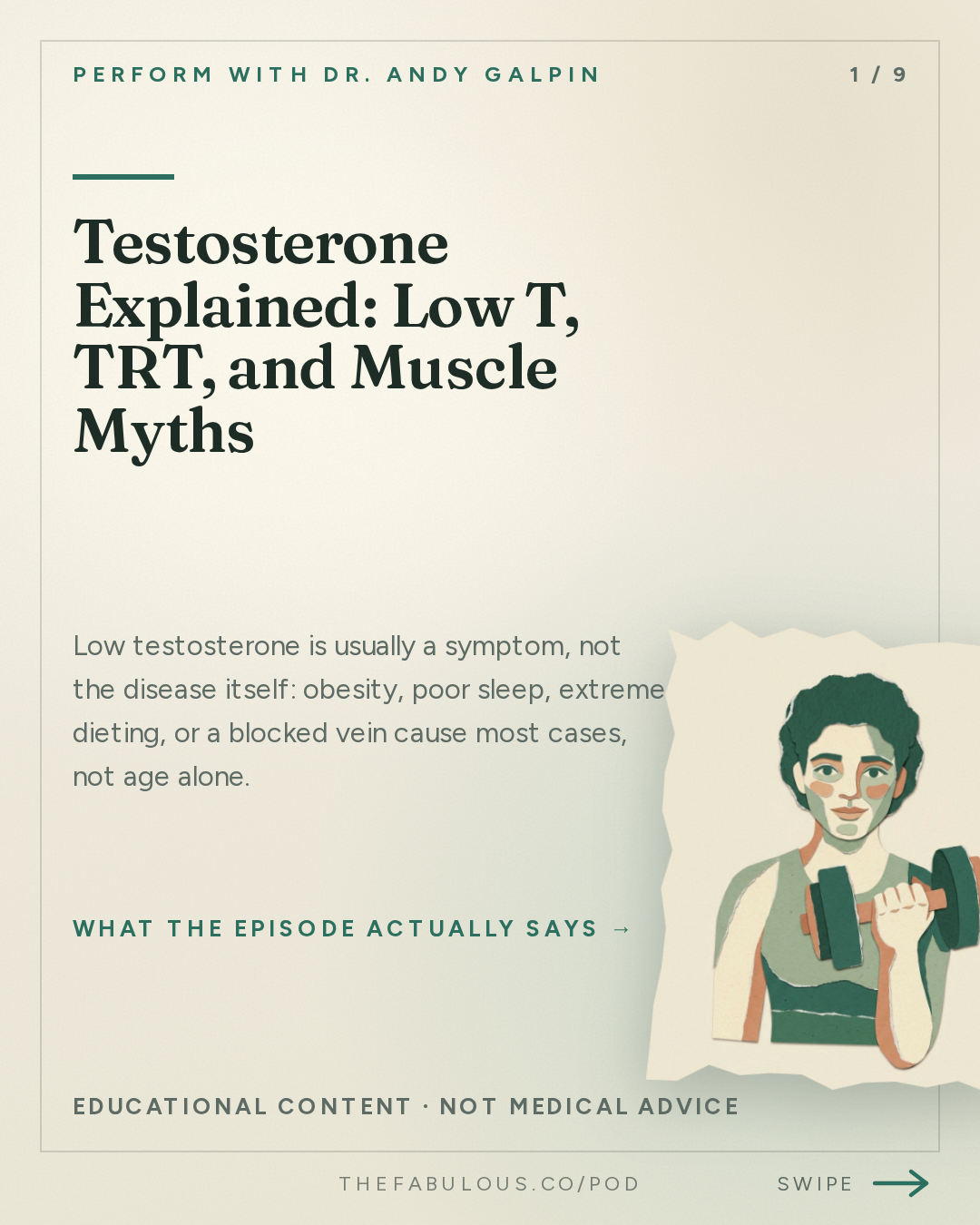
Low testosterone is usually a symptom, not the disease itself: obesity, poor sleep, extreme dieting, or a blocked vein cause most cases, not age alone (76:08, 95:06). Two PhDs argue for finding the cause before reaching for a syringe, and for treating any hormone therapy with real informed consent.
Imagine a backyard swimming pool. Now imagine dissolving a single paperclip's worth of salt into it, then asking a lab to find every grain. That is roughly the challenge of measuring testosterone in human blood, according to nutritional scientist Dr. Ben House, who has spent two decades working with professional athletes. "Take a couple paperclips of salt and dissolve it in your pool, and then we're gonna go find that with science, which is just, it just boggles my mind," he says (07:42). The comparison is not a throwaway joke. It explains why so much of the cultural conversation about testosterone, the hormone most associated with masculinity and muscle, rests on numbers far shakier than people assume.
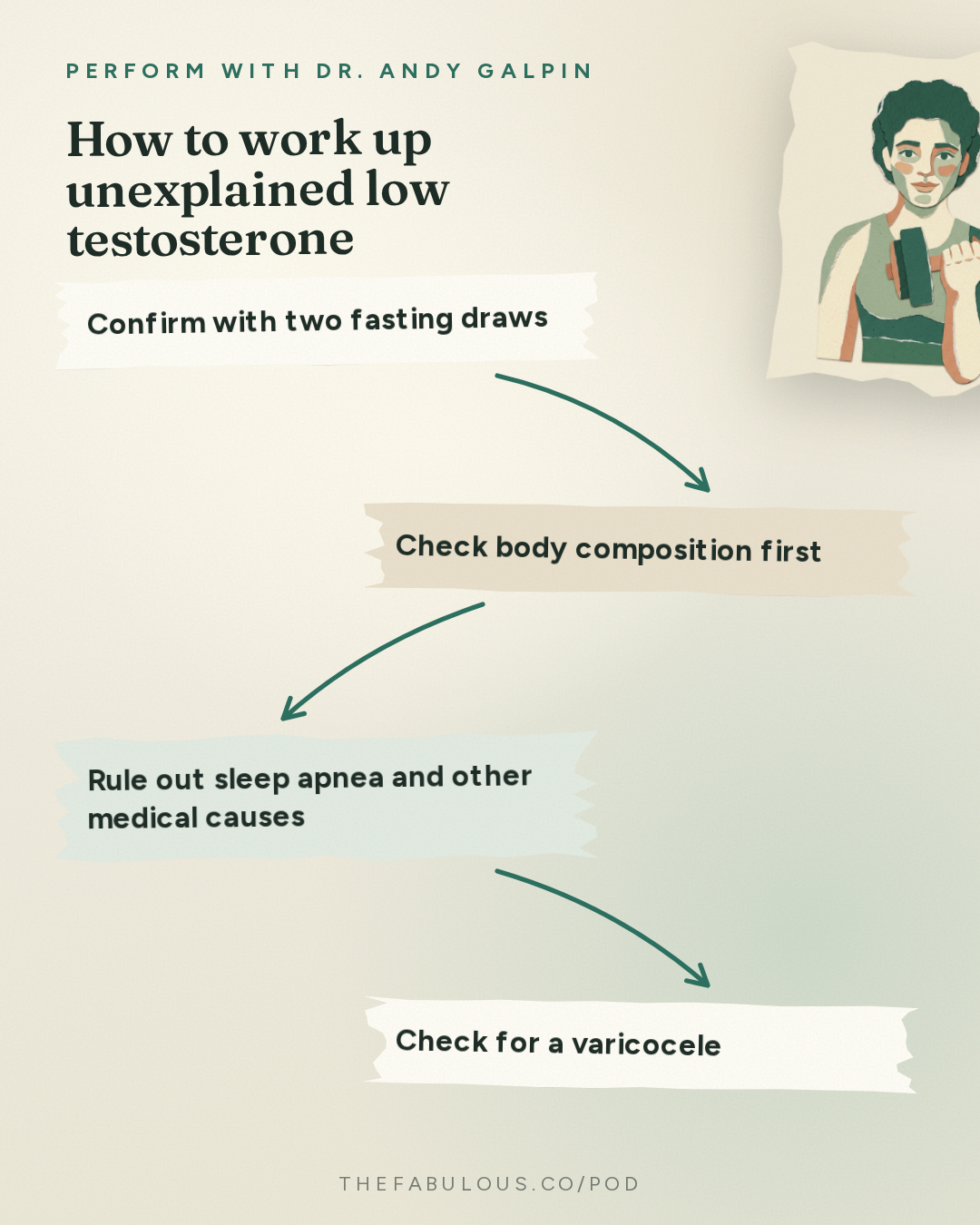
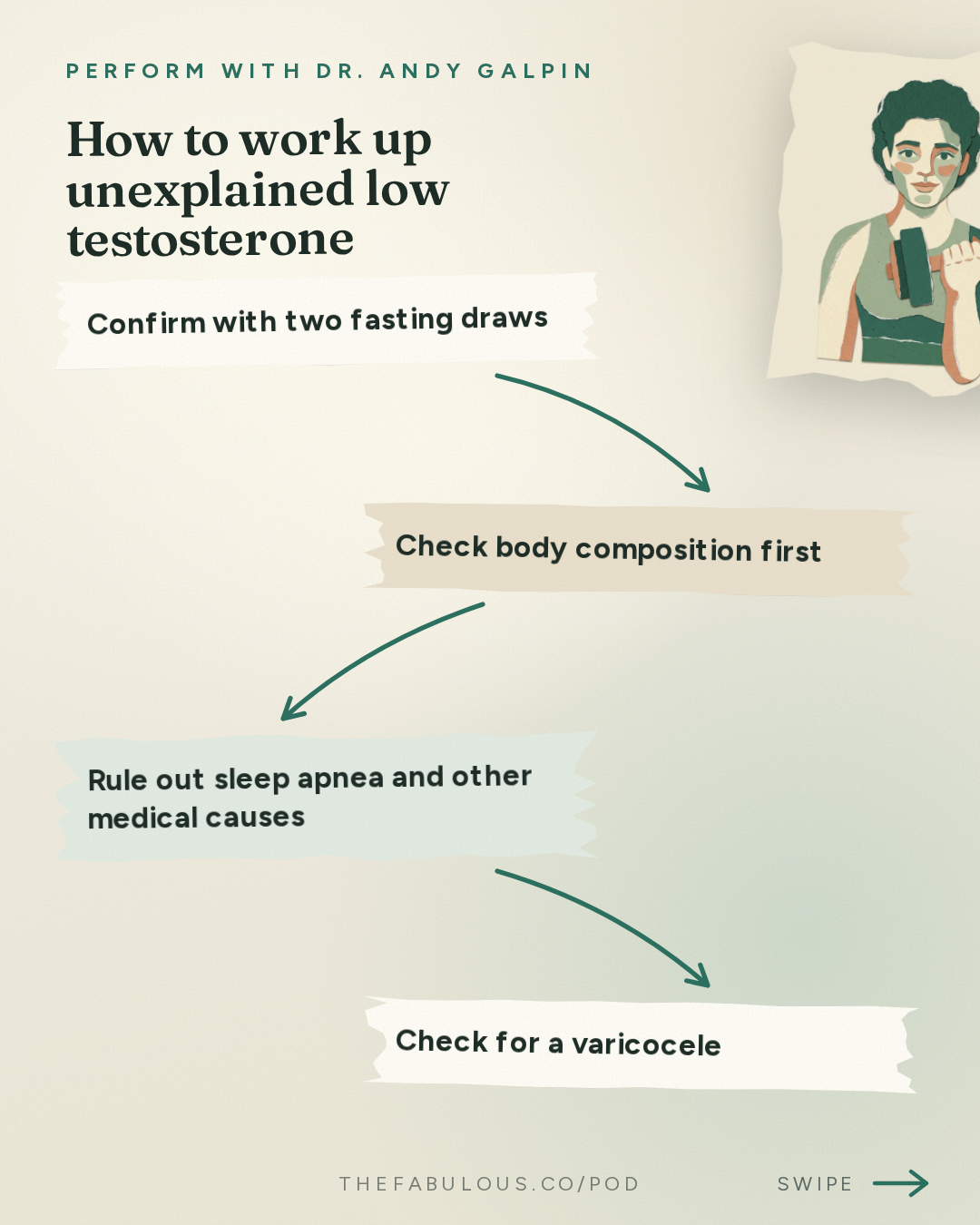
Start with the basics. The low end of the normal range for adult men sits somewhere between 264 and 300 nanograms per deciliter (05:52), a threshold drawn from population bell curves built by researchers including Shalender Bhasin. Only about 2 percent of that total testosterone floats freely enough to enter cells on demand (11:59); the rest rides bound to proteins, chiefly sex hormone binding globulin, or SHBG, a liver-made carrier protein. But free testosterone is also the hardest number to measure well. Standard lab tests carry an analytical error of 12 to 15 percent (08:00), and the gold standard method, called equilibrium dialysis, rarely appears on a basic panel unless a patient specifically requests it (19:41). Add in the fact that testosterone itself swings 30 to 40 percent between its morning peak and evening low (23:58), and a single blood draw starts to look less like a diagnosis and more like a coin flip. That is why the Endocrine Society calls for two separate fasting draws before anyone is told they have low testosterone (17:10). House notes that in some data sets, only about 4 percent of men who ended up on testosterone replacement therapy actually followed that protocol (25:14), meaning the overwhelming majority started treatment on shaky evidence.
This matters because testosterone replacement therapy, or TRT, is not risk-free. Andy Galpin, professor of human performance and host of the Perform podcast, and House walk through the physiology: testosterone stimulates the hormone EPO, which thickens blood by boosting red blood cell production. A hematocrit reading above 52 percent is a genuine red flag, they say, one that raises the odds of dangerous clotting and cardiac strain (35:19). It is a simple, cheap test, a complete blood count with differential that costs around $5.50, yet House says many people self-managing testosterone never check it.
The Myth That Muscle Needs More
Perhaps the most surprising claim in the conversation concerns muscle itself. Within the normal range, House says, study after study has failed to find any relationship between total testosterone and how much muscle a person gains from resistance training. "Every study to date has not shown a relationship between total testosterone and the amount of muscle that people gain," he says, describing roughly five to six controlled trials that all landed on a flat line (61:18). Even more striking are two experiments, run by Danish researcher Thue Kvorning and colleagues, that used a drug to chemically suppress men's testosterone down toward castrate levels, to around 30 nanograms per deciliter, sub 50 on a scale where 300 is already considered low. Those men still gained muscle from lifting weights, just at a blunted rate, somewhere between 43 and 73 percent less than a placebo group (53:29). Meanwhile, a 2016 study by Longenecker and colleagues found the opposite kind of surprise: a group of overweight subjects who dieted hard and exercised heavily for four weeks watched their average testosterone crash from about 500 to 110 nanograms per deciliter, yet still gained two to three pounds of lean mass while losing roughly eleven pounds of fat (56:16). Testosterone, in other words, sets a permissive floor for growth, but inside a wide range it does not appear to be the accelerator people assume.
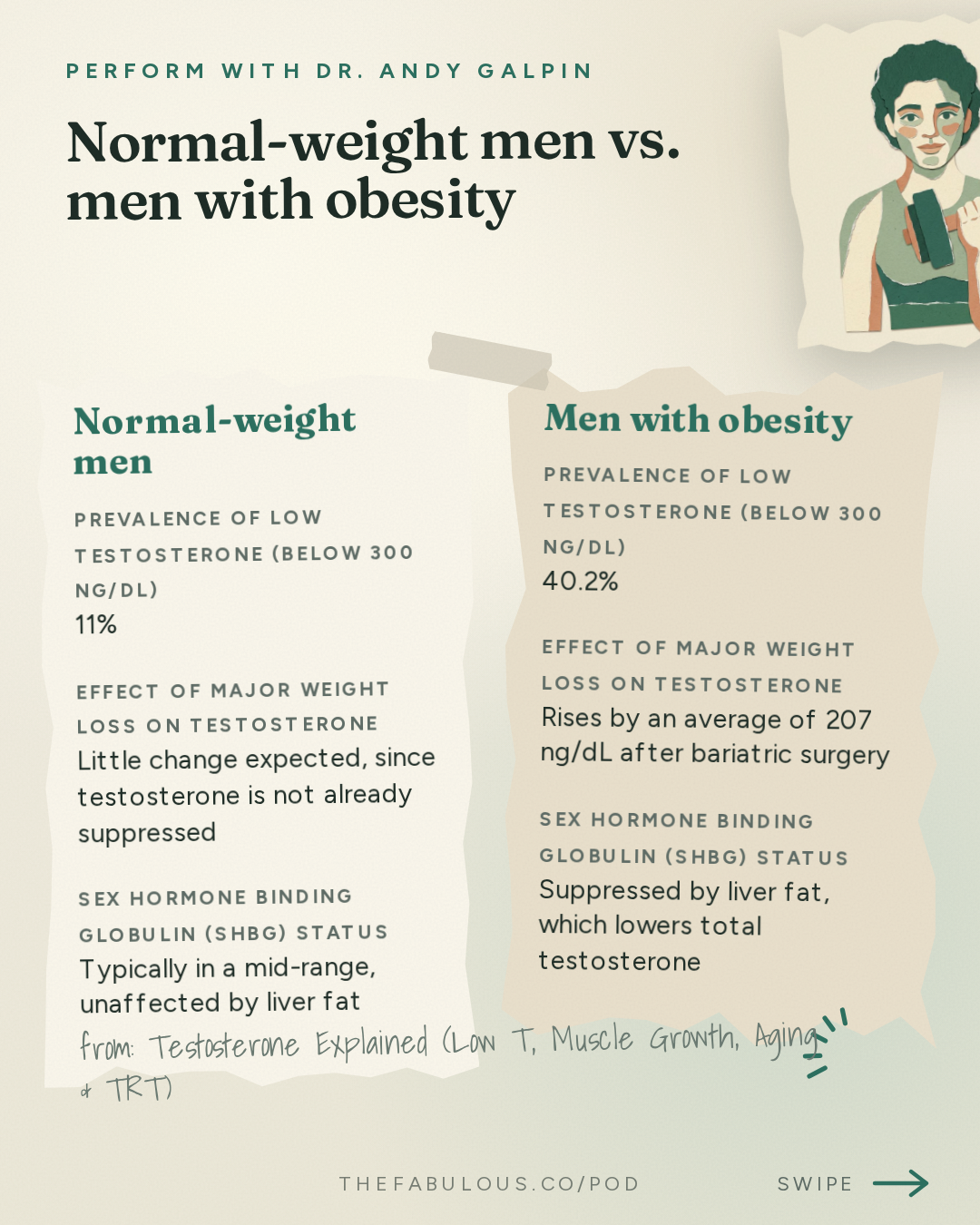
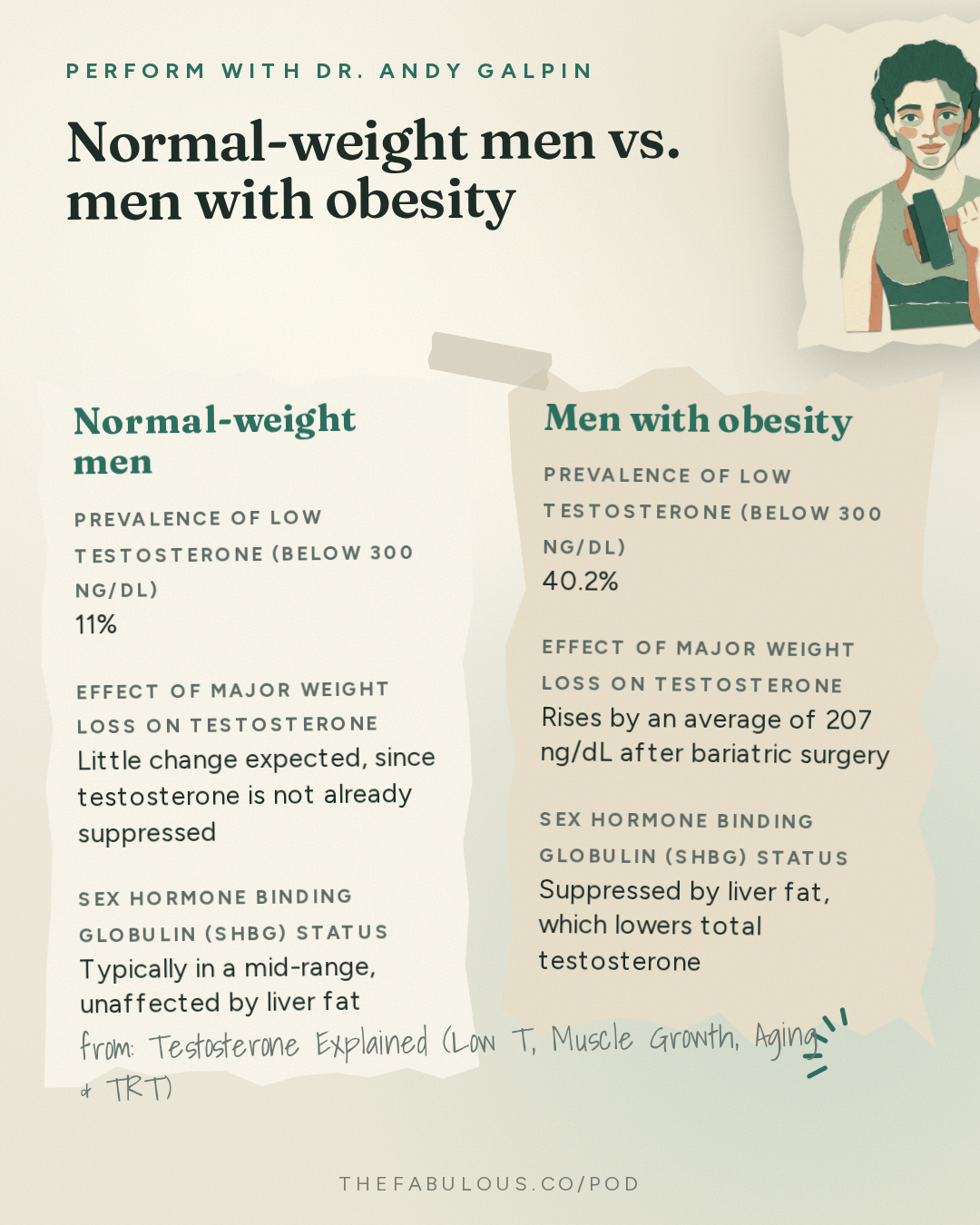
So if testosterone is not driving muscle growth in healthy ranges, why has "low T" become such a common complaint? House's answer is blunt: obesity. "Obesity is the number one driver of low testosterone right now, and that's through an SHBG mechanism and probably through a leptin mechanism," he says (76:08). Fat accumulating in the liver suppresses the liver's production of SHBG, and separately, rising body fat can trigger leptin resistance in the brain, a state where the brain stops registering how much stored energy is actually available. The numbers back this up starkly: about 11 percent of normal-weight men have measured low testosterone, compared with 40.2 percent of men with obesity (86:22). Weight loss surgery, meanwhile, raises testosterone by an average of 207 nanograms per deciliter (75:00), evidence that the relationship runs in a clear direction.
A Thermostat, Not a Malfunction
This leads to what might be the conversation's central idea: the body is not broken when testosterone drops, it is responding to conditions. As House puts it, referring to how the brain governs the hormone through what physiologists call the hypothalamic-pituitary-gonadal axis:
"Human physiology's always doing the best that it can given the scenario. It's just giving you protection against something and you don't like it." — Dr. Ben House (78:29)
That reframing extends to aging itself. The popular claim that testosterone declines automatically by 1 to 2 percent every year after age 30 does not hold up well once researchers restrict their data to genuinely healthy people rather than an average, comorbidity-laden population. House points to a large longitudinal study, Carto et al., 2023, in which filtering for people without disease cut that decline roughly in half, and another, Shi et al., 2013, in which men with zero components of metabolic syndrome showed no significant testosterone decline at all. His own conclusion is sharp:
"Age was not a factor until after 70. Up until 70, I think that it's very, very possible that someone can maintain their normal level of testosterone." — Dr. Ben House (95:06)
The data suggest something close to a rule of thumb: men under 50 who are metabolically healthy and keep their waist circumference under half their height have less than a 1 percent chance of having clinically low testosterone (87:21, 88:51). Above age 70, the picture changes, likely because Leydig cells, the testicular cells that manufacture testosterone, become more vulnerable to oxidative stress over decades.
None of this means low testosterone should be ignored. House describes physical causes worth ruling out first, including varicoceles, enlarged veins near the testicle common among lifters who strain hard while lifting; repairing one surgically can raise testosterone by 150 to 200 nanograms per deciliter, on par with the effect of major weight loss (121:00). He also describes helping clients who diet too aggressively for too long, whose testosterone can fall as dramatically as an obese person's rises, and who recover largely through patient, structured refeeding with whole foods rather than any pill (139:54).
The episode's sharpest line, though, is aimed at people already using exogenous testosterone at doses far above physiological replacement, sometimes still calling it TRT. House does not mince words with that group:
"Brother, that's not TRT. You're running gear. I don't know how to tell this to you. You are using it outside of the research that we have." — Dr. Ben House (156:04)
The distinction matters because the safety data people cite, notably the Traverse trial, only tested restoring diagnosed hypogonadal men to a normal range using a testosterone gel, and found no increased cardiovascular risk compared to placebo (155:18). It says nothing about running levels at 1,500 nanograms per deciliter year-round. House cites newer, messier data, a 2026 study he calls Kurnoos, suggesting a 51 percent higher risk of major cardiac events among men who went on testosterone without a diagnosis of hypogonadism (156:50). The honest position, both hosts agree, is not fear, but informed consent: know the actual studies behind a treatment, track the numbers that matter, hematocrit, estradiol measured with an ultra-sensitive assay, lipid panels, and treat testosterone as one signal among many rather than a magic switch.
Ask this episode anything
Pod's AI answers from the episode itself, with the minute mark so you can hear it yourself.
Or start with one of these
Ask this episode
Pod's AI listens to the whole episode to answer, and points you to the minute it comes from.
The rest of this answer, and any question after it
Answers come from the episode itself, never from a summary of it.
ContinueKey takeaways
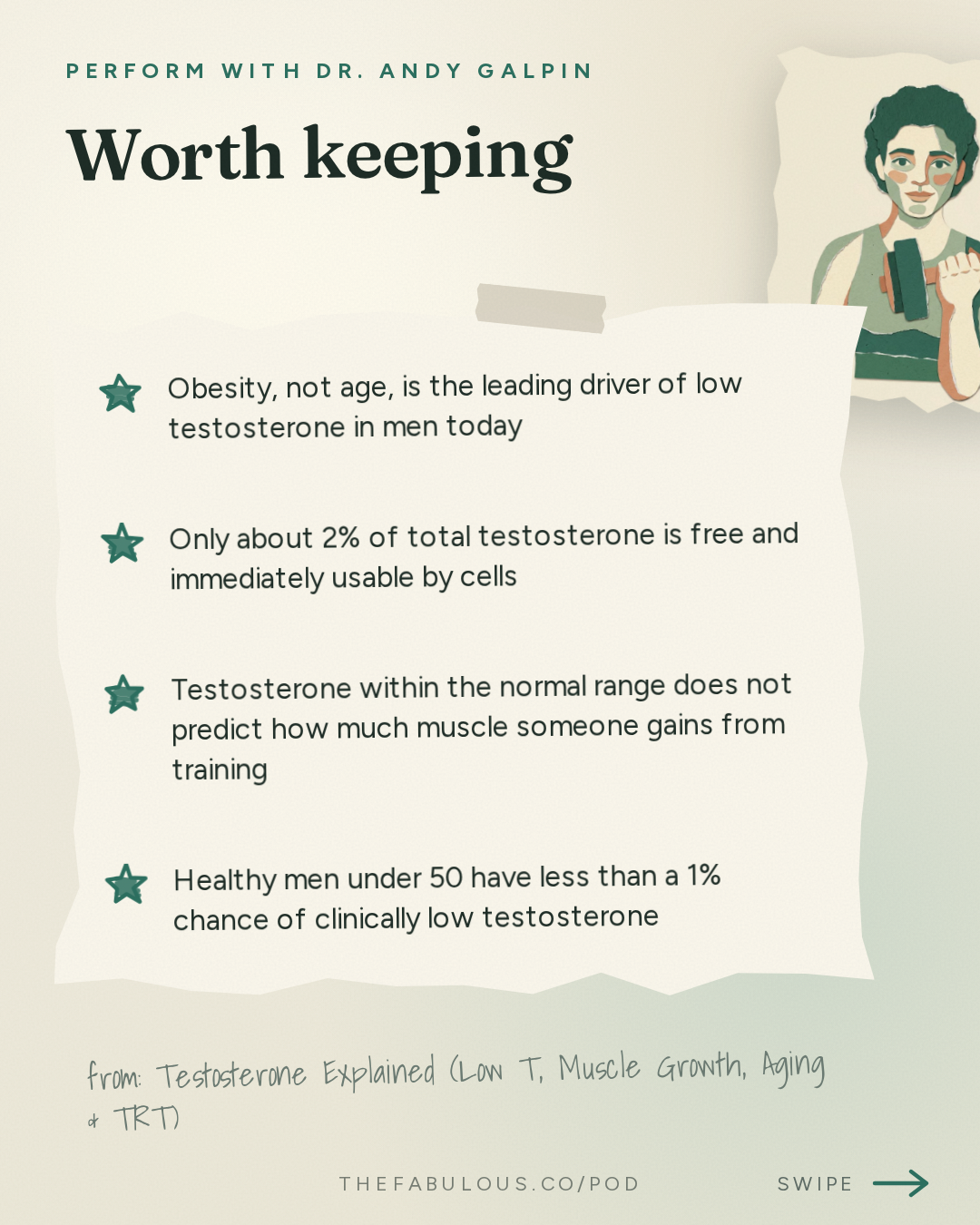
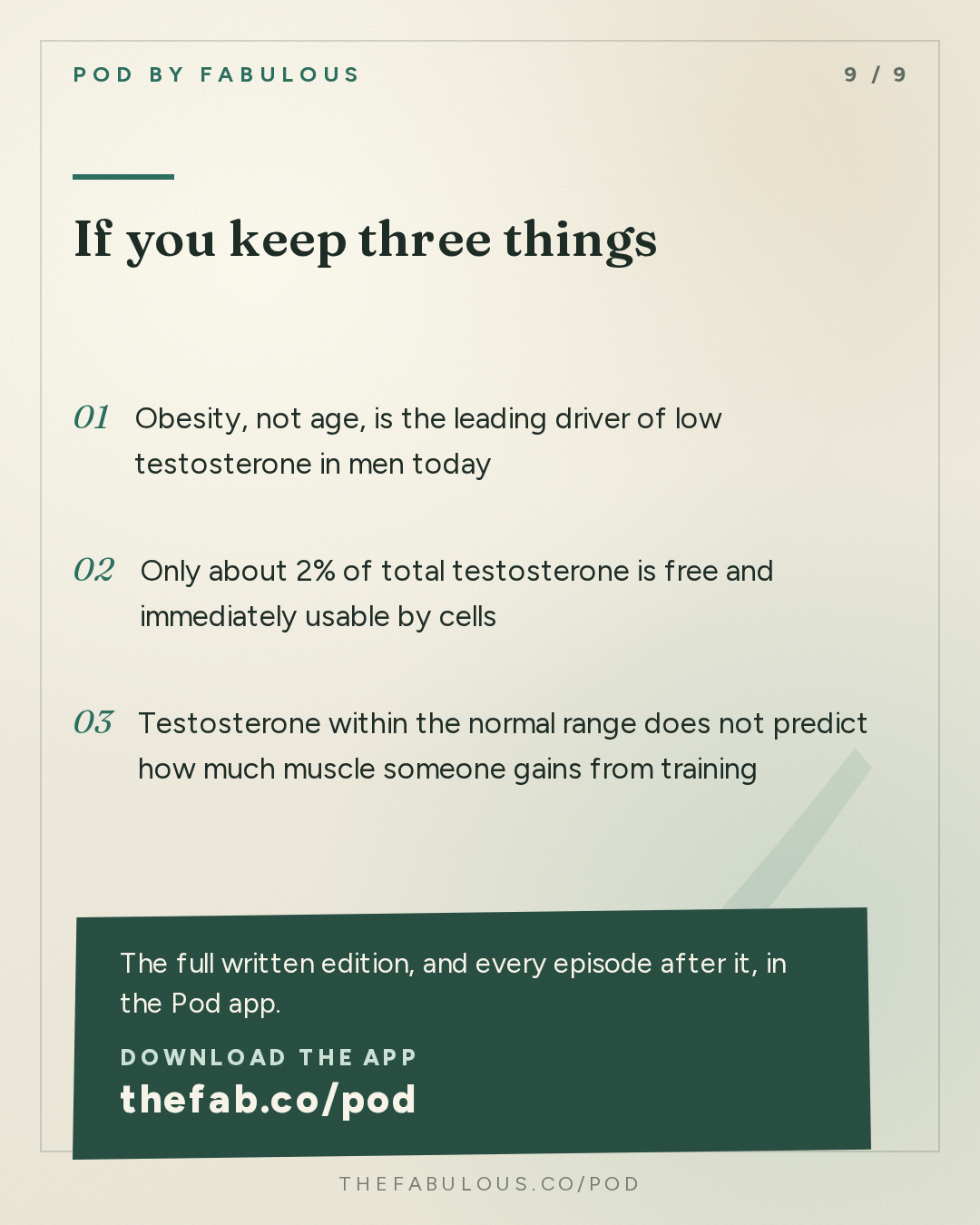
- Obesity, not age, is the leading driver of low testosterone in men today
- Only about 2% of total testosterone is free and immediately usable by cells
- Testosterone within the normal range does not predict how much muscle someone gains from training
- Healthy men under 50 have less than a 1% chance of clinically low testosterone
- A hematocrit above 52% is a safety red flag for anyone using exogenous testosterone
The episode in cards
By the numbers
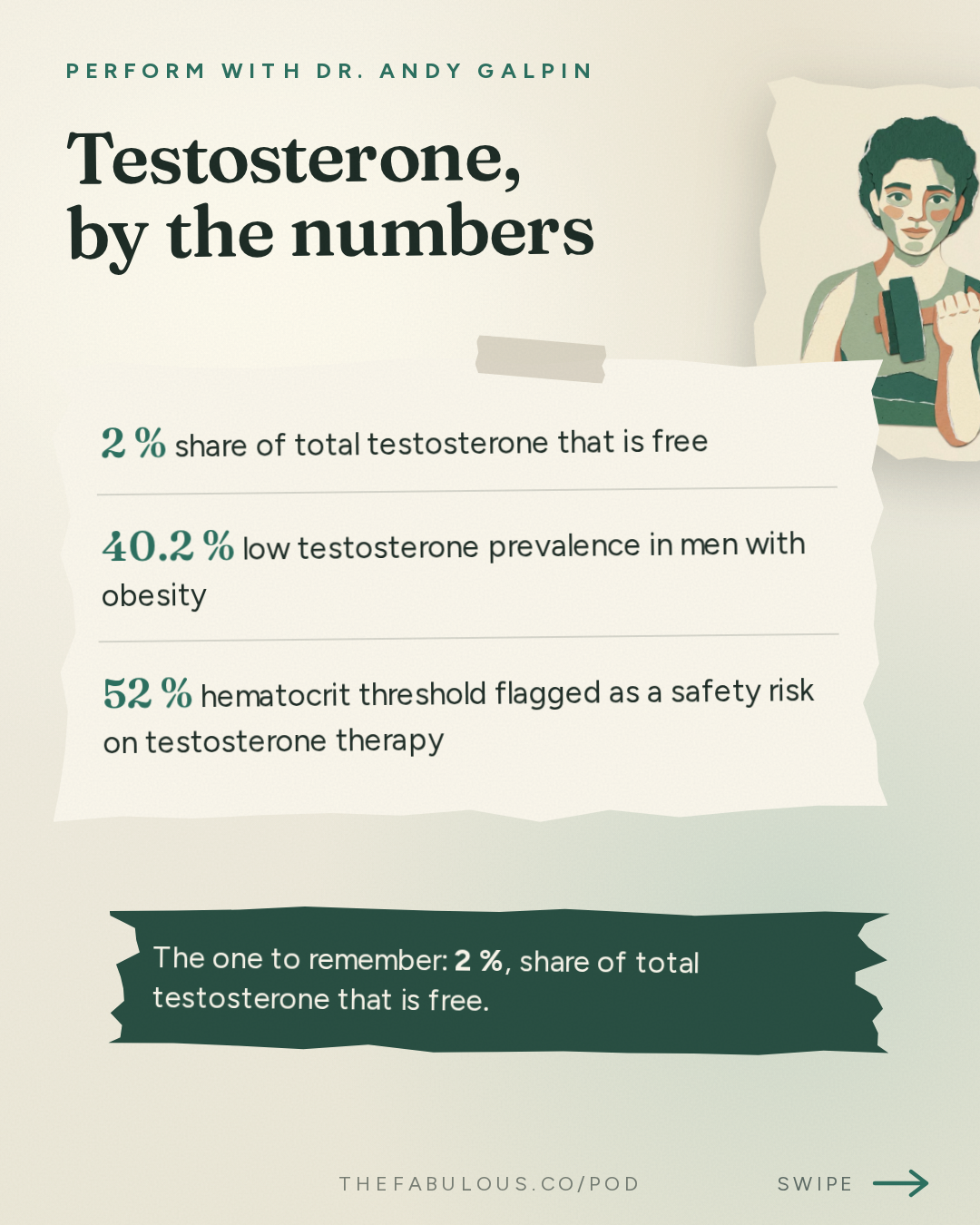
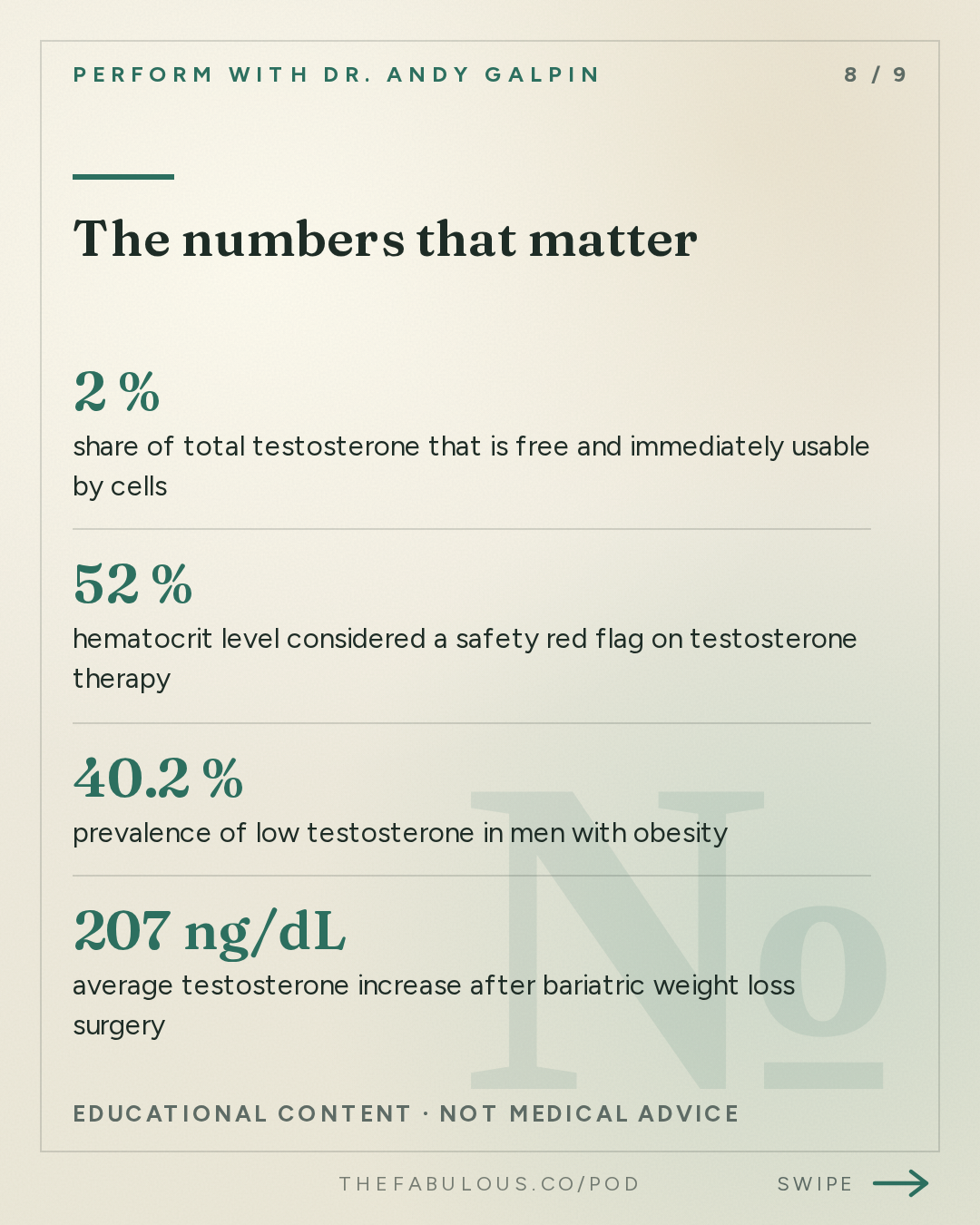
- 2 % share of total testosterone that is free and immediately usable by cells
- 52 % hematocrit level considered a safety red flag on testosterone therapy
- 40.2 % prevalence of low testosterone in men with obesity
- 207 ng/dL average testosterone increase after bariatric weight loss surgery
In their words
“If testosterone is ever your first line, uh, just from a low testosterone draw, if testosterone is the answer there, I'm walking to the door”
“Human physiology's always doing the best that it can given the scenario. It's just giving you protection against something and you don't like it”
Protocols
-
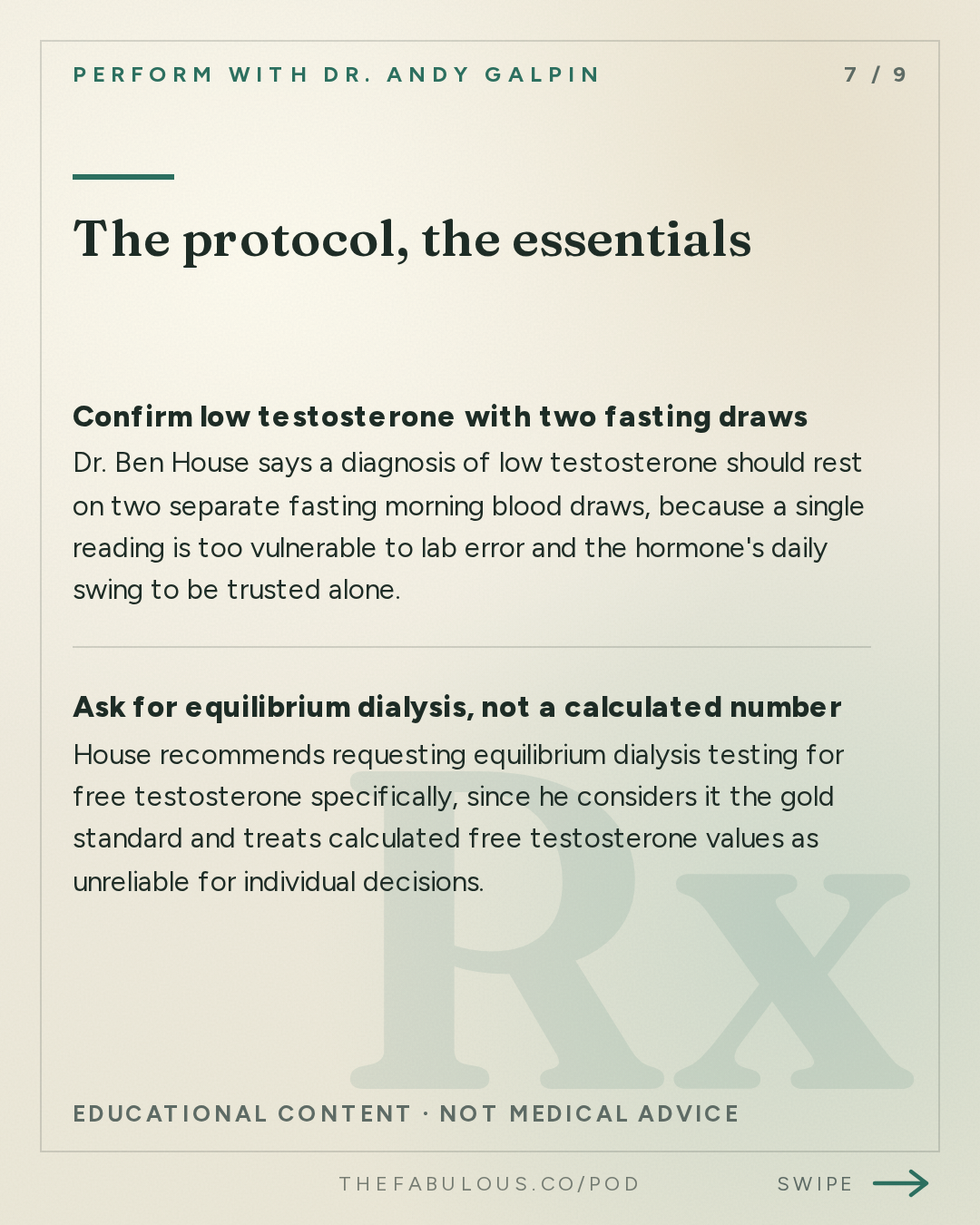
Confirm low testosterone with two fasting draws
Dr. Ben House says a diagnosis of low testosterone should rest on two separate fasting morning blood draws, because a single reading is too vulnerable to lab error and the hormone's daily swing to be trusted alone.
Two draws before any treatment decision
-
Ask for equilibrium dialysis, not a calculated number
House recommends requesting equilibrium dialysis testing for free testosterone specifically, since he considers it the gold standard and treats calculated free testosterone values as unreliable for individual decisions.
Each time free testosterone is checked
-
Track hematocrit above 52 percent as a stop sign
House advises anyone using exogenous testosterone to treat a hematocrit reading above 52 percent as a reason to pause and adjust, because it signals thickened blood and added cardiac strain, and he notes it can be checked cheaply with a basic complete blood count.
Regular monitoring while on testosterone therapy
-
Keep fat intake near 80 grams a day during a cut
House tells clients dieting for fat loss to keep daily fat intake above roughly 80 grams, or about 0.8 grams per kilogram of body weight, to support hormone production.
Daily during fat loss phases
-
Refeed in small weekly carbohydrate increases
House recommends restoring calories after an aggressive cut by adding 25 to 50 grams of whole food carbohydrate per week, such as a single piece of fruit, rather than returning to maintenance calories all at once.
Weekly increases until symptoms and testosterone recover
Questions this episode answers
What is the biggest cause of low testosterone in men?
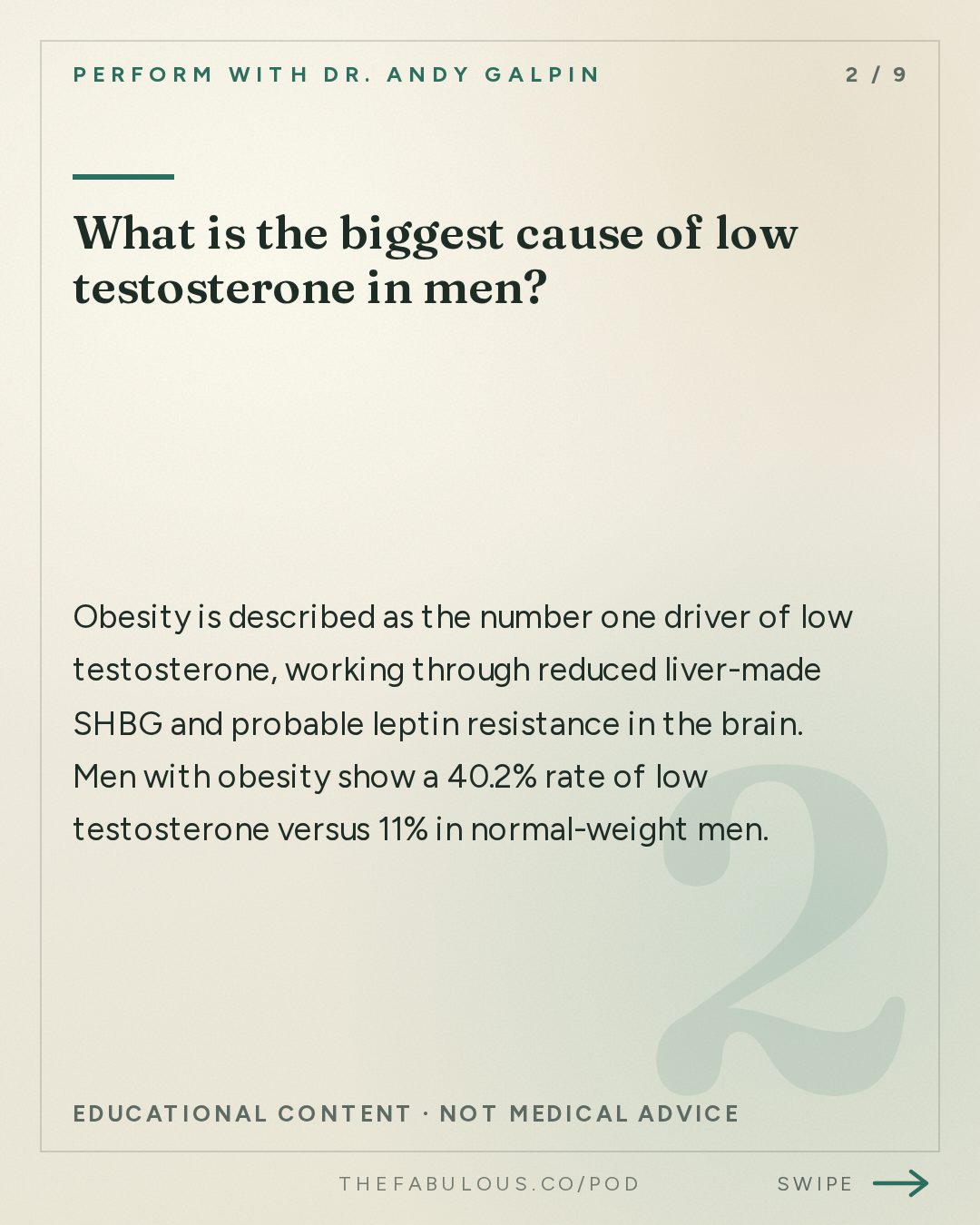
Obesity is described as the number one driver of low testosterone, working through reduced liver-made SHBG and probable leptin resistance in the brain (76:08). Men with obesity show a 40.2% rate of low testosterone versus 11% in normal-weight men (86:22).
Does testosterone naturally decline with age?
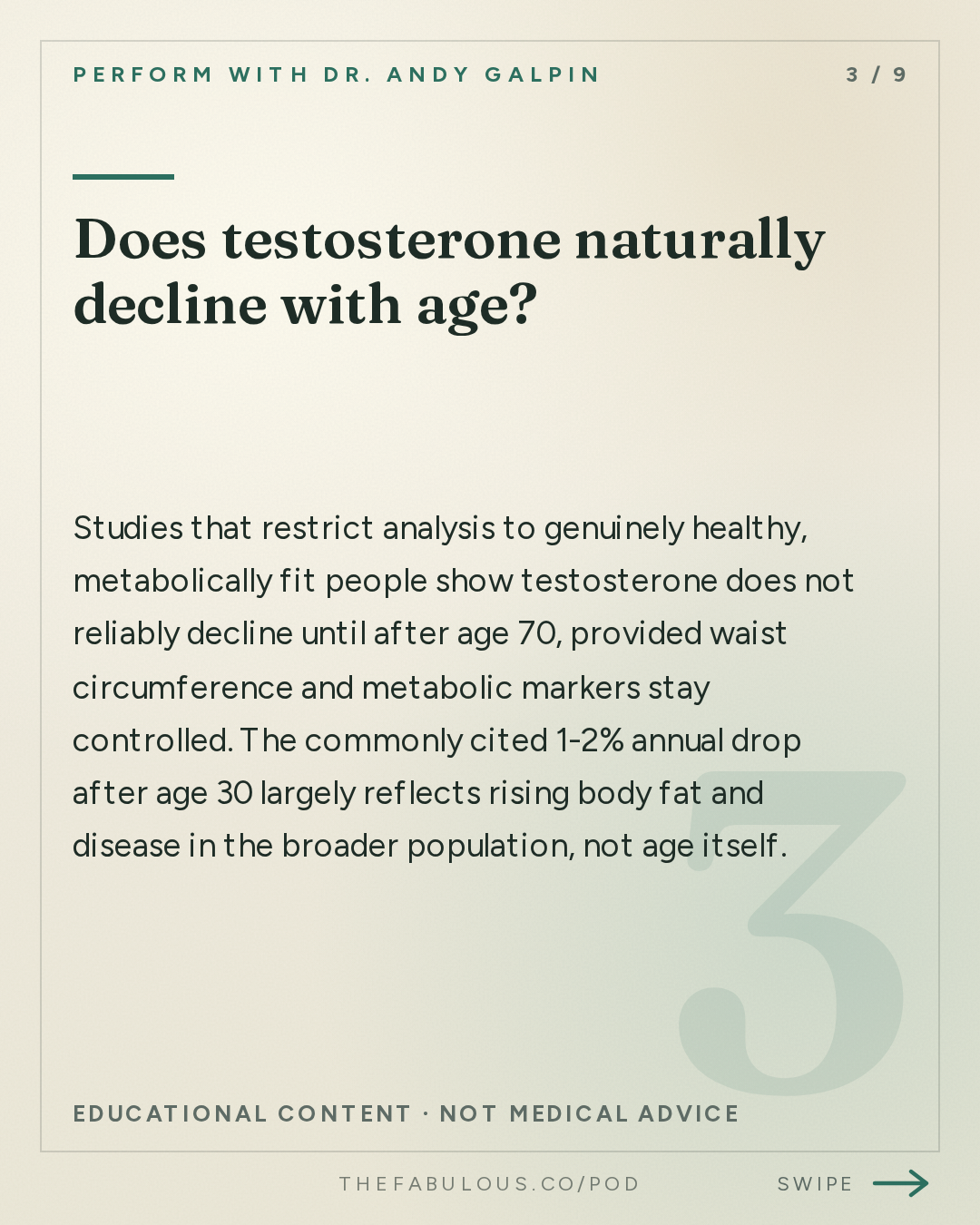
Studies that restrict analysis to genuinely healthy, metabolically fit people show testosterone does not reliably decline until after age 70, provided waist circumference and metabolic markers stay controlled (95:06). The commonly cited 1-2% annual drop after age 30 largely reflects rising body fat and disease in the broader population, not age itself (91:50).
Does higher testosterone build more muscle?
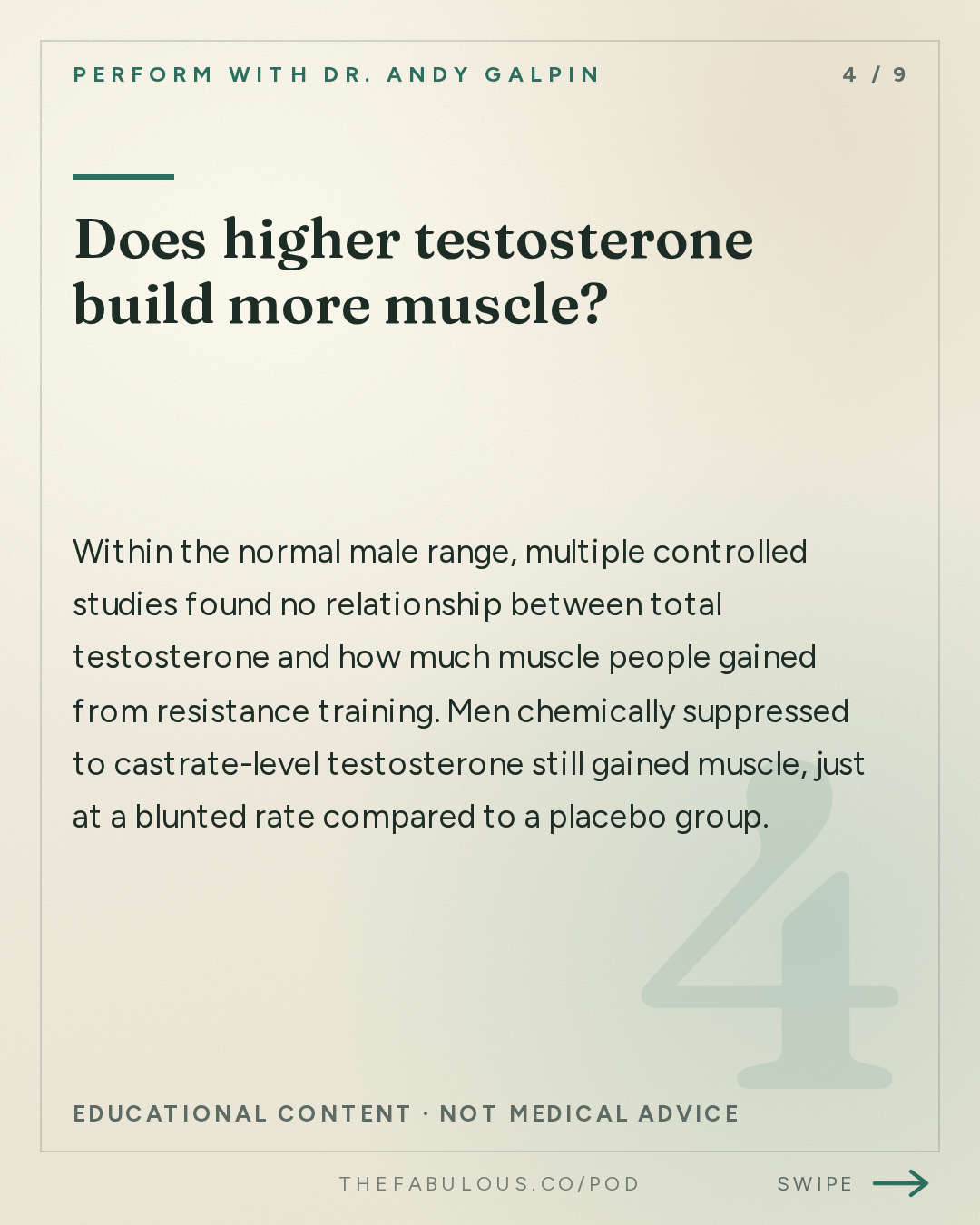
Within the normal male range, multiple controlled studies found no relationship between total testosterone and how much muscle people gained from resistance training (61:18). Men chemically suppressed to castrate-level testosterone still gained muscle, just at a blunted rate compared to a placebo group (53:29).
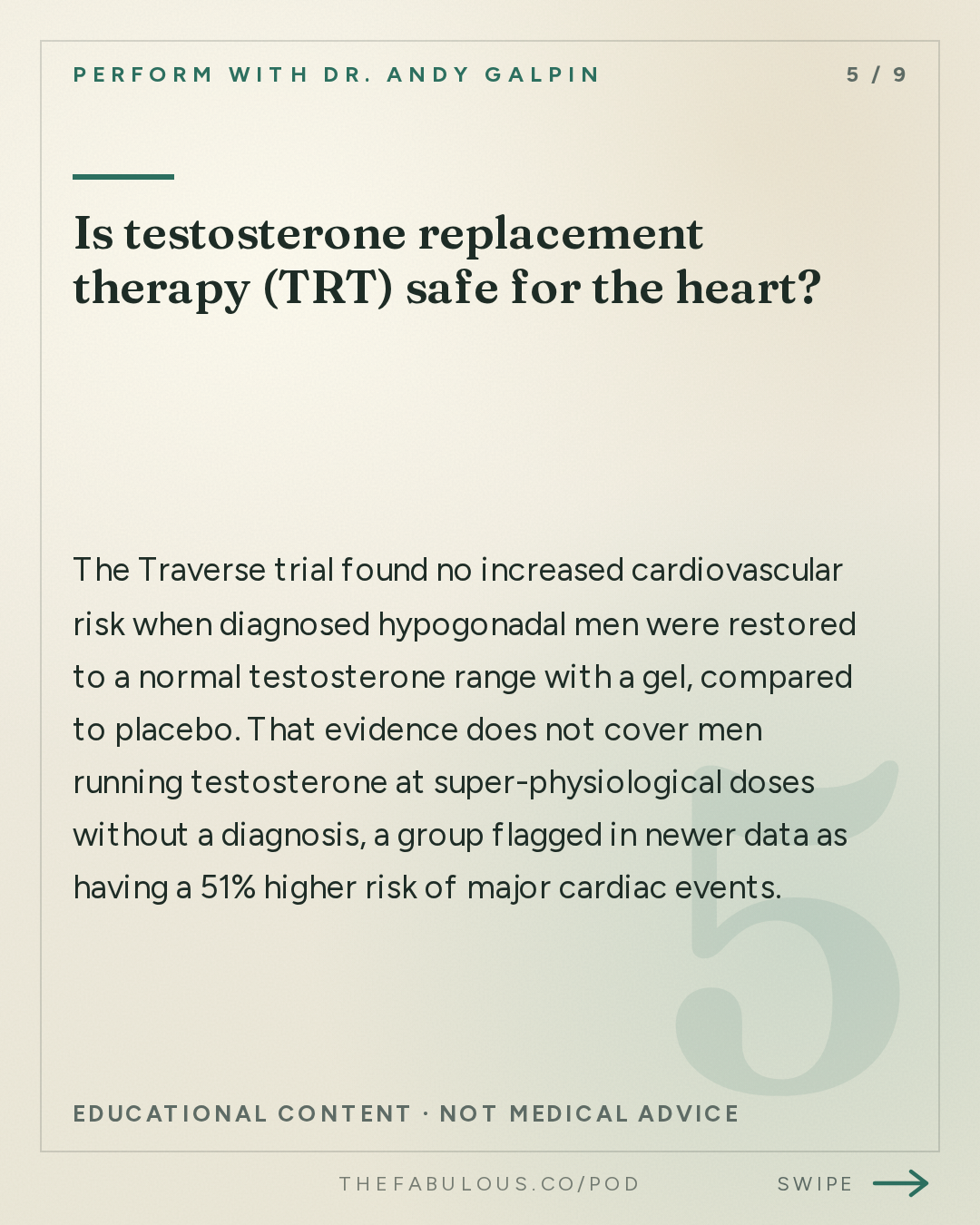
Is testosterone replacement therapy (TRT) safe for the heart?
The Traverse trial found no increased cardiovascular risk when diagnosed hypogonadal men were restored to a normal testosterone range with a gel, compared to placebo (155:18). That evidence does not cover men running testosterone at super-physiological doses without a diagnosis, a group flagged in newer data as having a 51% higher risk of major cardiac events (156:50).
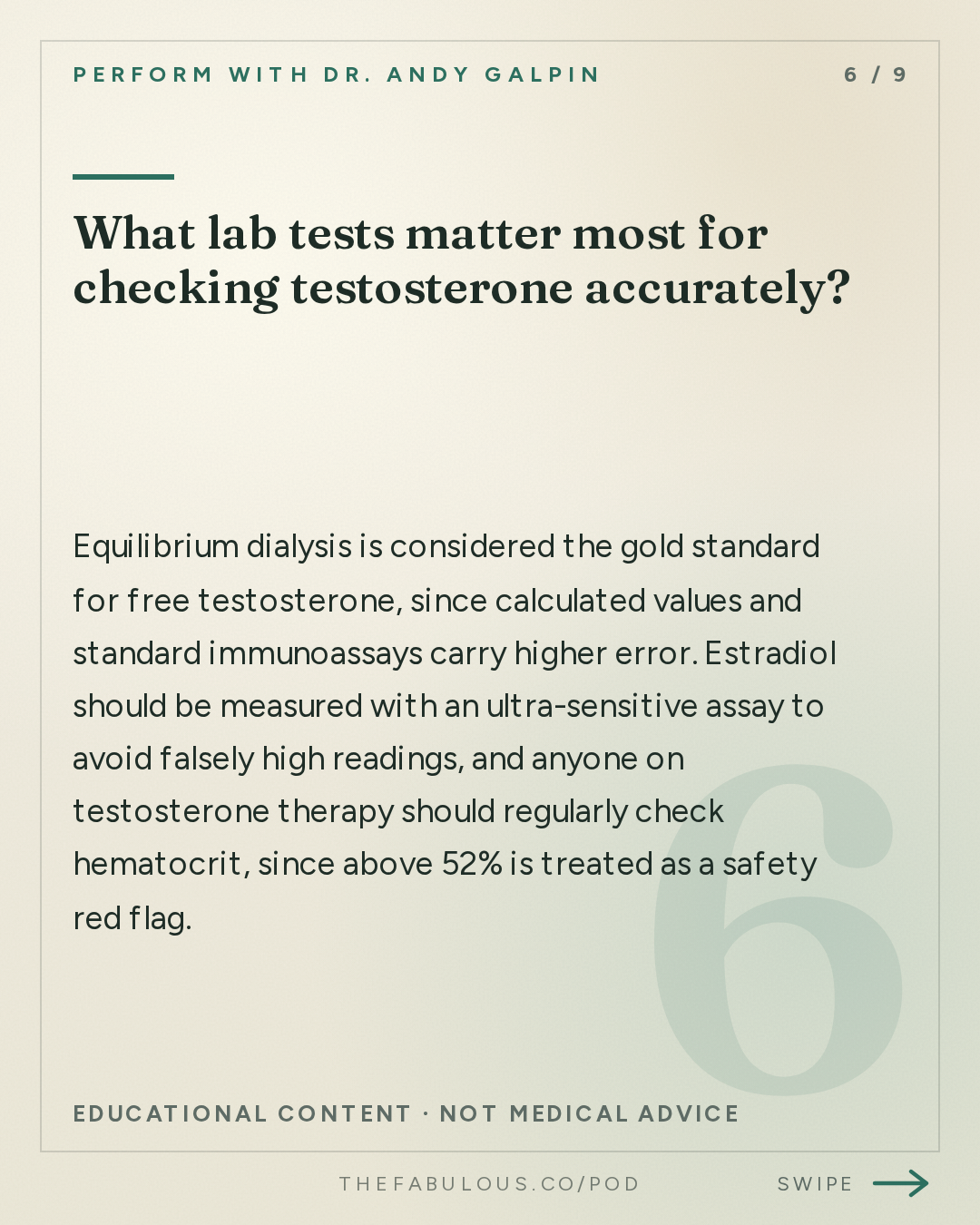
What lab tests matter most for checking testosterone accurately?
Equilibrium dialysis is considered the gold standard for free testosterone, since calculated values and standard immunoassays carry higher error (19:41). Estradiol should be measured with an ultra-sensitive assay to avoid falsely high readings, and anyone on testosterone therapy should regularly check hematocrit, since above 52% is treated as a safety red flag (35:19, 39:11).
Can a varicocele cause low testosterone?
A varicocele, an enlarged vein near the testicle common in lifters who strain heavily during lifts, can physically block testosterone release. Surgical repair can raise testosterone by 150 to 200 ng/dL, a magnitude comparable to major weight loss (121:00).
The full read, in cards
Go deeper
- Traverse trial — found restoring diagnosed hypogonadal men to normal testosterone with a gel did not raise cardiovascular disease risk versus placebo
- Kvorning et al., 2006 — used a GnRH agonist to drop men's testosterone to castrate levels and found they still gained muscle from resistance training, at a blunted rate
- Longenecker et al., 2016 — found a four-week diet and exercise program crashed testosterone from about 500 to 110 ng/dL while subjects still gained lean mass and lost fat
- Diver et al., 2003 — mapped the diurnal rhythm showing testosterone drops 30 to 40% from morning peak to evening low
- Kelsey et al., 2014 — pooled 14 prospective trials showing wide individual variation in testosterone across age, with the population mean masking that variation
Mentioned
Dr. Andy Galpin · Dr. Ben House · Endocrine Society · Shalender Bhasin · Thue Kvorning · Mike Roberts · Traverse trial · Anne Haines · Zapolski
More from this show and category

Dr. John Rusin's 6-Phase Dynamic Warmup Explained
Physical therapist and performance coach Dr. John Rusin lays out a diagnostic and warmup system for training around chronic pain without surgery or years off. His six-phase, 10 to 12 minute daily sequence (24:02) turns soft tissue work, stretching, and activation drills into deliberate, measurable steps rather than vague pre-workout ritual.
Dan Garner on Blood Work and Fitness Constraints
Dan Garner explains how blood work reveals the biological constraints, like low testosterone or vitamin D, that block fitness progress, and why lab noise often makes a rising or falling number meaningless. He also covers hypertrophy training splits, diet breaks, and why peptides like SS-31 sound impressive but lack real performance data.

Andy Galpin's Nutrition and Hydration Fundamentals
Andy Galpin argues nutrition science mostly agrees: eat whole foods, manage calories, hit protein and fiber targets, and hydrate by formula. The rest, like meal timing or keto versus low-fat, is personal preference layered on the same ten to fifteen fundamentals (03:50, 11:48, 32:37).

Surgical Prehabilitation Protocol Guide
Prehabilitation, the practice of preparing the body before surgery instead of only recovering after it, can measurably change outcomes. Duke University surgeon Rebecca Knackstedt recommends 2 grams of protein per kilogram of body weight daily (34:26), a vitamin D level near 70 ng/mL (25:47), targeted muscle training, and five days of immunonutrition before major operations (69:01) to cut complications and speed healing.
