
Joe Liemandt on How Alpha School Speeds Up Learning
How to Accelerate Learning & Improve Education | Joe Liemandt
The brief
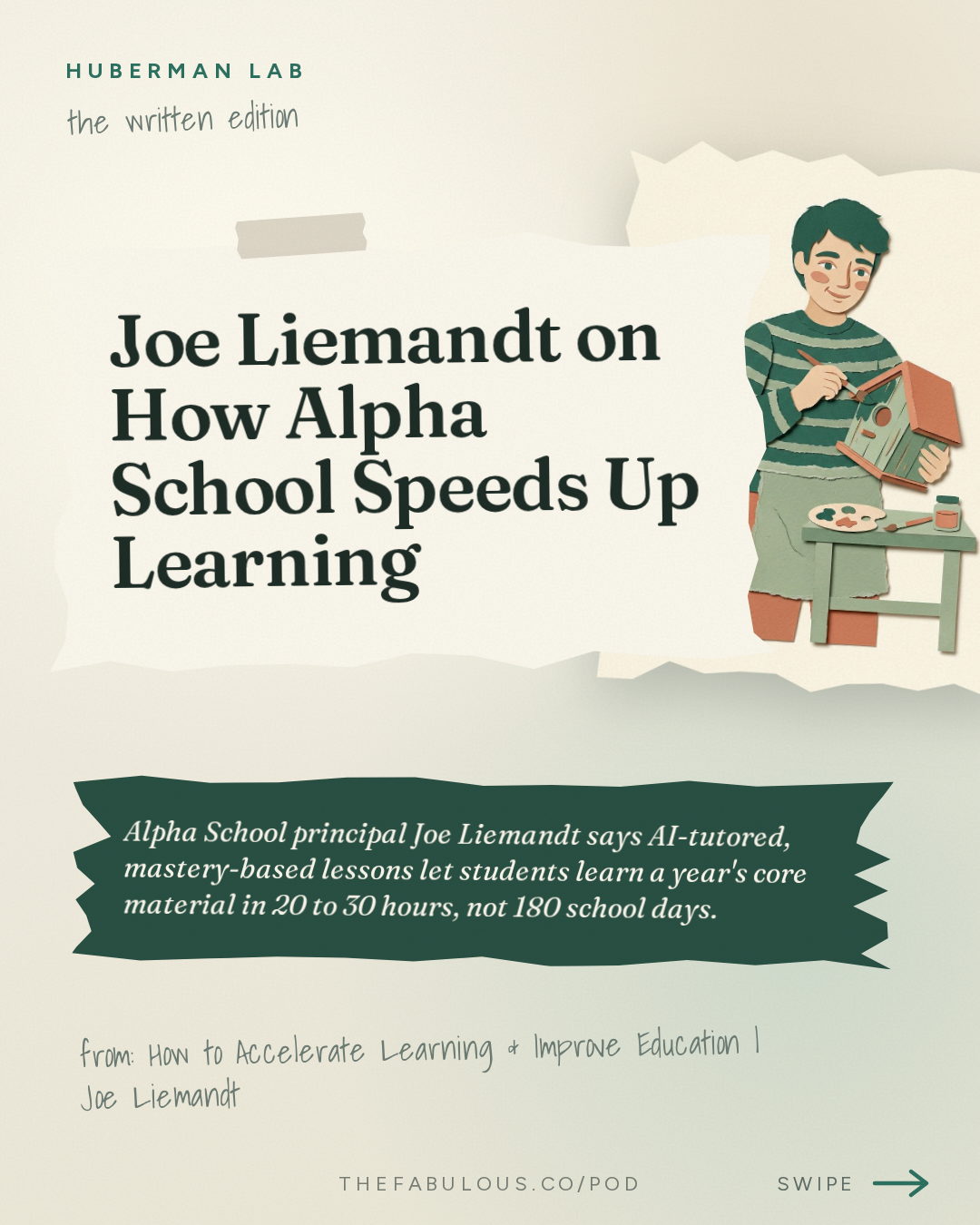
Alpha School principal Joe Liemandt says AI-tutored, mastery-based lessons let students learn a year's core material in 20 to 30 hours, not 180 school days. Alpha's K-12 students test in the top 1% nationally and average a 1,530 SAT, spending just two hours a day on academics before building real businesses and practicing life skills.
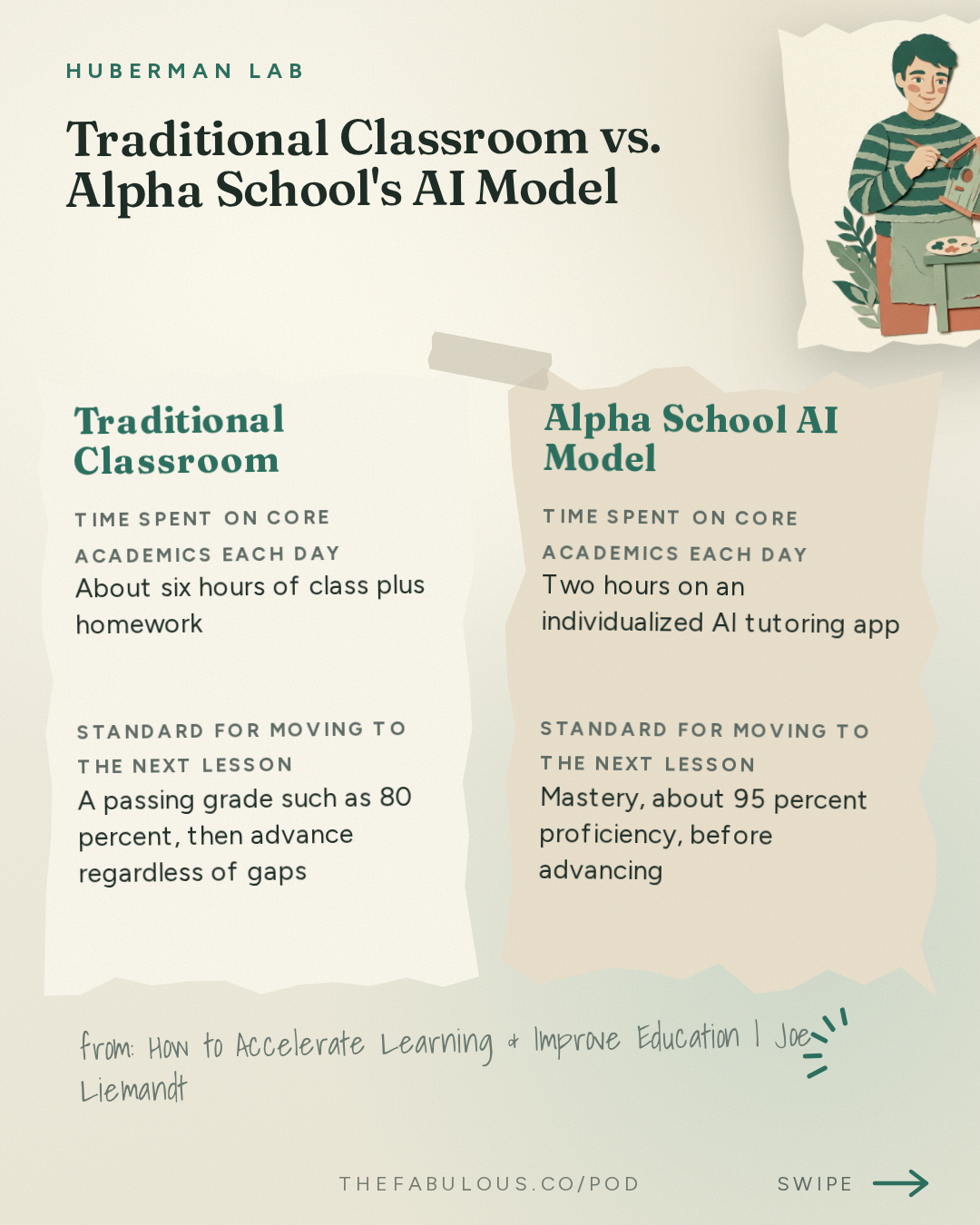
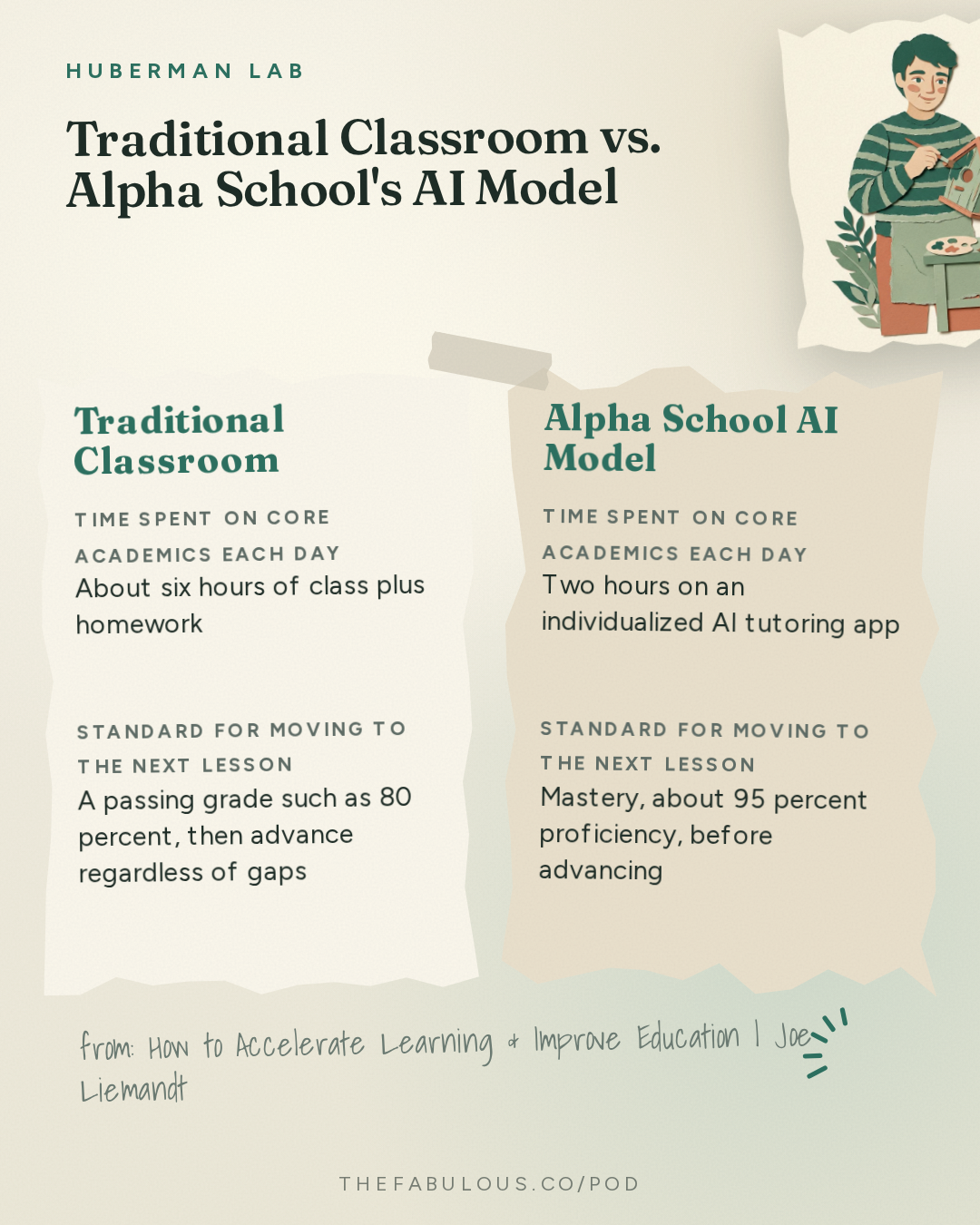
A basketball coach never tells a player who loses the ball one time in five to move on to dunks. Twenty percent is a crisis, not a passing grade. Joe Liemandt, principal of the Alpha School network, opens with that image because it captures what he thinks is broken in American classrooms: we let a student finish fourth grade with an 80 percent understanding of the material and send them straight into fifth grade content built on top of the missing 20 percent. In sports, gaps get fixed before you move on. In school, they compound for twelve years.
Liemandt did not start Alpha School. It was founded twelve years ago by Mackenzie Price, and Liemandt became a parent first, a skeptic second, and principal fifth. His pitch is not that children need more screens. It is that the thing actually limiting learning today is not access to information. Anyone can watch an MIT lecture on YouTube. Almost nobody becomes an MIT graduate by doing that. What is missing, Liemandt argues, is structure and motivation, the two things a good school still has to supply.
The Gap Nobody Named
A century ago, most of the world had no schooling at all. The Prussian model that spread afterward solved a real problem: it gave everyone access to a teacher and a room. Liemandt's complaint is that access and learning got confused for one another. "We have universal access. What we are trying to do is bring universal learning," he says (04:34). A rich district and a poor one can both put a teacher in front of thirty kids. What happens inside those twelve years of instruction can differ enormously.
The theoretical ceiling for closing that gap has been known since the 1980s. Educational psychologist Benjamin Bloom published a study showing that one-on-one tutoring, delivered to mastery, could move an average student into the top 2 percent of performance, a result researchers call the "two sigma" effect (30:18). The catch, which Liemandt says gets left out of the story, is that both halves matter: individualized instruction and mastery. Skip mastery and you lose most of the gain. Historically, one-on-one tutoring for every child was not affordable, so society settled for classrooms of twenty or thirty.
What changed, in Liemandt's account, is that AI tutoring software can now generate individualized lessons cheaply, at the level each student actually needs, and track whether they actually mastered it. Alpha students spend an average of 121 minutes a day on these apps (31:28) and, according to Liemandt, learn more in that time than they would in six hours of traditional class plus homework. He credits the technology less than the loop it creates. A teacher standing in front of a room gets noisy data: who was paying attention, who had the prerequisite knowledge, who was distracted. An AI tutor watching one student's answers in real time gets a clean signal, which Liemandt compares to what the microscope did for biology or the analytical balance did for chemistry (44:22).
The clearest illustration involves a very unglamorous idea: memorizing multiplication tables. Liemandt describes a student stuck with a low 710 math SAT score despite being told, repeatedly, to just be more careful. The actual problem was that she had never memorized her times tables to fluency, so every multiplication step during a word problem consumed one of her limited working memory slots. "If I know seven times eight is fifty-six, that takes nothing, right? I, you just know it. I have it to fluency," Liemandt says (53:32). Once she went back and drilled the basics, her score rose to 790. The lesson he draws is blunt: struggling students in algebra usually don't have an algebra problem, they have an unaddressed arithmetic problem, and piling on more algebra instruction won't fix it.
Alpha's own internal data pushed Liemandt to revise his views mid-course. He initially assumed spaced repetition alone, without requiring 95 percent proficiency on first pass, could substitute for old-fashioned drilling (49:05). That held true for eighth through twelfth grade, where worked examples carried most of the weight, but scores dropped in fourth through seventh grade until the school reinstated an initial mastery requirement. The finding that median students learn almost nothing academically between eighth and twelfth grade, based on NWEA MAP assessment data, is the backdrop for all of this: "High school, the median student in America doesn't learn anything" (62:10).
None of this works, in Liemandt's telling, without solving motivation first, which he estimates accounts for 90 percent of the problem. A student who is three years behind hears an impossible number and gives up. Liemandt's fix is reframing: a gap of three years sounds hopeless, but the same gap described as 20 to 30 hours of focused work per missing grade level (64:39) sounds doable. "You're twenty-two hours behind. It's twenty-two hours," he says of one reframed conversation (66:48). New students transferring into Alpha, even from $50,000-a-year private schools, arrive testing an average of 2.2 grade levels behind (63:50), which suggests the gap he's describing is common, not exceptional.
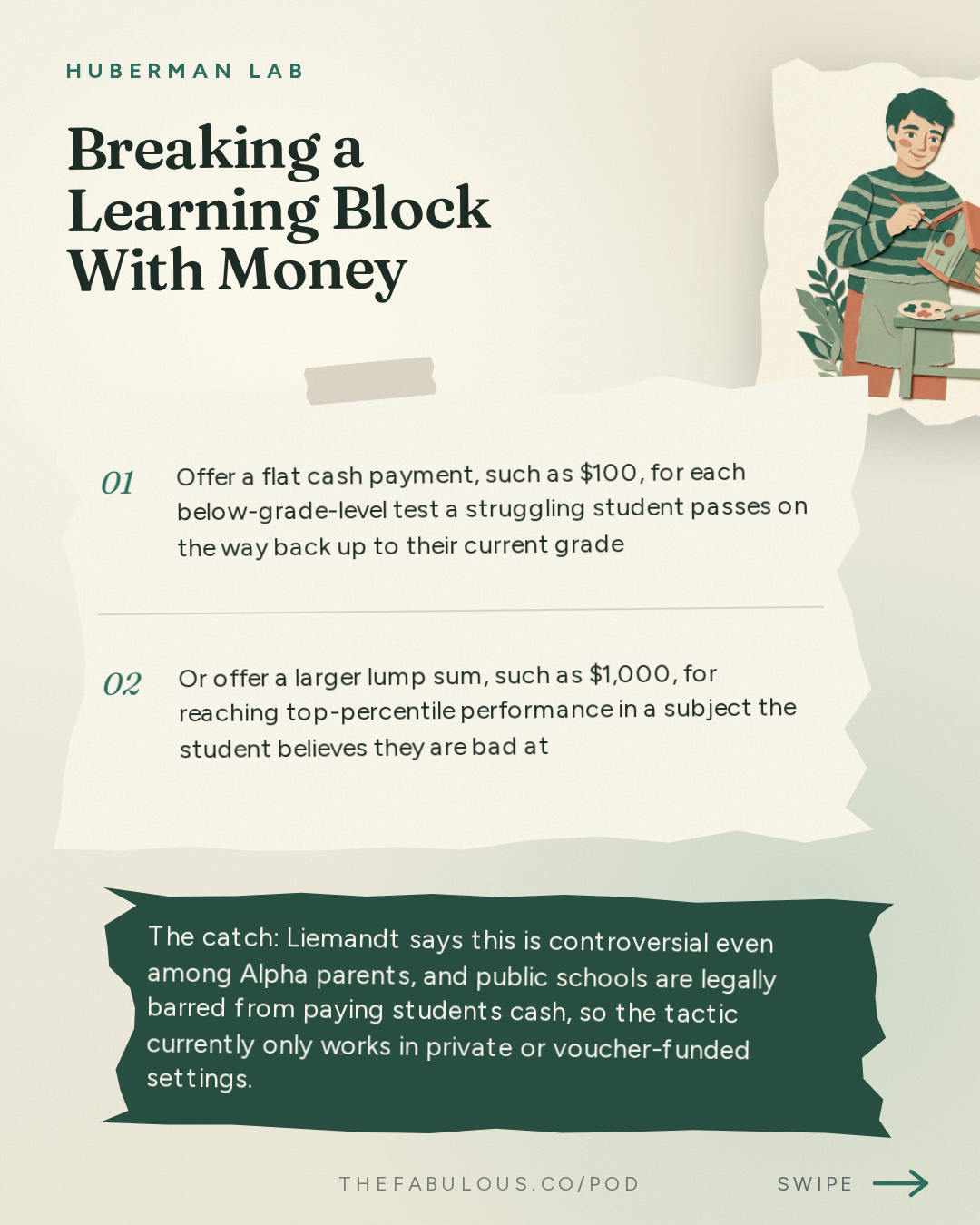
Where Liemandt gets more provocative is on incentives. Alpha has paid students directly, in cash, to break through a belief that they cannot succeed at something. A group of middle school girls who assumed they weren't "math and science people" were offered money to reach the top 1 percentile; his own daughter filled a $1,000 shopping cart in advance as motivation and later hit the target. Struggling seventh graders were paid $100 per grade level to take remedial tests they were embarrassed to take, working backward from third grade until their knowledge caught up (78:01). Liemandt argues the payment is a bridge, not the destination: once a student experiences the success, the external reward gives way to a revised sense of what they're capable of. Public schools, he notes, are legally barred from paying students cash, which he considers an unnecessary obstacle.
Builders, Not Just Test-Takers
The two hours of core academics are only half of Alpha's model. The rest of the day is built around what Liemandt calls "philosopher builders," a phrase meant to combine rigorous thinking with the habit of actually making things. Examples pile up quickly in conversation: a high schooler who trained a language model on dating advice and will be, in Liemandt's telling, the first Alpha student to be lead author on a paper published in Nature (100:15); a founder-school track that promises students a shot at $1 million in real business profit or a tuition refund; a student who built what became the best bike park in Texas.
Liemandt situates all of this against a broader anxiety about consumption. Many students arrive from what he calls a dopamine loop of TikTok and Fortnite, and the school's answer is a program called Dream Launcher, which asks students to track how they actually spend their hours against the person they say they want to become. The gap between the two, he says, is often the first real motivator a disengaged student encounters.
The obvious rebuttal to all of this is that Alpha is an expensive private school serving a self-selected, often affluent population, and that its results say more about who enrolls than about what works. Liemandt doesn't dodge this. He points to Alpha's Texas Sports Academy, funded through the state's new voucher program for families earning under $65,000 a year (141:39), which drew more than 120,000 applications for roughly 1,000 spots and is now, by his account, the largest recipient of that voucher category in the state. He also notes that family income remains the single strongest predictor of standardized test performance in the current system, ahead of IQ and even the personality trait of conscientiousness (131:48). Whether AI-personalized tutoring can actually break that link at scale is now the subject of a research partnership with MIT's Blueprint Labs, which Liemandt says will run randomized controlled trials rather than rely on Alpha's own numbers.
The honest version of Liemandt's argument isn't that every child can become MIT-eligible by middle school, a goal he reserves for a separate gifted track. It's narrower and more testable: that the frontier of what any given student can learn is farther away than the current system assumes, and that the tools to close that gap, cheap individualized instruction plus a reason to care, now exist outside of elite tutoring. Whether that promise survives contact with the ordinary public school system, with its budgets, unions, and legal restrictions on paying kids in cash, is the experiment Liemandt says he is only a few years into running.
Ask this episode anything
Pod's AI answers from the episode itself, with the minute mark so you can hear it yourself.
Or start with one of these
Ask this episode
Pod's AI listens to the whole episode to answer, and points you to the minute it comes from.
The rest of this answer, and any question after it
Answers come from the episode itself, never from a summary of it.
ContinueKey takeaways
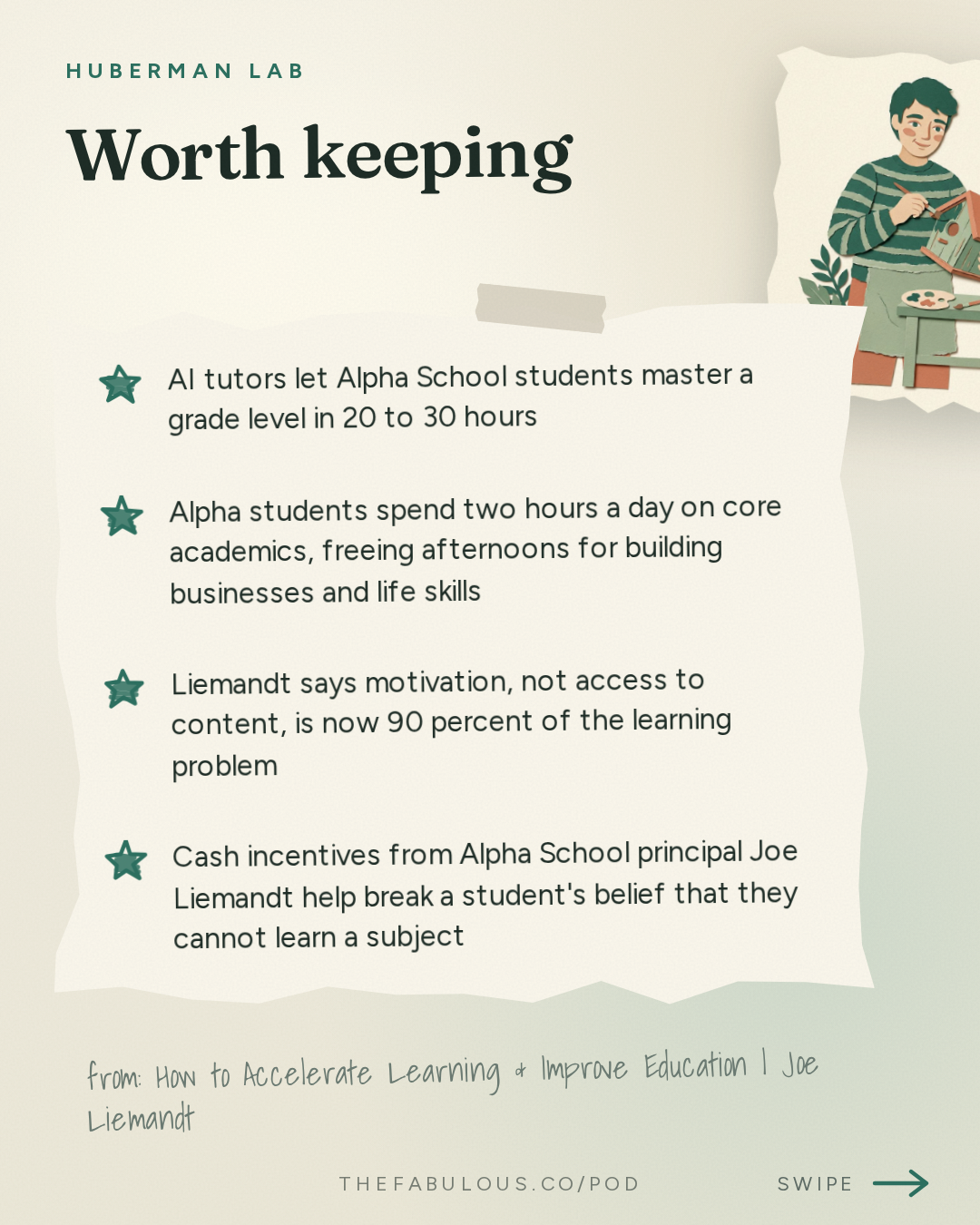
- AI tutors let Alpha School students master a grade level in 20 to 30 hours
- Alpha students spend two hours a day on core academics, freeing afternoons for building businesses and life skills
- Liemandt says motivation, not access to content, is now 90 percent of the learning problem
- Cash incentives from Alpha School principal Joe Liemandt help break a student's belief that they cannot learn a subject
- Fluency in basics like multiplication frees working memory for harder problems like algebra, Liemandt says
The episode in cards

By the numbers
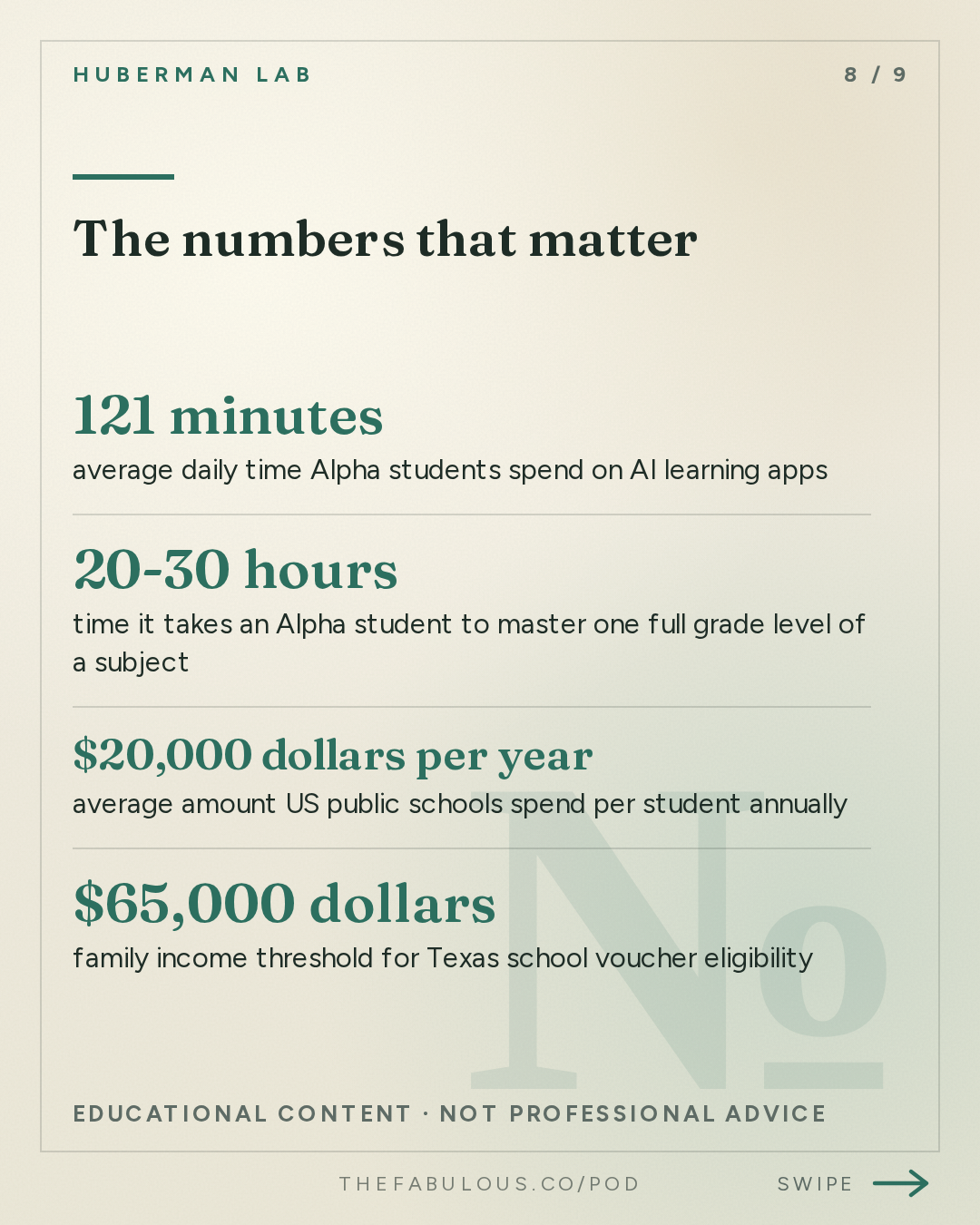
- 121 minutes average daily time Alpha students spend on AI learning apps
- 20-30 hours time it takes an Alpha student to master one full grade level of a subject
- $20,000 dollars per year average amount US public schools spend per student annually
- $65,000 dollars family income threshold for Texas school voucher eligibility
In their words
“We have universal access. What we are trying to do is bring universal learning.”
“I can't run a school that they love more than vacation if I have low standards.”
“If I know seven times eight is fifty-six, that takes nothing, right? I, you just know it. I have it to fluency.”
“High school, the median student in America doesn't learn anything.”
“This is the best time in history to be a five-year-old.”
Protocols
-
Catch students up with individualized AI lesson plans
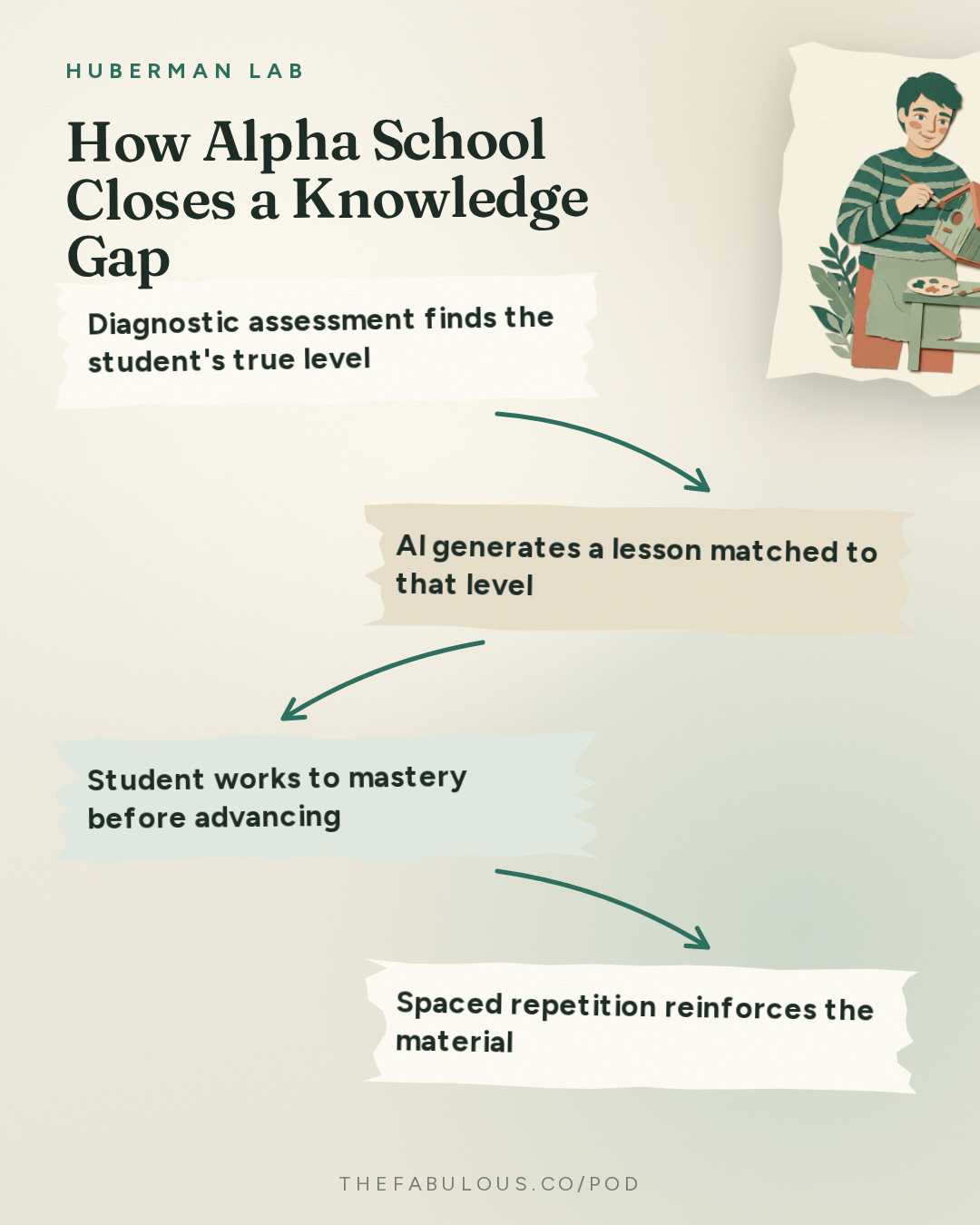
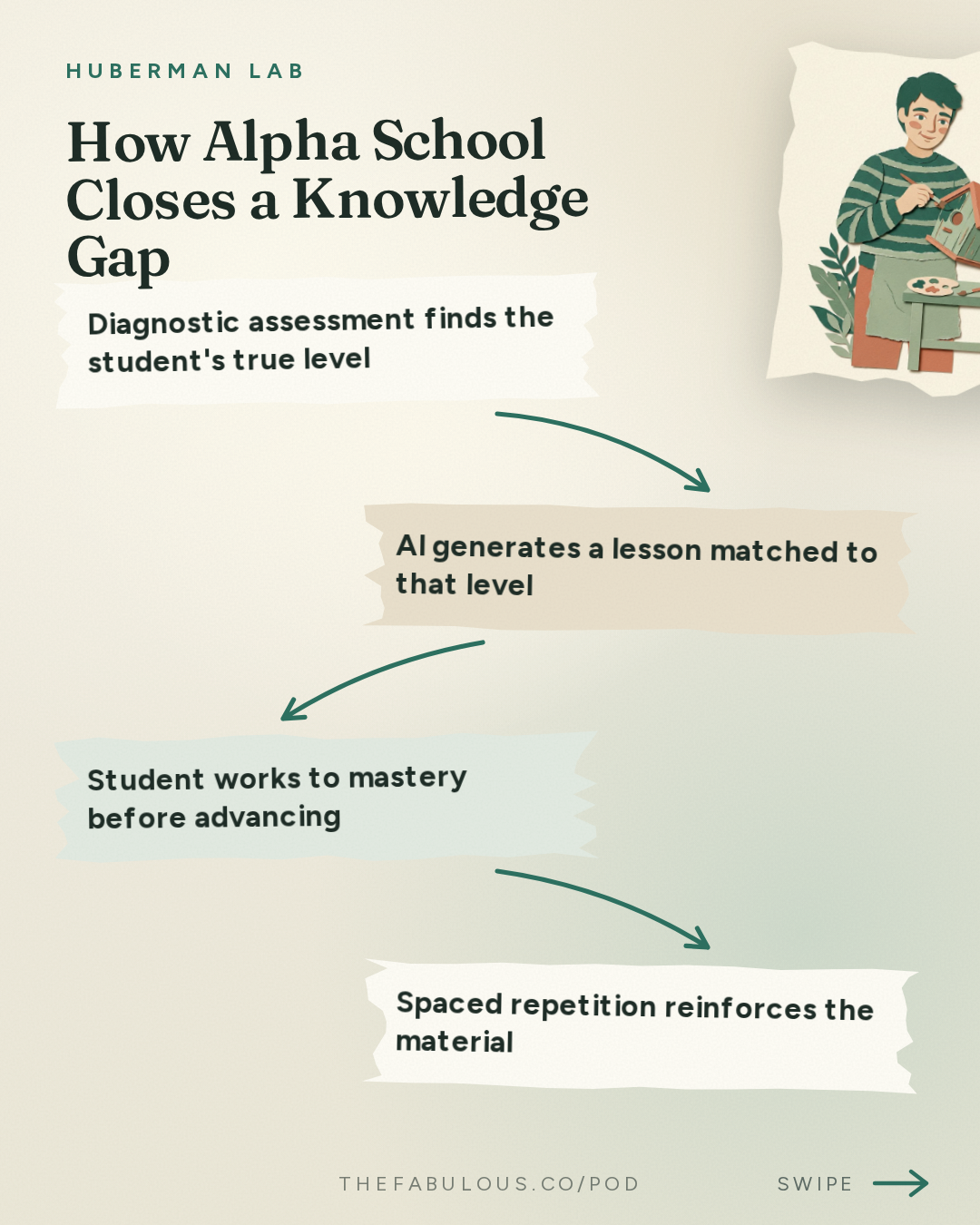
Liemandt has Alpha School's AI system assess each student's actual grade level, then generates a personalized lesson plan that targets the specific gaps in that student's core subject knowledge, and has the student work through those lessons until they hit mastery.
Daily, until the gap closes, which Alpha's data show takes 20 to 30 hours per missing grade level
-
Combine worked examples with spaced repetition, and require initial mastery for younger students
Liemandt's team teaches new material through worked examples that gradually remove scaffolding, then reinforces it with spaced repetition timed to each student's forgetting curve, and for students in fourth through seventh grade Liemandt requires 95 percent initial mastery before letting them move on, after finding that skipping this step lowered scores in that age range.
Ongoing, applied to every new lesson
-
Use cash incentives to break an 'I can't' block
Liemandt pays students directly, such as a flat fee per grade level mastered on a remedial test or a lump sum for reaching the top performance percentile, to push them through material they already believe they cannot learn, and he reports that once a student sees the result, the external reward gives way to intrinsic motivation.
One-time or per milestone, used only to break a specific mental block
-
Pair high standards with high support
Liemandt trains Alpha School's guides, the school's term for its non-academic teachers, to hold every student to a high academic and behavioral bar while staying present to coach them through the struggle, following the mentor-mindset model described in psychologist David Yeager's book Ten to Twenty-Five, and Liemandt says dropping either half of that pairing, standards without support or support without standards, fails the student.
Continuous, embedded in daily coaching
Questions this episode answers
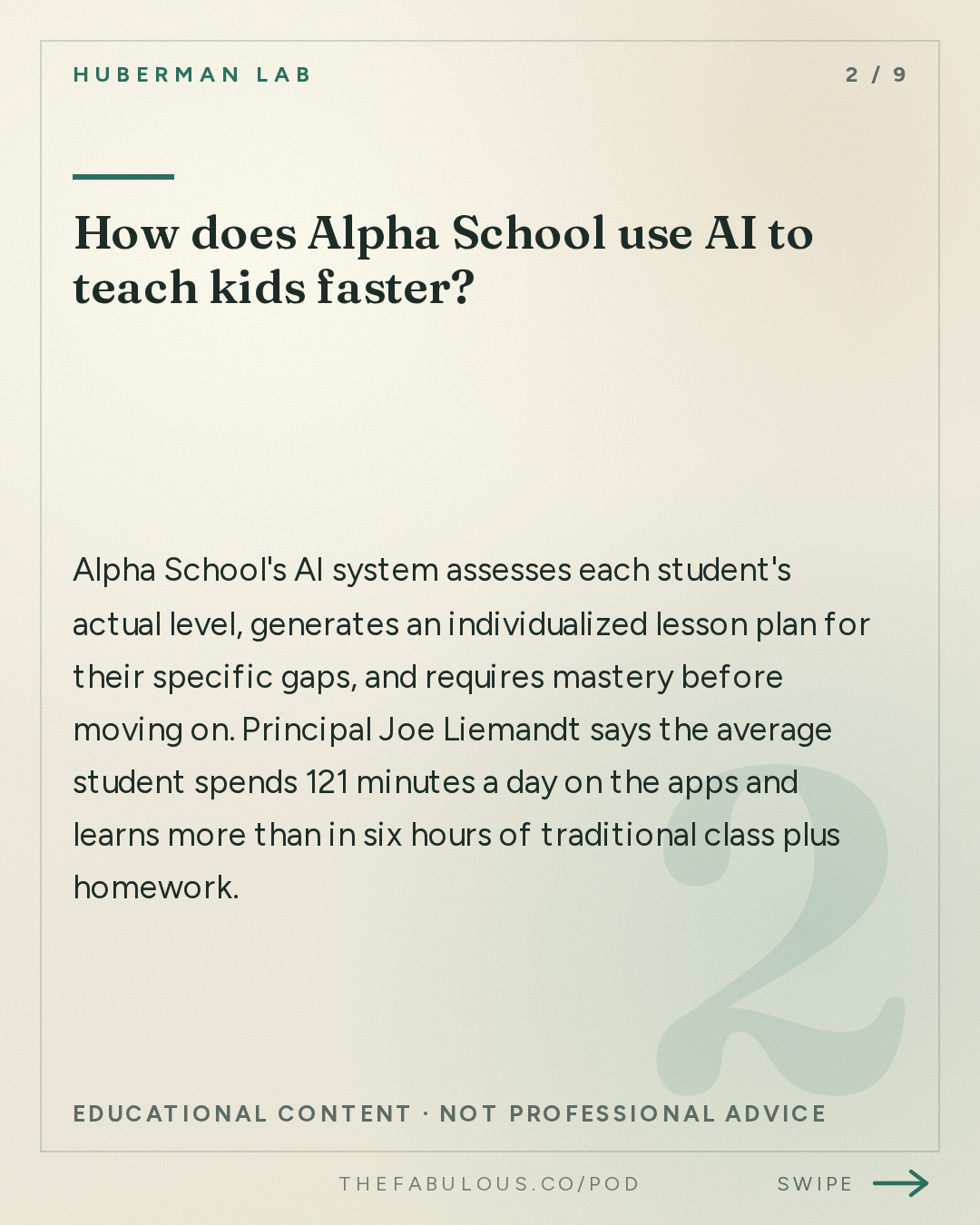
How does Alpha School use AI to teach kids faster?
Alpha School's AI system assesses each student's actual level, generates an individualized lesson plan for their specific gaps, and requires mastery before moving on. Principal Joe Liemandt says the average student spends 121 minutes a day on the apps (31:28) and learns more than in six hours of traditional class plus homework.
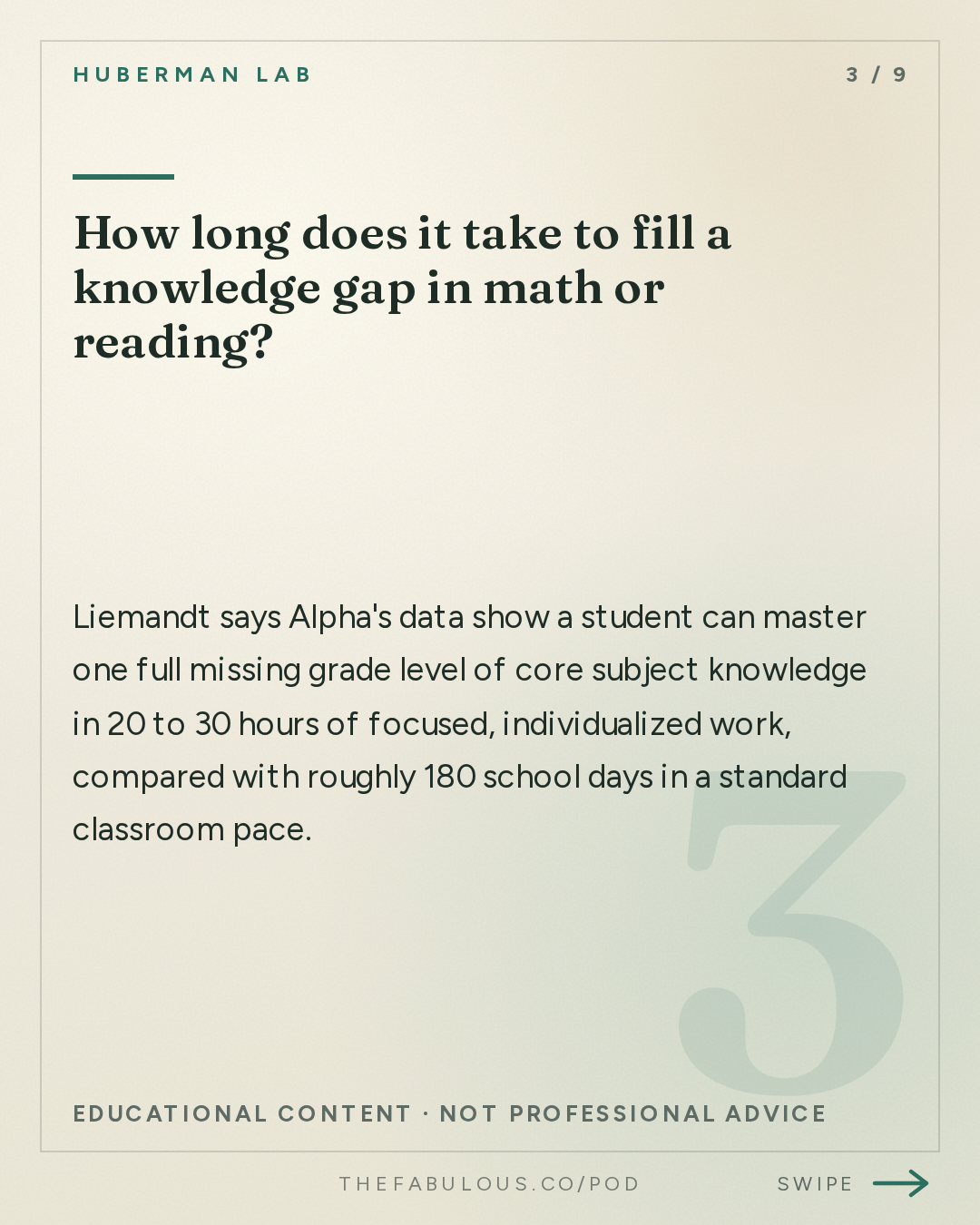
How long does it take to fill a knowledge gap in math or reading?
Liemandt says Alpha's data show a student can master one full missing grade level of core subject knowledge in 20 to 30 hours of focused, individualized work (64:39), compared with roughly 180 school days in a standard classroom pace.
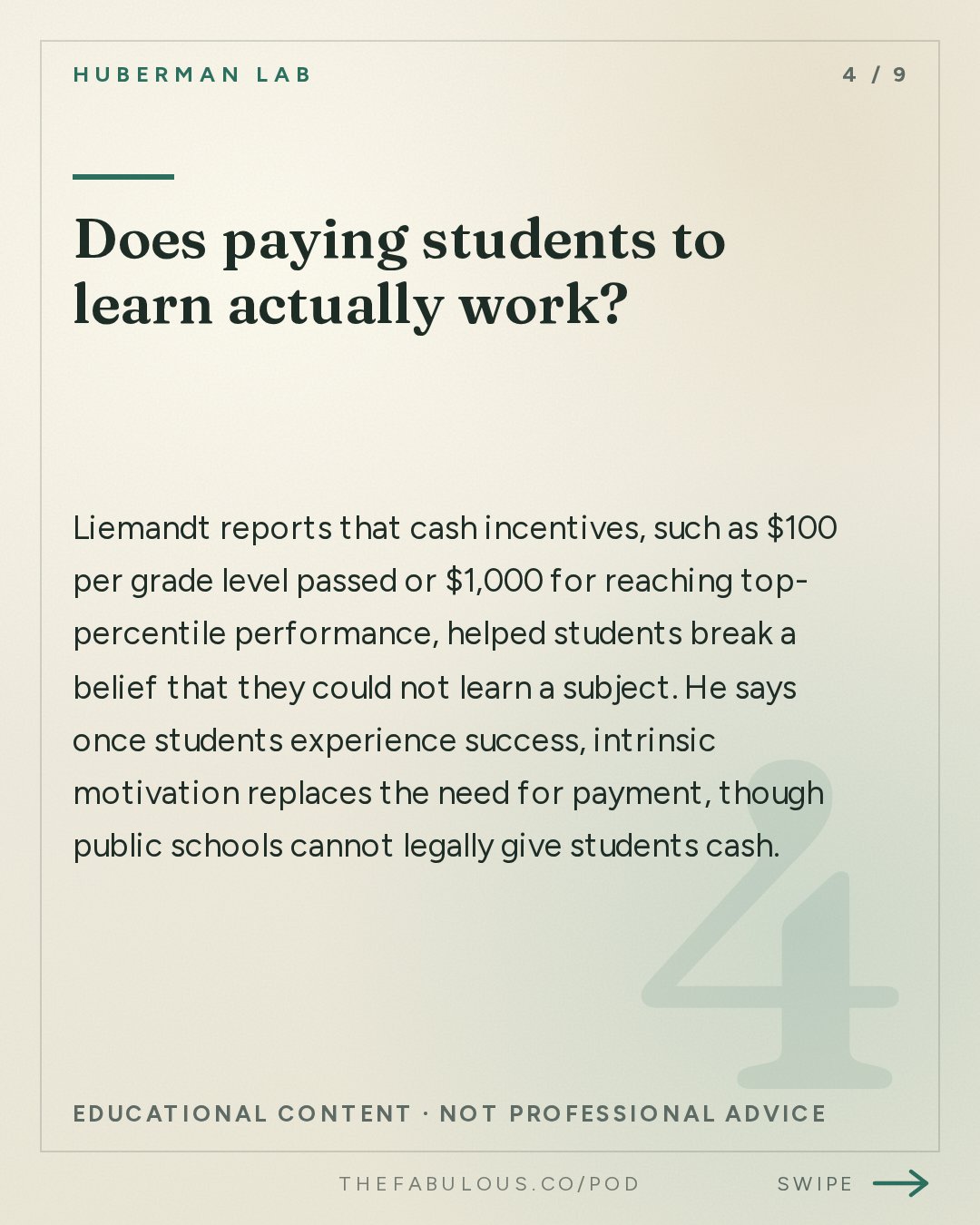
Does paying students to learn actually work?
Liemandt reports that cash incentives, such as $100 per grade level passed or $1,000 for reaching top-percentile performance, helped students break a belief that they could not learn a subject (75:11). He says once students experience success, intrinsic motivation replaces the need for payment, though public schools cannot legally give students cash.
What is Bloom's two sigma problem?
It refers to a 1980s finding by researcher Benjamin Bloom that one-on-one tutoring delivered to mastery could move an average student into the top 2 percent of performance (30:18). Liemandt argues both individualized instruction and mastery are required to get that result, and that AI tutoring now makes it affordable at scale.
Why does multiplication fluency matter for learning algebra?
Liemandt explains that solving a math fact from memory takes no working memory, but calculating it uses up a limited working memory slot needed for multi-step problems (52:39). He describes a student whose math SAT score rose from 710 to 790 after going back to memorize multiplication tables rather than practicing more algebra.
Is Alpha School's model just working because it serves wealthy, selected students?
Liemandt acknowledges the selection-effect critique and points to Alpha's Texas Sports Academy, funded by vouchers for families earning under $65,000 a year (141:39), which drew over 120,000 applications for about 1,000 spots. Alpha has also partnered with MIT's Blueprint Labs to run randomized controlled trials rather than rely on its own results.
The full read, in cards
Go deeper
- Bloom's 2 Sigma Problem (1984 study) — found that one-on-one tutoring delivered to mastery moved average students into the top 2 percent of performance
- Project Follow Through — a large 1970s federal study comparing teaching methods that Liemandt says most teachers never learn about in training
- Ten to Twenty-Five: The Science of Motivating Young People — psychologist David Yeager's book on the high-standards, high-support mentor mindset that shaped Alpha's guide training
- The Self-Driven Child — book Alpha parents are assigned on adolescent motivation and autonomy during middle and high school
- Nature paper on AI-generated dating advice for teens — an Alpha high school student's published study found an AI chatbot's dating advice outperformed typical parental advice
Mentioned
Joe Liemandt · Alpha School · David Yeager · Ten to Twenty-Five · Benjamin Bloom · Alex Hormozi · Project Follow Through · MIT Blueprint Labs · The Self-Driven Child · Mark Rober
More from this show and category
Jared Diamond on Leadership: Why Charisma Isn't Required
Charisma is optional for great leadership, biologist and historian Jared Diamond argues, pointing to the uncharismatic dictators Stalin and Pinochet as proof (00:26). Diamond, 89, applies a 'natural experiment' method from biology to politics, religion, business, and sports, showing only 2 of 22 modern political leaders stepped down voluntarily and that coaches and CEOs get too much credit or blame for outcomes that are mostly random (95:37).

Neuralink Trials for Quadriplegia: What Comes First
Neuralink's head neurosurgeon Matt MacDougall explains that the implant's first job is letting quadriplegic patients move a cursor and type by thought alone, not reconnect limbs. He also covers the robotic surgery that makes this possible, the safety case made in pigs and monkeys, and his own subdermal RFID chip.
How Diet Affects Memory and the Hippocampus
USC neuroscientist Scott Kanoski says the hippocampus, the brain's memory hub, tracks recent meals via the vagus nerve to judge hunger and fullness. Sugar, heat-processed foods, and artificial sweeteners early in life can impair that memory system and its gut bacteria, while exercise and simple recall of a recent meal can help restore or harness it.

Elissa Epel's Guide to Stress and Resilience
Psychologist Elissa Epel says stress is simply when demands exceed our resources, and most modern stress comes from our own thoughts. She shows how a challenge mindset, radical acceptance, and small daily practices like 'dropping the rope' change inflammation, telomere length, and mitochondrial energy output measurably.
