
Neuralink Trials for Quadriplegia: What Comes First
Essentials: Neuralink & Technologies to Enhance Human Brains | Dr. Matt MacDougall
The brief
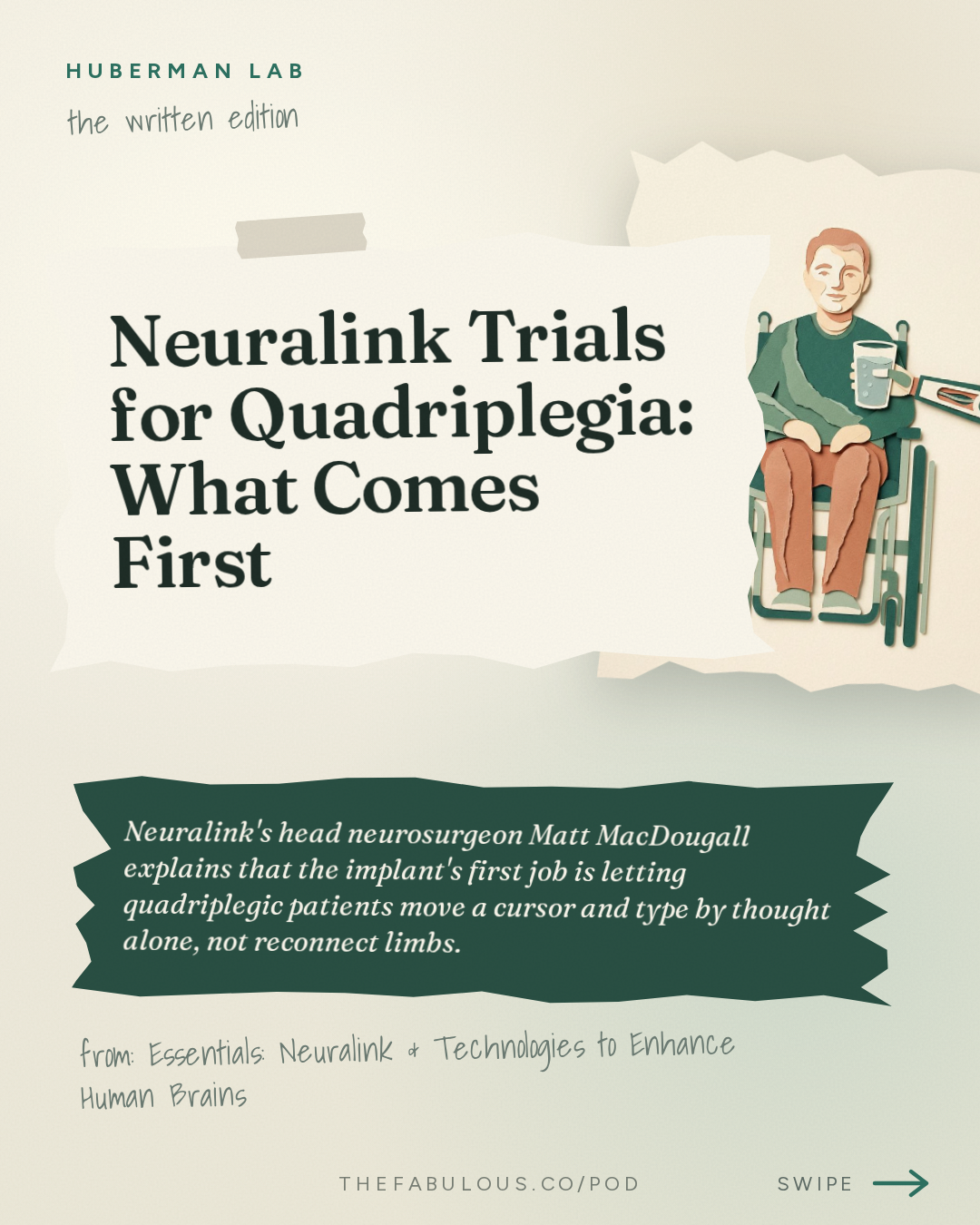
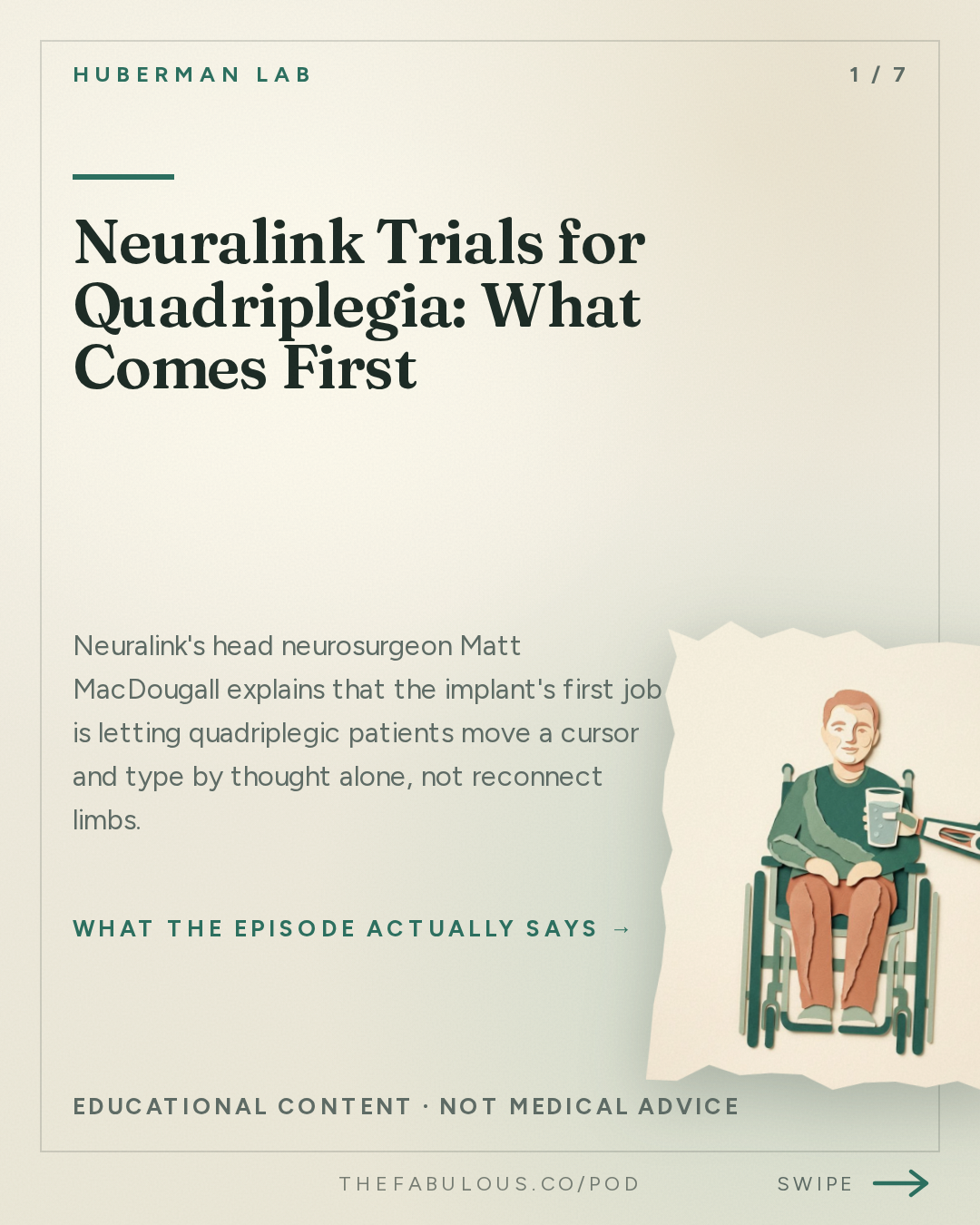
Neuralink's head neurosurgeon Matt MacDougall explains that the implant's first job is letting quadriplegic patients move a cursor and type by thought alone, not reconnect limbs. He also covers the robotic surgery that makes this possible, the safety case made in pigs and monkeys, and his own subdermal RFID chip.
A young man wakes from emergency brain surgery and points at his elderly recovery-room nurse. He has survived a car crash and the operation that saved his life, but with frontal lobe damage so severe that his impulse control is gone entirely. He points at the nurse and tells the doctors, bluntly, that she will not have sex with him. Neurosurgeon Matt MacDougall, head neurosurgeon at the brain-implant company Neuralink, tells this story early in his conversation with Andrew Huberman not to shock, but to make a point about what the brain actually is (01:43).
"The brain really is a collection of functional modules pinned together, duct taped together in this bone box attached to your head." (Matt MacDougall, [00:47])
That image, modules duct-taped inside a skull, explains both the tragedy of that patient and the opportunity MacDougall spends his career chasing. If the brain is modular, damage to one module, say, the frontal lobe that restrains behavior, can erase a single function while leaving the rest of a person intact. And if function lives in discrete modules, a device might in theory tap into one directly, bypassing whatever connection has failed between brain and body.
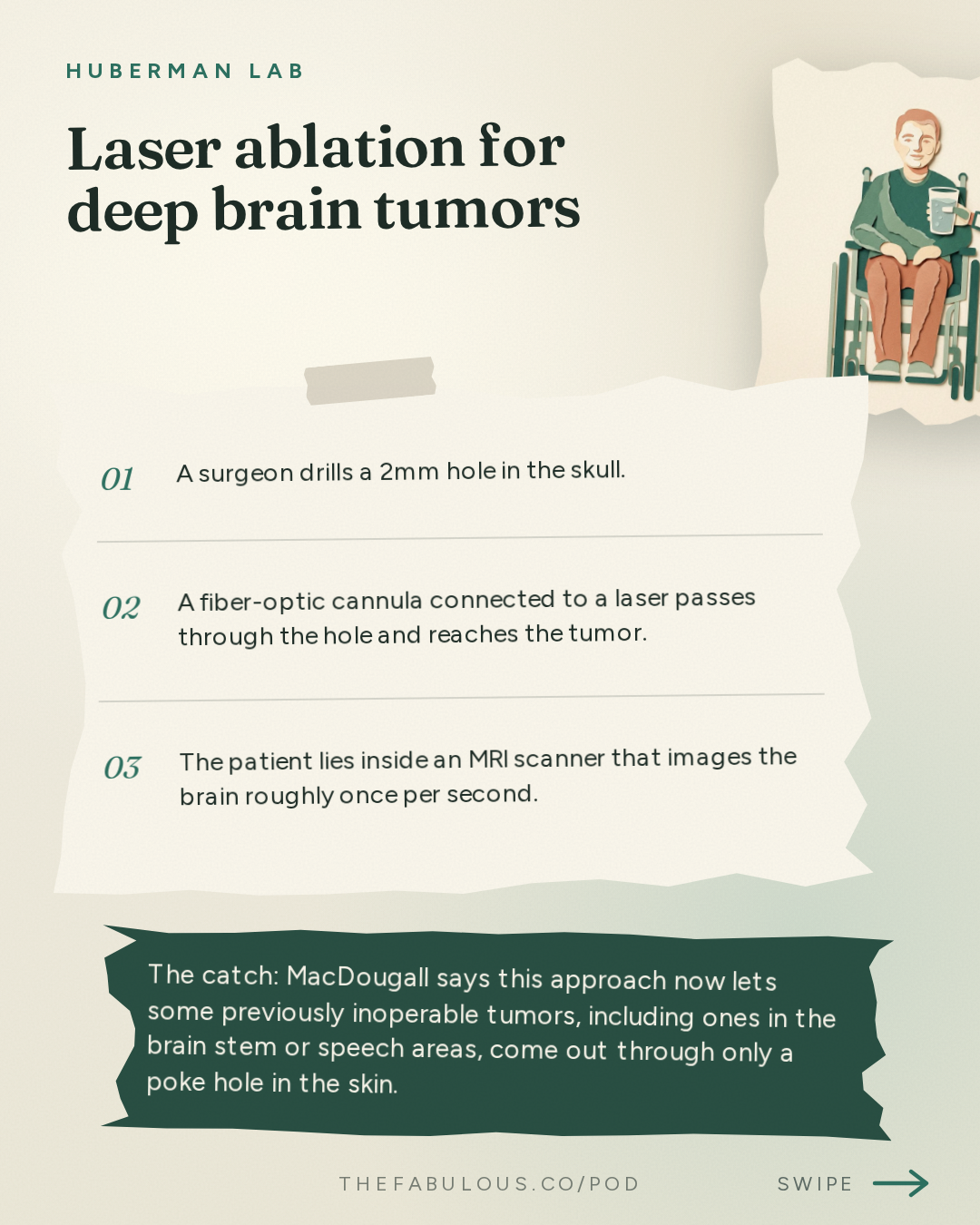
MacDougall's day job already proves half of that logic. For a small, deep brain tumor that once required cutting through healthy tissue to reach, he now drills a 2 millimeter hole in the skull, threads a fiber-optic cannula down to the tumor, and attaches it to a laser (03:28). The patient lies inside an MRI scanner the whole time, imaged roughly once a second, so MacDougall can watch the tumor's temperature climb in real time and stop before the heat reaches healthy brain nearby. Tumors once considered untouchable, including ones in the brain stem or in the brain's speech centers, can now sometimes be eliminated while leaving only what he calls "a poke hole in their skin" (04:02).
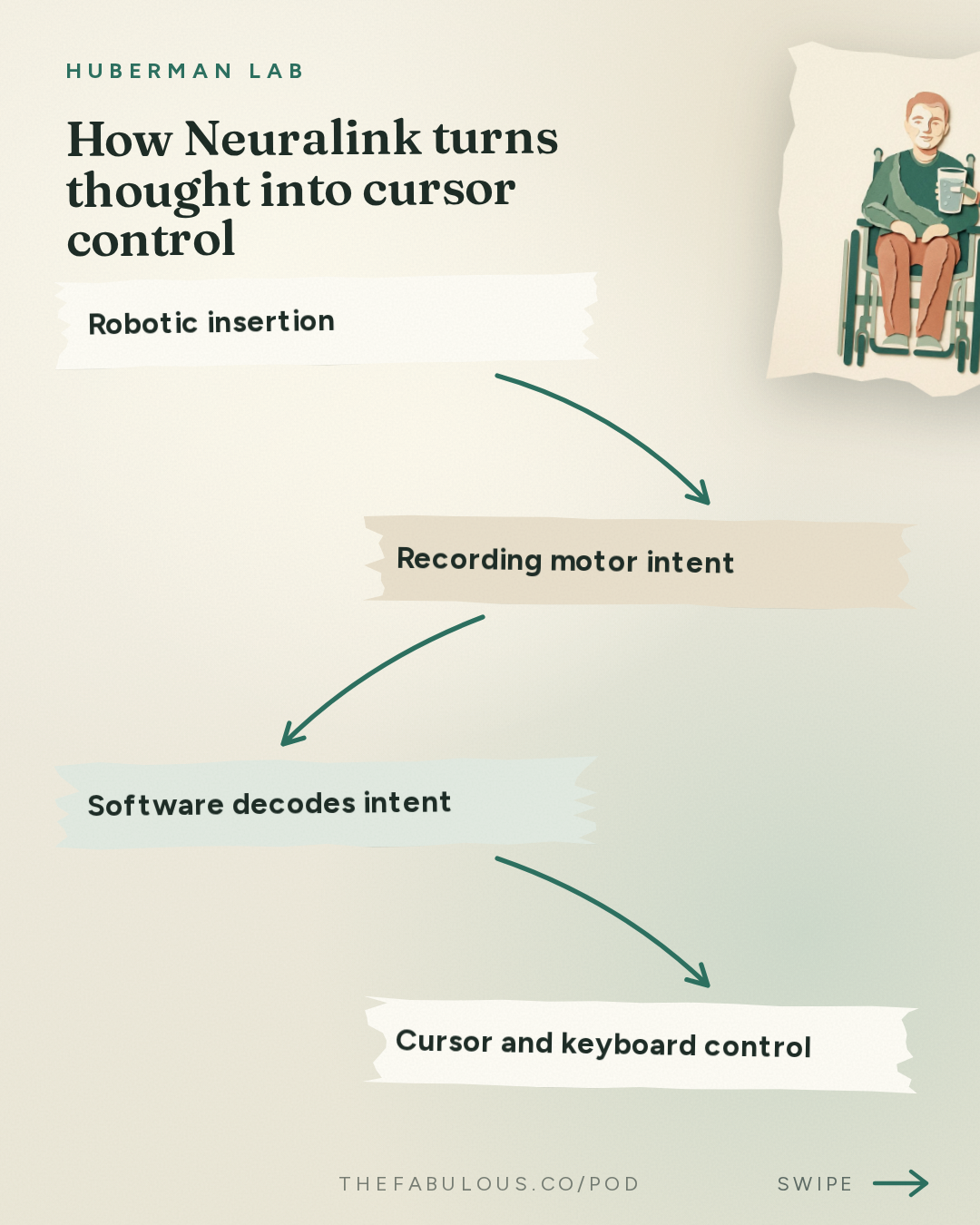
Neuralink applies that same logic of precision to a harder problem: a broken connection rather than a diseased piece of tissue. Its implant carries electrodes far thinner than a human hair, placed by a surgical robot rather than by MacDougall's own hands (05:29). The reason is mechanical, not symbolic. MacDougall notes that no human hand is steady enough to grasp and seat a loop just a few microns wide at the end of the electrode thread, blind, at the right depth, fast enough and consistently enough across the whole array (07:36). He still opens the skin and skull himself. The robot takes over once it is handed a clean brain surface.
What the first patients actually get
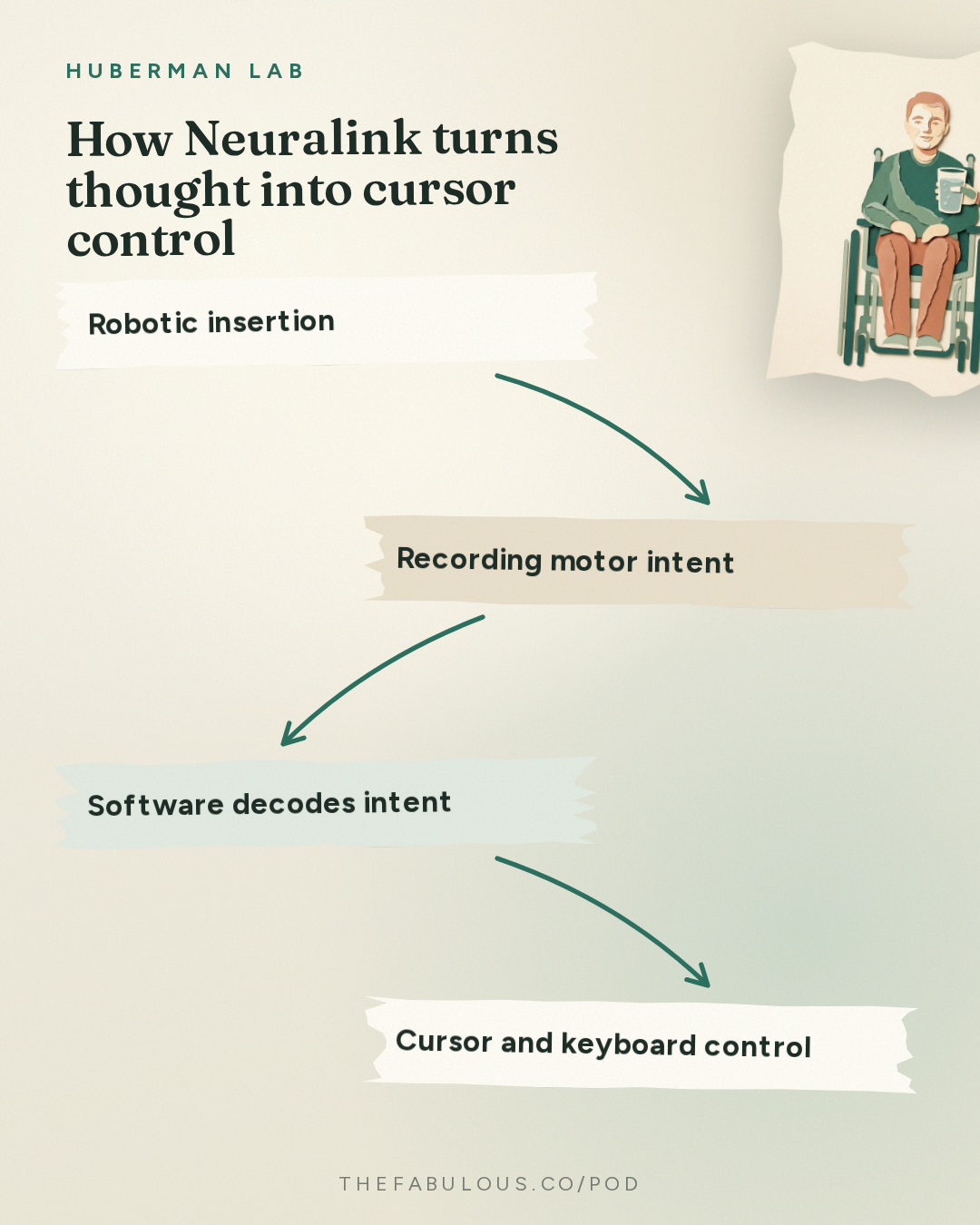
It would be easy to assume Neuralink's opening move is restoring movement to paralyzed limbs. It is not. The first target is people with spinal cord injuries who are quadriplegic but whose motor cortex, the brain region that plans and initiates movement, is intact. The implant reads the intention to move a hand and turns it into control of a computer mouse and keyboard, nothing more exotic than that (06:29). No arm moves. No hand touches anything. A cursor moves on screen because the signal that would have gone to a hand now goes to a device instead, and MacDougall calls the result digital freedom, meaning the patient can use a computer and the internet again on their own terms.
Reconnecting the brain to the patient's own body is a separate, later goal. MacDougall describes a planned second implant placed in the spinal cord itself, below the injury, that would talk directly to the brain implant above it, letting intact motor signals skip the damaged section of the cord entirely (18:20). By his own account, that is years further down the road than the cursor-and-keyboard version.
The groundwork for decoding intention has been built in animals first. Neuralink has monkeys playing simple video games for smoothie rewards, and the company says it holds the fastest recorded rate of information moving from a monkey's brain into deliberate, accurate cursor control (12:10). MacDougall is candid about how confident he is in the result for humans. He states that he believes Neuralink's implant surgery already clears a safety bar higher than many routine, FDA-approved procedures he performs regularly (13:53), though this is his own professional judgment rather than an independent regulatory finding, and the device was still in front of the FDA at the time of this conversation.
Small chips, bigger questions
MacDougall is also, by his own description, something of a test subject. For roughly seven years he has carried a small RFID tag implanted under the skin of his hand, a passive chip with no battery that a phone or an antenna can briefly power to read or write a small amount of data (14:37). It has unlocked his front door and, for a stretch, the doors at Neuralink's offices. He coated it in silicone over its biocompatible glass casing, a rock climber's precaution, and expects it could sit under his skin for the rest of his life without needing to come out (15:50). It is a minor piece of biohacking, but he frames it as a working principle: he will only recommend an implant to a patient if he has been willing to put something comparable in himself.
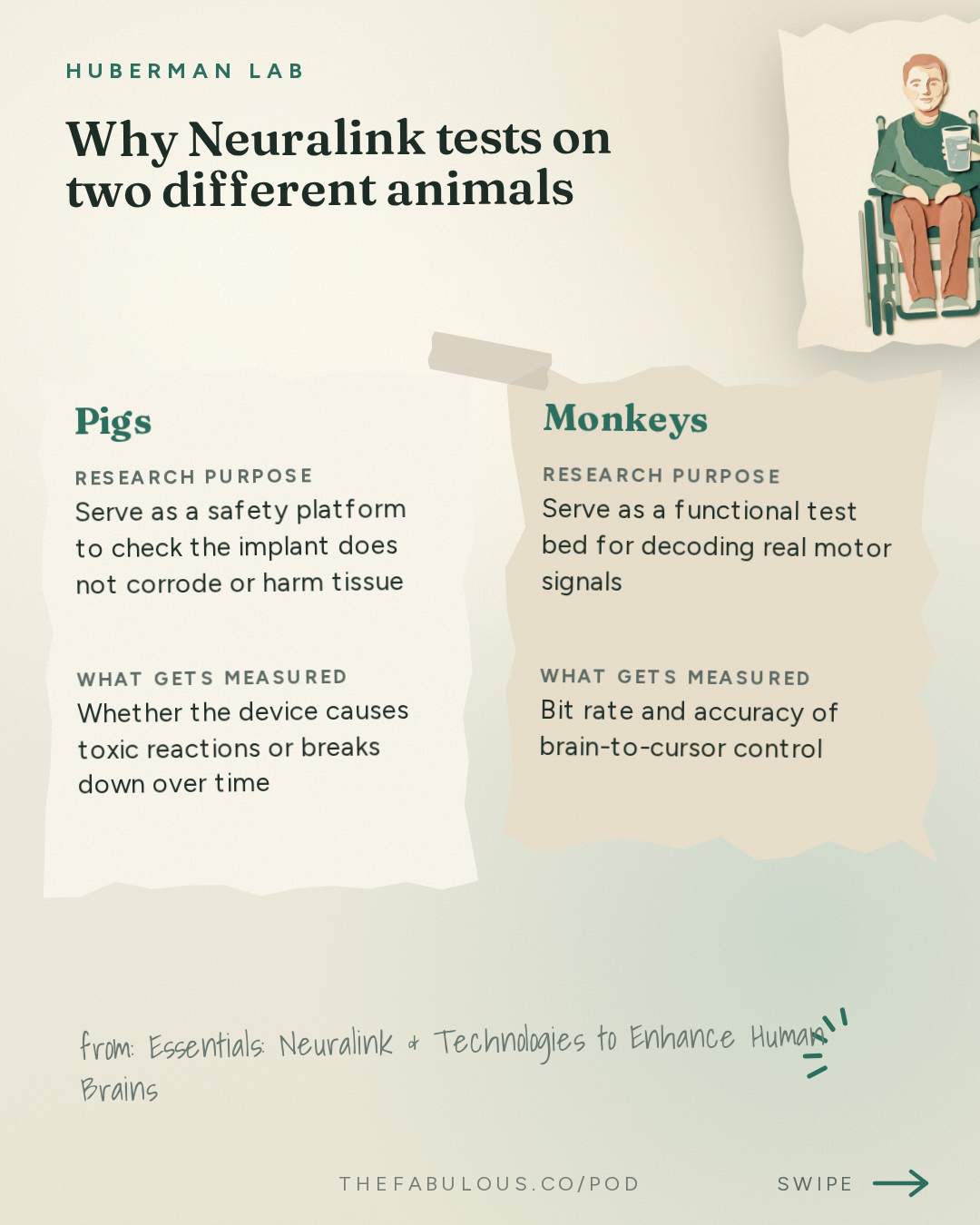
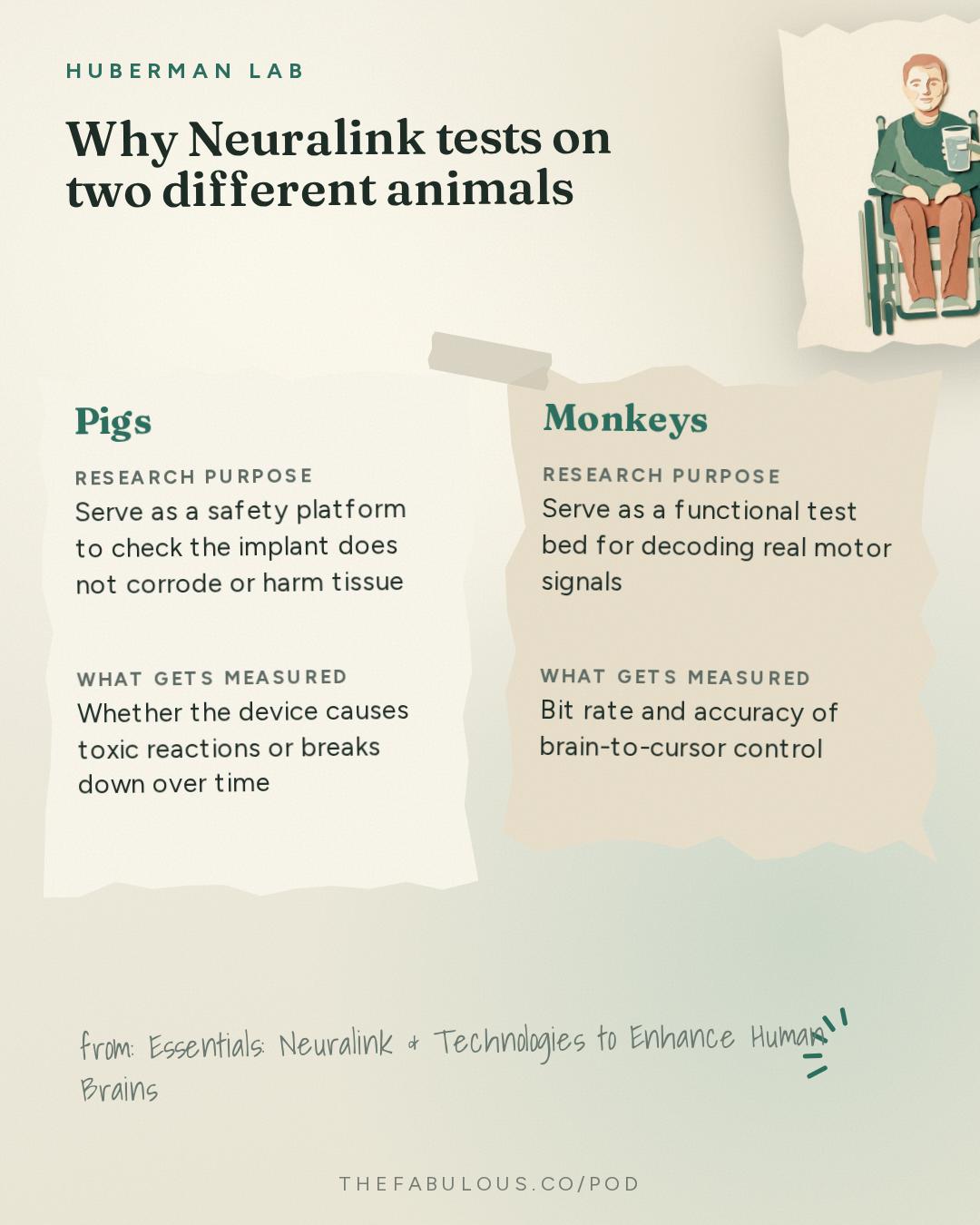
The animal research question gets a more serious airing. Neuralink uses pigs because their skulls are close enough in size and shape to a human's to make them a reasonable platform for testing whether the implant itself is safe, whether it corrodes, overheats, or provokes a reaction (26:58). It uses monkeys because their brains can learn complex tasks well enough to confirm that the signals the device records actually correspond to intended movement, the functional half of testing that pigs cannot provide (27:25). MacDougall insists the animals are never deprived of food or water and are never compelled to perform; a monkey that does not want to play the cursor game on a given day simply does not play (26:07). He places the debate in a wider context, too: compared with the number of animals used for food every day, he argues, the number used in device research like this is small, and he welcomes a future in which early-stage human volunteers make some of it unnecessary.
The most speculative part of the conversation is also the most familiar, in science-fiction terms: communication from one brain straight into another. MacDougall's answer deliberately deflates the mystique. Two people already send each other text messages without speaking or making eye contact. Moving that same function from a phone screen into an implanted device, he argues, needs no new scientific breakthrough, just a shift in where the keyboard-and-cursor signal originates (19:45).
"We're, you know, trying to send messages back and forth through a tiny straw, and there's no reason that needs to necessarily be true." (Matt MacDougall, [31:37])
Speech, in his telling, is a narrow channel built from air pushed past tissue in the face, prone to being misheard and slow compared with what a high-bandwidth brain interface might eventually carry. He puts a loose ten to twenty year window on something closer to full cognitive integration with artificial intelligence, offered not as a company roadmap but as a personal guess about what his own children might see (30:30).
What holds the conversation together is the modular view of the brain that opened it. A frontal lobe can fail and take impulse control with it. A tumor can sit in one region and be erased without touching its neighbors. A motor cortex can survive a spinal injury intact and still be reached from outside the body. None of this treats the brain as a mystery beyond reach. It treats it as wiring, with failure modes that can sometimes be routed around, and modules that, in MacDougall's view, have not finished showing what they can do once something is allowed to plug into them directly.
Ask this episode anything
Pod's AI answers from the episode itself, with the minute mark so you can hear it yourself.
Or start with one of these
Ask this episode
Pod's AI listens to the whole episode to answer, and points you to the minute it comes from.
The rest of this answer, and any question after it
Answers come from the episode itself, never from a summary of it.
ContinueKey takeaways
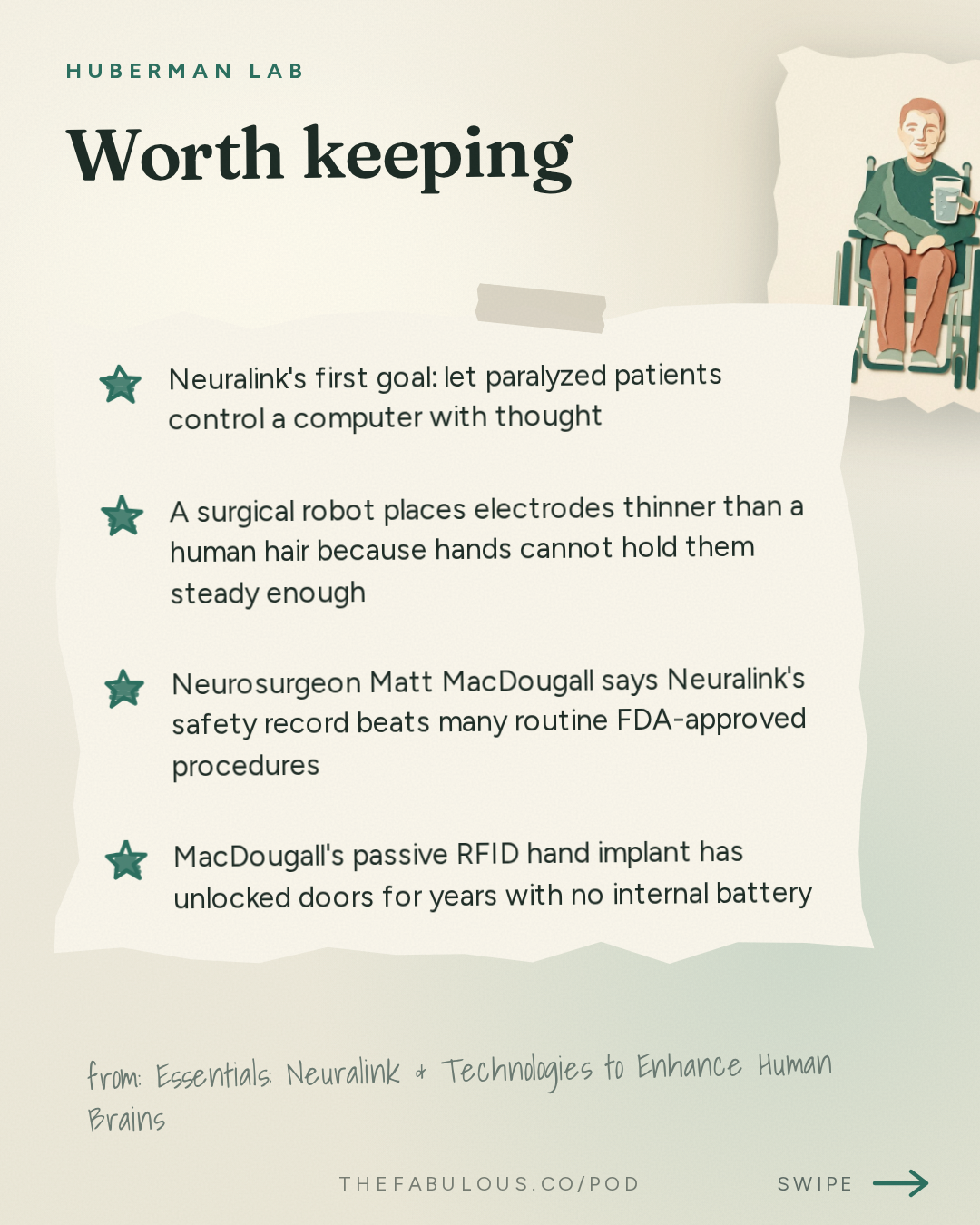
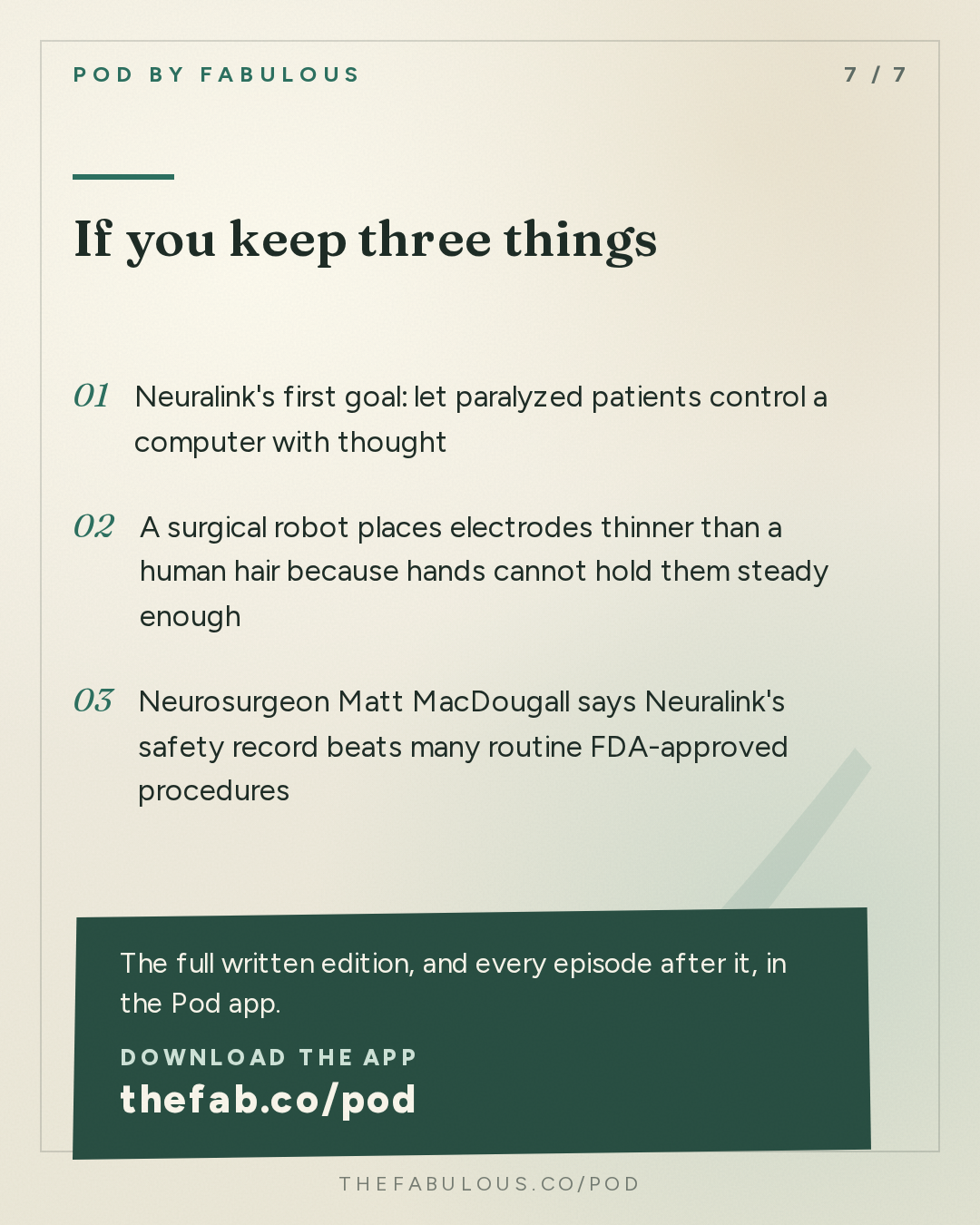
- Neuralink's first goal: let paralyzed patients control a computer with thought
- A surgical robot places electrodes thinner than a human hair because hands cannot hold them steady enough
- Neurosurgeon Matt MacDougall says Neuralink's safety record beats many routine FDA-approved procedures
- MacDougall's passive RFID hand implant has unlocked doors for years with no internal battery
- Pigs test implant safety while monkeys test actual brain signal performance, says MacDougall
The episode in cards
By the numbers
- 10x storage increase capacity jump between RFID chip versions MacDougall could upgrade to
In their words
“The brain really is a collection of functional modules pinned together, duct taped together in this bone box attached to your head.”
“A human hand is not steady enough to grab this, you know, m- couple micron width loop at the end of our electrode thread.”
“Neuralink has already reached, in my mind, uh, a safety threshold that is far beyond, uh, a commonly accepted safety, uh, threshold.”
“We're, you know, trying to send messages back and forth through a tiny straw, and there's no reason that needs to necessarily be true.”
Questions this episode answers
What is Neuralink's first use for quadriplegic patients?
The first target is letting a quadriplegic patient control a computer mouse and keyboard using motor intentions from an intact motor cortex, not reconnecting their own limbs (06:29). Neurosurgeon Matt MacDougall calls this restoring the patient's digital freedom rather than movement itself (06:29).
Why does Neuralink use a robot to insert the electrodes?
The electrodes are thinner than a human hair and must be threaded past dense surface blood vessels at a precise depth, and MacDougall says no human hand is steady enough to place them accurately and consistently (07:36). A surgeon still opens the skin and skull; the robot takes over for the electrode placement itself (05:29).
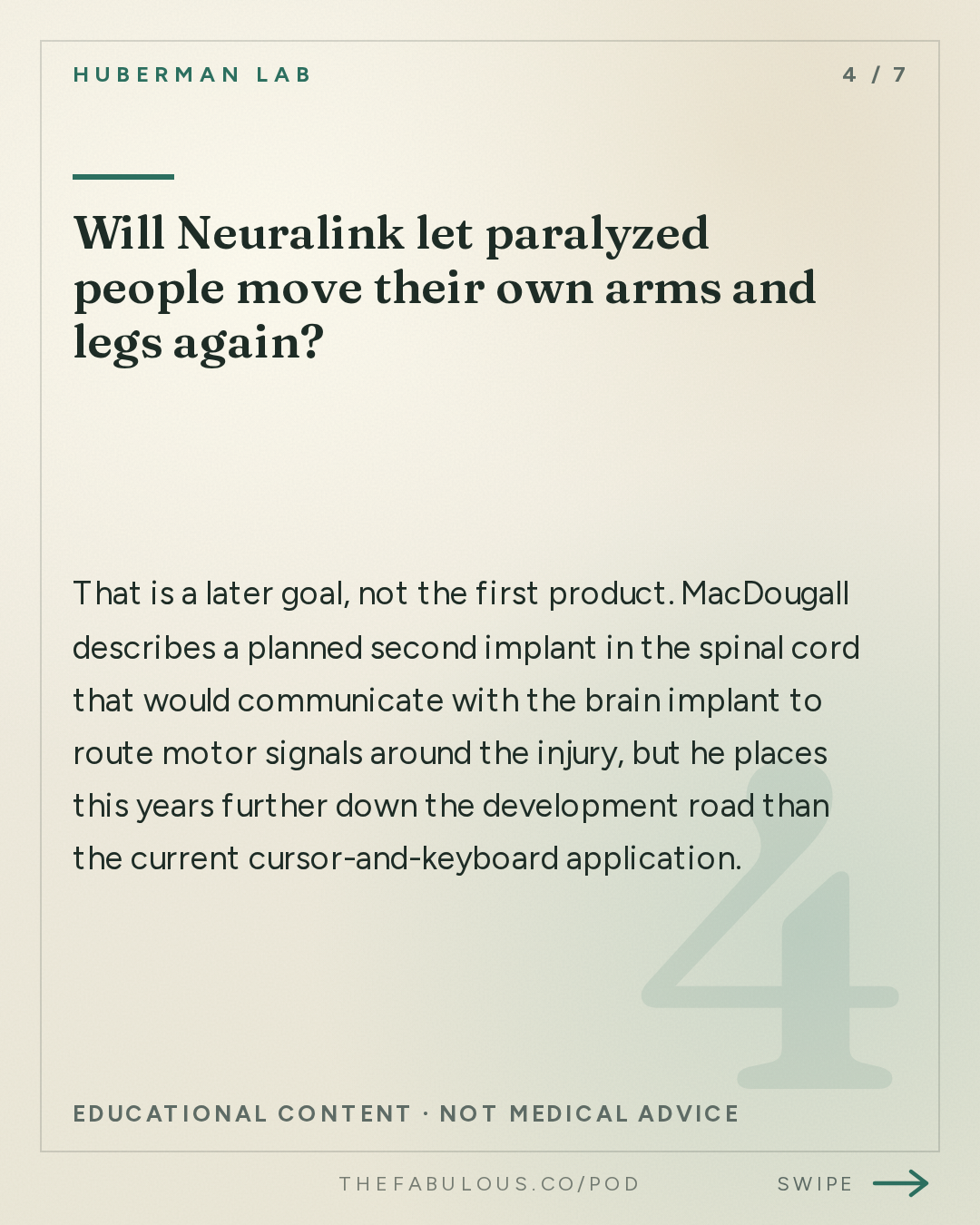
Will Neuralink let paralyzed people move their own arms and legs again?
That is a later goal, not the first product. MacDougall describes a planned second implant in the spinal cord that would communicate with the brain implant to route motor signals around the injury, but he places this years further down the development road than the current cursor-and-keyboard application (18:20).
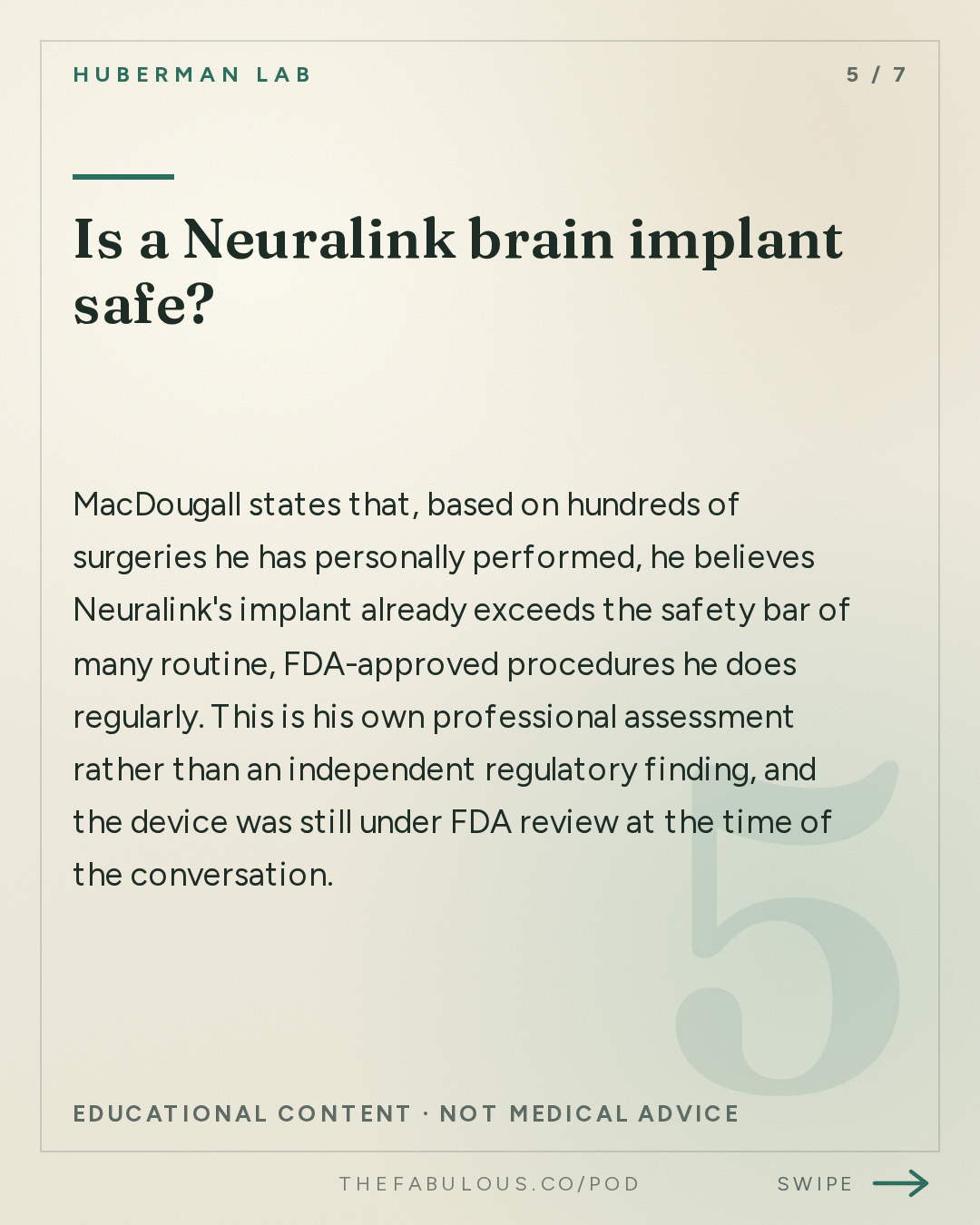
Is a Neuralink brain implant safe?
MacDougall states that, based on hundreds of surgeries he has personally performed, he believes Neuralink's implant already exceeds the safety bar of many routine, FDA-approved procedures he does regularly (13:53). This is his own professional assessment rather than an independent regulatory finding, and the device was still under FDA review at the time of the conversation.
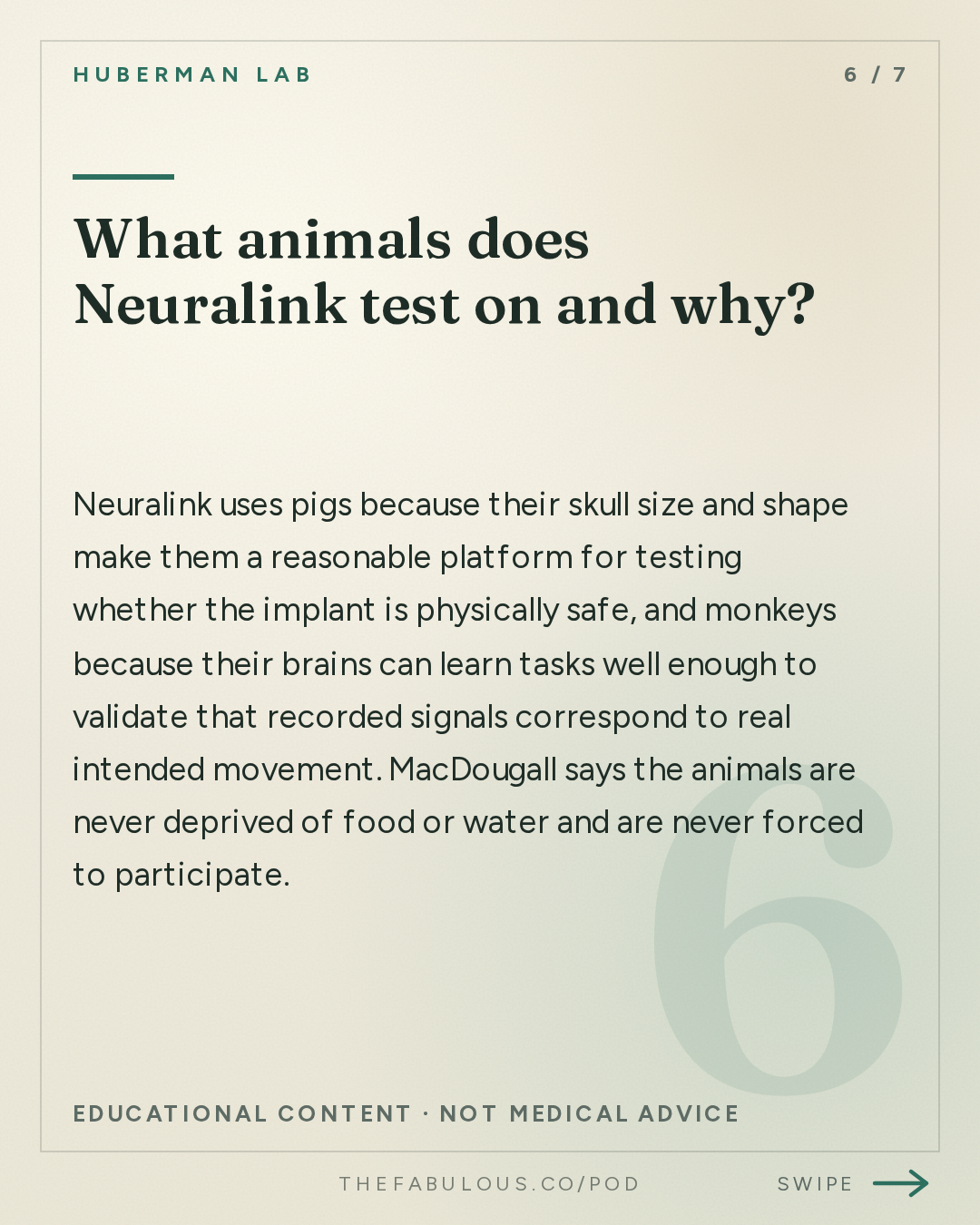
What animals does Neuralink test on and why?
Neuralink uses pigs because their skull size and shape make them a reasonable platform for testing whether the implant is physically safe (26:58), and monkeys because their brains can learn tasks well enough to validate that recorded signals correspond to real intended movement (27:25). MacDougall says the animals are never deprived of food or water and are never forced to participate (26:07).
Could a brain implant let two people communicate without speaking?
MacDougall argues this needs no new scientific breakthrough: two people already text each other without speaking, and shifting that same keyboard-and-cursor signal from a phone to an implant is a matter of engineering, not invention (19:45). He frames spoken language itself as a narrow, error-prone channel compared with a high-bandwidth brain interface (31:37).
The full read, in cards
Mentioned
Matt MacDougall · Neuralink · Elon Musk · FDA · MRI · RFID · Pager · UC San Diego
More from this show and category

How Diet Affects Memory and the Hippocampus
USC neuroscientist Scott Kanoski says the hippocampus, the brain's memory hub, tracks recent meals via the vagus nerve to judge hunger and fullness. Sugar, heat-processed foods, and artificial sweeteners early in life can impair that memory system and its gut bacteria, while exercise and simple recall of a recent meal can help restore or harness it.

Elissa Epel's Guide to Stress and Resilience
Psychologist Elissa Epel says stress is simply when demands exceed our resources, and most modern stress comes from our own thoughts. She shows how a challenge mindset, radical acceptance, and small daily practices like 'dropping the rope' change inflammation, telomere length, and mitochondrial energy output measurably.
Beth Shapiro on De-Extinction and Gene Editing
Evolutionary biologist Beth Shapiro explains why species are human categories and why dinosaur DNA cannot survive 66 million years. She describes how Colossal Biosciences engineered a dire wolf with 20 gene edits to a gray wolf genome, revived black-footed ferret genetics through cloning, and weighed the ethics of editing human embryos.

Huberman's Science-Based Focus Tools
Stanford neuroscientist Andrew Huberman lays out a stacked protocol for training focus, from sleep and caffeine to meditation and supplements. He covers 90-minute ultradian work blocks, a 13-minute daily breath meditation, cold exposure for epinephrine, and specific doses for creatine, alpha-GPC, and L-tyrosine, recommending behavioral tools before any supplement or drug.
